This is Edmonds
We’ve heard it so many times since we’ve arrived:
“You’ve arrived just in time for the best weather of the year!”
And it is true. Flying into Seattle, we saw every mountain, the air is crystal clear, the sun is out, and there are calming breezes and near 80 Degree (F) temperatures. The major secondary highway, Highway 99, is closed because there is a huge highway building program (YAYYY! Invest in infrastructure!) going on, and everyone warns us the traffic on I-5 going north will be hell. Because there are two of us, we can use the HOV (high occupancy) lanes, and we zoom straight north. The traffic isn’t the worst I have ever seen and we hit Edmonds in record time.
We are starving. We stop for a bite at Ivar’s, check in, and pick up my Mom to get her a new phone.
This is Edmonds. People are different here. Mom (in her wheelchair) and I have to wait, but not for long, and the specialist who deals with us is so kind. He talks to MOM, not me. Have you ever noticed when people are in a wheelchair some people treat them like they are invisible? I didn’t notice until Mom started using a wheelchair, and I had to remind people to talk to HER, not to me. Tyler, the telephone guy, talked to her, and walked her through her options. By the time we left – not with a phone, because the one she needs wasn’t in – she had a new friend. She has his card. She can call him to ask when the new phones are in, and she can call him with questions. He was genuinely kind, and treated her like a queen. This is Edmonds.
Of course, we are still on Central time, so wide awake at 0630. We hit breakfast around seven, thinking that since this is Saturday, we will have it mostly to ourselves, only to find that the breakfast room is full of athletically garbed people filling canteens, heading for mountains, boats, ferries, Saturday markets – when the weather is this fine, people take advantage of it! I’d forgotten – this is Edmonds.
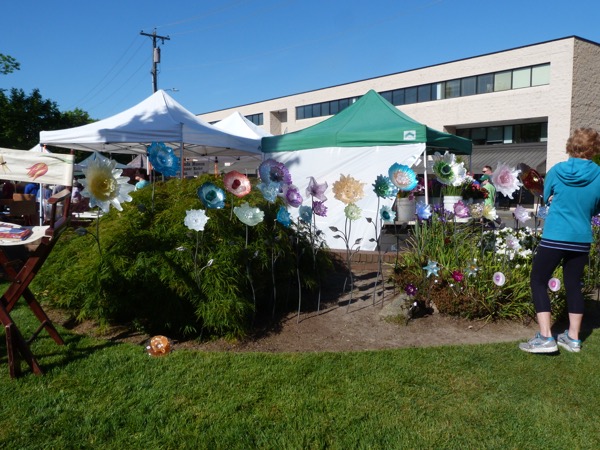
We hit the Fred Meyers and Trader Joes, stocking up for our road trip into Vancouver Island, then hit one our our favorite treats – The Edmonds Market. I thought it opened at nine, but at none, the place is packed.
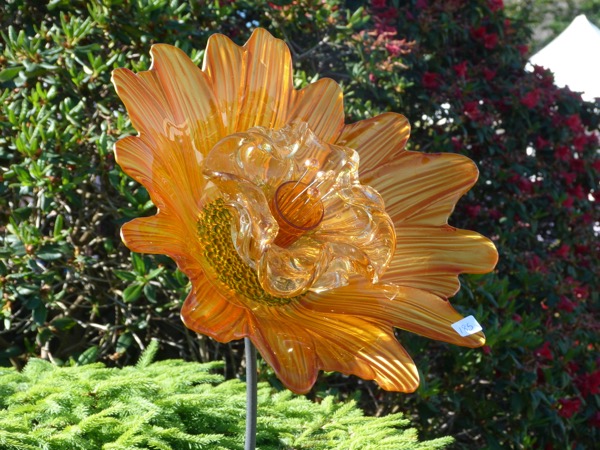
I am a great fan of Dale Chihuly, the Seattle artist who specializes in spectacular pieces in glass. His vision is unbounded; once he filled the canals in Venice with his art pieces. Seattle has a huge Chihuly museum, and houses his studios. These are not Chihuly, but Seattle gives birth to a lot of people unafraid to try their hand at artistic pursuits. If I weren’t traveling, I would buy this piece in a heartbeat. It’s cool laciness reminds me of seafoam as the waves hit the shore:

I wouldn’t buy this, but I appreciate its spirit!
Metalworks for sale, including Edmonds Salmons 🙂



Rhubarb is in season! Rhubarb was one of the few plants I can remember flourishing in the cool growing seasons in Alaska, and it is a unique taste I love.

This is Edmonds version of a bread line. This artisanal baker has the most delicious looking full grain loaves, and people get there early to line up to buy his wares.

The Museum volunteers always have a central tent where they can sell their wares to support the Edmonds museum. Up the street is another volunteer, signing up volunteers for the annual Edmonds Arts Fest, almost always on Father’s Day weekend, in June.

The normally usual good prices for flowers are hiked, as everyone is buying bouquets for their Mothers!

It’s an Edmonds kind of day 🙂
The Badass Librarians of Timbuktu
I saw this today on the NPR Books section, and as one great admirer of librarians, I wanted to share it with you. These librarians are my kind of badass! They are providing a service to humanity.
Timbuktu’s ‘Badass Librarians’: Checking Out Books Under Al-Qaida’s Nose

Handout picture dated 1997 and released in 2012 by the UN shows ancient manuscripts displayed at the library in the city of Timbuktu. Al-Qaeda has destroyed ancient texts it considers idolatrous.
Evan Schneider/AFP/Getty Images
For hundreds of years, Timbuktu has had a place in the world’s imagination. Located on the southern edge of the Sahara desert, the city flourished as a center of Islamic culture and scholarship in the 13th through 16th centuries. It was placed on the UNESCO World Heritage List in 1988, recognized for the University of Sankore, which had as many as 25,000 students who studied the Quran, as well as the historic Djingareyber and Sidi Yahia mosques.

The Bad-Ass Librarians of Timbuktu
And Their Race to Save the World’s Most Precious Manuscripts
Timbuktu was a center of the manuscript trade, with traders bringing Islamic texts from all over the Muslim world. Despite occupations and invasions of all kinds since then, scholars managed to preserve and even restore hundreds of thousands of manuscripts dating from the 13th century.
But that changed when militant Islamists backed by al-Qaida arrived in 2012. The hardline Islamists didn’t see these texts as part of their Islamic heritage, but as idolatry, contradicting their interpretation of Islam. They set about destroying important cultural icons, including 15th-century mausoleums of Sufi Muslim saints. Librarians feared the city’s prized medieval collections of manuscripts would be next.
Librarian Abdel Kader Haidara organized and oversaw a secret plot to smuggle 350,000 medieval manuscripts out of Timbuktu. Joshua Hammer chronicled Haidara’s story in the book The Bad-Ass Librarians of Timbuktu. Hammer spoke with NPR’s Michel Martin about how a librarian became an “operator.”
Interview Highlights
Why these manuscripts were so important
These volumes — and we’re talking hundreds of thousands of them — at the point at which al-Qaida invaded Timbuktu, there were something like 370,000 manuscripts amassed in libraries in Timbuktu. And they portrayed Islam as practiced in this corner of the world as a blend of the secular and the religious — or they showed that the two could coexist beautifully. And they did in this city.
So it was tremendously important for Haidara and those who supported him to protect and preserve these manuscripts as evidence of both Mali’s former greatness and the tolerance that that form of Islam encouraged.
On Abdel Kader Haidara’s background
Abdel Kader Haidara was a son of a scholar and he grew up in an intellectual environment in Timbuktu. He was not a wealthy person. After his father’s death in the early 1980s he inherited the family’s centuries-old manuscript collection.
So in 1984 the head of the Ahmed Baba Institute, the government-owned library in Timbuktu, called on Haidara and said, “Hey, we’re having trouble getting off the ground, we need to find manuscripts. We know they’re out there, they’re hidden away in the desert, in river towns. Can you undertake this job of traveling around northern Mali, tracking down these manuscripts that have been lost — buried, disappeared — over generations? Gather them up, we’ll give you money. And we want this library to be splendid. We want this to be something that people from all around the world will come to visit. So go out, do your best, find books for us.”
He was reluctant at first, but the call of duty and the curator’s constant pressure prevailed. And in 1984 he began this what turned into a 12-year really amazing quest to ferret out these manuscripts all across Mali.
How Libya changed Mali
In 2011, the Arab Spring breaks out. Gadhafi’s downfall, the arsenals of Libya — in the chaos of Gadhafi’s murder and the disintegration of the Libyan state — are opened for the taking. Then you’ve got these various rebel groups in Mali. You’ve got Islamic radicals all descending on Libya — on these arsenals. Walking in, loading up their pickup trucks with heavy weaponry, driving through the dust across the desert back to Mali. And so these heavily armed rebels sweep across the desert and in three months have captured two-thirds of the country.
Why he decided to do what he did
The first thing that Abdel Kader was worried about, frankly, was looting. In the first few days after the rebels took over Timbuktu and the army and the police had fled, there was total disorder. That’s when he kind of began to scheme — “Hey, the great treasures of Timbuktu are being held in these very ostentatious libraries.” He said, “These are going to be targets.”
The looting subsided pretty quickly. But as it subsided, you had this growing radicalism, you had Islamic police roaring through the streets, stopping people, throwing them in jail, grabbing cigarettes out of their mouths, whipping them in public. He just foresaw that this was going to get worse, and that the manuscripts, which as we already said expressed values that were anathema to fundamentalist Islam — to Wahhabi Islam — were in danger. That sooner or later, these manuscripts are going to be held hostage. They’re going to become political tools, they could be destroyed in an act of vengeance, caught up in military action. We’ve got to protect them.
So that’s when Abdel Kader and a small group of his supporters, friends, relatives got together and began what ended up being a three-stage effort to protect, and essentially smuggle to safety, all of these manuscripts.
Becoming a ‘badass’
Let’s remember that Abdel Kader was more than a librarian, this guy had spent 12 years as a badass explorer, as an adventurer. He was traveling on camels across the Sahara, on riverboats, going to small villages, finding these manuscripts. So he was an operator. So when the time came, he just knew what to do.
He said, “The first thing we’re going to do is get them out of these big libraries. We’re going to take trunks, we’re going to pack them into trunks at night when the rebels are asleep. And then we’re going to move them in the dead of night by mule cart to these various houses — safe houses, scattered around the city. We’re going to stick them in there and hopefully they’ll be safe for the duration of this occupation.” Which of course, nobody knew when that was going to end.
Why it’s important
One of the things that I think is important to draw from it is to realize that there is this whole strain of Islam that is moderate, that celebrates intellectuality, that celebrates culture, that celebrates diversity, secular ideas, poetry, love, human beauty. I think that is lost in this debate that’s going on. We tend to really kind of turn against Islam because of the actions of this particularly violent group.
But I think in fact that the Islam represented by those in Timbuktu and the badass librarians is in fact more representative of what Islam is. And these people [who] were the real victims of extremism in this part of the world are fellow Muslims. They were the ones who really suffered. They were the ones who had their hands and feet chopped off, who had to live through the horror of daily occupation.
For the most part, we see this from afar, but these people are on the front lines and they are living through the horror of radicalism every day and every minute.
Where the manuscripts are now
He hopes that he’ll be able to return them to Timbuktu. They are in about a dozen climate-controlled storage rooms in Bamako, the capital of Mali. And as far as moving them back, he’s waiting. I mean, these are very hard people to root out. But Timbuktu is a ghost town — tourists aren’t going there, flights aren’t going there. It’s very sad. And I don’t know and he doesn’t know if those glory days can ever be recaptured, given the strength of the Islamists — the terrorists in that area, in that part of the world.
“You Shall Love the Alien as Yourself”
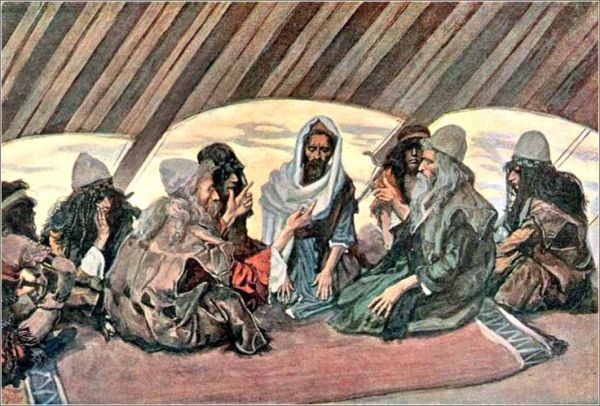
One of the disciplines available to those of the Episcopal faith is the reading of the Lectionary. Every day of the year are short readings from the Psalms, Old Testament, New Testament and Gospels. Every three year the cycle repeats itself. There are also additional readings on the “Saints” or remarkable people who have served God and his church.
Leviticus is not my favorite chapter, but today, I love Leviticus. As if the words were freshly spoken, I read Leviticus 19: 33-34:
33 When an alien resides with you in your land, you shall not oppress the alien. 34The alien who resides with you shall be to you as the citizen among you; you shall love the alien as yourself, for you were aliens in the land of Egypt: I am the Lord your God.
There are many references to the alien in the Bible, one of the earliest being Father Abraham, who is told to leave (what is now the current Iraq) and head for Canaan. When he arrives, peacefully, the local tribes are kind to him. They are good neighbors. Later, when Moses kills an Egyptian and flees to the desert tribes, he describes himself as “a stranger in a strange land.”
It’s who we are. It’s what our book tells us. We are to welcome the stranger. We are to leave wheat in the edges of our fields (yesterday’s reading) that he might not starve. We are not to oppress the alien, nor put up walls to fence them out. We are all aliens on this earth; waiting for the glory of the heavenly kingdom where we belong.
Hawaii Daze; a Sentimental Journey
My friend has been urging us – for years – to visit her in her Hawaii home.
I’ve been to Hawaii before. I wasn’t excited about going back, but when our long and happy friendship hit the 50 year mark, I looked at AdventureMan and asked if he would like to go to Hawaii. He really wanted to go. I booked the flights, and booked a car. Talking with my friend, she told me to cancel the car, we wouldn’t need one. We could use hers if we weren’t going to all go together.
Arriving was such fun. My friend was there to greet us with traditional Hawaiian leis, and we drove from the airport to Kailua, where she lives, stopping here and there to learn the lay of the land.
Her house is beautiful. She calls it her “happy place” and she had a firm idea in mind when she had her home built. She wanted it in a local style, and she wanted it to be able to sleep a LOT of people. My friend is the soul of hospitality. There is a gathering wing, with the kitchen, living room and dining room, there is the entry and her private living quarters, and there is a a very large guest wing.

She looks out over the Pacific to the north of the island, and the sound of the waves crashing on her beach provides a constant, lulling background.

“What do you want to see in Hawaii?” she asked me as we were planning our trip.
“I want to see your life,” I replied. “I want to see where you go, what you do, where you shop for groceries. I want to see what makes you happy.”
So our first day there, she took us to the Kailua Farmers’ Market, and to several places she shops. I loved it.

This is the view behind the Farmers’ Market.

Beautiful flowers, beautiful fresh fruits and vegetables, and exotic fruits, apple bananas, ugly oranges (but they taste wonderful). We bought food for dinner that night.


In front of the Kailua Foodland, there were wild chickens, and she explained to us that chickens roamed wild everywhere. Once she pointed it out, we could see them, too.

“You won’t see this in Seattle,” my friend said, and showed me the Poke Bar in the Foodland. Poke is a fish native to Hawaii, and the locals love it fixed a hundred different ways.

They also had wonderful fresh vegetables.

10 Science Proven Ways to be Happier
Happy – or happier – Saturday. Doesn’t everyone want to be happy? Happier? As it turns out, the science of being happy is studied, and there are ways proven to improve your feelings of happiness. I found this on a website called Motto, through AOL News:
10 Science-Proven Ways to Be Happier
March 4, 2016
Science continues to find ever more specific and idiosyncratic ways we can bring just a bit more of happiness into our lives
We never get tired of thinking about happiness, do we? Life is so much nicer when you’re able to couple it with joy and gratitude.
We’ve published posts before about simple ways to be happy and retraining your brain for more gratitude, and Buffer’s CEO Joel has even shared his own daily to-do list for happiness. (There’s also our popular list of things to stop doing to be happier.)
Meanwhile, science continues to study happiness, finding ever more specific and idiosyncratic ways we can bring just a bit more of this elusive quality into our lives.
I love keeping an eye on these studies, and thought I would share the latest batch with you here to see if any of them might resonate with you and make you just a bit happier.
Here are 10 truly unique ways to be happier that you can start today!
1. Do cultural activities
Need a boost of joy? Trying seeing a play or heading to a museum.
A study that collected data on the activities, mood and health of 50,000 adults in Norway found that people who participated in more cultural activities reported higher happiness levels and lower anxiety and depression.
“Participation in receptive and creative cultural activities was significantly associated with good health, good satisfaction with life, low anxiety and depression scores in both genders,” the researchers write.
Curiously, men saw stronger benefits from receptive, or passive, cultural activities (like visiting museums, art exhibitions, concerts or theaters) while women more enjoyed active participation events (like club meetings, singing, outdoor activities and dance).
2. Keep a diary: Rereading it brings joy
To learn to find more gratitude and joy in every day—not just special occasions, the boring days, too—try keeping a diary and re-reading it from time to time.
Researchers who did a variety of experiments involving keeping a journal discovered that “ordinary events came to be perceived as more extraordinary over time” as participants rediscovered them through their older writings.
In other words, simply writing down our ordinary, regular-day experiences is a way of banking up some happiness down the line, when the activities we describe could bring us unexpected joy.
3. Make small talk with a stranger
Chatting up your barista or cashier? Good for your health!
Behavioral scientists gave a group of Chicago train commuters a $5 Starbucks gift card in exchange for striking up a conversation with a stranger during their ride. (While another group kept to themselves.)
Those who started conversations reported a more positive experience than those who had stayed quiet—even though they had predicted they would feel happier being solitary.
Another study saw similar results from giving Starbucks visitors a $5 gift card in exchange for having a “genuine interaction with the cashier.”
It seems that connecting with another person—no matter how briefly—increases our happiness.
4. But have meaningful conversations, too
While positive small talk is great, more substantial conversations could up our happiness quotient even higher.
A study that tracked the conversations of 80 people for 4 days found that, in keeping with the small-talk study, higher well-being is associated with spending less time alone and more time talking to others.
But researchers also discovered that even higher well-being was associated with having less small talk and more substantive conversations.
“Together, the findings demonstrate that the happy life is social rather than solitary and conversationally deep rather than superficial,” the researchers write.
So dive deep in your conversations with friends and loved ones—it’s great for you.
5. Live in the suburbs and get involved
This one seems to apply to the U.S. A. only, but I still found it quite interesting.
I would have guessed that city dwellers might be the most satisfied with where they live, but in a poll of 1,600 U.S. adults, the highest rate of happiness was found in the suburbs.
84 percent of suburbanites rated the communities where they live as overall excellent or good, compared to 75 percent of urban dwellers and 78 percent of rural residents.
Another study on city happiness found that residents are happier if they feel connected to their cities and neighborhoods and feel positively about the state of city services.
So wherever you live, make sure to get involved in your community for maximum happiness.
6. Listen to sad songs: They provide emotional release
How could sad songs make us happy? And why do we seek them out?
That’s the question researchers wanted to answer with a survey of 722 people from around the world.
They discovered that there are 4 main reasons we take comfort in melancholy songs:
- They allow us to drift off into imagination
- They might provide us catharsis (emotion regulation)
- They allow us to relate to a common emotion (empathy), and
- They’re divorced from our actual problems (no “real-life” implications)
Researchers determined that “listening to sad music can lead to beneficial emotional effects such as regulation of negative emotion and mood as well as consolation.”
7. Spend money on experiences, not items
Here’s one that’s easy to understand but might be tougher to fix.
We know that spending money on life experiences will make us happier than spending money on material things (and it does!) but we can’t seem to stop ourselves from choosing the wrong option.
That’s what a study in The Journal of Positive Psychology found as they surveyed people before and after they made purchases.
The series of studies concluded that we’re more likely to spend on items than experiences because we can quantify them more easily and we want to see the best value for our dollars.
However, they found that the study subjects reported that after they spent, experiences brought them greater well-being and they considered them to be a better use of money.
So if we can keep that in mind, it’s possible to have our cake and eat it, too—definitely something to be happy about!
8. Set tiny, attainable goals: Make someone smile
It might be cliché, but making someone happy will make you happy, too.
And science says the more specific you can be with your goal, the better.
University of Houston professor Melanie Rudd found that a group of people who were told to make someone smile felt both happier and more confident that they’d actually achieved their goal than a similar group who’d been told simply to make someone else happy.
Even more interesting: In a separate experiment, people wrongly predicted that going for the bigger goal would make them happier.
“If you can meet or exceed your expectations of achieving a goal, you will be happier than if you fall short of your expectations,” Rudd explained.
9. Look at beautiful things: Design makes us happy
Could looking at a beautiful object make you feel happier?
The smartphone company HTC conducted a study that says yes.
In a series of laboratory and online experiments, volunteers looked at and interacted with objects that fell into 3 categories: beautiful, functional, or both beautiful and functional.
Their reactions uncovered some interesting findings, like:
- Well-designed objects that are both beautiful and functional trigger positive emotions like calmness and contentment, reducing negative feelings like anger and annoyance by almost a third.
- Purely beautiful objects (not functional) reduce negative emotions by 29%, increasing a sense of calmness and ease.
Objects that were both beautiful and functional created an especially high level of emotional arousal:
In general, people feel happier looking at and using beautiful objects that work well.
10. Eat more fruits and veggies
We know being healthier makes us happy, but can carrots give you purpose?
I have to admit I didn’t expect such a direct link between happiness and eating a lot of fruits and vegetables as researchers in New Zealand report.
Their 13-day study of 405 people who kept food diaries showed that people who ate more fruits and vegetables reported higher than average levels of curiosity, creativity, and positive emotions, as well as engagement, meaning, and purpose.
Even more interestingly, participants often scored higher on all of those scales on days when they ate more fruits and vegetables.
“These findings suggest that fruit and vegetable intake is related to other aspects of human flourishing, beyond just feeling happy,” writes the research team.
Beryl Markham and the EPIC Book Club
When the EPIC Book Club met this month, we were discussing Paula McLain’s Circling the Sun. Several of us had enjoyed her book about Ernest Hemingway, The Paris Wife, and had thought this one, about the famous early aviator, would be another great book. I was so impressed with The Paris Wife that I immediately read Hemingway’s The Movable Feast, his novel about the same period of time, and loved the way the books “danced together”. I think good historical fiction needs to stick to known facts.
It was a lively discussion; Beryl Markham was an unusual woman in an unusual culture in a time of transition. She grew up in Kenya as the British were beginning to colonize just after the first world war. Her mother abandoned the family, taking her frailer younger brother and leaving her, with no explanation. Some other woman moved in with her father; Beryl greatly raised herself with the indigenous people. Her father loved her, but was distant. He was first and foremost a horse breeder, and Beryl worked closely with him in breeding and training the horses.
She made a disastrous first marriage, leaving it to pursue a certificate – the first ever for a woman – as a horse trainer. She was spectacularly good at it, and worse (when it comes to the opinion of other women) she looked terrific in riding breeches. Men liked her. She liked men. She was not particular about boundaries, like marriage to other people or being the consort of her good friend, Karen Blixen. Later, she set records as one of the earliest female aviators.
It was also a time when women had few options, and most of the options required a man to take care of her. Beryl Markham had skills, and had more options.
So as we are discussing her behavior, which could be self-defeating and self-destructive, we discussed it in the context of Kenyan colonial society. Then one of the EPIC members mentioned that the same behaviors in the very church where we meet have been the spice of Pensacola gossip for more than a couple centuries; that people don’t change much. We were laughing, and another member mentioned being forbidden to read Peyton Place, many years ago when it was a banned book, and his wrestling coach told him “All the world is Peyton Place.”
I think of all the places I’ve lived and I am inclined to agree.
A Walk in the Vieux Carre’, French Quarter, New Orleans
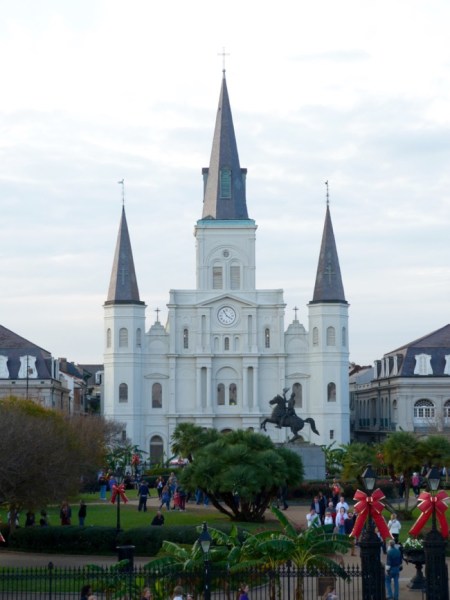
It’s been raining for so long we feel like frogs, with webbed feet. We have a gorgeous day, not hot, not cold, and a hotel in a perfect location for walking, so we go out to master our 10,000 steps. In the French Quarter, it is easy! There is so much to see; it is so much fun just to walk.
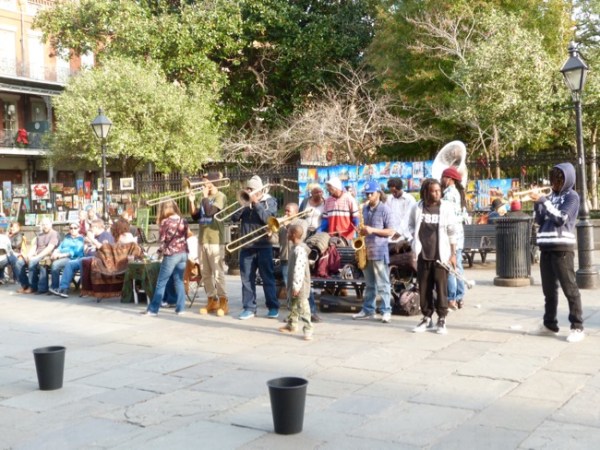
These kids are GOOD! They have attracted a large crowd, in front of the Cathedral. What a great way to get practice playing in front of an audience and to earn a little extra spending money, providing a little New Orleans culture. Loved our time listening; they really were good
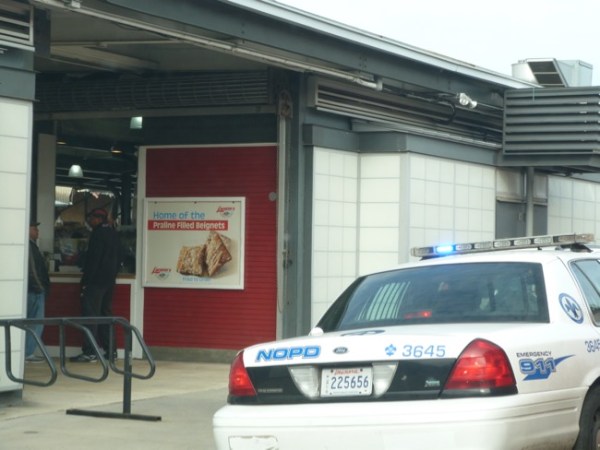
This policeman with his blue light special, blocked a whole lane of traffic so he could pick up his fresh hot beignet at the French Market.
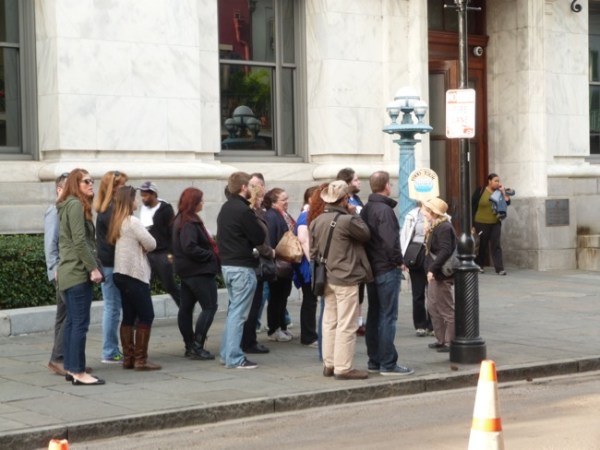
The Hop On, Hop Off Bus, New Orleans style:

“Follow the sign, please!” for the New Orleans city tour. No, we weren’t on that one, just walking around on our own.
A statue of Bienville, a founder of New Orleans:


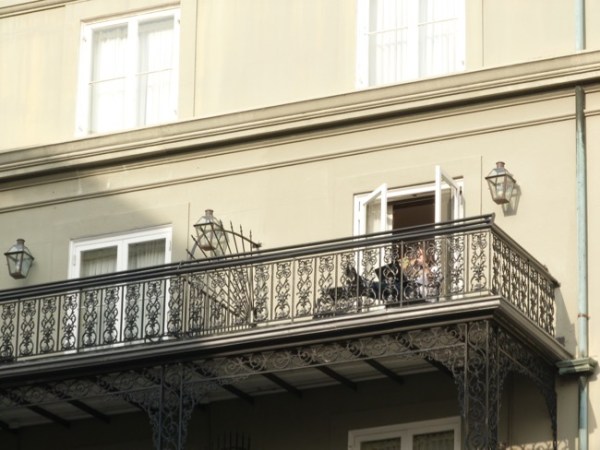

This is kind of creepy, to me, a woman who tells people their fortunes in front of the cathedral.

The Maiden of Oreans:


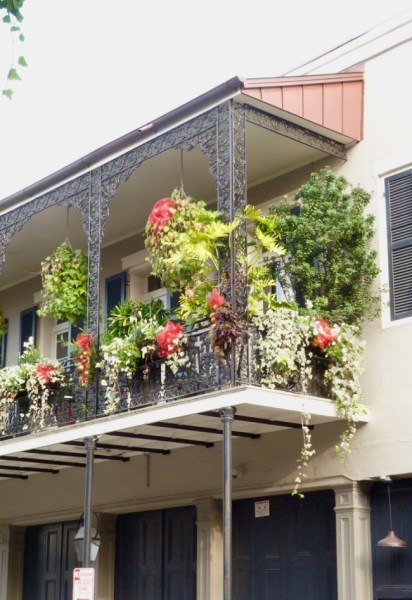
We loved this terrace garden, on Chartres:
This man earned every penny. He made up verses to songs about people watching, all very kind, and people gave generously 🙂

HOME by Somali poet Warsan Shire
An old friend from high school posted this on FaceBook today, and I found it so moving and so true that I had to repost it here:
HOME
Warsan Shire
no one leaves home unless
home is the mouth of a shark
you only run for the border
when you see the whole city running as well
your neighbours running faster than you
breath bloody in their throats
the boy you went to school with
who kissed you dizzy behind the old tin factory
is holding a gun bigger than his body
you only leave home
when home won’t let you stay.
no one leaves home unless home chases you
fire under feet
hot blood in your belly
it’s not something you ever thought of doing
until the blade burnt threats into
your neck
and even then you carried the anthem under
your breath
only tearing up your passport in an airport toilets
sobbing as each mouthful of paper
made it clear that you wouldn’t be going back.
you have to understand,
that no one puts their children in a boat
unless the water is safer than the land
no one burns their palms
under trains
beneath carriages
no one spends days and nights in the stomach of a truck
feeding on newspaper unless the miles travelled
means something more than journey.
no one crawls under fences
no one wants to be beaten
pitied
no one chooses refugee camps
or strip searches where your
body is left aching
or prison,
because prison is safer
than a city of fire
and one prison guard
in the night
is better than a truckload
of men who look like your father
no one could take it
no one could stomach it
no one skin would be tough enough
the
go home blacks
refugees
dirty immigrants
asylum seekers
sucking our country dry
niggers with their hands out
they smell strange
savage
messed up their country and now they want
to mess ours up
how do the words
the dirty looks
roll off your backs
maybe because the blow is softer
than a limb torn off
or the words are more tender
than fourteen men between
your legs
or the insults are easier
to swallow
than rubble
than bone
than your child body
in pieces.
i want to go home,
but home is the mouth of a shark
home is the barrel of the gun
and no one would leave home
unless home chased you to the shore
unless home told you
to quicken your legs
leave your clothes behind
crawl through the desert
wade through the oceans
drown
save
be hunger
beg
forget pride
your survival is more important
no one leaves home until home is a sweaty voice in your ear
saying-
leave,
run away from me now
i dont know what i’ve become
but i know that anywhere
is safer than here.
“HOME,” by Somali poet Warsan Shire
Pensacola’s Pelican Tribute to Native Americans
We’re on our way to lunch at Portobello, the restaurant in the old jail, when AdventureMan says “Look at that Pelican!” and I had just spotted it at the same time. It is fabulous. It is on the corner at the Wentworth Museum and is a tribute to our First Nation inhabitants. It reminds me of Alaska, where the Haida art was mostly black and white, with just a tiny accent of red here and there, or occasionally a tiny bit of blue. I love this Pelican 🙂

Different businesses and organizations in Pensacola sponsor Pelicans, and each one is different. At the main intersection at Garden and Palafox, the Navy, Army, Air Force and Marines have Pelicans stationed. Local artists make the pelicans vibrant and unique. Love the pelicans, but I love this one at the Wentworth most of all.
Qatar Sheikh Khalid bin Hamad Al-Thani Flouts US Law, Forced to Flee Country

Sorry, Sheikh Khalid, you do not have diplomatic immunity and you are not above the law. This is from AOL AutoBlog:
A prominent Qatari national has reportedly fled the United States after a video ostensibly showing his Ferrari racing through the streets of Beverly Hills went viral. Although the exact identity of the driver remains unclear, it is believed that the yellow LaFerrari was owned by Sheikh Khalid bin Hamad Al-Thani, a member of the ruling family of Qatar, the country’s former interior minister and a well-known racing enthusiast.
The video below, which has already attracted some 1.5 million views (but contains language that may not be safe for the workplace), shows the yellow hybrid hypercar racing with reckless abandon against a white Porsche 991 GT3 through the swanky Los Angeles neighborhood. The Ferrari is shown scraping its chin spoiler on the road before pulling back into the driveway (alongside a black Bugatti Veyron) with smoke billowing out its engine bay. Neither of the European exotics appear to show much regard for traffic laws, running stop signs as they speed through a residential area. The Ferrari appears to be wearing Qatari plates, while the Porsche does not appear to be carrying plates at all – just some racing decals on the doors and hood.
According to reports, the Ferrari belongs to Sheikh Khalid, but the identities of the drivers behind the wheel of either car has not been ascertained. The Al-Thanis are known for their supercar collection, which is shipped around the world for the enjoyment of royal family members. Their signature teal and black exotics are a regular site around London.
The Beverly Hills Police Department confirmed that, when approach by officials, the driver claimed diplomatic immunity – which the driver may not actually have. “It is against a federal law for someone to claim diplomatic immunity when they don’t have it,” said police chief Dominick Rivetti. The Ferrari was not, according to reports, registered with the State Department as belonging to a credentialed diplomat. Al-Thani has since reportedly fled the country, and taken his cars with him.
Recent Comments
ExpatAlien on What Country am I Living … intlxpatr on Yellowstone: Old Faithful to C… Michelle on Yellowstone: Old Faithful to C… Cathy on No Grown-Ups in Charge intlxpatr on Waiting for Snow Wikipedia Donate Button

Amazina


Early Voting in Florida


 Here There and Everywhere