From AOL News:
BY SAMEER N. YACOUB AND SINAN SALAHEDDIN
BAGHDAD (AP) — A contentious draft law being considered in Iraq could open the door to girls as young as nine getting married and would require wives to submit to sex on their husband’s whim, provoking outrage from rights activists and many Iraqis who see it as a step backward for women’s rights.
The measure, aimed at creating different laws for Iraq’s majority Shiite population, could further fray the country’s divisions amid some of the worst bloodshed since the sectarian fighting that nearly ripped the country apart after the U.S.-led invasion. It also comes as more and more children under 18 get married in the country.
“That law represents a crime against humanity and childhood,” prominent Iraqi human rights activist Hana Adwar told The Associated Press. “Married underage girls are subjected to physical and psychological suffering.
Iraqi law now sets the legal age for marriage at 18 without parental approval. Girls as young as 15 can be married only with a guardian’s approval.
The proposed new measure, known as the Jaafari Personal Status Law, is based on the principles of a Shiite school of religious law founded by Jaafar al-Sadiq, the sixth Shiite imam. Iraq’s Justice Ministry late last year introduced the draft measure to the Cabinet, which approved it last month despite strong opposition by rights groups and activists.
The draft law does not set a minimum age for marriage. Instead, it mentions an age in a section on divorce, setting rules for divorces of girls who have reached the age of 9 years in the lunar Islamic calendar. It also says that’s the age girls reach puberty. Since the Islamic calendar year is 10 or 11 days shorter than the Gregorian calendar, that would be the equivalent of 8 years and 8 months old. The bill makes the father the only parent with the right to accept or refuse the marriage proposal.
Critics of the bill believe that its authors slipped the age into the divorce section as a backhanded way to allow marriages of girls that young. Already, government statistics show that nearly 25 percent of marriages in Iraq involved someone under the age of 18 in 2011, up from 21 percent in 2001 and 15 percent in 1997. Planning Ministry spokesman Abdul-Zahra Hendawi said the practice of underage marriage is particularly prevalent in rural areas and some provinces where illiteracy is high.
Also under the proposed measure, a husband can have sex with his wife regardless of her consent. The bill also prevents women from leaving the house without their husband’s permission, would restrict women’s rights in matters of parental custody after divorce and make it easier for men to take multiple wives.
Parliament must still ratify the bill before it becomes law. That is unlikely to happen before parliamentary elections scheduled for April 30, though the Cabinet support suggests it remains a priority for Prime Minister Nouri al-Maliki’s administration. Al-Maliki is widely expected to seek a third term.
Baghdad-based analyst Hadi Jalo suggested that election campaigning might be behind the proposal.
“Some influential Shiite politicians have the impression that they should do their best to make any achievement that would end the injustice that had been done against the Shiites in the past,” Jalo said.
The formerly repressed Shiite majority came to power after the 2003 U.S.-led invasion that ousted Saddam Hussein’s Sunni-led regime. Since then, Shiite religious and political leaders have encouraged followers to pour in millions into streets for religious rituals, a show of their strength.
Iraqi Justice Minister Hassan al-Shimmari, a Shiite, has brushed off the criticism of the bill. His office introduced a companion bill that calls for the establishment of special Shiite courts that would be tied to the sect’s religious leadership.
Al-Shimmari insists that the bill is designed to end injustices faced by Iraqi women in past decades, and that it could help prevent illicit child marriage outside established legal systems.
“By introducing this draft law, we want to limit or prevent such practices,” al-Shimmari said.
But Sunni female lawmaker Likaa Wardi believes it violates women’s and children’s rights and creates divisions in society.
“The Jaffari law will pave the way to the establishments of courts for Shiites only, and this will force others sects to form their own courts. This move will widen the rift among the Iraqi people,” Wardi said.
New York-based Human Rights Watch also strongly criticized the law this week.
“Passage of the Jaafari law would be a disastrous and discriminatory step backward for Iraq’s women and girls,” deputy Middle East director Joe Stork said in a statement. “This personal status law would only entrench Iraq’s divisions while the government claims to support equal rights for all.”
It is unclear how much support the bill enjoys among Iraqi Shiites, but Jalo, the analyst, believes that it would face opposition from secular members of the sect.
Qais Raheem, a Shiite government employee living in eastern Baghdad, said the draft bill contradicts the principles of a modern society.
“The government officials have come up with this backward law instead of combating corruption and terrorism,” said Raheem who has four children, including two teenage girls. “This law legalizes the rape and we should all reject it.”
March 14, 2014
Posted by intlxpatr |
Civility, Community, Crime, Cultural, ExPat Life, Family Issues, Law and Order, Leadership, Living Conditions, Marriage | Child marriage, Iraq, Jaafari Personal Status Law, Shiite |
Leave a comment
Qatar makes some great laws – like fining those who go through red lights, or who drive near the speed of light. . . but when the violators turn out to be mostly young Qattari men, who pays the fines? Does anyone pay the fines?

From Doha News:
In an effort to tackle bad driving in Qatar, the Ministry of Interior plans to set up speed radars every two to four kilometers on major roads, Traffic Department Director Brig. Mohamed Saad Al Kharji has said.
Additionally, some 120 radars are being installed to catch drivers who overtake others from the right lane, the Qatar Tribune reports Al Kharji as saying.
He added that the software of speed radars that are already installed on the roads would be updated so that they could also catch such violators.
No timeline for when the cameras would be installed was disclosed. But last fall, the MOI announced it would be rolling out radars to catch queue-jumpers.
Using the “slow” right lane to overtake vehicles in the left lane is a traffic violation punishable by a QR500 ticket, but among one of several rules flouted by motorists here.
Enforcement
In Qatar, traffic violators are rarely pulled over by police officers, despite brief campaigns to step up enforcement. In 2012, plainclothes police officers began ticketing drivers who overtook other vehicles on the right.
And at the end of last year, the traffic department began a three-month campaign to ticket those who violate road rules, including drivers who hadn’t fastened their seat belts, used their phones while driving, and rode without a license.
Both initiatives were lauded by many residents who said enforcement is key to improving safety on the roads, but neither seem to have lasted.
March 9, 2014
Posted by intlxpatr |
Bureaucracy, Character, Community, Doha, Education, ExPat Life, Law and Order, Living Conditions, Qatar, Safety |
Leave a comment
AdventureMan and I were with a group of delegates from Iraq yesterday, taking them on a visit to a variety of Pensacola sites. They are here visiting through the GCCDC, on the IVLP program, studying elections and campaign strategies in the USA.
One stop we make with many delegates is the First Methodist program Serving the Hungry. Two days a week, led by Jerry Vititow and supported by many happy, willing volunteers, they serve a hot lunch to the hungry, varying in numbers but never less than fifty or so.
The delegates learn about the program, then don aprons and serve up the trays. It is often one of the highlights of the trip.
One delegate raises his hand to ask a question.
“We see this everywhere,” he starts, “Americans who are working for nothing and smiling. Why do they do this?” He was genuinely perplexed.
Jerry explained that it wells up from many sources, a yearning to give back some of the blessings we have received, an eagerness to serve those who have less, maybe just an eagerness to serve. “It’s part of what we believe in,” he sums it up.
The delegates had a wonderful time.
March 7, 2014
Posted by intlxpatr |
Character, Charity, Civility, Community, Cross Cultural, Cultural, ExPat Life, Faith, Interconnected, Living Conditions, Pensacola |
2 Comments
From today’s AOL News:
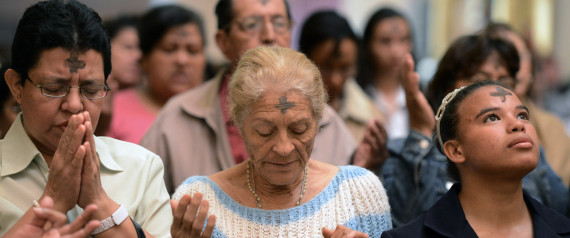
Ash Wednesday 2014: History, Dates, Traditions Of Lent’s First Day Of Fasting
Ash Wednesday is observed on March 5, in 2014. The Christian holy day marks the beginning of Lent, a 40-day season of fasting that is considered preparation for Holy Week and the celebration of Easter.
Although there is no Biblical reference to Ash Wednesday or Lent, scholars of Christianity date the tradition of a 40-day fasting period back to 325 A.D.
Lent mirrors Jesus’ own 40-day period of fasting, described in the book of Matthew. Observers have ash placed on their foreheads in the shape of the cross as the words from Genesis 3:19 are spoken: “You are dust, and to dust you shall return.”
Fasting requirements for Catholics are outlined by the Code of Canon Law, and include eating no meat on the Fridays during Lent, as well as fasting on Ash Wednesday and Good Friday. (Fasting in this case refers to eating just one full meal a day.)
Many Christians will make personal vows of abstinence during Lent, which could include anything from refraining from eating candy, meat, vowing not to gossip, or being less selfish. Others will make a vow to do more for others including volunteering and working for social justice. All are expected to spend more time in prayer and reflection as Lent is considered by many to be an opportunity for spiritual transformation.
The Catholic nun Sister Joan Chittister writes:
Lent is the opportunity to change what we ought to change but have not…Lent is about becoming, doing and changing whatever it is that is blocking the fullness of life in us right now… Lent is a summons to live anew…Lent is the time to let life in again, to rebuild the worlds we’ve allowed to go sterile, to “fast and weep and mourn” for the goods we’ve foregone. If our own lives are not to die from lack of nourishment, we must sacrifice the pride or the sloth or the listlessness that blocks us from beginning again. Then, as Joel (2:12-18) promises, God will have pity on us and pour into our hearts the life we know down deep that we are lacking.
March 5, 2014
Posted by intlxpatr |
Circle of Life and Death, Community, Easter, Faith, Lent, Spiritual, Values |
Leave a comment
We love having a grandson, not that we need an excuse, but it’s always more fun to go to a parade when you have a youngster with you. Today was particularly fun, he is four and totally gets the whole parade thing, we found a great parking place with no driving around and we had a great place to watch the parade from. Some kids sitting in front of us knew our grandson, and we were all invited “up front” to be with them.
Parades are always more fun with fun people, and these people were fun. The parade was fun. This is a family parade, lots and lots of children, and the bead throwers and gift givers are most generous to the children. While grown-ups compete to catch the beads, they turn around and give them to the little ones almost immediately. It’s a gentle spirit, and everyone has fun.
Our favored place is very near our church. You can see how crowded it is as the parade begins. It only gets worse; Mardi Gras parades attract more than 50,000 people. Imagine, 50,000 people all behaving themselves, families, children, and when it ends, the street looks normal within an hour or so. Thank God for civility.
Our church and the Mardi Gras revelers waiting for the parade. If you look closely, you can see beads hanging in the tree from the Krewe of Lafitte Parade the night before. Pensacola has LOTS of parades 🙂 :

I watched this guy in this crazy-wonderful horse head get LOTS of beads during the parade:

Everyone has a gimmick to try to get more beads, but it is a FAMILY parade, so there are no drunks (not that I saw anyway) and no one lifting up their shirts for beads. Several people had “targets” for bead throwers:



McGuires throws green beads, and our grandson got one with a medallion, very special 🙂 We’ve hung them all – all this treasures – in his room at our house so his little baby sister doesn’t chew on them by accident and he can visit them every time he stays 🙂 :

As you can see, it was a fabulous day for a parade, maybe 70 degrees F. and a slight breeze. We say “when March comes in like a lamb, it goes out like a lion” so we are expecting that the end of March may be cold and dreary, perfect Lent weather.
March 2, 2014
Posted by intlxpatr |
Community, Cultural, ExPat Life, Family Issues, Living Conditions, Mardi Gras, Pensacola, Weather | Pensacola Grand Mardi Gras Parade 2014 |
Leave a comment
Note to my Qatar, Kuwait and Saudi Arabian readers – YES. This is legal. This is what free speech looks like. This anonymous blogger can poke fun – and does – at everyone. He probably will want to remain anonymous because he does not discriminate in who he pokes and won’t have any friends if people figure out who he is, but yes. Yes. YES. This is legal, this is freedom of speech. He won’t go to jail.
Poking fun at appearance-over-substance Mayor Ashton Hayward, who made national news this week as he prayed, and rethought his ban on homeless people using blankets in Pensacola: Dicksblog goes viral:

February 18, 2014
Posted by intlxpatr |
Bureaucracy, Character, Community, Cultural, ExPat Life, Financial Issues, Florida, Free Speech, Living Conditions, Marketing, Pensacola, Political Issues, Transparency |
Leave a comment
This is disgusting. We’ve all known it’s true. The warrior culture protects those cowards who impose themselves sexually on both men and women. God willing, things will change. It’s already started, with the relieving of those in power who have imposed themselves on women who came forward with their complaints. Let there be more, until this culture is wiped clean of their disgrace.
Rape isn’t about sex. It’s about power. Rape is a personal violation.
It’s time for the good men and women in the military to police this up, to stop the outrage. Expose those bullies and cowards who prey on others.
Military Sex Abuse Investigation: Documents Reveal Chaotic Punishment Record
AP
by RICHARD LARDNER and YURI KAGEYAMA
TOKYO (AP) — At U.S. military bases in Japan, most service members found culpable in sex crimes in recent years did not go to prison, according to internal Department of Defense documents. Instead, in a review of hundreds of cases filed in America’s largest overseas military installation, offenders were fined, demoted, restricted to their bases or removed from the military.
In about 30 cases, a letter of reprimand was the only punishment.
More than 1,000 records, obtained by The Associated Press through the Freedom of Information Act, describe hundreds of cases in graphic detail, painting a disturbing picture of how senior American officers prosecute and punish troops accused of sex crimes. The handling of allegations verged on the chaotic, with seemingly strong cases often reduced to lesser charges. In two rape cases, commanders overruled recommendations to court-martial and dropped the charges instead.
Even when military authorities agreed a crime had been committed, the suspect was unlikely to serve time. Of 244 service members whose punishments were detailed in the records, only a third of them were incarcerated.
The analysis of the reported sex crimes, filed between 2005 and early 2013, shows a pattern of random and inconsistent judgments:
—The Marines were far more likely than other branches to send offenders to prison, with 53 prison sentences out of 270 cases. By contrast, of the Navy’s 203 cases, more than 70 were court-martialed or punished in some way. Only 15 were sentenced to time behind bars.
—The Air Force was the most lenient. Of 124 sex crimes, the only punishment for 21 offenders was a letter of reprimand.
—Victims increasingly declined to cooperate with investigators or recanted, a sign they may have been losing confidence in the system. In 2006, the Naval Criminal Investigative Service, which handles the Navy and Marine Corps, reported 13 such cases; in 2012, it was 28.
In two cases, both adjudicated by the 1st Marine Aircraft Wing, the accusers said they were sexually abused after nights of heavy drinking, and both had some evidence to support their cases. One suspect was sentenced to six years in prison, but the other was confined to his base for 30 days instead of getting jail time.
Taken together, the cases illustrate how far military leaders have to go to reverse a spiraling number of sexual assault reports. The records also may give weight to members of Congress pushing to strip senior officers of their authority to decide whether serious crimes, including sexual assault cases, go to trial.
“How many more rapes do we have to endure to wait and see what reforms are needed?” asked Sen. Kirsten Gillibrand, D-N.Y., chair of the Senate Armed Services personnel subcommittee. She leads a vocal group of lawmakers from both political parties who argue that further reforms to the military’s legal system are needed.
Air Force Col. Alan Metzler, deputy director of the Defense Department’s Sexual Assault Prevention and Response Office, said the department “has been very transparent that we do have a problem.” He said a raft of changes in military law is creating a culture where victims trust that their allegations will be taken seriously and perpetrators will be punished.
The number of sexual assault cases taken to courts-martial has grown steadily — from 42 percent in 2009 to 68 percent in 2012, according to DOD figures. In 2012, of the 238 service members convicted, 74 percent served time.
That trend is not reflected in the Japan cases. Out of 473 sexual assault allegations within Navy and Marine Corps units, just 116, or 24 percent, ended up in courts-martial. In the Navy, one case in 2012 led to court-martial, compared to 13 in which commanders used non-judicial penalties instead.
The authority to decide how to prosecute serious criminal allegations would be taken away from senior officers under a bill crafted by Gillibrand that is expected to come before the Senate this week. The bill would place that responsibility with the trial counsel who has prosecutorial experience.
Senior U.S. military leaders oppose the plan.
“Taking the commander out of the loop never solved any problem,” said Sen. Lindsey Graham, R-S.C., the personnel subcommittee’s top Republican. “It would dismantle the military justice system beyond sexual assaults. It would take commanders off the hook for their responsibility to fix this problem.”
Gillibrand and her supporters argue that the cultural shift the military needs won’t happen if commanders retain their current role in the legal system.
“Skippers have had this authority since the days of John Paul Jones and sexual assaults still occur,” said Lory Manning, a retired Navy captain and senior fellow at the Women in the Military Project. “And this is where we are.”
___
Lardner reported from Washington. Associated Press writer Leon Drouin-Keith in Bangkok and AP researcher Rhonda Shafner in New York contributed to this report.
February 9, 2014
Posted by intlxpatr |
Bureaucracy, Character, Community, Counter-terrorism, Crime, Cultural, Law and Order, Living Conditions, Political Issues, Relationships, Social Issues, Statistics, Survival, Values |
Leave a comment
From Forward Day by Day, a meditation from Hebrews that made me laugh while it instructed me.
Hebrews 12:17. He found no chance to repent, even though he sought the blessing with tears.
“I’m sorry.” For the first thirty years of my life, more often than not, this meant I regretted the personal consequences of what I had done, not necessarily the act or damage. During the last twenty years, I’ve come to see being sorry as distinctly different from regretting.
Most of us have said we’re sorry more times than we could hope to remember, but we are still able to recall events that we truly regret. Chances are that regret brings about change at a higher ratio than does being sorry—a change to ensure the behavior doesn’t happen again.
One of the illustrations that helped me came from an old farmer who used to volunteer at a prison where I was serving time. The discussion was about things done wrong and, with language more colorful than I can use here, he tipped his old dust-and-sweat-streaked cap back on his head and said, “Boys, you can’t put manure back in a horse.”
That was almost twenty years ago, and I wonder if that old man ever realized how much he helped me to begin to learn to live with some things.
February 8, 2014
Posted by intlxpatr |
Community, Faith, Interconnected, Lectionary Readings, Relationships, Spiritual |
Leave a comment
Thank you, John Mueller, for forwarding me this story. We lived in luxury, next to a vacant lot where a few laborers lived with next to nothing. They were the lucky ones, but lived in fear of being caught without passports (their sponsors held their passports) and without any papers. The Indian and Nepalese were treated like animals, not like human beings. They are a means to and end, and treated as a resource, without humanity:
Azfar Khan: Workers’ Advocate | Rising Stars | OZY
Workers queue up in Qatar
Source: Epa/Corbis
Boarding the bus back to their accommodation camp November 19, 2013
STANDING UP FOR THE LITTLE GUY
Azfar Khan: Laboring for Labor
February 07, 2014By Laura Secorun Palet
Share on facebookShare on Facebook Share on twitterShare on Twitter Share on emailEmail
Why you should care
Because migrant workers finally have an advocate worthy of their wants and needs in a place that believes they deserve none of the above.
Defending the little guy is a stance old as time, but you wouldn’t think the glitzy world of professional soccer would need that kind of advocate. But for the people who work so that others can play in new stadiums and watch from secure bleachers, it’s an entirely different story. And it’s the story being told by migrant workers in Qatar who are helping the city prepare for the world’s largest sports competition in 2022.
Cue Azfar Khan, a Pakistani native living in an increasingly unstable Lebanon because he sees an even greater threat facing the regions’ migrant workers.
“Sorry about the bad connection. There has been an explosion in the neighborhood,” Khan says in a surprisingly relaxed tone over the phone.
When you do something like this, it’s not only about the job — it has to be personal.
The senior migration specialist for the International Labour Organization (ILO) in Beirut, Khan monitors and advises Arab states on how to protect workers’ rights. He is talkative and cheerful, even in the face of bombs and sectarian violence.

Azfar Khan
“The security situation is pretty dire,” he says plainly.
If Khan doesn’t sound overly concerned about explosions, it’s because he’s focused on helping the countless immigrant workers who don’t make the headlines. As their champion, he is counseling the Qatar government on how to host the World Cup without violating any more international labor laws.
Working conditions in the region are “pathetic,” Khan says. He believes the kafala system — a traditional sponsorship scheme that binds each migrant worker to a single employer — is incompatible with modern-day labor because it puts workers in a very vulnerable situation.
Last year alone, 185 Nepalese workers — the single largest group of laborers in Qatar and also the lowest paid — died during the construction of the World Cup infrastructure. More than half, some as young as 16, died of heart attacks or workplace accidents, often after enduring 12-hour days and sharing unsanitary lodgings.
Surprisingly enough, Qatar has ratified most conventions on labor rights, which means all exploitative practices are technically illegal. But rules mean nothing if they’re not enforced.
”People with a little bit of assistance can do a better job about improving their lives than paternalistic policymakers.”
“The problem is an extreme lack of political will,” says Khan. “For example, Qatar has signed the convention on the elimination of forced labor but still allows the practice of withdrawing workers’ passports, which easily leads to forced labor.”

Source: Narendra Shrestha/EPA/Corbis
Nepalese domestic migrant worker Om Kumar Chaudhary, aged 23, fixes a goods lift at a 60 feet high construction building in Kathmandu, Nepal, December 16, 2013.
The Qatari government thinks Khan’s concerns are exaggerated, insisting, according to the Emir, that the country is “on the right track” and “truly committed to treating all workers fairly.”
Yet Qatar refuses to sign one convention — the very one Khan considers most crucial: the freedom of assembly and association. “Without any organization to adequately represent their interests, no matter how much we discuss, we are going to have problems,” he says.
And if you thought it was just a regional issue, think again. This unwillingness to take action is not unique to the Gulf states. According to Khan, “Labor law doesn’t get much attention anywhere, whether it is in developing countries or in developed ones.”
Pushing countries to implement these laws without the momentum of political will is like pushing water uphill, but Khan perseveres in his quest with modesty and conviction.
“I know that what I can do will not be earth shattering, but at least it is a cog in the wheel,” he explains.
Khan is himself a former immigrant who moved to Canada with his mother and sister from his native Pakistan at age 14. Raised in a household partial to Sufi philosophy, he was instilled with a sense of social justice from an early age.
“We were told that we had a commitment to people, and I guess championing the underdog was implicitly part of this teaching,” he says.

Source: Amnesty International/Corbis
Migrant worker sitting on a bunk bed in his accommodation in Qatar.
While in Canada, Khan’s dreams of cricketing stardom turned to aspirations of fighting for social justice. He studied economics at McGill University, specializing in development economics before moving to the U.K. and completing his Ph.D. on the impact of international migration on rural Pakistan. In the 1970s and ’80s, Khan noticed how many Pakistanis moved to the Gulf countries to earn money to send home and became concerned about the trend’s long-term effects.
In 1995, Khan started working for the ILO, where he promotes legal and social protection for migrant workers — a dream endeavor, but far from easy. A crucial part of his task is raising awareness among international organizations as well as the governments he already counsels. He thinks institutions should do more to empower those they seek to protect and stop viewing the poor as just another statistic.
What we really need are good institutions that will protect the workers like the unions used to.
Which explains why working face to face with people is Khan’s favorite part of the job. While running experimental community workshops in the region of Kochi, India, he realized “that people with a little bit of assistance can do a better job about improving their lives than paternalistic policymakers sitting in high offices can.” Grassroots work has become just as important to him as presenting reports in well-appointed meeting rooms.

Source: Fadi Al-Assaad/Reuters/Corbis
View of Doha city, under construction
The key to moving things in the right direction, he asserts, is public support — and Khan isn’t shy about using the media to get politicians’ attention. In Ukraine in 2003, for example, he surveyed how the restructuring of enterprises promoted by liberal policies was affecting workers’ security. The morning after he shared his results with the press, the issue was discussed in parliament, and his recommendations were adopted by the government.
Information is useful, Khan notes, but taking action is a whole other matter. “So what we really need are good institutions that will protect the workers like the unions used to,” he adds.
Unfortunately Khan’s work is as slow going as it is important, but he’s more than willing to put in the effort. Any moves toward social justice are worthwhile, he says, “regardless of the size.”
Khan’s genuine love of people seems to be the secret behind his boundless enthusiasm. After 20 years of working for the ILO, he will soon be forced to retire, but he plans to keep fighting for the proverbial little guy.
“When you do something like this, it’s not only about the job — it has to be personal. Do you believe in it or don’t you believe in it?” he asks rhetorically.
Spend a minute with Khan, and you too will believe.

A computer generated image shows the stadium to be built in Al-Wakrah.
February 7, 2014
Posted by intlxpatr |
Community, Cultural, Doha, ExPat Life, Qatar, Values, Work Related Issues |
Leave a comment
This is big news for people in my area, because they often flash lights to warn of speed traps ahead.
Warning Drivers Of Speed Traps With Flashing Headlights Is Free Speech
A federal judge in St. Louis has set the benchmark
A federal judge in St. Louis ruled Monday that a driver flashing their lights to warn other drivers of an impending speed trap is protected free speech.
On November 22, 2012 Michael Elli received a ticket for flashing his lights to warn fellow drivers of a speed trap, according to Fox 2. The American Civil Liberties Union helped Elli fight the $1,000 ticket all the way to federal court.
Judge Henry Autrey of St. Louis ruled a driver has the right to flash their lights under the First Amendment. Autrey issued an injunction to stop Ellisville Police from enforcing the policy.
“If you’re at the gas station on the corner and someone says ‘Hey be careful over there, there’s a speed trap,’ that’s protected speech. You can’t be ticketed for that. This is no different,” Tony Rothert, an attorney for the American Civil Liberties Union, told Fox 2.
A lawyer for the police in Ellisville said the department isn’t affected by the ruling, as this kind of ticket has only been issued five or so times in the last decade. Across the country, however, the ruling will be considered the benchmark for such cases.
February 5, 2014
Posted by intlxpatr |
Communication, Community, Crime, Cultural, ExPat Life, Financial Issues, Free Speech, Law and Order, Safety, Social Issues | speed traps |
Leave a comment





 Here There and Everywhere