The Pratt Museum: A Gem in Homer, AK
It’s our last day in Homer, and we are going to the Pratt Museum
The Pratt Museum is a WOW. It is beautiful, for one thing, all woods and stone, a beautifully crafted, cared for museum. We happened in at a relatively quiet time and had time to talk with the volunteer at the desk, who sold me several raffle tickets for this year’s quilts. I really want to win it; it has blueberries all over it. I suppose I could do a blueberry quilt, but this one is already done!
They also have a super gift shop, with lots of gift ideas, many locally produced by local artists. You know how it is with tourists, there are a lot of places that sell schlock. When you want a step up, go to a museum gift shop. I used to buy my blank cards at the Tarek Rajab museum in Kuwait, beautiful cards with silver bedouin and Arabic jewelry, or doors of old Kuwait, old Oman, etc. Lovely, artistic cards.
This is one of the permanent exhibit quilts. It may have been on the bottom floor, with the marine exhibits. Things got crazy after our quiet visit with the volunteer; a large group of students came in, maybe eighth grade, with all the chaos and laughter kids that age engender. We hurried ahead of them to the exhibits, and there are a LOT of exhibits.

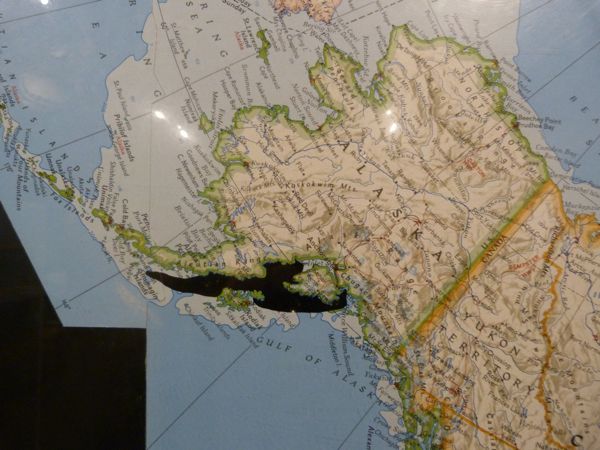
This was a map of the Exxon Valdez oil spill, from which Alaska is still recovering. We learned something interesting, and that is that as horrible as the spill has been for the environment, it put Alaska on the map, raised awareness, and that is when the tourists really started pouring in, maybe like to see the splendors of Alaska before they are destroyed by oil spills or climate change.
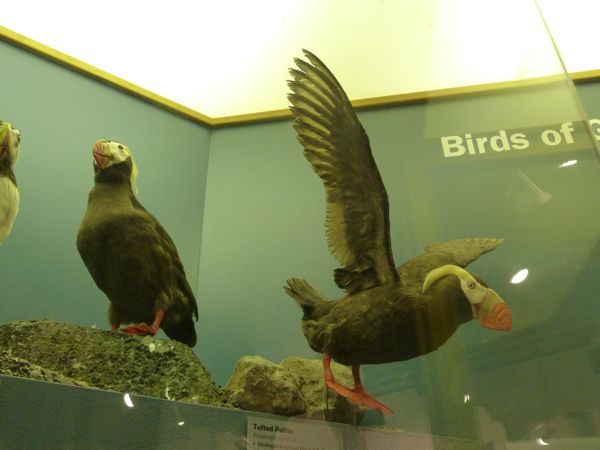
These are some of the Alaska birds you can see on the Kenai peninsula, including, I think, a puffin 🙂
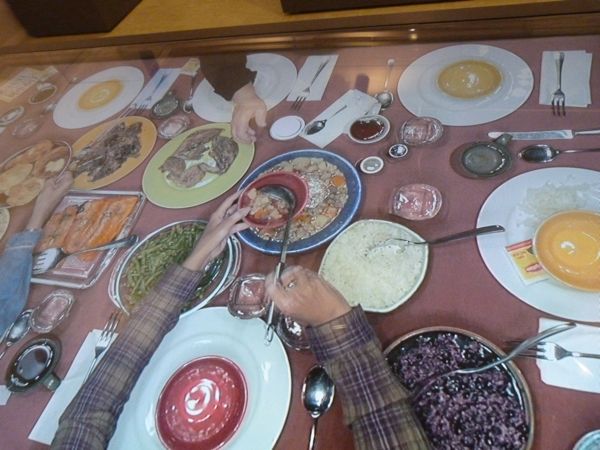
The Pratt has so many clever and original exhibits. I loved the film presentation on how the First Nation peoples catch, smoke and store salmon. If there is ever a zombie apocolypse and I have to survive, now I know how to prepare and keep salmon over long stretches of time by smoking it and drying it in strips. And protecting it from bears, who love salmon.
This presentation was like a table, but the movie was on the table. There were foods, and it was like we were the people eating. Someone would pass a dish and explain a little about what it was, like whale blubber or seaweed something. As much as I like to try new things, some of what they had on the table was stuff I would cut into very tiny pieces and push around the plate so it looked like I had tried some but I didn’t. I loved the presentation; so interactive.
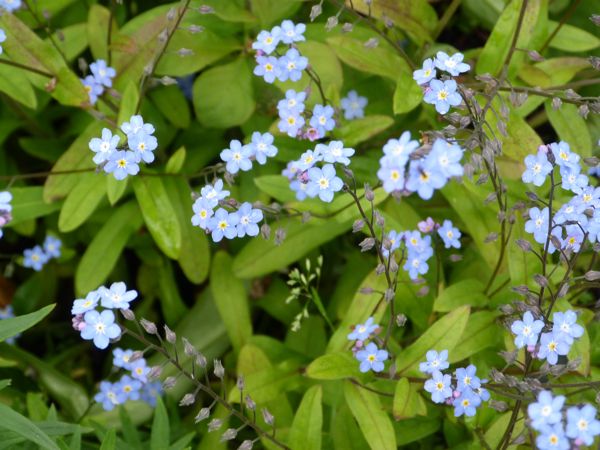
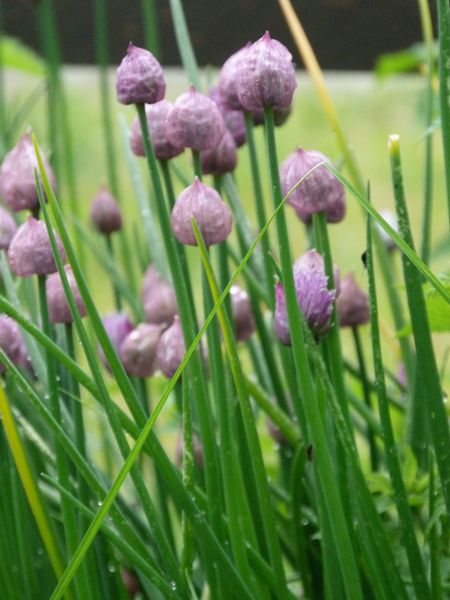
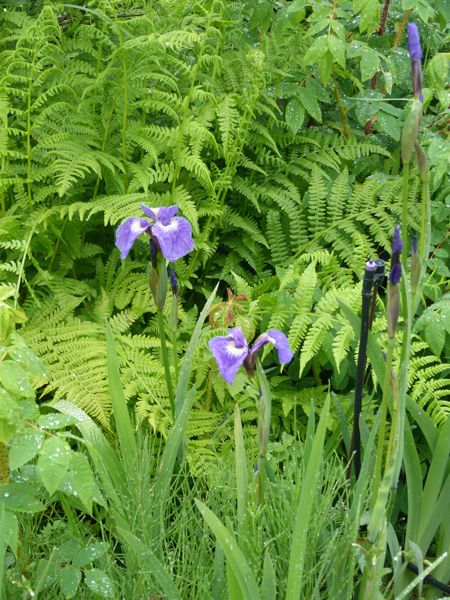
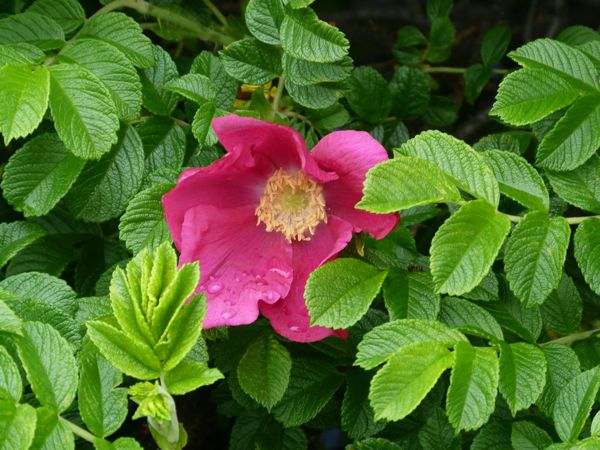
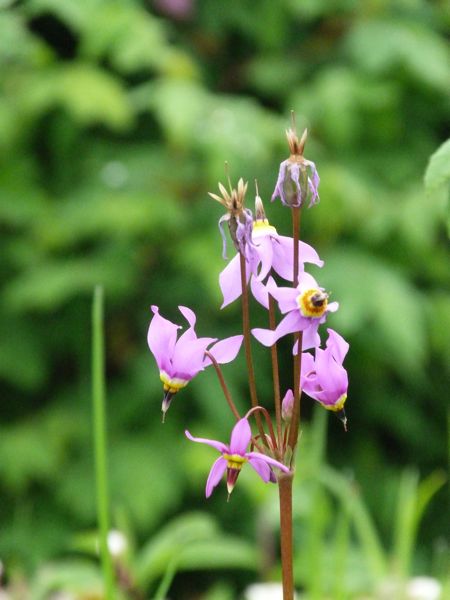
Although there were a lot of really good exhibits, we sort of hurried through once the crowd arrived. We did spend a good amount of time in the garden outside, where I laughed at myself. I learned a lot about myself this trip, why I love the colors I love (mostly greens – blues – purples and why I don’t like a lot of yellow or red in a garden. Almost everything in this garden was blue -purple – fuchsia with just a smattering of tiny yellow flowers, not a speck of red, except muted in some of the foliage, which was mostly shades of green. AdventureMan laughed, too, as it is the bane of his gardening existence that I want the bright red Turk’s Heads and the big yellow Cassia where I can’t see them.



Celebration 2014: Friday Afternoon Dancing
For the first time ever, the announcer tells us, the groups are all ready on time and the dancers ready to go – they are astonishingly ahead of schedule.
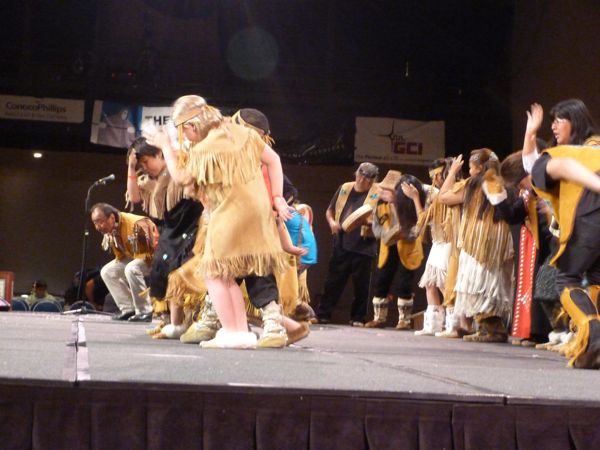
We return as a group of mixed dancers, from many Alaskan tribes, and some dancers with roots in classic “lower 48” tribes, so they all respect one another’s traditions, share, and do a little bit of everything. I kind of like this kind of flexibility. Some of the female costumes are a little ummm . . . skimpy . . . for the cold Alaskan climate, LOL, and some of the tattoos a little un-Alaskan and it doesn’t matter, they make it work.
The Celebration Hall is full and brimming over, dancers and their families in the waiting rooms, behind stage, in the halls, in the gift stores, children wailing for their Moms or Dads, it is totally a family affair. Grandma’s step in and help, and the dance goes on.


An Ice Cream Break and Totem Cones in Juneau
“Are you from the Philippines?” AdventureMan asked the man behind the counter as he dished me up a cone of Huckleberry (Blueberry) ice cream.
“Yes, there are many of us here,” the man answered, and told us how one of the fastest growing demographics in Alaska is the Philippine community.
“At home, we are so poor,” he explained. We are lucky to have a one room shack for a family, and for water we have to walk a long way for running water. It is very bad.” He looked serious.
“How do you like it here?” AdventureMan asked, and the man grinned. “Life is good!” he said, with enthusiasm. He also mentioned the Mexican population in Alaska is growing almost as fast as the Philippine population. Who knew?
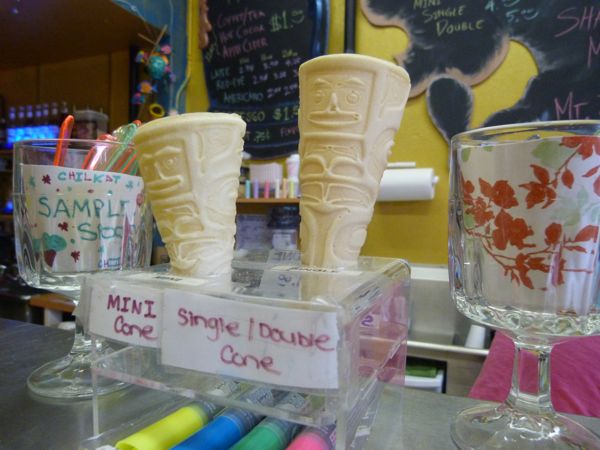
Normally, I don’t eat ice cream, but I have been craving something with either blueberries or rhubarb, two fruits that grew in Alaska when I was a kid, fruits we ate, jellied, froze, stored for later use. I had seen neither. Some might argue that huckleberries and blueberries are not the same. I don’t care. It is close enough for me. I also love that the cones are so extraordinary, artistic even, with their Alaskan Haida-esque sculptural quality:
And here is the proud cone-maker, also from the Philippines, who has a view to die for, the same view as from The Hanger on the Wharf, as she makes her specialty cones:

They insisted on giving us a 10% discount when they spotted my husband’s retired military ID card as he pulled out his wallet. They also shook his hand and thanked him for his service, a sweet and unexpected kindness in faraway Alaska.
Dancers, Costumes, Transmitting Culture at Celebration 2014
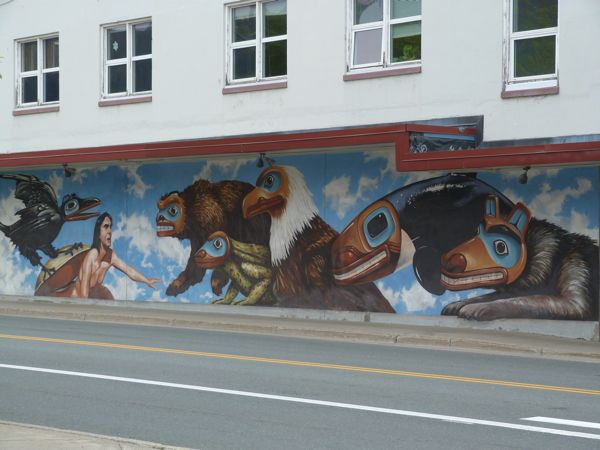
I am getting questions about the clans and tribes. I can’t answer your questions. I know there are the Ravens, and the Eagles, and I know they are not hostile but two halves of a whole. I know the raven legend; raven steals the sun – knowledge – and shares it with everyone. He is often shown with a long beak and/or curled around a ball. Eagles have short curved sharp beaks. But, with dispensation, an Eagle may marry a Raven. There are also subgroups, so you can be at once a Raven and a Bear, or a Killer Whale, or maybe a Wolf.
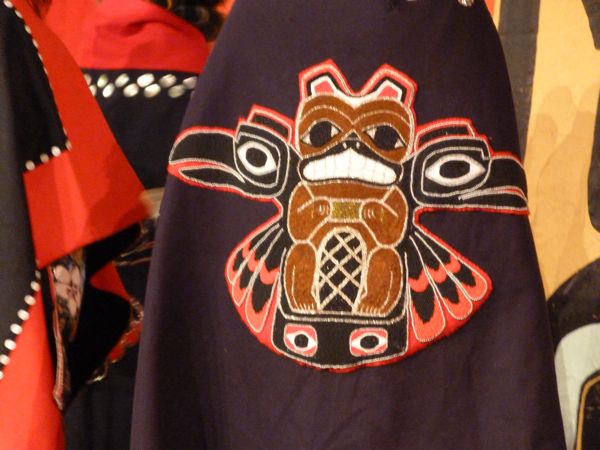
I try to understand, but it is a lot to absorb, and sort of complicated and flexible. As I look at my photos, I can see I was most interested in focusing on the costumes / textiles and less interested in the story. I wish I could tell you more, but you will have to read it for yourselves!
Here is a mural in downtown Juneau that demonstrates some of the artistic traditions of some of the various clans:
It’s important to remember – this is about them. It’s about holding on to traditional values and core beliefs, and transmitting knowledge of the culture to children and grandchildren. It’s not about us. As I said, we are there to witness and observe and celebrate, but they are there to celebrate who they are. Meanwhile, you can share the experience with these photos:


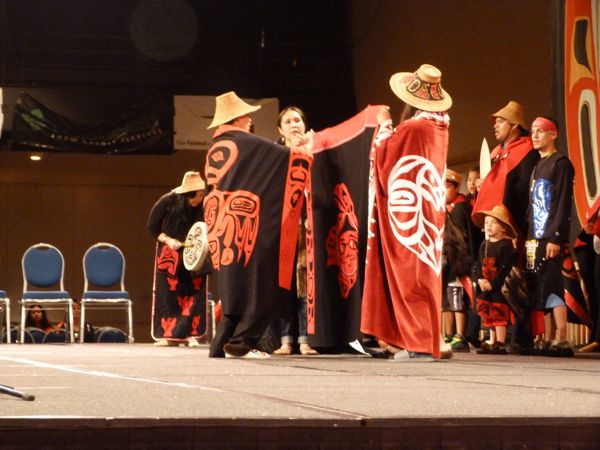


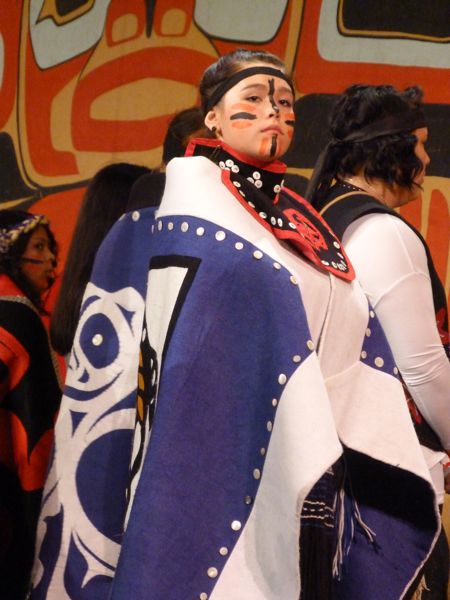

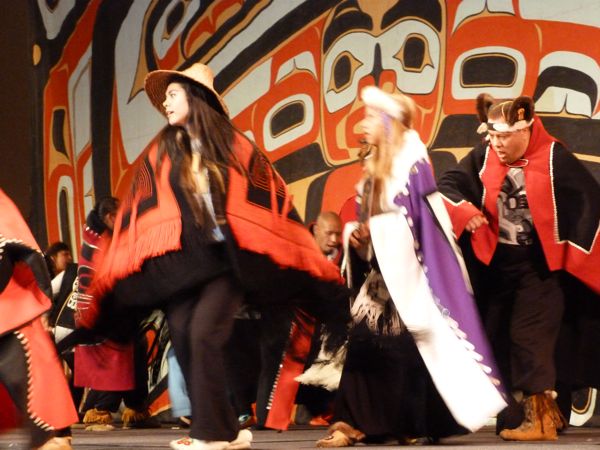


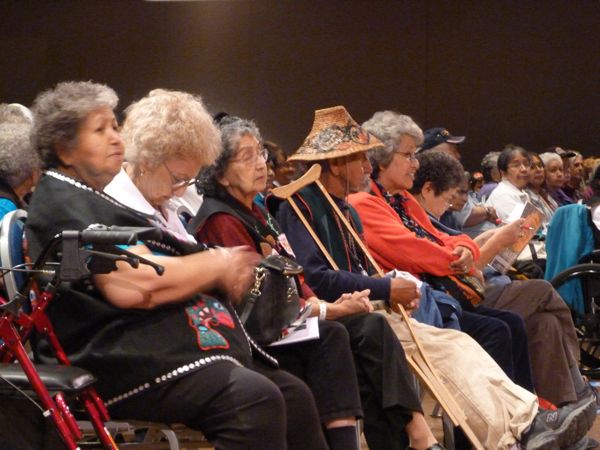
The front and center rows were reserved for the elders, and once the dancers started, every seat was filled. There were wet eyes, and open weeping. There were joyful moments, too, when the dancers would invite ‘all the Eagles’ or (something I didn’t understand) to rise and join them in their dance. My own heart swelled to witness their joy.

From Juneau to Tracy Arms Fjord on AdventureBound
Taking a break from The Celebration, we get up early, drive to our Juneau friend’s house and park our car and she drives us over and drops us off to catch the AdventureBound trip out to Tracy Arms. For two weeks the weather forecasts have told us that this day will be sunny, bright and warm, and ha ha ha on us, it is cloudy and cold, but not much rain. In Juneau, not much rain is a pretty good day :-).
We meet some really fun people as we wait to board – one couple married four days, one couple of young adventurers who, like us, travel on their own as opposed to group travel or cruise ship travel. Our lively conversation made us late to board, only to discover that everyone else had booked for this “sunny” day and every seat in the cabin would be occupied. Once you sit down, that is YOUR spot, oh ugh, this is the worst kind of tour for us, but we discover we can go in and out at will and this works. We spend a lot of time outside, taking photos, watching for whale and porpoise and bear and eagles – all kinds of wildlife. It’s not so bad.
Before we leave, I shoot this photo. It’s not original; I had a similar poster once from the 1920’s or 1930’s advertising trans-Atlantic boat travel on some French line. I just love the lines:

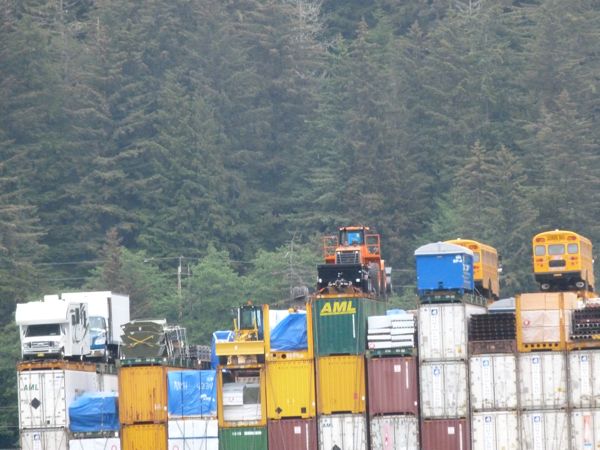
Juneau is landlocked, so everything that comes in or goes out goes by boat or plane. Container barges bring in larger items, and I was amazed how high they can stack a barge. I was also amazed that on top of the containers are vehicles strapped on tight; school buses, campers, snow plows – no wonder everything costs so much more in Alaska!

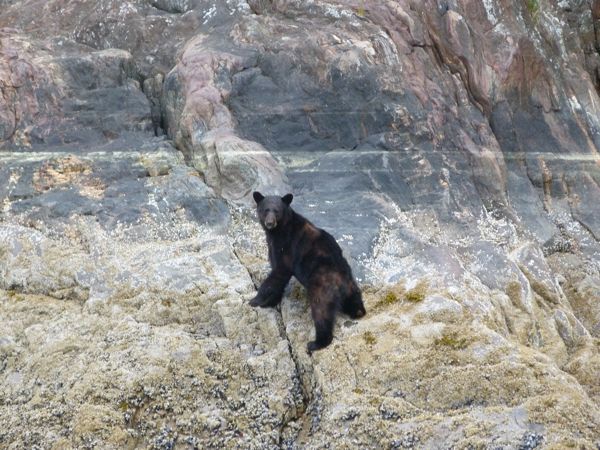
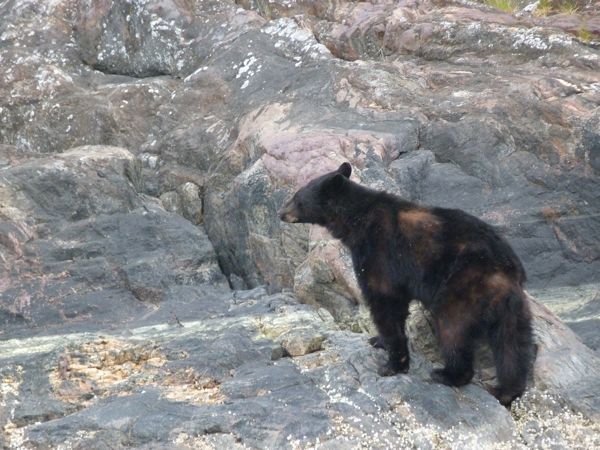
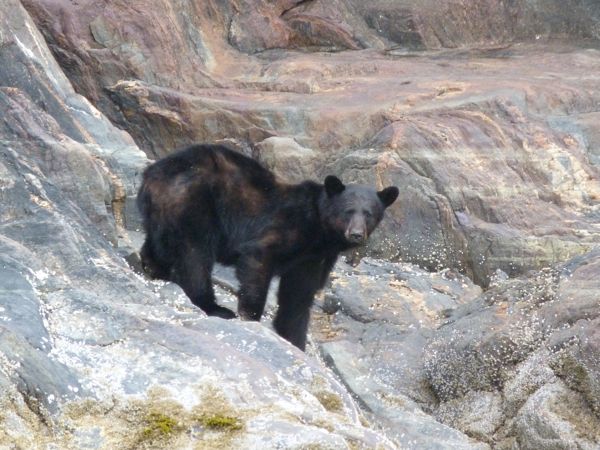
These bear made me so sad. Look how skinny they are, down at the bottom of tall, steep cliffs, eating barnacles. Bear eating barnacles – they must be starving. Some of them look all molty and have fur coming off.
I never saw these glaciers when I was little. The Mendenhall glacier is relatively large compared to the Sawyer glaciers (1) and (2) but the Sawyer glaciers are calving. The sound is unforgettable, the cracking, the thunder, and entire sections of the glacier falling into the bay. Other burgs crack off underwater, and they come up huge, whole and a sparkling, unforgettable icy deep blue:
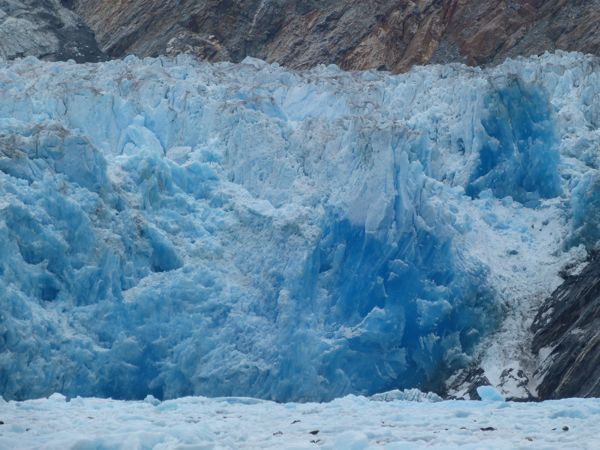
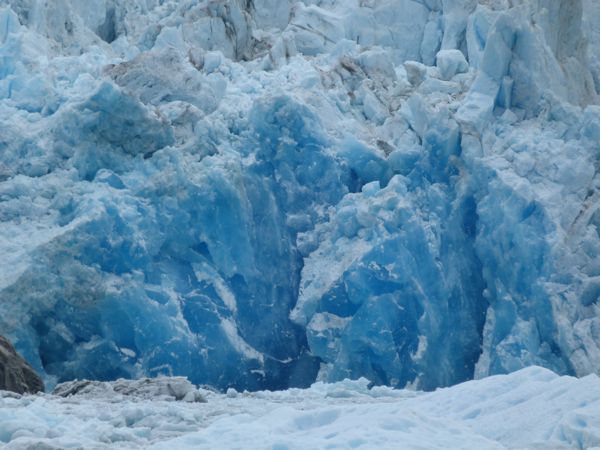
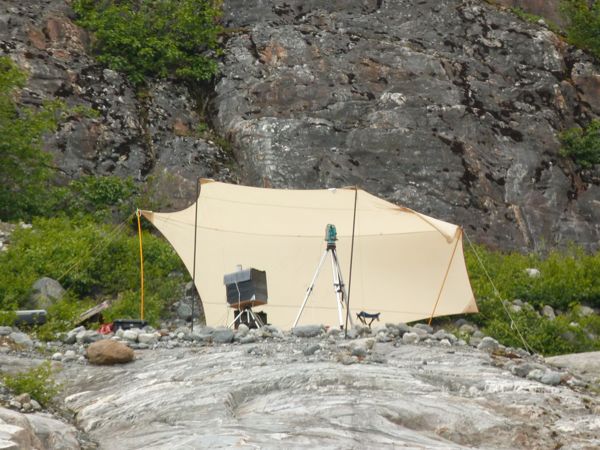
There is equipment going all the time at Tracy Arms to record the calving, the sights and sounds:
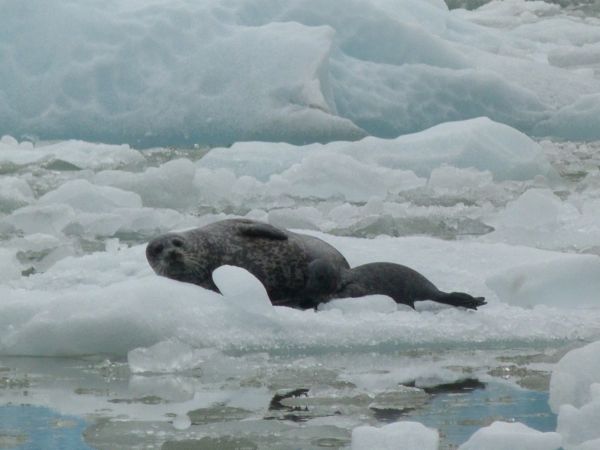
Mama and baby seals catching a few rays at high noon near the glacier:
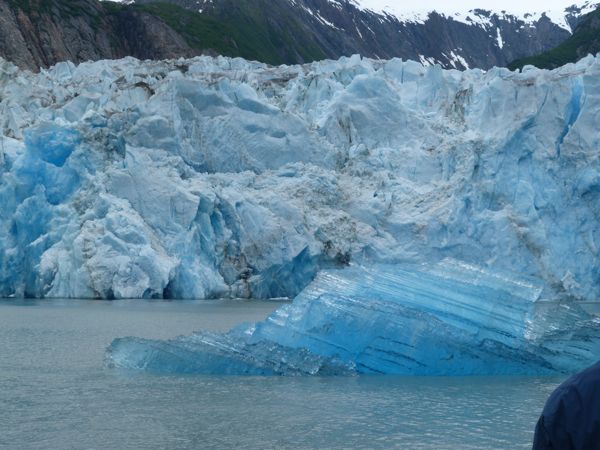


Here is a piece breaking and falling into the water:
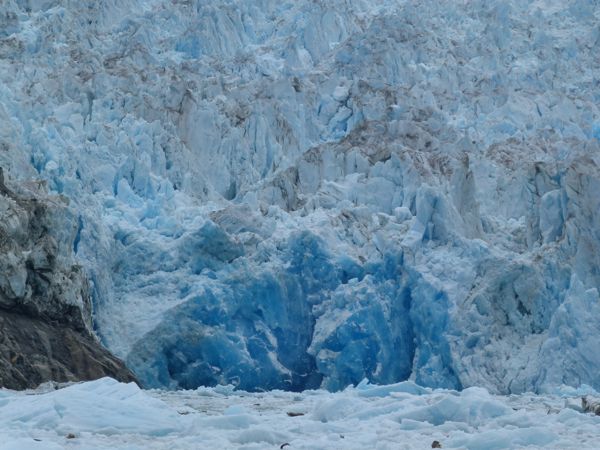


You can see the tour boat is surrounded by ice and icebergs:
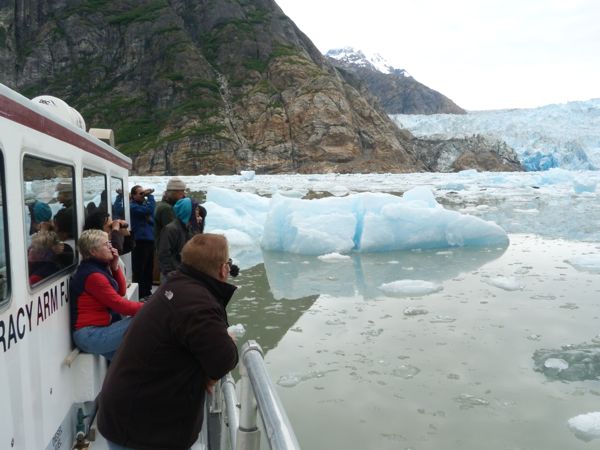
The glaciers are currently neither advancing nor receding, but you can read the trail of the glacier’s recession over thousands of years in the steep, ice-scraped mountains on both sides:

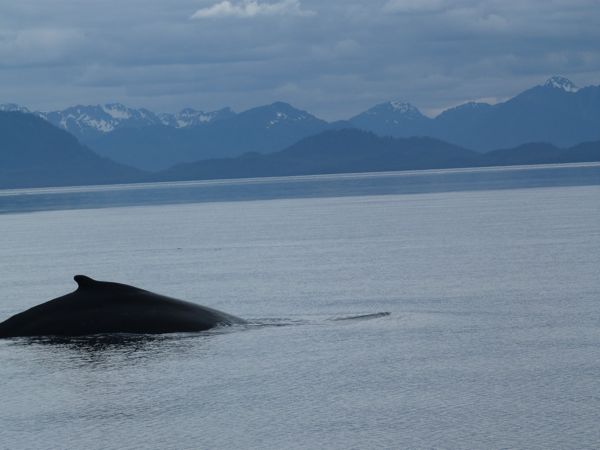
On our way home, we spot whale. You can shoot a lot of shots of a piece of whale, or where the whale was a split-second ago, LOL.

As we reach the dock, I call our friend to tell her we are arriving and she laughs and tells me she is already on her way; she was watching the boat arrive from her place across the channel. Within minutes, she is picking us up for home made fish cakes and chop chop salad. Best of all, great conversation, lots of laughter and wonderful stories of past times in Alaska. Her family was a pioneer family in Nome before she married and came to Juneau, so she has some great tales to share. Our families have had a lot of joint adventures, in Alaska, in Germany and in Edmonds.
She also asks great questions like “how did you buy groceries in Kuwait?” and “what did you do about laundry?”, practical questions, and exactly the kinds of things that made our lives more challenging – and interesting – to us. It was a great evening.
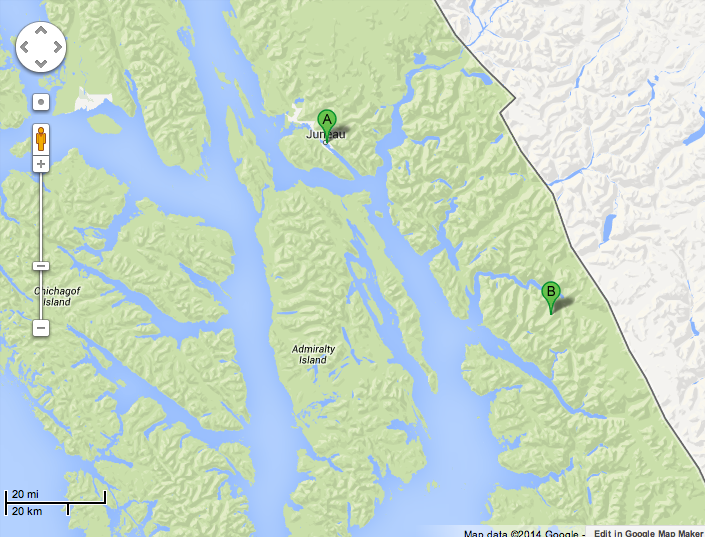
The Hanger at the Wharf in Juneau
First, we really love eating at the Hanger at the Wharf. So does just about everyone else. Twice, we got really lucky. It is easier getting a table if you are just two people, and it is easier getting a table if you eat early. As we are still on Pensacola tummy time, we are in luck. As the Celebration 2014 parade ended, we zipped straight over and as larger groups waited, we were immediately shown to a table for two.
No wonder The Hanger is so popular. The food is terrific and this is the view – straight down the Gastineau channel with Douglas and the cruise ships. As the sun slides behind the mountain, it is a stunning view:

Some hardier souls were eating outside on the deck. I used to be this hardy, but my years in the Middle East have softened me, made me not so good at eating in cool and drafty places, even in the middle of the Alaskan summer.

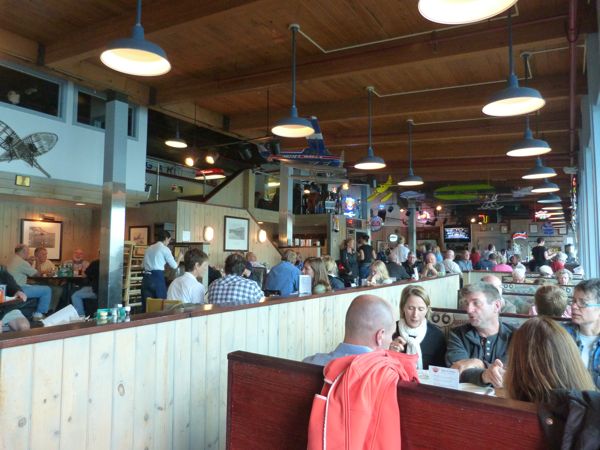
Inside The Hanger: great, courteous, friendly and efficient employees

Every table taken, the bar is packed, and people are waiting in the hallway to be seated:
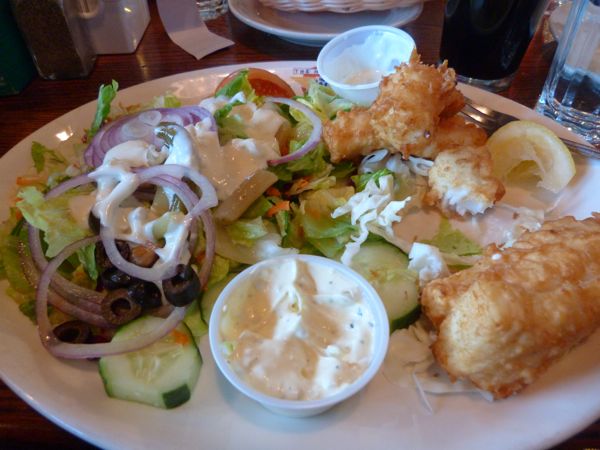
My halibut tempura:
AdventureMan’s halibut burger and fries:

We liked the food and atmosphere so well that we went back a second time during the ceremonial dances and were happy to see a lot of the dancers eating there, too. I had the first mate’s plate, with salmon and halibut and a berry chutney and AdventureMan had grilled halibut. We both left happy. We would go there again in a heartbeat.
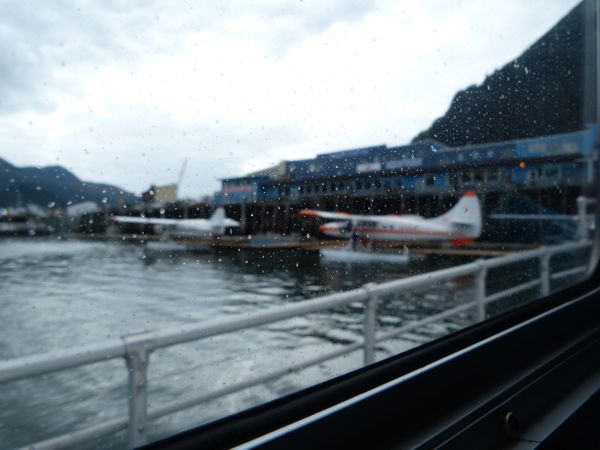
There is only one little thing about The Hanger that makes me uneasy, and it has nothing to do with The Hanger. When I was a little girl, living across the channel, I would watch for my Dad to come home – this was the airport for the amphibious planes, Alaska Coastal Airlines (now part of Alaska Airlines) and Ellis Airlines. When his plane would land, we would all rush to the car and drive like crazy across the bridge to pick him up (no cell phones then, LOL). So I still feel a little frisson and feel the ghosts of the past when I eat there.
Celebration 2014 Begins
This is the reason we are here – Celebration 2014. I had never heard of it, it is not well publicized. It only began some time in the 1980’s and I came across it by accident, researching a Native Alaskan hunting mask my Mother gave me. I found a blog written by a young girl from Nome, showing early Celebrations, and explaining it was a gathering of the Alaskan clans.
Wow. This was so totally new to me. Growing up, there was little or no acknowledgement of the First Nation tribes. We were told not to play with the native children; they had knives, they were dangerous. LOL, tell a kid another kid has a knife and guess who they want to play with?
All us kids went to school together. Even as a young child, you recognize discrimination when you see it. Kids have a strong sense of “Fair”. We knew, at a gut level, that not playing with our Native classmates was not right, not fair, and . . . we went right ahead and did what kids do.
I do kind of cringe, thinking of playing cowboys and indians with real Indians, LOL . . . . but anyone could be whoever they wanted to be, so often as not, cowboys were Indian. It’s funny now that I think about it; kids see things differently.
I am not Native American, but this is my connection, my early classmates. You know how sometimes the pieces just come together? Now I know why I worked so hard to attend those nomadic festivals in Douz, in the Sahara south of Tunis, the falcon festivals, why I urge locals to gather the stories and dances and clothing traditions and to preserve them – it’s because I learned to treasure the arts and crafts of the earliest Alaskans.
So I came back not as participant, but as witness. I wanted to see the First Nation people Celebrate who they are, and their own cultures and traditions. I had no idea how very moving I would find it, but once the drums started beating and the chants started, I was weeping.
The best part was the multi-generational participation. The groups were led by elders, but at their feet were the grand children and great grandchildren, all dressed, all chanting, learning the steps, learning the songs, learning the traditions, learning more about who they are. Their faces were full of joy, and pride, and I get a little choked up just writing about it.
The opening parade was not until evening, so we were on our way to the hotel for a quick snooze and we saw the dugout canoes headed toward Juneau, full of chanting rowers.

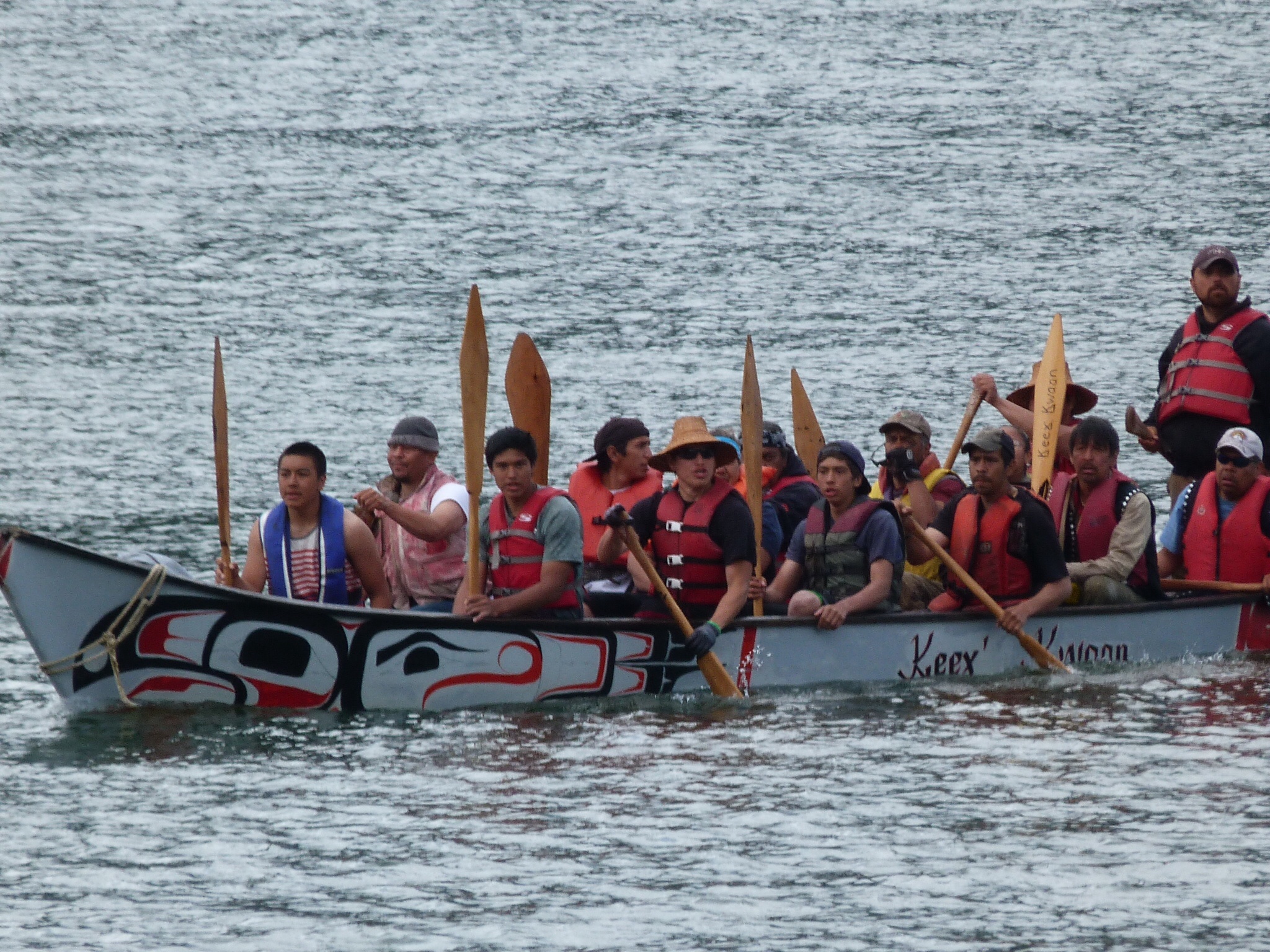

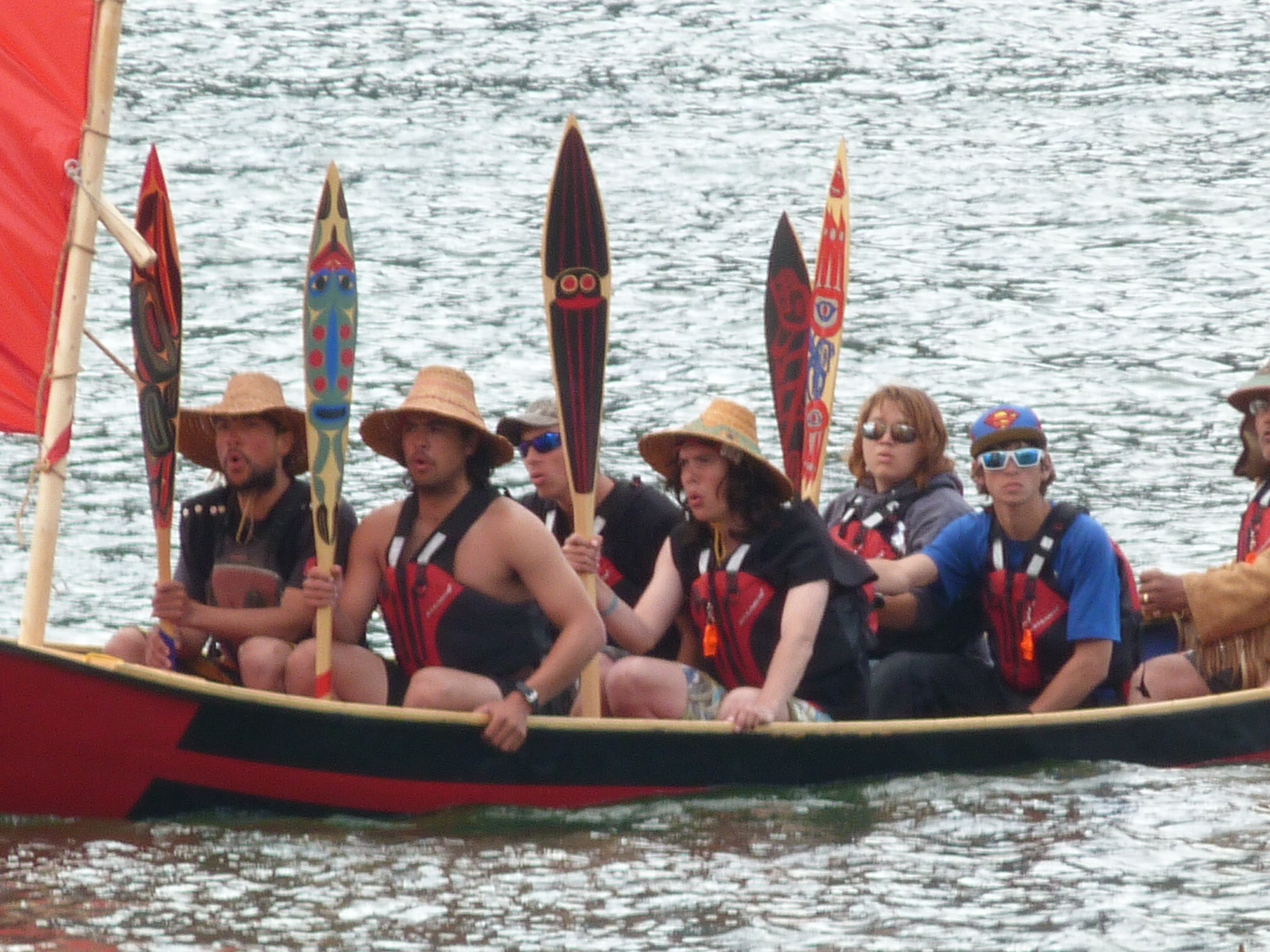
AdventureMan quickly turned the car around so we could watch them approach and land. It was haunting, beautiful, the drums, the chant, and a woman next to me, around my own age, turned to me, weeping and said “I never thought I would see this again in my own time.” It was a moment of pure joy.
(This was the end of a one week canoe trip by several canoes: read about it here)
The opening parade was a small problem; we looked and looked for where the parade was due to start and finish. Many in town knew there was supposed to be a parade sometime, but were hazy on the details. Finally, we found the right places, the right street and were scouting parking when a parking police person told us that all the government workers go home at five and the parking enforcement people go off duty at 5:30 so show up after 5:30 and you can park where you want. Wooo HOOOO! Thank you, City of Juneau!
The parade started promptly at 6, led by elders carrying the American flag. Tsimshia’an, Tlingket or Haida – all American. One of the lead dancers was a Marine who took leave to come back and dance with his tribe, leading the younger men in the movements to the hunting dances.


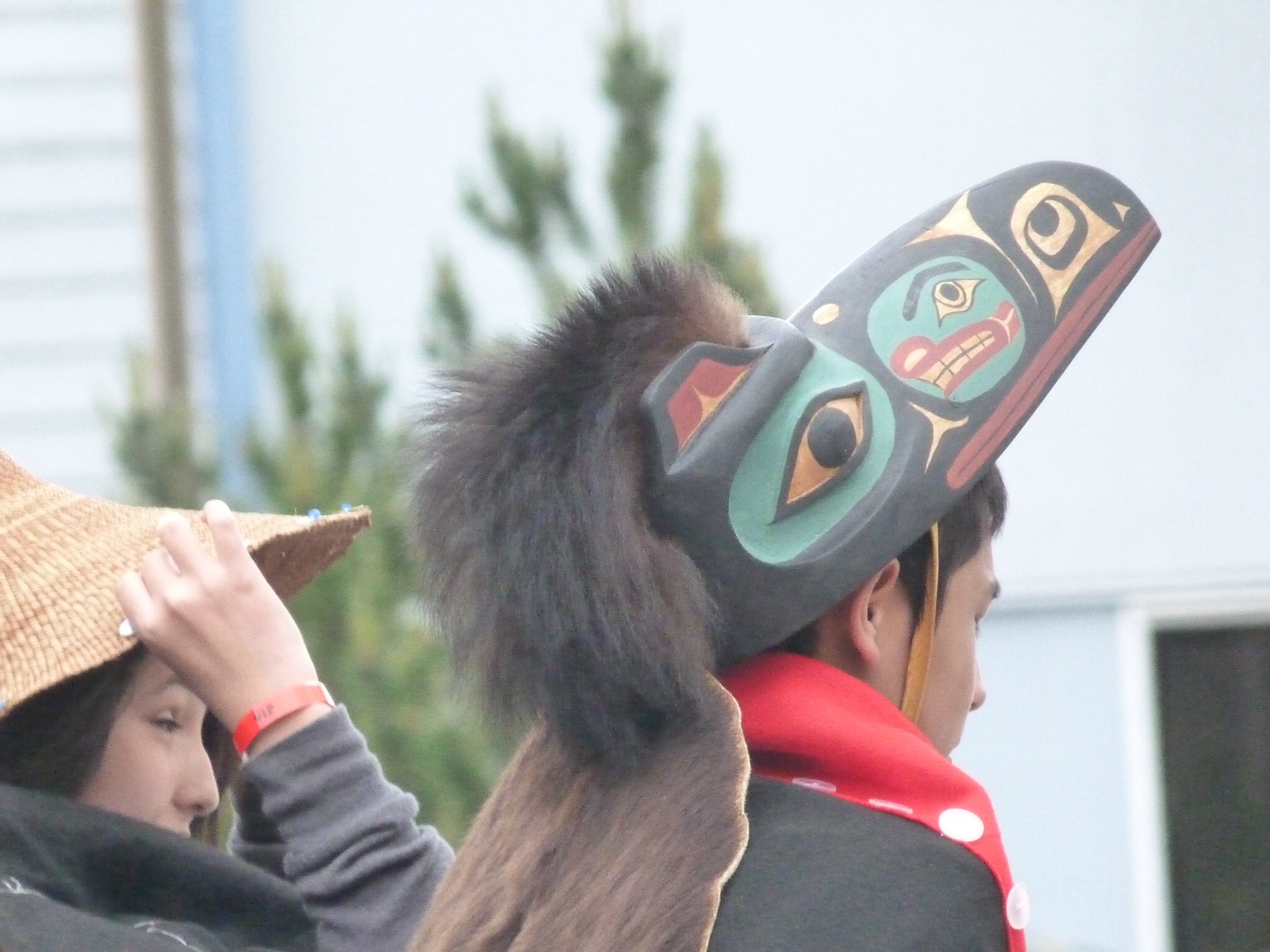

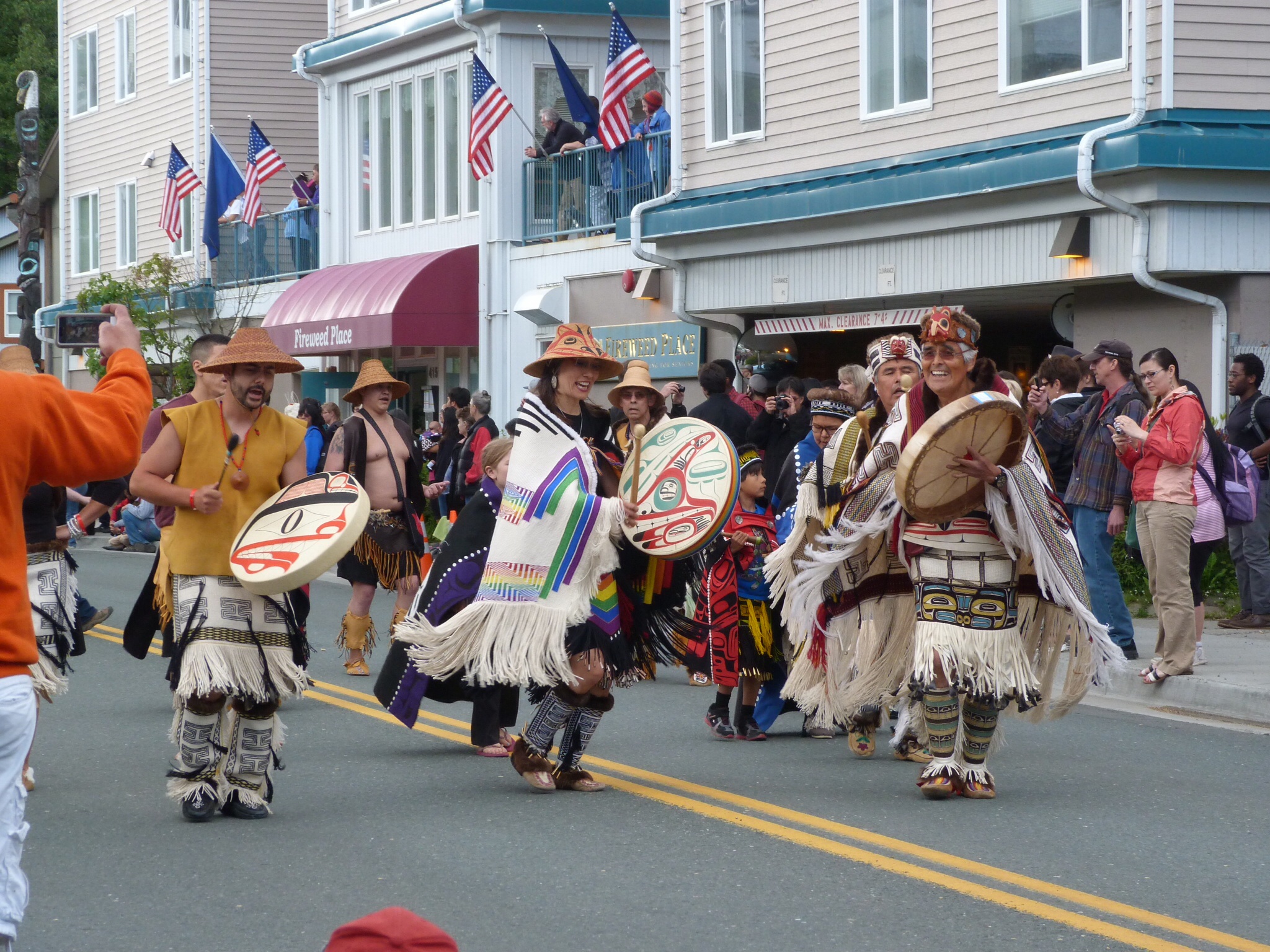
More images to come 🙂
Paradise Cafe Near the Juneau Airport
AdventureMan spotted this gem, near the airport, and said “I want to eat there!” We went inside, and what a surprise – it is eccentric, and quirky, and full of local people eating lunch. We noticed that thanks to the gorgeous display of sweet desserts and pastries, everyone also left with a box for ‘later on’ like coffee break.
They had a selection of ‘grillers’, no menu, everything is listed on the board or on display. It is so hard to focus on lunch when you are looking at flaky pastry confections . . .
I had the tomato pesto sandwich, and AdventureMan had a ham and cheese griller – both rich and filling. We sat at one of the tables, each table different, sometimes people share tables. On each table is a carafe of water, but we also saw a lot of people ordering specialty coffees and teas.
The Paradise Cafe is not a well-kept secret. You and I, as tourists, may not recognize it is there, but all the local helicopter pilots and airport workers know it is there 🙂 It is a well loved and busy place!


Revolutionary Government: South Africa
AdventureMan and I have a soft spot for South Africa, not the least of which for the dramatic and radical way they transformed from apartheid government to democratic government. It is not to say South Africa has been without problems – there are still problems. But the manner in which they confronted and dealt with their past and then moved on allows change to happen, change in the heart.
Today’s meditation from Forward Day by Day:
FRIDAY, May 30
Psalm 85:3. You withdrew all your wrath; you turned from your hot anger. (NRSV)
But for the grace of God and the work of extraordinary leaders such as Nelson Mandela and Desmond Tutu, the fall of apartheid in South Africa could have been marked by one of the worst bloodbaths ever seen.
The incendiary ingredients were all present: a repressive minority regime that ruled by violence, fear, and fiat over a majority population denied fundamental human rights and forced to live a subservient existence.
There was upheaval, but the nation never fell into anarchy as it radically changed its government, thanks largely to the Truth and Reconciliation Commission.
Chaired by Tutu, then the Anglican Archbishop of Cape Town, the commission held hearings throughout the country. Victims told their stories of torture, killing, and degradation, sometimes confronting the accused.
The goal was not vengeance or justice but truth-telling to clear a path for healing. Powerful emotions were released. There were tearful confessions and apologies. There was forgiveness. The people of South Africa managed to turn from their hot anger and begin building a new nation.
Can we do the same? Where can we forsake our anger for the liberating power of forgiveness?
Leadership – A Memorial Day Meditation
This is today’s Forward Day by Day reading, and I think it is perfect for Memorial Day, a day in which we celebrate those who fought and gave their lives that we might live free:
MONDAY, May 26 Rogation Day
Matthew 13:14. You will indeed listen, but never understand, and you will indeed look, but never perceive.
The daughter of the young clergyman looked and she did perceive.
She had taken a bus trip with her father to their home country so she could obtain an identification card at the age of eighteen. Before the bus left, the driver asked if someone would pray for a safe journey. Her father walked to the front of the bus and led the passengers in prayer. Later, at a rest stop, the priest noticed some trash littering the area. After other passengers walked past heedlessly, he scooped it up and put it in a trash bin.
The acts seemed minor, and he thought no more about them. But later, his daughter asked him to read her homework—a profile of a leader. He did and was humbled and amazed.
The profile was about him. Citing those two examples and others, the daughter described how his behavior reflected his values. She wrote, “Leadership is not a title, but it is about the way you live your life.”
She had done much more than see her father’s actions. She had perceived their meaning and importance in the context of their faith.
Recent Comments
Kitchen on Isiais: Winding Down intlxpatr on Shampoo Ginger tigerbutterya0c5ff1d… on Shampoo Ginger intlxpatr on British Soldier Kidnapped, Esc… John on British Soldier Kidnapped, Esc… Wikipedia Donate Button

Amazina


Early Voting in Florida


