ISIS: Follow the Money
I wish I could say that I had written this, but no, this is an article by Howard Shatz, published in Politico and brought to my attention by Digg, who sends me remarkable items:

President Obama is laying out his strategy to counter the Islamic State, whose rampages across Iraq and Syria have riveted Americans’ attention on a zone of conflict that many had hoped to forget. Many are urging him to step up military action. But if Obama wants to defeat the jihadis, he will need more than airstrikes—he should follow the money.
For all that ideology, religious belief and perhaps a lust for violence and power might motivate those who fight for the Islamic State (known variously by the acronyms ISIS and ISIL), money is what keeps the group going. As with any state, ISIL has bills to pay and mouths to feed. Even for the world’s richest terrorist organization—which, by all available accounts, ISIL is—money doesn’t grow on trees, and nothing in the world comes for free.
So where does ISIL’s money come from? As part of my research at the RAND Corporation, since late 2006 I have been studying the finances, management and organization of the precursors to the Islamic State—Al Qaeda in Iraq and the Islamic State of Iraq—using their own documents, manuals and ledgers. More recently, Rand has teamed up with scholars from Princeton and Emory universities, as well as analysts from other organizations, to study more than 150 documents produced between 2005 and 2010. Although our work is still not yet done, we can draw a number of conclusions.
The most important thing for U.S. policymakers to remember is that ISIL now possesses the financial means to support a long-term fight—some $2 billion, according to a recent report in the Guardian, citing a British intelligence official. At the same time, ISIL’s preferred fundraising methods and many financial commitments create vulnerabilities. The organization was badly damaged by late 2009, thanks to a combination of coalition and Iraqi forces, as well as intervention by the Iraqi government, and it can be badly damaged again. But without the establishment of a widely accepted, legitimate political order in Iraq, ISIL cannot be eradicated—and will continue to seek out and mete out cash.
ISIL raises most of its money domestically in Iraq and Syria. Its income streams include oil smuggled to other countries in the region, extortion, taxes—especially on non-Muslim minorities—and other essentially criminal activities.
Oil is ISIL’s biggest source of revenue but also presents the biggest problem. ISIL controls about a dozen fields in Syria and Iraq, in addition to a number of refineries, including mobile refineries. Based on media accounts, RAND has estimated the total production capacity of these fields to be more than 150,000 barrels per day, although actual production is estimated to be much lower: The website Iraq Oil Report has reported that exports for the month of August at about 2.4 million barrels per day, for instance.
ISIL smuggles this oil out in tanker trucks—clearly visible from the sky should any drone pass overhead, so the smuggling is not particularly furtive. The group then sells the oil to whoever will buy it—reported in the media to be buyers in Syria, Turkey, the Kurdistan Region of Iraq and possibly in Iran and even Bashar Assad’s regime in Syria, among other countries. Sales take place at rates deeply discounted from world prices. But even so, revenues have been estimated in the media at $1 million, $2 million or even $3 million per day.
We have seen this before. From 2006 to 2009, ISIL’s predecessor, the Islamic State of Iraq, raised perhaps $2 billion through smuggled oil originating in the Baiji refinery in northern Iraq. This ended as a result of a concerted effort by U.S. and Iraqi forces to destroy the group and create the conditions in which the Iraqi government could exercise its law-and-order responsibilities, as well as vastly improved management at Baiji, owned by the Iraqi government.
So where does all of ISIL’s money go?
ISIL historically has paid its members (yes, it maintains payroll sheets) based on a flat monthly rate per person and then additional fixed amounts for each wife, child and dependent unmarried adult woman in the household. In Anbar, Iraq, the rate was $491 per year in 2005 and 2006, and then about $245 per year per dependent; the rate was similar in Mosul in 2007 and 2008. These payments to family are meant to continue if the ISIL member is captured or killed—a primitive form of life insurance. If enough members are captured and killed, however, these costs start to mount.
ISIL also pays rent for its members in some cases—payments that might be bonuses to high-performing members, although we cannot be sure—and medical expenses for some members and their families. In the past, the group has sometimes hired lawyers to help get captured members out of jail. And it runs safe-houses and has to buy equipment. Guidelines published by a predecessor of the group say that expense reimbursements should be filled out in triplicate and explain where each copy goes within the organization. We don’t know for sure whether ISIL today is making money or even breaking even, but at least in Anbar from 2005 to 2006, the money was being spent as fast as it came in.
As a cash-based organization, ISIL relies on couriers not only to deliver messages among its dispersed leadership but also to move money—follow the right courier and you get to the leadership. Because it deals only in cash, ISIL also needs to worry about the honesty of its members. We have seen instances of skimming for personal enrichment, as you might see in any cash-based criminal network.
As a state, albeit a twisted version of one, ISIL also has administrative expenses. It is responsible for making sure electricity and water flow and the roads stay repaired in the regions of Iraq it now controls—including parts of the Anbar, Ninewa Salah-al-Din, Kirkuk and Diyala governorates. Whether the group chooses to or is able to fulfill those responsibilities creates a vulnerability: A discontented population is unlikely to remain passive under ISIL’s leadership.
Even if ISIL is making $3 million per day—at the higher end of the various estimates out there—then it makes slightly more than $1 billion per year. Just to be conservative, in case ISIL is doing more business than we’re aware of, let’s double that to $2 billion per year. Although exact totals are difficult to find, in 2013, before ISIL’s advance, the Iraqi government spent far more than $2 billion per year running the governorates ISIL now controls, including salaries to civil servants, other costs of service provision and investment spending. That means ISIL likely isn’t keeping up the same level of service that the Iraqi government once did. True, ISIL need not maintain that level—it hardly rules with the consent of the governed. But it’s not only a problem that those under its rule can rebel, as happened in 2007 and 2008; with the exception of oil, the group’s continued revenue-raising also depends on there being enough money to skim and extort from the economy, and this requires some minimum level of services and economic activity.
There is little that outside forces can do to halt the extortion and skimming that take place within ISIL territory. Oil smuggling, though, can be disrupted, at least to an extent. Intelligence resources from the United States, Iraq and any other country that takes on ISIL should be focused on identifying middlemen and buyers for the smuggled fuel and using any means necessary to halt those purchases.
It would be counterproductive to destroy oil field infrastructure, since repairs would be expensive and legitimate governments will need those oil revenues when they reestablish control. But mobile refineries should be targeted, and roads and other pathways that tanker trucks use to transport oil to and from oil fields should be made impassable by military means. The refineries and roads can be easily repaired when the time comes, but for now, ISIL should find it very difficult to move oil from fields.
Stopping ISIL will of course require much more than disrupting its funding. It will have to be defeated militarily, and legitimate, trusted governments will have to be established in Iraq and Syria to defeat the group over time. There’s no simple path to achieving this, but as long as ISIL’s coffers remain full, the task will not get any easier.
Bringing Great Good from the Evil of 9/11

A reading from today’s Forward Day by Day helps us to cope with the resonating horrors of that monstrous day. We are living in a world where we are more and more inextricably interconnected. Where I am living, I often hear people talk about how “Moslems are killing Christians all over the world!” and my heart breaks, thinking of the wonderful friends I have lived among is so many Moslem countries, their kindness, their hospitality, our long pleasant conversations. I learned so much.
I am glad we believe in a God who knows our hearts. I am thankful for grace, and forgiveness. When we talk about killing, we also need to take account for all the civilians we have killed, trying to bring about peace, trying to eradicate Al Qaeda, Al Shebaab, those who would harm us.
God asks us to love one another. He doesn’t say “Christians, you love just the Christians.” He shows us how to love the Samaritans, the lame, the blind, the mentally ill, the “other”. He tells us, clearly, to love our enemies. The Gospel that speaks the loudest is the gospel of our lives lived to honor him.
THURSDAY, September 11
Acts 15:8-9 [Peter said], “And God, who knows the human heart, testified to them…and in cleansing their hearts by faith he has made no distinction between them and us.”
Thirteen years ago, this day became one of those days that divide time into what life was like before, and after; one of those days when you will remember, always, where you were, what you were doing—this time when you heard the news that airplanes had crashed into the World Trade Center and thousands of people had died.
Job asks, “Does not calamity befall the unrighteous?” (31:3), but we learned, vividly, on September 11, 2001, that the righteous and the innocent suffer too.
Psalm 59:6 exhorts God to “show no mercy to those who are faithless and evil.” The terrorists who flew the planes on 9/11 forced us to confront the power of evil and challenged us to find a way to respond with forgiveness. Perhaps we can learn something about that in Peter’s response to the heated discussions about Jews and Gentiles, about who could be saved, and how: “God, who knows the human heart…has made no distinction between them and us” (Acts 15:8-9).
Then, as now, there were good people and evildoers on all sides, religions, and races. Now, as then, judgment and salvation comes only through the mercy and grace of God.
Why Not Pensacola?
Big article in AOL news about Dan Gilbert going to Silicon Valley to pitch moving their offices to Detroit because it’s way cool.

Excuse me?
While I appreciate his loyalty to Detroit, the things he is pitching all apply to Pensacola – AND. And in Pensacola you don’t have harsh winters. And in Pensacola you are minutes from one of the most beautiful sugar-white sand beaches, uncrowded, in the world. And Pensacola is family oriented. And Pensacola has affordable housing. And Pensacola has a way-cool culture, with parades, symphony, ballet, opera, theatre and restaurants, and world class National Naval Aviation Museum. And people spend thousands of dollars to come visit Pensacola when they could be living the dream – in Pensacola.
Dan Gilbert is a powerful man – in Detroit. Now he wants to convince Silicon Valley to move to America’s Motor City where they’ll have wide open offices, inexpensive living, and access to amazing talent.
Gilbert, the chairman of Rock Ventures and the owner of Quicken Loans, owns 60 buildings in downtown Detroit that house 12,000 employees. He is also an active backer in startups and has been inviting small companies to come bloom in Detroit over the past half-decade.
Why should you move to Detroit?
“The perception doesn’t do it justice. You have a huge talent pool,” said Gilbert. “And the people are way cooler.”
Gilbert believes that the Midwest work ethic isn’t a myth. He said that, despite the rumors to the contrary, the city has an innovative city government and, thanks to his extensive purchases in Detroit, there is space to spare for new startups. He is also working hard to reduce blight around the city, ensuring that city doesn’t look like it does in the popular “desolation porn” that characterizes the city.
The result is a smaller, more compact city that allows smaller companies to gain a foothold in the tech economy.
The city is, arguably, entering a period of renaissance. Thanks to Quicken Loans and Gilbert’s work in the city, most of the blight has been converted to cheap office space. While it does still seem like a wasteland to the average graduate, we saw a city reborn when we visited in 2012 and things are improving immensely.
In short, he said, Detroit is all about opportunity.
“We have great bones,” said Gilbert.
Detroit has good bones? Pensacola has office space, room to grow, a population of workers that can be trained to fill high tech jobs, several colleges, a university, and low stress living. It’s such an easy sell.
Pensacola Drug Sweep Arrests 13 with Warrants for 20 More
Wooo HOOOO Pensacola, getting those dealers off the streets. It’s not like its permanent, but it’s a start. There is one funny thing you will spot in this write-up in the Pensacola News Journal, that the next to last man named had charges that include selling cocaine within 1000 feet of a place of worship.
If you’ve ever been to Pensacola, you will understand how hilarious that is. You can’t go 1,000 feet away from one house of worship and not be within 1,000 feet of the next. It’s just like the mosques in Qatar and Kuwait, if you are lost, you can’t call someone and when they ask where you are, you can’t say “I’m by the big mosque/church on the corner!” because there are mosques/churches on EVERY corner! Pensacola has churches everywhere! I just think that’s interesting, that it seems to be an additional charge on the sheets in Pensacola.
An approximate 4-month-long investigation targeting street-level drug dealers resulted in the arrests of 13 people for selling crack cocaine to undercover Pensacola Police officers Friday.
Warrants for selling cocaine also have been issued for an additional 20 people, said Sgt. Marvin Miller, who supervises the department’s Vice & Narcotics Unit. Miller said the investigation targeted areas notorious for narcotics sales.
All of the charges are third-degree felonies punishable by up to five years in prison. Additional prison time can be added for selling within 1,000 feet of a specified area such as convenience stores, schools, and places of worship, or if the person is a repeat offender.
Officers from various units within the Pensacola Police Department spent approximately 12 hours today making the arrests.
Arrested today and charged with sale of cocaine and conspiracy to sell cocaine were:
Alfred Peasant, 34, of 1300 block of North Sixth Avenue, Pensacola
Sharon Pickett, 49, of 100 block of North J Street, Pensacola.
David Jones, 24, of 3600 block of Swan Lane, Pensacola.
Demarko Weathers, 21, of 2000 block of West Chase Street, Pensacola.
Minnie Mae Sapp, 54, of 100 block of South N Street, Pensacola.
Terry Crenshaw, 28, of 1000 block of West Hillary Street, Pensacola.
Larry Dornall Knight, 52, of 3600 block of North Ninth Avenue, Pensacola.
Antoine Booker, 34, of 1100 block of West Hope Drive, Pensacola.
Also arrested today were:
Donte A. Brazile, 36, of 3000 block of Torres Avenue, Pensacola. Charged with sale of cocaine.
Dominique Blackwell, 19, of 600 block of North B Street, Pensacola. Charged with possession of cocaine with intent to sell within 1,000 feet of a place of worship.
Kernist Ferrell, 57, address unavailable; Robert Lee Watts, 23, address unavailable; and Michael Coleman, 33, of 600 block of North A Street, Pensacola.
All three, who are currently in jail, were charged with sale of cocaine.
The First Pensacola Dragon Boat Races
Dragon Boat races! What fun! Oh wait – what exactly is a dragon boat? What is a dragon boat race? This is the first time we have seen this done, benefiting the Gulf Coast Kid’s House, but what is it? Organized by the Northeast SERTOMA (Service to Mankind), there are so many people involved, racers, helpers, supporters, cheering squads, food providers, live music, DJ’s, dogs, children, now this is a Pensacola kind of day. 🙂
AdventureMan invited our grandson to spend the night, and after breakfast we headed over to Bayview Park, where the dragon boats were loading up with 20 rowers and one drummer/leader in each boat for the first heat of the race:




There was a drone flying over the races. I am guessing it was a local news drone, but I find drones creepy and intrusive. I think I would like crime-prevention drones, flying around neighborhoods looking for suspicious activity, but in general, drones creep me out.
I liked this team; they were called the Justice Dragons and were sponsored by a local law firm. Every team had distinctive T-shirts, but this team also had these colorful hats, which as the day goes on, they will seriously be thankful to have.

It is a GREAT day for a race. And for such a good cause!
Coming in for a finish – I don’t know who is having a better time, the rowers or the audience. Hoots and hollers and bells and whistles and yelling . . . . there is a huge crowd at Bayview, and it is barely 8 in the morning.
Three teams are really close as they near the finish line . . . 
and then THIS team, below, picks up the pace in a serious way and totally WHOOPS the other two teams, catching them by surprise.
By ten, it is getting steamy and we head home. There so many great teams and they are having such a great team. This is a really fun event, and they are having a lot of fun. How cool is that, having so much fun, meeting a lot of people and it’s all going towards a great cause?
Below is the big win 🙂
A Surprise From Kuwait
I had a really super group of diplomats in town this week, really smart people dealing with serious topics – arms control, human rights, freedom of the press, immigration – and the appointments were fabulous. They were greeted at Baskervile-Donovan by a German speaker, coffee and cakes, and the presentation was a clear outline on corporate fund raisers, goals, and candidate selection.
We had a few extra minutes before our next appointment, and as we were just next door to Joe Patti’s, I took them there for a peek into life for “real” Pensacolians. Of course, they loved Joe Patti’s.
While I was there, my phone rang and it was a stranger, telling me she had a package for me from a friend in Kuwait. When could she bring it by?
You know how sometimes it’s hard to think? My mind was full with my delegation, but I set a time – and I was at Joe Pattis, so I quickly bought some cookies to serve and headed out for our next appointment.
When I said goodbye to the delegation for the last time and headed home, I put the coffee on and prepared for my Kuwait guests. They arrived and we had a wonderful visit, a friend in common and lots to talk about. And oh my, the packet my friend sent, full of fabrics from the Kuwait souks, a care package for my quilting addiction:

Even better – and it feels so wonderful to have a friend who understands me so well – look at the bag she sent them in! It is SO adorable! It is something I would have bought in a heartbeat, so unique, so special! My heart is dancing with ideas for a new quilt!

Thank you, Hayfa 🙂 for a real treat, both the fabrics and the friend you sent to carry the package 🙂
Pockets of Silence
Every now and then, after all these years, I can still crack my husband up by saying something unexpected.

Retirement carries some unexpected adjustments. There was a time, when he was managing a major contract in Germany, where over dinner, I once told AdventureMan I needed him to look at me and to listen. He looked at me in horror; he told me later he thought I was leaving him. No. No. I just looked at him and told him that I am very independent, but that at least once, every single day of our lives together, I need five minutes of his undivided attention.
“Five minutes isn’t much,” he said to me.
“Five minutes is more than I am getting now,” I responded. I knew he was busy, and under a lot of stress, but relationships require nurturing, and I knew I could get by on five minutes, as long as I could count on that five minutes to stay connected.
Now, years later, the shoe is on the other foot. AdventureMan LOVES retirement, and he comes into my office all the time to tell me about a new Tiger Swallowtail in his garden, or to update me on our financial worth, or to use me as a sounding board for a political item that has come up in his garden club.
There are times I need focus. All the years we were married, I had that time, and more, I had all this time to myself, and I learned how to fill and manage my time. I rarely had to coordinate anything with AdventureMan, he just trusted me to manage the house and finances and making sure everything was in its place.
Once he had time, I had to learn how to share my time. I also had to let go of a lot of control. The first time he organized and cleaned out the garage, I almost had a heart attack. He was so proud! And I was so horrified! I am very logical, and more than a little compulsive, and I knew where everything was, in its logical place, and now . . . things were, very literally, out of control. A part of me wanted to kill him, and another part of me said “hey, cool, now you don’t have to clean out the garage, he he he” but making that gain meant giving up control over where things were!
AdventureMan started cooking, and suddenly pots and pans and measuring spoons were not where they were “supposed” to be. AdventureMan took over the garden, and I danced for joy at not having to go out and water in the heat, but I lost control over what was planted out there.
It’s hard. We are both managers, and both very good at it. We’ve had to draw some lines. I’ve had to share territory I always thought of as mine, and he has had to consult with me, when he would much rather carry out his plans directly.
We’ve both had to draw some lines. We don’t touch stuff in one another’s offices. We consult. When I clean out the pantry, the first thing I do is show him the logic, even put little signs so he will know where to find things when he is cooking. I put up with things ending up in the wrong place, except for the spice drawers, where all the normal cooking herbs and in spices are in the left drawer and all the chilis and peppers and exotic herbs are in the right drawer, with all the teas. It can be irrational, but sometimes it is the smallest things that matter.
From time to time, I need a pocket of silence.
I welcome my sweet husband into my office; he is always welcome. From time to time, however, if I am working on paying bills or a blog post or designing a quilt, or trying to get my readings done for my bible study, I tell him I can listen for five minutes, and then I need a pocket of silence.
The first time I said it, he looked at me in horrified disbelief, what I was saying was so astonishing to him that he couldn’t even take it in. Once he comprehended, he started laughing, and now he tells his friends he has a wife who needs her “pockets of silence” – and I do. As he has become more relaxed and stress free, he has become chattier. As I live a life of commitments and connections in retirement, I need some times with no talking.
I need silence in my life the way some people need to be around other people hanging out. Silence refreshes me. Silence helps me focus, helps me think things through and develop a strategy. I am never bored with silence; for me silence is a resource I use with great respect and gratitude. I love my family and my friends, and then – I need a pocket of silence.
Wayfaring Stranger and James Lee Burke in the Heat of August
Just in time to save August from being my most hated month EVER, a new James Lee Burke novel, Wayfaring Stranger.

LOL, escaping from the relentless heat and humidity of Pensacola, I enter the heat and humidity of Burke country, ranging from the oil fields in Louisiana to the desolate social scene of Houston in the 1950’s.
I got hooked on James Lee Burke in a very cold winter February in Wiesbaden, Germany, when I came across a book called A Morning for Flamingos. I like mysteries, but this was a mystery by a poet! When I read about the what an approaching thunderstorm looks like when you live in a little cabin in New Iberia on Bayou Teche, I was lost. I-don’t-know-how-many books later, I’ve been to New Iberia, had lunch by the Bayou Teche and explored Burke country.
Louisiana is soulful, all those little roads, and sugar cane factories (think True Detective, here) but, (sigh) no matter how colorful, no matter how beautiful, the Louisiana in James Lee Burke’s books is better. He’s been there longer, he has the eye to see that heron, that shiver of wind over the water, that glint of pure evil in a bad guy’s eye. I know you think I am blathering on, but kinda-sorta the Dave Robicheaux detective series are all pretty similar, what changes is the particular social injustice. So this is what hooks me – Burke’s relentless battle against injustice, by writing powerful books that get read by a lot of people, and the elegant prose and philosophy he inserts to lift it way beyond the run of the mill mystery book.
The Wayfaring Stranger is the best yet. It’s not one of the Robicheaux series, it’s part of a Holland series, lawmen whose Texas lives and challenges we’ve read about in previous books. Wayfaring Stranger is the story of Weldon Holland (Burke tells us in an after word that Hollan – no D – is an old Texas family name in his line) who lives with his grandfather and runs into the real Bonnie and Clyde. Fast forward and he is fighting in the Ardennes, and the only reason you have faith he will survive is that there are so many pages ahead of you . . . he and one of his men trek, hop a train, and end up in a deserted death camp, where they find one survivor – a woman. The three of them are surrounded by fighting armies and find safety in a local farm’s cellar.
Oops. I’ve already given away that Weldon survives the battle. It’s hard to write much more without giving too much away. It’s a powerful story, powerfully written. It’s about good men and women and weak men and women and how sometimes an evil person can surprise you with a goodness.
Warning. Once you pick up Wayfaring Stranger, you’ll need a block of time so you can just go ahead and finish it. You won’t be putting it down.
“Give Me Your Tired, Your Poor . . . “
Who are we?
I’m listening to a heartbreaking discussion on National Public Radio’s Diane Rehm show about the masses of children heading toward the southern border of the United States.

Anti-immigration is nothing new, not in the United States, not in newer countries. It is shocking to me, however, that people who came from somewhere else are so strongly opposed to allowing these desperate children in. If they are running for our border – and they are – they are desperate. They are desperate to escape violent death, and death by starvation, death of the spirit eeking out a living day to day.
“They come here for a hand-out!” is the most common complaint.
Read your American history. Very few immigrants – your ancestors, American citizens – arrived with money. Most relied on friends, family, the immigrant community, social services – whatever they needed to survive until they could get on their feet.
And get on their feet they did. Immigrants to America come here to work hard, believing that working hard will give them a chance at a better life. Your ancestors and mine – they came and worked hard, scraping together the money to build a business and/or to send their kids to schools. If you’ve ever attended a citizenship ceremony, you will love the jubilation. They don’t want a handout. They want a chance at building a decent life.
So now it’s “I’ve got mine, go back where YOU belong?”
When I grew up, not even in the United States proper, but in a U.S. territory, we sang a wonderful song, from a poem by Emma Lazarus, The New Colossus, which is on a plaque on the Statue of Liberty:
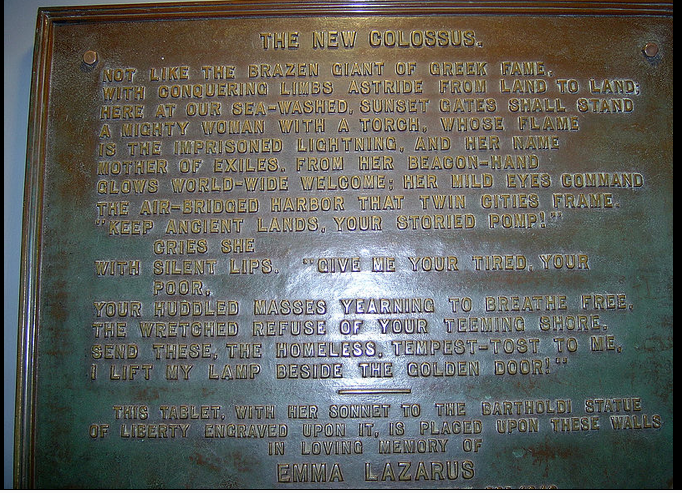
Not like the brazen giant of Greek fame,
With conquering limbs astride from land to land;
Here at our sea-washed, sunset gates shall stand
A mighty woman with a torch, whose flame
Is the imprisoned lightning, and her name
Mother of Exiles. From her beacon-hand
Glows world-wide welcome; her mild eyes command
The air-bridged harbor that twin cities frame.
“Keep, ancient lands, your storied pomp!” cries she
With silent lips. “Give me your tired, your poor,
Your huddled masses yearning to breathe free,
The wretched refuse of your teeming shore.
Send these, the homeless, tempest-tost to me,
I lift my lamp beside the golden door!”
I’ve never forgotten those words we all sang as children. The immigrant flows into America are our life-blood. You can keep your stale traditions and meaningless pomp, she cries, send me those willing to work hard and yearning for freedom.
How can we refuse CHILDREN seeking asylum? Each child we feed, house and educate will have a chance to become contributing citizens. The face of our nation is changing, has already changed greatly and will continue to change, and what we choose today will have a critical effect on what our society will look like tomorrow.
Do we still yearn for liberty for all? Do we want a highly stratified society where some are born to high paying jobs and others relegated to trades (I’ve seen how this works in another country; it’s stultifying.) Restricting access to all that we enjoy will create a wholly different society, a zero-sum-game society, where your loss is my gain, instead of an everyone wins society, where my success lifts you, too. Our country thrives on the creation of wealth; ideas are generated, resources and labor pools are created, they are not finite, they transition. Immigrants fuel the kind of innovation and population flow that keeps the lifeblood of our country flowing.
My family has been in the US a long time. We qualify as daughters-of-just-about-everything. We were immigrants; we were not native-born. The entire United States, other than the First People, are immigrants. We are immigrants, all of us. It makes us strong.
Pope Meets With Sudanese Woman Condemned for Apostasy
I am not Catholic, but what I love about this humble Pope shines through in these photos – the Pope, the revered leader of the Christian world, is standing, while the family sits in his presence. His loving actions speak loudly. You can see all the photos on AOL News by clicking here.

ROME (AP) – Pope Francis met privately Thursday with a Sudanese woman who refused to recant her Christian faith in the face of a death sentence, blessing the woman as she cradled her infant born just weeks ago in prison.
The Vatican characterized the visit with Meriam Ibrahim, 27, her husband and their two small children as “very affectionate.”
The 30-minute encounter took place just hours after the family landed at Rome’s Ciampino airport, accompanied by an Italian diplomat who helped negotiate her release, and welcomed by Italy’s premier, who hailed it as a “day of celebration.”
Vatican spokesman the Rev. Federico Lombardi said the pope “thanked her for her faith and courage, and she thanked him for his prayer and solidarity” during the half-hour meeting Thursday. Francis frequently calls attention to the suffering of those persecuted for their religious beliefs.
Lombardi said the presence of “their wonderful small children” added to the affectionate tone of the meeting. Ibrahim was presented with a rosary, a gift from the pope.
Ibrahim held her sleeping infant as she stepped off the plane from Sudan, which had blocked her from leaving the country even after the country’s highest court overturned her death sentence in June. An Italian diplomat carried her 18-month-old son and they were followed by her husband, Daniel Wani, who is a citizen of the United States and South Sudan.
Ibrahim and her family are expected to spend a few days in Rome before heading to the United States.
Ibrahim, whose father was Muslim but whose mother was an Orthodox Christian from Ethiopia, was sentenced to death over charges of apostasy. She married her husband, a Christian, in a church ceremony in 2011. As in many Muslim nations, Muslim women in Sudan are prohibited from marrying non-Muslims, though Muslim men can marry outside their faith.
The sentence was condemned by the United States, the United Nations and Amnesty International, among others, and both the United States and Italy – a strong death penalty opponent with long ties to the Horn of Africa region – worked to win her release.
Sudan’s high court threw out her death sentence in June, but she was then blocked from leaving the country by authorities who questioned the validity of her travel documents.
Lapo Pistelli, an Italian diplomat who accompanied the family from Sudan, said Italy was able to leverage its ties within the region. “We had the patience to speak to everyone in a friendly way. This paid off in the end,” he said.
Recent Comments
Kitchen on Isiais: Winding Down intlxpatr on Shampoo Ginger tigerbutterya0c5ff1d… on Shampoo Ginger intlxpatr on British Soldier Kidnapped, Esc… John on British Soldier Kidnapped, Esc… Wikipedia Donate Button

Amazina


Early Voting in Florida


