Every Day Sadists Walk Among Us

“Trust your feelings,” my friend told me when I was telling her about a person who seemed so nice, but made me uncomfortable. This article says the same thing; if you feel like a person takes pleasure from humiliating or hurting others, stay far far away. It’s only a matter of time before they turn on you.
Everyday Sadists Walk Among Us, Study Says
(From AOL News/Every Day Health)
Although we may think of sadism in a sexual or criminal context, sadistic tendencies are common in everyday life.
By Laurie Sue Brockway, Everyday Health Staff Writer
Whether it’s the Marquis de Sade, the evil stepmother from Snow White, or Nurse Ratched from One Flew Over The Cuckoo’s Nest, all sadists take great pleasure in inflicting pain on others. Fortunately, you are unlikely to meet those particular three anytime soon, but according to an unusual duo of studies conducted in Vancouver, British Columbia, and published in Psychological Science this week, it is very possible you will bump into a boss, a colleague, or even a family member who may be considered an “everyday sadist.”
While most people try to avoid hurting others — and will feel guilty, remorseful, and distressed if they do hurt someone intentionally or unintentionally — an everyday sadist enjoys being cruel and may find it exciting.
“We have probably all encountered people in our daily lives who — at least seem to — enjoy hurting others,” said lead researcher Erin Buckels, MA, who conducted this work as part of her master’s thesis in Social-Personality Psychology at the University of British Columbia. She is now a doctoral student at the University of Manitoba in Winnipeg.
“Everyday sadists lack empathy, and they possess an internal motivation to hurt others. However, they are unlikely to act in a way that would be criminal or dangerous — at least in most contexts, where such behavior is met with social disapproval or punishment,” Buckels said.
Everyday sadists may be cousins to classic sociopaths in their lack of empathy, but they are not considered a danger to society in the same way. “It is only in situations where cruelty is encouraged or socially acceptable that dangerous behavior might enter the equation,” said Buckels. “Both sadistic personality and situational pressures are necessary for sadism to manifest with everyday people. War is one example of this confluence — we have all seen the images of the Abu Ghraib prisoner abuse. All forms of cruel behavior have the potential to be motivated by sadistic pleasure, including bullying and abuse by others. If it were done purely for pleasure, then it would be sadism.”
If You Like to Hurt Bugs, You May Be a Sadist
It’s one thing to take an empty mayonnaise jar to catch fireflies when you are a kid and accidentally forget to poke holes in it, causing the fireflies to die. It’s another thing to enjoy harming bugs (or animals). Buckels used a bug-crushing exercise to draw the everyday sadists out in a controlled laboratory environment. For the experiment, she defined sadists in two ways: Their cruel behavior and felt pleasure in the lab, and personality characteristics consistent with sadism. A group of 71 participants were asked to fill out a sadism personality questionnaire and also given a list of four tasks they could choose from:
Killing bugs
Helping the experimenter kill bugs
Cleaning dirty toilets
Enduring pain from ice water
A bug-crunching machine fashioned out of a coffee grinder made distinct crunching sounds. Placed close to this machine were cups containing live pill bugs that were labeled with names like Muffin, Ike, and Tootsie. Those who selected bug-crushing were told to put the bugs into the machine and grind them up. Unbeknownst to them, there was a barrier that prevented the bugs from being dropped into the grinder. No bugs were killed for this experiment, but it brought the sadists out of the closet. Of 71 participants, nearly 28 percent chose to kill bugs.
What Exactly Is a Sadist?
Sadistic personality disorder was once defined as a mental illness, but over time sadism has been considered more of a lifestyle choice or a personality quirk or trait. The new Diagnostic and Statistical Manual of Mental Disorders (DSM-5), does include sexual sadism disorder. “This is marked by recurrent and intense sexual arousal from the suffering of others as manifested by fantasies, urges, and behaviors,” said Wilfried Busse, PhD, a psychotherapist based in Bethesda, Md. “To meet full criteria for the disorder, an individual also has to act on such urges by inflicting harm on a non-consenting individual, or must experience such uncontrollable urges to cause significant social and occupational impairment.”
“The central feature of sadism is deriving pleasure from watching or inflicting physical or psychological harm on others,” added Dr. Busse. “In the extreme form a sadist will seek to inflict suffering on another for the psychological gratification derived from such an action.”
Buckel’s study did not use classic criteria to define sadism – most widely known as sexual or criminal behavior – and instead explored sadism as it exists in the “subclinical” range of personality, an aspect of sadism not considered a mental illness.
“There is clearly a difference between a person who gets pleasure from killing bugs and a person who kills other humans for pleasure,” said Buckels. “That being said, the core experience of sadism is probably pretty similar for both of them. Our research has also revealed both similarities and differences between people who enjoy acting cruelly, or direct sadists, and those who simply enjoy watching cruelty, or vicarious sadists.Regardless of whom the victim is, direct aggression requires a certain amount of callousness and a lack of distress towards the suffering of another living creature.”
How to Spot a Sadist
There is a big difference between the kind of evil sadists we know from history and movies and people with sadistic impulses, who fall into a category of sadism that is considered a personality trait rather than a personality disorder.
“It is very important to differentiate between an antisocial, or sadistic, personality disorder and sadistic impulses,” said psychologist Fran Walfish, Psy.D., a family therapist and author in Beverly Hills, Calif.
“Antisocial personality disorder is very rare,” Walfish said, offering examples such as Hitler, murderers who enjoy torturing their victims and watching them suffer, and, possibly, Syrian President Bashar Assad. “But the rest of us have unconscious sadistic impulses. Even the kindest, most loving person, when terribly mistreated, can feel an impulse of hate very strong,” she added.
Walfish explained that there are several sub-types of sadists:
Explosive sadist. When disappointed and/or frustrated with their lives, humiliated or hopeless, they lose control and seek revenge for the mistreatment to which they feel subjected. They are known for being unpredictably violent. This manifests through tantrums, fearsome attacks on others, especially family members, and uncontrollable rage.
Tyrannical sadist. They are frightening and cruel because they appear to relish the act of menacing and brutalizing others; forcing their victims to cower and submit gives them satisfaction.
Enforcing sadist. They tend to be military sergeants, deans of universities, prison overseers, police officers or people with other authoritative functions who feel they should be the ones controlling and punishing people who have broken rules, regulations or laws.
Spineless sadist. They are typically deeply insecure and act like cowards. In anticipation of real danger, they project their hostile fantasies and strike first, hoping thereby to forestall their antagonist and ask questions later. They use aggressive hostility to send the message to others that they aren’t intimidated or fearful, so that they can control their inner feelings and display the exact opposite of how they actually feel. They seek out scapegoats to gang up on, which allows them to assault the exact things that exist within themselves that they want to deny.
Everyday sadist. There is a renewed interest in studying subclinical sadism as a personality trait, said Walfish. Subclinical psychopathy, narcissism, Machiavellianism, and everyday sadism form the so-called “Dark Tetrad” of personality.
“These people aren’t necessarily serial killers or sexual deviants but they gain some emotional benefit in causing or simply observing others’ suffering,” said Walfish. “The type of person the study is referring to are, for instance, the co-worker who repeatedly humiliates you and smiles or appears to reap pleasure from hurting you. If you self-advocate and say something that inflames your co-worker, she retaliates with evil revenge, further humiliating you.”
Exercise Caution Around Everyday Sadists
The British Columbia researchers surmised that everyday sadists are not the most popular people.“A person who has a high score on a sadism personality questionnaire is unlikely to be regarded as a nice and loving person,” said Buckels. “That is not to say that they are always nasty or that they can’t love others; but in general, high scorers tend to be less nice than average.”
How does someone become an everyday sadist? “In general, the cause or reason someone wants to go the extra effort to hurt another is because someone terribly mistreated them,” said Walfish. “That someone is usually their mother, father, or an older sibling. The sadist was a receptacle, or container, for hostility and evil meanness. These toxic feelings become too much for one to bear. They have no choice but to find a weaker victim and spew their venom onto the other.”
“Within their own families and in the workplace these people cannot be trusted,” Walfish observed. “No one can ever feel safe with them. Therefore, they do not have real relationships. They engage by exploiting, manipulating, and using other people as a means to their own end. The best thing to do is keep reasonable distance from these people. Always be pleasant so you don’t become their target. This does not mean to kiss up. It just means you present yourself as a benign nice guy. Never do business or get close to one of these people. They will always take you down.”
Buckels said she was surprised to find such a low baseline of positive emotions reported by sadists. “They are not just acting out to compensate for deep-rooted insecurity or low self-esteem,” she said. “Interestingly, after an act of cruelty, their moods seemed to lighten, suggesting instead that the sadist’s appetite for cruelty derives from some diabolical need. Although speculative, our hypothesis is that sadists have an underlying deficit that is sated through cruelty’s rewards.”
MRSA Link to Pigs

From Nature.com News:
People living near pig farms or agricultural fields fertilized with pig manure are more likely to become infected with methicillin-resistant Staphylococcus aureus (MRSA) bacteria, according to a paper published today in JAMA Internal Medicine1.
Previous research has found that livestock workers are at high risk of carrying MRSA, compared to the general population2. But it has been unclear whether the spreading of MRSA through livestock puts the public at risk of infection.
The study examined the incidence of infections in Pennsylvania, where manure from pig farms is often spread on crop fields to comply with state regulations for manure disposal. Researchers reviewed electronic health-care records from patients who sought care from the Pennsylvania-based Geisinger Health System (which helped to fund the study) in 2005–10.
The team analysed cases of two different types of MRSA — community-associated MRSA (CA-MRSA), which affected 1,539 patients, and health-care-associated MRSA (HA-MRSA), which affected 1,335 patients. (The two categories refer to where patients acquire the infection as well as the bacteria’s genetic lineages, but the distinction has grown fuzzier as more patients bring MRSA in and out of the hospital.)
Then the researchers examined whether infected people lived near pig farms or agricultural land where pig manure was spread. They found that people who had the highest exposure to manure — calculated on the basis of how close they lived to farms, how large the farms were and how much manure was used — were 38% more likely to get CA-MRSA and 30% more likely to get HA-MRSA.
The researchers also analysed 200 skin, blood, and sputum samples isolated from patients in the same health-care system in 2012. The MRSA strains found in those samples are commonly found in humans. Researchers did not find any evidence of bacteria belonging to clonal complex 398 (CC398), a MRSA strain classically associated with livestock and found in farms and farmworkers in many previous studies.
However, there is little information about which MRSA strains are most common on US farms, so the absence of CC398 is not a sign that MRSA is not being transmitted from livestock to humans. “We’ve done studies in Iowa, we haven’t always found CC398. That’s not too shocking,” says Tara Smith, a microbiologist at Kent State University in Ohio, who was not involved in the study.
Many researchers think that widespread use of antibiotics to encourage growth in farm animals fuels the proliferation of MRSA and other drug-resistant bacteria. The latest findings suggest that manure is helping antibiotic resistance to spread, says Joan Casey, an environmental-health scientist at the Johns Hopkins Bloomberg School of Public Health in Baltimore, Maryland, and a co-author of the study.
“We’ve certainly described a connection we think is plausible,” she says. “We haven’t described every step in the path.”
“It’s a pretty interesting and provocative observation,” says Robert Daum, a paediatrician and the principal investigator of the MRSA Research Center at the University of Chicago in Illinois. He adds that he would like to see similar studies done in different geographic regions, and research to find out whether the MRSA strains carried in pig manure are the same as the MRSA strains found in nearby human infections.
Casey is at work on a follow-up genetics study to identify the most common MRSA strains in the region.
Nature doi:10.1038/nature.2013.13752
References
Casey, J. A., Curriero, F. C., Cosgrove S. E., Nachman, K. E. & Schwartz, B. S. JAMA Intern. Med. http://dx.doi.org/10.1001/jamainternmed/2013.10408 (2013).
Show context
Smith, T. C. et al. PLoS ONE 8, e63704 (2013).
The Alaska State Museum in Juneau
“Oh,” the docent laughed, “everyone asks about that old bear. He hasn’t been around for years. He got all patchy because all the kids touched him and his hair fell off.”
LOL. I know one of those kids. There was a big sign that said “Do Not Touch the Bear” but he was a snowy white polar bear and . . . irresistible. My Dad worked in the same building as this museum, in its old location, and I would meet him there for a ride home after going to the library.
I loved this museum.
This time, it was one of the highlights of the entire trip. This museum is rich in well-curated pieces, and they are beautifully arranged. A new museum is going up; I can only hope that when it opens, it is at least as well done as this one is. Both AdventureMan and I could spend a lot more time in this museum.
Carving at the entrance:


Bent wood box

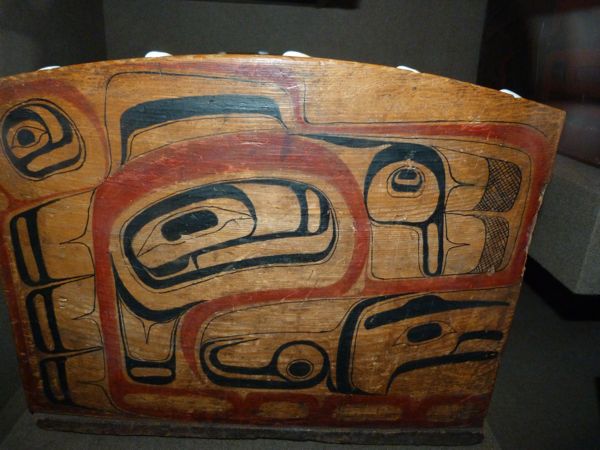
Painted chest
Ceremonial robe
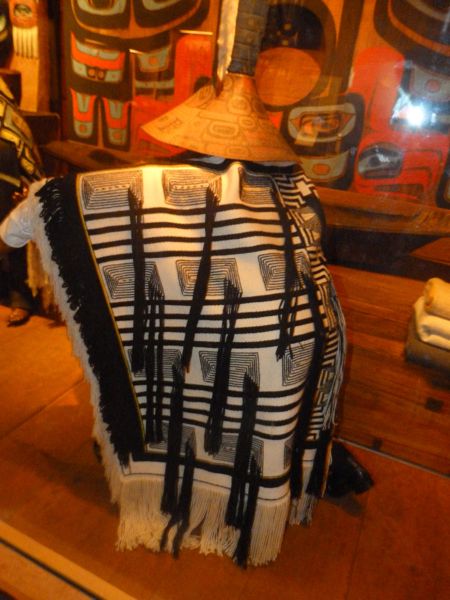
Everyday clothing
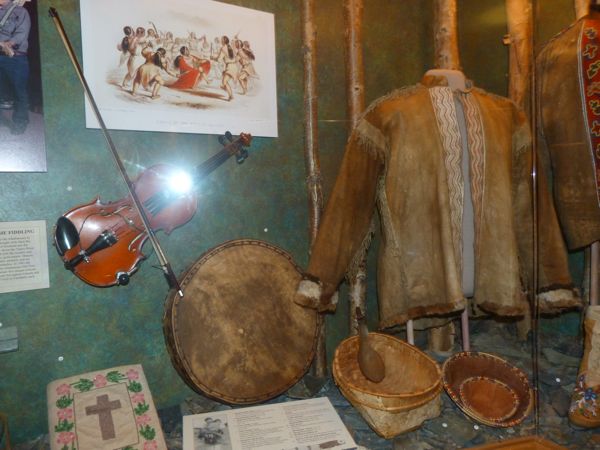
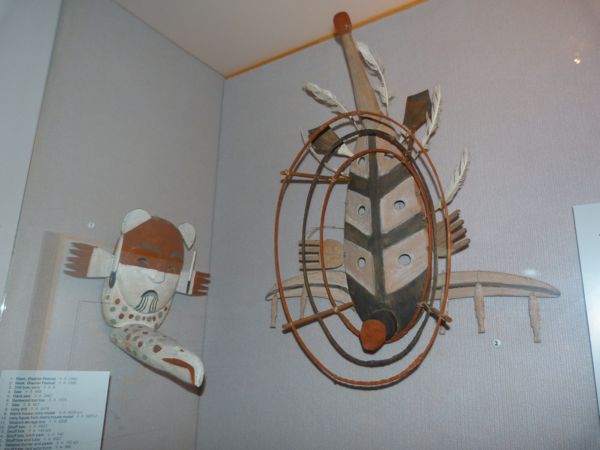
Upiq masks

Close up Upiq masks
Sun motif ceremonial outfit – look at the leg pieces – don’t they look like Sadu weaving to you?

Moon motif ceremonial outfit
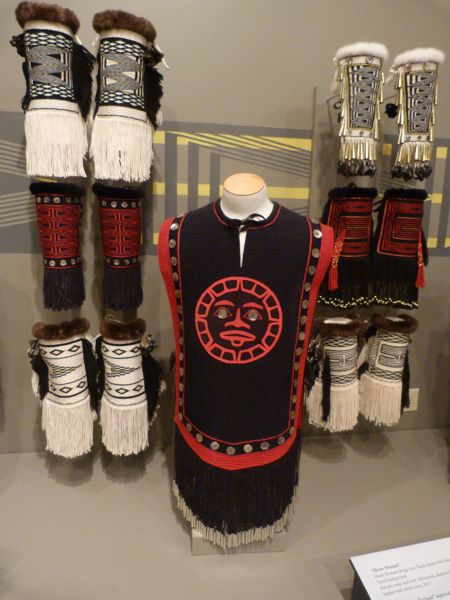
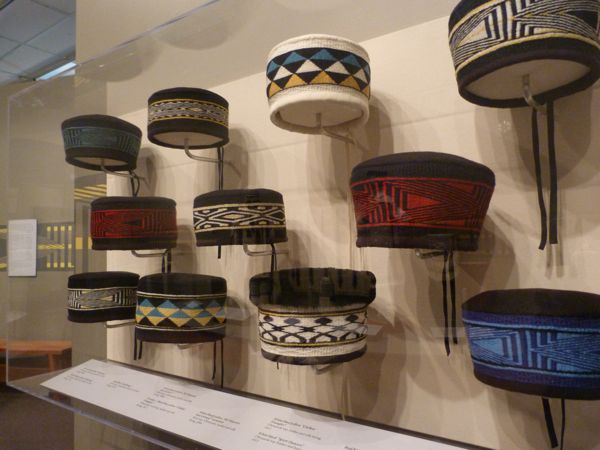
Hand made hats. I was so surprised; these are like prayer caps in Oman and in Pakistan and I think in Indonesia. That they would be so similar in shape and geometric embroidery was amazing to me.
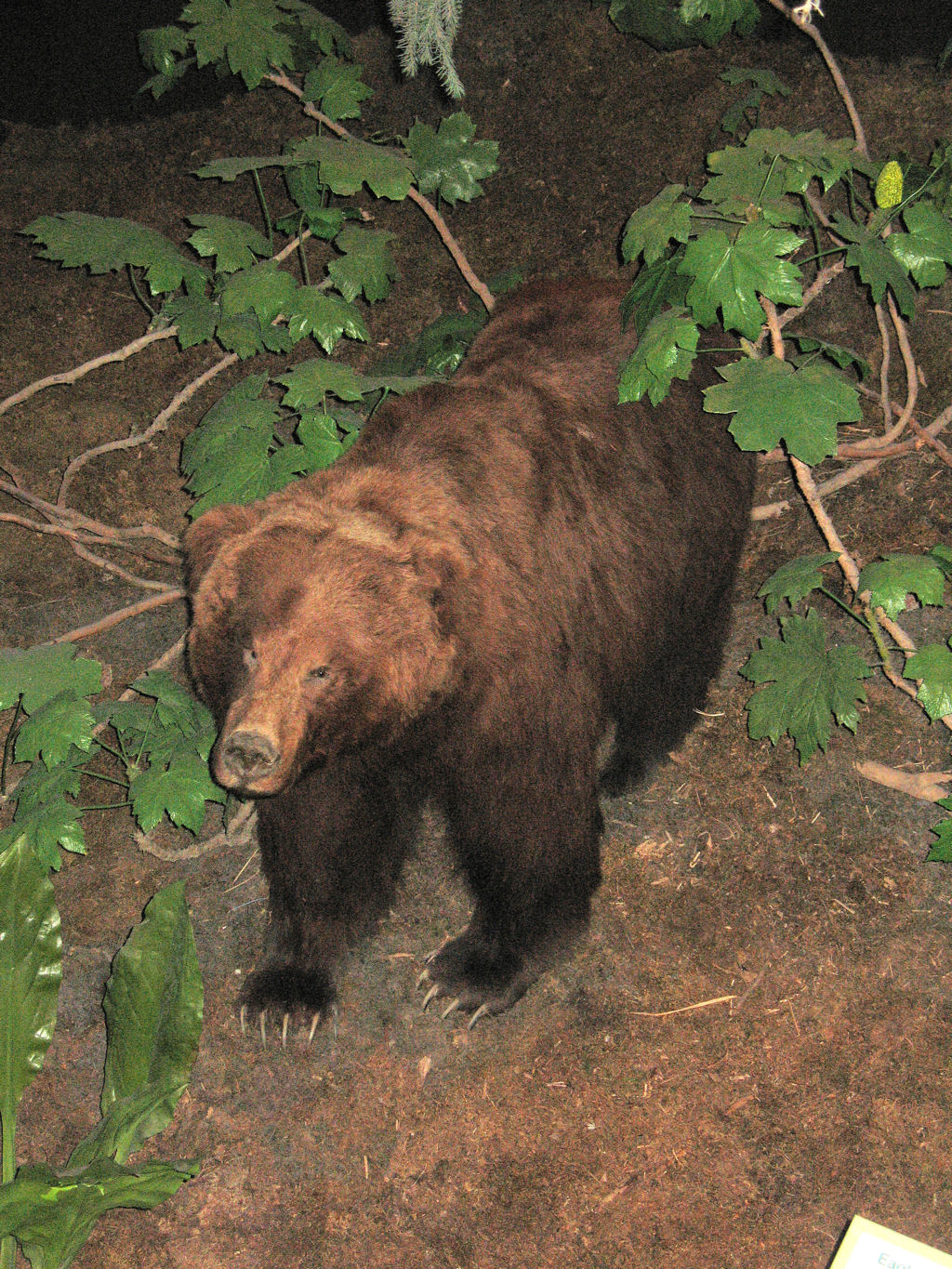
Eagle’s nest display, with eagle sounds. I love this! There is also a bear, but positioned so you really cannot touch . . . 😦

Corner pillars of Alaskan native houses used to look like this, not exactly totemic but with carved spirits:

There is so much more. I focused on the Alaskan Native inhabitants, but there are also exhibits of the coming of the Russians, the gold rush, the transition to territory and statehood . . . I can only take in so much at one time! Good thing we are going back 🙂
ALASKA STATE MUSEUM
395 Whittier Street
Juneau, AK 99811-1718
Tel: 907.465.2901
Fax: 907.465.2976
Revisiting Old Haunts and The Island Pub on Douglas Island
First, some random shots from our afternoon in various parts of Juneau, Alaska:
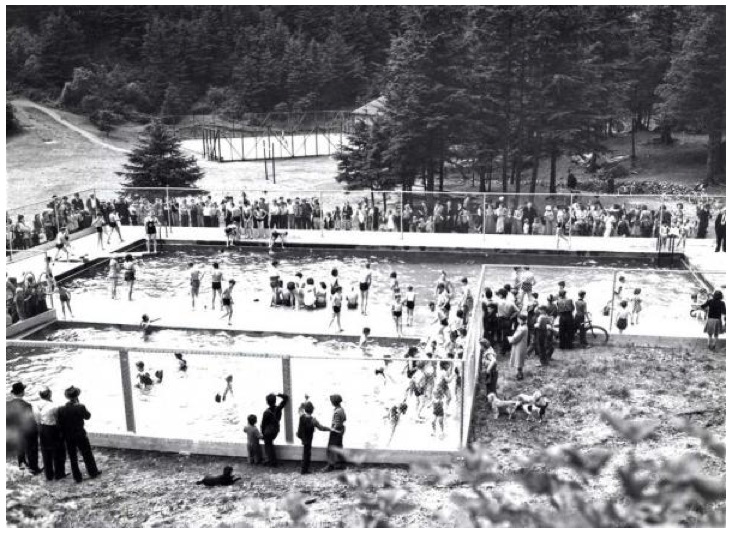
I didn’t take this photo, but I might be in it. I found it in the historical annals available from the Juneau-Douglas Museum. This is the old Evergreen Bowl pool, fed by glacier streams, where I learned to swim. This pool doesn’t exist any more; they have a new, indoor year-round pool:
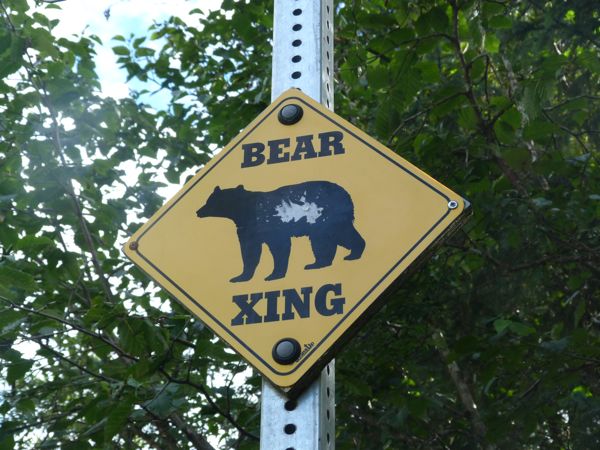
Out at Mendenhall glacier; no bears this trip, only their crossing sign and a lot of stripped salmon 🙂 Sleep well, salmon-fed bears!
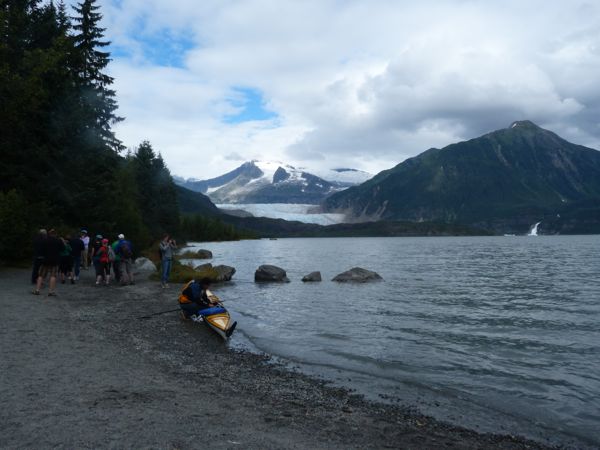
Kayakers at Mendenhall Lake; this is across the lake from the glacier observation point
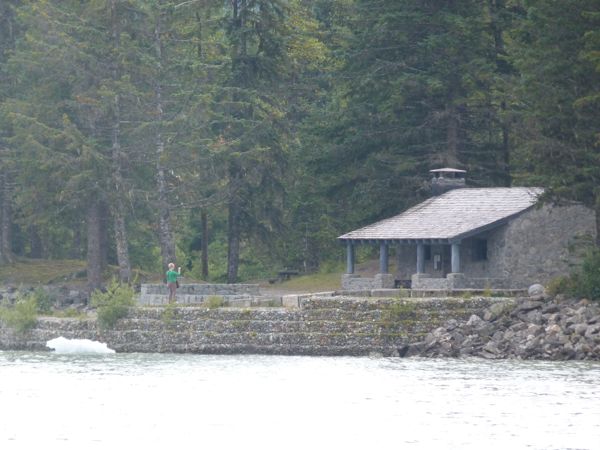
The old Skater’s Cabin, where we used to go ice skating when the lake would freeze. Volunteers from civic organizations would get up early and take home-made snow-pushers, and make paths through the snow on the ice, and clear a large patch where people could skate. The ice was rough, not like an ice rink at all. If you could skate here, you could skate anywhere 🙂
AdventureMan insisted I stop at this quilt shop while he read brochures in the car, LOL! No, I am not kidding, I am only laughing because he pretended he loves to wait in the car while I visit another quilt shop.

Dinner was at the Island Pub in Douglas, across the Gastineau Channel from Juneau. We used to go to this very same restaurant when I was a kid, then called Mike’s Place, only I never got to sit upstairs; I think that the bar was upstairs. Families went downstairs. They told us that they are thinking of renovating and opening the downstairs, too.

They were packed. We were lucky to get there when we did. I think we were the only people who don’t live on Douglas Island, there were couples and families and friends meeting up after work, and a birthday group – all people who live on the island.

The place has a spectacular view, especially around sunset when Juneau, across the channel, just lights up.
Our friend had said this is her favorite place to eat, and she was right! We had the smoked salmon spread, which was really good and really rich:

When our pizza came, it was also delicious, but the salmon spread on the pizza strips filled us up. We each ate one piece of the huge pizza and packed up the rest to warm up for breakfast the next day. It was still delicious!

This was one of the best meals we had on our trip. Great beer, great wine, great food, great atmosphere, great view.
Juneau and Tracey’s Crab Shack
Getting close to Juneau, we spot these very strange cloud formations:

As we dock, we call the hotel shuttle from Country Lane and they are there within minutes. They drop us off at the hotel so we can unload our bags, then take us over to the airport so we can pick up our car.
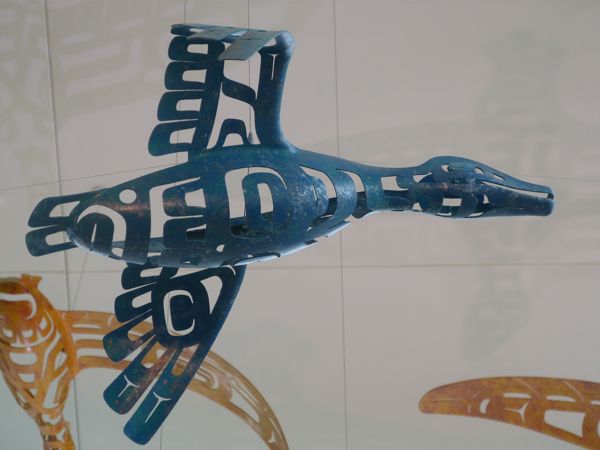
You know me and public art. I love these sculptures in the Juneau airport, and especially that they have the traditional Haida forms as part of their form:

It is a gorgeous day in Juneau, 70°, hey, the sun is shining, it is very warm, this is a great day. We head immediately in to town for lunch at Tracy’s Crab Shack.
This is for my Mom; she likes to see the prices 🙂

Tracy’s Crab Shack is one smart operation. First – location location location. They are right on the cruise ship docks. First thing you step off one of those giant ships, you see Traceys. Second, they don’t rely on location. They have a first quality product. They don’t compromise. They cook the crab legs right out in the open, fresh, while you wait. They have crowds standing in line to get these crab legs, and you eat outside at butcher paper covered tables; the crab meals are served in paper containers and you SHARE tables. It works.

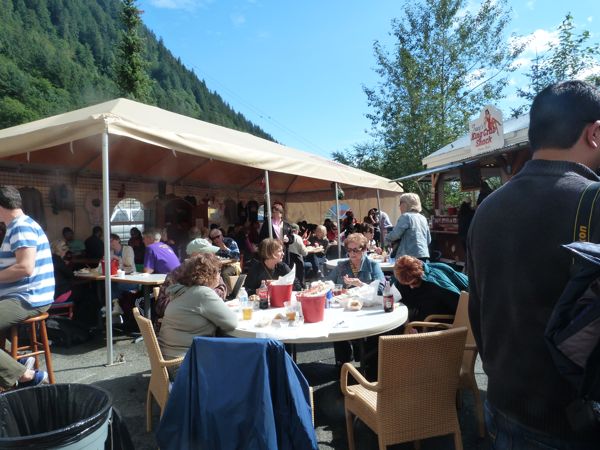


We share a table with two rough young men and have a fascinating conversation. They drove up, have had fabulous adventures and we shared information. I said that the thing that surprised me was that I expected Alaska to be more wired than it is; one of them said that his big surprise was to find Alaska as wired as it is, and that wifi is available at a large number of cafes and restaurants. That was fascinating to me, to opposite perspectives. Part of it, I think, was being on the ferry system – all the ferries in Seattle are wired, so it was a shock to me that the Alaska ferries were not.
One of our tablemates had now visited all 50 states, and the other had visited
49 states.
We saw people from all over the world lined up and eating King Crab at Tracy’s. AdventureMan had the crab bisque over rice and I had the crab cakes. Eating King Crab legs is messy, and I didn’t want to smell like crab for the rest of the day.
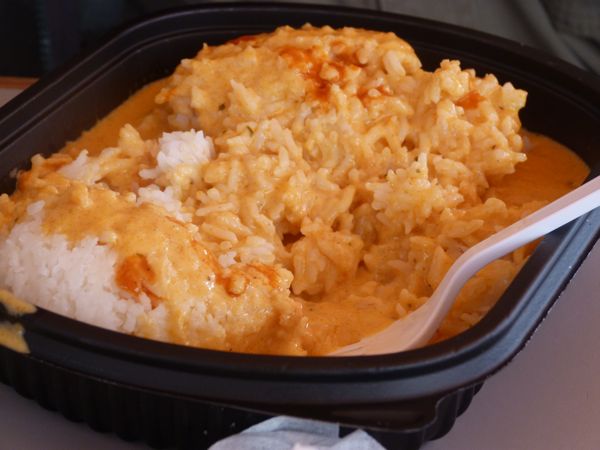

Tracey’s is the number one rated restaurant in Juneau on TripAdvisor and UrbanSpoon. I think it must be the combination of the crowd they attract and the product. Juneau people eat there, too.
Gospel for 9/11

Are we who we say we are?
Do we follow the spirit of The Word? Do we as believers pick and choose from our holy book(s) or do we humble ourselves, as Christ did, and do as he commands?
The Lord Jesus Christ commanded a very difficult life style. I have met holy people among all religions; I am forced to believe that “the way and the truth and the light” are behavioral, and that there will be many surprises when we get to the last days.
September 11th is a difficult day. This is a difficult Gospel reading for a difficult day:
Matthew 5: 38 – 47
Eye for Eye
38 “You have heard that it was said, ‘Eye for eye, and tooth for tooth.’h 39 But I tell you, do not resist an evil person. If anyone slaps you on the right cheek, turn to them the other cheek also. 40 And if anyone wants to sue you and take your shirt, hand over your coat as well. 41 If anyone forces you to go one mile, go with them two miles. 42 Give to the one who asks you, and do not turn away from the one who wants to borrow from you.
Love for Enemies
43 “You have heard that it was said, ‘Love your neighbori and hate your enemy.’ 44 But I tell you, love your enemies and pray for those who persecute you, 45 that you may be children of your Father in heaven. He causes his sun to rise on the evil and the good, and sends rain on the righteous and the unrighteous. 46 If you love those who love you, what reward will you get? Are not even the tax collectors doing that? 47 And if you greet only your own people, what are you doing more than others? Do not even pagans do that? 48 Be perfect, therefore, as your heavenly Father is perfect.
One New MERS Death in Saudi Arabia; One in Qatar
New in from Reuters, via AOL news:
DUBAI, Sept 8 (Reuters) – The MERS coronavirus has killed two more people in the Gulf, one in Saudi Arabia where the strain emerged last year, and one in neighbouring Qatar, health authorities said.
The death of a 74-year-old man in the Medinah region of western Saudi Arabia was the 45th fatality in the kingdom from Middle East Respiratory Syndrome Coronavirus (MERS-CoV) which can cause coughing, fever and pneumonia.
The Saudi Health Ministry also said on Sunday that three women aged between 64 and 75 had contracted the disease.
A 29-year-old Qatari admitted to hospital on Aug. 17 has died, Qatar’s Supreme Council of Health said in a statement dated Sept. 6, adding that another citizen who had contracted the disease while abroad had recovered.
The World Health Organization said last month the number of confirmed infections worldwide in the past year was 102, of whom almost half had died.
In a study into what kind of animal “reservoir” may be fuelling the outbreak, scientists said this month they had found strong evidence it is widespread among dromedary camels in the Middle East.
The virus has been reported in people in Tunisia, France, Germany, Italy, and Britain. (Reporting by Sami Aboudi in Dubai and Amena Bakr in Qatar; Editing by Robin Pomeroy)
The Duncan House Diner in Homer
We awake to a gorgeous day, a day with not a cloud in the sky, horizon to
horizon beautiful weather. That is thrill #1. AdventureMan goes outside while I
finish getting dressed, and comes swiftly back in for his camera – there is a
huge eagle perched on the turret of our building! We spend about half an hour
while he does what eagles do – soaks in a little sunlight, looks for a sparkle
in the water that might signal some breakfast – he knows we are here, and he
doesn’t care. How cool is that?
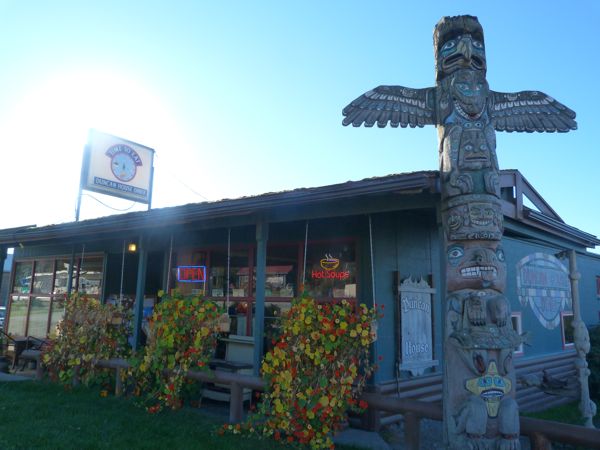
We can’t find Two Sisters Bakery (and discover later we stopped just feet short
of where it was hidden behind some shrubbery,) but we head up Main Street and
find Duncan Diner, with a parking lot full of pickup trucks and a very hip ’70’s
feel. I rarely eat pancakes, but I ordered something called the 1-1-2, which is
one egg, one pancake, and 2 strips of bacon.


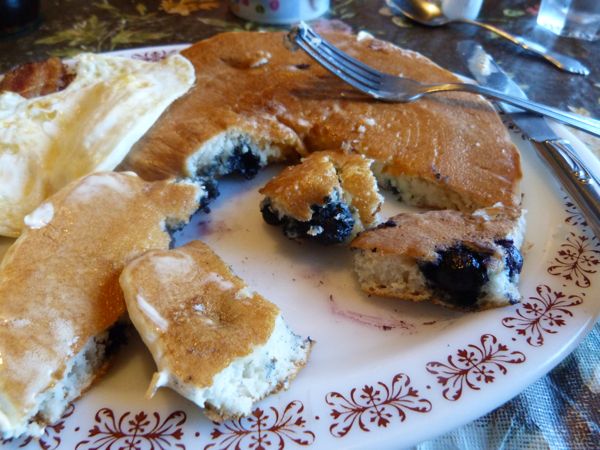
“Blueberries?” the very hip waiter asked. I must have looked puzzled, and he
asked again “Blueberry pancakes or plain?” and I said “Oh! Blueberries!”
That pancake was so good. I couldn’t eat it all, but it must have had a full cup
of blueberries in it. I only used a little bit of butter; the pancake was so
good just plain.
As we ate, we formed a plan. We had intended to just walk around Homer, but
Homer is bigger than it looked on the map, more spread out. There are sights to
be seen! Homer is nearly at the tip of the Peninsula, on Kachemak Bay; whether you go east or west, you end up in Anchorage.
We call Hertz, they have a car available, and then we call Kostas taxi (907-399-8008) who come and takes us to the airport where we pick up a car. I mention Kostas specifically because every single local we asked mentioned them by name as the most reliable, and we found that to be true for us, too.
Presenter Ses Condoléances
Some things you do. Some things are hard, and you do them anyway. I always think of them in the formal – pour prendre conge’, respondez, pour rendre petite assistance . . . must do’s, societal niceties, the grease that keeps civilization running, never mind smoothly.
I had to call a friend this morning to tell her how sorry I am that her husband had died. When she came to the phone, I was initially shocked. For months, since her husband’s stroke, she has been subdued and tired, but this morning she sounded happy and energetic.
“He’s free!” she said to me. “”As it says in the Bible, his passing was a breath; if I hadn’t been holding his hand and paying attention, I wouldn’t have known he was gone. It was so easy.” She was joyful. We wept together, for joy. He was free of the burden his life had become.
What I thought was going to be a sad call turned out to be a joyful call. She loves her husband still. They had years and years and children and grandchildren together, and she let him go with joy because he was ready.
Thanks be to God.
Kodiak and the Trip to Homer on the M/V Kennicott
Landed in Kodiak early, so early I don’t know how early. We rise, dress and WOW, it is not raining, you can even see some sun, so we decide to walk into Kodiak. As we debark, we ask which way and the Terminal Manager Steve catches up with us and offers us a ride. It warmed my heart, this is exactly what I wanted AdventureMan to see, this is what I grew up with, the Spirit of Alaska 🙂 taking care of one another. Alaska is like one big community.
On the way, he gives us an overview of Kodiak and we talk about the big problem with the lack of ferry transportation this year with the Tustemena out of service. Tustemena is the M/V ferry that runs down the Aleutian Islands all the way to Dutch Harbor/Unalaska, another trip we want to make. It’s been a big loss for all tour related businesses on the peninsula and for Kodiak. The Kennicott will make a run down in late September to help get people, goods and vehicles out who are waiting for transportation.
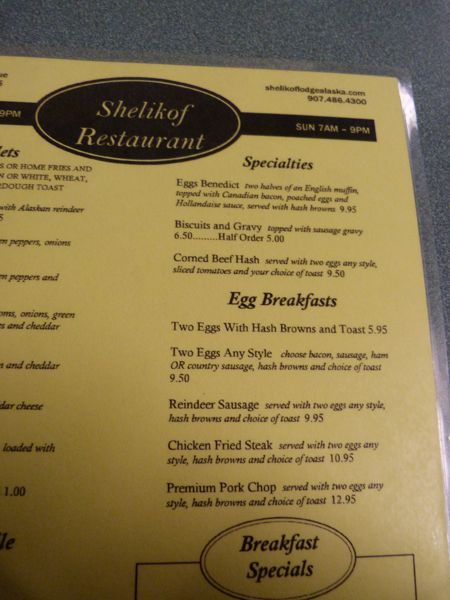
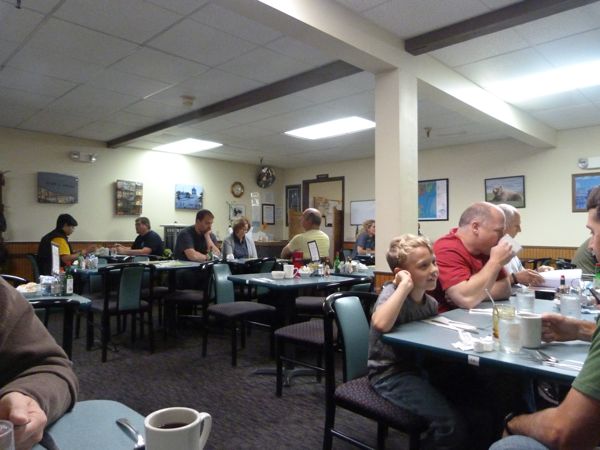
We told him we wanted some breakfast, and he dropped us off at the Shelikof Lodge, full of locals. I actually asked where he eats breakfast, and he said “at home” and we learned why – this is a very busy man. He runs back and forth between all the terminals, solving problems, making sure everything is going smoothly. In Kodiak, people work hard.
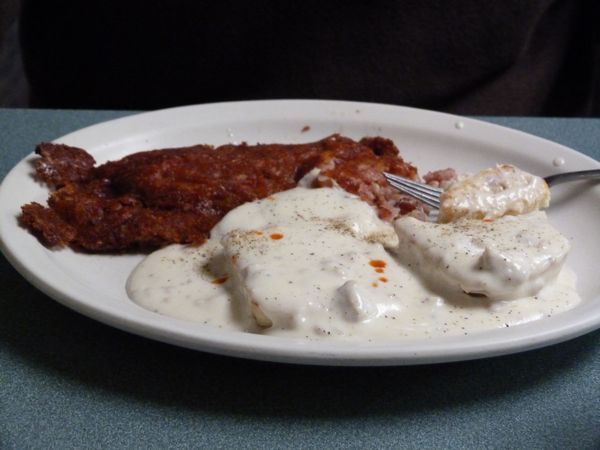
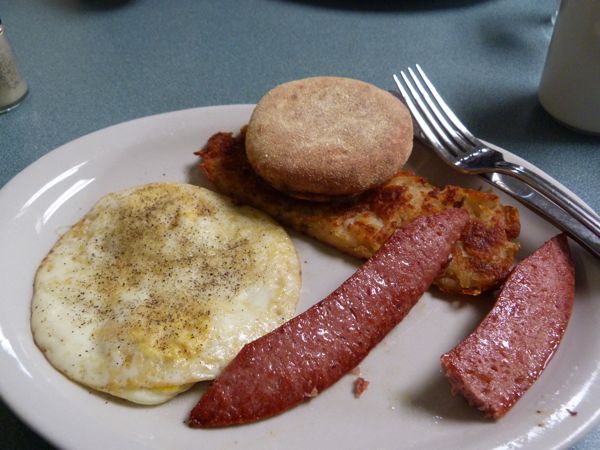
At the Shelikov, AdventureMan has biscuits and gravy, and I have reindeer sausage for the first time, with a hot, spicy aftertaste I love. Even though it is very lean meat, I only eat half.

Shelikov Lodge Breakfast Specialties:
AdventureMan’s Biscuits and Gravy
Reindeer Sausage
We hike to the Russian Orthodox Church, passing a tidal wave marker on the way. It is scary – it seems rather high on the island. That tidal wave came a long way up.


We walk through Kodiak, past all the processing plants, to ship. It’s not a very big place, but you can see a lot of pride in what they do.


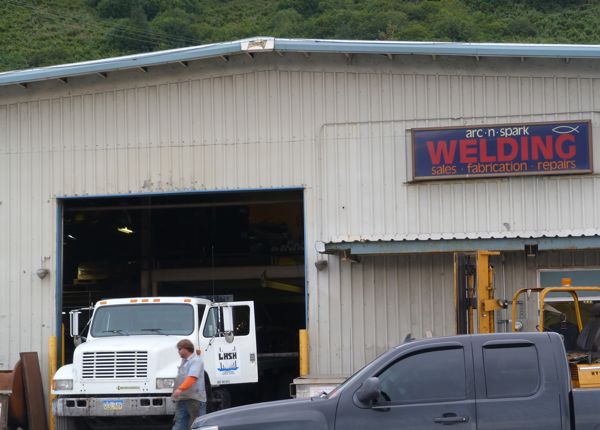


LOL, loading the cars and trucks and containers and R/Vs takes hours and there is a long long line of walk ons, first the Kodiak football team, all in their jerseys, and then the Kodiak high school cross country team in bright lemon yellow wind breakers. Maybe 150 students, good kids, full of energy, whooping it up.

We leave Kodiak late, but these late departures seem to be built into the ferry schedule – they never know where they will need more time.


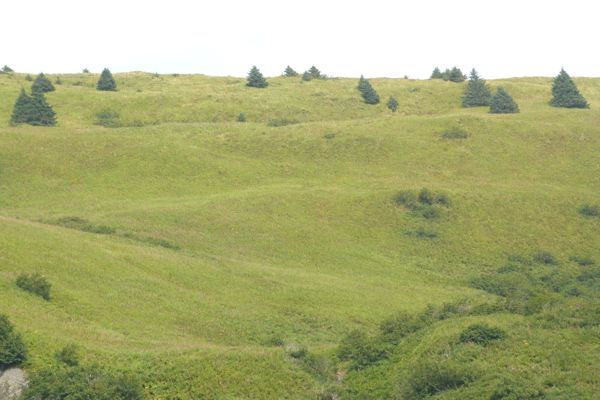
These meadows look so Swiss to me.

Just like Life of Pi! Fish jumping out of the water in tens and hundreds, flying!

Whales to feed on those crops of fish


Approaching the Barrens, as the sea passage gets a little rougher. This is one of the windiest, roughest areas to traverse

There is a whole new dynamic on board with the high-schoolers. They are hilarious! All that teenage energy! We hit rough water just after going through the Barrens, and the kids are standing on the forward deck waiting for huge waves to break over the bow. When the huge waves break, it is like in a movies, a sheet of water, and the kids hang on and come up laughing.

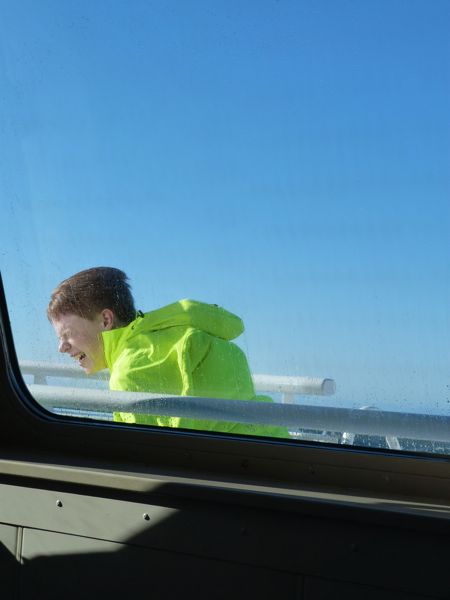
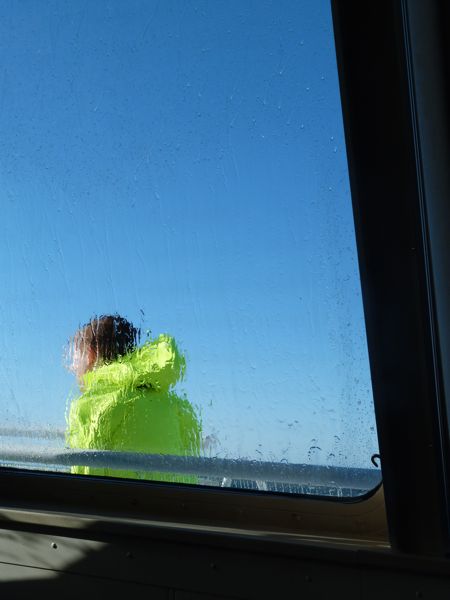
We go through rough waters about an hour, then things calm down and . . . the sun comes out! Gorgeous scenery, all the way to Homer.
Approaching Homer Spit on M/V Kennicott:

Docked almost exactly at 9, as scheduled. We waited for the kids to all get off, then walked to the terminal, where there are NO taxis waiting. When I made reservations, I had asked the hotel if they send a shuttle to the ferry terminal and they said no, they didn’t have a shuttle, but there are always taxis waiting. No. No, that is just not true. There are not always taxis waiting.
We see a couple we had met onboard, they ask where we are going and we tell them the Driftwood Inn and he says “that’s where we’re going!” and offers to split the cab they have already called with us. Perfect! Except when we get to the hotel he discovers that he is NOT staying at the Driftwood Inn, and he has to call the taxi driver back again to take him to the Heritage Inn.
It’s sad, I think this is a generational thing, he kept calling himself a dummy. We are raised in a different generation, to call someone a dummy is just so negative and so degrading that we would never do it, not to anyone else, not to ourselves. We might say “How could I be such an idiot!?” but we were horrified – and a little heartbroken – to hear this really nice man berate himself like that.
What was cool is that we ran into them again – twice – before twenty-four hours had passed, once at the car rental agency, and once again at the Homer Farmer’s Market. They had settled in quickly, only a couple blocks from where we were staying and were having a wonderful time, heading out that afternoon in route to Prudhoe Bay. (I’m impressed.)

Our room is lovely, spacious and welcoming, with gorgeous shared spaces and a view to die for, maybe 230 degrees of glaciers, mountains, Kachemak Bay and driftwoody beach. The sun is setting, the air smells clean; sea, salt and pine, the skies are clear, and oh, life is sweet.
Sunset from Driftwood Inn, Homer, Alaska:

Recent Comments
Kitchen on Isiais: Winding Down intlxpatr on Shampoo Ginger tigerbutterya0c5ff1d… on Shampoo Ginger intlxpatr on British Soldier Kidnapped, Esc… John on British Soldier Kidnapped, Esc… Wikipedia Donate Button

Amazina


Early Voting in Florida


