Happy 7th Blog-iversary to Me!
Once a year I get to troll the internet looking for cakes. It is so much fun. I had no idea there is so much creativity out there, so much daring. I found a wedding cake that is tilted! Something in me loved it, loved the spirit of a woman who would marry knowing life is often off-kilter and messy.
I love white roses, so this year I have sent some to myself:

Come on by, have some virtual cake with me to celebrate seven years of blogging:



And here, an elegant combination of cake and white roses:

Seven years ago in Kuwait, I started blogging. There was a wild blogging scene in Kuwait, a lively community. Blogs were candid, and many were substantial, dealing (carefully) with political and economic issues in Kuwait. I remember reading and learning, and finally gathering up my courage to write my very first entry, and it has been a recurring theme, cross-cultural communication. I learned so much from my life in the Middle East, Tunisia, Jordan, Saudi Arabia, Qatar and Kuwait. I made the most amazing friends. It changed my life and my perceptions utterly.
Of the three Kuwait female bloggers who inspired me to start blogging, Jewaira has gone private, 1001 Nights is a good friend, a mother, and an author 🙂 and Desert Girl is still going strong. Mark, at 2:48 a.m. is also still going strong, so strong that he has been able to leave his full time employment and operate on a consultant basis.
Of course, as any blogger will, I sometimes think of quitting. There are days I find myself with nothing to say, nothing in my life so interesting that I think it is worth sharing, not even a news story worth noting. So I’ve had to ask myself why I continue.
I do it for myself. When I started, I had a reason and that reason still stands. I forget things. This isn’t age-related, it’s busy-life busy-world related; we forget the details.
My Mother saved all my letters from Tunisia. I remember reading them and laughing because at three, my son’s best friend in his day school was a boy he called Cutlet. I know his real name is Khalid, but Cutlet was as close as this little American boy in a French-Tunisian school could get. I had totally forgotten, until I read the letter. So my primary reason for continuing to blog is documentary – just plain record keeping, like an old fashioned diary. Noting things in my daily life or the life around me.
Even now, sometimes I see a post written long ago, usually one of our Africa trips, Botswana, Namibia, Tanzania, Zanzibar, Zambia – will start getting a rush of stats. It thrills my heart. It makes it all worthwhile, knowing something I have put out there is helping others, even years later. Perhaps one day, I will quit blogging, but leave the blog up, with these informational articles.
My stats make no sense at all, one of my biggest stat gainers this year was a news article I tossed off about the prank on the South Korean pilot names after the plane crash landed in San Francisco. It just made me giggle, and I couldn’t resist printing it. It ended up with a life of its own, as many entries do – and you just never know. Someone pins an image and you get a million (ok hyperbole here) hits you never expected.
In the end, I believe that those who keep blogging do it because as Martin Luther once said, “I cannot other.” We do it because something within needs to be expressed, even if it is just some kind of daily record. I know it’s why I blog.
Whittier and Chenega Bay on the M/V Kennicott
Today we awoke in Whittier, a major shipping hub into the interior of Alaska,
and a connector to Anchorage. Although the town has only a population around
500, it is a very busy little port, acres of shipping containers, miles and
miles of train tracks, and trains coming in and out every few minutes.





There is an old government building, it looks like something the Soviets built.
It is huge, and was damaged by a bad earthquake several years ago so it has been condemned as unusable, but would be so expensive to destroy that they haven’t torn it down yet. It has become a sort of cult place, a favorite for raves and spontaneous parties, young people camp there. It is rumored to be haunted, which only makes it more alluring. No matter how secure they try to make the building, someone finds a way in.

There is some confusion in my mind about arrivals and departures – they are not
the same as the list I so carefully printed off from the website. If I had known we would be in Whittier until 10:30 we would have debarked, which we are allowed to do if we have tickets and ID to get back on. My little calendar showed a 0800 departure, so we waited, and waited – but the ferries make their own rules, according to weather and tides and what they are porting from one seaside village to another. We watched containers full of goods come on for the more remote locations.
I used to surprise my Kuwait friends, telling them it was a lot like Alaska, and the longer I am back here, the more parallels I see. One is that almost
everything you eat or wear or build with has to come from somewhere else. That
requires shipping, or flying something in. I remember my Mother used to order
our snow suits in August, so they would arrive before the ships stopped coming
in. Like Kuwait, groceries are expensive, especially specialty items that are
imported. Like Kuwait, people are dressed modestly, all the important parts
covered – it’s cold! Most women are covered from their toes to their wrists! If
the weather is bad enough, even their hair is covered, and occasionally their
faces! Men, too! Very modest people, these Alaskans 🙂

AdventureMan wanted to take a shower, but the ferry system asks that we not
shower while in port; they like not to dump waste water in port, so as soon as
we departed, he jumped in the nice warm shower. Once again, almost all we can
see is open water, en route to Chenega Bay, and fog.


During the trip to Chenega Bay, the big excitement is the once-a-week fire drill, and this time, the fire was near our cabin (pretend fire.) I am guessing some people would rather ignore the fire drills, but think about it – aren’t you glad the crew goes through these exercises in case there is some emergency? Aren’t you glad they know what to do? One of the guys laughed and said “We get a lot of respect and people step aside when they see us carrying these fire extinguishers!” The purser told me that sometimes people STEAL the signs they put on doors – imagine!
Lifeboat being lowered:

Do Not Enter tag on our door:

Chenega Bay – We arrive, foggy but no rain, to find an eagle perched in nearby tree, welcoming us.


Very short turn around time shown, so once again, we do not leave the ship, but wish we had when departure time is postponed. The dock is not near anything, but a short walk over the hill takes you to the small village of Chinega Bay and a beautiful Russian Orthodox Church and an Alaska Native arts museum named after fisherman Johnny Totenoff.
What love what happens here – this village of only maybe 50 people are welcomed on board whenever the ferry docks. They are isolated, remote. The men, women and children ride their ATV’s down the hill to the ferry, come aboard, and chow down on hamburgers, fries, and soft ice cream cones. Some of the young girls are dressed in long dresses, sort of odd, maybe a religious group. Others are wearing short short skirts and tank tops in the cool, foggy weather. Before the ferry departs, the Chenega Bay residents all have to debark.
Departing Chenega Bay:

Beginning to see snow peaked mountains en route to Kodiak Island

The M/V Kennicott and the Birders
I hesitate to even write this post, but it was a significant part of our first day on board. AdventureMan and I headed for the forward deck just after we had eaten lunch, and found a nice place to watch departure and the whales and the passing scenery. As we stood there, a crowd began to gather, and they were all chirping and grabbleing, and the group got larger and larger and we kind of got shoved aside. It wasn’t intentional, it’s just as the group grew in size, like minded birders, they just backed out, and pushed into us.
Birders. There was a group of birders on board. We like birders. We belong to a bird group! But these birders are seriously focused people. Have you seen the movie The Big Year? These birders were loaded for bear, all decked out in foul weather gear, real rubber overalls and headgear, and had serious huge single-focus lensed cameras and equally formidable bird spotters.
They took over the forward deck.
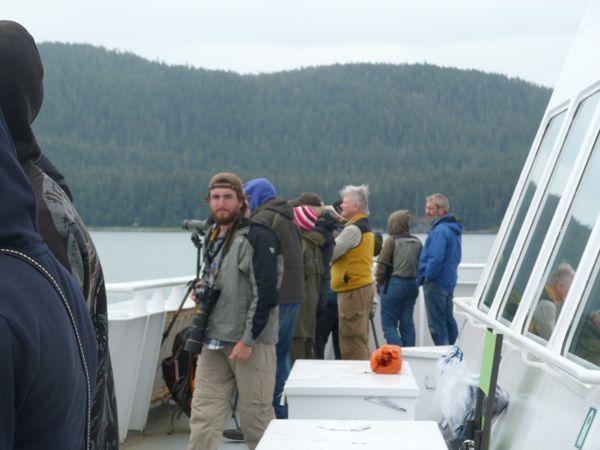
Like I say, my emotions are mixed on this, because we like birds, too. We like people who like birds. We don’t much like being pushed aside, and having to climb over equipment set up where people usually walk. For those inside, the best viewing is from the forward lounge, and there were so many of the birders, busy spotting, that you really couldn’t see from the inside, nor could you get one of these prime positions on the forward deck because they would be first up in the morning to get the spot, and they would hang out there dawn to dusk.
One of the birders turned out to be a person who knows a very good old friend of mine – life is funny that way, and you can meet some great people on the Alaskan Ferries.
We had to admire their focus, and their persistence, and their seriousness with which they pursued their passion.

When we hit Yakutat, they were first off the boat, early, 5 in the morning kind of early, the whole flock of ’em, beady little eagle eyes sharply seeking unusual birds for their check lists. You could hear them making bird noises. Back on the ship, someone would say something and all eyes, all binoculars, all cameras would turn in one direction, and people would take their best shots. They manned their prime observation post with military dedication.
They left the boat at Whittier, on the second day. We wished the all success, and we were glad to have access to the front viewing deck once again.
God Laughs; Life’s Craziness
One of my favorite Psalms is Psalm 2, which advises us to humbly submit to the will of Almighty God or suffer the consequences of our own actions. I’ve heard God laughing all week, sometimes at me, sometimes with me.
Psalm 2
1 Why do the nations conspire,
and the peoples plot in vain?
2 The kings of the earth set themselves,
and the rulers take counsel together,
against the Lord and his anointed, saying,
3 ‘Let us burst their bonds asunder,
and cast their cords from us.’
4 He who sits in the heavens laughs;
the Lord has them in derision.
5 Then he will speak to them in his wrath,
and terrify them in his fury, saying,
6 ‘I have set my king on Zion, my holy hill.’
7 I will tell of the decree of the Lord:
He said to me, ‘You are my son;
today I have begotten you.
8 Ask of me, and I will make the nations your heritage,
and the ends of the earth your possession.
9 You shall break them with a rod of iron,
and dash them in pieces like a potter’s vessel.’
10 Now therefore, O kings, be wise;
be warned, O rulers of the earth.
11 Serve the Lord with fear,
with trembling 12kiss his feet,*
or he will be angry, and you will perish in the way;
for his wrath is quickly kindled.
Happy are all who take refuge in him.
I’m a planner. I figure out what I want, and then I figure out how to get it. When we decided we wanted to take a trip to Alaska, we booked – and paid – a year in advance to get the kind of room we wanted. We also planned to buy a new car, and started saving for that, being pay-cash kind of people.
Then, early in the year we discovered we were going to become grandparents to a granddaughter! She would arrive shortly after we get back from our Alaska trip.
This week, God laughed. The doctors told our son and his wife that she needed to go on bedrest, and that this baby will be coming early. All the grandparents have been helping with childcare through the summer, now we just ratcheted it up a notch.
Do you know why God gives children to YOUNG parents? LOL, a three year old has SO much energy! So much curiousity! We have such a good time with him and when at the end of the day, we return him to his parents – we need a nap!
We are also trying to pack and prepare for our trip, get the Qatari Cat prepared for the cat hotel, get the guest suite prepared for the people who will stay while we are gone, and oh yes, finish up the purchase of that new car.
I had thought the first week in August would be a snooze, isn’t it always? Those long, hot humid days hit Pensacola, often one of those violent and emotional thunderstorms that clears the air in the late afternoon, lazy day after lazy day, right?

Not this year. This year was fly to Seattle for my Mom’s 90th birthday celebration, fly back, take care of our grandson for a week, do whatever we can to help out our son and his wife while she is on bed rest, buy and sell two cars, do our normal volunteer work – oh, and we had scheduled two meetings at our house, so we had to be presentable, and have some delicious things available. I could hear God laughing.

In the midst of all this, we are healthy. We have a good roof over our heads. We have the means to get a new car and travel to Seattle for Mom’s birthday. We pre-paid much of the Alaska vacation. Our little grandson is happy, and strong, and articulate, and fun to be around. Our son and his wife are wonderful, loving parents, and hard workers, and are preparing for this sweet new arrival. God laughs, and we thank him for his abundant blessings, and his abundant patience with us thinking we have any control over the months that come. We pray for the safe and healthy arrival of this little granddaughter who may arrive while we are gone, for a safe delivery, and a speedy recovery for her mother, and for strength and courage for her father, our son, who is a valiant man. We welcome your prayers.
Uwem Akpan and Say You’re One of Them

This is a very troubling book, and, for me, a difficult book to read. It has taken me weeks, and I will admit I have often interrupted the reading of it to read other, easier books. This book makes me very uncomfortable. The stories and images trouble my sleep.
Uwem Akpan is of the tribe of Annang, from Nigeria, and has committed to an even larger tribe, the Catholic Church, of which he is a priest, and this gives him a unique perspective. The stories in this book often focus on tribal differences, including religious differences, and although they are set in different African states, have parallels in lives lived elsewhere. Those tribal differences are between Moslem and Christian, but also between Pentecostal and Catholic, Tutsi and Hutu, and, most significantly, the differences between to tribe of the very poor and the very rich.
Each story is told through the eyes of a child living in a different African state – Kenya, Benin, Ethiopia, Nigeria, Rwanda.
In one of my favorite segments of the book, strife has broken out in Nigeria, strife between the Moslems and the Christians, but also throw in the Pentecostals and the Pagans and really mix it up. A bus is waiting in the bus station to take people back to the southern part of Nigeria, and on this bus is a young man, half Moslem, half Christian. The bus stands idle for hours, while the bus driver seeks fuel to make the trip. During this time on the bus, many conversations take place, and what I loved was how alliances shifted with each conversation. The people on the bus were from different traditions, but came together as a community. No community is without arguments and dissensions, however, and consensus builds, diminishes, shifts – it is a microcosm of the tensions and stressors pulling apart the Nigerian nation state.
Uwem Akpan treats the children in each story lovingly, treasuring their innocent perspective and the sweetness of their hearts and vision. The adults don’t come off so well, passing their days in drug-induced stupors, drunk, selling children into slavery and prostitution, chopping off their limbs with machetes, and closing themselves off into groups which protect themselves and exploit others.
It would be an easier book to read if it were about aliens, or if these stories were confined to Africa, but the stories of these abused, neglected and exploited children echo in every continent, country and city in the world.
Uwem Akpan writes prose that is poetry; the surroundings are described with such detail that you feel in the moment, you see through the eyes of each child, and you see things that are beautiful as well as scenes you did not want to see. As you can see, I have a lot of ambiguous feelings about this book. At the same time I can admire the writing, the stories have left images in my mind that cannot be erased. Dark images. There is hope in the persistence and resilience of many of the children, but concern about their long term survival. It leaves a heavy weight on my heart.
Touched the Hem of His Garment
Today’s meditation from Forward Day by Day touches on one of my very favorite stories – and its opposite. It’s all about the power of belief. The woman, suffering from bleeding, would have lived a terrible life, considered unclean, untouchable, and trying everything to be cured without success. Just a touch – one touch – and her illness is gone. Jesus is astonished and tells her that her faith has made her well.
In contrast, the people in his own village are skeptical. How can good ole Jesus, son of Mary and that carpenter, how can he be anything special? In the face of such callous disbelief, Jesus can do little.
SATURDAY, July 27
Mark 6:1-13. And he could do no deed of power there, except that he laid his hands on a few sick people and cured them.
What a contrast, in just a few verses. Yesterday the bleeding woman merely touched Jesus’ garment, and Jesus’ power streamed into her. Today he is home, and those who watched him grow up ask, “Just who do you think you are?” and the Son of God is stopped in his tracks, like Superman when he is exposed to kryptonite.
My field education rector preached on this passage a year ago, and I was spellbound by his ending. He asked, “If Jesus came to All Saints, would he be able to do deeds of power?” Then the rector got even more personal, asking, “If Jesus came to you, would he be able to deeds of power?”
Oh, how I hope so. I’m not sure how to have the faith that allows Jesus to perform deeds of power, but I can see what kind of behavior does. It is hopeful, brave actions that seem to open the way for Jesus to work; and it is arrogant, fear-based behavior that seems to block the way.
Lord, teach us not to fear the change you bring. Teach us to reach out to touch your garment.
When my Mother was still living on her own, there was a revolving guest room, and my sister left a CD for me there, as she departed and I arrived, which contained the song above. I want it sung at my funeral. It is a succinct statement of faith; it is the song of the bleeding woman who believes and is cured, and nothing is ever the same.
Pakistan’s Swat Valley Women Fight Back with Jirga
I love this. Women are using technology – and the traditional system – to persist in seeking justice for women who are often little more than slaves to their husband.

Tahira
Women in Pakistan’s Swat valley are making history, and perhaps some powerful enemies, by convening an all-female jirga, a forum for resolving disputes usually reserved for men. Some readers may find details of this report by the BBC’s Orla Guerin disturbing.
Tahira was denied justice in life, but she continues to plead for it in death – thanks to a grainy recording on a mobile phone.
As she lay dying last year the young Pakistan wife and mother made a statement for use in court.
In the shaky amateur video, she named her tormentors, and said they should burn like she did.
Tahira was married off at the age of 12 and died last year following a suspected acid attack
Tahira’s flesh was singed on 35% of her body, following a suspected acid attack. Her speech was laboured and her voice was hoarse, but she was determined to give her account of the attack, even as her flesh was falling off her bones.
“I told her you must speak up and tell us what happened,” her mother Jan Bano said, dabbed her tears with her white headscarf. “And she was talking until her last breath.”
Tahira’s husband, mother-in-law, and father-in-law were acquitted this month of attacking her with acid. Her mother plans to appeal against that verdict, with help from a new ally – Pakistan’s first female jirga.
Under the traditional – and controversial – jirga system, elders gather to settle disputes. Until now this parallel justice system has been men-only, and rulings have often discriminated against women. The new all-women jirga, which has about 25 members, aims to deliver its own brand of justice.
It has been established in an unlikely setting – the scenic but conservative Swat valley, formerly under the control of the Pakistan Taliban. We sat in on one of its sessions in a sparsely furnished front room. Women crowded in, sitting in a circle on the floor, many with children at their feet. Most wore headscarves, and a few were concealed in burqas.
Probing injustice
For more than an hour they discussed a land dispute, problems with the water supply, unpaid salaries, and murder. The only man in the room was a local lawyer, Suhail Sultan. He was giving legal advice to jirga members including Jan Bano who he represents.
“In your case the police is the bad guy,” he told her. “They are the biggest enemy. ” He claims the police were bribed by the accused, and were reluctant to investigate the case properly.

The jirga tackled land disputes, water supplies, and murder
The jirga is making history, and perhaps making enemies. In Swat, as in many parts of Pakistan, men make the key decisions – like whether or not their daughters go to school, when they marry, and who they marry. And oppression starts early. Tahira was married off at just 12 years old, to a middle-aged man.
“Our society is a male-dominated society, and our men treat our women like slaves,” said the jirga founder, Tabassum Adnan. “They don’t give them their rights and they consider them their property. Our society doesn’t think we have the right to live our own lives.”
This chatty social activist, and mother of four, knows that challenging culture and tradition comes with risks. “Maybe I could be killed,” she said, “anything could happen. But I have to fight. I am not going to stop.”
They glued [my daughter’s] mouth and eyes closed. Just her face was left, the rest was flesh and broken bones”
Taj Mehal
As we spoke in a sun-baked courtyard Tabassum got a disturbing phone call. “I have just been told that the body of another girl has been found, ” she said. ” Her husband shot her.” She plans to investigate the case, and push the authorities to act.
“Before my jirga women have always been ignored by the police and by justice, but not now. My jirga has done a lot for women,” she said.
There was agreement from Taj Mehal, a bereaved mother with a careworn face, sitting across the courtyard on a woven bed.
Her beloved daughter Nurina was tortured to death in May.
“They broke her arm in three places, and they strangled her,” she told me, putting her hands to her own throat to mimic the action. “They broke her collarbone. They glued her mouth and eyes closed. Just her face was left, the rest was flesh and broken bones.”
She speaks of her daughter’s suffering with a steady voice, but grief is wrapped around her, like a heavy shawl.
“When I looked at her, it was like a piece was pulled out of my heart,” she said. “I was turned to stone. I see her face in front of my eyes. I miss her laughter.”
Women are a rare sight on the streets of Mingora
Nurina’s husband, and his parents, have now been charged with her murder, but her mother says that initially the courts took no interest.
“Whenever we brought applications to the judge he would tear them up and throw them away,” she said. “Now our voice is being heard, because of the jirga. Now we will get justice. Before the jirga husbands could do whatever they wanted to their wives.”
Women are little seen or heard on the bustling streets of Mingora, the biggest city in Swat. Rickshaw taxis dart past small shops selling medicines, and hardware supplies.
There are stalls weighed down with mangoes, and vendors dropping dough into boiling oil to make sugar-laden treats. Most of the shoppers are men.
‘No justice’ at jirgas
When we asked some of the local men their views on the women’s jirga, the results were surprising. Most backed the women.
“It’s a very good thing,” said one fruit seller, “women should know about their rights like men do, and they should be given their rights.”
Another said: “The jirga is good because now finally women have someone to champion their cause.”
The response from the local male jirga was less surprising. They were dismissive, saying the women have no power to enforce their decisions.
Most local men who spoke to the BBC expressed support for the women’s initiative
That view was echoed by the prominent Pakistani human rights activist Tahira Abdullah. “I don’t see it as more than a gimmick,” she said. “Who is going to listen to these women? The men with the Kalashnikovs? The Taliban who are anti-women? The patriarchal culture that we have?”
Ms Abdullah wants jirgas stopped whether male or female. “The jirga system is totally illegal, and has been declared illegal by the Supreme Court of Pakistan. It can never be just. There are several extremely notorious cases where we have noticed that women do not get justice from jirgas, neither do non-Muslims.”
One of those cases took place last year in a remote region of northern Pakistan where a jirga allegedly ordered the killing of five women – and two men – for defying local customs by singing and dancing together at a wedding.
And there are regular reports of jirgas decreeing that women and young girls be handed over from one family to another to settle disputes.
But for some, like Jan Bano, the women’s jirga is bringing hope. Every day she climbs a steep hill to visit Tahira’s grave, and pray for the daughter whose voice has still not her heard. Her video recording was not played in court.
Yemeni Girl Escapes Child Marriage
This little girl is lucky; she has a sympathetic uncle who protected her when her own mother, twice, tried to sell her into marriage.
She is an amazingly articulate and resourceful little girl. I look forward to seeing the woman she grows into, safe under her uncle’s care. I love it that he convinced one prospective husband that she was not modest enough to be his bride 🙂
In a bone-chilling three minutes, a young girl who evaded child marriage tells the world that she would “rather die,” than be forced to undergo an arranged marriage.
After learning that her parents had plans to marry her off to a wealthy suitor, brave Nada al-Ahdal of Yemen risked her life and fled to the refuge of her uncle. The precocious little girl, who saw how her teenage aunt took her own life after being abused in an arranged marriage, shared in a harrowing translated video the cruelty of the child bride practice.
“I would have had no life, no education. Don’t they have any compassion?,” Nada asks. “I’m better off dead. I’d rather die [than be forced into a marriage].”
According to NOW News, Nada’s uncle, Abdel Salam al-Ahdal, a montage and graphics technician at a TV station, has protected his niece from being married off twice. Nada’s parents first accepted an offer from a wealthy expatriate, but al-Ahdel intervened and told the prospective groom that Nada was not nearly modest enough for him, in order to “scare him off.”
“When I heard about the groom, I panicked,” he told NOW. “Nada was not even 11 years old; she was exactly 10 years and 3 months. I could not allow her to be married off and have her future destroyed.”
When Nada’s mother tried once again to marry off her daughter against her will, Nada — despite threats that she could be killed — fled to her uncle’s once more, and filed a complaint with the police. She’ll now be living with al-Ahdal permanently.
But such forced marriages, like Nada’s, are on the rise across the globe.
According to a World Vision study released in March, more child brides are being led into arranged marriages due to an increase in global poverty and crises. Parents who live in fear of natural disasters, political instability and financial ruin look to arranged marriages as a way to save their struggling families.
Every day, 39,000 girls, younger than 18, will marry, according to the World Health Organization.
“Women have no rights to give an opinion in the family,” Humaiya, a 16-year-old from Bangladesh who managed to escape marriage, told The Huffington Post in March. “My father didn’t listen.”
Nada, whose video on YouTube has already garnered more than 2 million hits, hopes that the world will hear her message loud and clear.
“They have killed our dreams. They have killed everything inside us,” Nada said in the video. “This is no upbringing. This is criminal, simply criminal.”
Flashing Lights to Warn of Speed Trap: Free Speech?
I’ve done it – warned other drivers of a speed trap ahead. And I have benefited from other drivers warning me. And I am fully aware that for a law and order kind of girl, that is contradictory behavior. So the question is . . . are we allowed?
From AOL Auto News:
When Michael Elli of Missouri flashed his headlights to warn other drivers of an upcoming speed trap in Ellisville Mo. he didn’t think he was doing anything illegal.
After he received a ticket for obstruction of justice, which carried a $1,000 fine, he fought back, saying the warning was protected free speech. Eventually prosecutors in Missouri dropped the charges, but now Elli and the American
“Those who use their First Amendment rights to warn others to drive cautiously should not be punished for their message,” said Tony Rothert, legal director of the ACLU-EM. “After all, the purpose of traffic laws is to promote safety, not generate revenue.”
Is flashing your headlights protected free speech? It depends on where in the U.S. you are. Florida, Utah and Tennessee, Ohio, New Jersey and Pennsylvania have all deemed that warning other drivers with a flicker of your high beams is protected by the first amendment of the U.S. Constitution. Alaska and Arizona have laws strictly forbid headlight flashing in any situation.
Dubai’s Weight Loss Challenge: 1 Gram Gold Per Kilo Lost

Need some motivation to cut that flab? If you live in Dubai, you can win gold to do just that. A new campaign “You are Worth … Your Weight in Gold” is aimed at promoting a healthy lifestyle and achieving optimal body weight. The contest is open for public.
The winner will be the one who loses maximum weight during the program period of 30 days from its inception on Friday this week. The top three winners will get a gold coin equivalent to AED 20,000. Other participants will get a gram of gold for each kilo reduced from their body weight. However, the minimum weight to lose for the eligibility is two kilograms.
Addressing a press conference on Tuesday, Dubai Municipality officials said the winners will get two grams of gold if they could reduce at least two kilograms within one month.
Hussain Nasser Lootah, director-general of Dubai Municipality, said the initiative comes after the grand success of ‘Yallah Walk’ campaign launched in 2011.
“It is also aimed at introducing walking tracks in different parks in the city of Dubai. Walking is an easy and economic way to stay fit and healthy. The municipality has provided residents with safe and accessible walking tracks in urban and rural areas,’ Lootah said.
“Currently Dubai has a total of 91 places where one can practice sport activities. These include residential parks, public parks, jogging track and beaches. In addition to this, every year the civic body opens new parks in more areas and adds sports equipments and tools for the public to promote a healthy community, he said.
“Ramadan is the most appropriate season to launch such initiatives as it reminds us about many health benefits of reducing weight and encourages us to take strong steps to change our bad lifestyles,’ he added.
The weight of each participant will be measured during registration and at the end of program. Participants can register at the event sites any day during the period. Participants must have excess weight to reduce and stay away from unhealthy methods to lose weight.
The final weight will be measured after the Eid holidays on Aug. 16.
Ahmed bin Sulayem, executive chairman of Dubai Multi Commodities Center (DMCC), said the DMCC is proud to support this health awareness drive to encourage society to change their daily routines in return for a healthier lifestyle.
‘We would highly encourage everyone from all walks of life to take part in this great initiative and hope DMCC’s contribution of AED 100,000 worth of gold coins will help motivate individuals reach the final target of improving and sustaining a healthy lifestyle and consequently a better quality of life,’ he said.
“I am sure Dubai can be the role model and astonish the world by its innovative ideas and initiatives,” said Anil Dhanak, general manager of Dubai Gold & Jewelry Group.”
Recent Comments
Kitchen on Isiais: Winding Down intlxpatr on Shampoo Ginger tigerbutterya0c5ff1d… on Shampoo Ginger intlxpatr on British Soldier Kidnapped, Esc… John on British Soldier Kidnapped, Esc… Wikipedia Donate Button

Amazina


Early Voting in Florida


