US Sex Trafficking Ring Raided
From BBC News; this is not a “victimless” crime:
Twelve arrested in US raid on Latin sex-trafficking ring
Mr Morton said the case should be a ‘wake-up call’
Another 44 people have been detained. Eleven women from Central America and Mexico, most in their 20s, were freed.
The women were reportedly forced to have sex with up to 30 men a day, charging $30 (£19) for each act.
The gang is thought to have been smuggling women since 2008, moving them to different cities every week in the south-eastern US.
The US authorities have indicted eight men and four women. Most of the other detainees are said to be clients.
The sex-trafficking ring served mostly ethnic Latino immigrants in larger cities and rural communities of Florida, Georgia and the Carolinas, the authorities said.
One of the indicted, a Mexican citizen, is accused of having threatened to send one woman back to Mexico if she did not have sex with at least 25 men a day.
Immigration and Customs Enforcement Director John Morton said 967 arrests in connection with people trafficking and sex tourism were made last year alone.
“To those who would believe that sex trafficking doesn’t happen in America, reflect on this case and think again,” Mr Morton said at a news briefing.
Most of the 44 detainees were reportedly non-Americans and would face court action. Those who were illegal in the country would be deported, said Mr Morton.
The scale of human trafficking in the US is hard to gauge, but the National Human Trafficking Resource Center hotline, operated by Polaris Project since December 2007, has received more than 57,000 calls from every state in the union.
Incidences of sex and labour trafficking have been reported in all 50 states in the US, and the District of Columbia, in the two years leading up to 2012.
Feast Day of St. Anthony
In our Lectionary Readings for today, they list today as the Feast Day for St. Antony, one of the early monastics of the Christian Church.

ANTONY
ABBOT IN EGYPT (17 JAN 356)
Before the conversion of the Emperor Constantine in 312 AD, back in the days when Christianity was still a persecuted religion, the act of becoming a Christian involved turning one’s back on the pursuit of security, of fashionable prestige and popularity, of success as the term is widely understood. After the Emperor had changed Christianity from a persecuted religion into a fashionable one, many earnest Christians felt the need to make such a renunciation in the service of Christ, and did not see mere Church membership as any longer enough to constitute such a renunciation. Accordingly, many of them sought Christian commitment by fleeing from society into the desert, and becoming hermits, devoting themselves to solitude, fasting, and prayer. Although this trend was much accelerated and reinforced by the conversion of Constantine and attendant changes, it had already begun earlier. An outstanding early example is Antony of Egypt, often reckoned as the founder of Christian monasticism.
Antony of Egypt, the son of Christian parents, inherited a large estate. On his way to church one day, he found himself meditating on the text, “Sell all that you have, and give to the poor, and come follow me.” When he got to church, he heard the preacher speaking on that very text. He took this as a message for him, and, having provided for the care of his sister, he gave his land to the tenants who lived on it, and gave his other wealth to the poor, and became a hermit, living alone for twenty years, praying and reading, and doing manual labor.
In 305, he gave up his solitude to become the head of a group of monks, living in a cluster of huts or cells, devoting themselves to communal singing and worship, to prayer and study and manual labor under Antony’s direction. They did not simply renounce the world, but were diligent in prayer for their fellow Christians, worked with their hands to earn money that they might distribute it as alms, and preached and gave personal counseling to those who sought them out.
In 321, Christians in Alexandria were being persecuted by the Emperor Maximinus (the rule of Constantine was not yet universal), and Antony visited Alexandria to encourage those facing the possibility of martyrdom. He visited again in 335, when Arianism was strong in the city, and converted many, by his preaching and testimony, and by prayer and the working of miracles. His biography was written by Athanasius, who said of him: “Who ever met him grieving and failed to go away rejoicing?”
The Forward Day by Day website summarizes St. Antony just a little differently:
Today the church remembers Antony, Abbot in Egypt, 356.
Father of Christian Monasticism Many young men of the third-century world despaired of their decaying, materialistic, and licentious society. In Egypt many fled into the desert in protest and for their own souls’ health. Sometimes their behavior became almost as bizarre and unbalanced as the behavior of those from whom they fled. This was not true of Antony. Antony’s quiet and well-ordered life of devotion in the desert stood out in contrast both to the wickedness of the contemporary world and the eccentricities of some other hermits. He gave away all his possessions to the poor and thereby freed himself from the demands of property. Still, he found that he had to fight a seemingly endless battle against his personal passions and temptations. He helped fellow Christian hermits to organize their lives in meaningful patterns of prayer, work, and meditation. His own solitude was frequently interrupted by his concern for the secular church and by requests for counseling. He was a friend to Athanasius (see May 2) and his orthodoxy was unquestionable. It has been said that, “Alone in the desert, Antony stood in the midst of mankind.”
This is not the same St. Anthony who helps you find lost things; that is St. Anthony of Padua, but when I read about this St. Anthony, and his orderly life, I thought that beating back the forces of chaos keeps things from getting lost in the first place. 🙂
Saudi Students Flock to US Universities
When I was student teaching in EFL/ESL, my Arab Gulf students often complained that they couldn’t go directly to US universities, that they had to take English classes first.
“How did you do on the TOEFL?” I would ask, and their response would be a combination of anger and sheepishness.
“They all think we are rich. They just want our money. They make us take classes we don’t need, just to make money on us,” they would bitterly complain.
Most of these guys could speak passable English. Their writing skills were almost non-existent. They weren’t ready for real universities, with standards and accountability. The very first thing – and this is cultural, not something that is “right” is being ON TIME.
We don’t even realize what a priority it is in our own culture to be where we are supposed to be at the time we are supposed to be there. To be habitually late is to be morally inferior in some undefined way, lazy, a slacker. It’s custom, it’s cultural, it’s not a universal. But if you’re going to go to school in the United States, you need to respect the need to be on time – especially for things like exams, boarding a flight, when a paper is due, paying a bill by the due date.
We all learn when we confront our own assumptions by knocking up against another culture. I learned a lot about my own erroneous assumptions living in Saudi Arabia. I hope they are learning as much here. I wish these students well. I hope some of the students are Saudi girls; I hope they are driving around Pensacola having a good old time.
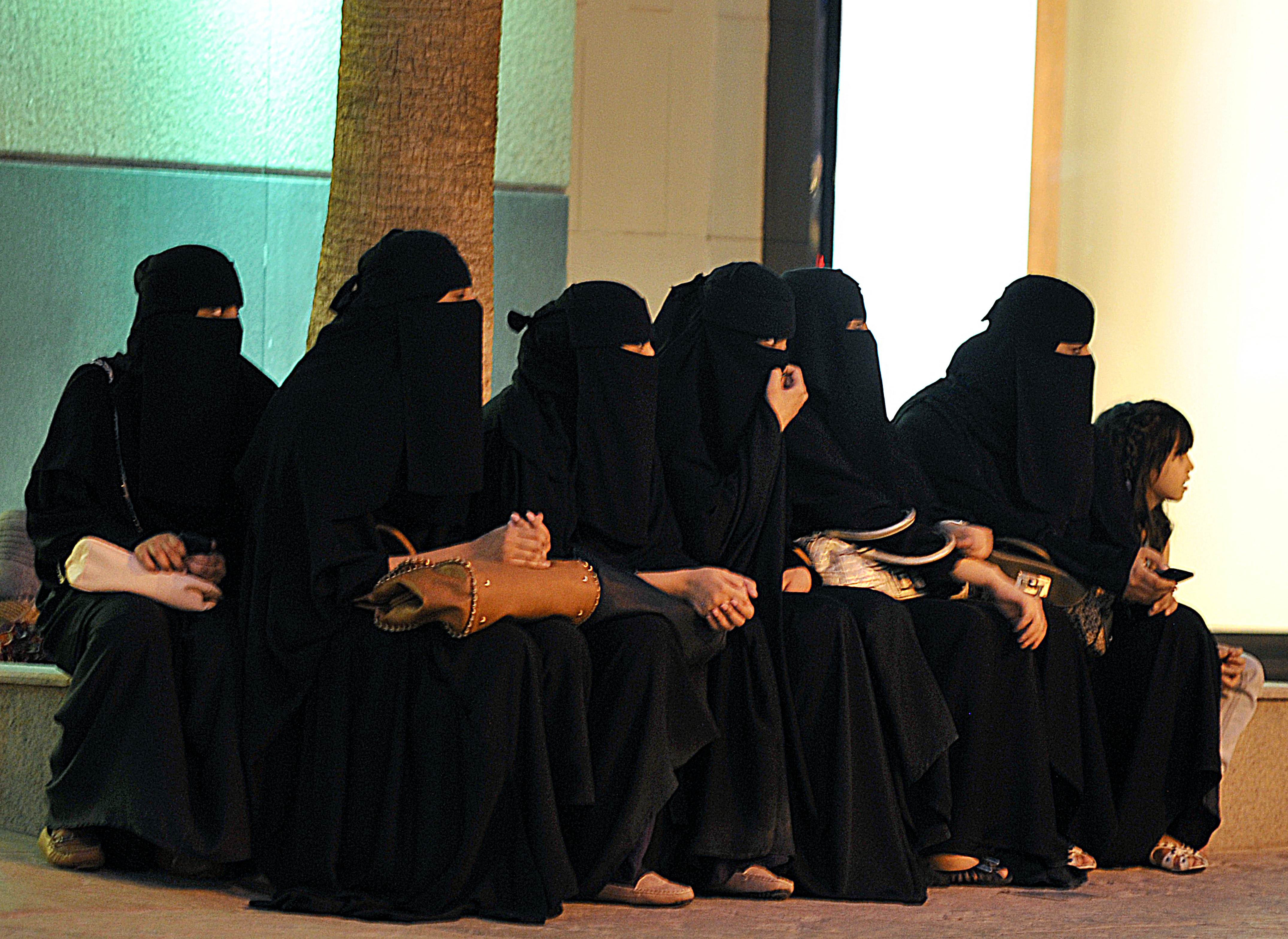
Saudi students flood U.S. colleges for English lessons
Mary Beth Marklein, USA TODAY
FREDERICKSBURG, Va. — That University of South Carolina cap on Meshari Albishi’s head? Just for looks, he says. Its colors match the red of his vest, where a metallic pin displays flags for the United States and Saudi Arabia, his homeland.
For now, his allegiance is to the University of Mary Washington, which Albishi says “is like my second home.”
Technically, Albishi is not a student here, but he has made “a lot of friends,” and has access to the library, workout rooms and other campus facilities. The university has offered him admission, on one condition: Before he can enroll, he must complete a non-credit program, called English for Academic Purposes.
Albishi, 25, is one of thousands of international students arriving each year in the United States to study English as the first step toward a college degree. They come from all over the world, but Saudi Arabia, where the government has poured billions of dollars into a generous scholarship program, is driving the recent surge.
In just seven years, Saudi student enrollments have skyrocketed from 11,116 in 2006, to 71,026 last year, according to the Saudi Arabian Cultural Mission to the United States, the Virginia-based agency that administers the scholarship. Nearly all recipients (95%) start with language training, which can take anywhere from a month to a year or more, officials say.
The infusion of full-paying international students has been a boon for cash-strapped U.S. colleges.
For instance, Western Michigan University in Kalamazoo, which founded its Center for English Language and Culture for International Students 38 years ago, enrolled a record 267 international students last semester, nearly half from Saudi Arabia, says center director Diana Vreeland. The University of Dayton’s language center, established in 2006 with eight students, now enrolls 400.
The Saudi scholarship grew out of a meeting in 2005 between Crown Prince (now King) Abdullah, and President George W. Bush as a way to strengthen ties — and ease tensions — between the two countries in the wake of the 2001 terrorist attacks.
Saudi scholarship students can receive up to a five-year visa. The scholarship covers full tuition, housing and health benefits for students and family members. All that, plus round-trip tickets home once a year. After language training, business and engineering are the top fields of study.
When students are finished, “they come back with a collective experience that can help move the country forward,” says Mody Alkhalaf, the Saudi Arabian mission’s assistant attaché for cultural and social affairs.
Even so, the arrangement doesn’t sit well with skeptics, who argue for stricter visa policies. Fifteen of the 19 hijackers in the Sept. 11 attacks were from Saudi Arabia; and several had entered the USA with student visas.
In 2011, after a Saudi engineering student was charged in a failed plot to bomb U.S. targets, Investor’s Business Daily repeated its concern that a new initiative for Saudi students opened the door for terrorist attacks. “How many will overstay their visas and become sleeper agents?”
Programs for international students have recently come under greater federal scrutiny. In 2010, Congress tightened rules for English-language programs after an investigation found that a for-profit language school in Florida served as a front for the sale of fraudulent student visa applications. Last year, a federal report urged U.S. Immigration and Customs Enforcement to strengthen oversight of the Homeland Security program that oversees compliance with a student-visa system. Recently, immigration officials have raised concerns that some colleges might be mishandling documentation for students accepted into an academic program on the condition that they first complete language studies.
Some schools mention only the academic degree program on federal forms, a practice that is “essentially defrauding the immigration requirements” and potentially “defeating the purpose” of a student tracking system, says Ernestine Fobbs, a spokeswoman for Immigration and Customs Enforcement.
ELS Educational Services, a for-profit company that operates the center housed at the University of Mary Washington, lists language study on its paperwork, says communications director John Nicholson, based in Princeton, N.J.
No language students have continued their academic studies at the University of Mary Washington. But officials say they value the diversity such students bring to campus. Last semester, Arabic studies professor Maysoon Al-Sayed Ahmad organized a regular coffee hour for Saudi and U.S. students. “I wanted American students to change their idea about what they think about the Arab people, so they can become friends,” she says.
Saudi students have similarly had their eyes opened. Until he arrived on campus, “I thought all (Americans) had guns,” says Abdullah Khalid Maghrabi, 19. He stayed indoors for a week before he thought it was safe to go outside. Now, he says, weather is a more pressing concern.
“I don’t know what to wear every morning. In my country, all the seasons are the same — it’s hot.”
WOW! New YMCA For Pensacola in Maritime Park?
Fresh from the Pensacola News Journal Page:
Wow. Wow. Wow.
A $5 million pledge by Quint and Rishy Studer has kick-started a drive to build a new downtown Pensacola YMCA on a waterfront site at Community Maritime Park.
Studer said this afternoon he is interested in seeing a new YMCA downtown because of the positive impact it can have on children and adults, on community health and on residential development in the downtown area.
Studer said his pledge is contingent on the YMCA being located on a waterfront site at the southwest corner of the park, and that the project move forward at a rapid pace.
“We told them (the YMCA board) if they are serious, this has to move quickly,” Studer said. “Emotionally, Rishy and I can’t take another long, drawn-out things like with the stadium. We can’t take getting beat up again.”
Studer said the YMCA project, tentatively estimated at about $10 million, would be an excellent fit for the Maritime Park.
“There is a vacant piece of property there and either there’s going to be nothing on it, or a private developer will build something, or there can be a YMCA there.”
Brian Hooper, chair of Mayor Ashton Hayward’s Urban Development Advisory Committee, said a new YMCA in the downtown area was a key recommendation of the report released last month.
“One of the most common suggestions we heard from the public was the strong desire to see a family-oriented community center downtown,” Hooper said. “As our final report recommended, a new YMCA in downtown Pensacola would provide those who live and work in the community with a centrally-located hub for recreation, wellness, learning, and community. And I’m excited to see that many of our recommendations — such as this one — are already being acted upon.”
In addition to Studer’s pledge, community benefactor Terri Levin said she is co-chairing the YMCA fundraising committee.
Levin also said she will be making a dollar pledge to the project but has not yet decided the amount.
Pensacola developer Eric Nickelsen and real estate developer Joe Buehler are co-chairing the steering committee.
Nickelsen said the 10-person, all-volunteer YMCA steering committee, which includes former Mayor Mike Wiggins and former Pensacola City Councilman Ron Townsend, is meeting later this month to recommend a site to the Y’s board of directors. It’s
expected the recommended site will be the CMPA’s waterfront parcel.
Nickelsen said the YMCA project is in the early stages of development, but has considerable momentum.
“Apparently there is good feeling among our committee members that we can be successful in our fund raising campaign,” Nickelsen said.
Manohar Lal Sharma: “Until today I have not seen a single incident or example of rape with a respected lady”
If you are a follower of my blog, you know I am not a person of violent tendencies. This morning, however, I am so thankful to be half a world away from the scum lawyer who would make these statements about a woman so brutally raped by six men that she died of horrendous internal injuries.
I am fighting instincts which would wish him ill. When he accuses rape victims of being responsible for their attacks, it pushes me over the line.
A person should be free to take a bus without fear of assault. And I suspect that there are also male victims, too ashamed to come forward.

Manohar Lal Sharma, lawyer for one of the accused, speaks to journalists outside the Saket district court complex in New Delhi, India, on Jan. 10. Police badly beat the five suspects arrested in the brutal gang rape and killing of a young woman on a New Delhi bus, Sharma said Thursday, accusing authorities of tampering with evidence in the case that has transfixed India. (AP Photo/Saurabh Das)
As the trial of the men charged with the brutal gang rape and murder of a woman in New Delhi last month gets under way this week, a lawyer for some of the accused suggests the victim was partly to blame for the attack.
Lawyer Manohar Lal Sharma said his clients were innocent and implied that the 23-year-old student must have been in some way responsible for the horrific crime, Bloomberg reports.
“Until today I have not seen a single incident or example of rape with a respected lady,” Sharma said. “Even an underworld don would not like to touch a girl with respect.”
The lawyer’s controversial comments are sure to anger victim’s advocates, especially in light of somewhat similar sentiments proclaimed by Indian guru Asaram Bapu.
Last week Bapu said the victim should have “taken God’s name and could have held the hand of one of the men and said I consider you as my brother and should have said to the other two ‘Brother I am helpless, you are my brother, my religious brother,'” according to the Hindustan Times.
It is worth noting, however, that a representative for Bapu later said the media distorted the guru’s remarks.
“[He] never made such statements. He just asked his women followers to avoid such situation anyhow,” the rep told Asian News International. “He was only suggesting that women should try their level-best to come out from such situation by using diplomatic ways.”
News outlet The Week compiled a list of several other statements that seem to place blame on the rape victim. The compilation includes a comment from Andhra Pradesh Congress Committee president Botsa Satyanarayana, who suggested the victim stayed out too late.
“Do we roam in streets at midnight as we got Independence at midnight?” Satyanarayana said. “She should have assessed the situation before getting into the bus.”
The attack, which occurred on the evening of Dec. 16, has shocked Indian residents and prompted violent protests in cities across the country, CNN notes.
Sharma, who stepped in to help defend the suspects when many other lawyers refused to represent them, also claimed his clients had been tortured by police while in jail, Time reports.
The main suspect in the trial, the bus driver, will plead not guilty according to Reuters, as will the driver and a third suspect he represents.
“We will plead not guilty. We want this to go to trial,” Sharma said. “We are only hearing what the police are saying. This is manipulated evidence. It’s all on the basis of hearsay and presumption.
French Intercede to Save Mali
Heard yesterday on NPR that France was stepping up to the plate on Mali, found the story on BBC this morning . . . it isn’t easy. It’s like people in the US don’t get news of countries like Mali unless they really seek it out. You can find more stories on Mali and the Tuareg / Al Qaeda alliance tormenting Northern Mali at the BBC link.


The Ansar al Din is imposing in Mali the kind of Islam that the Taliban imposed in Afghanistan – an Islam which forbids music, forbids women to participate in public life, enforced by a group of ignorant, uneducated thugs with weapons. Everything Ansar al Din stands for is contrary to the true nature of Islam.
Go France!
French troops continue operation against Mali Islamists
Mali: Divided nation
French Defence Minister Jean-Yves Le Drian said army units had attacked a column of rebels heading towards the central town of Mopti.
He also revealed that a French pilot had been killed in fighting on Friday.
The French troops deployed on Friday after Mali’s army lost control of a strategically important town.
Mali’s government said its forces had recaptured the town, Konna, after the air strikes, but it was not clear if all Islamist fighters had left the area.
‘Terrorist state’
Armed groups, some linked to al-Qaeda, took control of the whole of northern Mali in April.
They have sought to enforce an extreme interpretation of Islamic law in the area.
Regional and Western governments have expressed growing concern about the security threat from extremists and organised crime.
Mr Le Drian said on Saturday that hundreds of French troops were involved in the military operation in Mali.
The minister said Paris had decided to act urgently to stop the Islamist offensive, which threatened to create “a terrorist state at the doorstep of France and Europe”.
He also revealed that a French pilot was killed in Friday’s fighting – during an air raid to support Mali’s ground troops in the battle for Konna.
“During this intense combat, one of our pilots… was fatally wounded,” the minister said.
Speaking on Friday, French President Francois Hollande said the intervention complied with international law and had been agreed with Malian interim President Dioncounda Traore.
It would last “as long as necessary”, Mr Hollande said.
French officials gave few operational details.
Residents in Mopti, just south of Konna, told the BBC they had seen French troops helping Malian forces prepare for a counter-offensive against the Islamists.
Mr Traore declared a state of emergency across Mali, which he said would remain in place for an initial period of 10 days.
He used a televised address to call on Malians to unite and “free every inch” of the country.
‘Crusader intervention’
The west African bloc Ecowas said it was authorising the immediate deployment of troops to Mali “to help the Malian army defend its territorial integrity”.
UN Secretary-General Ban Ki-moon says the situation in Mali is becoming increasingly volatile
The UN had previously approved plans to send some 3,000 African troops to Mali to recapture the north if no political solution could be found, but that intervention was not expected to happen until September.
French Foreign Minister Laurent Fabius said the aim of the operation was to stop Islamist militants advancing any further.
It was not clear how far the French would go in helping Mali’s government retake territory in the north.
At least seven French hostages are currently being held in the region, and Mr Fabius said France would “do everything” to save them.
A spokesman for al-Qaeda in the Islamic Maghreb (AQIM) said he considered the French operation a “Crusader intervention”, and told France it would be “would be digging the tombs of [its] sons” if the operation continued, according to the Mauritania-based Sahara Media website.
France ruled Mali as a colony until 1960.
This chart is from a Blog called The Moor Next Door:

Not-So-Friendly Downtown Pensacola
When I first moved to Pensacola – a mere three years ago – one of the things I loved was how inviting downtown was. When we go downtown for lunch, or to the market, or to the symphony, it’s not like all the big cities where they gouge you for parking and then moan that no-one wants to come downtown. No, parking was free, and ample. It was a joy to go downtown.
Today, I was down picking up a friend to go to lunch. I got a shock:


This breaks my heart. I parked illegally, in a loading zone, while I waited for my friend.
If this is a downtown improvement, it is not one I fine user-friendly. Pensacola is trying to encourage people to come downtown, and has been successful. Why shoot the golden goose, getting greedy, putting in pay kiosks?? Why not give the customers a break? BOOOOOOOO and HISSSSSS to the Downtown Improvement Board.
“Watch Out For those Christians”
AdventureMan and I knowingly make bad choices every now an then, and Chow Time is one of them. We haven’t been for months, ever since the nearby Mediterranean Plus shut its doors because of the competition from Chow Time, it broke our hearts. But today, AdventureMan just had a hankering for Chow Time, and it’s fresh oyster day, so we went.
We had hit the early service at our church, 0800, so we had been home, changed, AdventureMan hit the garden and I hit the Christmas decor, taking it all down, which I do superstitiously since my Chinese friend told me the way I come into the new year is the way I will spend my new year, so you need to have everything done, EVERYTHING, so that your new year will be prosperous and easy and not full of tasks left undone. You have to have your bills all paid and money in your pocket and a clean clean and organized house.
Oh aaarrgh. It’s a lot of pressure to get it all done by New Year’s Eve. But we had accomplished a lot by noonish, and AdventureMan was hungry – STARVING! I like Chow Time, too, because you can have whatever you want, in the amount you want it. I like tiny bites of bad things, and I try to make myself focus on eating good things.
So I am thinking about my strategy when I see an older woman with a walker, the kind with a seat in it, so she has her plate on the seat and she is very carefully and sedately making her way along the buffet stations, but there are well-dressed crowds of people politely pushing in front of her, all around her. These are no-make-up, long skirt, long hair kinds of people, and they are all sitting together in very nice clothes at several tables in one area, and unbidden, the thought comes to me “Oh! Watch out for those Christians!”
And then I have to laugh, because of course, I am one of THEM. We all think we are so good in our own way, but don’t get between these Christians and the buffet, or, even if you are elderly and pushing your plate on a walker, you might get run-over by these good Christian folk!
I am telling you this, knowing that I have my own weakness. I can be perfectly polite at a buffet, I can patiently allow others to push in front, or rush to get all the crab legs – I’m not going to starve. I think of our Kuwaiti friend who would jokingly tell his wife “have you never seen food before?” He told us it was something Kuwaiti parents would say to their children, teaching them to be polite.
My weakness is airports, airplanes, air travel. Partly it comes from growing up in Europe, where even if seats were assigned, everyone just rushed on the plane and sat where they wanted. It was hilarious, but if you are from a culture where people think seat assignment means something, it is also kind of frustrating. If you didn’t edge your way onto the plane, you got a rotten seat, like the middle seat, where you have to sit stiffly so your shoulders don’t bump someone else’s.
These days it is even worse. Even if you have an assigned seat, with all the people afraid to pay a baggage charge, they are heaving these hefty bags on board, and overhead space is first-come, first served. Those late on the plane have difficulty finding a place in the overhead bins.
So here is the dilemma. Not even a dilemma, we all KNOW what the right answer is. Do you politely let others go ahead? Do we courteously allow those who are disabled, or accompanied by young children, or having trouble walking, do we courteously allow them to board first, with no grumbling?
I still remember being Platinum, getting to board first, getting frequent upgrades, getting all the perks . . . being treated “special.” It’s kind of addictive, being treated as if you are special.
I contrast that with what we KNOW to be true, that the first will be last, and that those who serve others, who wait upon others, who allow others to be preferred – those are the ones who will inherit the kingdom of heaven.
So as I sit in our little booth at Chow Time, I wonder if I show the face of Christ by my behavior, and I cringe a little at all the instincts in me that still want to be first. Even if I step back and allow the lady with the walker to go ahead, I still have my failures in other areas of my life, areas where I step up rather than step back. Food for a new year’s resolution . . . .
Savannah’s in Wakulla Springs for Breakfast
Sometimes I can be too exclusive, literally, for my own good. The first time I saw this place, I said to myself “no no no no no.” The sign says it all. Not my kind of place. Full of things that are bad for me. Bad! Bad! Bad!
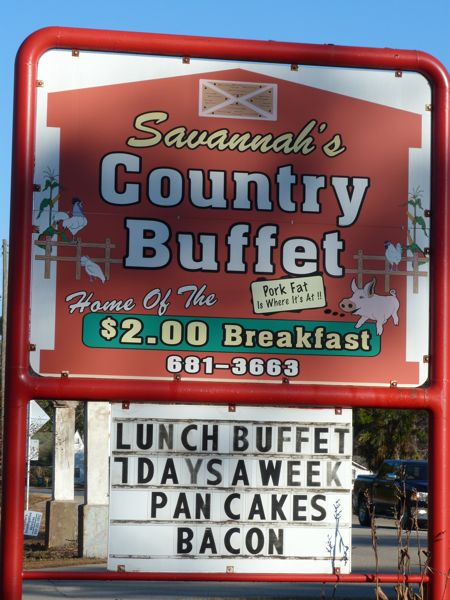
And yet, when The Black Bean was not open, and we were on our way to St. Mark’s National Wildlife Refuge, one of the coolest places on earth, we needed breakfast. I needed coffee. You need a little fuel to run the engines, you know? So, sighing, we pull into Savannah’s.

As soon as we walk in, I realize I might have made a big mistake, meaning, if we hadn’t come here, we never would have known how cool this place is. Sometimes snobbery can get in the way of having a good time, you know?
It’s exactly the kind of small town breakfast place – and restaurant – that I grew up with in Alaska, and my husband grew up with in his small southern town. The furniture is all locally made. The place is full of town folk, local people who all know one another, and a few birders on their way to St. Marks. There is a large menu of choices; yes, I don’t see any healthy choices, and at some point, it just becomes irrelevant. This is a great experience.

AdventureMan orders the Biscuits and Gravy, a sort of quintessential Southern breakfast dish and I order a biscuit breakfast sandwich. It takes a long time – they are baking fresh biscuits. 🙂 The coffee is good, not fancy, but well brewed and fresh.
When the breakfast comes, it is delicious. The biscuits are crumbly and flakey. The sausage is tasty. Yep, Pork Fat is Where it’s At.


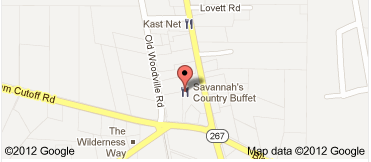
Savannah’s Breakfast Buffet gives you an astonishing breakfast at very reasonable cost, great service. The atmosphere is warm and welcoming, and you can learn a lot about the community by listening to the local discussions. Here’s how you find Savannah’s:
The Black Bean in Wakulla Springs and Tallahassee, FL

So we’ve arrived in Wakulla, to be received rudely at the hotel, turned away until the 3:00 pm check-in, the restaurant closed as we were trying to check in, and there is a part of every human being that wonders if this is going to be the story of our trip.
And then, to save the day, we find The Black Bean.
We drove to the nearby crossroads, where I saw a sign to a restaurant to which we did not go, but we turned left, up 363 and saw an all-day breakfast buffet place with a sign saying “Pork Fat is Where It’s At” (no, no, it’s true, how could I make that up?) and I am praying “Please Lord, find us someplace else, please Lord” and we keep going. AdventureMan says “should I turn around?” and I see a sign just a little up and say “let’s go up there and turn around if it’s nothing.”
As we get closer, we see a big sign for Jerry’s Bait Shop and my heart sinks. But as we turn in to turn around, we see the sign for The Black Bean Cuban Food, and my prayer is answered. Yes!
As it turns out, this is not the REAL Black Bean, which is in Tallahassee, but this is the Black Bean Express, their outpost, for people on the run, going down to St. Marks to go birding, heading out in their boats, etc. The menu is almost the same, just a few things less.
We both ordered the same thing, which we never do, but the Habanero Pork BBQ just sounded so good, and oh, man, it was. It was SO good. We didn’t know how much sandwich there was going to be, we could have shared one, but no, we didn’t know, and we ordered the fabulous black bean soup, too, and we couldn’t eat it all.


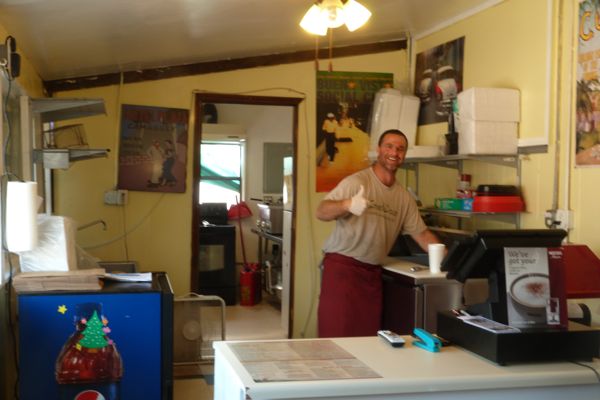
This is one of the owners, who fixed these fabulous sandwiches. He told us about their breakfasts, so we decided to come back the next day, but when we came back the next day, they were not open and we saw on the sign that the breakfast is only Friday, Saturday and Sunday at the Black Bean Express.
We went back around lunch and had their grilled chicken wrap, which – smarter now – we split, and we also split a red beans. You can read more about them HERE. We met the other owner (the are married to one another) and as we ate, we decided that rather than enjoy another perfectly uninteresting dinner at the Lodge, we would bet another sandwich, and split it for dinner along with some trail mix and water we already had with us.
The Black Bean saved the day. The food was so good; we even stopped for breakfast on our way out toward Tallahassee, having the biscuit sandwiches. I never knew Cuban food could be SO good, so tasty. It was fast, convenient, close to the Lodge, and very tasty. Let’s see, pay a lot more money for uninspired food at Wakulla Lodge, or pick up something at The Black Bean . . . . ? I don’t have to give it two seconds thought! Life is too short! It’s a Wakulla Red R! (Michelin Red R’s are given for good local foods at reasonable prices)
In the adjoining bait shop; a huge box full of live crickets, eeeeeeek!

And a guard dog, Zorah:

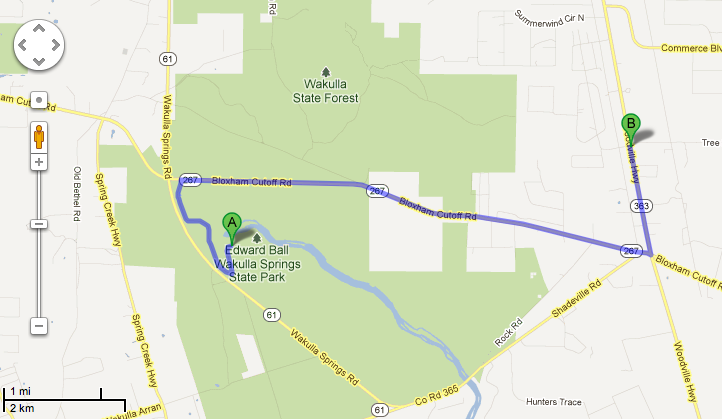
Here is how to get to The Black Bean Express, in Wakulla Springs. There is another, larger Black Bean in Tallahassee:
Recent Comments
ExpatAlien on What Country am I Living … intlxpatr on Yellowstone: Old Faithful to C… Michelle on Yellowstone: Old Faithful to C… Cathy on No Grown-Ups in Charge intlxpatr on Waiting for Snow Wikipedia Donate Button

Amazina


Early Voting in Florida


 Here There and Everywhere