Two New Restaurants to Open on Palafox Place, Pensacola
Woooo HOOOOO, Carleton Proctor at the PNJ just tweeted there will be two new restaurants, one Italian, opening this year on Palafox Place in downtown Pensacola:
The menu of downtown Pensacola’s restaurants is about to add another entree.
David Hambrick, owner and manager of Jaco’s Bayfront Bar & Grille, has reached an agreement with Durnford Enterprises Inc. to lease the former Distinctive Kitchens property on Palafox Place.
Hambrick said Thursday he plans to open an Italian-themed restaurant in one half of the 11,000-square-foot building, and eventually will open a second adjacent restaurant within that space at a later date.
“We’ve been talking to them (Durnford) since October when he heard the property had become available,” Hambrick said. “We’ve verbally agreed to a lease and now we’re just waiting for incorporation papers and a name for the restaurant.”
“The core menu will be modern Italian,” he said.
The deal and lease is expected to close March 1, Hambrick said.
Durnford Manager Frank Webb confirmed the agreement with Hambrick. Durnford owns the building, which has addresses of 29 and 31 Palafox Place.
First opened in 2004, Distinctive Kitchens and Culinary Arts Center closed late last summer, and the building has been unused since then.
Hambrick said he is working with Pensacola architect Brian Spencer on the interior design of the proposed restaurant.
Hambrick and business partner Paul Bruno will design the entirely rebuilt kitchen area, which eventually will serve both proposed restaurants.
Follow Carlton Proctor at twiter.com/CarltonProctorPNJ.
Carmen’s Lunch Bar on Palafox in Pensacola
Yesterday, AdventureMan was on an adventure, but I knew there might be an opportunity to grab lunch with him ‘downtown’ so I suggested we try Carmen’s Lunch Bar, which has only been open four months. When I got there, it was full – inside and outside – but an ideal location opened moments later – we were in luck! I ordered a Cranberry Orange Iced Tea, just what the doctor ordered for the remnants of a bad cold still lingering, and shortly AdventureMan arrived, then another, and then two more – we couldn’t all eat together, but we found spaces for groups of two and three, oh what fun. (You can see more photos and take a look at the menu by clicking on the blue hypertext above.)
Here is how to find Carmen’s – next to the Bodacious Olive. There is seating at a large bar inside, against the window and at three or four tables outside:



In my group, we all ordered the North Carolina BBQ plate, which came with potato salad and cole slaw – all good. I loved the sauce, which had candied orange peel in it, piquant and tasty:

It’s not a large restaurant, but it has a happy buzz about it. It’s a mix, the downtown business crowd and locals dropping by for a good lunch and a good chat. They don’t rush you. The menu is concise, but offers an intriguing variety – you can’t go once, you have to go back and try those Moroccan vegetables, say, or the Chicken Tikka Masala. I’m intrigued by the Smoked Salmon Deviled Eggs.
I even found a free parking spot, away from the nasty downtown ‘improvement’ board spots where you now have to pay for parking, not far away. There are also parking places behind the Bodacious Olive, which shares space with Carmen’s.
The story behind Carmen’s is also interesting. There is a couple in Pensacola, Quint and Rishy Studer, who worked hard and made a lot of money, which they are now using to benefit Pensacola. Carmen’s resulted from a contest; over 100 people submitted business plans to have this spot, Mari Josephs won. I am guessing some of the close runner ups will be featured at the Al Fresco lot nearby where airstreams are showing up with fun names, including Jerry’s Cajun, which a lot of people have missed greatly since it closed.
If you look at the photo of the exterior tables (above) you will see another building the Studers have bought and are renovating; I can’t wait to see what this building becomes. AdventureMan asked what I would do and I told him I would make two condos on the upper level, perfect for Pensacola as long as downtown remains sleepy once the sun goes down except for Gallery Night. Other than that, just a parade now and then, otherwise, fairly quiet and great location with one of those old Spanish balconies overlooking the street. What’s not to love?
Karen Thompson Walker and The Age of Miracles

The Age of Miracles is a very odd name for this book, which starts off in a beautiful little coastal town in California, a very normal, modern town, and then everything changes. Suddenly, the earth’s rotation is slowing, incrementally, but resulting in longer and longer days and longer and longer nights. The difference is small at first, but grows.
Julia is in sixth grade, a painful time anyway in most lives where your body suddenly changes and all your relationships with all your friends change, and boys become a major factor. Imagine. All this AND the earth’s rotation is slowing.
No one knows what to expect. No one knows why or how the rotational slowing is happening, and no one has a clue how to fix it. Do you stay on a 24 hour clock, as the days grow to 30 hours? Forty hours? Can you even function in a forty hour day, or sleep a 40 hour night? How do you stay on a 24 hour clock and force yourself to sleep when the sun is shining brightly overhead? How do you have a school day entirely in the middle of the darkest part of the night? How does food continue to grow? What impact does this have on birds? Migrations? How does kicking a soccer ball feel when earth’s gravitational field starts to lessen?
The author does a brilliant job in a what-if situation, and manages to make it quite real. Don’t read this book if you are the suggestible type – it’s just one more thing you’ll start worrying about when you don’t need to. If you can read speculative fiction without letting it influence you, then by all means read this book, it is a good read.
The Death of Bees by Lisa O’Donnell
Death of Bees was another powerful recommendation by National Public Radio.

I believe in a greater power, in a God who sends things my way and that I am meant to be paying attention. Several books have been recommended to me lately which I didn’t choose, or might have avoided had I known how painfully they dealt with poor parenting and children in the depths of horrific poverty.
Here is what the lead into the book says:
Today Is Christmas Eve,
Today is my birthday,
Today I am fifteen,
Today I buried my parents
in the back yard.
Neither of them were beloved.
Oh my goodness! I am sucked in immediately. And immediately I am overcome by the grinding nature of poverty, the enormous amount of energy it takes just to be fed, to have a roof over your head, to function in the bureaucracy that seeks to ameliorate the burdens of poverty.
I am horrified by the lives of innocent children in the hands of people who should never have responsibility for anyone, even themselves, their decision making skills are so non-existent. There are parents who have no idea what self-sacrifice GOOD parenting requires, who raise children who are often trying to survive their own parents.
The Death of Bees has redemption. It has two sisters who love one another and are smarter than the average child. It has a neighbor who notices, not in a snoopy or intrusive way, but in a kind, helping and ultimately sacrificial way. It has moments of black humor, when the neighbor’s dog keeps digging at the parental graves in the backyard and bringing bones inside just at the worst moments.
Ultimately, it is a tale of survival, in spite of the parents, in spite of the system, in spite of betrayals by family and friends. There is a glimmer of hope that life may be different for these sisters, if they can survive their upbringing and overcome their childhood.
Now, go read the book 🙂
Amitav Ghosh and River of Smoke

The National Public Radio website recommended this book as one of the best historical fiction reads, and I had never heard of it, so I ordered it. I ordered it in spite of the little voice I had in my head reminding me that this was the second in a trilogy, that the first is Sea of Poppies. I was too eager. I wanted to jump right in, and the review said it could be read stand-alone. I had read Ghosh’s Glass Palace a couple years ago for book club, loved it, and was eager to read this one.
With a raging cold and no possible way I can be around humanity, it was a good time to start. Just picking up the book, it has a dense feel. Once you start, it is like being suddenly in a whirlpool, drowning in new words, characters who have more than one name and more than one identity, whirling between England, Mauritius, Hindustan, Gujerat, Hong Kong, Macau and China, whirling between cultures and professions and trades, but oh, what a ride.

It would have been helpful to be reading River of Smoke on an iPad, where I could poke at a new word and it would give me the meaning, but in truth, you can guess a lot of the meaning of the vocabulary from the context. The seafarers all speak a language sort of like Jack Sparrow, a pidgen language filled with simplified grammar and with words from many nations and cultures. It forces you to slow down. It’s worth it. It would also be nice if you could poke on a place-name and have Google Earth show you where it is. There used to be a website called Google Books, and you could put in a book and it would show you the places in which actions in the book took place; that would be particularly handy reading this book, provide context in place-relations.
But reading slowly is it’s own reward. This book has depth, depth of character, depth of textures and senses, and depth of morality. I love a book like this where you can smell the smoke drifting over the water, where you can smell the sewer and bloated animal corpses floating outside the foreign hongs of the Canton traders, you can feel the textures of the textiles and see their colors, you can taste the exquisiteness of Macau cuisine and you can hike in a Hong Kong not yet settled by anyone, Chinese or foreign.
The scope of time covered by the major part of the story is short, although there are years of back-stories for several characters. The period is 1837-8, during which the Chinese Emperor decides to put teeth in the long established edict against opium trade to China. The edict had been in place, but not enforced, and China watched her citizens sink into opium addiction and lowered productivity. The traders were making fortunes – shiploads of money. Opium was grown in India and shipped from there to China.
When the ban against shipping opium into China is announced, many traders believe it is just another attempt to attain greater bribes on the part of the mandarins, and decline to obey. There is great debate, and while it is lively in the book, it is based on documents from that era, many of the arguments word for word. Traders stood to loose a great deal of money, in truth, it would ruin most of them to lose their shipments.
There is a side story I also like, that of the botanical trade between China and England, and the importation of many of the garden plants we take for granted today, which were unknown until sent from China. Camellia – one of which is the plant for tea, did you know that? Roses, azaleas, orchids – many many familiar plants would be missing from our gardens were it not for their introduction during this period.
Ghosh gives us disparate characters of many cultures and upbringings, and slowly weaves them together, each one tangential to all the others, some closely interwoven. It is a fascinating read, and I can’t wait for the next volume. I may have to go back and read Sea of Poppies while I am waiting.
New Mexico Bill Would Criminalize Abortions After Rape As ‘Tampering With Evidence’
And Republicans wonder why they have problems getting elected, why they are accused of war on women. This proposed law is not a whole lot different than Morocco’s law that the rapist can escape prosecution by marrying the rape victim. Like let’s just go back a couple centuries where women have no rights, and a rape victim is considered damaged property. So a rape victim who has an abortion is prosecuted for destroying evidence???’
New Mexico is an interesting state, historically Republican but trending Democrat. No wonder . . .
New Mexico Bill Would Criminalize Abortions After Rape As ‘Tampering With Evidence’
Laura Bassett
lbassett@huffingtonpost.com
A Republican lawmaker in New Mexico introduced a bill on Wednesday that would legally require victims of rape to carry their pregnancies to term in order to use the fetus as evidence for a sexual assault trial.
House Bill 206, introduced by state Rep. Cathrynn Brown (R), would charge a rape victim who ended her pregnancy with a third-degree felony for “tampering with evidence.”
“Tampering with evidence shall include procuring or facilitating an abortion, or compelling or coercing another to obtain an abortion, of a fetus that is the result of criminal sexual penetration or incest with the intent to destroy evidence of the crime,” the bill says.
Third-degree felonies in New Mexico carry a sentence of up to three years in prison.
Pat Davis of ProgressNow New Mexico, a progressive nonprofit opposing the bill, called it “blatantly unconstitutional” on Thursday.
“The bill turns victims of rape and incest into felons and forces them to become incubators of evidence for the state,” he said. “According to Republican philosophy, victims who are ‘legitimately raped’ will now have to carry the fetus to term in order to prove their case.“
The bill is unlikely to pass, as Democrats have a majority in both chambers of New Mexico’s state legislature.
UPDATE: 12:25 p.m. — Brown said in a statement Thursday that she introduced the bill with the goal of punishing the person who commits incest or rape and then procures or facilitates an abortion to destroy the evidence of the crime.
“New Mexico needs to strengthen its laws to deter sex offenders,” said Brown. “By adding this law in New Mexico, we can help to protect women across our state.”
Indian Gang Rape Case Goes to Trial
From today’s Huffpost

India Gang Rape Trial Begins In New Delhi
By ASHOK SHARMA
NEW DELHI — The trial of five men charged with the gang rape and murder of a 23-year-old student on a New Delhi bus began in a closed courtroom Thursday with opening arguments by the prosecution lawyers in a special fast-track court set up just weeks ago to handle sexual assault cases.
The brutal attack last month set off protests across India and opened a national debate about the epidemic of violence against women. A government committee established in the wake of the attack has called for a complete overhaul of the way the criminal justice system deals with rape, sexual assaults and crimes against women in general.
The five men on trial – who face a maximum sentence of death by hanging if convicted – covered their faces with woolen caps as they walked into the courtroom Thursday surrounded by a phalanx of armed police. Two hours later, after proceedings were over, they were whisked away by the police.
Details of the day’s proceedings were not available. The courtroom was closed to the public and the media – a routine move in Indian rape cases – even though defense lawyers had argued that since the victim is dead, the proceedings should be opened. There was also a gag order on the lawyers to not reveal what happened inside the court.
Judge Yogesh Khanna turned down requests by journalists Thursday that they be briefed on the day’s proceedings and said the gag order would remain.
Since Friday is a public holiday in India, the next hearing in the case was set for Monday, when the defense will present its opening arguments.
A sixth suspect in the case has claimed he is a juvenile and is expected to be tried in a juvenile court.
On Thursday, a magistrate separately rejected a petition by Subramanian Swamy, a prominent politician, that no leniency be shown toward the accused who claims to be a juvenile because of the brutal nature of the crime, said Jagdish Shetty, an aide to Swamy.
Documents presented by prosecution last week to the Juvenile Justice Board indicated that the defendant was a juvenile at the time of the attack, which would make him ineligible for the death penalty.
Magistrate Geetanjali Goel is expected to rule on the suspect’s age on Jan.28.
The suspect, who is not being identified by The Associated Press because he says he is 17, would face three years in a reform facility if convicted as a juvenile.
After the fast-track court hearing, M.L. Sharma, a defense lawyer for Mukesh Singh, one of the accused, said he had withdrawn from the case. V.K. Anand, who represents Mukesh’s brother Ram Singh, will now defend both brothers. The two lawyers had been arguing over who was Mukesh Singh’s real lawyer.
Sharma said he left the case to save his client from being tortured to fire him. He has long maintained that the other defense lawyers were planted by the police to ensure guilty verdicts.
Dozens of police were outside the sprawling court complex in south New Delhi where the trial is taking place. Inside the court, about 30 policemen blocked access to the room where Khanna heard the prosecution’s case.
Outside the courtroom scores of journalists and curious onlookers crowded the hallway.
Prosecutor Dayan Krishnan warned defense lawyers that if they spoke to journalists he would slap contempt of court notices on them, said V.K. Anand, a defense lawyer.
Police say the victim and a male friend were attacked after boarding a bus Dec. 16 as they tried to return home after an evening showing of the movie “Life of Pi.” The six men, the only occupants of the private bus, allegedly beat the man with a metal bar and raped the woman with it, inflicting massive internal injuries to her, police said. The victims were dumped naked on the roadside, and the woman died two weeks later in a Singapore hospital.
Abhilasha Kumari, a New Delhi-based sociologist, said the attack could end up having a large impact on the country.
`’This case has brought the violence against women center stage and it has, out of sheer public pressure, forced the government to sensitize itself to crimes against women,” she said.
The trial began a day after a government panel recommended India strictly enforce sexual assault laws, commit to holding speedy rape trials and change the antiquated penal code to protect women.
The panel appointed to examine the criminal justice system’s handling of violence against women, received a staggering 80,000 suggestions from women’s groups and thousands of ordinary citizens.
Among the panel’s suggestions were a ban on a traumatic vaginal exam of rape victims and an end to political interference in sex crime cases. It has also suggested the appointment of more judges to help speed up India’s sluggish judicial process and clear millions of pending cases.
Law Minister Ashwani Kumar said the government would take the recommendations to the Cabinet and Parliament.
“Procedural inadequacies that lead to inordinate delays need to be addressed,” he told reporters.
Although I have marked this with “Women’s Issues,” it is only a women’s issue when violence is directed against women and women have a limited access to justice in the system. Rape is a crime of power, inflicting unwanted and uninvited invasion of the very most personal nature. It happens to men, too. Men are far less likely to come forward. They live with the shame; many commit suicide or turn to drugs and alcohol to escape the pain. One day, with women leading the way, men, too, will be able to come forward and claim justice against those who violate them.
Changing Face of the Worlds Families

I had always assumed a two parent family provided the best support for a child. It never occurred to me there may be situations where the single-parent model could focus more resources on the child . . . It doesn’t matter what we believe; the face of families around the world is changing, and we will need to be dealing with the realities.
Marriage is a struggle. Raising children is a struggle. The more help, the better, I think!
The structure of families is changing worldwide, and based on a new report, some children are better off living with one parent than two.
According to the 2013 World Family Map report by non-profit research centre Child Trends, children living in two-parent families did better in school in higher-income countries, but children in lower-income regions did better with one parent.
“In some single parenting examples, resources were controlled by the mother of the household, ensuring these resources went to the well-being of children,” says Laura Lippman, senior program area director, education, and co-investigator of the World Family Map. “It suggests that some single-parent families may not benefit from a second parent who might be taking these resources away.”
Using 10 different data sources and partnering with universities around the world, Child Trends looked at the well-being of families in both low-income and high-income countries and the outcome on their children’s education. Based on the research, two-parent families are becoming less common, marriage rates are falling and a majority of children under 17 still live at home.
Significant Statistics From The Study
Two Parents vs. Single Parent:
DID YOU KNOW? Children in Asia and the Middle East under the age of 18 are more likely to live in two-parent families, compared to other regions in the world. Also, children are more likely to live with one or no parent in the Americas, Europe, Oceania, and Sub-Saharan Africa than other regions, according to the report.
Extended Family:
DID YOU KNOW? Living with extended family, which includes parents and other relatives outside the immediate family, is more common in Asia, the Middle East, South America, Sub-Saharan Africa and not any other part of the world.
Marriage:
DID YOU KNOW? Marriage rates are declining in many regions. Adults are most likely to be married in Africa, Asia and the Middle East.
Childbearing:
DID YOU KNOW? Childbearing rates are also declining, according to the report. The highest fertility rates are in Sub-Saharan Africa — a woman in Nigeria gives birth to an average of 5.5 children.
Living Together:
DID YOU KNOW? There have also been dramatic increases in cohabitation, divorce, and non-marital childbearing in the Americas, Europe, and Oceania over the last four decades, according to the report.
Population:
DID YOU KNOW? In the Americas and Oceania countries, women in these regions were having enough children for the population to replace itself from one generation to the next, or were slightly below these “replacement levels,” according to the report.
Non-Martial Childbearing:
DID YOU KNOW? In South America, over half of all children were born to unmarried mothers — Colombia had the highest rate at 85 per cent.
Poverty:
DID YOU KNOW? The report also looked extensively at rates of children and absolute poverty around the world. Absolute poverty was measured as the percentage of the population living below $1.25 a day. The report found Nigeria had the highest absolute poverty rate at 64 per cent.
Employment:
DID YOU KNOW? Between 45 and 97 per cent of parents polled were employed worldwide, and the highest employment rate was in Asia.
Family Life:
DID YOU KNOW? Between 31 per cent (in Russia) and 74 per cent (in Chile) of adults around the world are completely or very satisfied with their family life.
Household Work:
DID YOU KNOW? Approximately 55 per cent of couples in Russia and 88 per cent of couples in Philippines reported low levels of disagreement around household work.
Eating Together:
DID YOU KNOW? In Italy, 94 per cent of 15-year-old kids eat meals with their families regularly.
Family Structure:
DID YOU KNOW? In a majority of countries polled, respondents felt children were more likely to flourish in a home with a mother and a father. However, in Sweden, only 47 per cent of adults shared this belief compared to 99 per cent in Egypt, suggesting to World Family Map surveyors a more liberal attitude to changing family structures in certain countries.
Pensacola Saturday, January 19th
This was a busy and fun Saturday, starting off with a productive and satisfying meeting for AdventureMan, followed by a chat in my office, during which he drifted off and snoozed for an hour while I culled my iPhoto program. Then we headed for the Fill a Bowl for Manna event, where you pay your $30 entry, pick a hand crafted bowl and proceed to eat soups from a great variety of generous Pensacola supporters. Such a wonderful variety of soups, and also – such a great support from the Pensacola community:

The lines were long, even if you had tickets in advance, but everyone was patient and good humored about waiting their turn.
From soup, we headed downtown to visit the African Art collection on display at the Pensacola Art Museum. First, we had to dodge all the colorful walkers in the Mardi Gras Run, Walk, DRAG with Color, people colored green, gold, and/or purple like the folk in the festival in India, then we had to find a parking place, dodging the police and fire people busy cleaning the streets from the chalk. The water was running green!

The African Art exhibit was a collection from a family who had lived in Western Africa and brought back fabulous pieces. Truly, the detail and artistry we were able to see close-up just blew us away:


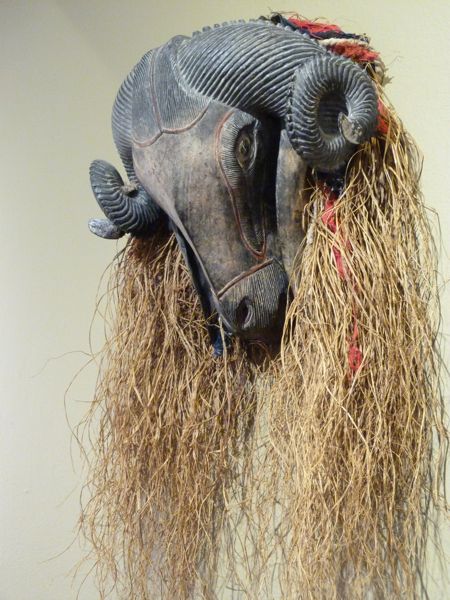

These were so different from the other masks presented, clearly a different tribal group, different aesthetics. I called them the zombie masks for their very grey, formless, chaotic nature, and the black circle eyes:


The textiles on the walls were not identified, but we immediately recognized this sizzling textile as identical to a bedspread we had on our bed at the Grumeti Camp when we were there on the Following the Great Migration trip we took with CC Africa, now called And Beyond:

(This is not in the Pensacola Art Museum; this is our bed in the Grumeti Camp, where you can see the bedcover folded at the end; same amazing cloth:)


Late lunch at our favorite go-to local deli, the East Hill Market, and home – a very satisfying day altogether.
Recent Comments
Kitchen on Isiais: Winding Down intlxpatr on Shampoo Ginger tigerbutterya0c5ff1d… on Shampoo Ginger intlxpatr on British Soldier Kidnapped, Esc… John on British Soldier Kidnapped, Esc… Wikipedia Donate Button

Amazina


Early Voting in Florida


