Qatar, the Magical Kingdom
I just finished watching the 13 minute segment 60 minutes showed this last weekend on Qatar:
Oh, to be in the Souk al Wakif in January / February. My Doha buddies and I are getting together next weekend; if only we could have breakfast once again together at the Beirut. We truly enjoyed our years in Qatar.


It was fun seeing the shiny sparkly skyline, only five or six of those buildings were there when we arrived in January of 2003. When my husband used to travel to Doha in the ’80’s, it was called “sleepy little Doha” or even “Doh-ha-ha-ha” but no one is laughing at Doha any more, and sleepy little Doha has gone uptown in a big way.

The Emir used to carry a lot more weight – literally. He looks good, he looks healthier and more fit, and consequently younger, and more vital. I’m betting he has the Sheikha Moza to thank for that; don’t we all nag our husbands a little to encourage them to take care of themselves? We want them to live a long, healthy life.

Not a single mention of the Sheikha Moza in the entire segment, nor of her influence in the creation of the Qatar foundation, bringing reputable American and Canadian universities to Qatar, the creation of the Islamic Museum of Art, the face-lift to the Souk al Waqif, the creation of the symphony. Not a mention of her influence on the schools, the health system, the modern face of Qatar.

Only a passing reference to the appalling conditions under which the laborers work in Qatar, treated like animals, worked to the bone. Not a mention that many of those glorious buildings don’t meet any codes, that proper building standards have not been enforced, and that the standards for safety are noticeable in their absence. Not a mention of the malls where the laborers are not allowed on Fridays, their only day off, or the beatings they get if they wander into the Souk al Waqif. The miracle of this richest city on earth is built on the back of the Indians, Philipinos, and Nepalese who sacrifice health, family and comfort to be able to send something back in hopes that their children will be educated and live better lives.

Not a mention of the concerns among the conservatives that Qatar has modernized too fast, that traditional standards are not being respected, that English is the language spoken in all the stores, not Arabic. Not a mention that this ‘richest nation on earth’ is now also the fattest nation on earth, that the Qatari children are suffering obesity, and are greatly raised by the household help. Not a mention of the crisis of intermarriage, and the tragic health problems the children suffer from inbreeding. The 6 minute segment showed a Qatar that was all shine and glitter, and none of the dark underbelly.

Grandparents Move Near Children and Grandchildren
Fascinating article published this week in the AOL News Huffpost section on Life and Style on a growing trend for people in the grandparent stage of their lives to uproot, sell the family home and move to be near their children and grandchildren while the grandchildren are little.
Karin Kasdin, Author, ‘Oh Boy, Oh Boy, Oh Boy: Confronting Motherhood, Womanhood and Selfhood in a Household of Boys’
Grandparents Uprooting Their Lives to Move Near Grandchildren
Edye was the first to leave. In her late 50s, she sold her home, packed her belongings and her cats, and left her close circle of friends to pursue a relationship and a job three states away from those who love her most. My inelegant and somewhat selfish response was, “Seriously? In late middle age you’re going to LEAVE ME AND START ALL OVER?”
Apparently her answer was “yes,” because she lives in Chicago, and I live near Philadelphia. She owns a house that she renovated from the floorboards up, and she has meaningful work she loves. It’s been a decade since the big move, so it’s almost time for me to accept the fact that this could be a permanent situation. And I would accept it, if it weren’t for another fact … the fact that she now has a grandson on the East Coast. She’s talking about how nice it would be to live near him. Grandchildren trump everything else, even best friends.
I know this because Elayne moved next. She moved to California permanently in order to enjoy her grandchildren’s formative years. After managing a bicoastal relationship with the kids for nine years, she simply could not bear the distance any longer. So off she went, leaving me bereft and confused.
“I suddenly realized I have very few years to spend with the kids before they become teenagers,” she explained to me one day as I sat in her kitchen crying into my tea. “When that day comes, they will prefer to spend time with their friends and I will become irrelevant.”
She was right. The frequency of her grandchildren’s visits had dwindled considerably over the years as the kids became engaged in school and neighborhood activities.
Gathering the fragments and memories of one’s entire adult life to begin anew in an unfamiliar place is not on most middle-agers’ to-do lists. But those lists were most likely compiled before we thought about grandchildren, and today baby boomer grandparents are moving in droves.
A recent AARP study revealed that 80 percent of adults 45 and older believe it is important to live near their children and grandchildren.
Nancy and Harm Radcliffe are among this number. After spending much of their adult lives living abroad, they returned to the United States and established a happy home in Bethesda, Maryland. In the 13 years they resided in Bethesda they made lifelong friends, became very involved in their church, and looked forward to spending their retirement years there.
Their plans were discarded in the blink of an eye when their daughter and son-in-law called from Philadelphia and hinted that they could use some help with their 7-year-old special needs son and his two siblings.
For Nancy, the decision was a no-brainer. She said, “As soon as I was off the phone, I asked myself, ‘Why am I here in Maryland when my daughter and three kids need me in Philadelphia?'”
Convincing her husband, Harm, to leave the Washington, DC area, was a bit challenging. He was retired and had fashioned a contented life for himself in Bethesda. Reluctantly, he agreed to the move and now says he has no regrets.
For the first two months the Radcliffes babysat 12 hours a day, five days a week. Their daughter, Laurel, works fulltime as a doctor. Today the Radcliffes spend three days a week engaged with their grandchildren. They like to give each child one full day alone with them.
Friends have been plentiful in their new neighborhood. “I don’t wait for people to come to me,” Nancy said. “I extend invitations to the neighbors. You have to be proactive with regard to making new friends.”
Sally Fedorchek followed her grandchild from Yardley, Pennsylvania to Austin, Texas when her son-in-law’s job took him there. It was a move she never expected to make, and it happened so quickly that she and her husband had little time to find a house.
“We found something reasonable. It’s not the perfect house, but the longer I’m in it, the more I like it,” she said. “At first it felt like this was just an extended visit. I had to keep reminding myself that I’m here permanently. I miss my friends back home, but not as much as I missed the kids when I was living in Yardley. I’m not worried about a new life. So far the kids have included us in everything. I’m well aware that won’t last and I’ve already made a list of activities I’d like to try.”
We boomers encouraged our kids to be independent. In many cases we sent them to college far from home. Our children have traveled more than we ever did at their age. Cellphones, Skype and email have made it possible for them to feel close to us even when they live a continent or two away. Sometimes the price we pay for the independence we granted our children is the disappointment we feel when they decide to leave the homestead for other adventures. If we want major roles rather than cameo appearances in our grandchildren’s lives, it becomes our burden to make that happen. Some of us choose to move. Others practically live on airplanes and manage their lives around their frequent flyer miles.
Susan Newman, PhD, a social psychologist and author of 13 books about family life, asks grandparents to consider the following questions before making the big move:
Is your child or his/her spouse likely to relocate in a year or two? Will you continue to follow them if their careers involve living in several different places?
How jarring would it be for you to move in terms of your own social network? Do you make friends easily? Can you give up the friends you already have?
Remember your adult children will have lives of their own. When they have commitments that don’t include you, will you feel cut off?
If you’re still working, what does the employment picture look like in the new location?
If you’re single, what activities will be available to you?
I am no longer confused by Elayne’s move. Still sad, but not confused. I know exactly why she did it. At the moment, I have a 6-month-old granddaughter and a one-month lease on an apartment in California. We’ll see how it goes.
We did this. After carefully planning our retirement, when our son told us they were going to have a baby, suddenly all our former plans paled in comparison to being near our son, his wife and coming baby. Within months, we had bought a house in an area we had never considered living, and had begun a life totally different from that we had envisioned.
There are risks. Especially in this economy, things can change. For us, it was a calculated risk – we kept our house in Seattle, because it’s there, if we ever want to live in Seattle, and meanwhile brings in income as a rental house. We calculated that while our son and his wife have adventuresome spirits, that she also has a lot of family in this area, and the odds are, at least in the early years of marriage and child-bearing, that they will stay put long enough for our investment in living here to pay off in terms of growing a solid relationship with our son as an adult, his wife, and our grandchild(ren), before he/they hit(s) those independent pre-teen and teenage years.
We had actually spent some time in Pensacola, through the last five years, visiting our son. We knew there was a church here we liked, and I knew there was a quilting group. We knew the cost of living was within our means, and that there were military resources nearby. There were a lot of factors to consider, which we did, but the deciding factor was our commitment to being a part of an extended family.
My next younger sister and her husband recently made a similar decision, and I know they are as happy with their decision as we are with ours. Time passes so quickly, and we want to know our grandchildren, and to be a part of their lives. We are thankful that they feel the same way. 🙂 I find it interesting to know that we are part of a growing trend; we thought it was the influence of the Arab world on us, but it appears to be a part of a generational shift in paradigm.
Saudis Investigate Dancing Nurses
Unfortunately, I can no longer find the video sent me by John Mueller on U-Tube; it has been removed, but you can see it for yourself here:
What the Saudis are investigating – and yes, there were men and women present – is a game of musical chairs, a game even children play at birthday parties.
Hospitals are a high stress environment – and these are sweet young people having a good time. Lord have mercy, and “investigation.”
Saudi health authorities have opened an investigation into three films published on U-Tube showing Asian nurses dancing at a mixed-gender birthday party inside a government hospital.
The three separate films showed several male and female nurses were involved in the concert that included music and dances, which are strictly banned at Saudi hospitals and other public facilities.
The films showed the party was held at King Fahd Hospital in the eastern town of Hofouf and the participants were apparently from the Philippines and Indonesia, according to Saudi newspapers.
One film was titled in Arabic “a scandal at King Fahd Hospital in Hofouf” while the heading of another video read “in the absence of supervision at King Fahd Hospital”. The third read “a dancing party for a nurse’s birthday.”
“We have been instructed to open an investigation into these films to determine whether this party was really held at King Fahd Hospital,” said Ibrahim Al Hajji, information director at the Health Department.
Hajji, who was quoted by Sharq newspaper, did not elaborate on what measures would be taken against those involved in the party.
Emergency Message for U.S. Citizens 1-2012- Possible Gathering at the U.S. Embassy
Kuwait City, Kuwait
January 11, 2012
Please circulate the following message without additions or omissions
immediately to all U.S. Citizens within your area of responsibility.
There are reports of a possible gathering in front of the U.S. Embassy on
Wednesday, January 11, 2012 at approximately 7:00pm. The gathering may take
place near the main Embassy gate. An increased police and security presence
around the Embassy compound is expected.
Spontaneous and planned demonstrations take place in Kuwait from time to time in
response to world events or local developments. At times, even demonstrations
intended to be peaceful can turn confrontational and possibly escalate into
violence. Please avoid areas where demonstrations occur or are planned and
exercise caution if within the vicinity of any large gatherings. Please stay
current with media coverage of local events, be aware of your surroundings, and
practice personal security awareness at all times.
U.S. citizens traveling and residing abroad should enroll in the Smart Traveler
Enrollment Program (STEP) at the following website: https://travelregistration.state.gov.
U.S. citizens without internet access may enroll directly at the U.S. Embassy or
Consulate at their destination. By enrolling, U.S. citizens make it easier for
the Embassy to contact them in case of emergency.
Updated information on travel and security may be obtained from the Department
of State by calling 1-888-407-4747 toll-free in the United States and Canada or,
for callers outside the United States and Canada, a regular toll line at
1-202-501-4444. These numbers are available from 8:00 a.m. to 8:00 p.m. Eastern
Time, Monday through Friday (except U.S. federal holidays). For further
information, please consult the Bureau of Consular Affairs Internet website at
http://travel.state.gov where the Worldwide Caution and Country Specific
Information can be found. In addition, the Embassy encourages U.S. citizens to
review “A Safe Trip Abroad,” which includes valuable security information for
those traveling or living in foreign countries. You can also follow the Bureau
of Consular Affairs on Twitter and on Facebook.
The U.S. Embassy is located at Al-Masjid Al-Aqsa Street, Block 6, Plot 14,
Bayan, Kuwait. If you are a U.S. citizen in need of emergency assistance in
Kuwait, you may reach the U.S. Embassy by calling +965-2259-1001 and requesting
the duty officer.
U.S. citizens in Kuwait who would like to receive future Emergency and
Informational Messages from the Embassy directly by e-mail may sign up for this
service by sending an e-mail to the following address: join-wardenmessagekuwait@mh.databack.com
This message may be accessed on the Embassy website, http://kuwait.usembassy.gov
Please note that the Consular Section is closed for U.S. and most local
holidays. The current holiday schedule for 2011 is posted on
http://kuwait.usembassy.gov/holidays.html.
Tinker Tailor Soldier Spy

We couldn’t wait. We saw the earlier version of Tinker Tailor Soldier Spy, you know, the one with Alec Guiness, and we couldn’t wait to see this new version, with Gary Oldman playing the Smiley role. He was awesome.
The LeCarre’ books featuring George Smiley are grim and grey, and the opening captures that exactly. The entire movie has a bureaucratic, institutional bleakness, with all the power plays, the petty snobberies, the jockeying for position that these bureaucracies seem to nurture. The only times in the movie when there is color and life is the annual bureau party, once done entirely in Russian, once in French.
The movie is faithful to the book, which I think I need to go back and read once again. It all seems so historical now.
One of the things we noticed was that the theatre was utterly quiet as the movie progressed. A lot of the action is in the mind, figuring things out, and trying not to get caught, so the suspense is of the subtle kind, not the car-crashing and jumping off buildings kind. It was as if the entire theatre were holding its breath; noticeable because of its rarity.
We were oddly jangled as we left the theatre, and over dinner we talked about how we never thought we would be obsolescent, but the Cold War has passed; the soldiers of today weren’t even alive when the Berlin Wall came down and the Iron Curtain parted and the cars flowed east. Life goes on.
There were several quotes, one that made us laugh was spies talking about recruiting other nationalities “You can hire an Arab but you can’t buy ’em.”
Helping Others, Help Yourself
I found this article this morning in an e-mail from Bottom Line, and it rings true to me. When AdventureMan was in the military, there were social events I was obligated to attend. I often felt so much reluctance I just wanted to go to bed; just the thought of the events made me tired. Then I discovered a secret – when I got there, to look for someone shy, and to go over and talk with them. There was always someone, and it made all the difference – to me!
It feels good to be a Good Samaritan, of course. But there’s more to the story—because science reveals that being of service to others brings numerous health benefits. Maria E. Pagano, PhD, an associate professor of psychiatry at Case Western Reserve University School of Medicine in Cleveland, has investigated the helper therapy principle (HTP), which is based on the concept that when people help others, they are also helping themselves—particularly when the helper and the recipient of that help share a common malady. Alcoholism Treatment Quarterly published her recent review article on the topic. Among the evidence cited were studies showing that…
- People with chronic pain who counseled other pain patients reported a significant decrease in their own symptoms of pain and depression.
- Multiple sclerosis (MS) patients who were trained to have monthly 15-minute supportive phone conversations with other MS sufferers showed improvement in self-confidence and self-esteem as well as reduced depression.
- Alcoholics who helped other alcoholics were almost twice as likely to stay sober in the year following treatment…had lowered levels of depression in the three months after they started helping other alcoholics…and had significantly improved self-image. Dr. Pagano explained, “Helping others with a desire to live sober transforms the helper’s dark past and pain to greater good and enables him or her to be uniquely helpful to a fellow sufferer.”
While service to fellow sufferers is a cornerstone of 12-step programs of recovery, such as Alcoholics Anonymous, Dr. Pagano noted that it is not necessary to share a common health problem in order to benefit from doing good. For instance, helping others in general has been linked with longer life, less depression, higher self-esteem and greater life satisfaction.
Bottom line: For a “helper’s high” and a significant health boost, lend a helping hand to someone in need.
Maria E. Pagano, PhD, is a psychologist and an associate professor of psychiatry at Case Western Reserve University School of Medicine in Cleveland. She also is a recipient of a career development award funded by the National Institute on Alcohol Abuse and Alcoholism. www.HelpingOthersLiveSober.org
US Navy Rescues Iranian Fishermen from Somali Pirates
I love this story. I found it on AOL News / Huffington Post; it’s an Associated Press Story.:
WASHINGTON — The political tensions between the U.S. and Iran over transit in and around the Persian Gulf gave way Friday to photos of rescued Iranian fisherman happily wearing American Navy ball caps.

The fishermen were rescued by a U.S. Navy destroyer Thursday, more than 40 days after their boat was commandeered by suspected Somali pirates in the northern Arabian Sea. The rescue came just days after Tehran warned the U.S. to keep its warships out of the Persian Gulf – an irony not lost on U.S. officials who trumpeted the news on Friday.
“We think it’s very doubtful that the Iranians or the pirates were aware of recent events of the last couple days,” Rear Adm. Craig S. Faller, commander of the U.S. Navy Carrier Strike Group involved in the rescue, told reporters by phone Friday. “Once we released them (the fishermen) today they went on their way very happily, I might add, waving to us wearing USS Kidd Navy ball caps.”
Faller, speaking from the aircraft carrier USS John C. Stennis in the Arabian Sea, said the fishermen, who had been living off the fish they could catch, expressed their thanks and are believed to be headed back to their homeport in Iran.
The rescue was carried out by American forces flying off the guided-missile destroyer USS Kidd, after crew on the Iranian fishing vessel, the Al Molai, made it clear they were in trouble.
The USS Kidd, part of the Stennis carrier group, was sailing in the Arabian Sea, after leaving the Persian Gulf, when it came to the sailors’ aid. It was alerted to the hostage situation when the captain of the fishing boat spoke by radio to the Americans in Urdu – a Pakistani dialect that he hoped the pirates near him would not understand – and managed to convey that he needed help.
A U.S. Navy team helicoptered to the ship, boarded it without any resistance, and detained 15 suspected Somali pirates. They had been holding the 13-member Iranian crew hostage and were using the boat as a “mother ship” for pirating operations in the Persian Gulf.
“They were scared,” U.S. Navy Cmdr. Jennifer L. Ellinger, commander of the USS Kidd, said of the Iranians. “They pleaded with us to come over and board their vessel, invited us to come over. And we reassured them that we would be on our way.”
Amid escalating tensions with Tehran, the Obama administration reveled in delivering the news.
“This is an incredible story. This is a great story,” State Department spokeswoman Victoria Nuland said, explaining that the very same American ships the Islamic republic protested for recently traveling through the Strait of Hormuz were responsible for the Iranian vessel’s recovery.
“They were obviously very grateful to be rescued from these pirates,” Nuland said.
The episode occurred after a week of hostile rhetoric from Iranian leaders, including a statement by Iran’s Army chief that American vessels are no longer welcome in the Gulf. Iran also warned it could block the Strait of Hormuz, the strategic waterway that carries to market much of the oil pumped in the Middle East.
The Iranian threats, which were brushed aside by the Obama administration, were in response to strong economic sanctions against Iran over its disputed nuclear enrichment program. Last week, President Barack Obama signed into law new sanctions targeting Iran’s Central Bank and its ability to sell petroleum abroad.
According to Faller and Ellinger, the incident began Thursday morning when the Navy got a distress call from a Bahamian-flagged ship, and saw six individuals in a small boat next to it, throwing what appeared to be weapons into the water. They checked but found no evidence of piracy, so they released the small boat, but followed it by helicopter.
The small boat headed back to the Iranian-flagged ship, where U.S. Navy officials said it looked like there were both Middle Eastern and Somali on board.
The radio conversation with the Iranian captain made it clear his crew was under duress, so the USS Kidd launched a Navy search and seizure team. The suspected pirates hid on the ship, but the Iranian crew told the team where they were, Ellinger said, adding that the pirates surrendered quickly.
“The Al Molai had been taken over by pirates for roughly the last 40-45 days,” said Josh Schminsky, a Navy Criminal Investigative Service agent aboard the Kidd. “They were held hostage, with limited rations, and we believe were forced against their will to assist the pirates with other piracy operations.”
Schminsky said the Iranian boat’s captain thanked the U.S. for assistance. “He was afraid that without our help, they could have been there for months,” Schminsky said in a prepared release.
The U.S. team gave the crew food, water and medical care, and on Friday morning they moved the captured pirates to the Stennis. They will remain there while the U.S. considers options for prosecution and consults with other nations that have joined forces against piracy.
“Sadly, this is not a new thing,” Nuland told reporters, citing more than 1,000 pirates picked up at sea who are under prosecution in some 20 countries. “So this is always a question of where to send them and who will do the prosecution.”
Asked if the rescue mission could provide a chance for a thaw in relations with Iran, Nuland declined to comment. She said the Navy had made a “humanitarian gesture” to take the Iranians onboard, feed them and ensure they were in good health before setting them off. She said the U.S. and Iranian governments have had no direct contact over the incident.
Defense Secretary Leon Panetta called Faller on Friday to congratulate him on the rescue, adding that, “When we get a distress signal, we’re going to respond. That’s the nature of what our country is all about.”
Insecure
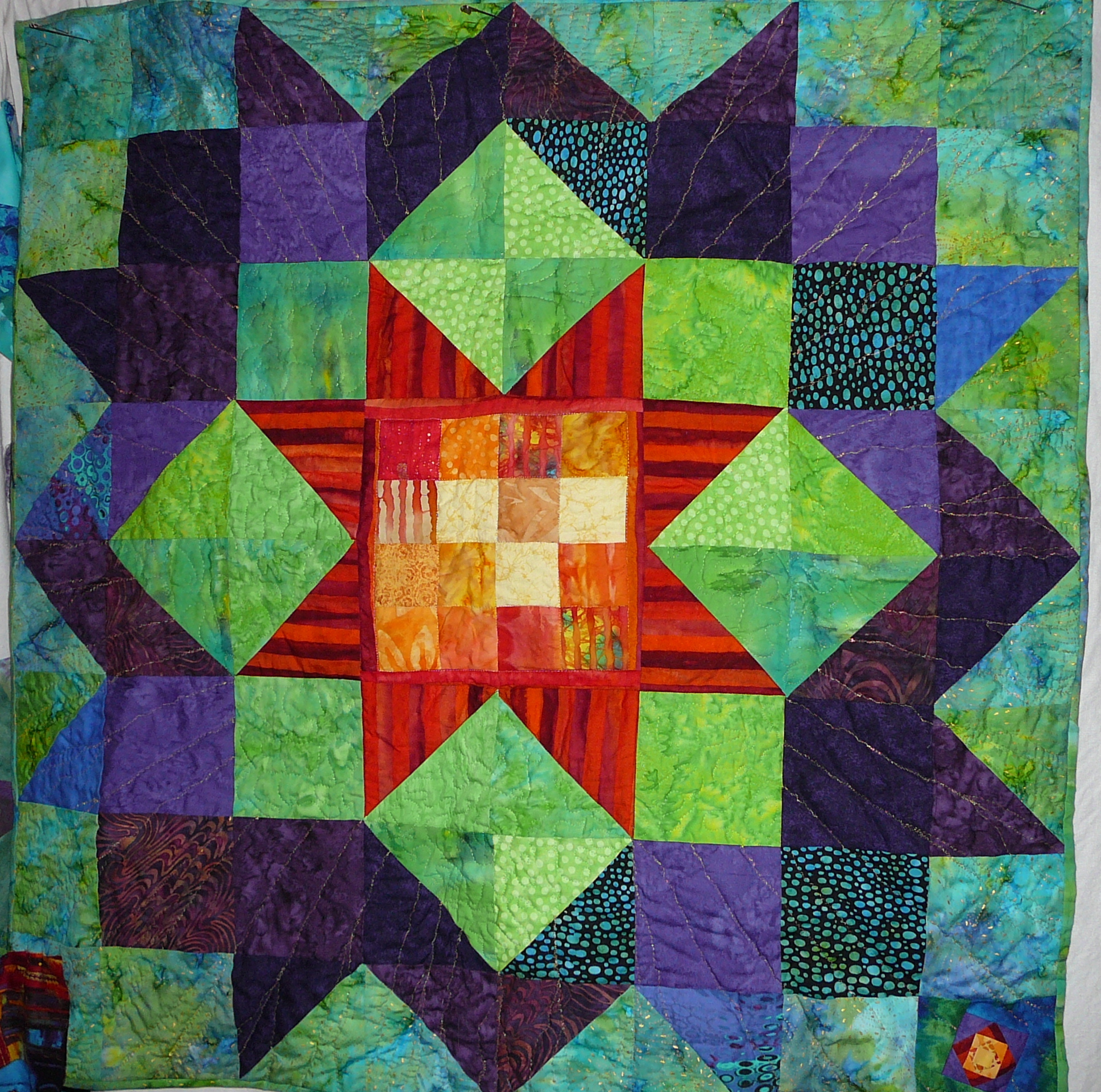
How can I be this ripe old age and still suffer from insecurity? Thanks be to God, it isn’t often, actually only a couple situations. I always joke that when I visit my Mom, I gain ten pounds on the way, and feel huge as I waddle off the plane. Flying back home, those new pounds miraculously disappear. I know it is all in my imagination, and knowing that doesn’t help.
There is a competition coming up, a quilt show, and I am trying to get a couple entries ready. One design I knew would be a snap, I’ve done all the various parts a hundred times before (well, many times anyway) but this time I am painfully aware if points don’t match up or placement is not perfect. It is costing me time, crucial time for the preparations, as I rip out and re-do, sigh, rip out again and re-do. Just when I think I have it licked, I see something else that needs a re-do.
I know that the problem is that I am looking with a critical eye of the most critical judge. Most of the time my quilts are for babies, or friends, or family, and while they may be flawed, my family and friends love me and love my quilts, and they live happily ever after. It’s only when I know the quilts will be compared to other quilts, other, more painstaking and meticulous quilters, that I start to quail and flounder.
When I teach, I tell my students “this is supposed to be fun! Have fun with it! If you struggle too long, set it aside and come back; a solution will appear.” I teach tricks to cover flaws, I build their self-confidence, I show them how to attain ‘good enough’.
I am my own worst critic. I just have to fight discouragement and defeat at the hands of my inner critic.
(The quilt at the top is not one of the entries; it is a quilt I did for an earlier competition.)
Moslems and John the Baptist
In Damascus, in one of the most famous mosques, in the very center of the ancient city, is a special area of worship devoted to John the Baptist (in Arabic, Yahyah). As I was reading the readings for today in The Lectionary, I wondered, once again, why such reverence from our Islamic brothers and sisters?

I went looking, and found this in the SoundVision website, a religious website for English speaking Moslems:
John: A Prophet of Islam
Amongst the 25 Prophets mentioned by God in the Quran, one name is Prophet John (peace be upon him). In Arabic, his name is Yahya. He is also a Prophet who figures prominently in Christianity, where he is known as John the Baptist. His story in the Christian tradition is described in Bible Luke 1:5-22.
In Islam, belief in all of Allah’s Prophets is a fundamental article of faith. A person who denies belief in any of the Prophets, be it Jesus (peace be upon him) Moses (peace be upon him), or any of the others leaves the fold of Islam.
His miraculous birth
Prophet Jesus was not the only Prophet who was born miraculously. By miraculous, we mean outside of the normal process of human reproduction Allah has ordained which requires a man and a woman to conceive a child. In the case of Jesus, this meant being born of a mother but no father.
But Prophet Adam (peace be upon him)’s birth was even more miraculous in this sense since he was created with no mother or father. Similarly, Hawwa or Eve (may Allah be pleased with her) was created from a man, her husband, and no parents.
The birth of Prophet John is miraculous because he is the offspring of a barren mother and an elderly father. His father, it should be noted, was also a Prophet named Zecheriah.
“‘Zecheriah, We bring you the good news of the birth of a son whose name shall be John, one whose namesake We never created before.’ He said: ‘My Lord! How can I have a boy when my wife is barren and I have reached an extremely old age?’ He answered: ‘So shall it be.’ Your Lord says: ‘It is easy for Me’, and then added: ‘For beyond doubt, I created you earlier when you were nothing’ (Quran 19:7-9).
“Zecheriah exclaimed: ‘My Lord! How shall I have a son when old age has overtaken me and my wife is barren?’ He said: ‘Thus shall it be; Allah does what He wills'”(Quran 3:40).
With the birth of John, Allah granted Zecheriah his desire for an heir.
“And We bestowed favor upon Zecheriah, when he cried to his Lord: ‘Lord! Leave me not solitary [without any issue]. You are the best Inheritor.’ So We accepted his prayer and bestowed upon him John, and We made his wife fit (to bear a child). Verily they hastened in doing good works and called upon Us with longing and fear, and humbled themselves to Us” (Quran 21:89-90).
The beautiful qualities of John
Allah did not just miraculously grant Zecheriah a son. He made this child a blessing for his parents and beautiful in character. Prophet John is described in the Quran as chaste and righteous.
“Then Zecheriah prayed to his Lord: ‘O Lord! Grant me from Yourself out of Your grace the gift of a goodly offspring, for indeed You alone heed all Prayers. As he stood praying in the sanctuary, the angels called out to him: ‘Allah gives you good tidings of John, who shall confirm a command of Allah, shall be outstanding among men, utterly chaste, and a Prophet from among the righteous” (Quran 3:38-39).
“‘O John! Hold fast the Book with all your strength. We had bestowed wisdom upon him while he was still a child; and We also endowed him with tenderness and purity; and he was exceedingly pious and cherishing to his parents. Never was he insolent or rebellious. Peace be upon him, the day he was born, and the day he will die, and the day he will be raised up alive. (Quran 19: 12-15).
Part of a line of honored Prophets
Finally, as mentioned above, Prophet John is one of the Prophets Muslims must believe in. He is one of the 25 mentioned in the Quran.
“And We bestowed upon Abraham (offspring) Isaac and Jacob and each of them did We guide to the right way as We had earlier guided Noah to the right way; and (of his descendants We guided) David and Solomon, Job, Joseph, Moses and Aaron. Thus do We reward those who do good. (And of his descendants We guided) Zecheriah, John, Jesus and Elias: each one of them was of the righteous.” (Quran 6:84-85).
The following section is from Wikipedia:
John is also honored as a prophet in Islam as Yaḥyā ibn Zakarīyā (Arabic: يحيى بن زكريا), translated literally as “John, son of Zechariah”. He is believed by Muslims to have been a witness to the word of God, and a prophet who would herald the coming of Jesus.[64] His father Zechariah was also an Islamic prophet. Islamic tradition maintains that John was one of the prophets that Muhammad met on the night of the Mi’raj,[65] his ascension through the Seven Heavens. It is said that he met John and Jesus in the second heaven, where Muhammad greeted his two ‘brothers’ before ascending with archangel Gabriel to the third heaven. John’s story was also told to the Abyssinian king during the Muslim refugees’ Migration to Abyssinia.[66] According to the Qur’an, John was one on whom God sent peace on the day that he was born and the day that he died.[67]
[edit]Name
John’s name in Arabic, Yahya, was present in Arabia before the Qur’an was revealed.[68]Muslim exegetes frequently connected the name with the meaning of “to quicken” or “to make alive” in reference to John’s mother’s barrenness, which was cured by God, as well as John’s preaching, which, as Muslims believe, “made alive” the faith of Israel.[69] The Qur’an accords the significance of John’s name to the fact that it was a new name for mankind, in that no one previously had been named “John”.[70] Other scholars hold that John’s name, which they state connects with the meaning of “He shall live”, referred to his legacy, in that his memory will remain in the mind of the faithful for the generations to come.[71]
[edit]John in the Qur’an
In the Qur’an, God frequently mentions Zechariah’s continuous praying for the birth of son. Zechariah’s wife, mentioned in the New Testament as Elizabeth, was barren and therefore the birth of a child seemed impossible.[72] As a gift from God, Zechariah was given a son by the name of “John”, a name specially chosen for this child alone. In accordance with Zechariah’s prayer, God made John and Jesus, who according to exegesis was born six months later,[73] renew the message of God, which had been corrupted and lost by the Israelites. As the Qur’an says:
(His prayer was answered): “O Zakariya! We give thee good news of a son: His name shall be Yahya: on none by that name have We conferred distinction before.”
He said: “O my Lord! How shall I have a son, when my wife is barren and I have grown quite decrepit from old age?”
He said: “So (it will be) thy Lord saith, ‘that is easy for Me: I did indeed create thee before, when thou hadst been nothing!'”
(Zakariya) said: “O my Lord! give me a Sign.” “Thy Sign,” was the answer, “Shall be that thou shalt speak to no man for three nights.”
—Qur’an, sura 19 (Maryam), verse 7[74]
John was exhorted to hold fast to the Scripture and was given wisdom by God while still a child.[75] He was pure and devout, and walked well in the presence of God. He was dutiful towards his parents and he was not arrogant or rebellious. John’s reading and understanding of the scriptures, when only a child, surpassed even that of the greatest scholars of the time.[72] Muslim exegesis narrates that Jesus sent John out with twelve disciples,[76] who preached the message before Jesus called his own disciples.[73] The Qur’an says of John:
(To Zachariah’s son came the command): “O John! take hold of the Book with might”: and We gave him Wisdom even as a youth,
—Qur’an, sura 19 (Maryam), ayah 12[75]
John was a classical prophet,[77] who was exalted high by God, for his bold denouncing of all things sinful. Furthermore, the Qur’an speaks of John’s gentle pity and love for all creatures and his humble attitude towards life, for which he was granted the Purity of Life:
And piety (for all creatures) as from Us, and purity: He was devout,
And kind to his parents, and he was not overbearing or rebellious.
So Peace on him the day he was born, the day that he dies, and the day that he will be raised up to life (again)!
—Qur’an, sura 19 (Maryam), ayah 13-15[67]
John is also honored highly in Sufism as well as Islamic mysticism, primarily because of the Qur’an’s description of John’s chastity and kindness.[78] Sufis have frequently applied commentaries on John’s passages on the Qur’an, primarily concerning God-given gift of “Wisdom” which he acquired in youth as well as his parallels with Jesus. Although several phrases used to describe John and Jesus are virtually identical in the Qur’an, the manner in which they are expressed is different.[79]
Excitement at the Apple Market
“This is what happens when you live in a state where every other person is carrying a handgun,” AdventureMan grumbled as we left the Apple Market.
We had been to see the new Sherlock Holmes Movie, Game of Shadows, (really action packed, by the way, and entertaining) when we remembered we needed milk. The Publix parking lot, shared with Toys R Us, is totally gridlocked on this Wednesday night before Christmas, and we figure the Winn Dixie, shared with Target, Michaels, etc. will be another gridlock. Although the Apple is out of the way, we always love to stop at the Apple Market.
As we are heading into a light, we hear sirens. We pull over (it’s the LAW) and two police cars go wailing past.
“I hope it’s not the Apple Market,” I say.
The fog is thick as pea soup, and we drive a lot more slowly than usual. As we near the Apple market, we can see lots of lights – but they are at the CVS next door, four squad cars with their lights twinkling blue.
“Think it’s OK to go into the Apple Market?” I ask AdventureMan.
“Yeh – I see customers going in and out; I think it must be OK.”
We go in, make our purchases. As we are checking out, we overhear one customer telling another that “someone saw a guy breaking into a car and started yelling at him to stop. He got into his car and tried to run down the other guy but the guy SHOT at him!”
At this point, I don’t know who shot at whom. I don’t know if the situation was under control. There was a part of me that wished we weren’t at the Apple Market, because if there are people shooting guns (and did I mention it is really foggy?) some innocent bystander-customer could get hurt . . .

Recent Comments
ExpatAlien on What Country am I Living … intlxpatr on Yellowstone: Old Faithful to C… Michelle on Yellowstone: Old Faithful to C… Cathy on No Grown-Ups in Charge intlxpatr on Waiting for Snow Wikipedia Donate Button

Amazina


Early Voting in Florida


 Here There and Everywhere