Changes in the Air
“It’s still hot,” I said as we were coming out of the movie, “but can you feel a change in the air? Even though it’s hot, the air is changing, the light is changing – you can feel hints that Fall is coming . . . ”
We had just been to see “The Help,” and if you haven’t seen it yet, you need to make plans to see it soon. It is a really good movie, which will make you laugh, and cry, and remember that it wasn’t so long ago in our country when it took place. (You can read my review of the unforgettable book here.)
The movie is a serious movie, and at the same time, I loved the attention to detail – the hair, the fashions, the manners – all very 50’s, even though it is the 1960’s in Jackson, Mississippi.
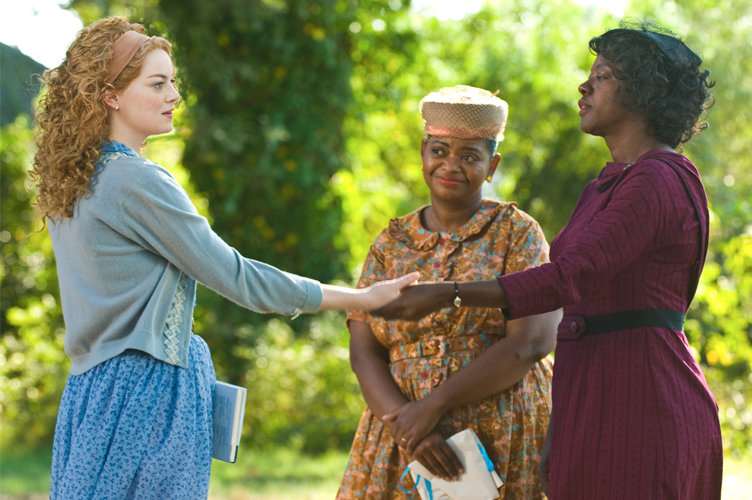
I remember reading this book in Qatar, just after I had moved back there from Kuwait. The Kuwait book club also read White Tiger and Half of a Yellow Sun, all of which had domestic service as at least part of the theme. It’s another one of those cultural things we all have in common – how do we treat the people who work for us? How do they see us? Who is raising our children and teaching them values?
In the Gulf, there are horror stories in the papers of servants who never receive their wages, or who work 16 hours a day, sun-up to sun-down, with never a day off. The families who take good care of their servants never make the papers, but I have seen good and caring relationships, lasting many years, between employers and employees. We’re glad we saw this movie, which sticks closely to the book. For a fuller experience – read the book.
Meanwhile, the temperature early this morning was below 69° F, which means that my tomatoes will begin setting once again and we may have a good crop coming before the cold sets in. I noticed, to my horror, I have a decent crop of weeds trying to establish themselves while it is too hot for me to go out and do battle with them. Some of my tomatoes actually continued producing even during the hottest days of the summer; I’m going to have to plant more of those next year. The golden pear and the red pear tomatoes are producing merrily; the bigger tomatoes have stopped – I hope temporarily.
Culture of Honor Shortens Lives
As I read this article, I thought about life growing up in a small town in Alaska, and how similar it was to life in Qatar and Kuwait, where you live all your life in one community and reputations, once ruined, are never lived down.
HealthDay News
For Men, ‘Culture of Honor’ Can Be Deadly
Mindset spurs risky behaviors and is most prevalent in U.S. South and West, study shows.
By Kathleen Doheny, HealthDay News
MONDAY, Aug. 15 (HealthDay News) — Psychologists call it the “culture of honor,” a mostly male mindset that places a high value on defending one’s reputation at any cost. But new research confirms that it’s linked with high rates of accidental deaths.
“People who embrace these values also report more risk-taking,” explained study author Dr. Ryan Brown, an associate professor of psychology at the University of Oklahoma, in Norman.
This dangerous male mindset is also more prevalent among those living in the South and West, in such states as South Carolina, Texas and Wyoming, he added.
In two studies published in the current issue of the journal Social Psychological and Personality Science, Brown looked at the consequences of such thinking.
First, he compared rates of accidental deaths (car accidents, drowning, over-exertion and so on) in all U.S. states. He found the so-called “honor states” had higher rates than non-honor states (such as New York, Ohio, Wisconsin).
More than 7,000 deaths a year can be blamed on risk-taking linked with the “culture of honor,” he said.
The behavior was most common in more rural areas of the honor states, he found. In the cities of honor states, he found a 14 percent higher accidental death rate than in the cities of non-honor states. He found a 19 percent higher rate in the smaller towns of honor states compared to non-honor states.
“In a smaller town, your reputation is much more important,” he said. It’s likely that everyone knows your business, and that could be good or bad for your reputation, he explained.
In a second study, Brown surveyed 103 college students from his university, including 79 women.
The participants completed tests measuring how much they subscribed to the culture of honor, finished a self-esteem test and answered questions about their tendencies toward risk-taking behavior. A sample statement to which they agreed or not was: “A real man doesn’t let other people push him around.”
The more the person subscribed to a culture of honor, the more likely they were to engage in risky behaviors, the findings showed.
The effect was there for women, too, Brown said.
He and others have previously noted that this culture of honor originated with the Ulster Scots (mistakenly sometimes called the Scotch-Irish) who came to the United States during the 18th century.
In their homeland, he said, they were herders and were always being invaded by someone. They learned to protect and defend themselves, not always in ideal ways. A typical statement, Brown noted: “You take one of our cows, we will take your whole herd.”
The culture of honor behavior persists, he said, despite the disappearance of the herds.
It has staying power, Brown added, and is fostered through norms and values about masculinity and femininity. It’s the stuff of country songs, he explained.
That makes sense to Richard Nisbett, the Theodore M. Newcomb Distinguished Professor of Psychology at the University of Michigan. He is the author of Culture of Honor: The Psychology of Violence in the South.
In the past, Nisbett explained, “if you kept animals for a living, you ran the risk of having your entire livelihood taken away [if someone opens the pasture gate, for instance].”
In modern times, “if you stand the risk of losing your livelihood easily and the state is not around to protect you, you are going to develop this kind of culture of honor,” Nisbett said.
There’s more to it than showing off for women, although that is part of it, he added. It is also, for a man, showing other guys your toughness.
While Brown’s research and that of others clearly shows that some states aren’t honor states, Nisbett said that the behavior is kept going partly by the false belief that everyone else subscribes to the same mindset.
“We tend to think of the culture of honor as historical,” said Joe Vandello, an associate professor of psychology at the University of South Florida. But, “elements of this culture of honor still exist today.”
Simply becoming aware of the phenomenon might help reduce the behavior, Brown noted. Even though it can become “part of your programming,” he said, “we have a will, we have a choice.”
Learn more in the Everyday Health Emotional Health Center.
Arabian Gulf Legacy
In today’s Lectionary, Psalm 107, there is the following verse:
41 but he raises up the needy out of distress,
and makes their families like flocks.
My heart goes back to Qatar, and I think of “my” family there, a family who adopted me, slowly but surely. The woman, who taught me Arabic, has twelve children. “Twelve children!” I used to think, was about ten too many, but I learned so much from this woman, and from her family. Every day she and her husband would sit together. They discussed each child. No child in that family was lost or overlooked; they cared for each and every one. I, too, know each child. I was particularly close to the oldest girls, but there was one young son who hit me on my bottom during my very first visit, hard, as I was bending over to put on my shoes. While everyone else looked on in horror, he just grinned up at me, and I couldn’t help but laugh. I pray for each and every one in this family, and they pray for me. Relationships don’t get much more intimate than that, I think, that we pray for one another, and we have some idea what to pray for.
And while they are not wealthy, they have enough, and they are a happy family. When one has a need, the others sacrifice, and I never hear a grumble of a complaint. Each has an assurance that when their turn comes – as it comes to all of us – their family will be there to assist them.

We said goodbye to our Saudi friends this week, on their way back to the desert kingdom to finish Ramadan and celebrate Eid with their family. They have been such a blessing in our lives here, and we wish them well. They left a lot of last minute things for me, a coffee and tea set with coffee cups, trays for serving drinks, spices, bags – the detritus of a life of moving, there are always things which still have use but for which you have no room in your packing crate. I am starting a lending closet with them; as other families arrive, I will offer them up to new arrivals who need the same pieces for their daily life and entertaining. The spices I will share with one of my co-mother-in-laws who makes a chicken biryani they call Chicken Perlow. It is moister than biryani, but has much the same flavor. Oh yummm.
As our Saudi friends depart, we have new friends arriving and we will have them for dinner tomorrow night. We have met them, one is Algerian, the other is Omani; as the Ramadan fast ended, the Algerian was trying to eat a piece of bruschetta with a knife and form. “You are so French!” I laughed, and told him we eat this with our fingers, which greatly relieved him, as he was standing, and to try to cut a piece of French break with a fork while standing is close to impossible. Both are a lot of fun, and while we will miss our departing Saudi friends, we are looking forward to these new friends.
One thing that pleases me greatly. I asked my Saudi friend how she was received when she went out, as she is fully covered, abaya and scarf and niqab (face covering). She said she had been warned before leaving Saudi Arabia that people would be unkind to her, but never once did she run into this, that people were always kind, “in the hospital, in the Wal-Mart, in the shopping, everywhere.” It just made me so proud to be living in Pensacola.
Surprising Secrets to Happiness
Received this in an e-mail this morning from Bottom Line, a service we have subscribed to for many years because they report some of the newest findings in concise and readable articles:
Surprising Secrets from the World’s Happiest People
Dan Buettner
We’ve all heard that “wealth doesn’t buy happiness.” Neither, it turns out, does social status, youth or beauty.
Social scientists have collected tens of millions of data points that help identify what truly makes people happy. Genetics and life circumstances can influence happiness, but personal choices account for about 55% of it. That means we all have more control over our happiness than we may realize.
National Geographic author and explorer Dan Buettner spent five years talking to people in areas identified by researchers as the world leaders in happiness—Denmark’s Jutland Peninsula… Singapore…Nuevo León, Mexico … and the town of San Luis Obispo in California.
In his new book, Thrive, he identified the main characteristics of what he calls thrivers, people who consistently report the highest levels of well-being. Here, secrets from the world’s happiest people…
Own one TV, no more. Americans spend more than four hours a day, on average, in front of the television. This is time that they’re not spending with other people, including their families. (Family time in front of the television is not the same as real interaction.)
In the places where happiness is highest, people spend the least time watching television. It’s not that they never watch—they just watch less than most people.
I advise people to own no more than one television—and to keep it in an out-of-the-way place, such as the basement. You still can watch your favorite programs, but watching will become a deliberate activity, not something you just do automatically.
Create a “flow room.” In Danish society, most families have an area in the house where everyone naturally congregates. I call these rooms “flow rooms” because they’re places where time seems to flow away when people are engaged and enjoying one another’s company. Flow rooms have no screens (TVs or computers) and no clocks. They are quiet environments where it’s easy to engage in meaningful activities with family.
In our house, I chose a room with good lighting and the best views—it’s comfortable, and everyone in the family wants to be there. I keep it stocked with good books, musical instruments and the best family games.
There’s nothing formal about our gatherings. People wander in and out. Because it’s so pleasant, we spend a lot more time there than in front of the TV or separated in different parts of the house.
Experience the “sun bonus.” By most standard measures, people in Mexico should be less happy than those in other countries. About 60% of the population is poor. Education and health care are less than optimal. Yet on the happiness scale, Mexico ranks high.
This is partly due to the “sun bonus.” People in sunnier climates are consistently happier than those who live in northern countries.
Those of us who live in colder, less sunny climates still can take advantage of the sunny days we do have by getting out and enjoying the sun. The vitamin D that is produced in the body from sun exposure is sometimes called the “happiness vitamin” because it increases brain levels of serotonin, the same neurotransmitter that is increased by some anti-depressant medications.
Stop shopping. The satisfaction that we get from buying things—an expensive watch, a new suit, a fancy car—wears off within 14 months. Yet in the US, we’re pressured by the media and social expectations to always want more. In order to get it, we have to work longer hours and take fewer vacations, which generally reduces happiness.
In Denmark, regulations limit the number of hours that shops can be open. In Mexico, most of the inhabitants are not running a status race with their neighbors.
For more happiness, take the money that you could spend on nonessential items and spend it on something that lasts. For example, take a vacation with your family or sign up for a painting class. The experiences and good memories will continue to give satisfaction for the rest of your life.
Employ yourself. Self-employed workers and business owners report some of the highest levels of well-being. It may be because they are more likely to pursue work that they love or simply because they feel more in control.
The happiness zone of San Luis Obispo, California, has far more self-employed people per capita than the average community in the US. These self-employed workers are shop owners, graphic designers, artists, wine-makers and the like. The more autonomy and control you have over your job, the more likely you will be satisfied with your work.
Make new friends. People around the world report higher levels of satisfaction when they spend time with family and friends. Every additional friend that you make (assuming that these friends are upbeat) increases your chances of being happy by 9%.
People who get together with others for at least seven hours a day have the highest levels of happiness. That sounds like a lot, but the time quickly adds up.
For example, everyone eats lunch. Ask a coworker to join you, or sit with a group in a cafeteria. Talk with friends during coffee breaks. After work, encourage the family to eat and socialize together, rather than dispersing to separate rooms. Take classes or join a club.
The Danes don’t identify themselves as being particularly outgoing, yet 19 out of 20 Danish adults belong to clubs dedicated to arts, exercise and hobbies.
Get addicted to this. The happiest people almost always volunteer in some fashion—at their church, with environmental groups, for social-service organizations and the like. Volunteering means spending time with others, and it also takes your mind off your own problems and increases self-worth and pride in your community.
Studies have shown that altruism has an effect on the brain that is similar to that of sugar and cocaine. It creates feelings of well-being, along with an addictive feedback loop that encourages people to keep doing it.
Also, volunteers are healthier. They tend to weigh less than those who don’t volunteer, and they’re even less likely to suffer a heart attack.
Commit to volunteering for a set period of time—say, once a week for four weeks. People are more likely to keep doing it when they make this initial commitment—and then get “hooked” on the rewards.
Keep the faith. Religious people tend to be happier than those without faith. It’s not clear whether religion makes people happy or if happy people tend to be drawn to religious practices. Either way, those who are religious have less disease, live longer and are less likely to engage in dangerous behavior (such as smoking and heavy drinking).
In Mexico, for example, more than 80% of people who were asked, “How important is God in your life?” responded with a 10 on a scale of one to 10, compared with only 58% in the US. This helps explain why people in some parts of Mexico, despite the hardships of daily life, tend to thrive emotionally.
Even if you’re not religious, you can achieve similar benefits by cultivating a sense of spirituality—and a belief in giving back to your community and making the world a better place.
Bottom Line/Personal interviewed Dan Buettner, founder of Blue Zones, an organization that studies the regions of the world where people commonly live active lives past the age of 100. Based in Minneapolis, he is a writer for National Geographic and author of Thrive: Finding Happiness the Blue Zones Way (National Geographic). http://www.BlueZones.com
The ExPat Dilemma
A short while back, I told you about a book I read and loved, Cutting For Stone. You know it is a really good book when, months later, you are still thinking about it.
What I am thinking about today is how the main character writes about when he got to New York, and was homesick for Ethiopia, a country where he was born, but was always an expat. He spoke several Ethiopian dialects, he ate Ethiopian foods, he was affected by Ethiopian politics – but he was never Ethiopian. He was an Indian expat, working in Ethiopia, with Ethiopians, but always an expat.
He is in the US, and is desperately homesick for Ethiopia, and at the same time, he wryly notes that he is homesick for a country-not-his-own.
We’ve been away from Kuwait for two years now, but every now and then I am disoriented, missing Kuwait. It is hot now, for one thing, and it is so hot on some days that it feels like Kuwait. There are times my mind slips, and I am crossing the street near the Afghani shops, heading into the Mubarakiyya.
Today I am working on a new quilt, and I need a purple. I see just the right one, lurking on my purples shelf, and as I unfold it, a note falls out, from my good friend, and it says “(Intlxpatr) With love I dye this for you.”

I never cry, or hardly ever. I’m not crying now. I am in that fragile state where I COULD cry, my throat is a little thick and my eyes are a little watery, and I never saw it coming. It totally caught me by surprise.
I miss my friend. I miss Kuwait. I am home, and yet, I am homesick for a country-not-my-own, and a life I used to have.
Jerry’s Drive-In, Pensacola
We pass it all the time. Jerry’s BBQ Drive-In. People kept telling us we had to go there, everyone goes there. When we were asking about the best hamburger in Pensacola, the word came back: Jerry’s.
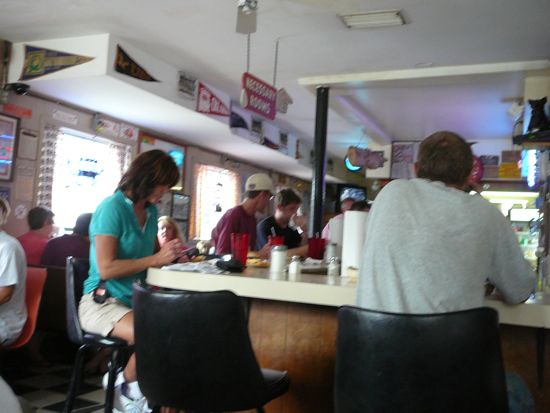

When people tell you about Jerry’s it’s like in Qatar when people tell you “it’s near where Parachute Roundabout used to be,” because it isn’t a drive-in anymore, and they also don’t seem to have a lot of BBQ. Jerry’s IS like a time capsule, you walk in, you wait about 15 minutes for a table at lunch, or you try to find a seat at the counter, and it’s like you’ve walked back into the 1950’s. But it isn’t a theme restaurant, it’s just that nothing has changed. When we looked at the menu, we got a big shock – we don’t even remember prices like these. It would be hard to spend $20 on a lunch for two, unless you toss back a beer or two, and we saw a few people doing that.



It seems like a place where people are known – like people eat there all the time. We heard a many greeted by name. AdventureMan said if he were a widower, he would probably eat there all the time. It looked like the kind of place where you could get a good meal and a kind and friendly greeting.
Service was prompt, efficient, courteous and friendly.
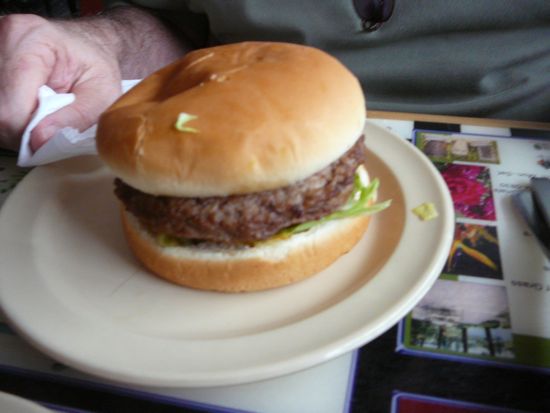
AdventureMan said it was one of the best hamburgers he has ever eaten. He compared it to Red Robin and said it isn’t so big, and it doesn’t look so fancy, but it is the perfect size, perfectly cooked and he thinks it is hand packed, it had a great texture. He ordered it with ‘the works’ and was surprised that ‘the works’ doesn’t include a slice of onion, but it did include lettuce, tomato and pickle.
I had the BLT, which came on toast, with lettuce and tomato, nothing fancy, just a BLT, but a good BLT, generous on the bacon:
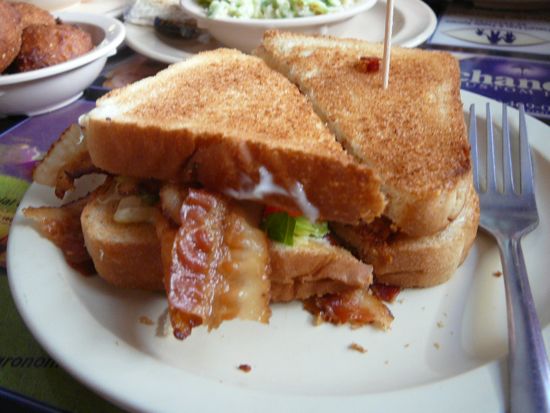
We ordered sides of hush puppies, baked beans and cole slaw, so we could see how they compare. Hush puppies were like AdventureMan used to eat when he was a kid, the kind people make at home, no surprises, no corn, no jalepenos, no sugar, just plain hush puppies, exactly in character with this slice-out-of-time. The cole slaw was wonderful. I am not a fan of mayonnaise-y cole slaw, and this one was a little vinegary, just what I love. The baked beans were divine. Not a lot of chunks of anything, just plain beans, baked to melting in a sweet tangy sauce. The best of the ’50’s.
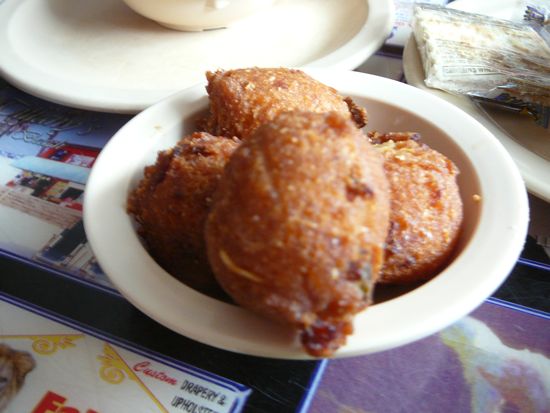
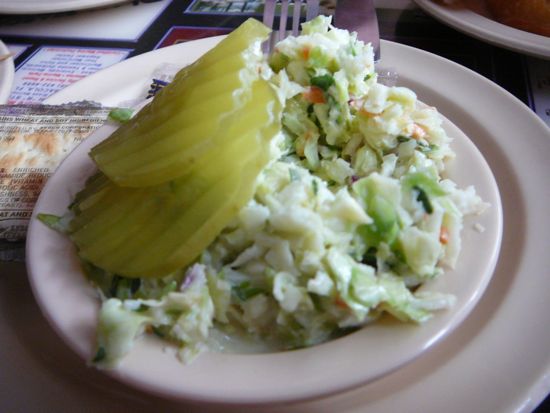
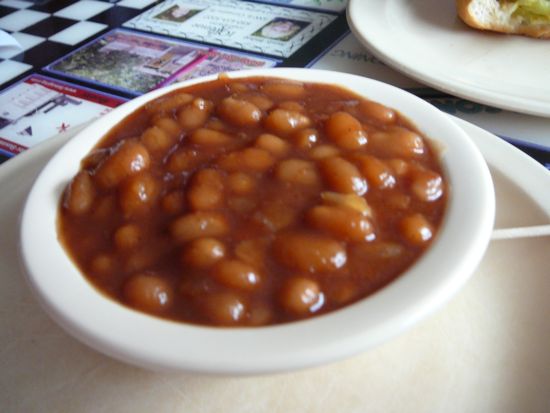
They are undergoing renovations to add more seating room and waiting room – business is good, and they need more space to handle their many loyal customers. At the corner of Perry and Cervantes, in East Pensacola Heights, right at the stoplight. AdventureMan says this is the kind of restaurant they feature in Southern Living magazine, or Garden and Guns, one of the hidden gems of Pensacola.
Ramadan for Non-Muslims 2011
Ramadan is coming, coming with a vengence, it is almost here. Ramadan is expected to start with the sighting of the new moon on August 1st. I am feeling happy – a friend has asked me to help her find special Eid dresses for her daughter returning to Saudi Arabia. I know what she is looking for, and I am at a loss as to where they might be found. I will check tomorrow with friends who have lived in Pensacola for a long time and see what they have to suggest.

Meanwhile, as is my annual tradition, I will reprint an article I wrote in September 2007, Ramadan for Non Muslims. Even better, go back to the original Ramadan for Non Muslims and read the comments – I’ve always learned the best information from my commenters. 🙂
Ramadan for the Non Muslim
Ramadan started last night; it means that the very thinnest of crescent moons was sighted by official astronomers, and the lunar month of Ramadan might begin. You might think it odd that people wait, with eager anticipation, for a month of daytime fasting, but the Muslims do – they wait for it eagerly.
A friend explained to me that it is a time of purification, when your prayers and supplications are doubly powerful, and when God takes extra consideration of the good that you do and the intentions of your heart. It is also a time when the devil cannot be present, so if you are tempted, it is coming from your own heart, and you battle against the temptations of your own heart. Forgiveness flows in this month, and blessings, too.
We have similar beliefs – think about it. Our holy people fast when asking a particular boon of God. We try to keep ourselves particularly holy at certain times of the year.
In Muslim countries, the state supports Ramadan, so things are a little different. Schools start later. Offices are open fewer hours. The two most dangerous times of the day are the times when schools dismiss and parents are picking up kids, and just before sunset, as everyone rushes to be home for the breaking of the fast, which occurs as the sun goes down. In olden days, there was a cannon that everyone in the town could hear, that signalled the end of the fast. There may still be a cannon today – in Doha there was, and we could hear it, but if there is a cannon in Kuwait, we are too far away, and can’t hear it.
When the fast is broken, traditionally after the evening prayer, you take two or three dates, and water or special milk drink, a meal which helps restore normal blood sugar levels and takes the edge off the fast. Shortly, you will eat a larger meal, full of special dishes eaten only during Ramadan. Families visit one another, and you will see maids carrying covered dishes to sisters houses and friends houses – everyone makes a lot of food, and shares it with one another. When we lived in Tunisia, we would get a food delivery maybe once a week – it is a holy thing to share, especially with the poor and we always wondered if we were being shared with as neighbors, or shared with as poor people! I always tried to watch what they particularly liked when they would visit me, so I could sent plates to their houses during Ramadan.
Just before the sun comes up, there is another meal, Suhoor, and for that meal, people usually eat something that will stick to your ribs, and drink extra water, because you will not eat again until the sun goes down. People who can, usually go back to bed after the Suhoor meal and morning prayers. People who can, sleep a lot during the day, during Ramadan. Especially as Ramadan moves into the hotter months, the fasting, especially from water, becomes a heavier responsibility.
And because it is a Muslim state, and to avoid burdening our brothers and sisters who are fasting, even non-Muslims refrain from eating, drinking, touching someone of the opposite sex in public, even your own husband (not having sex in the daytime is also a part of fasting), smoking is forbidden, and if you are in a car accident and you might be at fault, the person might say “I am fasting, I am fasting” which means they cannot argue with you because they are trying to maintain a purity of soul. Even chewing gum is an offense. And these offenses are punishable by a heavy fine – nearly $400 – or a stay in the local jail.
Because I am not Muslim, there may be other things of which I am not aware, and my local readers are welcome to help fill in here. As for me, I find it not such a burden; I like that there is a whole month with a focus on God. You get used to NOT drinking or eating in public during the day, it’s not that difficult. The traffic just before (sunset) Ftoor can be deadly, but during Ftoor, traffic lightens dramatically (as all the Muslims are breaking their fast) and you can get places very quickly! Stores have special foods, restaurants have special offerings, and the feeling in the air is a lot like Christmas. People are joyful!
Sign of the Times in Pensacola

Pensacola, with its mild climate, attracts a lot of the nation’s homeless. In an area with high unemployment and where the housing crisis has wreaked havok with the economy, people still find it in their hearts to be generous and compassionate.
There are united efforts to clothe and feed the homeless, and efforts to help them get off the street – if they want to get off the streets, and a lot of them don’t.
I wonder what funds Krispy Kreme gives – bus tickets home? A donut and a cup of coffee? Help with a mortgage payment? I thought it might give a glimmer of hope to someone down and out.
An Old Dented Bucket
THIS IS NOT MY STORY. 🙂 This is from my long time friend Kit Kat who passed it along to me and I loved it so much I want to share it with you:
THE OLD DENTED BUCKET
Our house was directly across the street from the clinic entrance of
Johns Hopkins Hospital in Baltimore . We lived downstairs and rented
the upstairs rooms to out-patients at the clinic.
One summer evening as I was fixing supper, there was a knock at the
door. I opened it to see a truly awful looking man. “Why, he’s hardly
taller than my 8-year-old,” I thought as I stared at the stooped,
shriveled body. But the appalling thing was his face, lopsided from
swelling, red and raw.
Yet his voice was pleasant as he said, “Good evening. I’ve come to
see if you’ve a room for just one night. I came for a treatment this
morning from the eastern shore, and there’s no bus ’til morning.”
He told me he’d been hunting for a room since noon but with no
success, no one seemed to have a room. “I guess it’s my face …. I
know it looks terrible, but my doctor says with a few more treatments
..”
For a moment I hesitated, but his next words convinced me: “I could
sleep in this rocking chair on the porch. My bus leaves early in the
morning.”
I told him we would find him a bed, but to rest on the porch.. I went
inside and finished getting supper. When we were ready, I asked the old
man if he would join us. “No, thank you. I have plenty.” And he held
up a brown paper bag.
When I had finished the dishes, I went out on the porch to talk with
him a few minutes. It didn’t take a long time to see that this old man
had an oversized heart crowded into that tiny body. He told me he
fished for a living to support his daughter, her 5 children, and her
husband, who was hopelessly crippled from a back injury.
He didn’t tell it by way of complaint; in fact, every other sentence
was preface with a thanks to God for a blessing. He was grateful that
no pain accompanied his disease, which was apparently a form of skin
cancer. He thanked God for giving him the strength to keep going…
At bedtime, we put a camp cot in the children’s room for him. When I
got up in the morning, the bed linens were neatly folded and the little
man was out on the porch.
He refused breakfast, but just before he left for his bus, haltingly,
as if asking a great favor, he said, “Could I please come back and stay
the next time I have a treatment? I won’t put you out a bit. I can
sleep fine in a chair.” He paused a moment and then added, “Your
children made me feel at home. Grownups are bothered by my face, but
children don’t seem to mind.”
I told him he was welcome to come again.
And, on his next trip, he arrived a little after 7 in the morning. As a
gift, he brought a big fish and a quart of the largest oysters I had
ever seen! He said he had shucked them that morning before he left so
that they’d be nice and fresh. I knew his bus left at 4:00 a.m. And I
wondered what time he had to get up in order to do this for us.
In the years he came to stay overnight with us, there was never a time
that he did not bring us fish or oysters or vegetables from his garden.
Other times we received packages in the mail, always by special
delivery; fish and oysters packed in a box of fresh young spinach or
kale, every leaf carefully washed. Knowing that he must walk 3 miles to
mail these, and knowing how little money he had made the gifts doubly
precious.
When I received these little remembrances, I often thought of a
comment our next-door neighbor made after he left that first morning.
“Did you keep that awful looking man last night? I turned him away!
You can lose roomers by putting up such people!”
Maybe we did lose roomers once or twice. But, oh!, if only they could
have known him, perhaps their illnesses would have been easier to bear.
I know our family always will be grateful to have known him; from him
we learned what it was to accept the bad without complaint and the good
with gratitude to God.
Recently I was visiting a friend, who has a greenhouse, as she showed
me her flowers, we came to the most beautiful one of all, a golden
chrysanthemum, bursting with blooms. But to my great surprise, it was
growing in an old dented, rusty bucket. I thought to myself, “If this
were my plant, I’d put it in the loveliest container I had!”
My friend changed my mind. “I ran short of pots,” she explained, “and
knowing how beautiful this one would be, I thought it wouldn’t mind
starting out in this old pail. It’s just for a little while, till I can
put it out in the garden.”
She must have wondered why I laughed so delightedly, but I was
imagining just such a scene in heaven.
“Here’s an especially beautiful one,” God might have said when he came
to the soul of the sweet old fisherman. “He won’t mind starting in this
small body.”
All this happened long ago – and now, in God’s garden, how tall this
lovely soul must stand.
The LORD does not look at the things man looks at. Man looks at the
outward appearance, but the LORD looks at the heart.” (1 Samuel 16:7b)
Recent Comments
ExpatAlien on What Country am I Living … intlxpatr on Yellowstone: Old Faithful to C… Michelle on Yellowstone: Old Faithful to C… Cathy on No Grown-Ups in Charge intlxpatr on Waiting for Snow Wikipedia Donate Button

Amazina


Early Voting in Florida


 Here There and Everywhere