Lessons and Carols December 18th, 5:00 pm at Christ Church, Pensacola
Here is the write-up from the Christ Church website about the annual Lessons and Carols festival, a tradition in most Anglican and Episcopal churches, and an exhilarating treat during a busy season:
A FESTIVAL OF NINE LESSONS AND CAROLS
December 18, 2011, 5:00 pm, in the Church.
Each year, the Christ Church Parish Choir presents A Festival of Nine Lessons and Carols, a uniquely Anglican Christmas celebration. The Festival at Christ Church is notable because the Choir devotes itself to cultivating the carol literature that is at the heart of the most notable celebration in the world, that of King’s College Cambridge. The fine readers in the choir share scripture readings between the carols, and prayers open and close the service. Several congregational hymns are also included. The service is free and open to the public.
The Festival of Nine Lessons and Carols is a format for a service of Christian worship celebrating the birth of Jesus that is traditionally followed at Christmas. The story of the fall of humanity, the promise of the Messiah, and the birth of Jesus is told in nine short Bible readings from Genesis, the prophetic books and the Gospels, interspersed with the singing of Christmas carols, hymns and choir music.
The format was based on an Order drawn up by Edward White Benson, later Archbishop of Canterbury but at that time Bishop of Truro, in Cornwall, for use on Christmas Eve] and that a key purpose of the service was to keep men out of pubs on Christmas Eve. (24 December) 1880. Tradition says that he organized a 10 pm service on Christmas Eve in a temporary wooden shed serving as his cathedral
The original liturgy has since been adapted and used by other churches all over the world. Lessons and Carols most often occur in Anglican churches, but also in some Roman Catholic, Lutheran parishes, and Presbyterian institutions. However numerous Christian churches have adopted this service, or a variation on this service, as part of their Christmas celebrations. In the UK, the service has become the standard format for schools’ Christmas carol services.
The best-known version is broadcast annually from King’s College, Cambridge, on Christmas Eve. It features carols sung by the famous Choir of King’s College, Cambridge. Groton School of Groton, Massachusetts, has performed the festival longer than any institution other than King’s, holding its first Lessons and Carols in 1928.
LOL @ for keeping men out of the bars on Christmas Eve! Holy Smokes!
Pensacola Nutcracker
AdventureMan and I had a truly wonderful seasonal adventure tonight, as we attended the opening night of the Ballet Pensacola production of The Nutcracker. All over America, ballet companies pay their bills by putting on this annual favorite, but Pensacola has a knack for making it fresh and new every season.
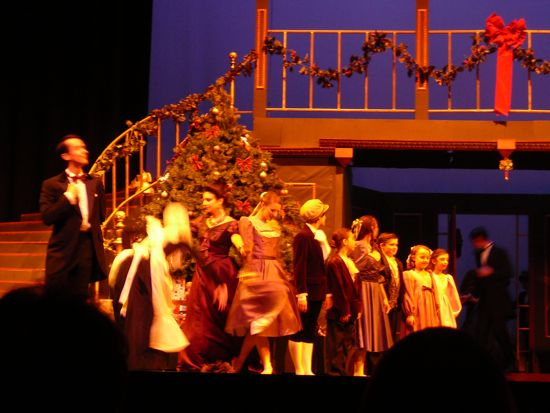
I am sorry, this is the only photo I have that turned out halfway decent, and AdventureMan was poking me and huffing about my rudeness because my little camera will shoot in low light, but I brought the wrong one, and this one doesn’t have an viewfinder, so it’s ‘making too much light’ to quote AdventureMan.
The sets and costuming are wonderful. The sets were lush and colorful; the costumes fresh and delightful. The snowflakes really sparkled, and had sparkly silver hairpieces that looked light, stayed in place, and captured the sparkly lightness of real snowflakes; it was one of the highlights of the ballet for me. I also loved the coffee costumes – sort of Middle East-y if Middle East dancers wore sparkly pinkish scarves and tinkling belly dancer wraps around their hips. The costumes were delightful, and the dancers seemed to be having a lot of fun.
The tiny angels were hilarious, and oh, my stars, the sheep! You must go, you must see the sheep! This is one sweet production, a treasure of the season, and you might still have a chance to buy a ticket for the Saturday night performance at 7 or the Sunday afternoon performance, both at the Saenger Theatre on Palafox. Children are DRESSED; this is the South, and this is The Nutcracker Ballet!
Kisses From Katie by Katie Davis

This is a photo from Katie’s blog: Kisses From Katie.
Do you believe in God? Do you believe that God believes in you? Then how do you live your life? Do you commit 100% to God and trust him to provide as you leave all your riches behind and follow him, serving the poorest of the poor, speaking for those who have no voices?
I will warn you, this unforgettable book has a lot of talk about God in it. A part of me watches in horror, wondering how long Katie can continue to serve God with all her heart, with all her soul, and with all her mind? How long she can work against all odds, trusting in God to lift her and provide for her and her children. This is a true story, an ongoing life. A part of me fears a terrible crash, but the greater part of me prays for Katie, and stands in awe of her courage and her commitment.
I don’t know who told me about Kisses for Katie, the blog. As soon as I started reading it, I was addicted.
Now for the shocker: Katie is only 23 years old. A year before she graduated from high school, she felt an undeniable call to do a 6 week mission teaching in a school in one of the poorest parts of Uganda. At the end of her six weeks, she couldn’t bear to leave. She returned, finished out her senior year in high school (HIGH SCHOOL!) but she never felt entirely ‘home,’ her heart was with the children of Uganda, the poorest of the poor.
Although her parents had her doubts, the strength and consistency of Katie’s belief that she was called to serve in Africa brought them around, and they agreed she could go work for a year in this small, poor village, before starting university. At eighteen, Katie was teaching, raising money for food, tuition and uniforms for over 100 children, and working to prepare all the meals, bathe all the children, and teach them about the love of Jesus.
When I saw, a month ago, that Katie had a book published, I had to buy it. Kisses from Katie is inspirational and unforgettable. Her story continues on her blog, but the book lays all the groundwork, the heartaches and the joys, the delights of her 13 adopted daughters, the horrors of the Ugandan bureaucracy, Katie’s dogged day-by-day fight to claim and save lives. She is a remarkable young woman, powered by an awesome God.
If Katie were going to burn out, I think it would have happened earlier, as she suffered terrible disappointments, and made truly amazing sacrifices to raise her girls, to be their “mommy” and to insure the educations of over a hundred children. With a growing foundation, Amazina, and a growing group of contributors, she carries on, and the miracle of this book is that she doesn’t seem to sense the amazing woman that she is at all, she seems to believe that she is a simple woman following God’s will for her life, and reveling in it, joyfully surrounded by her 13 adopted daughters and frequent foster babies. She feels blessed to have the life that God created her to live.
I stand in awe.
You can order this book from Amazon.com for $12.49 plus shipping. It might even change your life, or how you view your life. Yes, I own stock in Amazon.com. No, I make no money from recommending this book. 🙂
First Flash Mob in Doha, Qatar
Thank you, my friend Hayfa, for sending this flash mob from City Center Mall; very nice;
But this one dates from May 2011, and I love the energy!
And one more, this time at Villagio! Wooo HOOOO, Qatar!
I’m eager to see one done at the Souk al Waqif!
I think Qatar’s National Day is December 18th, and the Qataris know how to party. It would be lovely to see a Qatari flash mob.
Christmas Time in Pensacola
Christmas in Pensacola starts just after Thanksgiving, for most people. I saw a very few decorations go up around Veteran’s Day (11 November) but very few. Most started going up around Thanksgiving. Because we are having some work continuing on our house, I couldn’t do the same decorations I did last year, so I did something new; my goal in the week before I left was to get SOME Christmas up, inside and out.
This year, AdventureMan is here, too, and it makes all the difference. Last year, he left for Kuwait just before Christmas, and I was so sad that it was hard to put a lot of effort into decorating. I did it, mostly because I am too proud not to. (No. I will not let adversity get me down!) But mostly, it takes a lot of energy to fight depression, so this year, I am appreciating just how good it is to have a ‘normal’ Christmas, i.e. my husband is on the same continent as me, in the same country, even the same state, same city, and same residence. It’s all good. 🙂
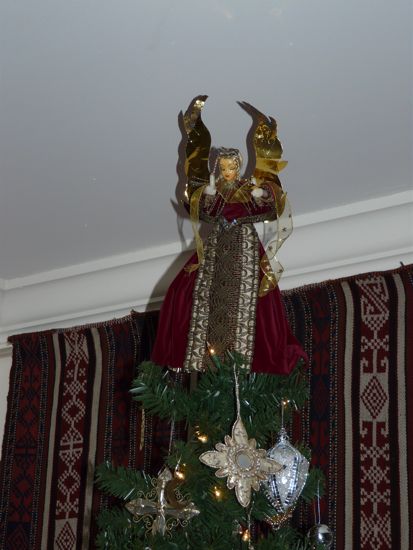
Our tree this year is smaller – and higher – that other years, and all the ornaments on it are unbreakable. Yes. Happy Baby, now Happy Toddler, will be coming by and I want to protect him – and the tree. Over the years we have collected so many wonderful ornaments that I have a lot to work with, and still manage to have a nice tree; the angel on the top is a traditional angel from Nurnberg, and we bought it the first year we were married. It’s nice to have her high on the top of the tree once more.

Under the tree, covering the table, is a special wool sefsari we bought when we lived in Tunisia, bright red with bands of gold trim. These were everywhere when we lived there, especially in the cold winters, but when we visited, I no longer saw them in any stores. Covering the tree stand, I have one of my smaller Damascus tablecloths; I treasure these coverings, and beads, Pensacola parade beads.

“Beads!” we shouted to Happy Toddler as we put them over his head.
“Beads!” the crowd shouted as the floats went by at the Pensacola Christmas Parade last night.
Last year, even as a Happy Baby, the parade was an enthralling event. What baby wouldn’t love a parade that starts with flashing lights, and motorcycles, and a loudly wailing, lights fashing FIRE TRUCK?? What Happy Toddler wouldn’t love the bands with the throbbing drums, and trumpets, and tubas, and trombones? And the dancing girls, and oh yes – the BEADS! Life is sweet at the Pensacola Christmas Parade.
The parade starts at 5:15 and we get there about 5:14. Here is what I love about Pensacola; you can get there at 5:14 and get a place to park only about 1/2 a block from the parade and be there when the spectacle begins. It is a laid back kind of parade, still a community parade, you see your friends there. It is sort of a Christmas parade, you see some Santas, and some reindeer, and snowmen, and there is usually at least one float with angels, but it is also sort of Mardi Gras, with all the Krewes (local social groups focused on Mardi Gras) on floats with their buds throwing beads, coins, toys and candy out into the waiting, dancing crowd.
Technically, I know this isn’t a great photo because you can’t even really tell what it is, but it is the beginning of the parade, and I love the motion of it all:
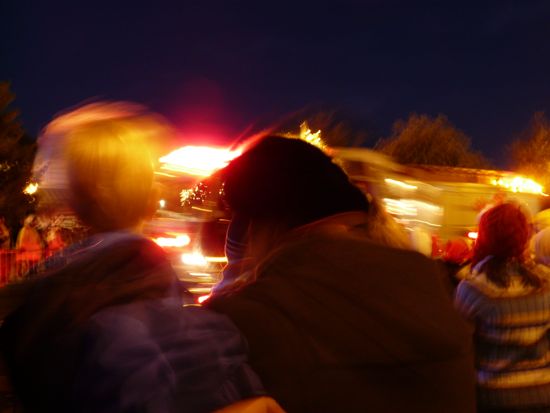

As it turned out, we were in a pretty good spot for catching beads, and we loaded down the Happy Toddler, put a few on each of us, and shared the bounty with some of the babies standing behind us. There were some people in front of us who caught a LOT of beads, and as soon as they caught them, they stashed them in a bag; they caught LOTS. Maybe they sell them back or something.
Last week, we took Happy Toddler to Boats on the Bayou, where boats decorated with Christmas lights gather near the bridge and then come parading to the park, and people gathered there sing Christmas Carols. Happy Toddler loves going to the park; the boats were interesting for about five seconds, and then he got to swing and play on the playground, which mattered a whole lot more to him:

It was just a really fun, community thing, and it was pretty, too.
Lunch at the Fish House, always a treat, and their tree is BLUE!

The Pensacola Christmas Parade attracts around 50,000 people every year. Imagine! It is so much fun. What I love about it is that there are so many floats, so many bands, so many civic heroes – you know how I feel about giving back to your community. These people are doing it. On one of the coldest nights of the year, they are on the Krewe floats throwing beads, they are patrolling behind the dog clubs, cleaning up, they are making sure the floats make the turn at Wright and Palafox, they are marching with bare legs in the cold, windy night – and it is so much fun.
Who would think that 50,000 people gathered in one place, competing for beads, would keep it all so civil? There is no place for ‘special people;’ we are all Pensacola citizens, there to enjoy a family evening, and it is just that, it is a great Pensacola evening, one of my favorite of the year.
Best of all was watching the Happy Toddler take it all in. The lights! The sirens! The beads, and the scrambling to catch them! The loud music, the pounding drums! It was all so much fun, and that fun was doubled watching him try to figure it all out. I can hardly wait ’till next year. 🙂
The Day I Might Have Died
“I have a photo you might want.” my Mom said, rummaging under the bed in the office, where I am sleeping while I have a working holiday here in Seattle, running errands and helping her with things she can no longer do easily for herself. I have two sisters living here who take good care of Mom, and I want to do some small part, too.
She pulled out an envelope and looked through it.
“No, not this one, but you might want this one,” and she handed me this photo.

I know to you it looks like a very strange photo; it looks like a very strange photo to me, too. Old photo, probably taken with some kind of brownie box camera, you cannot tell anything, it looks misty and indistinct.
It was taken at an airport ‘lake,’ like a water retention pond, in Juneau, Alaska, when I was around three. In Juneau, the lakes and ponds might stay very cold the entire summer, but these man-made lakes were fairly shallow, and might warm up a little when the temperatures reached the 70’s (F), like in July or August.
What I remember is dropping off, but not being afraid. I was under water, but my eyes were open, and the colors were beautiful and I was just watching the play of color and light, and I just kind of bobbed along.
My aunt tells me that she saw me drop out of sight and not return. She ran out into the water, found me, and pulled me to the shore. She saved my life. Later, when I was grown, she told me the old Chinese adage that if you save a person’s life you are responsible for them as long as you – or they – live. I always felt a special connection to that sweet aunt.
I wonder now if my memory is as I have always remembered it? I can still see the green and gold flickering, just as clearly as when it was happening. I can remember the shock of being grabbed, and hustled to shore, and fussed over, as everyone wanted to make sure I was OK. I remember having to stay on the blanket for what seemed like a lifetime, and then only being allowed to play in the very shallow water. And I wonder if I remember it all, or if I have heard the story so many times that I just think I remember it?
I love this photo. I love the indistinct nature, and mistiness. It is a metaphor for my memory of that day, and I am delighted that a photo exists.
The Water Street Hotel in Apalachicola
So after feeding the goats, LOL, we headed out for a very serene, very zen drive from Panama City to Apalachicola, arriving near lunch time. AdventureMan and I are on track in so many ways, one of which is that we like to have a place to stay before we eat, and the last few years, it’s been a piece of cake, no problem, people haven’t been filling the hotels and you can walk in almost anywhere and find a place to stay. Not so, this year.
First, there are a LOT of people in Apalachicola as we come in. And there is a lot of activity going on, Christmas lights going up, merchants decorating their stores, and SANTA is coming on on a BOAT!
We tried the first, obvious place, where the receptionist told us frankly she had a room but we wouldn’t like it and it is her last room, right next to the dining room. We found another likely place, and every room was taken. They told us to try down the street at the Water Street Hotel, which we did.
We got the last room.
“You’re going to love this room,” she said, and oh! We did!
One of the reviewers on TripAdvisor.com said “its like the (Marriott) Residence Inns, only nicer,” and that is exactly what we thought. The suites are all differently configured, and have beautiful finishes. For me, the best part is the view.
We’re still talking about the kind of house we want. We like the house we have, but we would like something a little more open-plan, and with a view of a bayou – or an estuary. The unit at the Water Street had a large screened in porch where I spent an hour watching boats go too and fro, and pelicans, and an entire flock of about 200 birds, and watching the grass wave in the breeze . . . it was heaven.
This was the view straight out from our unit:
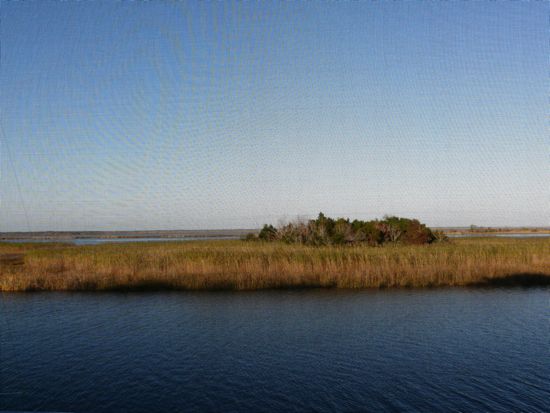
And now looking up the channel:
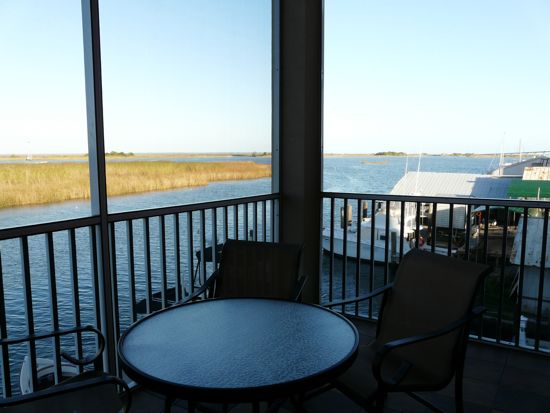
The interior going out to the deck:

The Water Street Golf Cart that takes you on tours of Apalachicola 🙂

There was a huge master bedroom, and another bedroom with a daybed, two full bathrooms.
What we want is a place like this in Pensacola, same finishes, same kind of view where there is always something going on, birds, boats, nature happening. We love the attention to detail they put into this hotel. We’d like something a little bigger; we loved this place.
. . . Hurray for the Pumpkin Pie . . .
“You’ve worked HARD!” our water aerobics instructor told us. “You get a free pass tomorrow; you can eat anything!”
I wish she hadn’t said that. We did work hard, but it wasn’t just one day of feasting, it was pretty much four days, and we enjoyed ourselves too much. No matter how hard we had worked Wednesday morning, it wasn’t enough to cover four days.
Arriving at Papa’s and Grammy’s we were welcomed with a bubbling gumbo, a combined effort of Papa and Grammy; Grammy did all the shopping and chopping, and PaPa worked the roux, which is the butter and flour combination that makes that smoky flavored base for the gumbo. They had just finished cleaning and deveining about 40 pounds of shrimp for Thanksgiving, and threw a few in the gumbo. Oh YUM. The next morning was full of preparations, and then, mid-morning, the feasting began, with all the guys shucking oysters and eating boiled shrimp. As you drive up, you can smell smoke from an outdoor fire, and chairs and tables are out everywhere, but the shucking goes on down near the creek:
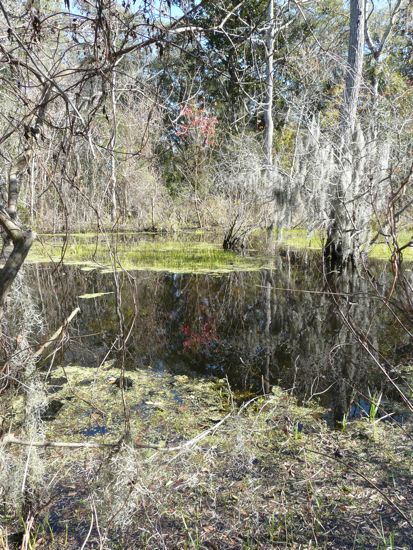
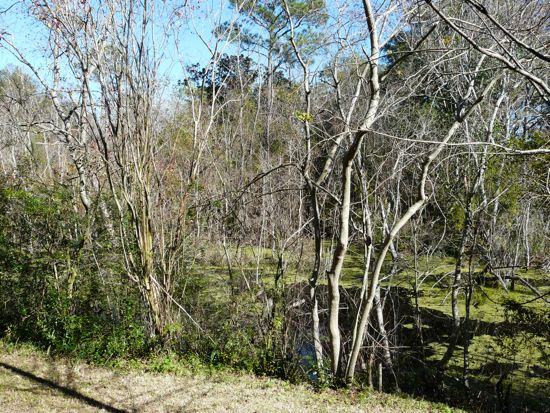

The house is beautiful, spacious and welcoming for so many people. The happy baby, who is now a happy toddler, was in heaven – he was surrounded by boy toys – tractors and golf carts and a Model A and all sorts of age appropriate toys, as well as cousins, aunts, uncles and a lot of hilarious rough housing. Why is it kids just love the terror of being turned upside-down?
For me, this was the best Thanksgiving with the family; finally I am beginning to figure out who is who from year to year. I still have to ask questions, but they seem more comfortable with me, and I had some really good conversations, sort of beyond the polite-passing-the-time conversations. I’m not that great in big crowds, but now I am beginning to have some good one-on-ones, and for me, that’s a great Thanksgiving.
And on, man, the food. Tables and tables of food. I don’t know how they do it, but I saw the list of cakes, and there must have been twenty cakes on THE LIST. They each have responsibilities, and somehow, it all works.
Three turkeys, all carved, and so much dressing (which I grew up calling stuffing, it all depends on where you grew up):
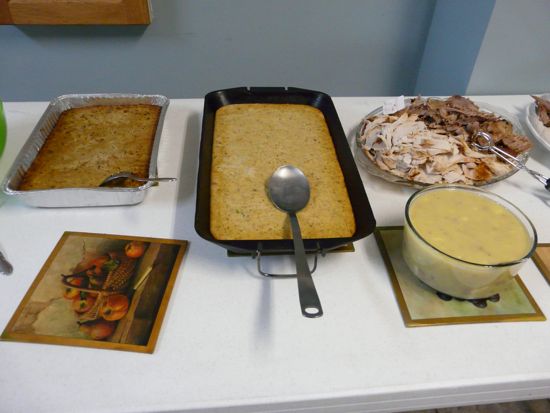

That green container is AdventureMan’s first foray into cranberry chutney. This one was a little tart, but tasty. As are darling daughter in law so diplomatically put it, “I would probably like it more if my taste buds were accustomed to having cranberries without sugar.”
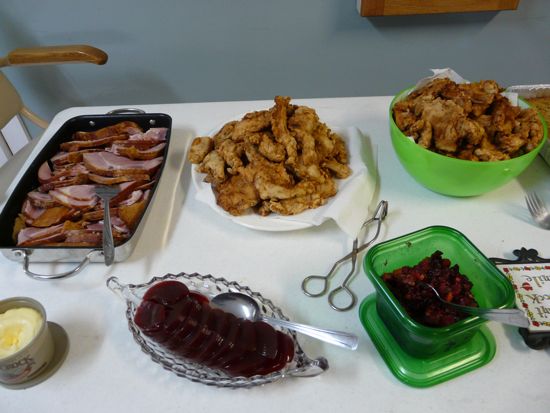


About half of the sides were sweet potato casseroles; you can’t believe how good these are. This year this front dish was one of the favorites, squash cassarole:

This photo doesn’t begin to do justice to the desserts – holy smokes:

So the biggest brother blessed the food and we ate around one, then we visited for a few hours, people going back and grazing a little. Then the next generation cleaned everything up and got all the food packaged up and put away. About an hour later, that broccoli salad started calling me, and I went out to try a little more and discovered it was all put away, but a partner in crime knew where it was, and we pulled it out and had some, which started a whole landslide of second-platers, just when everything had been all put away, LLOOLLL!
It was a great day, a day full of thanks for all the things in life that really matter.
Over the River and Through the Woods
. . . . to the co-grandparents house we go!
This is preparation week, and we are scurrying to get things together for Thanksgiving with the large family group. When we were first invited, one of the aunts told us “You’re not invited, you’re family! You’re expected!” It made us feel so welcome, and the gathering is so much fun we look forward to our time together.
Mom’s Cranberry Salad
Christmas Punch, Rum and Rumless
Rosettes
The world’s cutest grandbaby will be there; we are all having so much fun with him as he is in the steep learning curve phase, and pops out with language which astonishes us daily. While bathing him the other night, I was explaining about washing with soap and he said “I know.” I almost dropped the soap! He adores his BaBa, and whenever he sees me, he gets a big grin – and looks for BaBa to be behind me. LOL!
He loves going to his other PaPa’s house; he has a TRACTOR! And a Boat! The happy baby loves trains and motorcycles and buses; he loves anything that GOES.
We have so much for which we are thankful. God has blessed us mightily with family, and with friends, and with a wide and spacious place in which to live our lives. He has surrounded us with his grace, and we feel blessed, so blessed.
Happy Thanksgiving!
Qatar: The Richest Fattest Nation on Earth
Thank you, reader John, for passing along this fascinating article from The Atlantic:
Qatar is a tiny country with a big problem.
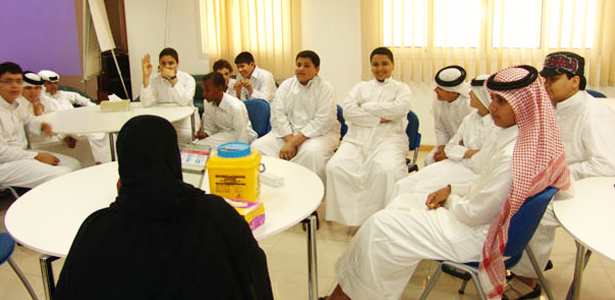
This Connecticut-sized nation, sticking out like a loose tooth in the Persian Gulf, is one of the most obese nations in the world, with residents fatter, on average, than even those of the United States, which often takes the cake in such competitions.
According to recent studies, roughly half of adults and a third of children in Qatar are obese, and almost 17 percent of the native population suffers from diabetes. By comparison, about a third of Americans are obese, and eight percent are diabetic. Qatar also has very high rates of birth defects and genetic disorders — problems that, along with the prevalence of obesity (PDF) and diabetes, have worsened in recent decades, according to local and international health experts.
So what’s going wrong in little Qatar?
Qatar also has very high rates of birth defects and genetic disorders — problems that have worsened in recent decades.
To misappropriate a well-worn phrase: It’s the economy, stupid. In September, Qatar officially became the richest nation in the world, as measured by per capita gross domestic product. It also recently became the world’s biggest exporter of natural gas, and earned the title of fastest growing economy in the world. By international development standards, all this growth has happened virtually overnight, making Qataris’ lifestyles much more unhealthy, and at the same time leading many to hang on resolutely to what’s left of their fleeting tribal traditions — practices that include inter-marriage between close family members and cousins.
“They’re concentrating the gene pool, and at the same time, they’re facing rapid affluence,” said Sharoud Al-Jundi Matthis, the program manager at the Qatar Diabetes Association, a government funded health center in Doha, the capital. As a result of these factors, Qataris are becoming obese, passing on genetic disorders at an alarming rate, and getting diabetes much more often than others around the world. They’re also getting diabetes a decade younger than the average age of onset, which is pushing up rates of related illnesses and complications, like hypertension, blindness, partial paralysis, heart disease, and loss of productivity. “It’s a very, very serious problem facing the future of Qatar,” Matthis said.
It’s a fascinating read, not too long, little more than double what you have already read. You can read the entire article by clicking HERE: The Atlantic
Thank you, John, for the recomendation.
Recent Comments
Kitchen on Isiais: Winding Down intlxpatr on Shampoo Ginger tigerbutterya0c5ff1d… on Shampoo Ginger intlxpatr on British Soldier Kidnapped, Esc… John on British Soldier Kidnapped, Esc… Wikipedia Donate Button

Amazina


Early Voting in Florida


