So Much Hatred . . .
Today I saw a story about US soldiers in Afghanistan, killing for fun. It follows hard on the heels of the story of Reverend Terry Jones who has ‘prayerfully’ decided to burn a copy of the Quran on the anniversary, today, of 9-11. These stories are like wounds in my heart, and I begin to wonder if there is any hope for ‘peace on earth, good will toward men.’
Sometimes I get discouraged.
9-11 wounded us badly, wounded that fountain of optimism that believes we can all be friends, that we can overcome, that ‘Yes, we can.’
We’ve recovered.
Acts of hate are acts of hate, whether they originate from Americans, from Moslems, from Hindus, from Mongolians, from Krakens . . . We each have it within us to make the right choice, to choose NOT to act in hate against our fellow man. It’s not a one-time choice. It’s a choice we each, individually, make over and over again, every day.
Pat Conroy and South of Broad
I don’t know where to start, telling you how much I like this book. I couldn’t wait for reading time to read it. It never flagged, every page kept me glued. I want you to read it, I want to be able to talk about it with you, but there is so much in this book that I don’t want to spoil it for you.
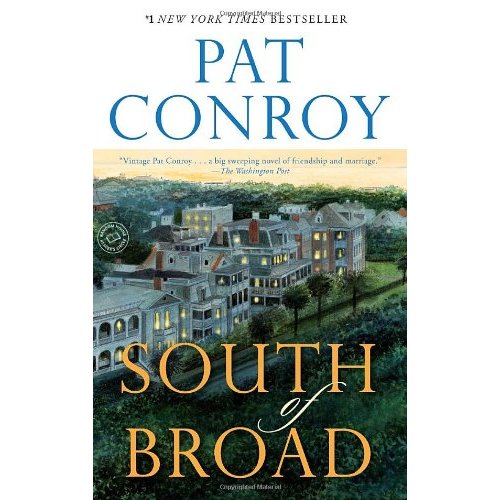
There are huge themes. There are some very bad people. There are some very good people. Sometimes the very good people can do very bad things, and sometimes the bad people can have some redeeming moments.
We meet the main character as he is about to begin his senior year in college. On the day we meet him, his life changes. Several new people come into his life. Two orphans. A beautiful sister and equally beautiful brother. A black football coach and his son. Three rich kids kicked out of the best private school in town for doing dope.
There are two ‘characters’ who are not people. One is the city of Charleston, SC, and there are entire paragraphs in this book which will make you fall in love, through Pat Conroy’s eyes, with this complicated, beautiful city. Another is Hurricane Hugo, which is as destructive as Charleston is beautiful.
South of Broad covers a time of tumult and change, and you see it through the eyes of of Conroy’s endearing characters. Times changes, society changes and change comes hard for those who stand to lose the most. Conroy deals with segregation, integration, child abuse, suicide, gay sex, economic discrimination, and psychiatric illness, a psycopathic criminal, who happens to be the father of two of this friends, and a hurricane.
For me, what was most engrossing was the complicated question of who is righteous? It’s what I want to talk about with you. Who is most like Jesus? (LOL, give examples) Which characters would you expect think themselves closest to God? Do you think they are? (Be prepared to defend your opinion.) What is a good parent? In this book, who do you think was the best parent?
If you decide to buy this book, please buy a copy with the Reader’s Guide in the back – an interview with Pat Conroy and questions that help you think about the book. I’d like to share with you a segment of the interview which I found so brightly illuminating:
. . . . I found the Parisians rarified, vigilant, hypercritical and fabulous. They had made themselves worthy of the great city they lived in. They oozed style and they ate like kings. . . . The Parisians seem special to both the world and themselves. Then it hit me: My God, they are like Charlestonians.
As I see it, you can take out Charlestonians and substitute Kuwaitis. Or New Yorkers. Or Romans. In fact, just about every society I have visited have their elite, who consider themselves rarified and special, and fight to keep themselves so.
So not only is the book dealing with spiritual righteousness, but also with themes of entitlement and deprivation, bullies and the bullied, parenting, self-fulfillment, and the very real and over-arching theme of friendship and the power of a close circle of friends.
I don’t want to tell you too much. I loved this book. I’m still thinking about it. I hope you’ll read it and think about it, too, and then come back and tell me what you’re thinking. 🙂
Edmonds Market Day
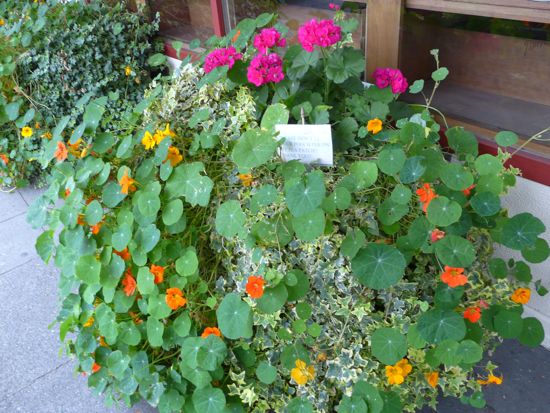
It’s all rush rush rush but we make time on Saturday morning to go to the Edmonds Market, my very favorite thing to do. First, I wanted to show you how my little home town decorates the street lights with hanging baskets:

Street pots:
And one of my favorite vendors, the Cedar Creek Soap lady. 🙂

(My favorite soaps are Clove, Cinnamon Orange and Safari)
Edmonds, Washington Street Gardens
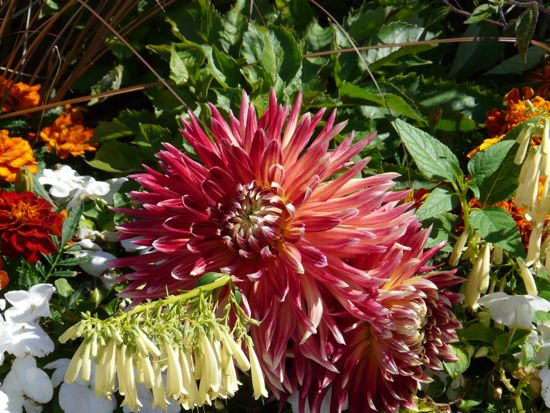
In a time where states and counties and cities and towns are cutting back, I am infinitely grateful to my little home town that they find the resources to maintain the street gardens. In the town, you find huge baskets of flowers hanging from poles along the main streets (one of which is called Main Street, in true small town fashion). These are from the street level gardens; they are so beautiful.


Nearby, two of our favorite stores are side by side:

Woo HOOO, Half Price Books is having their annual Labor Day Sale, 20% off everything in the store. Like we need more books. 😉
Just How Emirati Do You Have to Be? (Mixed Marriages)
Thank you, Little Diamond, for sending the article from The National. I totally love this article, and hats off to it’s author, Sultan Al Qassemi.
Mixed marriages bring strength upon strength to the UAE
Sultan Al Qassemi
Not too long ago, I boarded a plane in Dubai bound for the United States. There were a number of Emirati families on board, some of whom I recognised and greeted. After a 14-hour direct flight, we descended from the plane and made our way to passport control.
One Emirati family walked towards the line for US citizens and, in my naivety, I almost told them they were standing in the wrong queue. I hesitated, correctly it turned out. They were American citizens and obliged to stand in the US citizens section.
Many people who hear this story immediately assume that the mother was a foreigner. Not only is that incorrect – the mother is a true-blue Emirati – but she also works in the UAE government.
In the past week, I was reminded of this by an article in The National relating to mixed parentage. The Grand Mufti of Dubai, Dr Ahmed al Haddad, made controversial comments questioning whether there should be restrictions on Emiratis marrying outside their nationality.
In truth,a substantial number of talented Emiratis have been born to mixed marriages, a point that Dr al Haddad’s comments did not seem to take into consideration. According to one person who was present at the panel discussion, Emiratis from mixed marriages may have “mixed loyalties”. So are they Emirati enough?
Well, let us take a look at some of these Emiratis to find out. Ali Mostafa, the director behind City of Life, is the product of a mixed marriage. City of Life, which depicts contemporary life in Dubai in a powerful and realistic fashion, has become an international ambassador for the UAE after opening in Australia and Canada with a screening scheduled in Washington DC. Is its director Emirati enough?
Omar Saif Ghobash and Yousef al Otaiba, the UAE ambassadors to Russia and the United States respectively, both have foreign-born mothers and yet they serve the UAE with as much attention and dedication as any other Emirati ambassador. I have written before about how Mr al Otaiba has worked tirelessly on behalf of the country, in particular on the nuclear 123 agreement with the United States. Mr Ghobash speaks six languages and was heavily involved in bringing New York University to the UAE’s capital. Are they Emirati enough?
Razan al Mubarak is also a product of a mixed marriage. Her late father, like Ambassador Ghobash’s, gave his life for the country. Ms al Mubarak, in her roles as assistant secretary general of the Environment Agency – Abu Dhabi and managing director of the Emirates Wildlife Society, is busy protecting the country’s wildlife on both land and sea. Is she Emirati enough?
At Abu Dhabi’s strategic investment arm Mubadala, the chief operations officer, Waleed al Mokarrab al Muhairi, also happens to be chairman of Yahsat, Advance Technology Investment Company and Cleveland Clinic Abu Dhabi. But perhaps most importantly, he is credited with being “one of the principal architects behind the Abu Dhabi 2030 Economic vision”. And yes, Mr al Mokarrab comes from a mixed family.
Wael Al Sayegh is a writer, poet, translator and founder of the consultancy firm Al Ghaf, which delivers “inter-cultural induction programmes to multinational organisations serving the region”. Mr Al Sayegh has spoken to many multinational corporations about UAE culture and offered a Dubai perspective to foreign news outlets, including the BBC, during recent high-profile criminal cases. Is he Emirati enough?
Sarah Shaw, an Emirati whose biological father is English, currently works at the General Secretariat of the Abu Dhabi Executive Council and is a huge supporter of Emiratisation. Is she Emirati enough?
Other Emiratis from mixed families who have made substantial contributions include the director general of the Dubai World Trade Centre, Helal Saeed al Marri, the film director Nawaf Janahi and the columnist Mishaal al Gergawi, among many others.
There are examples in my immediate circle of Emirati friends who genuinely care about this country, not despite one of their parents being foreign born but perhaps because of it.
Should the UAE, and specifically Dubai, known for being hospitable and welcoming to people of all ethnicities, backgrounds and cultures, make our very own citizens feel unwelcome?
The truth is the UAE is a richer country because of these individuals of mixed backgrounds. What we should concentrate on is strengthening the ties that people have to this great nation. I have previously suggested military service for Emirati high school graduates, cultural immersion and social volunteering as ways to build civic participation.
Frankly, it would be insulting to question the loyalty of Emiratis who are born to a foreign parent. It is also unfair, un-Islamic and ultimately in this case un-Emirati to generalise about people of any background. The Emirates is a vibrant country of many colours – only seeing a single shade excludes too many of its strengths.
(The author, Sultan Sooud Al Qassemi is a non-resident fellow at the Dubai School of Government)
Why People Give
An urgent message came out today asking us to help the homeless people in Pensacola – and there are a lot of them, thanks to the warm climate. With all the rain recently, sleeping rough has been doubly rough, and it has been made worse by a sudden humidity-moisture related surge in the mosquito population.
As I talked with AdventureMan about our donation, he laughed. I was in fund-raising for a while, and was unexpectedly good at it. One thing I learned, there are a lot of ways to persuade people to donate, and then again, sometimes people will donate and you haven’t a clue as to why they felt this urge to be generous.
AdventureMan laughed; he totally got it. I used to work with a homeless, a long time ago, so I have a soft spot where they are concerned. Mosquitos also love me, and I get these horrid great but huge itchy bumps any time I am anywhere near a mosquito, AdventureMan always says he keeps me nearby because they head straight for me and ignore him.

Of course we donated. Wet homeless people and mosquitos, it was a golden combination. If you would like to donate, too, you can, through the EscaRosa Coalition on the Homeless (Working to Eliminate Homelessness). They will hold an Annual Fundraiser on Saturday September 11th from 7pm – 11pm at The Garden Center.
Welcome Home Dinner and Empress Rice Recipe
We had a dinner yesterday, to welcome AdventureMan home, and just to gather together friends and family in the area to have a good time.
AdventureMan stuns me with his ability to transfer all those time zones with no effect. He slept through every night, no problems. Amazing resilience. He also bought a great big watermelon, and made juice from it – delicious!

The Happy Baby is now big enough for a high chair. A high chair is a really good thing now, because he has started crawling, and he is really, really fast, especially when he is going after a cat!

Now that he is crawling and jumping and going to school, his little baby fat is turning into muscle:

(Sorry if this one is a little fuzzy, but he is jumping so fast I can’t get a clear photo)
Following traditional Middle Eastern / Southern customs, we had way too much food:

Including several long time favorites, one of which was Autumn Plum Torte:

One old favorite I am making again (I lost the recipe for a while) is Empress Rice. This recipe is so easy, so rich, so so good:
Empress Rice
1 large onion, chopped
1/4 cup butter
2 cups rice, raw
2 cans consomme
1 Tablespoon soy sauce
1 cup sliced mushrooms, drained
2 cups grated sharp cheddar cheese
1/2 cup chopped walnuts
Set oven for 325°F / 160°C
Saute onion in butter until golden brown. Brown raw rice with onion, then add all the rest of the ingredients. (How easy is that??) Grease a 3 quart/litre casserole, cover, and bake in oven for 1 hour and a half, or until liquid is absorbed. 8 – 10 servings.
(I did not make this with mushrooms, because our son doesn’t like mushrooms, but mushrooms make it richer. For church suppers, I sometimes add in some sausage, like smoked turkey sausage, or some chicken chunks.)
Some of the things I served I have shared with you before:
Autumn Plum Torte
Cauliflower Salad
Soused Apple Cake
Rotkohl
It was a great gathering, lots of stories exchanged, lots of laughing, and sweet little Happy Baby went to sleep just as lunch was served, freeing his parents to relax and enjoy a couple hours of socializing. 🙂 My old friend in Germany slipped into my kitchen and functioned as my second right hand; I actually enjoyed having her help because it’s like she knew what I needed before I knew I needed it. We could hardly believe so much time had passed when our last guests left; time just flew by, the sign of a truly memorable gathering.
‘Some Just Like to Hate’
I am receiving hateful e-mails; e-mails claiming Barack Obama is really Muslim, and that Muslims are trying to take over America. Sometimes I wonder how well my friends really know me? Sometimes I wonder how well I know my friends, that they would be so nice and kind as I know them to be, and so rabid in their hate-filled beliefs?
When I found this article today in AOL News it comforted me . . . that this round of Anti-Islam is no where near so mindless and destructive as the hatred of the Catholics, of the Mormons, of the Jews. I can only hope that this too, shall pass.
I work at changing perceptions one person at a time. The most common question I get about living in Jordan, Tunisia, Saudi Arabia, Qatar and Kuwait is “Weren’t you scared?” and I laugh, and point out that the crime rate in Pensacola is much higher, and that the risks of my walking alone in any of those countries was much less than here.
I tell them about my time with women in those countries, the many kindnesses I received, the fun we had working and playing together. They know I am religious. It puzzles them that I can find being around people so different from me comfortable. I tell them how we share values, how being around religious women from Qatar is easier than being around non-believing American women. It’s the stories that make the difference. I can understand why Jesus spoke so often in metaphors. You have to find some way to explain that people can understand, some way they can visualize and connect to what may seem alien and strange.
Andrea Stone
Senior Washington Correspondent
WASHINGTON (Aug. 19) — Are Muslims the new Jews? Or Irish Catholics? Perhaps Mormons? Or are they really the war on terror’s Japanese?
Religious experts and historians say: all of the above.
The still-unfolding controversy over plans to build an Islamic center near ground zero is just the latest chapter in a long saga of religious and ethnic misunderstanding that experts say goes back to the nation’s earliest days.
Fear of foreigners dates to the Alien and Sedition Acts of 1798, which were aimed at French immigrants suspected of disloyalty, said American University historian Allan Lichtman. “Then it was the Irish, the Germans, and the Catholics, and the Jews,” he said. “These waves of xenophobia are as American as apple pie unfortunately.”
Despite the appeal of blaming the overheated rhetoric over the dispute in lower Manhattan on the still raw emotions left over from the Sept. 11 attacks, antipathy toward Muslims predates the furor around the proposed Park51 Islamic center.
A Gallup Poll conducted late last year found 43 percent of Americans admit to feeling some prejudice toward followers of Islam. That’s more than twice the number who feel that way about Christians, Jews or Buddhists.
Acts of vandalism against mosques are rising. Plans to build new ones sprout not-in-my-backyard protests and even calls to outlaw them. Muslim women complain that bans on head scarfs trample their religious rights. In Florida, congressional candidate Allen West, who has been endorsed by Sarah Palin, has said Islam is not a religion but “a totalitarian theocratic political ideology.”
Blogs such as Stop Islamization of America and Creeping Sharia have helped lay the foundation for the controversy. And the culture war promises to grow even hotter. A fundamentalist Christian pastor who describes Islam as “of the devil” has called for an “International Burn a Quran Day” to mark the ninth anniversary of 9/11 next month. A more mainstream minister, Franklin Graham, was booted from a prayer service at the Pentagon, where Muslim prayer is welcome, after he called Islam “evil.”
Yet is any of this new? While nearly one in five believe, incorrectly, that Barack Obama is a Muslim, this is not the first time a president has been suspected of lying about his religion. Anti-Semites and Nazi sympathizers spread false rumors in the 1930s that Franklin Delano Roosevelt, a mainline Episcopalian, was Jewish.
The latest debate reveals “the dark underbelly of the American psyche,” said Boston University religion professor Stephen Prothero, author of “God Is Not One: The Eight Rival Religions That Run the World–and Why Their Differences Matter.” “We keep imagining that we’ve outgrown our religious bigotry and we haven’t. It keeps getting tested for each new religious group.”
Everything old is new again
Scholars liken today’s Muslim bashing to similar episodes in American history. In the 19th century, the nativist Know-Nothing Party wanted to prevent immigrants, especially Irish Catholics, from coming to America. Prejudice against Mormons forced them to flee west to Utah. Anti-Semitism spawned lynchings as, of course, did racism.
In 1924, Congress clamped down on immigration from eastern and southern Europe — home to such “undesirables” as Italians and Jews — as well as all of Asia. And after the attack on Pearl Harbor, more than 110,000 Japanese-Americans living on the West Coast were forced into internment camps for the duration of World War II.
Today’s debate over the mosque “is very mild compared to some of these previous episodes,” said John Green, a University of Akron political scientist who studies religion and politics. He notes that religion, ethnicity and race are often conflated to produce a conflict between new groups and old groups.
“Each of these episodes has its unique circumstances,” he said, “but they appear to be most severe when the unpopular group is linked to national security and the definition of the nation. 9/11 is a good example and many of these episodes were associated with wars. Other were linked to other crises like state rights, civil rights, immigration and communism.”
Louise Cainkar, a Marquette University sociologist, sees similarities to anti-German sentiment during World War I and against the Japanese in World War II but says neither were as “strong or pervasive” as the feelings about Muslims. The only thing that comes close, she said, was the anti-Catholic movement of the 19th century that lingered in a less-virulent form until 1960, when presidential candidate John F. Kennedy had to affirm publicly that he would take no orders from the pope.
Religion and politics have often mixed in America, with uneven results. After 9/11, President George W. Bush rejected the formula that Islam equaled terrorism and spoke out loudly in favor of religious tolerance. In the current debate, political rhetoric has ranged from far right to moderate middle to wishy-washy to impassioned.
But Prothero was struck by two reactions “by politicians who should know better” — Senate Majority Leader Harry Reid and Republican presidential hopeful Mitt Romney. Both men oppose the proposed Islamic center in lower Manhattan and both are Mormons.
“It’s unconscionable and frankly shocking that any Mormon would speak on this issue the way Romney and Reid have spoken. Don’t they remember that the founder of their religion was assassinated by an anti-Mormon mob?” said Prothero, who also wrote “Religious Literacy: What Every American Needs to Know — And Doesn’t.”
Yet he said the men are typical of Americans who live in one of the most religious countries on earth but are “astonishingly ignorant” about religion. He noted that Imam Faisal Abdul Rauf, who heads the Cordoba Initiative behind the proposed Islamic center, is a Sufi. Sufism is a tolerant strain of Islam that Osama bin Laden and al-Qaida consider an infidel religion and whose shrine in Pakistan was recently the target of a double suicide bombing.
“I find the lack of memory frightening,” Prothero said. “This is a classic moment when it helps to remember something about American history – that our freedoms have been hard won.”
Muslims in America
Akbar Ahmed, chairman of the Islamic studies department at American University and a former Pakistani diplomat, visited 100 mosques in 75 cities over the last year for his new book, “Journey Into America: The Challenge of Islam.” What he found in interviews with Muslims and non-Muslims, native-born and immigrant, was a common feeling of being under siege from a faltering economy, natural disasters and two wars at a time when the first non-white president in history “has become a lightening rod for everything that is going on in America.”
But he said the controversy “is not just about one mosque, although that is a very special and sensitive one because of 9/11. It is much more.”
Ahmed said Muslims haven’t had the chance to go through “the process of Americanization that successive waves of immigrants” did before them.
When the Immigration Act of 1965 opened the door for the first time to people from Third World countries — many of them Muslims — the doctors, lawyers and engineers who came “flew straight into the American dream,” Ahmed said. “Nobody challenged them. They didn’t go through the century-long process that Italians and Jews did” to be accepted. But when 9/11 happened, “People said, ‘Who are these Muslims? We don’t know anything about them’ ” and some quickly equated the 19 hijackers with all Muslims in America.
“Some Muslims have been here five generations,” Ahmed said, “but today they are all under a cloud.”
Cainkar, author of “Homeland Insecurity: The Arab American and Muslim American Experience after 9/11,” noted that Arabs have lived in America for more than a century but anti-Arab feelings intensified only after the Six-Day War in 1967 and have since combined to inflame ill will toward Muslims. Today, she said, those speaking out against the proposed mosque are motivated by more than just religious beliefs.
“Some have foreign policy interests. Some think a strong America means controlling Muslim movements and countries. Some support Israel and so understand that to mean opposing Muslims. Some have a conservative view of American society and think it should be Euro-American. Some don’t like people of color. Some believe Jesus is our savior and other religions are false. Some just like to hate,” she said.
“It is not really about Muslims at all — they actually know very little about them.”
Zeitoun by Dave Eggers
Do you remember being in university, and how when it came time to buy textbooks, the new ones were really, really expensive, and sometimes you couldn’t find it used and you just had to bite the bullet? Especially in political science and international relations, it didn’t take me long to figure out that many of the authors had one little idea, and they stretched it, kneaded it, elaborated upon it, made each different iteration a new chapter – but essentially, they took this one little idea, stretched it into a book and charged $30-$40 bucks for what might have made a good essay in Foreign Affairs or the New Yorker.
I often felt so cheated. I often find that when I look at the New York Times list of Best selling Non Fiction, most of the books look just like that.
When I bought Zeitoun, that day I just needed an escape, I didn’t know it was non-fiction. I had seen Zeitoun mentioned, even advertised in my very favorite magazine, The New Yorker. I fell in love with The New Yorker when I was a kid, even though I didn’t understand half of the comics, I thought they were hilarious. I still do. 🙂 When my New Yorker arrives, I read it cover to cover, and I often order books reviewed or recommended there.

I started Zeitoun shortly after watching the HBO series Treme´ about life just after Hurricane Katrina, so this book was timely and relevant. Zeitoun, a Syrian immigrant to the US whose wife is a Moslem convert, has a thriving painting and contracting business. When Katrina threatens, his wife and kids leave town, but he stays to watch over his multiple properties and businesses.
He survives the hurricane, and actually finds the change of pace enjoyable. He has a canoe he bought at a yard sale, and he rows around the neighborhood feeding dogs locked inside his neighbors houses, checking on his friends, rescuing stranded people or notifying rescue services where people need their help – he has a feeling he is exactly where he is meant to be, that he stayed on in New Orleans as part of God’s purpose for his life. He feels valuable and useful.
Then, one day, as he is checking on one of his rental properties, he is arrested, along with three friends, in the one house they know has water for showers and a working land line, which they all use to call their families. It is Zeitoun’s property. They are arrested by the National Guard.
One of Zeitoun’s friends, Nassar, has ten thousand dollars with him. Any of us who are expats can laugh – every expat has his cache of emergency escape money. Nassar, on hearing the hurricane was coming, withdrew his savings from the bank so it would be safe. The National Guard arrests them and takes all their money, wallets, identification and sends them off to jail, and in the chaos of post-Katrina New Orleans/ Louisiana bureaucracy, there is no paperwork and their families have no idea where they are.
Nassar and Zeitoun come into the worst of it, because they have Arab names, because of the large amount of cash Nassar has, and Homeland Security advisory that terrorist organizations could try to take advantage of the post-disaster confusion. It is seriously Kafka-esque; they are good men who are just in the wrong place at the wrong time with the wrong last names. Most of the meals served in the prison contain ham or bacon or pork. The system just stops working, and they never even get to telephone people who could clear their names and get them out.
I couldn’t stop reading. Eggers captures the sensual aftermath, the sewage, the foul water, the stink of rotting food and rotting bodies, and the bureaucratic nightmare of trying to prove you are innocent when you don’t even know the charges against you, and people are being picked up on mere suspicions.
While Zeitoun is eventually released from prison, and his construction and painting business flourishes, his family is not left untouched by the post-traumatic stresses the events surrounding Katrina. Every life resounds with the impact of Katrina and the damage inflicted on New Orleans. His friend Nassar never got his ten thousand dollars back.
I love books about people who come to America, create a business, and make a go of it. Zeitoun is one of the best – he isn’t afraid of hard work, and he loves his life and family. His story is well worth a read.
Zeitoun is available from Amazon.com for a mere $10.85 plus shipping, and while I own stock in Amazon, I don’t get any kind of payment for mentioning them in reviews. 🙂
The Edmonds Market

I made a quick round of the market very early, as I wanted flowers to welcome Mom back. First round – maple bars, flowers, farm grown zucinni and carrots, and some lovely farm-raised lamb chops for dinner.

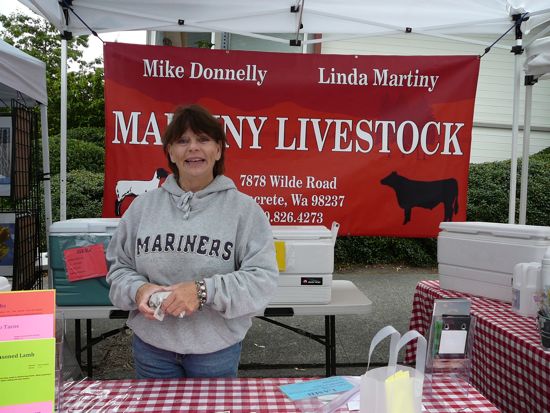
Later, Mom told me about the wonderful Pear and Gorgonzola pizzas made at the market, and after some grocery shopping, I stopped by and ordered the Pear Gorgonzola and the Pizza Fresca, both vegetarian, and, woo hooo, very thin crusted, and baked right there on the street in a special oven they have created:
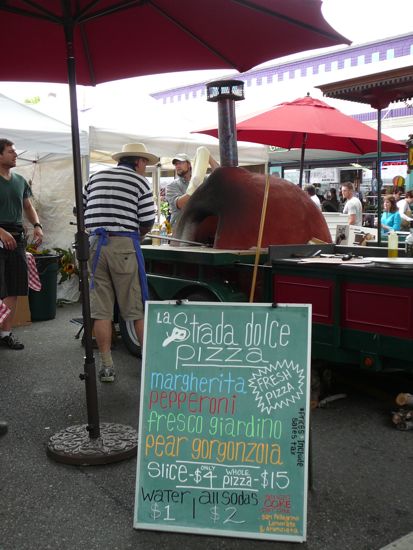
Mom was right. The pizzas were really, really good. We also had enough left over to freeze several slices to microwave on a night when she doesn’t feel like a heavy dinner.
While I was waiting for my pizzas, I visited my favorite soap maker. Last year, I asked for clove soap. AdventureMan and I fell in love with clove soap in Zanzibar, and we have used ever sliver and are yearning for more. This year, she had it! And more! Wonderful soaps, but these two are my favorites:

Sorry there is no photo of the gorgeous finished pizzas, but we gobbled them right up. 🙂
Recent Comments
ExpatAlien on What Country am I Living … intlxpatr on Yellowstone: Old Faithful to C… Michelle on Yellowstone: Old Faithful to C… Cathy on No Grown-Ups in Charge intlxpatr on Waiting for Snow Wikipedia Donate Button

Amazina


Early Voting in Florida


 Here There and Everywhere