Oil Spill Moving Towards Land
You can follow the oil spill movement on this interactive map from usatoday.com

There are lots of meetings. The answer to most questions is the same “I don’t know.” “We don’t know.” Fishing has been banned in the Gulf areas where the oil spill may have effect.
The Shrimp Basket
Even though The Shrimp Basket has specials like 25 cent oysters all day on Tuesdays, and even though the first time, I really did order the steamed shrimp, it is hard to walk into the Shrimp Basket and not to order something fried.
I can go for years most of the time and never eat anything deep fried. It just isn’t that important to me. I can see that living in Pensacola, it is going to be a serious challenge, because so much is deep fried, and holy tomole, it all smells so good. Fried onion rings. Fried fish. Fried shrimp. Fried seafood platters. Fried grouper sandwiches. Stop! Stop! You’re killing me!
Pensacola is a real military town, and loves their Blue Angels, the Navy stunt flying team. The Blue Angels practice on Tuesday and Wednesday mornings, and have autograph signings after the practice and anyone in Pensacola can go and it’s FREE!
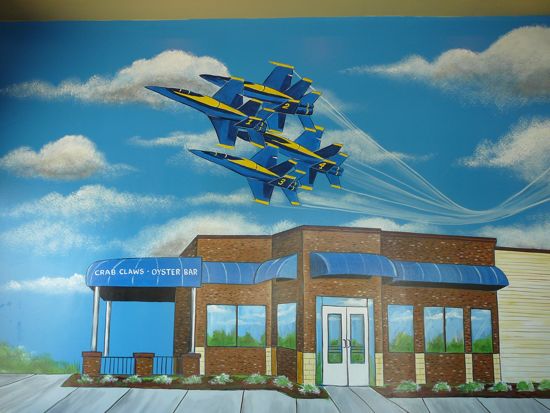
There is often a waiting line to get into the Shrimp Basket because of their specials. On Fridays, the special is all you can eat Fried Fish for $7.99.

When you finish the first batch, you just tell the waitress you want some more. We ordered it, but we could only eat the first batch, there was so much fish. They also have very cool and colorful T-shirts for Shrimp Basket fans:

One Moment in Time
I would have told you if I had known about it long enough in advance. The New York Times had a photo . . . not contest . . . opportunity. They asked people all around the world to shoot a photo at 1500 Greenwich Mean Time, which is 1000 Pensacola time.
As we were leaving for the Episcopal Lite service (0800; it is amazing, they do a processional, recessional, sermon, prayers of the people and communion in 45 minutes flat, amazing!) and I told AdventureMan I needed to take a photo.
It is what I love about AdventureMan. No matter what I propose, he is up for it. OK, sometimes I get a little foot dragging, but for the most part, he is Gung Ho. We hit church, we even had time for a little breakfast at the Shiny Diner, and then we went to take photos. This is what the New York Times instructions were:
Where will you be on Sunday, May 2, at 15:00 hours (U.T.C.)?
Wherever you are, we hope you’ll have a camera — or a camera phone — in hand. And we hope you’ll be taking a picture to send to Lens that will capture this singular instant in whatever way you think would add to a marvelous global mosaic; a Web-built image of one moment in time across the world.
Please keep your photos under 5MB in size.
I didn’t read the instructions. I sent them three photos. I was only supposed to send one.


AdventureMan is going down tomorrow to volunteer with the Fish and Wildlife service; they are going to need a lot of volunteers when the oil slick hits, Tuesday or Wednesday. It is going to be a horror.
Tax Day Tea Party in Pensacola
We don’t really understand the Tea Party. It is clearly against Obama, but then again, it is clearly the party of “against” and it is hard to find anything it is for. This is a problem; it is easy to tear down, and it is a lot more difficult to create – to formulate solutions which will provide benefits for the majority of participants.
As we were approaching our hotel, we saw this huge crowd of ‘protesters’ who appeared to be partying. But every sign was different! As 15 April is Tax Day, the day our income taxes are due, maybe about 10% were carrying signs that had to do with taxes, preferably NO taxes. The rest of the signs protested other things – constitutional amendments (what – women voting? black people being counted as full people? the repeal of prohibition?), no abortion, putting God first – it was a total potluck of causes.
The weather was mild, the sun was shining, there was a breeze – great day for an incoherent protest, LOL. I took pictures from the safety of our car, although everyone seemed very friendly:






Here is what cracks us up. Pensacola is a highly military reliant community. There is a huge military presence here, from Eglin Air Force Base to the Pensacola Naval Air Station. Pensacola is glad to have the military business. So where do they think the money comes from that pays the military salaries, and thus, gets spent in their economy, at their businesses? Few Americans have saved enough to comfortably retire, who do they think is contributing to their Social Security support, and Medicare, and Medigap? Tax dollars! Who do they think supports public education, and guarantees law and order? Who do they think runs the justice system? Who do they think provides emergency fire and medical services? Tax dollars! Who builds and maintains the roads and bridges, insures safety in our food supplies, construction and medicines? Our government, supported by our tax dollars!
Do I like paying taxes? No! Not one bit! But in the interest of the greater good, we pay our taxes honestly, and thank God to live in a society with order, thanks to our tax dollars.
Short Break
Tonight is our last night in the hotel, and tomorrow morning we move into our house, with all it’s fresh new wiring, and fresh new paint, too.
I was in the house, picking up mail, when our contractor was there.
“Have you picked a color yet?” he asked.
“I’m still not sure, ” I said.
“Do you want the electricians to leave the receptacles off so you can paint and then replace them?” he asked, and I didn’t know what to say because yes, what he was saying made sense, but no, I wasn’t so sure I was ready to start painting.
“Look,” he said to me. “We’re coming in under budget. I know what you’re thinking, you’re thinking you can do this cheaper yourself, but with the house empty, our painters can come in and get this all painted for you and you will still be under budget.”
I almost cried. I know the paint is very fashionable, but it made me think of mushrooms, and caves, and it was just too dark for me. I need light.
“Lilting Laughter,” I said.
“Lilting Laughter it is,” he said, “But if you want anything done differently, like one room painted something else, it is OK. We can do that. How about the ceilings?”
“White” I said, without a second of hesitation. I need light! I want the rooms to be light and airy!
What a difference. The color is peachy in some lights, rosy in others. In the morning light, you think it is a white, but it has all these subtle undertones. I love it, and we love this company and the way they do their work.
It still smells a little painty, but we have our air shipment arriving tomorrow, and a house full of furniture we haven’t seen for 12 years arriving next week. We’re going to have our hands full.
I will blog if I can, but we don’t even know when we will get internet connected. I’ll be back. 🙂
Pensacola/Escambia County Honors WWII Vets
To understand how significant this is, you need to know that Pensacola is not a wealthy area, suffering more than 10% unemployment. Pensacola and Escambia County were hit hard by Hurricanes Ivan and Dennis, and are still recovering, but when asked to support this effort, exceeded – and nearly doubled – the charitable contribution:
The sixth trip of Emerald Coast Honor Flight is scheduled to depart from the Pensacola Gulf Coast Regional Airport this morning, taking a group of Northwest Florida’s WWII veterans to see the WWII Memorial.
This is from the Pensacola News Journal for today:
The Escambia County School District is the major sponsor for the April 14 flight, which will take 98 World War II veterans to Washington, D.C.
More than $114,000 was raised through individual donations. Teachers made personal donations to sponsor a veteran, often doing so in honor of their own loved ones who served during WWII. Students saved pennies and participated in school activities such as the “Hats Off To Veterans” day hosted at N. B. Cook.
All of the funds given were donations made by employees, students, schools, parents and community members.
In October, the district set a goal to sponsor 50 veterans, but within six weeks, the goal had been exceeded. On March 16, Superintendent Malcolm Thomas presented a ceremonial check to Emerald Coast Honor Flight, representing the largest donation ever made to the organization.
“I’m so incredibly proud of Escambia County’s staff, teachers and students,” Thomas said in a news release. “They really stepped up to the challenge to honor our local veterans by sending them on Honor Flight.”
The veterans, whose ages range from 82 to 95, will have guardians to escort them throughout the entire day. A cherished war time memory , “mail call,” will be re-created on the flight to Washington, with letters of appreciation from students and employees being distributed to each of the veterans.
Bryce Cox, a fourth-grade student from N. B. Cook Elementary, wrote one of the letters.
“I wrote ‘Thank you for serving our country and protecting it and I hope you have fun on the Honor Flight,” Bryce said.
A big homecoming celebration is planned upon the veterans’ return to Pensacola. Escambia County School District high school bands, cheerleaders and NJROTCs will be participating.
The public is invited to welcome home the veterans as at 7 p.m. at the Pensacola Gulf Coast Regional Airport.
Wooo HOOOO on you, Pensacola and Escambia County!
The Quest for a Florida Driver’s License
I thought it would be a piece of cake.
One of the hardest driver’s licenses to get is a German one, unless you are a driver’s license holder from select states who have an agreement with Germany. I was not a resident of any of those states, but my husband’s company was located in one of them, so as I went through one year, I exchanged my current state license for that state’s license by showing my license and letting them punch a hole in it, getting a new photo and a new license from the needed state – it took like ten minutes.
So AdventureMan and I show up at the Florida Driver’s license place with our old licenses. The man hands us a check list of items we need, and it is like a scavenger hunt! You must have one from column one, one from column two, one from column three and two from column four.
Aha! The Queen of Paperwork, one of my aliases, assures AdventureMan we can cobble together what we need. I have utility bills! I have a 1099! We have passports! We have a deed to our new house, with our names on it!
We walk back in and meet a very nice Florida driver’s license guy and discover our paperwork is not quite so adequate as we thought. My 1099 does not have my FULL social security number on it. I haven’t seen my social security card for – decades. No one has EVER asked to see it before. I know my number, and it isn’t enough that it is on the several other cards I pull out to verify who I am.
We have 9/11 to thank for this, and the Orwellian Patriot Act, life has gotten a lot more complicated.
AdventureMan does not have exactly the right papers either, but very close, so the attendant allows me to write out a statement verifying that I am responsible for him and verify he is living at my address with me (the utility is in my name.)
On our way down to the Social Security Administration, which, by the way was amazingly efficient for a bureaucracy, AdventureMan started laughing and said it’s not unlike when we first got married and he, being four months younger than I am, was not old enough to rent a car, so I rented the car in my name. I laughed and told him he was lucky that when I vouched he lived with me, I did not check the block where I said I was his guardian!
Less than an hour later, I have a letter verifying I have a social security number, and will have a new card, and we are back at the Driver’s License office for the third time; the third time’s the charm, and now I am a legal Florida driver, a registered voter, and an organ donor.
I still have my lifetime-good German driver’s license, which has been handy many a time, and my Kuwait driver’s license, valid for eight more years, and a valid Qatar driver’s license, although maybe now that we are no longer legal residents, we no longer have valid licenses, either, LOL!
Ketchup Entry
“It’s been five days since you blogged,” my friend wrote to me. “Isn’t that some kind of a record?”
Well, no.
Back when I went to Damascus for Christmas, it was also the Eid al Kebir, and I was gone for a week and everyone was so busy with their own celebrations that no one really noticed. 🙂 Well, maybe my Mother. 🙂
This time, it has to do with AdventureMan.
AdventureMan became semi-retired this last week. He and the Qatteri Cat flew to Pensacola, where we met up and now the three of us are staying in a hotel while our heroic contractors are battling to have us in the house by April 15th. Will we make it?
The Qatteri Cat was totally freaked out by his long long trip to the United States. First, for all my annoyances with KLM, we have to tell you that they are totally superb when you are shipping an animal with you. At every stage of the journey, they kept AdventureMan informed on QC’s progress, and he was in great shape when he arrived, except that he was really, really scared. He didn’t understand any of this, the long flight, all the noise, the vibration and then the hotel room full of strange smells of a 1,000 previous guests. (If you are a cat, you can smell things we can’t even dream).
He is OK now. He has a short memory.
Meanwhile, AdventureMan and I have been doing the business of getting ready to get settled, and at the same time, AM is jet lagging. I tell him I think he is catching up on months of sleep deprivation, and he says he thinks it is just jet lag. It makes me happy to see him sleep.
Today, we went by the house so I could pot a cherry tomato, a very special heirloom tomato that I found at the Emerald Coast Garden Show this last weekend. It is a black cherry tomato, and I have never seen one! I have sent for some other heirloom seeds; I love cherry tomatoes and grape tomatoes, tiny little tomatoes with intense flavor. I love to mix them all together with some green onion tops and just a little lemon-y vinaigrette dressing, maybe on some lettuce. YUMMM!
Anyway, AdventureMan likes gardening, too. He comes by it honestly, both his grandfathers gardened. One of them had chickens, too, and grew peanuts, and corn as well as a garden full of vegetables. I garden on a much smaller scale. Mostly I plant things that will take care of themselves – lavender, rosemary. Here, in the mild climate of Pensacola, basil becomes a perennial (I saw that in Kuwait, too, at our Kuwait gardening friend’s house) and I have planted some bougainvillea, which I am hoping will be hardy enough to weather an occasional cold winter or two like the last one.
When we got to the house – and this is Sunday, in the heart of the Bible-belt deep South – the ceiling and drywall people were there, working on a ceiling. We were surprised to see them there, but we know they are all trying really hard to get us into the house as soon as they can.
I was thinking AdventureMan was going to kick back and take it easy, but it hasn’t turned out that way – we are up and at-’em every day, and we have accomplished amazing things. More about some of that in future posts.
Just wanted to let you know I haven’t forgotten about you – just haven’t had the opportunity to sit for very long to organize my thoughts.
Tampa Grapples with Dog Poo
When former suburbanites move back to the city, they bring their dogs with them. The city of Tampa is having to re-educate dog owners to clean up after their pets.
“It’s the LAW!” LLOOLL
I’ve lived in communities where Dog Poo has been a problem. It helps to know your neighbors. When you know your neighbors you are more considerate. There needs to be a downtown Tampa Neighborhood Association that helps people do the right thing because they want to get along with their neighbors. 🙂
From AOL Housing Watch
When the housing market finally improves in this country, is a lot more poo in the streets all we really have to look forward to?
That particular reward came along with a booming housing market in downtown Tampa, Florida. Buyers have snatched up condos and rental units in recent months, after prices were pummeled by the housing market collapse. The area’s population has zipped from almost zero to some 3,000 residents, Paul Ayres, the director of marketing for the Tampa Downtown Partnership, tells a local website.
It turns out that a lot of these new downtown residents have brought their pets with them — along with a pretty inconsiderate attitude toward their new neighbors. Now, Tampa is grappling with a virtual explosion of dog poo.
It’s a nuisance for residents who must dodge errant dog poo like landmines. But it’s also a health issue, since the feces can end up being washed down storm sewers and into water systems without being treated, as a recent Tampa Tribune article points out.
To combat the problem, new Pooch Stations — plastic bag dispensers and bins where pet owners can dispose of the package — are being set up in downtown Tampa. Postcards are also being handed out to remind folks to pick up after their animals. “When your pet has finished its business, do yours by cleaning it up! It’s the law!” scold the cards.
Of course, there are fines of $150 for not cleaning up after your pet, but they are rarely enforced.
In some cases, downtown property managers have started issuing fines to to tenants in the their buildings who refuse to pick up their dog’s droppings, according to the Tampa Tribune.
Lynda Remund, director of district operations at the Tampa Downtown Partnership, told the paper, “We’ve have guides who have witnessed this happening and told the owner to clean it up, only to be told that, ‘It’s your job to clean it up!'”
“Well,” replies Remund, “guess what? It’s not!”
Somehow, as the nation struggles to heal its housing market, I find it difficult to think that the folks at Treasury or FHA or the too-big-to-fail banks are giving much thought to the potential poo problem that has arisen in downtown Tampa. Maybe they should. Who better than our government officials and esteemed CEOs to deal with poo?
Charles Feldman is a journalist, media consultant and co-author of the book, “No Time To Think-The Menace of Media Speed and the 24-hour News Cycle.” He has written about real -estate related issues for several years. This is his very first post about poo!
Y.M.C.A.
Last week I joined the Y.M.C.A. I joined it because I really really need to exercise, and I don’t think exercise is a lot of fun. In fact, mostly I think it is boring, and I don’t keep up with it. The only exercise I ever keep up with is water aerobics, and I don’t know why, except it isn’t as bad as all the other kinds of exercise. I might like dance-aerobics, if I could ever learn the moves, but I always get discouraged – or embarrassed – before I have been there long enough to figure out the sequences.
So this morning, I attended my very first aqua aerobics class. I was late. I think the devil didn’t want me to exercise; I slept badly last night and then overslept this morning. I walked into class late, and if you have ever taken an exercise class, you know that all the best spots are taken, and I had never been in the pool before. I got in, and discovered where I had entered the pool was over my head.
In the meanwhile, the class goes on, and it is kick-a$$.
I had been trying to talk AdventureMan into considering taking the class with me, but he pooh-poohed it and said aqua-aerobics was girly. No No No, AdventureMan, not this class! This class has participants from teen-age to creaky, men and women, all trying to keep up with the instructor, who sets a relentless pace. We have one hour to get through the entire repetoire, including cool down stretches, and then O-U-T so the next class can get started. There is a hot tub and a steam room, and a totally dry floor policy – like after you shower, you have to be dry before you enter the locker room so no one will slip and fall. There are several elderly women, and people are very protective of them.
I was lucky. There was a very nice young woman who would whisper explanations to me as we went along, and, of course, in the water the fact that you are totally out of your league is not so obvious. She clued me in to the dry floor policy as she helped one of the elderly women get her pool-shoes off, and told me to hang out in the hot tub so my muscles wouldn’t seize up. You wouldn’t think an water exercise could be so demanding, but I can feel some of those muscles already. 🙂
“Think you’ll be coming back?” she asked as I was leaving.
Oh, YES. 🙂 It was actually . . . fun!
Recent Comments
intlxpatr on Shampoo Ginger tigerbutterya0c5ff1d… on Shampoo Ginger intlxpatr on British Soldier Kidnapped, Esc… John on British Soldier Kidnapped, Esc… intlxpatr on British Soldier Kidnapped, Esc… Wikipedia Donate Button

Amazina


Early Voting in Florida


 Here There and Everywhere