Stieg Larsson and The Girl With the Dragon Tattoo
I needed some escape time, so I started The Girl With the Dragon Tattoo, a mystery by Stieg Larsson, set in Sweden. I love these detective stories set in other countries; I can learn something as I pass the time reading an exciting mystery. And part of my heritage is Swedish, so I thought this should really be fun.
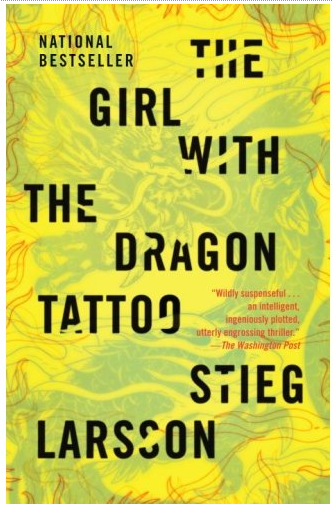
It wasn’t, at least not at the beginning. At the beginning, I didn’t like any of the characters, and they were always eating sandwiches that sounded awful, like liverwurst and egg. I felt like the characters didn’t have any moral center, like they drifted from day to day without neither conscience nor a plan. The main character, Mikael Blomkvist, is about to go to prison for libel; he printed a story about a major industrialist which turned out to be false, and he protected his source. We don’t really know the whole story, not until the end, which makes it hard to evoke a lot of sympathy for Blomkvist.
He is contacted by another industrialist, and asked to solve a mystery, if possible, about the disappearance, 40 years ago, of his niece, Harriet Vanger. Blomkvist would investigate under the cover of writing an autobiography of his employer and his family. There are members of the family who object. In many ways, it isn’t a very nice family.
Blomkvist gets an assistant, a deeply troubled and flawed young woman, Lisbeth Salander, with a gift for investigation. There is a lot of violence, sexual violence, and mutilation of animals. One of the points I credit Larsson with making is the amount of violence against women in Sweden, which goes on under a seemingly civilized veneer. The truth, as I see it, is that there is violence against women in every society; in some it is better documented than in others. In some, it is better punished that others. It exists in all societies, in all countries.
Another think I ended up liking about the book was that the main character, Blomkvist, who writes financial analysis, takes the press to task for printing what passes for financial news without critically reading and evaluating, which he feels is a responsibility of the press. At one point, as people quail with fear that the stock exchange will drop dramatically, he is interviewed and explains that the stock market is based on perceptions, while the Swedish economy is based on production and services; that while the markets may fail, the economy can still be going strong.
Slowly, the book tightens up. Actually, by the end, I was hooked. The only question in my mind is – did I like it enough to read another?
The book is available, new, from Amazon.com at $6.00 plus shipping.
New Qatar Traffic Violations and Fines
Update: LLOOLL, I went to QatarLiving.com and discovered that these “new” laws came out in 2007. These are great laws, deterrents to bad driving and aggressive driving, but the laws mean nothing without enforcement. Do I still see many many children sitting in the front seat? Are people driving while talking on their mobile phones? And not a word about one of the worst offenses these days – texting.
A recent study showed texting is even more dangerous while driving than talking on a mobile phone:
The crash risk attributable to texting is substantial. One possible explanation is that drivers who text tend to decrease their minimum following distance and also experience delayed reaction time. For example, in the Drews et al. study, drivers’ median reaction time increased by 30% when they were texting and 9% when they talked on the phone, compared with their performance in a driving-only condition.
Notwithstanding the safety risk of texting while driving, previous research by Drews and colleagues at the University of Utah — not to mention crash data and widespread legislation — makes clear that using a phone while driving is dangerous.
(To check my source, just click on the blue type, above)
We were talking about people who were saying “Qatar is the most dangerous place to drive in the world” and wondering where this is coming from? Most of us have driven in more dangerous places, but this is the new quote floating around, with no foundation, no statistics, no studies, at least not any I can find with a simple Google.
The topic of new laws came up next over Christmas dinner. New laws? New fines?
“I never saw a word about this in the paper,” I said, peevishly.
“Oh, didn’t I tell you?” said AdventureMan.
People who have been married a long time will understand the urge to kill . . .
Someone else jumped in,
“I think the different companies are passing it around. The Education Foundation has it. Some of the universities have it. That’s the way it is in Qatar, news of new laws filters out.”
LLLOOOLLL. News of new laws “filters out?”
I found it online HERE, at Team BPH and it looks exactly like the copy AdventureMan brought home yesterday, but there is no attribution. Who put this out? There is no kind of official marking on it at all.
IF ENFORCED, these laws would have a serious effect on Qatar traffic.
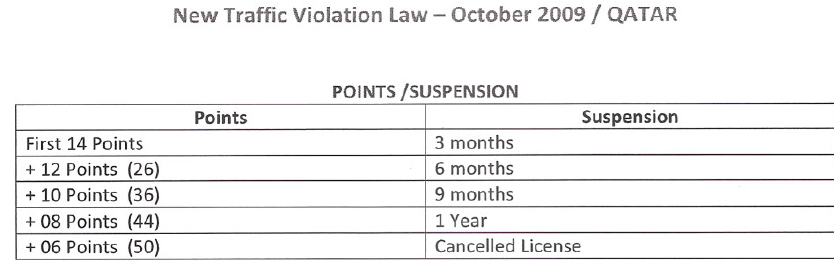

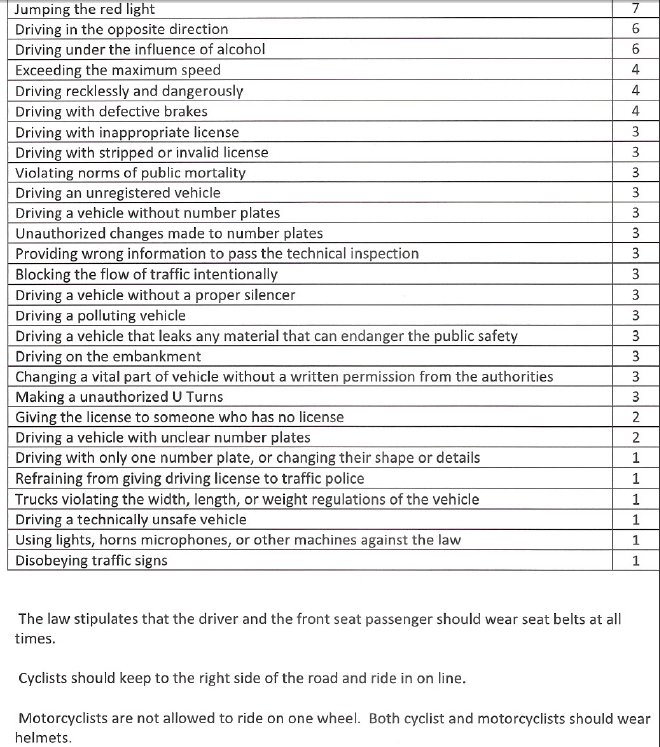
In theory, these went into effect in November 2009, just last month. Who issued these? Has there been any coverage in the newspapers? TV? How can people be held accountable for violating laws of which they are not aware? Or is this something one of the companies printed up, anticipating new laws?
Mixed Forecast
Interesting article from today’s Peninsula Business Section on rising mortgage trends in the United States. The views are so mixed; is the economy recovering? Are there going to be buyers for all those houses on the market? Will they find a way to forestall the next round of foreclosures as ARMs come due and new rates kick in?
US mortgages on upward trend
Web posted at: 12/27/2009 11:52:57
Source ::: LAT-WP
WASHINGTON: After hitting an all-time low in early December, the average rate on a 30-year, fixed-rate mortgage rose to 5.05 percent this week and could climb to 6 percent by the end of 2010, if not sooner, according to giant mortgage financier Freddie Mac.
The results are noteworthy because rates have not topped 5 percent since the last week of October, when they reached 5.03 percent, based on the results of this closely watched survey, which polls lenders during the first three days of every week.
Many firms regularly track interest rates and come up with slightly different numbers because they survey different lenders at different times of the day or week. But several have reported the upward trend in recent weeks. They attribute it in part to the effects of the holiday season, when demand for buying and refinancing homes dies down and financial markets coast through the end of the year.
“However, this is also a glimpse of what we’re going to see in 2010,” said Greg McBride, a senior financial analyst at Bankrate.com, a personal finance Web site.
The key catalyst for interest rates going forward will be the end of a Federal Reserve program that buys a sizable chunk of mortgage-backed securities issued by firms such as Fannie Mae and Freddie Mac. That program succeeded in immediately pushing mortgage rates well below the 6 percent mark when it was announced last year.
But the Fed has committed to winding down the program by March. The central bank is betting that by gradually tapering its purchases, private buyers of mortgage-backed securities, who have largely been absent from the market, will return and rates won’t rise much.
But Amy Crews Cutts, deputy chief economist at Freddie Mac, said interest rates are bound to rise to six percent by the end of 2010 because private buyers will demand a higher rate of return on the securities than the Fed did. Lenders may have to raise the rates they charge to consumers in order to make that happen.
“Extraordinary resources have been put into keeping the rates down and supporting the mortgage markets and it’s hard to imagine that the rates can go much lower than they are,” Crews Cutts said. “Anything we get at or below five percent is a gift at this point.”
This week’s Freddie Mac survey found that the 5.05 percent average on 30-year fixed-rate loans (with an average 0.7 point) was up from 4.94 percent the previous week but down from 5.14 percent at the same time last year. The all-time weekly low since the firm started tracking the numbers in 1971 was in the first week of December, when rates fell to 4.71 percent.
Many borrowers have not been able to secure the best rates because they lack the stellar credit scores and hefty down payments that many lenders now demand. Some who have tried to refinance have not been able to qualify because their home prices have plummeted to the point where they now owe more on their mortgages than their homes are worth.
But anyone who can secure a loan should not wait much longer, especially if they are looking to refinance, McBride said. Homeowners are more sensitive to interest rates when they refinance than when they buy a home. “The difference between 5 percent and 5.5 percent could mean the difference between refinancing or not,” he said.
But the interest rate is less critical to people who want to buy a home, McBride said. In that case, price and affordability should trump interest rates.
Christmas Eve Hilarity
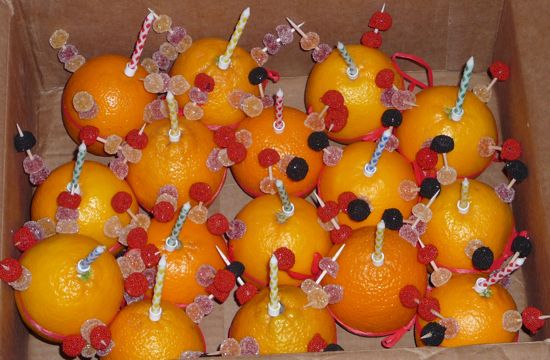
All of a sudden, life slows down and friends can gather, relax, share stories and share laughter. We were full of hilarity as we sat down to make Christingles, which, as it turns out, none of us have ever made before and none of us have a clue what they are supposed to look like.
Here is an explanation of a Christingle from NationMaster.com encyclopedia:
A Christingle is a symbolic object used in advent services in churches of many Christian denominations. It has its origins in the Moravian Church , with the first recorded use, in Germany, in 1747.
This is the story of the first Christingle:
One Christmas time back in 1747 at a town in Germany, Pastor John sat at home in front of his fire. He was thinking how he could explain the love of Jesus, and what Christmas really meant to the children in the church. He decided to prepare a simple symbol to help make the message of Christmas fresh and lively for them. Pastor John gave each child a lighted candle wrapped in a red ribbon, with a prayer that said “Lord Jesus, kindle a flame in these dear children’s hearts”. This was the first ever Christingle service.
Many years later, in 1968, Christingle services were introduced to the Anglican Church in Britain, and the custom spread quickly; each year there are more and more Christingle services in England and Wales, although today’s Christingles are a little different.
The Christingle consists of:
- an orange representing the world with
- a red ribbon around it representing the blood of Jesus
- fruits and sweets (usually dolly mixtures) are skewered on 4 cocktail sticks which are pushed into the orange representing the fruits of the earth and the four seasons
- and a lighted candle is pushed into the centre of the orange representing Christ, the light of the world
Here are some illustrations I found online:

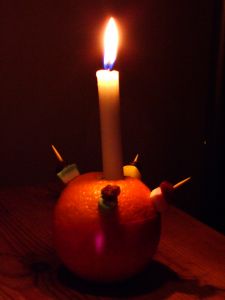
Here is where the hilarity begins – have you ever tried to tie a red ribbon around a sphere? Have you ever tried to determine the proper “Anglican angle” for the fruit filled cocktail picks? Worst of all, how can such a simple assignment end up looking more like Sputnik than an object to teach children lessons in holiness? We struggled to meet the challenge, and, in the end, had fulfilled our mission, but not one of us was confident that we had produced the real thing. Our results:
 After so much stress and hilarity, we needed to unwind, so off to the Ritz Carlton once again, where we discovered that the disappearing Christmas Tree is back in all its glory:
 You can opt for a plate from the Ritz Carlton Christmas food yummies buffet:
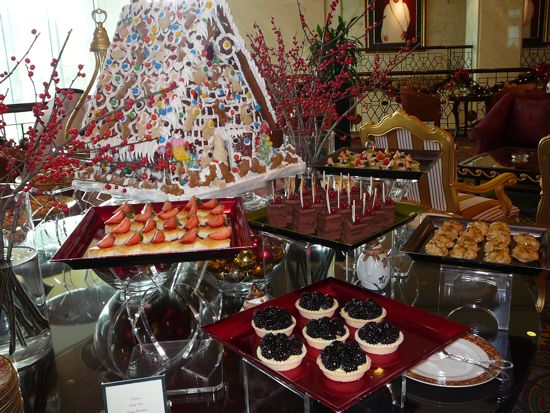 Or you can order the Ritz special Christmas Tea, which comes in towers (and you can actually order coffee with it if you prefer coffee to tea)

A lovely beginning to Christmas.
We wish you a Merry Christmas, and unexpected joy in the coming year.
Souk al Waqif: Men’s Souks
AdventureMan and I have a tradition, and that is we like to go shopping together before Christmas, helps him help Santa Clause with things to put in my Christmas stocking, and gives us precious time together in a relaxed setting.
So of course, we headed to our favorite place, the Souk al Waqif, where I discovered that the place I love the most to buy scarves – he always has things no one else has – was totally out of scarves! Well, he had six hanging up, but they were not special. I said “Where are the scarves??” and he laughed and said “Sold out!” and I said “Well that is good for you but not so good for me!” and we both laughed. He said he will be getting more early in January, but that is no help to Santa!
Then we wandered over into the older area of the souks, closest to Grand Hamad street. There is a new shop with beautiful misbah (worry beads) and unusual treasures. We wandered further, and came upon the falcon souk.
OK, I get it, the rest of you knew all about it, but I think because I usually go early in the morning, maybe this area isn’t open when I go – I have seen the seats outside, the majlis area, but I never saw the falcons before, not in the new souks. What fun! But aside from tourist women, there are no women in this area – the falcon souk, the camping souk, the hunting souk – these are very masculine domains, Guy Souks.
And they are equally lovely:


In this hallway, everything is giant. Hanging up above is a giant falcon glove, a giant falcon hood, and at the end of the hall, where the men with falcons are entering, are two gigantic falcon stands.
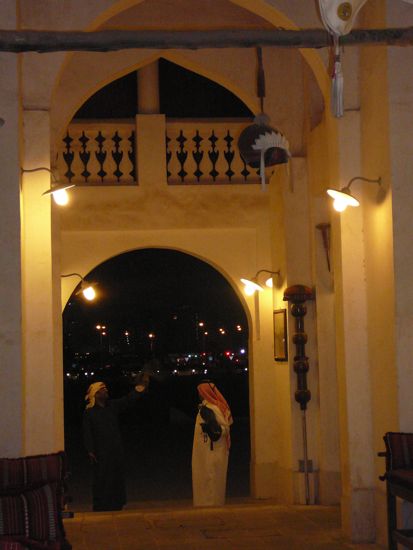
Look at this beautiful space! I think there are some offices around this space, as well as shops:

The camping and hunting souks have all kinds of tentings, bedrolls, washing up fixtures, etc, not so good for camping in the Pacific Northwest, but great for desert camping and hunting:

When the hardware souks and shoe repair souks were cleared out of the main street, I wondered where they had gone, and last night we found them. To my joy, I also found the scribes! I had been told they dispersed, went to various police stations to do their translations, fingerprints, etc. but last night I found them here! Right next to the police station! How have I missed them, all these evenings in the souks? I didn’t see them!
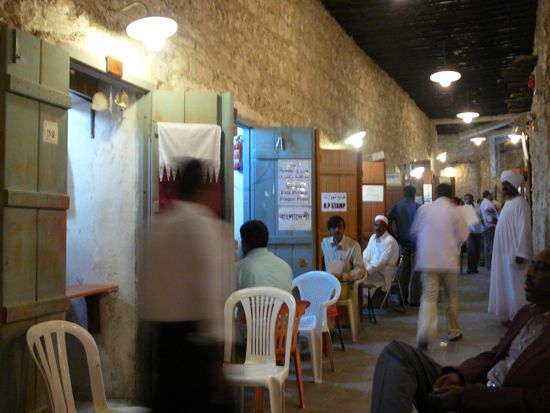
When first in Doha, where there is not one single modern hardware store, and before I had discovered my neighborhood hardware area, (remember, my secret vice is that I love hardware? and hardware stores?) I would go to the Souk al Waqif and start at one store saying “I need 3/4 inch masonry nails” and I would show them one. The man would leave his shop and take me to whichever of his buddies carried those nails. Or chains. Or bungee cords – they always had what I needed, or something close I could use. I’m glad to see the hardware shops are still there, along with the fishing and boating supply stores, and those huge pot and griddle stores.
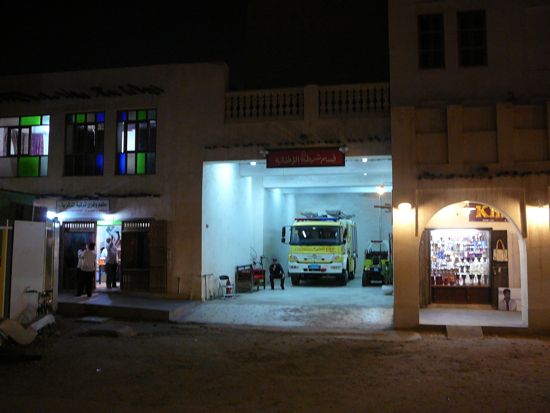
Did you know Souk al Waqif had it’s own fire truck? Neither did we!
Shaking Things Up

First, you have to understand how quietly AdventureMan and I live. He works long hard hours. He gets home, we eat dinner. Most nights we watch some TV together, usually some season of a program we enjoy.
But after dinner last night, we decided to take a walk, instead. While our family in the states is braving out a variety of winter storms, the weather here has become – WONDERFUL! There is a hint of freshness in the morning and evening, and while days are warm, they are comfortable. We walked our compound, enjoying ourselves thoroughly, looking at all the Christmas decorations, and Eid decorations still up. It was a great walk.
Once we came home, we settled in – or so we thought. We were about 15 minutes into the newest season of Lost when our doorbell rang, and a group arrived to give us a very special caroling session. It was so much fun – and thank goodness, I had some cookies on hand to share with the people who came caroling! It was a delightful and moving evening.
We settled down once again, and once again the doorbell rang, neighbors coming to tell us some very good news, a miracle, really, something we had all prayed for, and that they were going home briefly, and would see us in a week or so. We had a wonderful visit with them, were able to send them off with joy.
We looked at each other and grinned. All this was so totally out of the ordinary for our usual week-day nights, but wonderfully out of the ordinary. We like it when things get shaken up a little bit. 🙂
Defense: It’s The Cops Fault; He Was Chasing Me!
Court asks motorcycle rider to pay blood money
Web posted at: 12/19/2009 2:30:29
Source ::: THE PENINSULA
DOHA: A young man who rode a motorcycle and killed a pedestrian in a bizarre crash has been asked by the court to pay QR200,000 as blood money to the family of the deceased.
The court fined the convict QR10,000 for violating traffic law. But how the man was caught by the law-enforcement agencies is quite interesting.
It so happened that the Police Patrol saw two men riding motorbikes with tremendous speed. They gave the duo a chase but in vain. They vanished in think air. But soon the police was informed that a pedestrian was hit by a speeding motorbike.
When a police party reached the spot of the crash it saw a motorbike lying near the body of the victim.
The cops were quick to realize that this was one of the two motorbikes they had given a chase sometime ago.
With help from its registration plate they zeroed in on the culprit and referred the matter to the court after investigation.
The defense lawyer argued in the court that the crash occurred because they motorbike was chased by the cops. The court, however, did not buy the argument and convicted the man.
QR 200,000 sounds like a fortune, but it is $55,000 for taking a man’s life. For a young man who was running from the cops and then tries to claim their chasing him as a defense! This case sounds like a perfect opportunity to give a community service penalty in addition to the blood money; expose this young man to the consequences of motorcycle accidents, and accident victims, allow him to see with his own eyes, and serve, the victims. It could change his life, and change his callous attitude.
Qatar National Day Fireworks Video
So my friends, this is the very first video I have ever uploaded to YouTube, three minutes of the twenty minute spectacular fireworks display on the Corniche last night for Qatar National Day:
Qatar National Day Fireworks Spectacular
The problem is, even with the most amazing situation in the world, my wonderful little hand held Lumix can’t begin to capture the awe-inspiring grandeur of the 20 minute Qatar National Day Fireworks spectacular.
Another amazing thing – the fireworks started ON TIME. Suddenly the entire length of the Corniche erupted in white waterfalls. The fireworks were kept relatively close to the ground, and compact, but spread along a couple miles – it was an amazing feat, and the timing was to the second.
Caught in traffic, we decided to try something different. Like the Robert Frost poem, we took a road less travelled by, and it made all the difference. We lucked into a fantastic vantage point.



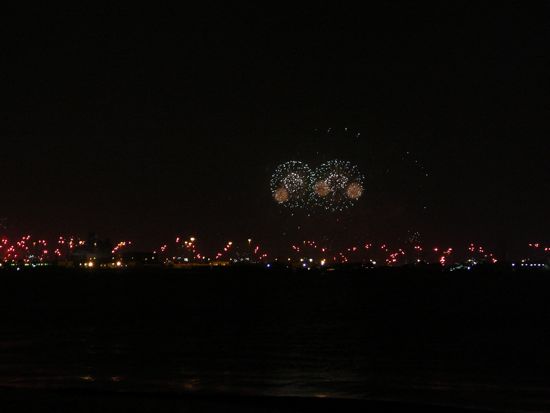






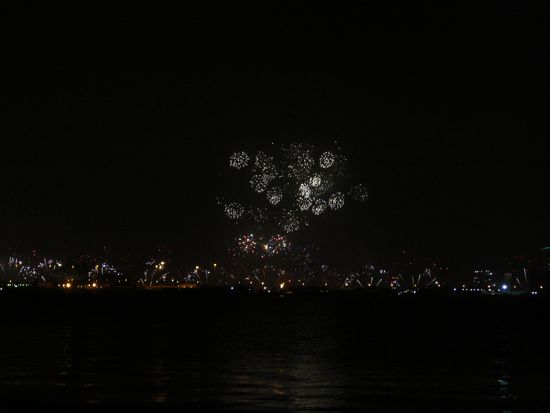





I have to add a special thanks here to AdventureMan. He knows how much I love fireworks, and I knew he has to work tomorrow, and still, he took me to see the fireworks. We were stuck in bumper-to-bumper traffic until we took a chance, and by a miracle, found this fantastic, uncrowded vantage point. He love the fireworks as much as I did, but he did it for me, and my heart is full of gratitude. 🙂
It’s Good To Be The Amir :-)
One of the first things visitors say when I take them around Doha is “It’s so clean!” said in a voice of total wonder. Doha IS clean, noticeably clean. Along the Corniche, everything is clean – and manicured. Doha is beautiful. The roads are beautiful, and getting beautifuller – er . . . more beautiful.
Qatar is not a democracy. It has a monarch, the Amir. The Amir has huge resources, and he channels much of his resources into infrastructure – highways, water treatment, electricity, parks (along the Corniche, wireless internet is provided to the community, totally FREE, miles of free internet), education – and serious work is being done to raise the level of education and educational possibilities continually – planning for future food and water, trying to insure that if and when the gas runs out, Qatar will have a sustainable economy.
It’s not a job I would want. It’s a lot of hard work, and who do you trust to share your vision and help you get the job done? Every day must have its frustrations, and the triumphs take a lot of work and perseverance. Building a country’s infrastructure is not for the faint-hearted.
But the job has its perks, and one of them is that you can create your own viewing stand for the 0800 Friday morning military review parade. This reviewing stand makes me grin. This Amir has some Events people with a flair for the dramatic and a tip of the hat to the traditional at the same time. While some complain that the new souks are like Disney Does Doha, anyone who used to go there and goes there now will tell you that there is new life in the souks. They are clean and safe and light and well cared for.
Anyway, I digress.
Here is where the Amir gets to sit to review his military at the parade tomorrow morning at 0800:
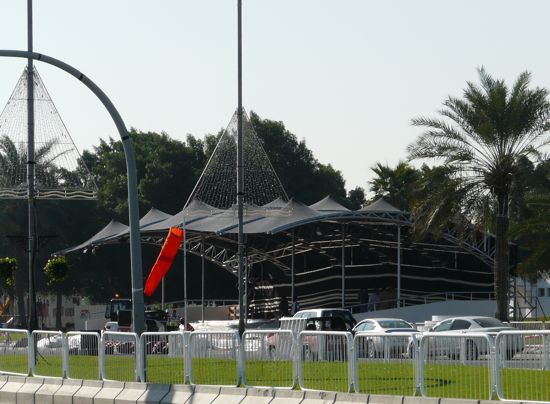
I was afraid to go any closer, as people were practicing for the parade, security might not like me taking photos, but how cool is this? They used original beit as-shar (house of hair, i.e. wool) fabric for the inner lining of the review tent. I totally love it. This fabric was originally made mostly from goat hair, but also stripes of sheep and camel hair. I have some. It’s tough and strong, and in panels, woven by the women. I don’t think they make tent bodies like this any more.
Recent Comments
intlxpatr on Shampoo Ginger tigerbutterya0c5ff1d… on Shampoo Ginger intlxpatr on British Soldier Kidnapped, Esc… John on British Soldier Kidnapped, Esc… intlxpatr on British Soldier Kidnapped, Esc… Wikipedia Donate Button

Amazina


Early Voting in Florida


 Here There and Everywhere