
Update on Animal Market in Kuwait
From the Kuwait edition of the Arab Times today:
Confusion on closure of animal market, need seen to set minimum standards
KUWAIT CITY, Nov 2: Conflicting reports to the Arab Times caused confusion about the shut down of Al Rai animal market. News reports said that the animals were kept as hostages within the stalls to “starve to death”.
Ayesha Al-Humaidhi, from Animal Friends League of Kuwait, assured that shopkeepers do have access to the shops and tend to their animals. “They do enter their shops and do conduct their business, but they can’t run their business openly until they settle the rent dispute with the Municipality,” she said. Al-Humaidhi explained that a number of her friends have gone to Al Rai area and had either purchased animals or animal related products. “It’s logical that if proprietors can access their shops to serve customers, they can enter the same shops to feed their animals,” she explained. She, however, pointed out that if animals kept in the stalls are lacking anything, it would be a proper flow of air.
“My friends told me that birds were the main sufferers, and that is only because of the way they are kept by the shopkeepers. “Up to 50 birds are put in one small cage which causes a relatively higher death rate amongst birds compared to other animals under normal conditions. Slower air flow had cast its toll on the poor birds,” she added.
Al-Humaidhi affirmed that the conditions in which these animals are kept were “hellish to start with”. “The shutting down of these stalls has made it worse. “However, there is a dire need to set minimal standards for shopkeepers to abide by when tending to their animals. “It’s inevitable from the reckless way these shopkeepers tend to their animals that they would not even feed them if they had no market,” she said.
Meanwhile Abu Sulaiman Al-Hadad, one of the shopkeepers, claimed that he, along with other proprietors, have not accessed their shops since these were shut down on Oct 15. “My animals have been imprisoned for more than two weeks and have all died from starvation,” he complained. Asked if he had entered his shop at all during this period he said it’s “impossible”. “If any of us is caught entering a shop we’d be obliged to pay a fine of KD 500, along with other legal action,” Al-Hadad said.
Al-Hadad said that shopkeepers have been selling some of their shop items which they managed to pick before the Municipality shut the shops. Asked about measures taken by him and or other proprietor to “rescue” their businesses and animals, Al-Hadad informed the Arab Times that a law suit has been filed to the Administrative Court. “No one knows how long it will take to be finalized. Our animals have long since choked to death,” he said.
By Dahlia Kholaif
Arab Times Staff
It seems some of the shopkeepers are keeping this story going.
Barbaric. Animals Left to Starve to Death
It’s hard to believe that this could be happening. This article is from Kuwait’s Al Watan and I learned about it from Mark, at 248am.com. Unbelievable. Unthinkable.
KUWAIT: It only happens in Kuwait. No other country would demand money from people already paying rent.
Initially, those renting stalls at the animal market in AlـRai thought it was a mistake, but when their shops were shut down “because of rent arrears,” business owners went berserk. In addition, the animals displayed in the stalls were left inside the locked stalls, with the proprietors unable to tend to or remove then, thereby what was a municipal disagreement has ballooned into an animal rights fiasco.
It remains unfathomable to many where the decision to charge a second “Municipality rent” arose from, when the proprietors were already paying rent to the owners of the commercial space, the Ministry of Finance. With the Municipality shutting down the stalls, and the Ministry of Finance staying silent ـ only to say: “this is not our issue” ـ the business owners are helpless as the animals howl and cry for food, with every passing day the stench of death growing ever stronger.
Al Watan Daily went to the animal market in Al Rai area and witnessed the disaster first hand.
Shopkeepers told Al Watan Daily that the Municipality had closed all the stalls over two weeks ago, “and they haven”t opened the doors even once till now. All the animals are inside the stalls, and most of them have died due to lack of water, food and air. These animals have been in cages within the stalls for 15 days and they have not seen any light, nor eaten anything.”
Ridha Ashkanani told Al Watan Daily: “We signed contracts with the State Properties Department; we pay them 300 Kuwaiti dinars per year, and we also have been paying KD 60 per year to the Municipality as for the cleaning of the area. We were forced to pay this sum although the Municipality is not taking care of the area and the place is not clean at all. The problem now is that the Municipality is asking us to pay another rent for the stalls themselves. They want KD 3 per every square meter within the shop per month. They also want the money to be paid in arrears from 1995. We can”t afford to pay all this, and there isn”t any law that requires us to pay a second rent to the Municipality.”
The situation is this: according to the traders, they have been paying a normal rental fee since 1997, which continued when the Ministry of Finance relocated their businesses to the current location, but in 2004, a Municipal inspector came and asked them to pay a “Municipality rent.”
The proprietors explained to the inspector that they were not aware of any second “Municipality rent,” and that according to the contract with the Ministry of Finance, the rent was to be paid to the ministry, and the ministry only.
After receipts were shown to the inspector that payments were being made to the ministry, he quietly withdrew and disappeared.
However, in 2006, another inspector came demanding “Municipality rent.” The traders explained, once again, to the new inspector the same story, to which he accepted their argument but demanded a KD five monthly surcharge for cleaning.
The traders saw no qualms with the demand and agreed to the nominal fee, but then some months later, the inspector returned, requiring that the cleaning fees be paid in lump sum six months in advance. After some grumbling, they acquiesced.
Oddly, some weeks later, traders were informed that instead of 6 months, it would have to be 12 months in advance. Again, they reluctantly agreed.
Now you have the current situation, where the Municipality has shut all the stalls with the animals locked inside, and is demanding the “Municipality rent,” in arrears as far back as 1995.
“Our major issue is that the animals are trapped inside the stalls, and most of them died. We are losing our business and losing the animals we have in the shops, and we are not allowed to open the shops at least to feed the animals, which have not eaten any food for 15 days,” explained Ashkanani
Ahmed, another proprietor, said: “I lost all the gold fish I had in the shop, worth KD 5,000. We want the animal rights societies to help us in our problem. We went to the State Properties Department and they didn”t help us, and stated that it”s not their responsibility. We then went to the Cabinet and they told us to go to the minister, and he also refused to help us. We finally went to the Municipality, (which refused to open the doors until they are paid), and now we are filing a case at the court and we are waiting to see what will happen.”
ـ
Last updated on Monday 2/11/2009
Halloween Post Mortem
Hallowe’en is really more a cultural tradition these days than a religious event. We no longer worry about spirits walking around on Hallowe’en, and wear costumes to try to scare them away from us. In fact, many of the trick-or-treaters who came by our house last night were pretty! There were fairies, and little mermaids, and some very alluring witches.
In fact, there were so many trick-or-treaters that we ran out! How embarrassing! I thought I had a LOT, but there were more trick-or-treaters than we had treats.
It was a great evening, altogether, and next year I will know better.
Here is our not-scary pumpkin. I wish you could see the ears – it is an orange cat pumpkin, in honor of the Qatteri Cat.

All the visitors made the Qatteri Cat jumpy. He was happy to stay inside and hide with all the action in the streets last night.
Back in Traffic; How Do You Alphabetize / File?
So today I became, once again, a legal driver in Qatar, five months to the day from my arrival. Yep, for those of you who never have the joy of trying to maneuver through the complexity of getting a license in a foreign country – you have NO idea. NO idea. There are people who try and try to get a license and never do.
We are really lucky. We have some very good people who help us get things done. Somehow, it’s my turn to be lucky today.
When I showed up at the office, however, one of the HR girls told me “Oh! Flana is not here today! You will have to come back.”
You all know how nice I am. I smiled at her and said “my husband told me to be here today to get my driver’s license. Someone is going to help me.” Smile again, big smile.
Sure enough, someone is going to help me, and it is someone who I like, someone who has helped me before and who is always calm and patient and knows how to persist pleasantly until he gets what he wants from the bureaucrats. In fact, I admire him, because people end up liking to help him. He is low key. He takes me to the driver’s station, where, because of my advanced age (DO NOT ASK) I have to have an eye test. This leads me to wonder. Doesn’t everyone have to have an eye test?
Then I wait, in the special ladies’ majlis:
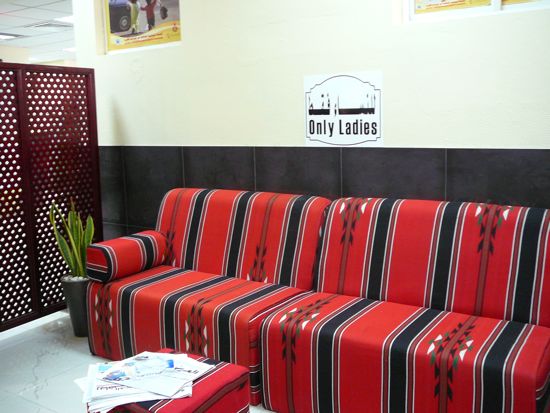
I had to wait quite a long time, but I was comfortable, and while I was waiting, I read all the driving safety signs they had up along the ceiling. They were all in English and Arabic, and they were great thoughts, but too many words. Like if you are reading that many words: If you are driving too fast you may not get home alive (that is not a real one, but that was the gist of most of them) so I was creating a new driving safety campaign called the equal campaign:
Speed + Texting = (shows a vehicle turned on its side and all smashed
Speed + Weaving = Two or three crunched vehicles
Texting + Driving = QR (enormous fine)
Something simple to read, graphically simple, something you can glance at and get the meaning.
When I got my driver’s license, I was really happy, except for one tiny little thing – it’s kind of my name but not exactly my name. It’s an easy mistake to make, names can be complicated, but . . . it isn’t my name on my license. It’s my face, it’s my information – it isn’t my name. For half a heartbeat, I consider saying something and then Wisdom kicks in and I zip my lip.
So then, driving home in traffic, I got to thinking about names and how we file things, alphabetically, and even Europeans sometimes file us wrong, which has led us to first class seats because airlines can’t find us, etc. It isn’t always such a bad thing.
Then I started wondering about how Arab speaking people file. Like do you have half the files in the “A” drawer, like Al So-and-So and Al Somebody Else, and how do the sun and moon words affect the filing, like Ar Rayyan, or Ath Thalaka, or As Shams, etc. Once you have filed someone, the goal is to be able to retrieve that information? How does alphabetization work in Arabic? How are things filed?
So being stuck in traffic might not be so bad if someone answers my question and I learn something. 🙂
Pomegranate Soup by Marsha Mehran
I saw a mention of this book in an Amazon.com referral as a book I might like, and was almost set to order it when something said “go check the stack of books Little Diamond left for you” and sure enough, I already had the book.
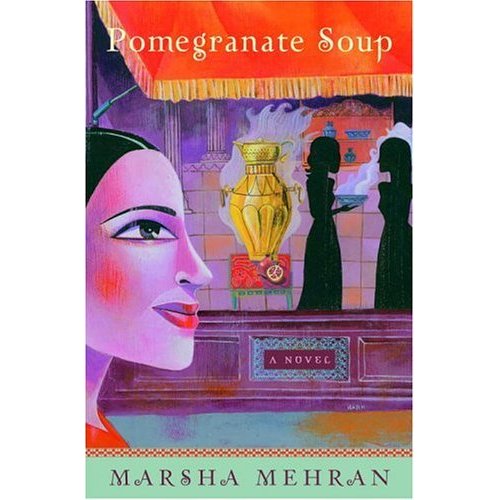
I use books as an incentive to get me through life’s inevitable tasks I don’t like – like “if I finish this project on time, I get to read this book as a reward.” It works for me.
When I first started reading Marsha Mehran’s book about three Persian sisters starting up a cafe in a small Irish town after fleeing Iran, I found it sour. The author has a critical point of view, and generally speaking, I don’t like hanging around with people who criticize others and judge them harshly. At the beginning of the book, Mehran introduces a lot of people, many of whom we are not meant to like.
Even the sisters are not all that sympathetic – at the beginning. But also, near the beginning, she discusses Persian cooking, the idea of balance in a meal, hot and cold, spicy and bland, so you kind of get the idea that if there is sour, then there will also be sweet. In addition, at the end of each chapter there is a wonderful recipe, a wonderful, fairly easy-to-follow recipe, and she included one, Fesanjan, that is my all-time favorite Iranian dish and now, I know how to make it, Wooo HOOOO!
Three sisters, orphaned by fate, held together by love and duty, start a cafe, which, against all odds, becomes a raging success. Raging success does not heal all the old wounds, however, nor the hearts that bear them, and we learn through the book what the sisters have borne and overcome.
It turns out to be a sweet book, one well worth reading. And oh! the recipes! In each chapter, there are also hints that make them even better, so you can’t just copy out the recipes and use them, you really have to read the book. 🙂
It’s a pity that two of the most wonderful countries in the world – Syria and Iran – are off limits. We’ve been back to Syria, and it was everything we remembered (see the Walking Old Damascus blog entries) but oh, how we would love to explore Iran. Sigh. The world turns, and we can only hope to be able to get there in our lifetime. Stranger things have happened.
NO PARKING!
On my way home, driving along the wall of our compound where they recently installed bright shiny new NO PARKING signs – not one or two, but like twenty; one every thirty feet – there are a whole brigade of big huge trucks, you know, the kind that accompany beginning construction? I am not even sure I can get through, there are so many, like six or seven or eight (it is a small street).
But one of the trucks is orange, and I am hoping hoping hoping, so I grab my camera out of my bag as I inch by, and yes! yes! he has parked right next to one of the signs. I take my shot and keep inching by, and just beyond the last truck on the left is a gaggle of truck drivers, I guess they are trying to figure out what to do about something.
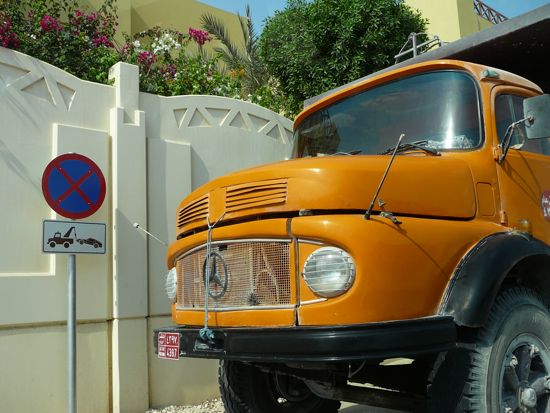
When I get to our gate, I tell them, “there are many trucks parked by the compound wall” (here I point in the direction) “can’t you see them on the security cameras??” and the gate guy says there is a man fixing the camera input right now, but did I get the truck number?
(Did I get the truck number I am thinking??? GO DO YOUR JOB! YOUR JOB IS SECURITY! GO TELL THEM NOT TO PARK THERE!)
I smiled and said “you need to tell them to move their trucks, and not to park right by the compound wall, it is a security risk.” I am a nice lady, yes I am, and so I say this nicely, with a smile, but there is a hint of steel in my voice.
He says “we have people working out there! They will tell them!”
The people out there working are the gardening crew.
I said “No. Your people are about 400 feet away from the trucks, and they are gardeners. They are not going to tell Pakistani truck drivers to move their big trucks.” (The smile is still there, but there is a hardness in my eyes.)
He doesn’t want to go. “Did you get his number?” he asks again. “I say no,” but then I pull out my camera and show him the photo. His eyes widen. The security man comes, and the gate guard shows him and his eyes widen. He assures me they will call the Bolice immediately.
Did they? I don’t know. Honestly, you do what you can. Sometimes it is like knocking your head against a wall, it just feels so good when you stop.
Little Mosque on the Corner
This is for my western friends, but anyone who sees me saying something wrong is welcome to jump in and fix it so it’s right.
We have a little mosque on the corner near our villa. Now, having a mosque on the corner is nothing special, in fact, when giving directions, it is kind of a joke, because you can give landmarks and then say “and you turn right at the mosque” but there are SO MANY mosques that using a mosque as a landmark is almost sure to confuse whoever is trying to find you.
Nonetheless, every neighborhood has its own mosque, and then there are bigger mosques where everyone gathers on Fridays, we call them Friday mosques, and then there are even bigger ones where everyone gathers on the two big holidays called Eids.
But this is our little neighborhood mosque:

I think it is very beautiful.
In the back, around this time of the year, they start a garden. I think it is for poor people to have something to eat, but I don’t know. I love it that they take a tiny little space and make it useful.

We live close enough to hear the call to prayer five times a day – it seems like more. There is the “get ready” call and then there is the real thing. During Ramadan, sometimes there are prayers over the microphone (it is on low) all night. It isn’t so intrusive; when it is hot and the air conditioning is on, you can’t even hear it. It’s kind of reassuring, to me, hearing someone praying all night long.
The Heart of Doha – Disney Does Doha?
“No, it’s not DOHALAND!” I snapped at my friend. ‘It’s called the ‘Heart of Doha’ project.”
We were exploring the project in it’s first phase, the destruction phase, which is turning old haunts into several circles of hell – shopping hell, driving hell, parking hell, disorientation hell. And just as we were inching our way into a new diversion, I saw the big sign describing the future this funky area of Doha and telling us to go to ‘Dohaland.com.’
Oops. I apologized profusely and she very humbly pretended not to be gleeful that she was right and I was wrong. Well, actually, we are both right. It is both ‘Dohaland’ and ‘The Heart of Doha,’ but I shouldn’t have snapped at her over something so inconsequential. Blame it on the rain . . . umm . . . .err . . . the traffic.
Dohaland. I’m sorry, it sort of cracks me up. It’s just like Disney – JungleLand, FutureLand, etc.
I remember when the Suq al Waqif project first started, how outraged I felt, and how delighted I am to go down there now, where the shop-keepers have electricity that is reliable, even air-conditioning wafting out into the corridors, the appearance of ancient woven mats shading the twisting cobblestone street which no longer reaches out and grabs your heels, or changes levels unexpectedly. How can you be a successful curmudgeon when it turns out so positively? Even if it is a little bit Disney-does-Doha, it is so attractive!
What I love about what has been accomplished so far is how it has enhanced the experience for everyone. If you go down into the souks, you see more people. You used to see only a few westerners, now you see all kinds, even tourists, even your neighbors; you see every nationality down in the souks now, and people are actually buying things, not just killing time. There is a great variety of shops and restaurants, and even if the parking spots are tiny, there is parking.
Have you visited the website yet? Dohaland.com? I love the vision, although in one shot with people in suits crossing the streets, I want to shout “Hurry! Hurry! Or you’ll get run over!”
Here is what it is going to look like – and you can go to the Dohaland website and get a great big full screen map:
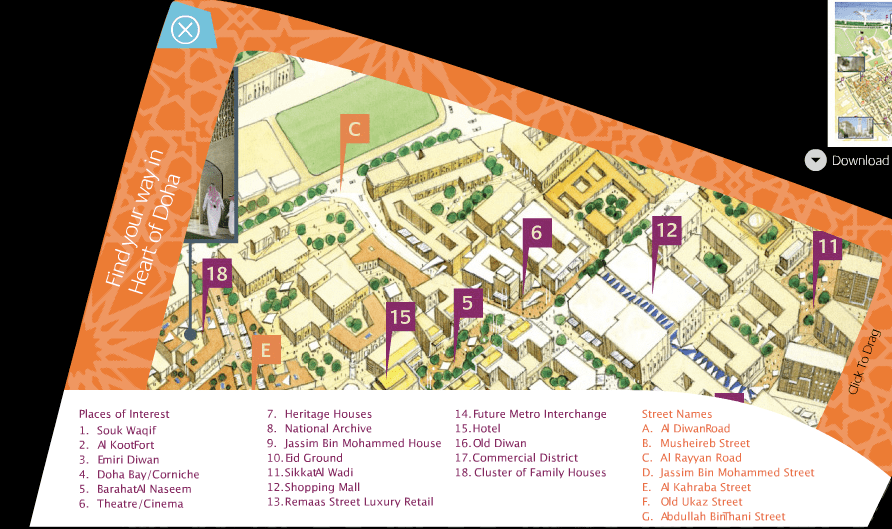
And here is what it looks like now:
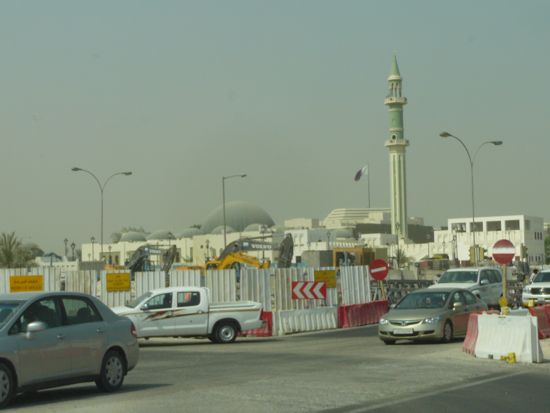

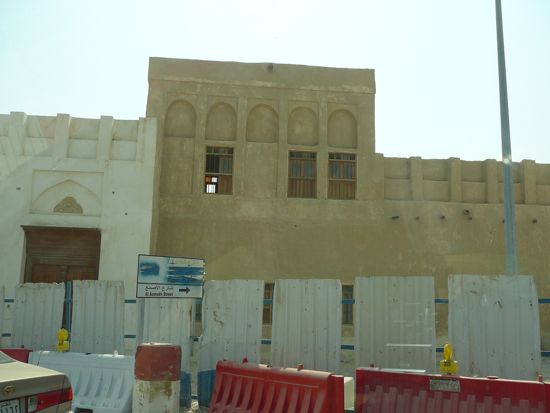
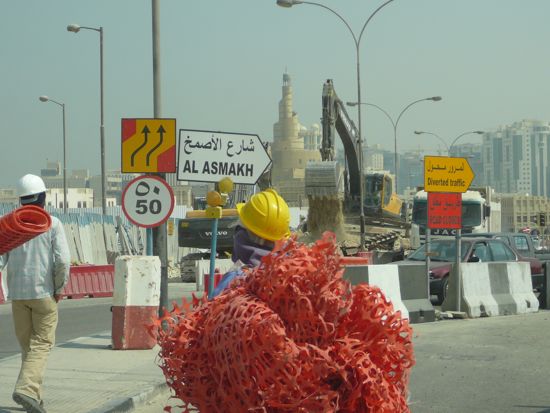
These machines are like huge dentist’s drills, with points that pound down into the hard-packed Qatar soil to break it up so that foundations can be built:
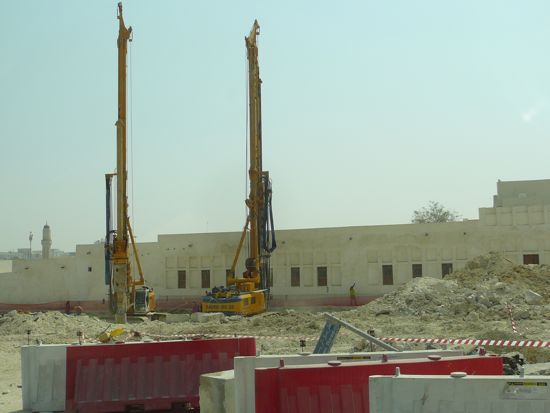
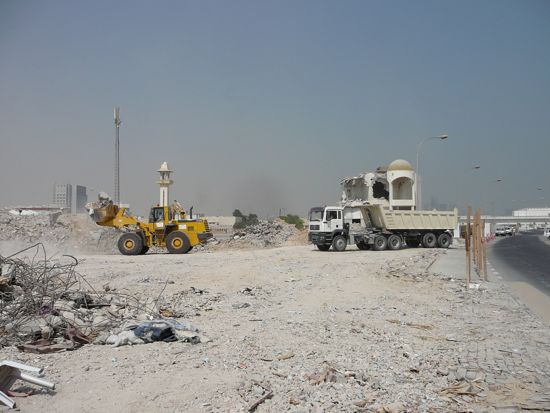

It’s not unlike house-cleaning. When you pull everything out of the closets, out from under the beds, the drawers, those piles of things in the corner, for a while everything looks worse than it did before you started. Slowly, slowly, you create areas of organization and calm amidst the chaos, and slowly, slowly those areas expand, join, until the chaos is eliminated, you know where things are, and your living area is a calm and peaceful and organized oasis. I hope I get to see that day in Doha.
Update: Dohaland AKA Heart of Doha is now known as Musherib
Recent Comments
intlxpatr on Shampoo Ginger tigerbutterya0c5ff1d… on Shampoo Ginger intlxpatr on British Soldier Kidnapped, Esc… John on British Soldier Kidnapped, Esc… intlxpatr on British Soldier Kidnapped, Esc… Wikipedia Donate Button

Amazina


Early Voting in Florida


 Here There and Everywhere