Qatar Train Map
I found the paper with the map! How cool is this?

When I look at this, I think if the money ever runs out in Qatar, they will still have invested in a superior infrastructure – education, transportation, roads, parks, attractive public areas, effective policing and traffic control – way more important than luxury malls.
The Tribal in all of us – Prayers for Rain
I know it is about that time of the year . . . clouds are gathering, you can almost smell rain coming. And yet it holds off. Every year, in Qatar, and also in Kuwait, the national leader gathers with his people and prays for rain.
What country doesn’t need rain? Even in the Pacific Northwest, where jokes are made about the abundance of rain, when the rains fail to fall, people pray for rain.
I remember living in Monterey, California during a drought; it didn’t rain for a couple YEARS. When it rained, people danced in the streets for joy.
There is no sweeter smell on earth, I think, that the smell of the first rain hitting the dusty earth.
From today’s Gulf Times
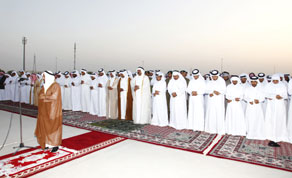
Prayer for rains
HH the Emir Sheikh Hamad bin Khalifa al-Thani joining the worshippers to perform the Istisqa (rain-seeking prayer) at the Al Wajbah prayer ground yesterday morning. The prayer is in line with the Sunnah (sayings and deeds) of the Prophet Muhammad (Peace Be Upon Him), who performed Istisqa prayers when there was a delay in rainfall.
FYI: How Long is a Generation?
So I get on a track and I can’t get off, like a little hamster running on the wheel. I got to thinking about generations, and how long ago is 10 generations and so I had to ask Google the question: How long is a generation? Don’t you love Google? They always have an answer.
Now I know something new. Now I will share it with you. This comes from Ancestry.com
Research Cornerstones: How Long Is a Generation? Science Provides an Answer
How Long Is a Generation?
By Donn Devine, CG, CGI
We often reckon the passage of time by generations, but just how long is a generation?
As a matter of common knowledge, we know that a generation averages about 25 years—from the birth of a parent to the birth of a child—although it varies case by case. We also generally accept that the length of a generation was closer to 20 years in earlier times when humans mated younger and life expectancies were shorter.
In genealogy, the length of a generation is used principally as a check on the credibility of evidence—too long a span between parent and child, especially in a maternal line, has been reason to go back and take a more careful look at whether the evidence found reflects reality or whether a generation has been omitted or data for two different individuals has been attributed to the same person. For that purpose, the 20- and 25-year averages have worked quite acceptably; birth dates too far out of line with the average are properly suspect.
But now, researchers are finding that facts differ from what we’ve always assumed—generations may actually be longer than estimates previously indicated.
Several recent studies show that male-line generations, from father to son, are longer on average than female-line generations, from mother to daughter. They show, too, that both are longer than the 25-year interval that conventional wisdom has assigned a generation. The male generation is at least a third longer; the female generation is about one-sixth longer.
As early as 1973, archaeologist Kenneth Weiss questioned the accepted 20- and 25-year generational intervals, finding from an analysis of prehistoric burial sites that 27 years was a more appropriate interval but recognizing that his conclusion could have been affected if community members who died away from the village were buried elsewhere.
Why Age Matters
In a more-recent study regarding generation length, sociologist Nancy Howell calculated average generational intervals among present-day members of the !Kung, contemporary hunter-gatherer people of Botswana and Namibia whose lifestyle is relatively similar to that of our pre-agricultural ancestors. The average age of mothers at the birth of their first child was 20 years and at the last birth 31, giving a mean of 25.5 years per female generation—considerably above the 20 years often attributed to primitive cultures. Fathers were six to 13 years older than mothers, giving a male generational interval of 31 to 38 years.
A separate study, conducted by population geneticists Marc Tremblay and Hélène Vézina, was based on 100 ascending Quebec genealogies. Researchers found a generational interval, based on the years between parents’ and children’s marriages, to average 31.7 years, and they determined that male generations averaged 35.0 years while female generations averaged 28.7 years.
Biological anthropologist Agnar Helgason and colleagues used the Icelandic deCODE genetics database to arrive at a female line interval of 28.12 years for the most recent generations and 28.72 years for the whole lineage length. Male line lineages showed a similar difference—31.13 years for the recent generations and 31.93 years overall. For a more mathematically appealing average, Helagason and fellow researchers recommended estimating female generational line intervals at 30 years and male generational intervals at 35 years, based on the Quebec and Iceland studies.
Calculating Ideas
What does this mean to the genealogist? When assigning dates to anthropologically common ancestors 50 or more generations in the past, using the “accepted” 20 or 25 years as a conversion factor can produce substantial underestimates of the time interval.
For my own purposes, however, given the imprecision of the various results and my own need for an estimate that lends itself to easy calculation, I decided that three generations per century (33 years each) for male lines and 3.5 generations per century (29 years each) for female lines, might work better when I needed to convert generations into years.
To check the accuracy of my values, I decided to compare the generational intervals from all-male or all-female ranges in my own family lines for the years 1700 to 2000. I was pleasantly surprised to see how closely the intervals agreed with the estimates I was using. For a total of 21 male-line generations among five lines, the average interval was close to 34 years per generation. For 19 female-line generations from four lines, the average was an exact 29 years per generation.
In genealogy, conclusions about relationships are subject to change whenever better evidence is discovered. Similarly, it’s the nature of the physical and biological sciences that current understandings are subject to change as more data becomes available and that data’s interpretation becomes more certain. So, for now, when genealogists want to convert generations to years and create probable date ranges, using an evidence-based generational interval—like Helagason’s 30 and 35 years or one that you’ve developed based on your own family history research—may be the best solution.
Donn Devine, CGSM, CGISM, a genealogical consultant from Wilmington, Delaware, is an attorney for the city and archivist of the Catholic Diocese of Wilmington. He is a former National Genealogical Society board member, currently chairs its Standards Committee, is a trustee of the Board for Certification of Genealogists, and is the administrator for Devine and Baldwin DNA surname projects.
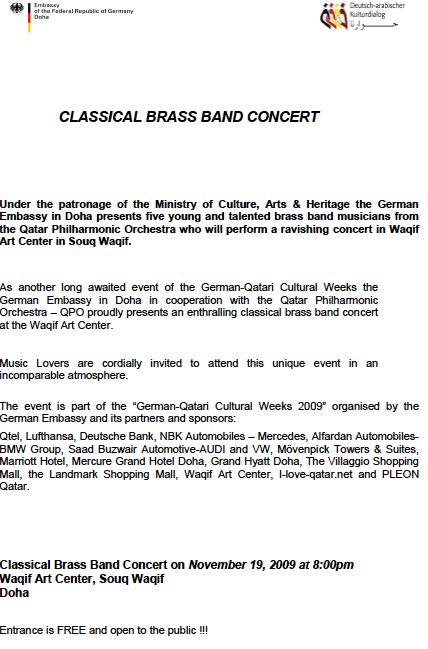
Brass Band Concert Tomorrow, Suq Al Waqif
Thanks, Grammy! If you have ever had an interest in exploring the Souqs, now is the time. The weather is perfect, nights are breezy and warm but not hot, there are a zillion good restaurants to choose from, AND tomorrow night is a very cool concert:
Breakfast in the Souks
“I need a hundred camel spoons,” my friend said, and since we all sort of think on the same track, no one looked at me like I was crazy when I said “let’s all meet for breakfast, shop when the souks open and leave.”
In fact, they didn’t look at me like I was crazy for two reasons. One was that we really sort of think alike, and meeting for breakfast is just the kind of thing we don’t do often, but it is a good time to grab some time together in lives that get very busy later in the day.
The second reason is that we are all introverts, and three of us were doing most of this arranging by e-mail. We’re not really phone chatters, although every now and then we will dial, but it tends to be the exception rather than the rule.
The weather is perfect. You would be amazed how lovely and peaceful the souks are early in the morning. There are customers in the restaurants, but it is a very laid back time of the day.
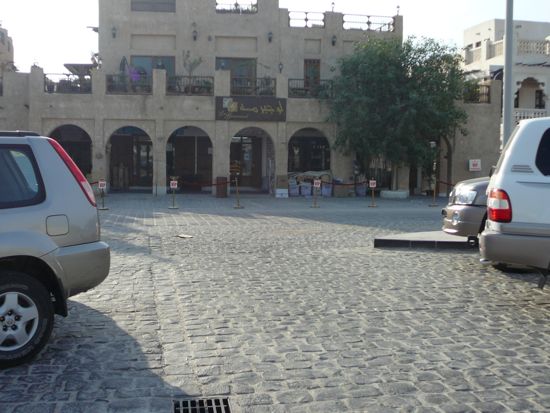
For a significant sum – I can’t remember how much, but I think I remember like 80 QR – you can park in VIP parking. Me, I was there an hour, and paid QR4 (just a little over a dollar) I just wanted you to see the difference from plain old everyday common folk parking and the VIP parking (above.) (Those signs in front of the stores straight ahead say VIP Parking, and at night they are roped off with red velvet ropes)
We find a shady table and order breakfast, across the street guys are into their early morning hubbly bubbly, there are people sweeping up to be sure everything is Disney-tidy, and it really is. As we are sipping at our coffee, the mounted police come by. Their horses are gorgeous, with high bushy tails and beautiful dressings in Qatar’s blood red and white colors.
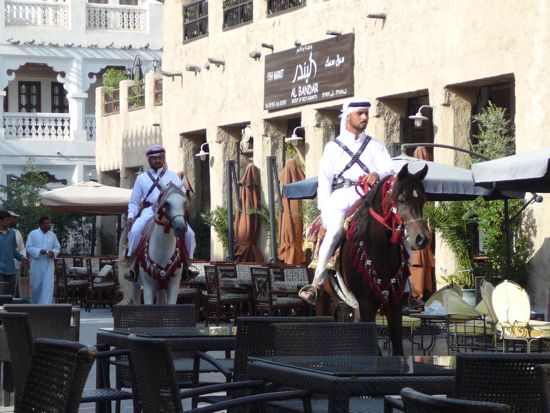
What I like even better is the police-riders. They are handsomely dressed, and they ride like cowboys – look at that posture, the way real horsemen ride, with that cowboy slump and the weight firm in the saddle. The horses aren’t big horses, but they have beautiful bones. I wonder where they stable these horses in the souqs?
On to find the Yemeni Honey Man, relocated from Karabaa / Electricity Street. The police help us find him, hidden back next to a metal kitchen crafter, and we see he has other old customers who have also found him. His new shop is shiny and clean, with great shelves for displaying his beautiful baskets from the Asir.

“Big troubles” he says, and I know he is right, many people are being evacuated from that area while the Saudis and Yemenis have problems near the border. One of his customers communicates to us with gestures that in our new baskets, we must pack our jewelry in the bottom, then our abayas, and then food, oud or honey on top, so people won’t know where we are hiding our jewelry.
My Kuwaiti friend told me that in his memory, before oil, people kept all their clothes in baskets like this, folded neatly. They didn’t have a lot of clothes, he told me, and then there were other baskets specially woven to hold food stuffs, and to keep the insects off the food. Those baskets are not the same as these sturdy baskets, the more local Kuwait and Qatteri baskets are woven from palm fronds, I believe, and you can still find them in the more traditional stores at the Souq al Waqef, behind where the Bedouin women sell foods on Thursday night and sometimes on Fridays.
Big Change; No Smoking
Sometimes change happens, and it happens so slowly or so subtly that you don’t really realize it has happened until something draws it to your attention.
Kuwait blogger Touche, one of my old virtual-blogging-buddies commented on a driving post, wondering about the baby steps it takes to change a mentality. The subject was driving, and I know he was right, I am writing “endlessly” about how annoyed I get by the lack of civility in driving here.
What I am not writing about, I noticed, is how annoying it is to be breathing other people’s smoke while I am eating.
Because it is not happening.
Who knew?
When we lived in Qatar before, people would sit right under the NO SMOKING signs and light up.
I saw things change in Kuwait. From the time we got there to the time we left, there were fewer and fewer times someone would light up in a restaurant.
Things CHANGED.
Expectations changed. I am guessing the smokers felt pressure, not just from the community, but also from family members. I don’t know if there are fewer smokers; I am inclined to think not, because I can see them smoking in their own cars. Hey – as long as I do not have to breathe their smoke, it’s fine with me, it’s their choice.
But the significant thing is – I didn’t believe it could ever change. And it did change, and it changed faster than I would have thought possible.
So I have hope for the driving issue. I think it starts with seat belts. I think if Mothers and wives start buckling up, and buckling up their children, that will be a first step. I think if there is an emphasis on driving manners, things could change. It’s a mind-shift before a behavior shift, an awareness of safety and an awareness of our interconnectedness. One thing I have seen in the Gulf is that parents raise their children to have good manners; manners are an important consideration also when considering a mate. If you take the driving problem as a manners problem, and emphasize the need for good manners on the road, maybe there is a possibility of change . . .
There is another area where I think change can happen – throwing things out the car window. If it becomes a commonly held value that throwing trash / cigarette butts / food wrappers out the window is bad behavior, I think it will stop. Maybe hand out car trash bags to raise awareness?
Have you seen the change in smoking? What I am noticing is that my dinners are no longer ruined by someone nearby lighting up. I don’t smell smoke in the malls. I don’t smell smoke in the airports. Pretty amazing, don’t you think?
The Carrefour Majlis
Hubby and I were at a mall which is one of the Qatar see-and-be-seen places tonight, not to see nor to be seen, but looking for a special end table. As it turns out, we can probably get it, but not until January. No problem.
AdventureMan wanted to pick up some teas for his office and I needed skim milk so we headed for the Carrefour before leaving.
“Oh! How totally cool!” I said to AdventureMan, “Look! They have provided a tent majlis for guys waiting for their wives to grocery shop!” (A majlis, sometimes called diwaniyya, is a place where people gather – usually men, but not always, sometimes women also gather in a majlis but usually separately from men)
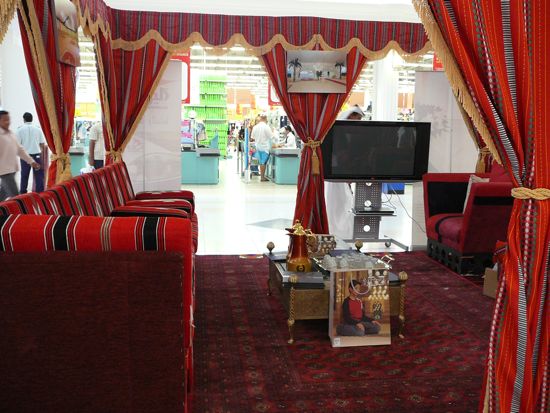
“I think that is one of the Islamic Center places,” AdventureMan said.
On our way out of Carrefour with our purchases, the majlis was packed, and everyone was drinking Arabic coffee in graceful little cups, even one western couple. It is a lovely, hospitable oasis, full of soft surfaces in a hard surface mall.
Debate on Media Freedom in Doha, Qatar
From today’s Gulf Times:
Debate on Qatari press law
The Doha Centre for Media Freedom (DCMF) will hold a roundtable discussion on the Qatari press law that dates back to 1979, on Wednesday, at The Ritz-Carlton Doha, an official said yesterday.
According to the official, under the discussion will be the need for a Qatari media, and the view concerning modification and changes to the accrual Press Law, in order for it to match the requirements of the current era.
Discussions will be moderated by DCMF deputy director general Maryam al-Khater, while senior media officials of the country, editor-in-chiefs, senior journalists, heads of media organisations and others are expected to be in attendance.
After an introductory presentation of the most-recent study prepared by DCMF on the Press Law, comprising recommendations, suggestions, and analyses, the floor will be opened to what is expected to be a “vigorous debate”, the official said.
“The DCMF calls on all media specialists to exercise their right of expression by participating in this gathering and sharing their thoughts about the possibility of amending the negative provisions of the law for journalists’ rights as well as adding provisions which respond to their ambitions,” the official added.
The event coincides with the National Day for Human Rights, which falls on November 11 every year.
There was an earlier report, on June 24th, that most of the original members of the DCMF had resigned:
Media Freedom Centre team leaves office
DOHA: Robert Ménard, director- general of the Doha Centre for Media Freedom and his team have left the Centre.
“We no longer have either the freedom or the resources to do our work,” said Menard, in a statement issued yesterday.
The heads of the assistance, research and communications departments have also left the Centre, said the statement.
The Center was set up on the initiative of H H Sheikha Mozah bint Nasser Al Missned and Reporters Without Borders in December 2007.
Ménard, who became director-general on April 1, 2008, was the founder of Reporters Without Borders, which he headed for 23 years.
I imagine this is going to be a very interesting “vigorous” debate, of interest to all those who write – or blog – on Qatar. One of the things I notice in both Kuwait and Qatar is that in the interest of self-preservation, the newspapers self-censor. For example, when a crime is committed, if it is an Asian, or even, rarely, a westerner, the name of the criminal can be printed. If it is a local citizen, they do not print the names, not ever, unless it is a rare case where the defendant is convicted and appeals – on rare occasions, the name will appear then. In order to spare the family the embarrassment, I have been told, but I would think that the fear of embarrassing the family would have a strong deterrent effect on young men, for example, who think it is OK to abduct, rape and humiliate young men and women, without fear of having their crime made public.
In Kuwait, they publish the crimes committed, at least. In Qatar, you would think from reading the papers, that these crimes don’t exist. They do. They aren’t reported.
I think it is very cool that in Qatar, many of these issues are opened for public debate, as in this media debate, and in the ongoing Doha Debate series.
Somalia Returns to Stoning
What gets me about this article I found on BBC News is buried way down is a detail that a 13 year old girl was recently stoned for adultery. What does a 13 year old know? Some say she was raped. What kind of protection is this, for a little girl, to be stoned for something over which she had no control. Oh? She was just so tempting, she must be punished?
Somali adulterer stoned to death
Islamists in southern Somalia have stoned a man to death for adultery but spared his pregnant girlfriend until she gives birth.
Abas Hussein Abdirahman, 33, was killed in front of a crowd of some 300 people in the port town of Merka.
An official from the al-Shabab group said the woman would be killed after she has had her baby.
Islamist groups run much of southern Somalia, while the UN-backed government only control parts of the capital.
This is the third time Islamists have stoned a person to death for adultery in the past year.
Al-Shabab official Sheikh Suldan Aala Mohamed said Mr Abdirahman had confessed to adultery before an Islamic court.
“He was screaming and blood was pouring from his head during the stoning. After seven minutes he stopped moving,” an eyewitness told the BBC.
The BBC’s Mohammed Olad Hassan in Mogadishu says that if the woman is also killed, her baby would be given to relatives to look after.
Meanwhile, President Sheikh Sharif Sheikh Ahmed has accused al-Shabab of spoiling the image of Islam by killing people and harassing women.
“Their actions have nothing to do with Islam,” said the moderate Islamist during a ceremony at which he nominated a new administration for the capital, Mogadishu.
“They are forcing women to wear very heavy clothes, saying they want them to properly cover their bodies but we know they have economic interests behind – they sell these kinds of clothes and want to force people to buy them.”
Last month, two men were stoned to death in the same town after being accused of spying.
A 13-year-old girl was stoned to death for adultery in the southern town of Kismayo last year.
Human rights groups said she had been raped.
Another man has also been punished in this way in the Lower Shabelle region.
Mr Sharif, a former rebel leader, was sworn in as president after UN-brokered peace talks in January.
Although he says he also wants to implement Sharia, al-Shabab says his version of Islamic law would be too lenient.
The country has not had a functioning national government for 18 years.
Recent Comments
intlxpatr on Shampoo Ginger tigerbutterya0c5ff1d… on Shampoo Ginger intlxpatr on British Soldier Kidnapped, Esc… John on British Soldier Kidnapped, Esc… intlxpatr on British Soldier Kidnapped, Esc… Wikipedia Donate Button

Amazina


Early Voting in Florida


 Here There and Everywhere