Baker’s Ribs and Fried Pies
Texas is a lot of fun! As we are driving through Ft. Worth and Texas, very early on a Saturday morning, the highway closes and all the traffic is diverted off, and then back on. Time for some major work, I guess, and early Saturday morning is probably one of the best times to do it.

Around mid-morning, we start seeing signs for Fried Pies. I have no idea what a fried pie is, so AdventureMan explains it to me, it is a round pie crust with a filling, usually fruit, folded in half, crimping the edges, and then deep fried.
Sounds like a lot of calories, LOL!
Then we start seeing more signs, and we decide it is a good time for a stop at Baker’s Ribs and Fried Pies.
We have to walk through the barbecue section to get to the pie section. Our downfall.
There are a million kinds of fried pies, so we buy an apricot, a peach, and a cherry, and we take a few bites, but we don’t want to eat the whole thing because it will spoil our lunch. Lunch . . . we can’t resist the barbecue. We buy a couple of smoked turkey sandwiches for later, the smell is just irresistible.
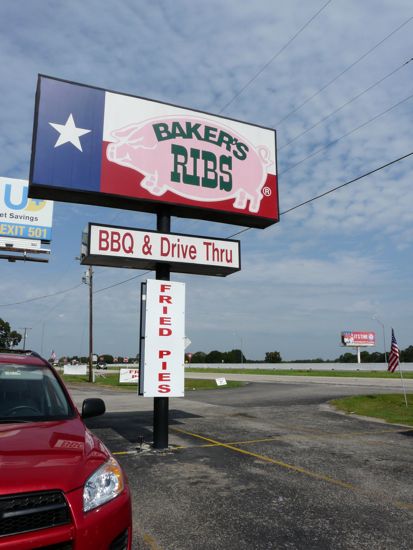

These girls were just so nice, and helpful. 🙂
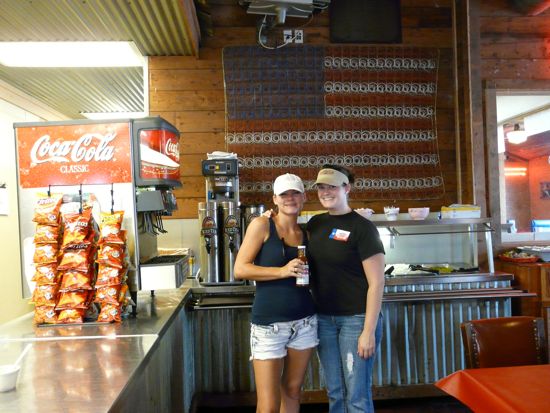
This gal is making the pie crusts:

And this lady has just pulled out a batch of the fried pies (to the right)
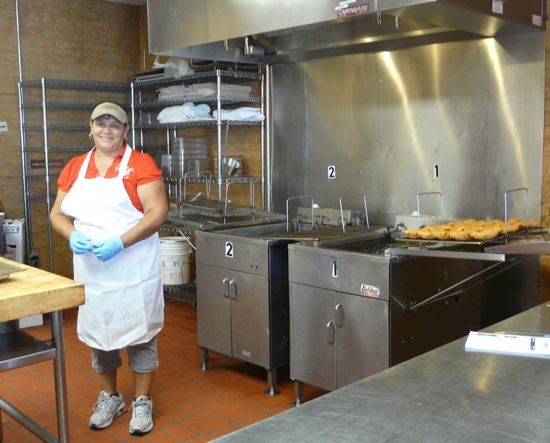
Fried pies are delicious, and I learned you have to eat them fast or the liquid in the fruit makes the crust start to crumble. The smoked turkey was even better, maybe the best smoked turkey I have ever had. The sandwiches were a wonder.
Update: AdventureMan says choosing to eat fried pies is part of How Do You Want to Die? and that he is willing to sacrifice the few minutes those bites of fried pie might have cost him. (We don’t eat fried pies; this was an exception. Don’t do this at home!)
Welcome Home Dinner and Empress Rice Recipe
We had a dinner yesterday, to welcome AdventureMan home, and just to gather together friends and family in the area to have a good time.
AdventureMan stuns me with his ability to transfer all those time zones with no effect. He slept through every night, no problems. Amazing resilience. He also bought a great big watermelon, and made juice from it – delicious!

The Happy Baby is now big enough for a high chair. A high chair is a really good thing now, because he has started crawling, and he is really, really fast, especially when he is going after a cat!

Now that he is crawling and jumping and going to school, his little baby fat is turning into muscle:

(Sorry if this one is a little fuzzy, but he is jumping so fast I can’t get a clear photo)
Following traditional Middle Eastern / Southern customs, we had way too much food:

Including several long time favorites, one of which was Autumn Plum Torte:

One old favorite I am making again (I lost the recipe for a while) is Empress Rice. This recipe is so easy, so rich, so so good:
Empress Rice
1 large onion, chopped
1/4 cup butter
2 cups rice, raw
2 cans consomme
1 Tablespoon soy sauce
1 cup sliced mushrooms, drained
2 cups grated sharp cheddar cheese
1/2 cup chopped walnuts
Set oven for 325°F / 160°C
Saute onion in butter until golden brown. Brown raw rice with onion, then add all the rest of the ingredients. (How easy is that??) Grease a 3 quart/litre casserole, cover, and bake in oven for 1 hour and a half, or until liquid is absorbed. 8 – 10 servings.
(I did not make this with mushrooms, because our son doesn’t like mushrooms, but mushrooms make it richer. For church suppers, I sometimes add in some sausage, like smoked turkey sausage, or some chicken chunks.)
Some of the things I served I have shared with you before:
Autumn Plum Torte
Cauliflower Salad
Soused Apple Cake
Rotkohl
It was a great gathering, lots of stories exchanged, lots of laughing, and sweet little Happy Baby went to sleep just as lunch was served, freeing his parents to relax and enjoy a couple hours of socializing. 🙂 My old friend in Germany slipped into my kitchen and functioned as my second right hand; I actually enjoyed having her help because it’s like she knew what I needed before I knew I needed it. We could hardly believe so much time had passed when our last guests left; time just flew by, the sign of a truly memorable gathering.
Really Bad News for USA Olive Oil Lovers
Horrifying. I read the labels. I thought we could trust the labels. Thank God for independent testing. Bring on the Palestinian Olive oil!
Most ‘extra virgin’ olive oil bottles are actually cheaper mix
(See full article from WalletPop
More than two of every three bottles labeled imported extra virgin olive oil are either a cheaper grade of olive oil or adulterated with another type of oil, a University of California at Davis study found.
Top-selling brands including Bertolli, Filippo Berio, Carapelli, Pompeiian, Colavita, Mazola and Carapelli all had bottles that flunked the test — containing instead a cheaper virgin olive oil, the study by the university’s Olive Center found. Even a brand carrying the name of TV host Rachael Ray — who frequently touts her supposedly extra virgin olive oil — flunked the testing on two of three samples.
The chemical analysis did find that 90% of the California-packaged olive oils were indeed what they claimed to be. Two that were exactly what they claimed to be were Walmart’s Great Value brand and Costco’s Kirkland Organic.
“The intent of the study was to provide consumers and retailers with an accurate picture of the quality of olive oils now being marketed through grocery stores and other retail outlets in California,” Dan Flynn, executive director of the Olive Center, said in statement sent to Consumer Ally. “Our hope is that these findings will lead to improved methods for evaluating extra virgin olive oil, and increased consumer confidence that ‘extra virgin’ on the label means extra virgin in the bottle.”
Flynn said the United States is the world’s third-largest consumer of olive oil.
Consumer Ally contacted several of the largest manufacturers cited in the study, but only one immediately responded to the request to comment on the study. A Colavita official wanted to read the study before discussing.
A history of duping consumers believing they’re buying the rich-flavored and often pricey extra virgin olive oil led the federal government to enact more stringent olive oil standards, scheduled to take effect in October. In 2008, Connecticut became the first state to regulate olive oil after finding that some being sold included nut oils or soy oils, which could cause dangerous allergic reactions.
“Before this study, we had anecdotal reports of poor quality olive oil being sold as extra virgin,” Flynn said. “Now there is empirical proof.”
Some of the tests analyzed for problems that would affect flavor — the very essence of extra virgin olive oil. “Many of these oils just did not taste good,” Flynn said.
He cited the following reasons for the oil flunking the tests:
adulteration with cheaper refined olive oil
oxidation due to elevated temperature, light and or aging;
poor-quality oils made from damaged and overripe olives,
processing flaws or improper oil storage.
See full article from WalletPop: http://srph.it/9Svxpx
No Standards for Virgins or Extra Virgins in USA
I found this today on AOL News/Slashfood and it is a subject – long time readers will know – of interest to me. Ever since I read the article on The Olive Oil Scandal in The New Yorker I have been a religious reader of labels. I have discovered that in most of the US stores, the olive oil, virgin, extra virgin or otherwise is a blend of oils from Turkey, Spain, maybe even a South American country. To get olive oil from one country, I go to specialty shops. I have not seen one single bottle of my very favorite – Palestinian olive oil – and I wonder if it is even exported. I always bought it from my friends overseas; someone would bring in gallons and gallons of it and it was always so fresh tasting, and so tasty. It smelled so good you were tempted to eat a spoonful! No, no, I didn’t. The smell is unforgettable, and nothing I have tried in the US comes close. I can’t even find any California olive oil in the local stores!
Virgin? Extra virgin? Or something else entirely?
You never know what you’re really getting when you open a bottle of “100% extra virgin” olive oil, but the U.S. Department of Agriculture is hoping to change that with new standards for the green-gold oil set to roll out this fall, the Los Angeles Times reported.
The new rules come at a time when olive oil demand is surging. Americans bought 79 million gallons in 2008, up from 47 million gallons a decade earlier, the paper reported.
There are no federal rules that define “virgin” or “extra virgin” olive oil, Vito S. Polito, professor of plant sciences at UC Davis and co-chairman of the school’s Olive Center, a research group, told the Times. As a result, he said, “the U.S. has been a dumping ground for cheap olive oil for years.”
Bob Bauer, president of the North American Olive Oil Assn., said most of the olive oil on U.S. store shelves is legit, but his group alerts the FDA when problems occur.
Bauer told the Times 3 to 4 percent of the 200 to 300 samples his group tests each year are unadulterated or mislabeled, meaning they’re not as pure as they say they are or they’ve been combined with another type of oil.
“We’ve petitioned the FDA to create a standard of identity, which would define in black and white what olive oil is and is not,” Bauer told the Times. “They never acted on the petition.”
A spokesperson for the FDA told the Times that the agency does not regularly test olive oils for “adulteration,” but relies on information from the public or other groups.
The voluntary regulations being rolled out this fall set parameters for freshness and purity, fatty acid levels and ultraviolet light absorption, which can tell how fresh the oil is. USDA experts will also conduct tasting reviews, the Times reported.
Some worry that the regulations will be meaningless until they’re mandatory.
“It’s like saying you have to stop at stop signs, but there are no cops at the corner,” Paul Vossen, a University of California Cooperative Extension farm advisor for Sonoma County, told the paper. “Standards are a good start, but enforcement is important.”
Garden Gate Newsletter for June
We love this place!
The Garden Gate
3268 Fordham Pkwy.
Gulf Breeze, Fl. 32563
850-932-9066
thegardengategb@bellsouth.net
June Class Schedule
Cut Flowers
Flowers are used to mark every occasion in our lives — bouquets celebrate the birth of a baby, weddings and engagements, or other special celebrations and even help us mourn the passing of a loved one. Since Victorian times, certain flowers and flower colors have had special meanings and were used to convey tender (or not so tender) sentiments. Many of these meaningful flowers can be grown in our landscapes, either in an area dedicated to cut flowers or incorporated into other plantings. Join us Wed. June 9, from 10:00 until 11:00 A.M. to learn the about the language of these flowers plus how and where to grow them. Cost of the class is $5.00. Please call to register.
Shade Gardening
Even though shady sites can limit the plants that can be used, and are often hard to dig in because of roots, these areas can provide landscaping interest with color and texture. Many plants that grow in shade don’t bloom as long as their sun-loving counterparts but continuous color can be achieved by choosing species that flower in succession. Join us Sat. June 12, at 10:00A.M. Until 11:00A.M. to learn about plants that thrive in shady areas and how to successfully grow them. We will talk about under-story trees, shrubs, perennials, and ground covers to use in shade, how to amend your soil to plant them, plus other ideas to turn you shade into an low-maintenance asset rather than a landscaping problem. Cost of the class is $5.00. Please call to register.
Cooking Demo – Tomatoes!
Tomatoes will be the main ingredient in this cooking demonstration. Beefsteak, heirloom, cherry, grape – no matter the size and shape, they are delicious! Join us Sat. June 12, at 11:30A.M.when Kim Armstrong will demonstrate simple and exciting recipes using these home-grown favorites (we will talk a little bit about growing tomatoes in our area, too). The cost for this cooking demo (and tasting!) is $7.50. Please call to register.
Natural Pest Control
As the heat and humidity rise, so do the number of pest and diseases that attack our gardens and landscapes. Join us Wed. June 16, to learn ways to keep your plants healthy without using manufactured fungicides, pesticides, and other “cides”. We will discuss using organic products, physical barriers, beneficial insects and other wildlife, and companion planting plus other tips and techniques for less toxic gardening. Class will be held from 10:00 A.M. until 11:00 A.M. Cost of the class is $5.00 – please call to register.
Topiary
Join us Sat. June 19 to learn about the craft of topiary — growing plants on forms or by pruning plants to create shapes. This ancient form of gardening is enjoying a resurgence in popularity right now, adding a touch or formality or tradition when used in the landscape or in interior spaces. You will learn which plants to use for topiaries and how to plant and grow them, whether in containers or in the ground. Tips for maintaining topiaries will also be discussed. We will provide all materials for you to make a topiary during the class, to take home. (This is the season to start topiaries to use or to give as gifts during the holiday season.) Class will begin at 9:30 A.M. until approx. 11:00A.M. Cost of the class is $30.00. Space will be limited for these classes, so please call to register.
Summer Containers
This class will teach you tricks to plant and maintain beautiful planters in summer’s high heat and humidity. Choosing the right plants for your growing conditions is only a part of successful summer container gardens. How to select plants for dramatic effect will also be discussed – combining “thrillers, fillers and spillers” (using flowers, herbs, vegetables, or grasses) to make fantastic, functional focal points in your landscape. Learn watering, fertilizing and maintenance techniques in the lecture part of the class. After the class, you are invited to put together a great container garden to take home. We will provide all plants and materials. This class will be held on Wed. June 23, and Sat. June 26, at 10:00A.M. Second session will follow immediately at approx. 11:00 A.M. Cost of the class is $5.00. Cost of the after-session is $25.00. Please call to register and let us know if you will be staying for both sessions.
News and Notes
Hot weather, rainy weather, steamy weather – it must be summer! Spring flowers are beginning to fade but the heat-loving flowers are coming on strong. Annuals such as zinnias, cosmos, and coleus are tried and true for summer color. Unlike in our grandmother’s time, however, coleus can now be grown in the sun and cosmos can be found in dwarf or double forms in a much wider range of colors. The dwarf zinnias are our favorites, blooming from now until frost with a low mounding habit that does not need dead-heading. They are available in pinks, oranges, reds, yellows, and whites. Try the Profusion series or the Narrow-leaf zinnias in hanging baskets or other containers or in the front of a flower bed. Plant breeders have also worked to improve some old-fashioned perennials. For example, there are many new forms and cultivars of rudbeckia (black-eyed Susans) and gaillardia, or blanket flowers. Some of the most recent and interesting breeding breakthroughs have been with Echinacea (or purple-cone flower). By crossing a yellow species with a purple species, a series of orange flowered Echinacea have been developed. These North American native perennials are now available in all the colors of a sunset or a sunrise. They make spectacular and long-lasting cut flowers, blooming from summer well into fall. Purple cone flowers like sunny sites on the dry side, with a little compost or manure to slightly sweeten the soil. Butterflies love them!
We are seeing lots of birds at our feeders right now, mostly hard-working moms and dads feeding their nestlings. The Carolina wrens that have built the nest in the canvas bag on our porch seem especially busy, not only visiting the feeders but also combing the gardens and container plants for insects for their ravenous young. This week, we have seen the wrens, chickadees, house finches, cardinals, sparrows, bluejays, and red-bellied woodpeckers at our feeders. And then we have our “other” birds — for those of you who have not met “the girls”, we now have six chickens (all hens) brought to us by a customer in early April. We have two California Whites (Beatrice and Gertrude), two Rhode Island Reds (Perryia and Katherine Hepburn), and two Americaunas (Betsy Ross and Martha Washington). We are busily preparing to build a new coop for “the girls”. Come by and check our progress.
We are planning a number of new upcoming classes and cooking demos, and we would love to have your input about garden subjects or related crafts that you would like to learn about. Ideas that we are working on include classes on meditation gardens, romantic gardens, gardening on the water, living roofs and walls or vertical gardening. We are always looking for ways to engage children in gardening or the environment, we are always interested in connecting cooks and gardeners, and we are always interested in passing along information that makes gardening easier or more successful. Please let us know your ideas for classes and other activities, by calling, e-mailing, or just stopping by. Thanks!
Grilling at Garden Gate Nurseries
Late Friday, we saw a notice in the paper that there would be a class on grilling vegetables held on Saturday at the Garden Gate Nursery. Any excuse will do; AdventureMan calls and finds there are still a couple slots available and we sign up.
Oh what fun! The teacher, Kim, was clever and entertaining, and best of all, she has a gift for imagining what flavors will go together if fresh ways. We learned how to grill corn-on-the-cob which is plentiful right now in the Florida markets, and how to grill pineapple, with an orange sauce, fabulous over ice cream.
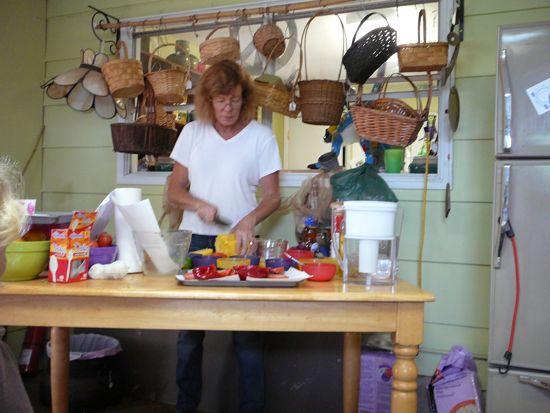
Garden Gate is so clever, combining gardening and growing and grilling, but also, they are coming up with classes on how to manage the vegetables and fruits that you grow – cooking with basil, iced courses made with exotic and unexpected ingredients, new ways to utilize all those zuccini and tomatoes . . . Well worth the drive. 🙂
“Is it Spicy?”
AdventureMan and I have wide ranging taste in dining out, as you know if you are a regular reader of this blog. We like Barbecue, we like Mexican, we like Vietnamese, we like Chinese, Japanese, Indian and Seafood. There is one food we do not like – tasteless food. We like TASTE.
Living here in the South, we will often see a group come into a restaurant, and one person – always a lady – will ask the waitress “Is it spicy?”
Spicy doesn’t mean fiery hot, spicy means pretty much anything other than the food’s natural taste plus salt – they do use a lot of salt in food here. At one restaurant, the waitress said “no, it’s not spicy, but there is a little bit of horseradish in the cocktail sauce” and the little lady said “oh, then I had better order something else.”
It’s all a matter of taste, what your palette is used to, and what it craves.
I wonder, too, if it isn’t what we are trained to expect – for example, some Nigerian friends once told us that from the time their children are babies, they give them little bites of hot hot pepper with their food. I think many of our restaurants add sugar, as well as salt, so that we have become more and more addicted to sweetness.
How To Be a Southern Lady
You’d think moving back to your own country would be a piece of cake, wouldn’t you? We nomads know better. Young people who travel to other countries to go to school know better. Military people know better. Missionaries know better. Diplomats know better. Anyone who has spent time living abroad know that it works both ways – you have an impact where you are living, and where you are living has an equal impact on you. You may go back, but you are never the same.
With this move, AdventureMan and I have been too busy trying to get settled and to take care of the incredible amount of bureaucratic detail it takes to relocate. Even with AdventureMan ‘retired’, the days are flying by, and we don’t know why we are so busy.
For one thing, I am doing my own housework, and I am finding I am not very good at it. Like I am good at getting laundry done, and even folded, but I haven’t ironed in a long time, and the things that need ironing are stacking up. I have bought a beautiful new ironing board, and a beautiful iron . . . and some starch, the liquid kind I like, not the spray kind. . . but I haven’t set it up, and I haven’t ironed, not a thing. I have discovered that all my packed things looked a lot better after hanging in the closets for a week, most of the wrinkles fell out, lucky me. But . . . the day of reckoning is coming.
The worst part, for me, is cleaning my floors. My floors are supposed to be beautiful; wood and tile floors. They actually ARE beautiful, maybe two days a week, the day I clean them and the next day, but five days a week, they need work. I wish I had asked my cleaning lady in Doha how she got my floors so beautifully clean. I wish I had paid more attention. I keep looking in the store for some miracle, a machine that will clean them in a heartbeat and make them all shiny. . .
The wonderful thing about moving into this culture – and it truly is a different culture from the one in which I was raised – is that we have our wonderful son and his wonderful wife to give us hints on what to do and not to do, and we have his wife’s wonderful family.
Mostly, I try to keep my eyes open. Southern women admire things extravagantly, and after living for so many years in the Middle East and Gulf, learning to admire extravagantly goes against all my instincts.
In the MIddle East, when you admire extravagantly, you can make people nervous. Some people worry about attracting “the evil eye” of jealousy, evil intentions, people who envy you and wish you harm. Some people, if you admire something, will give it to you! It’s true, those stories, it has happened to me. So now I have to un-learn my lessons in retraint and learn to appreciate, if not extravagantly, at least enough to be polite.
One of my wife’s relatives gave us a house-warming gift, an iced-tea maker, with a darling card that states Rule #1 is that every Southern Hostess knows that a pitcher of iced tea is a MUST for all occasions. I like iced tea, but I have never kept it on hand to serve, and I guess I need to start!
Her second rule was one that made me burst out laughing – “A Southern Lady, the most interesting ones anyway, know that rules are made to be broken.”
“Just be prepared for people to leave your home saying “Bless her heart, she must be getting forgetful. There was no iced tea!”
And then rule #3 – “The only correct and acceptable way to criticize anyone is to add ‘bless his/her heart!’ and then, anything goes!”
At a party at her house this weekend, I learned a couple more – the first rule being that when you are invited to a great big family dinner, bring dessert! Thank God, I did take a little guest gift, but now I know – bring dessert! And it had better be sweet!
The next rule is would make any Kuwaiti or Qattari feel right at home – spare nothing in making our guests comfortable. This Southern Hostess had seating areas inside the beautiful air conditioned home, and also seating outside for those who don’t mind a little heat. She had a big basket loaded with all kinds of insect repellents to keep her guests from being bitten. She took time with each guest, and although she was running her little bottom off getting everything organized, she made it all look easy, and as if she was having a good time. I have a sneaking suspicion the truly was enjoying having all the people around and that her great big heart loves taking care of the crowd. She was the essence of gracious hospitality. Did I mention she has also lived in Kuwait?
Dinner was “Perlow” an old Southern tradition, made in a huge old kettle from her husband’s mother, and hung from a tripod over a roaring fire to cook. The actual cooking was the men’s work as they sat outside drinking iced tea:

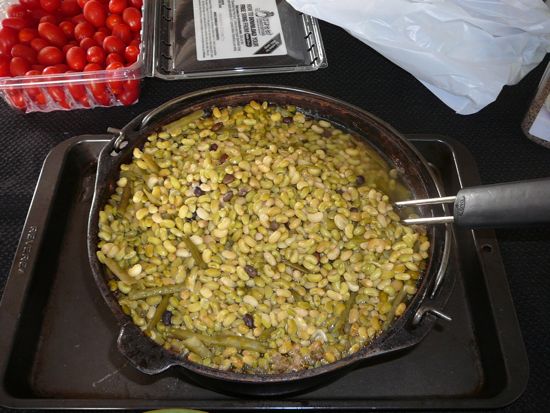
Home grown peas and beans mix – delicious!
Serving up the perlow:
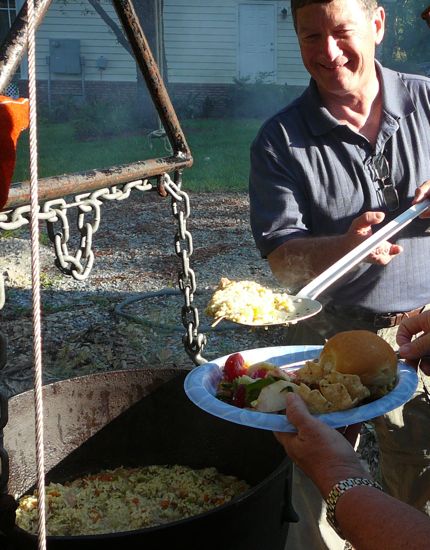
My Middle East / Gulf friends would be comfortable eating this meal – Perlow is a variation of Pilaf, and very similar to Biryani. No alcohol served. No pork. Lots and lots of fabulous sweet desserts.
It’s funny, I used to tell people in Kuwait and Qatar that it was a lot like Alaska; when the weather got too bad, you just stay inside most of the time. When the weather gets good, you go outside as much as you can. When it’s too hot/cold, you run from your air conditioned/heated car to your air conditioned / heated store or movie theater, or restaurant, and then back to your air conditioned / heated car and back to your air conditioned/ heated house.
In the same way, I am beginning to wonder if the South and the Middle East know how much they have in common? In Pensacola, on Saturdays, we have the religious people on the corners shouting at passing cars, not a whole lot different from the volunteer morality police in Saudi Arabia. In the South, as in the Middle East, ‘family’ isn’t just blood, it’s also who you’re married into, and there is a lot of emphasis on family getting together and spending time together. In the South, as in the Middle East, men tend to gather in one area, women in another.
In the South, they drink iced tea; in the Middle East, it’s hot tea. Both have passionate patriots, fundamental believers and a tradition of gracious hospitality. Both have a passion for hunting and fishing. Nobody much likes obeying the rules in either culture. Maybe I’m still in the MIddle East?
AdventureMan Cooks a Florida Bouillabaisse
One of AdventureMan’s retirement dreams was to have time to cook. There have been two times in our lives together when he has had the time – one, when our son was born and he learned Chinese cooking so he could stir-fry while I held the squalling baby (he had colic, and squalled from about four in the afternoon to eleven at night. Do you know how long every single minute is when you are holding an inconsolable baby?)
The second time was when he retired from the military, and spent several months at home, keeping house, taking our son to visit colleges, and serving up some of the most fantastic meals we have ever eaten. (I was working; it was a total role reversal. Kind of fun to shake things up, do things differently in a relationship now and then. 🙂 )
So when he started thumbing through cook books, I started grinning to myself. This man is very talented, and while I am very good at ‘survival cooking’, i.e. getting a meal on the table that will nourish and quell hunger pains, AdventureMan takes cooking to an art form.
First we had to make a trip to the grocery store for some basics. When you set up housekeeping after a (yet another) move, you are missing some of the most basic things – like cayenne pepper, or garlic.
Then – oh heaven! – we visited Maria’s Fresh Seafood Market, heaven on earth for this little old Alaska girl.
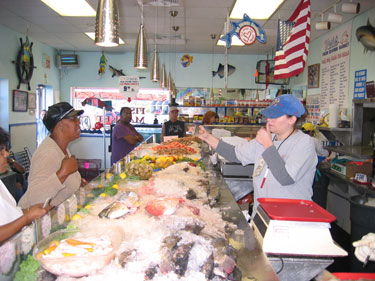
Fresh, fresh seafood, and people who know how to cut it. The prices are good. As we entered, a drama began, a woman buying a lot of (something) picked a fight, first with the man serving her and then with the cashier. We were there about half an hour, and during this time, she complained, loudly and vigorously, to anyone who would listen. I think she wanted her purchase comped.
AdventureMan bought what he needed, got it cut mostly how he needed it, and also got a fish head and tail for making stock – a great big grouper! He said as he cooked it up, the head and mouth were sticking out of the pot like “Help me! Help me!” but I wouldn’t know because I was upstairs minding my own business while he worked his magic on the Florida fish bouillabaisse. 🙂
Soon, tantalizing odors drifted upstairs, rich, complex odors, with a hint of sherry . . . it was divine. I had to pop down to let him know how much I was appreciating his efforts.
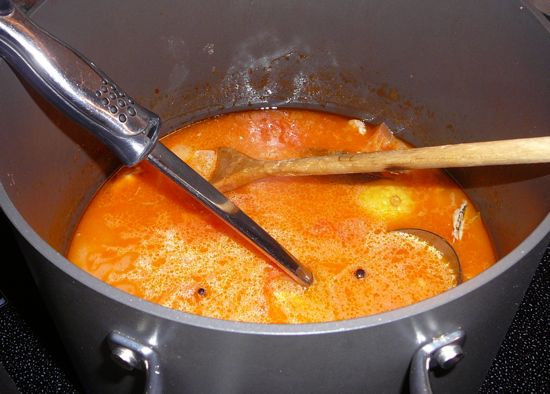
“Do you think it’s a little too thick?” he asked.
“I think it’s like a fish stew; I think thick is OK. You can add a little more liquid if it seems to need it,” I added, but actually, he is doing just fine without any input from me.
Finally, it was time to eat. AdventureMan dished the concoction into some shellfish soup bowls I found many years ago at that exotic resource store, TJ Maxx (LOL) and dinner was served.
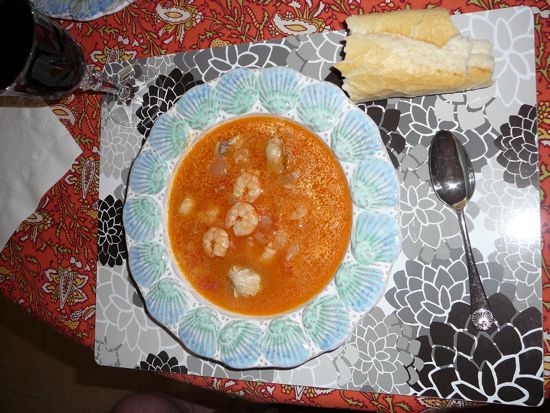
Total YUMMMMMM. Bravo, AdventureMan, Bravo! I am having a lot of fun with your retirement! 🙂
Slow Cooker Cassoulet
When I first saw this recipe on allrecipes.com I thought “this isn’t right! Where’s all the fat?” Cassoulets we have eaten in the high plateau central southwest part of France had duck in them, and goose fat, and some mutton, maybe a little pork. They have elaborate rituals, where you boil it in a large enamel pot for hours, then bake it, pulling it out now and then to break and stir in the crust that forms, baking again, breaking the crust, for hours. Cassoulet is a ritual, not just a dish.
But I saved the recipe, because our son and daughter-in-law have gotten us intrigued with slow cooker cooking, and this week, I gave it a try:
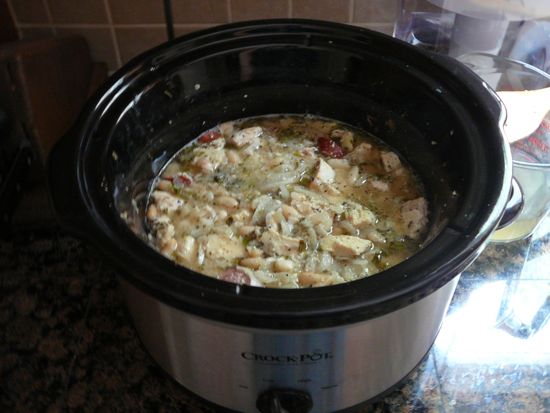
The hardest part of this recipe is finding cannelini beans. After I finally found dried beans (at the Four Winds International Grocery at 9th and Creighton) I actually found canned cannelini at WalMart. (I know! Whoda thunk?) I wanted to go ahead and try it with the dried beans, so I soaked them overnight, cooked them, and then went ahead with the following recipe:
Cassoulet Slow Cooker
• 2 pounds skinless, boneless chicken breast halves, cut into chunks
• 1 onion, quartered and thinly sliced
• 2 large cloves garlic, minced
• 1/4 cup chopped fresh parsley
• 1/2 teaspoon salt
• 1/4 teaspoon black pepper
• 2 (15 ounce) cans cannellini beans, drained and rinsed
• 1 pound turkey kielbasa, cut into 1/2-inch slices
• 1/3 cup dry white wine
Directions
Place the chicken into the bottom of a slow cooker.
Stir together the onion, garlic, parsley, salt, pepper, cannellini beans, and turkey kielbasa in a large bowl. Pour the mixture over the chicken in the slow cooker, and pour the wine over all the ingredients.
Cover, set the cooker to Low, and cook until the chicken is very tender and the cassoulet is thickened, 5 to 6 hours.
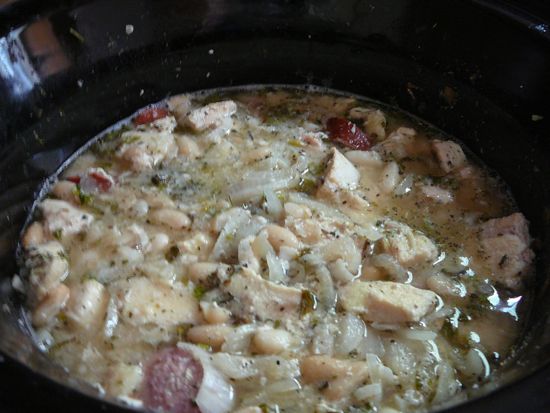
This recipe perfumed the house with rich aromas. We could hardly wait to eat. Such simple ingredients, so easy to fix! Toward the end, I had to add a little more wine and I also added about a teaspoon of Herbes de Provence. If you live in Kuwait or Qatar, or don’t use alcohol in your cooking, you can substitute chicken broth for the wine, or an unsweet grape juice, or one of the non-alcoholic wines available in some supermarkets.
Here’s how it looked close up, shortly before serving. 🙂 Hope you try it, hope you like it. 🙂
Recent Comments
ExpatAlien on What Country am I Living … intlxpatr on Yellowstone: Old Faithful to C… Michelle on Yellowstone: Old Faithful to C… Cathy on No Grown-Ups in Charge intlxpatr on Waiting for Snow Wikipedia Donate Button

Amazina


Early Voting in Florida


 Here There and Everywhere