“Middle Eastern” Honey Cake
This recipe was from a paper in Monterey, California, and was called Middle Eastern Honey Cake. I have never seen it in any country I have lived in or been to in the Middle East, and none of my friends in the Middle East have ever had anything like it. . . I almost wonder if it is East European?
But it is a treasure, because it is fast, and easy, and totally DELICIOUS!
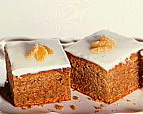
(This recipe, the icing is more honey colored)
“Middle Eastern” Honey Cake
3/4 cups sugar
1/2 cup vegetable oil
1/2 cup honey
2 eggs
1/2 teaspoon vanilla extract
2 cups unsifted flour
2 1/2 teaspoons baking powder
1/2 teaspoon salt
1 cup milk
1. Combine sugar, oil, honey, eggs and vanilla. Mix until well blended. Add combined dry ingredients to oil mixture, alternately with milk, mixing well after each addition.
2. Pour batter into greased floured 9” square pan. Bake at 350 degrees 40 – 45 minutes or until wooden pick comes out clean. Cool. Frost with Honey Cream Cheese Frosting
Honey Cream Cheese Frosting
2 Tablespoons butter or margarine, softened
1 8 oz package cream cheese, softened
1/2 cup powdered sugar
4 Tablespoons honey
sprinkle salt
Blend well.
How can anything so simple be so good? I usually double the recipe and freeze one to pull out when unexpected guests show up. Sometimes I use that black honey that comes from Egypt, and if I can get it, I use Yemeni honey.
Ramadan for Non-Muslims
Ramadan started last night; it means that the very thinnest of crescent moons was sighted by official astronomers, and the lunar month of Ramadan might begin. You might think it odd that people wait, with eager anticipation, for a month of daytime fasting, but the Muslims do – they wait for it eagerly.
A friend explained to me that it is a time of purification, when your prayers and supplications are doubly powerful, and when God takes extra consideration of the good that you do and the intentions of your heart. It is also a time when the devil cannot be present, so if you are tempted, it is coming from your own heart, and you battle against the temptations of your own heart. Forgiveness flows in this month, and blessings, too.
We have similar beliefs – think about it. Our holy people fast when asking a particular boon of God. We try to keep ourselves particularly holy at certain times of the year.
In Muslim countries, the state supports Ramadan, so things are a little different. Schools start later. Offices are open fewer hours. The two most dangerous times of the day are the times when schools dismiss and parents are picking up kids, and just before sunset, as everyone rushes to be home for the breaking of the fast, which occurs as the sun goes down. In olden days, there was a cannon that everyone in the town could hear, that signalled the end of the fast. There may still be a cannon today – in Doha there was, and we could hear it, but if there is a cannon in Kuwait, we are too far away, and can’t hear it.
When the fast is broken, traditionally after the evening prayer, you take two or three dates, and water or special milk drink, a meal which helps restore normal blood sugar levels and takes the edge off the fast. Shortly, you will eat a larger meal, full of special dishes eaten only during Ramadan. Families visit one another, and you will see maids carrying covered dishes to sisters houses and friends houses – everyone makes a lot of food, and shares it with one another. When we lived in Tunisia, we would get a food delivery maybe once a week – it is a holy thing to share, especially with the poor and we always wondered if we were being shared with as neighbors, or shared with as poor people! I always tried to watch what they particularly liked when they would visit me, so I could sent plates to their houses during Ramadan.
Just before the sun comes up, there is another meal, Suhoor, and for that meal, people usually eat something that will stick to your ribs, and drink extra water, because you will not eat again until the sun goes down. People who can, usually go back to bed after the Suhoor meal and morning prayers. People who can, sleep a lot during the day, during Ramadan. Especially as Ramadan moves into the hotter months, the fasting, especially from water, becomes a heavier responsibility.
And because it is a Muslim state, and to avoid burdening our brothers and sisters who are fasting, even non-Muslims refrain from eating, drinking, touching someone of the opposite sex in public, even your own husband (not having sex in the daytime is also a part of fasting), smoking is forbidden, and if you are in a car accident and you might be at fault, the person might say “I am fasting, I am fasting” which means they cannot argue with you because they are trying to maintain a purity of soul. Even chewing gum is an offense. And these offenses are punishable by a heavy fine – nearly $400 – or a stay in the local jail.
Because I am not Muslim, there may be other things of which I am not aware, and my local readers are welcome to help fill in here. As for me, I find it not such a burden; I like that there is a whole month with a focus on God. You get used to NOT drinking or eating in public during the day, it’s not that difficult. The traffic just before (sunset) Ftoor can be deadly, but during Ftoor, traffic lightens dramatically (as all the Muslims are breaking their fast) and you can get places very quickly! Stores have special foods, restaurants have special offerings, and the feeling in the air is a lot like Christmas. People are joyful!
Cultures Collide
Maybe “culture clash” is too strong, maybe it’s more like huge continents that kind of bump into each other and send a reverberation through both continents, more a slow grinding than a crash? And maybe, like rough stones tumbling in a barrel, as we rub our rough edges against one another over time, maybe we become smooth, polished gems?
I have a dear friend, one of those friends that when you can grab some time together you never run out of topics, and when they leave, you remember “Oh! I forgot the point of that story was . . . and I never got to it!” or “Oh! she was starting to tell me about the . . .. and then we segued off into something else!” This friend delights my heart; when you see her face, you can see her lively soul in her sparkling eyes.
Those eyes were looking at me in utter puzzlement.
“What do you mean you couldn’t find any celery?” she asked. “Didn’t you go to the grocery store?”
“Yes! I spent hours there! Big mistake, shopping just before Ramadan, me and everyone else in the village.”
“So why didn’t you just buy some celery?” she persisted.
“There wasn’t any celery! It was all gone!” i responded.
“How could it be gone?” she asked, incredulity in her voice, “Don’t they always have celery?”
Something is wrong with this conversation. We look at each other.
“Have you ever been grocery shopping just before Ramadan?” I asked her.
“I never go grocery shopping!” she replied.
(Can you hear those continents grinding?)
I sat down. I looked at her. I believed her; I don’t think this woman is capable of lying, she is innocent and straight-forward.
“You’ve never been grocery shopping?” I asked her, knowing that if she said it, it is true, but trying to figure out how this could even be possible.
“Well, a couple times, like when I was making that pie, but only for a few little things, not like food to feed the family.”
She has staff. They’ve always had staff.
So I explained to her that just before Ramadan, like in western countries just before Christmas, some items just disappear.
“One time, in Tunisia, olive oil disappeared! And eggs! And even tomato sauce, and these are all products made in Tunisia!” I explained. “Here,” I went on, “you know how it is, sometimes even when it is not Ramadan, things will disappear, but when Ramadan is coming, if you know you might need something, you have to plan way in advance. Your Mom probably has taken care of all that. ”
“I don’t think so,” she said, two little tiny worry lines creasing her brow.
“Your Mom doesn’t shop, either?” I asked.
“Not for groceries.” And she’s looking at me like I am from another world.
And I am. This friend is so patient with me, with my little ignorances. When you are a stranger in a strange land, you expect some of the big differences. Like Ramadan, that is a big difference, when the whole country becomes more religious and for a whole month the focus is on God, on fasting during daylight and gathering with family and friends and feasting at night, reading the Qur’an, submitting your sins and begging forgiveness. . .
It’s the little things that catch you up. You kind of assume that everyone lives life a lot like you do, and it can be a real shock to discover that in small, everyday things you take for granted, you do things very differently.
Some of my earliest memories are in the kitchen, cutting dates and prunes to help my Mom make fruit cake. I can remember stirring chocolate pudding as it cooked on the stove, making jello, simple things before I graduated to chopping nuts and onions, etc. And I wrongly assumed this is everyone’s experience.
I know I have shocked my friend, too, sometimes. I asked what I thought was a very simple question once, and watched her face become a mask of horror at the very thought. God bless her for her patience with me!
I bless all my friends today, my Tunisian friends, my Kuwaiti friends, my Saudi friends, my German friends, my French friends, my Qatteri friends – all the friends who have endured my chauvinistic mistakes, assuming all the world thinks as I do. I bless my American friends, because even though we are from the same nation, we, too, are from different areas and different family cultures (tribes!) and we don’t see through the same eyes, our views are colored by the culture through which we observe the world. Today I am thankfully amazed that we manage to get along as well as we do!
Watermelon Sorbet
Sorbet is so simple, and so good, and not so bad for you. The first time I fixed this, we were living in Tunisia. It tasted so good on a hot summer’s evening. It will be icy and grainy, not smooth. The Italians call it “granita”.
The watermelon available right now in Kuwait is perfect, so intensely flavorful. Try it!
3 cups water
1 cup sugar
4 cups seeded, chopped watermelon
1/4 cup lime juice
Bring the water and sugar to a boil over high heat and stir until sugar dissolves. Remove from heat and cool.
In several batches, blend watermelon pieces and sugar syrup in a blender until smooth. Stir in lime juice, chill 2 hours in refrigerator.
Pour into ice cream maker and freeze according to instructions. It’s best if served fresh, so start the ice cream maker when you sit down to dinner, and it will finish just as you are ready for dessert.
EXTRA: You can blend up the leftover watermelon for a delicious refreshing summer drink. Serve with a sprig of mint, if you are growing any.
Kuwait Bans Melmac

Today on the front page of the Kuwait Times is the announcement of a ban by the Ministry of Commerce on selling any goods containing melamine, stating it was “based on information received from the Customs Department and office of the Secretary-General of the Gulf Cooperation Council, and has to do with melamine containing urea formaldehyde, which is banned” because it is “believed to be harmful to health.”
I was so curious, I had to Google “Melamine kitchenware + danger” because, to the best of my knowledge, Kuwait is now the only country in the entire world to ban melamine.
Melamine appeared in dog and cat food, and is believed to have been the cause of some early poisonings in the US, but as far as I can see, that came from insecticides, not from eating off melmac.
On the same front page is an article about hundreds of camels dropping dead in Saudi Arabia, also believed poisoned by a insecticide contaminated feed. Is there some relationship?
It isn’t an issue in our house; we don’t have melamine. But I have this irrational fondness for Melmac, because there used to be a show called Alf, about an alien that lived with an American family, and he was from the planet Melmac, which always cracked me up. I can’t imagine the generations of Americans – and others – who have eaten off Melmac dishes without any serious effects. How can this be? Is Melmac now formulated differently from before? Are Melmac plate users going to succumb to some serious problems because they ate off Melmac plates?
And why is Kuwait the only country in the world banning Melmac?
Summer Fruit Crisps
If you haven’t cooked before, and are interested in beginning, Crisps are a good place to start. They are easy, don’t take a lot of time, and you get instant – and delicious! – gratification. Now, while fresh fruit is abundant in Kuwait (and elsewhere) is a great time to try a crisp.
These recipes are from Mary Cullen’s Northwest Cook Book, 1946. My aunt gave it to me before she died, and some of my best cooking efforts have been based on recipes from this book. They are simple, but . . . simply GOOD!
Apple Crisp
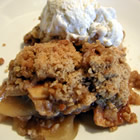
Crisps are wonderful when made with fresh fruit, and not so much trouble as a pie requiring crusts. Here, the topping is delicious, and easy.
5 cups apples
1/2 cup butter
1 cup sugar
3/4 cups all purpose flour
1 teaspoon cinnamon or nutmeg
Peel, core and slice apples and place in a greased baking dish or cassarole (a ceramic pie dish is perfect, but you can also use a ramekin, or something not too deep, not too shallow).
Using a pastry blender, or a metal whisk, or an electric mixer, work together the butter, sugar, salt, flour and spices.
Pack closely around apples.
Bake in 425 degree oven for 45 – 50 minutes. Serve with whipped cream or ice cream.
Berry Crisp or Peach / Apricot / Plum Crisp
Substitute berries (peaches or apricots or plums) for apples. If berries are very tart, sprinkle with 1/2 cup sugar mixed with 1/2 cup flour before covering with crumb mixture.
Rhubarb Crisp
Use diced rhubarb in place of apples. Mix 1/2 to 1 cup sugar and 1/2 cup flour with rhubarb before placing in baking dish.
French Chocolate Ice Cream
Perfect for beating the summer heat! This ice cream is so rich, so creamy, and so chocolat-ey that it makes you forget your worries.
French Chocolate Ice Cream
This takes a little time – and an ice cream churn – but oh, is it so worth it.
2 teaspoons vanilla flavoring
2 cups milk
6 egg yolks
1 cup sugar
1 Tablespoon cornstarch
1/4 teaspoon salt
6 squares unsweetened chocolate
3 cups heavy cream
Heat milk in small saucepan just until bubbles begin to appear around edge of pan.
Beat egg yolks in large bowl with sugar, cornstarch and salt.
Slowly add hot milk into egg yolk mixture, stirring constantly.
Return all to saucepan and heat slowly , stirring constantly, over medium heat until mixture thickens and just comes to a boil.
Remove from heat and add two teaspoons vanilla and chocolate squares, and continue stirring until the chocolate is melted.
Stir in cream.
Cool completely.
Strain into a four quart freezer can of ice cream maker.
Freeze according to manufacturers directions. Serve immediately, or spoon into freezer container and place in freezer. This won’t last long – it is SO good!
Note:
One time I was making this ice cream for guests. My small son, who loved this ice cream, kept asking if it was cool enough to churn yet. I told him one thing: Don’t touch the ice cream container.
He couldn’t help it. He had to see if it was cool enough to churn. Unfortunately, the refrigerator-slick canister slid through his hands, and as he struggled to catch it, he somehow hit it up, and put some spin on it. As I prepared to welcome guests, the gooey, thick, chocolate mixture twirled up, up and out of the canister, spinning ALL OVER THE KITCHEN and all over my small son.
He looked so horrified as he stood there, rooted to the floor, covered by his chocolaty guilt. He looked at me with terror in his eyes. He had disobeyed, and he feared the consequences.
I struggled really really hard not to laugh, and I looked at him very crossly and told him he had to stand there, covered with chocolate, until I had cleaned up the rest of the mess. Then I cleaned him up, and started another batch of the mixture. Just in time, I popped him into the bathtub as the guests arrived. The mixture was cool enough by the time I served dinner, and churned as we ate. It was ready just in time for dessert.
To this day, I think of my son with a big grin every time I see this recipe.
Cost Cutter
The store I was going to wasn’t open, and I knew we needed a couple groceries, so I headed across the parking lot to the Cost Cutter (yep, it’s raining):

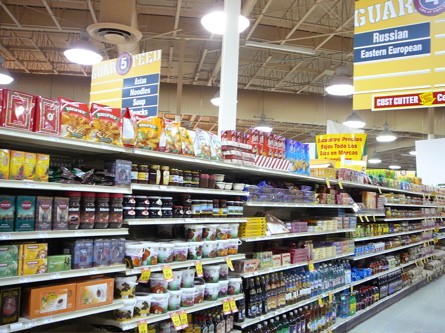
As soon as I got inside, I knew this was not just any old grocery store. The cashiers, the manager and the butchers all looked Mexican! And when I got to the deli section, the specialities were things like Dulce de Leche, all packaged up for people who eat a LOT of dulce de leche:
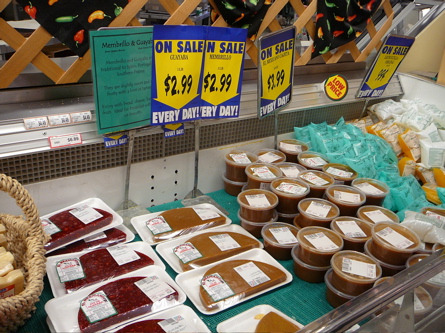
To my delight, there was an aisle labled Middle East foods, with tabbouleh, canned hummus and muttabel, foul, and Lebanese olive oil:
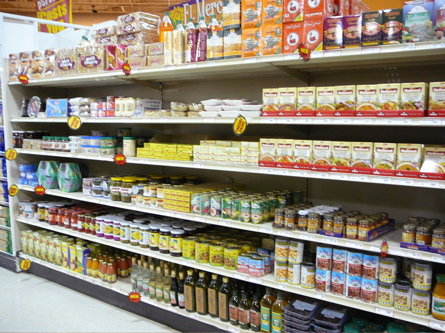
And a huge aisle with East European foods (I am not sure what East European foods are!)
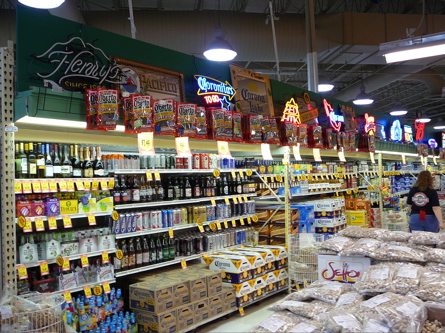
And, while most stores hide their beer selection in some dark corner of the store, Cost Cutter has a huge aisle down the center of the store, with all kinds of neon signage – it looks very festive:
Stores like Cost Cutter, that serve the large and varied population of immigrants are one of the reasons I love Seattle.
Ivar’s Acres of Clams
In Seattle, there are three restaurants, Ivar’s Acres of Clams (the original, established in 1938), Ivar’s Salmon House and Ivar’s Landing in Mukilteo, and several smaller, more casual, fast-food kind of Ivars, famous for fish and chips.
This was one very smart man. The first Ivar’s Acre of Clams was built next to the ferry terminal in Seattle and provided both oceanfront dining and a quick place to grab some fish and chips coming to and from the ferries. It was a Seattle landmark; everyone knew Ivar’s Acres of Clams.
He also did a lot of promotions, appearing on TV in his own ads, often singing. The ads were very very bad, so bad that everyone remembered them, so in fact . . . they were so bad that they were good.

(Photo courtesy Paul Dorpat from the HistoryLink.org collection of Pacific Northwest History.)
(Kuwait needs this Wikipedia kind of historical page, gathering data and stories before the old Kuwaitis are all gone, and their stories with them. This would be a great thesis program, getting this set up and running.)
Some of my earliest memories are meals at Ivar’s. As a child, visiting from Alaska, the whole of my father’s clan, aunts, uncles, cousins, would all gather at Ivar’s for a grand dinner. Later, as a starving college student, from time to time a kind aunt would invite us to dinner or lunch there, taking us out of the university environment. As a young married, it was the restaurant where my husband-to-be met my extended family for the first time. Ivar’s is full of memories, as well as good food!
To this day, I often meet my old friends at Ivar’s. The food standards remain high – good Pacific Northwest Seafood, prepared so that their flavors come through. Dungeness crab Louis, salmon and chips, prawns and chips, halibut and chips – even plain old fish and chips, fresh out of the deep fryer. Even Ivar’s fast food is delicious, and as well as the fish and chips you can get their great clam chowder, also smoked salmon chowder, and a salmon ceasar salad, or a shrimp or crab cocktail – at the fast food Ivars. Great quality food, not the supersize me kind of food.
These are photos of the original Ivar’s Acre of Clams:

This is what their seafood cocktails look like (YUMMMMMMM!)

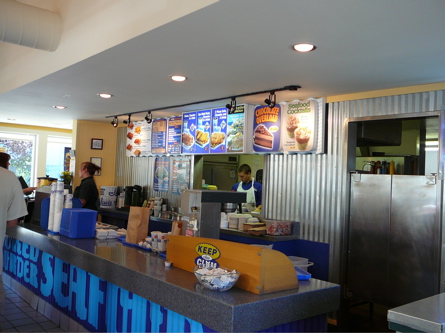
This is one of their dine-in fast food places; there is a long line of people ordering!:
This is the Ivar’s motto:

The Mukilteo Landing Ivars suffered so much damage in a recent storm that they were closed for over a year as they remodeled to be able to seat more people:

This big fish is part of the interior:

You sit in this beautiful restaurant, inside or outside, and watch the Mukilteo ferry come in and out of the dock. The restaurant is right next to the dock, and also has a fast-food Ivars outside to sell fish and chips or chowder to all the people in line waiting for the next ferry.
Ivar Hagland isn’t alive anymore, but his restaurants live on, thriving, after all these years. The concept holds true – have a great product in a great location and the profits will follow. You can read more about his restaurants, and even look at their menus by clicking Ivar’s.
Autumn Plum Torte
We are watching the farmer’s markets for the first of the Italian plums, those elongated plums that show up around this time of the year. We are getting eager for Pflaumekuchen, or Autumn Plum Torte.
It’s really more like a pie. And I hate to tell you how easy it is to make.

This is my mother’s recipe:
Autumn Plum Torte (Pflaumekuchen)
1/4 Cup Butter
1 T Sugar
1/4 t. salt
2 eggs
1 c sifted flour
10 – 12 purple prune plums
1 c sugar
1 T Flour
Dash nutmeg and cinnamon
1/2 cup half and half
1. Cream butter and sugar, add salt and 1 egg yolk. Blend well, add 1 cup flour, mix well.
2. Press mix into bottom of greased 8” pie pan.
3. Cut plums in half or quarters; place cut side up on top of mix. It is pretty if you make a kind of circular pattern out from the center.
4. Combine sugar, 1 T flour and spices. Sprinkle over plums.
5. Beat 1 egg and 1 white, add half and half, pour over top.
6. Bake at 425 for ten minutes, then turn down to 350 for 40 – 45 minutes, until custard sets and plums are cooked.
The smell as it is cooking is divine. You can serve it in wedges, warm or cold.
You can also double this, and make it in a 9 x 14 pan, to serve to larger groups. It goes FAST!
Recent Comments
ExpatAlien on What Country am I Living … intlxpatr on Yellowstone: Old Faithful to C… Michelle on Yellowstone: Old Faithful to C… Cathy on No Grown-Ups in Charge intlxpatr on Waiting for Snow Wikipedia Donate Button

Amazina


Early Voting in Florida


 Here There and Everywhere