Paradise Cafe Near the Juneau Airport
AdventureMan spotted this gem, near the airport, and said “I want to eat there!” We went inside, and what a surprise – it is eccentric, and quirky, and full of local people eating lunch. We noticed that thanks to the gorgeous display of sweet desserts and pastries, everyone also left with a box for ‘later on’ like coffee break.
They had a selection of ‘grillers’, no menu, everything is listed on the board or on display. It is so hard to focus on lunch when you are looking at flaky pastry confections . . .
I had the tomato pesto sandwich, and AdventureMan had a ham and cheese griller – both rich and filling. We sat at one of the tables, each table different, sometimes people share tables. On each table is a carafe of water, but we also saw a lot of people ordering specialty coffees and teas.
The Paradise Cafe is not a well-kept secret. You and I, as tourists, may not recognize it is there, but all the local helicopter pilots and airport workers know it is there 🙂 It is a well loved and busy place!


Sugar Eight Times More Addictive than Cocaine
This is from AOL News: “The rats go for the sugar and it is eight times more addictive than cocaine” in studies done on sugary foods.
A U.S. doctor is making it his mission to publicly highlight some scary effects sugar has on the body. The chairman of the Institute for Functional Medicine says we’re becoming more dependent on sugary foods and drinks – saying they’re even more addictive than cocaine.
On”CBS This Morning,” Dr. Mark Hyman said, “In animal studies, they find that the rats go for the sugar and that it’s eight times as addictive as cocaine. Small amounts of sugar can be part of a normal diet, but most of us are addicted to sugar and don’t know it.”
Hyman himself has gone as far as calling sugar and sugary foods “deadly.”
He told the New York Daily News that “sugar is the new nicotine. And worse, sugar actually causes diabetes and obesity.”
The doctor’s trying to help people find ways to lessen their dependence on sugar with tips from his book, “The Blood Sugar Solution 10-Day Detox Diet.”
On the book’s website, Dr. Hyman says 600 people took part in the diet, which encourages healthier eating habits. Together, they lost more than 4,000 pounds, and their average blood pressure fell by about 10 points.
Dr. Hyman told New York Daily News the average American eats 152 pounds of sugar a year. Whoa.
All the Light There Was by Nancy Kricorian
AdventureMan came into the room where I was reading and handed me this book. “Will you read this?” he asked, and there was a note in his voice that sounded a little aggrieved.

“What’s up?” I asked. “You sound a little peeved.”
“I read this,” he said. “I thought it was pretty good, but when I read the reviews on Amazon, some people called it ‘trivial’,” and I could see he was embarrassed that something he thought was pretty good others believed was of little importance.
Big mistake, Adventureman.
I might read a little of the reviews when deciding whether to buy a book or not, because I won’t remember it when it comes time to actually read the book or review the book, but I never, NEVER read the reviews as I am reading or before I review a book. And, truthfully, I don’t really care what this reviewer says or that reviewer says. Sometimes I read a New Yorker review of a book and I think “that reviewer has her own filter and can’t see beyond her framework” or “Wow! That reviewer saw some things I’d like to see!” Sometimes I will read a review and then read the book and think that the reviewer really missed the mark, positively or negatively, it could be either way.
Reviews are opinions. We all have them. Some you might agree with, some you might not, but don’t let them touch you, or your experience with the book. We are each unique, and see through a unique lens!
First, it delighted me that I read this just after I read Babayaga, because I ejnoy Paris, and delight in walking Paris, and in Babayaga and in All the Light There Was, people do a lot of walking in Paris. So much so in All the Light There Was that I ran down to my little map collection for the Paris maps and would track the heroine through Paris. It was fun.
Although All the Light There Was is called a novel, I don’t think it is. As I read it, I thought it was highly biographical or autobiographical, based on a diary or diaries. The significant details – how the mama stockpiled food just as war was announced and all the places she stored it, including under the bed, the clothing they wore, the sweaters they knit, the indignities they endured, and the risks they bravely took against the occupying Germans – it doesn’t sound made up to me, it sounds like a story someone has told from that time.
The details are so strong – the bicycle tires that are treasured because if they go flat, that is the end of the last transport they have, the dresses that have become too big because people have eaten too little – these details sound like voices to me.
So I would not call this book trivial. This book captures a moment in time, it’s a snapshot. The characters don’t have a lot of depth, the events don’t have a lot of texture, but I do know what occupied Paris ate during the last years of the occupation (turnips) and the ambivalence with which Paris viewed their Jewish citizens. In this war-time Paris, Kricorian captures well Pastor Martin Niemoeller’s poem about When They Came for Me:
In Germany, they came first for the Communists, And I didn’t speak up because I wasn’t a Communist;
And then they came for the trade unionists, And I didn’t speak up because I wasn’t a trade unionist;
And then they came for the Jews, And I didn’t speak up because I wasn’t a Jew;
And then . . . they came for me . . . And by that time there was no one left to speak up.”
Many in Paris were happy to see the Jews go, happy it wasn’t them. Kricorian tackles this issue indirectly, with a light but inescapable hand.
One of the things that was shocking to both of us what that when Maral’s ancient Auntie Shakeh died, and we see the tombstone – she is 35 years old. We knew she and Maral’s parents had escaped the Turkish efforts to eradicate the Armenians in Turkey, but because we are seeing the story through Maral’s eyes, her parents and aunt seem ancient, whereas in today’s terms, they are very young adults.
Don’t read the reviews, AdventureMan! Read the book, take from the book what you will, enjoy your own experience. Write your own reviews!
“Extinct” Shark Found in Kuwait Fish Market
January was always the best month to visit the fish souk in Kuwait; cooler weather = less smell. One of my best memories is my friend who was living in Teheran going through with her camera, taking photos of every fish to show her husband – they didn’t get a lot of fresh seafood, and they missed it so much. It was January, it was cold – but so much less fish-y smelling than in July 🙂
This is from AOL News:

A shark species previously thought to have been extinct was reportedly found in a fish market in the Middle East.
This is the smoothtooth blacktip shark, and the last time anyone ever reported seeing one was was in 1902 in Yemen. Scientists eventually labeled it extinct, or vulnerable to extinction in the 1980’s.
Then in 2008, the Shark Conservation Society took a trip to a fish market in Kuwait. They were looking at sharks and noticed one looked ‘very similar, but different, to a couple of other species.’ So of course they decided to investigate.
Further analysis confirmed it was in fact the smoothtooth blacktip shark.
But there’s more: Recent studies of Middle Eastern fish markets also counted as many as 47 more have been spotted.
Now this doesn’t mean the species is necessarily thriving, but it does mean scientists have a greater chances at learning more about the shark and possibly even ways to save the species.
Rosettes in 2013
Tomorrow is the day I’ve been waiting for – a crisp, cool, dry day when I can make thin, delicate rosettes. We have so many special occasions coming up and I want to be able to share them with others.

The weather here is so erratic – from hot with high humidity and fog to sudden cold and clear. I knew the weather was changing last night when the Qatari Cat came running in to snuggle up close to me. Today I ran errands so I would have tomorrow all to myself – it takes a major portion of the day; you make the rosettes one at at time. Bless his heart, AdventureMan will take care of the new happy baby for me tomorrow afternoon so I won’t even have to rush. 🙂
The Green Parrot on Panama City Beach
Our first day in Panama City Beach, I watched AdventureMan’s head swivel 120° to the left as we drove down the main drag.
“Did you see that?” he exclaimed! “A ‘Mediterranean’ restaurant!! Woooo HOOOOOOO!”
We’ve come to learn that ‘Mediterranean’ is code for comfort food. It is not Mediterranean-Italian, or Mediterranean-Greek, it is Mediterranean like Lebanon or Syria or Palestine . . . it is comfort food.
Sigh. Or close enough. There is no machboos, and sometimes the felafel aren’t home made. Still, we know we’ll give it a try.
On our last night in town, it is the perfect night to go. 

The owner is a delightful Lebanese import named Hani, and he is a word-of-mouth phenomenon on Panama City Beach. He has many fanatically loyal customers, and people recommend him all the time. We can see why. He loves what he is doing, and it shows.

Mixed appetizers/Mezze
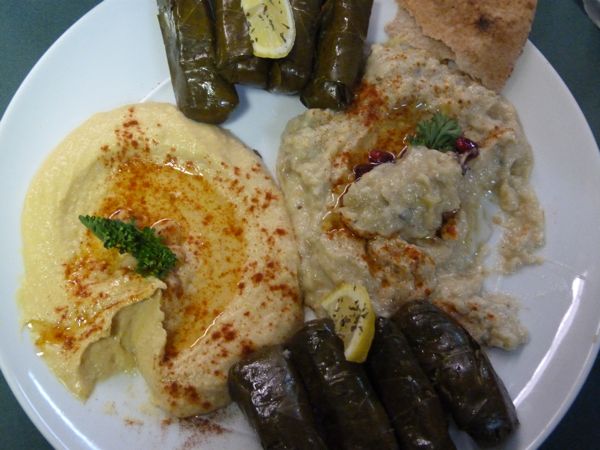
His food is DELICIOUS 🙂


Everything tasted so good. We can understand how he is developing such a following – his food is really good.

Southern Family Thanksgiving
Oh, what fun!
Some photos from the gathering.
My daughter-in-law made these fabulous bacon-wrapped stuffed dates:


The kids dish up their plates first, and go to the Cousins Table:

These are all the desserts waiting to be unveiled:

AdventureMan did the roasted root vegetables on this table 🙂


Re-telling old family stores – so much laughing!
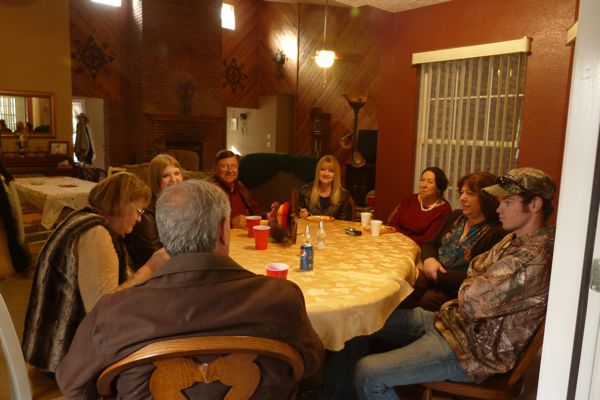

Uncle Woodrow introduces the cousins to farm-grown sugar cane:

Schooners For Dinner
We usually start our stay at Panama City Beach with dinner at Schooners, a very local beach bar with a aid back atmosphere. It is a cold cold windy night, the bar is packed, but there is a table for us.

We start with the smoked tuna:

AdventureMan has a Cuban with so much meat he can’t even eat it all:

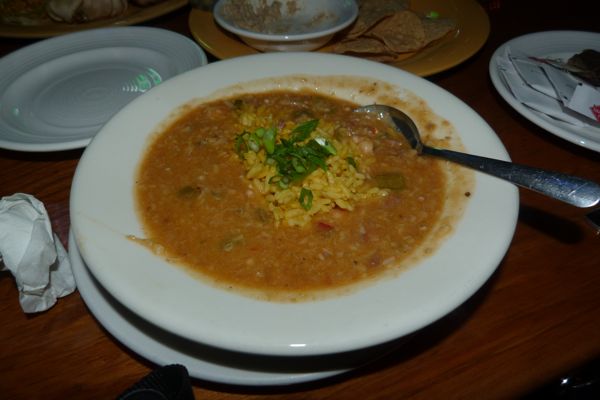
I have the seafood gumbo, perfect for a cold night; sticks to your ribs kind of food, LOL:
A View from the Sunset Inn, Panama City Beach
We love this place, the Sunset Inn, a little Mom and Pop kind of motel, hard to find in over-developed Panama City Beach with its huge soulless condominiums towering over the white sands.
As we walk in the door, the view hits us and we breathe in the sea air and go “Ahhhhhhhhhhhh.” The minute we walk in the door, we start to feel relaxed.

We both have cooking to do, so we get busy, but busy with glances at the view, and trips to our balcony to breathe. It is COLD, with a cold wind, but so gorgeous, so breath-takingly gorgeous, and we are happy.
Soon, there are cranberries cooking for Mom’s Cranberry Salad and hot juice brewing for the punch, redolent of cinnamon and cloves and orange peel, wonderful smells filling our room – and that view. Life is sweet.


And then, just when you think it can’t get any better, the sun starts to set, the light goes all golden and soft and oh, life is sweet.

Saudi Arabia Inching Toward Allowing Women to Drive
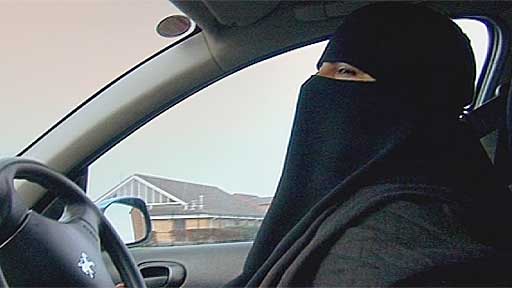
Saudi Arabia is the only country in the world where women are not allowed to drive. There is an irony – there is no law banning women from driving. They do not issue driver’s licenses to women, they arrest women seen driving, and they do not – officially – teach women to drive. Thank God for good fathers and brothers and husbands, who take their daughters, sisters and wives to isolated places and teach them, often for the good of the family in case of an emergency.
Saudi women drive in Europe, in the USA – they drive everywhere except in their own country. The government shows signs of wanting to allow women to drive (officially) but they seem hesitate to stir the wrath of the religious police who believe – based on nothing – that God forbids women to drive. Recently, the head of the Saudi religious police said there is nothing in Islam that forbids a woman to drive. What’s the hold-up guys?
This article is from AOL Auto News, where you can also see a video of a woman driving in Saudi Arabia with cars passing her and waving encouragement:
Saudi Arabian Women To Protest Driving Ban On Oct. 26
Saudi society is slowly inching toward more equality, but driving is still disallowed for women

When Farha was a young girl, about seven years old, her mother told her something that rocked her world: She said women could drive.
For Farha, a 24-year-old writer who has spent her entire life in Saudi Arabia, this was akin to a Western child learning the truth about Santa Claus. She’d only ever seen men behind the wheel in her country, where women are not permitted to drive. The revelation was slightly scandalous, a little bit funny, and totally paradigm-shifting.
It took another two years for Farha (who didn’t want to be identified with her last name due to the sensitivity of the issue in her home country) to decide she would, one day, learn how to drive a car. And, for good measure, she’d learn how to ride a bike. Two modes of transportation that have been banned to women and girls for most of Farha’s lifetime.
On Oct. 26, women in Saudi Arabia will engage in the third protest against the female driving ban by getting behind the wheel anyway. The protest won’t be widely attended, because the vast majority of women in Saudi Arabia don’t know how to drive. There are no driving schools in the Kingdom that cater to females, and state agencies will not issue a driver’s license to a woman.
“Since there is no justification for the Saudi government to prohibit adult women citizens who are capable of driving cars from doing so, we urge the state to provide appropriate means for women seeking insurance of permits and licenses to apply and obtain them,” a petition at the protestor’s web site reads. The web site has been blocked within Saudi Arabia, yet there are still a thousand or so names on the petition. The few women who are adept behind the wheel learned while living overseas, often in the U.S., Canada, or nearby Bahrain or Dubai.
In urban areas, women are chauffeured around by male relatives or paid drivers, or they pay for taxis. In rural areas, the driving ban generally isn’t enforced, and more women drive out of necessity. One woman who was recently videotaped disobeying the ban got support from her fellow (male) drivers, who passed by and gave her the thumbs up, a sign that society may be more willing to accept an eventual change.
Learning to drive
Farha tackled the task of learning to drive first by reading about the process. She edited a story on how to drive for her high school newspaper, and from that she felt she learned quite a bit. Then her father spent some time talking to her about how cars work, and the theoretical aspects of driving. He took her out for a few hours over the course of a few days, letting her drive around their neighborhood in the coastal city of Jeddah. But she never ventured onto the main roads.
She also learned the basics of riding a bicycle, but doesn’t consider herself adept at either skill. When the ban is lifted, she said she’ll sign up for classes at a real driving school.
“I always thought this ban would go away when I was 18,” she told AOL Autos. We connected with her through a publication where Farha wrote, under a pseudonym, about the driving ban. “And I’m still hoping it will be lifted when I am 26.”
“I always thought this ban would go away when I was 18,” Farha said. “And I’m still hoping it will be lifted when I am 26.”
Not driving makes life’s everyday movements difficult. Sidewalks aren’t available, so walking isn’t realistic. Farha’s father has mostly been responsible for driving her and her mother around, but five months ago he got into a car accident and broke his leg. He is currently unable to drive. Farha feels the burden of her father’s injury. If she could drive, she said, she could bring him to doctor’s appointments and help him get out of the house. Instead, the family is home-bound unless they pay someone to bring them places.
Farha has hired a part-time driver to take her to and from work. It costs about 2,000 to 3,000 Saudi riyals (or around $530 to $800) a month for a driver. That’s about the same amount that women make earning minimum wage in Saudi Arabia, prompting many women to just stay home.
“A lot of women don’t feel the incentive to work and hire a driver,” she said. “It doesn’t make any economic sense.”
Some women opt for the public bus system, but that makes women from conservative families feel nervous because it exposes them to strange men – the exact problem the country is trying to avoid by banning women drivers. Taxis run the same problem, putting females into cars with strange men. “It doesn’t make sense,” Farha said.
Farha is considering signing up for a karate class, but she’ll have to pay her driver for more hours or take a taxi to the classes. On top of the class fees, the price of getting to and from karate starts to seem like a silly amount of money, she said.
And she worries she’s spending too much money on herself. She could spend 30 riyals on a taxi each way, or she could donate that money to a family in need. Or spend that money sending school supplies to girls in other countries.
“It’s a difficult decision to make every time,” she said.
One unintended consequence of the rule strikes Farha as incredibly unsafe: Women often let their 13-year-old sons drive them around when they are out of other options. Farha’s observation was backed up by a U.S. intelligence research note made public by Wikileaks, which noted that these young drivers sometimes get into very serious accidents.
Weird, long history
Oddly enough, there isn’t any actual law in Saudi Arabia banning women from driving. In 1991, the late Grand Mufti of Saudi Arabia, Sheik Abdulaziz bin Baz issued a fatwa prohibiting women from driving. A fatwa is different from a government law, in that only followers of the religious leader who issues the fatwa are obliged to follow that law. But given the intertwined nature of Saudi Arabia’s government and its religious leaders, the fatwa took hold. The government agency in charge of issuing driver’s licenses will not issue one to a woman. Saudi Arabia’s court system relies heavily on fatwas from the Grand Mufti.
So, in essence, the religious order became a rule that everyone follows, even though it’s not enforced by the Saudi government. The government just makes it impossible for women to get drivers licenses, and if they catch women driving, they make them sign a pledge promising they won’t do it again.
Abdulaziz bin Baz said at the time that the ban would protect women, because allowing women to drive would put them out in society alone, leaving them to mix with men. If women were stranded by the side of the road due to a flat tire or car problem, they could end up being assaulted or raped by a man who came to help them, argue critics who still uphold the ban.
A reporter for the Christian Science Monitor recalled a 2012 conversation with a man in Saudi Arabia about what would happen if the ban was lifted. “What would happen if a woman got in a car accident, he asked? Then she would be forced to deal with the male driver of the other car, a stranger, with no oversight – a problematic situation in a country where male guardianship of women is deeply entrenched.”
Just last week, a Saudi cleric came under fire for claiming women were damaging their pelvises and causing birth defects by driving. Sheikh Saleh bin Saad al-Lohaidan argued women should put reason ahead of their hearts, because it “could have negative physiological impacts as functional and physiological medical studies show that it automatically affects the ovaries and pushes the pelvis upward.”
Saudi society is slowly inching toward more equality for women. Just this week, four women became attorneys. Earlier this year, women were allowed to work in retail establishments that sell underwear and bras, taking away the embarrassment for women who’d previously had to purchase these items from male salespeople.
Since around 2006, the Saudi government has been indicating it would consider lifting the driving ban if society deems it acceptable for women to drive. Diplomatic cables released by Wikileaks showed the U.S. government has been paying attention to this issue, and putting some pressure on the Saudis to change their ways.
Will of the people?
But it’s clear the Saudi government won’t make any controversial moves: “This has to do with the will of Saudi society,” said Saudi Justice Minister Muhammad Al-Issa in a TV interview in April, according to a translation by the non-profit group MEMRI. “If Saudi society, given its culture, wants women to drive, it’s fine. But if society has any reservation for whatever reason, that’s fine too.”
Farha said she’s holding out hope that the rules will change, as soon as possible. But the change will depend greatly on men’s attitudes.
“More men certainly support it now, but … they have their concerns,” she said. And “some are outright hostile to the idea.”
When she does get her license, Farha said she’d like to try driving a sports car. It doesn’t matter what kind, she just would like to try driving something fun. But she’d rather be able to walk or bike to work, even if she could drive.
“Cars feel suffocating inside,” she said. “But the whole idea is to lift this difficulty for women. I hope it happens soon.”
In sharing this story, and others, with our readers we hope you are inspired to Raise Your Hand for girls’ education, helping us spread the word on this crucial effort.
Recent Comments
intlxpatr on Shampoo Ginger tigerbutterya0c5ff1d… on Shampoo Ginger intlxpatr on British Soldier Kidnapped, Esc… John on British Soldier Kidnapped, Esc… intlxpatr on British Soldier Kidnapped, Esc… Wikipedia Donate Button

Amazina


Early Voting in Florida


