Rape Goes Unpunished in US Military
This is disgusting. We’ve all known it’s true. The warrior culture protects those cowards who impose themselves sexually on both men and women. God willing, things will change. It’s already started, with the relieving of those in power who have imposed themselves on women who came forward with their complaints. Let there be more, until this culture is wiped clean of their disgrace.
Rape isn’t about sex. It’s about power. Rape is a personal violation.
It’s time for the good men and women in the military to police this up, to stop the outrage. Expose those bullies and cowards who prey on others.
Military Sex Abuse Investigation: Documents Reveal Chaotic Punishment Record
AP
by RICHARD LARDNER and YURI KAGEYAMA
TOKYO (AP) — At U.S. military bases in Japan, most service members found culpable in sex crimes in recent years did not go to prison, according to internal Department of Defense documents. Instead, in a review of hundreds of cases filed in America’s largest overseas military installation, offenders were fined, demoted, restricted to their bases or removed from the military.
In about 30 cases, a letter of reprimand was the only punishment.
More than 1,000 records, obtained by The Associated Press through the Freedom of Information Act, describe hundreds of cases in graphic detail, painting a disturbing picture of how senior American officers prosecute and punish troops accused of sex crimes. The handling of allegations verged on the chaotic, with seemingly strong cases often reduced to lesser charges. In two rape cases, commanders overruled recommendations to court-martial and dropped the charges instead.
Even when military authorities agreed a crime had been committed, the suspect was unlikely to serve time. Of 244 service members whose punishments were detailed in the records, only a third of them were incarcerated.
The analysis of the reported sex crimes, filed between 2005 and early 2013, shows a pattern of random and inconsistent judgments:
—The Marines were far more likely than other branches to send offenders to prison, with 53 prison sentences out of 270 cases. By contrast, of the Navy’s 203 cases, more than 70 were court-martialed or punished in some way. Only 15 were sentenced to time behind bars.
—The Air Force was the most lenient. Of 124 sex crimes, the only punishment for 21 offenders was a letter of reprimand.
—Victims increasingly declined to cooperate with investigators or recanted, a sign they may have been losing confidence in the system. In 2006, the Naval Criminal Investigative Service, which handles the Navy and Marine Corps, reported 13 such cases; in 2012, it was 28.
In two cases, both adjudicated by the 1st Marine Aircraft Wing, the accusers said they were sexually abused after nights of heavy drinking, and both had some evidence to support their cases. One suspect was sentenced to six years in prison, but the other was confined to his base for 30 days instead of getting jail time.
Taken together, the cases illustrate how far military leaders have to go to reverse a spiraling number of sexual assault reports. The records also may give weight to members of Congress pushing to strip senior officers of their authority to decide whether serious crimes, including sexual assault cases, go to trial.
“How many more rapes do we have to endure to wait and see what reforms are needed?” asked Sen. Kirsten Gillibrand, D-N.Y., chair of the Senate Armed Services personnel subcommittee. She leads a vocal group of lawmakers from both political parties who argue that further reforms to the military’s legal system are needed.
Air Force Col. Alan Metzler, deputy director of the Defense Department’s Sexual Assault Prevention and Response Office, said the department “has been very transparent that we do have a problem.” He said a raft of changes in military law is creating a culture where victims trust that their allegations will be taken seriously and perpetrators will be punished.
The number of sexual assault cases taken to courts-martial has grown steadily — from 42 percent in 2009 to 68 percent in 2012, according to DOD figures. In 2012, of the 238 service members convicted, 74 percent served time.
That trend is not reflected in the Japan cases. Out of 473 sexual assault allegations within Navy and Marine Corps units, just 116, or 24 percent, ended up in courts-martial. In the Navy, one case in 2012 led to court-martial, compared to 13 in which commanders used non-judicial penalties instead.
The authority to decide how to prosecute serious criminal allegations would be taken away from senior officers under a bill crafted by Gillibrand that is expected to come before the Senate this week. The bill would place that responsibility with the trial counsel who has prosecutorial experience.
Senior U.S. military leaders oppose the plan.
“Taking the commander out of the loop never solved any problem,” said Sen. Lindsey Graham, R-S.C., the personnel subcommittee’s top Republican. “It would dismantle the military justice system beyond sexual assaults. It would take commanders off the hook for their responsibility to fix this problem.”
Gillibrand and her supporters argue that the cultural shift the military needs won’t happen if commanders retain their current role in the legal system.
“Skippers have had this authority since the days of John Paul Jones and sexual assaults still occur,” said Lory Manning, a retired Navy captain and senior fellow at the Women in the Military Project. “And this is where we are.”
___
Lardner reported from Washington. Associated Press writer Leon Drouin-Keith in Bangkok and AP researcher Rhonda Shafner in New York contributed to this report.
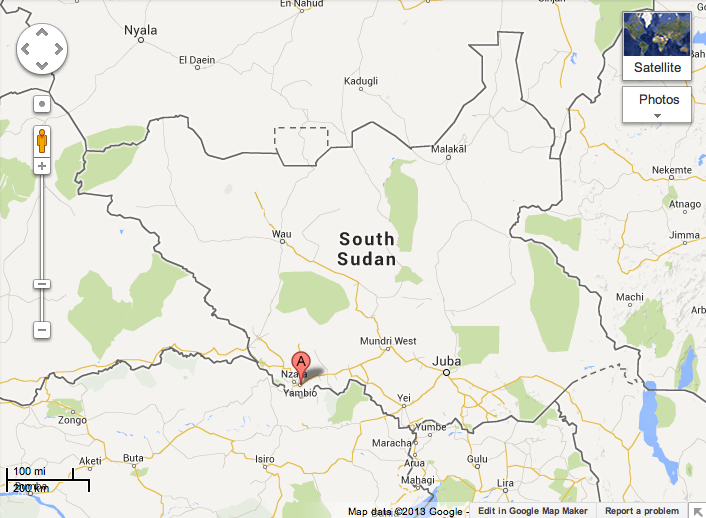
David, and Where is Yambio, South Sudan?
A year ago, we had an extraordinary experience. We often entertain delegates visiting from other countries, and this time we had three African journalists, and, strictly by chance, they all turned out to be Christian. Most of our gatherings are strictly ecumenical, but these were joyful, praying Christians, and the evening took a turn we never anticipated.
“So how did you find Jesus?” one woman asked David, from the newest country in the world, South Sudan. Inside, I was shocked, and when I am shocked, my tendency is to laugh, I don’t know why, it is just the way I am wired. Every culture is so different. In the South, people might ask that of one another, particularly if you worship in a fundamental sect, but our sect is more formal, and to inquire into another’s spiritual life can be perceived as intrusive.
David, however, was not taken aback. “It’s a long story,” he said, and we all settled into comfortable chairs to listen better. It was Christmas, the decorations were up, the lights all twinkling and we had eaten. A good time for a story.
It was a long story. It started with a little boy in a happy family, who one day was told to run! Run! Run into the forest and hide! The riders were coming! His family grabbed a very few things and ran.
His family ran for years. His family ran into forests, across borders, into dry arid spaces. Sometimes some of the children would get separated from their parents for a while, but they would keep asking, and eventually meet up again, only to face separation again. Their whole lives were running, from the Janjaween, from border police, from robbers.
At one point, he and a brother stayed in a church, and a priest taught them about Jesus. Simple stories, simple songs, and he drew letters and numbers in the dirt – that was his early schooling. It was a haven of peace for him.
Many years later, the family was reunited in their village in the new country of South Sudan. Miraculously, every member of his family survived, indeed, most of his village survived. They had maintained lines of communication through all those years of running and separation, and were so thankful. Most of all, now, they were thankful – they had a church in their village. David had learned to love learning, and had completed his education and had found a wonderful job.
“I don’t know the book like you do,” he told us, “I only know it like a little child sitting at the feet of that priest, but I am learning.”
I can’t help but think that David knows more than he thinks. David holds his belief in Jesus like a child, simple and direct. His testimony is powerful and unforgettable. I am in awe, even a year later, of his story and testimony.
Today the church prays for the diocese of Yambio, in the South Sudan:
Taliban Says Malala ‘Has Done Nothing To Earn Prize’
Mr. Taliban, did you see Jon Stewarts interview with Malala? (See below) All she wants is an education. She wants an education for herself, but also for all children in Pakistan. Your children, too! She wants them to have that opportunity, that’s all. And she has paid the price for her courage speaking out, and she bravely continues to state the obvious – there is nothing in Islam against educating women.
MIRANSHAH, Pakistan: The Pakistani Taliban Thursday said teenage activist Malala Yousafzai had done “nothing” to deserve a prestigious EU rights award and vowed to try again to kill her.
The European Parliament awarded the Sakharov human rights prize to the 16-year-old, who has become a global ambassador for the right of all children to go to school since surviving a Taliban murder attempt.
Malala survived being shot in the head by a TTP gumnan on October 9 last year and is seen as a leading contender for the Nobel Peace prize, to be announced on Friday.
“She has done nothing. The enemies of Islam are awarding her because she has left Islam and has became secular,” Tehreek-e-Taliban Pakistan (TTP) spokesman Shahidullah Shahid told AFP by telephone from an undisclosed location.
“She is getting awards because she is working against Islam. Her struggle against Islam is the main reason of getting these awards.”
He repeated the TTP’s threat – made numerous times in recent months -try again to kill Malala, “even in America or the UK”.
Malala and moved to Britain in the wake of the shooting for treatment and to continue her education in safety.
Feted by world leaders and celebrities for her courage, Malala has addressed the UN, this week published an autobiography, and could become the youngest ever Nobel Peace Prize laureate on Friday.
Her autobiography “I am Malala”, written with journalist Christina Lamb, has gone on sale in Pakistan and Shahid warned the Taliban would target bookshops stocking it.
“Malala is the enemy of Islam and Taliban and she wrote this book against Islam and Taliban,” he said. (AFP)
Every Day Sadists Walk Among Us

“Trust your feelings,” my friend told me when I was telling her about a person who seemed so nice, but made me uncomfortable. This article says the same thing; if you feel like a person takes pleasure from humiliating or hurting others, stay far far away. It’s only a matter of time before they turn on you.
Everyday Sadists Walk Among Us, Study Says
(From AOL News/Every Day Health)
Although we may think of sadism in a sexual or criminal context, sadistic tendencies are common in everyday life.
By Laurie Sue Brockway, Everyday Health Staff Writer
Whether it’s the Marquis de Sade, the evil stepmother from Snow White, or Nurse Ratched from One Flew Over The Cuckoo’s Nest, all sadists take great pleasure in inflicting pain on others. Fortunately, you are unlikely to meet those particular three anytime soon, but according to an unusual duo of studies conducted in Vancouver, British Columbia, and published in Psychological Science this week, it is very possible you will bump into a boss, a colleague, or even a family member who may be considered an “everyday sadist.”
While most people try to avoid hurting others — and will feel guilty, remorseful, and distressed if they do hurt someone intentionally or unintentionally — an everyday sadist enjoys being cruel and may find it exciting.
“We have probably all encountered people in our daily lives who — at least seem to — enjoy hurting others,” said lead researcher Erin Buckels, MA, who conducted this work as part of her master’s thesis in Social-Personality Psychology at the University of British Columbia. She is now a doctoral student at the University of Manitoba in Winnipeg.
“Everyday sadists lack empathy, and they possess an internal motivation to hurt others. However, they are unlikely to act in a way that would be criminal or dangerous — at least in most contexts, where such behavior is met with social disapproval or punishment,” Buckels said.
Everyday sadists may be cousins to classic sociopaths in their lack of empathy, but they are not considered a danger to society in the same way. “It is only in situations where cruelty is encouraged or socially acceptable that dangerous behavior might enter the equation,” said Buckels. “Both sadistic personality and situational pressures are necessary for sadism to manifest with everyday people. War is one example of this confluence — we have all seen the images of the Abu Ghraib prisoner abuse. All forms of cruel behavior have the potential to be motivated by sadistic pleasure, including bullying and abuse by others. If it were done purely for pleasure, then it would be sadism.”
If You Like to Hurt Bugs, You May Be a Sadist
It’s one thing to take an empty mayonnaise jar to catch fireflies when you are a kid and accidentally forget to poke holes in it, causing the fireflies to die. It’s another thing to enjoy harming bugs (or animals). Buckels used a bug-crushing exercise to draw the everyday sadists out in a controlled laboratory environment. For the experiment, she defined sadists in two ways: Their cruel behavior and felt pleasure in the lab, and personality characteristics consistent with sadism. A group of 71 participants were asked to fill out a sadism personality questionnaire and also given a list of four tasks they could choose from:
Killing bugs
Helping the experimenter kill bugs
Cleaning dirty toilets
Enduring pain from ice water
A bug-crunching machine fashioned out of a coffee grinder made distinct crunching sounds. Placed close to this machine were cups containing live pill bugs that were labeled with names like Muffin, Ike, and Tootsie. Those who selected bug-crushing were told to put the bugs into the machine and grind them up. Unbeknownst to them, there was a barrier that prevented the bugs from being dropped into the grinder. No bugs were killed for this experiment, but it brought the sadists out of the closet. Of 71 participants, nearly 28 percent chose to kill bugs.
What Exactly Is a Sadist?
Sadistic personality disorder was once defined as a mental illness, but over time sadism has been considered more of a lifestyle choice or a personality quirk or trait. The new Diagnostic and Statistical Manual of Mental Disorders (DSM-5), does include sexual sadism disorder. “This is marked by recurrent and intense sexual arousal from the suffering of others as manifested by fantasies, urges, and behaviors,” said Wilfried Busse, PhD, a psychotherapist based in Bethesda, Md. “To meet full criteria for the disorder, an individual also has to act on such urges by inflicting harm on a non-consenting individual, or must experience such uncontrollable urges to cause significant social and occupational impairment.”
“The central feature of sadism is deriving pleasure from watching or inflicting physical or psychological harm on others,” added Dr. Busse. “In the extreme form a sadist will seek to inflict suffering on another for the psychological gratification derived from such an action.”
Buckel’s study did not use classic criteria to define sadism – most widely known as sexual or criminal behavior – and instead explored sadism as it exists in the “subclinical” range of personality, an aspect of sadism not considered a mental illness.
“There is clearly a difference between a person who gets pleasure from killing bugs and a person who kills other humans for pleasure,” said Buckels. “That being said, the core experience of sadism is probably pretty similar for both of them. Our research has also revealed both similarities and differences between people who enjoy acting cruelly, or direct sadists, and those who simply enjoy watching cruelty, or vicarious sadists.Regardless of whom the victim is, direct aggression requires a certain amount of callousness and a lack of distress towards the suffering of another living creature.”
How to Spot a Sadist
There is a big difference between the kind of evil sadists we know from history and movies and people with sadistic impulses, who fall into a category of sadism that is considered a personality trait rather than a personality disorder.
“It is very important to differentiate between an antisocial, or sadistic, personality disorder and sadistic impulses,” said psychologist Fran Walfish, Psy.D., a family therapist and author in Beverly Hills, Calif.
“Antisocial personality disorder is very rare,” Walfish said, offering examples such as Hitler, murderers who enjoy torturing their victims and watching them suffer, and, possibly, Syrian President Bashar Assad. “But the rest of us have unconscious sadistic impulses. Even the kindest, most loving person, when terribly mistreated, can feel an impulse of hate very strong,” she added.
Walfish explained that there are several sub-types of sadists:
Explosive sadist. When disappointed and/or frustrated with their lives, humiliated or hopeless, they lose control and seek revenge for the mistreatment to which they feel subjected. They are known for being unpredictably violent. This manifests through tantrums, fearsome attacks on others, especially family members, and uncontrollable rage.
Tyrannical sadist. They are frightening and cruel because they appear to relish the act of menacing and brutalizing others; forcing their victims to cower and submit gives them satisfaction.
Enforcing sadist. They tend to be military sergeants, deans of universities, prison overseers, police officers or people with other authoritative functions who feel they should be the ones controlling and punishing people who have broken rules, regulations or laws.
Spineless sadist. They are typically deeply insecure and act like cowards. In anticipation of real danger, they project their hostile fantasies and strike first, hoping thereby to forestall their antagonist and ask questions later. They use aggressive hostility to send the message to others that they aren’t intimidated or fearful, so that they can control their inner feelings and display the exact opposite of how they actually feel. They seek out scapegoats to gang up on, which allows them to assault the exact things that exist within themselves that they want to deny.
Everyday sadist. There is a renewed interest in studying subclinical sadism as a personality trait, said Walfish. Subclinical psychopathy, narcissism, Machiavellianism, and everyday sadism form the so-called “Dark Tetrad” of personality.
“These people aren’t necessarily serial killers or sexual deviants but they gain some emotional benefit in causing or simply observing others’ suffering,” said Walfish. “The type of person the study is referring to are, for instance, the co-worker who repeatedly humiliates you and smiles or appears to reap pleasure from hurting you. If you self-advocate and say something that inflames your co-worker, she retaliates with evil revenge, further humiliating you.”
Exercise Caution Around Everyday Sadists
The British Columbia researchers surmised that everyday sadists are not the most popular people.“A person who has a high score on a sadism personality questionnaire is unlikely to be regarded as a nice and loving person,” said Buckels. “That is not to say that they are always nasty or that they can’t love others; but in general, high scorers tend to be less nice than average.”
How does someone become an everyday sadist? “In general, the cause or reason someone wants to go the extra effort to hurt another is because someone terribly mistreated them,” said Walfish. “That someone is usually their mother, father, or an older sibling. The sadist was a receptacle, or container, for hostility and evil meanness. These toxic feelings become too much for one to bear. They have no choice but to find a weaker victim and spew their venom onto the other.”
“Within their own families and in the workplace these people cannot be trusted,” Walfish observed. “No one can ever feel safe with them. Therefore, they do not have real relationships. They engage by exploiting, manipulating, and using other people as a means to their own end. The best thing to do is keep reasonable distance from these people. Always be pleasant so you don’t become their target. This does not mean to kiss up. It just means you present yourself as a benign nice guy. Never do business or get close to one of these people. They will always take you down.”
Buckels said she was surprised to find such a low baseline of positive emotions reported by sadists. “They are not just acting out to compensate for deep-rooted insecurity or low self-esteem,” she said. “Interestingly, after an act of cruelty, their moods seemed to lighten, suggesting instead that the sadist’s appetite for cruelty derives from some diabolical need. Although speculative, our hypothesis is that sadists have an underlying deficit that is sated through cruelty’s rewards.”
Gospel for 9/11

Are we who we say we are?
Do we follow the spirit of The Word? Do we as believers pick and choose from our holy book(s) or do we humble ourselves, as Christ did, and do as he commands?
The Lord Jesus Christ commanded a very difficult life style. I have met holy people among all religions; I am forced to believe that “the way and the truth and the light” are behavioral, and that there will be many surprises when we get to the last days.
September 11th is a difficult day. This is a difficult Gospel reading for a difficult day:
Matthew 5: 38 – 47
Eye for Eye
38 “You have heard that it was said, ‘Eye for eye, and tooth for tooth.’h 39 But I tell you, do not resist an evil person. If anyone slaps you on the right cheek, turn to them the other cheek also. 40 And if anyone wants to sue you and take your shirt, hand over your coat as well. 41 If anyone forces you to go one mile, go with them two miles. 42 Give to the one who asks you, and do not turn away from the one who wants to borrow from you.
Love for Enemies
43 “You have heard that it was said, ‘Love your neighbori and hate your enemy.’ 44 But I tell you, love your enemies and pray for those who persecute you, 45 that you may be children of your Father in heaven. He causes his sun to rise on the evil and the good, and sends rain on the righteous and the unrighteous. 46 If you love those who love you, what reward will you get? Are not even the tax collectors doing that? 47 And if you greet only your own people, what are you doing more than others? Do not even pagans do that? 48 Be perfect, therefore, as your heavenly Father is perfect.
Pakistan’s Swat Valley Women Fight Back with Jirga
I love this. Women are using technology – and the traditional system – to persist in seeking justice for women who are often little more than slaves to their husband.

Tahira
Women in Pakistan’s Swat valley are making history, and perhaps some powerful enemies, by convening an all-female jirga, a forum for resolving disputes usually reserved for men. Some readers may find details of this report by the BBC’s Orla Guerin disturbing.
Tahira was denied justice in life, but she continues to plead for it in death – thanks to a grainy recording on a mobile phone.
As she lay dying last year the young Pakistan wife and mother made a statement for use in court.
In the shaky amateur video, she named her tormentors, and said they should burn like she did.
Tahira was married off at the age of 12 and died last year following a suspected acid attack
Tahira’s flesh was singed on 35% of her body, following a suspected acid attack. Her speech was laboured and her voice was hoarse, but she was determined to give her account of the attack, even as her flesh was falling off her bones.
“I told her you must speak up and tell us what happened,” her mother Jan Bano said, dabbed her tears with her white headscarf. “And she was talking until her last breath.”
Tahira’s husband, mother-in-law, and father-in-law were acquitted this month of attacking her with acid. Her mother plans to appeal against that verdict, with help from a new ally – Pakistan’s first female jirga.
Under the traditional – and controversial – jirga system, elders gather to settle disputes. Until now this parallel justice system has been men-only, and rulings have often discriminated against women. The new all-women jirga, which has about 25 members, aims to deliver its own brand of justice.
It has been established in an unlikely setting – the scenic but conservative Swat valley, formerly under the control of the Pakistan Taliban. We sat in on one of its sessions in a sparsely furnished front room. Women crowded in, sitting in a circle on the floor, many with children at their feet. Most wore headscarves, and a few were concealed in burqas.
Probing injustice
For more than an hour they discussed a land dispute, problems with the water supply, unpaid salaries, and murder. The only man in the room was a local lawyer, Suhail Sultan. He was giving legal advice to jirga members including Jan Bano who he represents.
“In your case the police is the bad guy,” he told her. “They are the biggest enemy. ” He claims the police were bribed by the accused, and were reluctant to investigate the case properly.

The jirga tackled land disputes, water supplies, and murder
The jirga is making history, and perhaps making enemies. In Swat, as in many parts of Pakistan, men make the key decisions – like whether or not their daughters go to school, when they marry, and who they marry. And oppression starts early. Tahira was married off at just 12 years old, to a middle-aged man.
“Our society is a male-dominated society, and our men treat our women like slaves,” said the jirga founder, Tabassum Adnan. “They don’t give them their rights and they consider them their property. Our society doesn’t think we have the right to live our own lives.”
This chatty social activist, and mother of four, knows that challenging culture and tradition comes with risks. “Maybe I could be killed,” she said, “anything could happen. But I have to fight. I am not going to stop.”
They glued [my daughter’s] mouth and eyes closed. Just her face was left, the rest was flesh and broken bones”
Taj Mehal
As we spoke in a sun-baked courtyard Tabassum got a disturbing phone call. “I have just been told that the body of another girl has been found, ” she said. ” Her husband shot her.” She plans to investigate the case, and push the authorities to act.
“Before my jirga women have always been ignored by the police and by justice, but not now. My jirga has done a lot for women,” she said.
There was agreement from Taj Mehal, a bereaved mother with a careworn face, sitting across the courtyard on a woven bed.
Her beloved daughter Nurina was tortured to death in May.
“They broke her arm in three places, and they strangled her,” she told me, putting her hands to her own throat to mimic the action. “They broke her collarbone. They glued her mouth and eyes closed. Just her face was left, the rest was flesh and broken bones.”
She speaks of her daughter’s suffering with a steady voice, but grief is wrapped around her, like a heavy shawl.
“When I looked at her, it was like a piece was pulled out of my heart,” she said. “I was turned to stone. I see her face in front of my eyes. I miss her laughter.”
Women are a rare sight on the streets of Mingora
Nurina’s husband, and his parents, have now been charged with her murder, but her mother says that initially the courts took no interest.
“Whenever we brought applications to the judge he would tear them up and throw them away,” she said. “Now our voice is being heard, because of the jirga. Now we will get justice. Before the jirga husbands could do whatever they wanted to their wives.”
Women are little seen or heard on the bustling streets of Mingora, the biggest city in Swat. Rickshaw taxis dart past small shops selling medicines, and hardware supplies.
There are stalls weighed down with mangoes, and vendors dropping dough into boiling oil to make sugar-laden treats. Most of the shoppers are men.
‘No justice’ at jirgas
When we asked some of the local men their views on the women’s jirga, the results were surprising. Most backed the women.
“It’s a very good thing,” said one fruit seller, “women should know about their rights like men do, and they should be given their rights.”
Another said: “The jirga is good because now finally women have someone to champion their cause.”
The response from the local male jirga was less surprising. They were dismissive, saying the women have no power to enforce their decisions.
Most local men who spoke to the BBC expressed support for the women’s initiative
That view was echoed by the prominent Pakistani human rights activist Tahira Abdullah. “I don’t see it as more than a gimmick,” she said. “Who is going to listen to these women? The men with the Kalashnikovs? The Taliban who are anti-women? The patriarchal culture that we have?”
Ms Abdullah wants jirgas stopped whether male or female. “The jirga system is totally illegal, and has been declared illegal by the Supreme Court of Pakistan. It can never be just. There are several extremely notorious cases where we have noticed that women do not get justice from jirgas, neither do non-Muslims.”
One of those cases took place last year in a remote region of northern Pakistan where a jirga allegedly ordered the killing of five women – and two men – for defying local customs by singing and dancing together at a wedding.
And there are regular reports of jirgas decreeing that women and young girls be handed over from one family to another to settle disputes.
But for some, like Jan Bano, the women’s jirga is bringing hope. Every day she climbs a steep hill to visit Tahira’s grave, and pray for the daughter whose voice has still not her heard. Her video recording was not played in court.
Your Calls – Every One – Reported to the Government
I found this on AOL News/Tech Crunch this morning. Post 9/11, did we know that the Homeland Security legislation would give the government so much power? To gather so much information on individual citizens who are not remotely suspected of committing a crime against the United States seems excessive to me.

Report: NSA Secretly Collecting Phone Records Of All U.S. Verizon Calls
Gregory Ferenstein
The National Security Administration is secretly collecting phone record information for all U.S. calls on the Verizon network. “Under the terms of the blanket order, the numbers of both parties on a call are handed over, as is location data, call duration, unique identifiers, and the time and duration of all calls,” reports The Guardian, which broke the story of the top-secret project after it obtained record of a court order mandating Verizon hand over the information.
The contents of the call are not recorded and it is also not known whether Verizon is the only cell-phone carrier complying with the massive spying project. The court order concerns all calls to, from, and within the United States.
With this so-called “metadata,” the government knows “the identity of every person with whom an individual communicates electronically, how long they spoke, and their location at the time of the communication,” explains the Guardian.
The Senate’s tech-savviest member, Ron Wyden (CrunchGov Grade: A), has been discretely warning citizens of these kinds of secretive government projects. “There is now a significant gap between what most Americans think the law allows and what the government secretly claims the law allows,” wrote Wyden and Senator Mark Udall to embattled Attorney Eric Holder.
The order apparently draws from a 2001 Bush-era provision in the Patriot Act (50 USC section 1861). The revelation dovetails similar exposes on massive government spying projects, including one project to combine federal datasets and look for patterns on anything which could be related to terrorism.
Bloggers Create Freedom Friday in Oppressed Eritrea
I heard whispers of this on National Public Radio, and found this write up on The International Business Times website. The message is simple – in a country where even a glance can be interpreted as treason, express your non-support of the government by STAYING AT HOME ON FRIDAY, the day Ethiopians usually go out and visit with friends, gather together and mingle. Ghandi would smile; this is civil expression at it’s most civil 🙂
Let the empty streets speak for you. LOL @ a tyrant making staying at home a crime against the government!
Eritrean bloggers outside of Ethiopia started it, smuggling an old Eritrean phone book out of the country and making calls to acquaintances – and strangers – in Eritrea. People didn’t even have to respond. they could just listen . . . then they developed a robo-call to help them enlarge the number they could reach.
Eritrea is considered one of the continent’s most opaque countries. National elections have not been held in the Horn of Africa country since it gained independence in 1993. Torture, arbitrary detention and severe restrictions on freedom of expression remain routine.
President Isaias Afwerki does not tolerate any independent media, the internet is strictly controlled and Reporters without Borders recently named it 179th out of 179 countries for freedom of expression.
It is illegal to criticise the government, prompting the Eritrean diaspora to set up a campaign to reverse the Arab-style call to take to the streets every Friday by emptying the streets in protest.

“We made phone calls from diaspora to Eritrea,” Meron Estefanos toldIBTimes UK. “We have a phone catalogue and called random numbers every Friday, telling them to stay at home and think about problems in our country.”
The phone calls “give them [Eritreans within the country] an opportunity to protest without risking too much”, according to Freedom Friday’s coordinator in the UK Selam Kidane.
The activists turned to a computerised auto-dialer called robocall to spread hundreds of thousands of taped messages to Eritrean phones. “It is time to restore our liberty and dignity” messages were sent automatically.
In another message, the mother of renowned political prisoner Aster Yohannes recalls the fate of her daughter, who was arrested in 2003 and has disappeared.
After two years, the movement is finally gaining momentum inside the country.
“Now they trust us inside the country, we have our team in Eritrea that puts out posters and leaflets late at night,” Estefanos said.
“The plan now that we have their trust is asking them to go out and demonstrate.”
About 1,500 Eritreans leave their country every month, according to the United Nations, paying up to 30,000 euros ($39,500) each to seek a new life free of grinding poverty and repression.
Earlier this year, Amnesty International put the spotlight on Eritrean asylum-seekers who are kidnapped from Sudanese refugee camps by the local Rashaida tribe, sold to Bedouin criminals in Egypt’s Sinai peninsula and severely abused while they are held for ransom.
One thousand refugees are held captive in the Sinai, according to reports. About 7,000 people in total may have been tortured and 4,000 may have died as a result of the people-trafficking in humans from 2009 to October 2012, according to recent data. A total of 3,000 people disappeared from 2007-11.
This is Your Boston Marathon First Victim – SHAME
This is on AOL News – information on the first victim from the first blast in the Boston Marathon. This is your victim, bomber, an eight year old boy. His mother is also hospitalized. Hang your head in shame.

Martin Richard was standing near the finish line, waiting for his father to complete the grueling Boston Marathon on Monday, when an explosion took his life.
He was 8 years old and in the third grade.
Neighbor Jane Sherman told WCVB that Martin was a typical little boy, who loved to ride his bike and play baseball.
Martin’s mother, Denise, was hospitalized with “grievous injuries,” The Times of London reported. She reportedly underwent surgery late Monday for an injury to her brain.
His 6-year-old sister, a first grader whose name was not made public, lost her leg in the blast, WHDH reported.
The status of his father, William, has not been released. A third child was reportedly unharmed in the explosion.
Boston Marathon Winners, lost in the aftermath of the explosions:

This is the face of America – welcoming all nations and all races to compete in the Boston Marathon. The winners were Ethiopian and Kenyan, and we celebrate their victories, year after year. Their nationality doesn’t concern us, their race is irrelevant, their politics are their own – they are all welcome to race, runners from all nations.
BOSTON — The Kenyans finally face a challenge to their dominance of the Boston Marathon, and it’s from their East African neighbors.
Ethiopia’s Lelisa Desisa took the title in the 117th edition of the world’s oldest marathon on Monday, winning a three-way sprint down Boylston Street to finish in 2 hours, 10 minutes, 22 seconds and snap a string of three consecutive Kenyan victories.
“Here we have a relative newcomer,” said Ethiopia’s Gebregziabher Gebremariam, who finished third. “Everything changes.”
In just his second race at the 26.2-mile distance, Desisa finished 5 seconds ahead of Kenya’s Micah Kogo to earn $150,000 and the traditional olive wreath. American Jason Hartmann finished fourth for the second year in a row.
“It was more of a tactical race, the Ethiopian versus the Kenyans. That fight played out very well,” defending champion Wesley Korir, a Kenyan citizen and U.S. resident, said after finishing fifth.
Putting TEETH into Anti-Rape Solutions :-)
Thank you, Hayfa, you always find the most amazing articles. What I love about this one is that if everything is where it is supposed to be, nobody gets hurt. Only invasive behavior results in . . . .lets hope excruciating pain 🙂 It also gives an attacker something else to focus on. This invention is a public service.
Rape-aXe: The Anti-Rape Condom
This is so brilliant! An anti-rape female condom invented by Sonette Ehlers.… A South African woman working as a blood technician with the South African Blood Transfusion Service, during which time she met and treated many rape victims. The device, known as The Rape-aXe, is a latex sheath embedded with shafts of sharp, inward-facing microscopic barbs that would be worn by a woman in her vagina like a tampon. If an attacker were to attempt vaginal rape, their penis would enter the latex sheath and be snagged by the barbs, causing the attacker pain during withdrawal and (ideally) giving the victim time to escape. The condom would remain attached to the attacker’s body when he withdrew and could only be removed surgically, which would alert hospital staff and police. This device could assist in the identification and prosecution of rapists.


A medieval device built on hatred of men? Or a cheap, easy-to-use invention that could free millions of South African women from fear of rape, in a country with the world’s worst sexual assault record?
Dubbed the “rape trap”, trademarked “Rapex”, the condom-like device bristling with internal hooks designed to snare rapists has re-ignited controversy over South Africa’s alarming rape rate, even before plans for its production were announced in Western Capethis week.
Some say the inventor, Sonette Ehlers, a former medical technician, deserves a medal, others that she needs help.
The device, concealed inside a woman’s body, hooks onto a rapist during penetration and must be surgically removed.
Ms Ehlers said the rape trap would be so painful for a rapist that it would disable him immediately, enabling his victim to escape; but would cause no long-term physical damage and could not injure the woman.
Some women’s activists call the device regressive, putting the onus on women to address a male problem.
Charlene Smith, an anti-rape campaigner, said it “goes back to the concept of chastity belts” and would incite injured rapists to kill their victims.
“We don’t need these nut-case devices by people hoping to make a lot of money out of other women’s fear,” Ms Smith said.
But Ms Ehlers contends that South Africa’s rape problem is so severe women cannot wait for male attitudes to improve.
“I don’t hate men. I love men. I have not got revenge in mind. All I am doing is giving women their power back,” Ms Ehlers said. “I don’t even hate rapists. But I hate the deed with a passion.”
The United Nations says South Africahas the world’s highest per capita rate of reported rapes – 119 per 100,000 people. Analysts say the total, including unreported rapes, could be nine times higher.
Ms Ehlers sees her invention as particularly attractive to poorer black women, because they often walk long distances through unsafe areas to and from work. She foresees women inserting the device as part of a daily security routine.
She said a majority of women surveyed said they were willing to use the device, which will go into production next year and sell for one rand (20 cents).
Ms Ehlers said she was inspired after meeting a traumatised rape victim who told her, “If only I had teeth down there.”
Recent Comments
intlxpatr on Shampoo Ginger tigerbutterya0c5ff1d… on Shampoo Ginger intlxpatr on British Soldier Kidnapped, Esc… John on British Soldier Kidnapped, Esc… intlxpatr on British Soldier Kidnapped, Esc… Wikipedia Donate Button

Amazina


Early Voting in Florida


