Ansar Din Runs Away From Mali in Disarray After French Air Strikes
Last year, we were honored to have a member of the Algerian Seal team at our table for dinner. Together with the French, they got the job done clearing the rats out of Mali in short time.
From today’s BBC News:
 :
:
Three weeks of French targeted air strikes in northern Mali have left Islamist militants “in disarray”, France’s defence minister has said.
Jean-Yves Le Drian said the jihadists had now scattered, marking a “turning-point” in France’s intervention.
His comments come as the French troops continue to secure Kidal, the last town occupied by militants.
France is preparing to hand over towns it has captured to an African force, which has begun to deploy to Mali.
So far about 2,000 African soldiers, mainly from Chad and Niger, are thought to be on the ground.
It will be the job of the African Union-backed force, the International Support Mission to Mali (Afisma), to root out the al-Qaeda-linked insurgents that have fled into the desert and mountains further north.
Meanwhile, at least two Malian soldiers have been killed when their vehicle hit a landmine south-west of Gao.
‘Tactical withdrawal’
Mr Le Drian said that some militants in Mali and been on a “military adventure and have returned home”.
Others had made a “tactical withdrawal to the Adrar des Ifoghas”, the mountainous region east of Kidal covering some 250,000 sq km (96,525 sq miles), he said.
Although this was now a turning-point for France, he said it did not mean that “the military risks and the fighting has ended”.
He also said he backed the idea of sending a UN peacekeeping force to Mali.
The BBC’s Christian Fraser in Paris says the UN Security Council had previously been uncomfortable about deploying a force under a UN mandate, but support is growing.
Envoys believe it would easier to monitor and prevent human rights abuses if the UN could pick and choose which national contingents to use, he says.
A French army spokesman in Bamako, Lieutenant-Colonel Emmanuel Dosseur, told the BBC French Service that France’s special forces were in Kidal, but the majority of troops were still at the airport.
A heavy sandstorm that had hampered operations on Wednesday was starting to clear, and troops may soon be able to continue their deployment, he said.
Haminy Maiga, who heads the regional assembly in Kidal, said he had witnessed no fighting as French forces entered and two helicopters were patrolling overhead.
Correspondents say the bigger problem is how to manage the concerns of the separatist Tuareg fighters in Kidal – the only city in the north to have a majority ethnic Tuareg population.
Chad’s army is full of experienced desert fighters needed to fight the militants
The secular National Movement for the Liberation of Azawad (MNLA) said its fighters would support the French but would not allow the return of the Malian army, which it accused of “crimes against the civilian population”.
Human rights groups have accused the Malian army of targeting ethnic Tuareg and Arab civilians.
The Tuareg rebels launched the insurgency in October 2011 before falling out with the Islamist militants.
The Islamist fighters extended their control of the vast north of Mali in April 2012, in the wake of a military coup.
An MNLA spokesman told the BBC that its fighters had entered Kidal on Saturday and found no Islamist militants there.
Kidal was until recently under the control of the Ansar Dine Islamist group, which has strong ties to al-Qaeda in the Islamic Maghreb (AQIM).
The Islamic Movement of Azawad (IMA), which recently split from Ansar Dine, had said that it was in control of Kidal.
The IMA, which has Tuareg fighters amongst its members, has also said it rejects “extremism and terrorism” and wants a peaceful solution.
France – the former colonial power in Mali – launched a military operation this month after the Islamist militants appeared to be threatening the south.
French Intercede to Save Mali
Heard yesterday on NPR that France was stepping up to the plate on Mali, found the story on BBC this morning . . . it isn’t easy. It’s like people in the US don’t get news of countries like Mali unless they really seek it out. You can find more stories on Mali and the Tuareg / Al Qaeda alliance tormenting Northern Mali at the BBC link.


The Ansar al Din is imposing in Mali the kind of Islam that the Taliban imposed in Afghanistan – an Islam which forbids music, forbids women to participate in public life, enforced by a group of ignorant, uneducated thugs with weapons. Everything Ansar al Din stands for is contrary to the true nature of Islam.
Go France!
French troops continue operation against Mali Islamists
Mali: Divided nation
French Defence Minister Jean-Yves Le Drian said army units had attacked a column of rebels heading towards the central town of Mopti.
He also revealed that a French pilot had been killed in fighting on Friday.
The French troops deployed on Friday after Mali’s army lost control of a strategically important town.
Mali’s government said its forces had recaptured the town, Konna, after the air strikes, but it was not clear if all Islamist fighters had left the area.
‘Terrorist state’
Armed groups, some linked to al-Qaeda, took control of the whole of northern Mali in April.
They have sought to enforce an extreme interpretation of Islamic law in the area.
Regional and Western governments have expressed growing concern about the security threat from extremists and organised crime.
Mr Le Drian said on Saturday that hundreds of French troops were involved in the military operation in Mali.
The minister said Paris had decided to act urgently to stop the Islamist offensive, which threatened to create “a terrorist state at the doorstep of France and Europe”.
He also revealed that a French pilot was killed in Friday’s fighting – during an air raid to support Mali’s ground troops in the battle for Konna.
“During this intense combat, one of our pilots… was fatally wounded,” the minister said.
Speaking on Friday, French President Francois Hollande said the intervention complied with international law and had been agreed with Malian interim President Dioncounda Traore.
It would last “as long as necessary”, Mr Hollande said.
French officials gave few operational details.
Residents in Mopti, just south of Konna, told the BBC they had seen French troops helping Malian forces prepare for a counter-offensive against the Islamists.
Mr Traore declared a state of emergency across Mali, which he said would remain in place for an initial period of 10 days.
He used a televised address to call on Malians to unite and “free every inch” of the country.
‘Crusader intervention’
The west African bloc Ecowas said it was authorising the immediate deployment of troops to Mali “to help the Malian army defend its territorial integrity”.
UN Secretary-General Ban Ki-moon says the situation in Mali is becoming increasingly volatile
The UN had previously approved plans to send some 3,000 African troops to Mali to recapture the north if no political solution could be found, but that intervention was not expected to happen until September.
French Foreign Minister Laurent Fabius said the aim of the operation was to stop Islamist militants advancing any further.
It was not clear how far the French would go in helping Mali’s government retake territory in the north.
At least seven French hostages are currently being held in the region, and Mr Fabius said France would “do everything” to save them.
A spokesman for al-Qaeda in the Islamic Maghreb (AQIM) said he considered the French operation a “Crusader intervention”, and told France it would be “would be digging the tombs of [its] sons” if the operation continued, according to the Mauritania-based Sahara Media website.
France ruled Mali as a colony until 1960.
This chart is from a Blog called The Moor Next Door:

The War We are Losing: Assault of American Servicewomen
Shocking, and sad. What can be worse than serving your country and to be assaulted by a member of your own team? To double that shock and betrayal, to have the team captains bury your injury for the sake of the team?? I thank God for the gals that are taking their cases to civil court and making a stink. Sometimes, that is what it takes to make people pay attention.
I have a friend, a friend in her sixties. She has served in Iraq and Afghanistan as a civilian, and she has had senior officers stalk and attack her. She is disgusted that senior leaders could feel so entitled, and so free from constraints.
I can’t print this whole article here, but it is fascinating. You can read the entire article from Huffpost: HERE.
Active-duty female personnel make up roughly 14.5 percent — or 207,308 members — of the more than 1.4 million Armed Forces, according to the Department of Defense.
One in three military women has been sexually assaulted, compared to one in six civilian women, according to Defense. According to calculations by The Huffington Post, a servicewoman was nearly 180 times more likely to have become a victim of military sexual assault (MSA) in the past year than to have died while deployed during the last 11 years of combat in Iraq and Afghanistan.
According to the most recent report by the Pentagon’s Sexual Assault Prevention and Response Office, 3,192 sexual assaults were reported out of an estimated 19,000 — roughly 52 a day — between Oct. 1, 2010, to Sept. 31, 2011. The department estimates that only roughly 14 percent of the assaults were reported. The majority of sexual assaults each year are committed against service members by service members, SAPRO reports. While MSA does not affect only women, the office characterizes the “vast majority” of victims as female junior enlists under the age of 25, and the “vast majority” of perpetrators as male, older (under the age of 35) and generally higher-ranking.
Last Tuesday, Defense Secretary Leon Panetta ordered a sweeping review of all initial military training across the services: Army, Navy, Air Force, Marine Corps and Coast Guard. The move resulted in part from mounting pressure at Lackland Air Force Base in Texas, where at least 43 women have recently come forward as victims of sexual assault. Every aspect of training, from the selection of instructors who directly supervise trainees to the number of female instructors, is under consideration. And a day after Panetta issued the directives, Defense officials revealed that Jeffrey A. Sinclair — a brigadier general with five combat tours behind him — is facing possible courts martial on charges ranging from inappropriate relationships with female subordinates to forcible sodomy.
On Friday, Panetta called the military’s record on prosecuting MSA an “outrage.”
Panetta’s refrain for years has been heartening: “One sexual assault is too many.”
To which Havrilla responds, “This whole concept of ‘zero tolerance,’ it’s just words and no action.”
“You can’t leave. You can’t quit. You can’t walk away.”
We were in the military when the first women were sent to serve with formerly all-male battalions. There was a lot of controversy, and a lot of chagrin among the men. I think those first women were some of the bravest women ever. Almost forty years later, the battle is still being fought. Militaries attract the guys with high testosterone, the guys who don’t think the rules, laws and boundaries apply to them – and slowly, slowly, they have to be brought to understand that yes, the rules apply to them, and that forcible sex with another woman – or man – is OFF LIMITS. Bravo to those brave women who go public and create awareness and disgust for this problem. Evil whens men get away with this despicable crime.
Wil Saudi Arabia Curb the Morals Police?
This is a tiny little article in the Qatar Gulf Times:
New curbs on Saudi moral police: reports
AFP/Riyadh
Saudi Arabia will curb the powers of its religious police, a newspaper report said yesterday.
“The new system will set a mechanism for the field work of the committee’s men which hands over some of their specialisations to other state bodies, such as arrests and interrogations,” Al Hayat daily quoted religious police chief Sheikh Abdullatiff Abdel Aziz al-Sheikh as saying.
Agents of the body known as the Commission for the Promotion of Virtue and Prevention of Vice will also be banned from carrying out “searches without prior approval from the governor”, he said.
Okaz daily also reported that the religious police agents will be prohibited from “standing at the entrances of shopping malls to prevent the entry of any person”, referring to attempts by agents to ban women who do not comply with the Islamic dress code and unmarried couples from entering malls.
Sheikh was appointed in January as the new chief of the religious police. Two weeks into his post, he banned volunteers from serving in the commission which enforces the kingdom’s Islamic rules.
In April he went further, prohibiting the religious police from “harassing people” and threatening “decisive measures against violators”.
In June, Sheikh came out strongly against one of his men who ordered a woman to leave a mall because she was wearing nail polish.
The woman had defied the orders as she filmed her argument with the policeman and posted it on YouTube.
Turkish Rape Victim Kills and Beheads Her Rapist to Protect Her Honor
Not all women will show this kind of courage and determination when bullied and intimidated by a powerful rapist. Now, she faces the penalty, but her actions have ignited a debate in Turkey. I found this on Huffpost, a re-publication of a CNN story:
A 26-year-old Turkish woman, who was impregnated by her rapist, reportedly shot and beheaded her alleged attacker to protect her honor. The case has forced the country into a new round in the intensifying debate over abortion.
Nevin Yildirim, a mother of two from Turkey’s Yalvac district, faces charges of murder for the August killing of 35-year-old Nurettin Gider. Yildirim, according to CNN, is at least five months pregnant and claims she was rape-impregnated by Gider.
Yildirim told police that Gider, a father of two who was married to her husband’s aunt, first raped her in January, when her husband left town to work a seasonal job.
Yildirim said Gider threatened to kill her children if she alerted anyone to the crime. The rapes allegedly continued over the course of the next several months and Gider reportedly threatened to publish photos he took of Yildirim’s pregnant body if she did not do as he said, Turkish broadcaster DHA reported.
On Aug. 28, Yildirim claims spotted Gider climbing up a wall behind her house and grabbed a rifle that was hanging on the wall.
“I knew he was going to rape me again,” Yildirim said at an Aug. 30 preliminary hearing.
Yildirim allegedly shot Gider twice and chased him from her property. She claimed in court he was armed at the time.
“He fell on the ground. He started cussing,” she said. “I shot his sexual organ this time. He became quiet. I knew he was dead. I then cut his head off.”
Witnesses told police they saw Yildirim walk into the village square, carrying Gider’s bloody head by his hair.
“Don’t talk behind my back, don’t play with my honor,” Yildirim allegedly told witnesses in the square as she threw Gider’s head to the ground. “Here is the head of the man who played with my honor.”
Authorities arrived on the scene shortly thereafter and Yildirim was taken into custody without incident.
“He kept saying that he would tell everyone [about the rape],” Yildirim told authorities, according to Doğan News Agency. “My daughter will start school this year. Everyone would have insulted my children. Now no one can.”
“I saved my honor,” she added. “They will now call [her children] ‘the kids of the women who saved her honor.'”
According to CNN, Yildirim went to a health clinic for an abortion prior to the murder but was turned away because she was 14 weeks pregnant at the time. In Turkey, abortion is only permitted during the first 10 weeks of pregnancy. Anything beyond that requires a special circumstance.
Turkey’s abortion debate has now been re-kindled as the public prosecutor’s office considers Yildirim’s request. Authorities are waiting for experts to weigh in on her mental stability.
“The extremity of Nevin’s actions show the extent of the trauma the rape has caused,” Dr. Gürsel Öztunalı Kayır, Foundation for Women’s Solidarity, told International Business Times. “We shouldn’t be distracted by the murder; if she wants to have an abortion following months of abuse, she should have the right.”
Prime Minister Recep Tayyip Erdogan, however, considers abortion “murder” and wants the practice outlawed. Melih Gökçek, mayor of the capital, Ankara, supports the proposed ban, saying a mother who considers abortion should “kill herself instead and not let the child bear the brunt of her mistake,” IBT reported.
Women’s groups in Turkey consider Yildirim a heroine. The case also resonates in the United States, where abortion remains a topic of heated debate.
“Never for Acclaim, Always for Country”
This weekend the CIA also honors fallen warriors, and in a new level of transparency, shares some of those names. It’s devastating to lose a loved one in the military, and I cannot imagine what it was like to lose a loved one and not to even be able to tell people your loved one was lost in service to his or her country. Heartfelt thanks to all those who have served silently and anonymously and sacrificed identity and history for our nation. You know who you are. 🙂
From ABC News:

Out of the shadows in death: The CIA honors its fallen
By Suzanne Kelly CNN – When you’re a spy, you have to accept the fact that everything you do will go unnoticed by most people during your life. Sometimes that secrecy even follows you in death, with a simple star carved into a marble wall at Langley being the only memorial to your service.
Sometimes though, in death, the names come out, along with just enough information to piece together a glimpse of what life — and death — have been like for CIA spies over the past three decades.
This past Monday, 15 names were added to what’s known by insiders as the “Book of Honor.” When a name is inscribed in the book, it allows family and friends of the fallen to publicly acknowledge in general terms, how their loved ones spent their lives, and how they died.
The names and brief stories shared with a crowd said to number in the hundreds gathered in the CIA lobby, told a story of an Agency spread far and wide; the story of an Agency not only consumed with tracking down terrorists, but sometimes becoming victims of the hunted.
Jeffrey R. Patneau, described by CIA Director David Petraeus as a “young can-do officer,” was killed in Yemen in September 2008. Yemen has become a hotbed of al Qaeda activity and is where a recent al Qaeda in the Arabian Pensinsula (AQAP) plot to bring down an airliner with a difficult-to-detect new explosive material, was recently foiled by undercover operatives.
Five of those honored this year died on April 18, 1983, when terrorists targeted the U.S. Embassy in Beirut, killing 63 people. Phyliss Nancy Faraci had also been one of the last four Americans evacuated from the Mekong Delta when Saigon fell, according to an Agency spokesman. She died in Beirut along with Deborah M. Hixson, Frank J. Johnston, and a married couple, James F. and Monique N. Lewis. Petraeus noted the Embassy bombing as the place where the Agency “first caught sight of the adversary we face today.”

To get a sense of just how widespread the CIA presence has been over the years, Matthew K. Gannon was killed in the December 1988 bombing of Pan Am Flight 103 over Lockerbie, Scotland; Molly N. Hardy was killed in the 1998 suicide bombing of the U.S. Embassy in Nairobi; Leslianne Shedd died when hijackers downed the plane she was on over the Indian Ocean in November 1996; Jacqueline K. Van Landingham was killed in Pakistan in March 1995; Barry S. Castiglione died during the ocean rescue of a colleague in 1992 in the waters off El Salvador; Lawrence N. Freedman was killed in Somalia in December 1992; Thomas M. Jennings, Jr. died in Bosnia in 1997; Freddie R. Woodruff was killed in Georgia in 1993; and Robert W. Woods died in a plane crash during a humanitarian mission to Ethiopia in 1989.
Petraeus told the group of gathered mourners and friends that the officers who have died for the mission “all heard the same call to duty and answered it without hesitation — never for acclaim, always for country.”
One more star has been carved into that wall so far this year, bringing the number of stars representing fallen officers to 103. We don’t know who the latest person was, or how they died, but maybe someday, we will.
Copyright 2012 Scripps Media, Inc. All rights reserved. This material may not be published, broadcast, rewritten, or redistributed.
Stop Kony 2012
I love this campaign. I love its focus and specificity. I love that it goes after a merciless bully who uses children as a weapon, and twists religion to serve the evil. I spit on you, Lords Resistance Army.
Please, take twenty-something minutes to watch this, what young people all around the world are doing to stop a hideous abuse of children in Uganda.
April 20. Wooo HOOOO!
Bullying and Community
I found this on AOL/Huffpost Parenting: it contains a line – I italicized it – that I need to think about. In America, we tend to think of the individual over the community. For the most part, we don’t encourage our children to continue with an activity they don’t like ‘for the good of the group,’ we tend to take them out of the activity. I’ve lived in cultures where obligations to the group are much stronger, and I’ve always felt confined and constricted by the burden of those expectations, but it does make for a more peaceful situation when we consider the needs of others and the needs of the group.
Preventing Bullying Begins With Us
Richard Weissbourd and Stephanie M. Jones
On Feb. 29, Lady Gaga will launch a foundation dedicated to creating caring communities and stopping bullying. Hosted by the Harvard Graduate School of Education and Harvard’s Berkman Center, Lady Gaga will be joined by Oprah and other celebrities. A powerful new film, “Bully,” will be widely released at the end of March, and many Americans in recent years have been galvanized by a blizzard of tragic bullying stories.
Yet too often in the past a problem plaguing children like bullying has received huge waves of public attention that simply never translates into any positive changes in kids’ lives. What will it take to capitalize on this attention? How can we curb this problem once and for all?
We can start by recognizing where the main solution lies. There is a tendency to simply blame bullying on “bad” kids or peer groups or destructive media. But bullying often has deep roots in parents’ attitudes and behavior, and stopping bullying begins with us.
How can parents prevent bullying? Parents in recent years have been flooded with articles and books that guide them in shielding, or “bully-proofing,” their own child. But just protecting our own kids won’t stop bullying, and this guidance reinforces the damaging tendency of many parents to just focus on their own children. The best way to prevent bullying — and many other forms of cruelty and harassment — is to encourage and enable children to care for and take responsibility for each other. Research indicates that bullying is greatly reduced in particular when children who witness bullying stand up for the victim. Bullying brings home to parents our fundamental moral responsibilities. How can we help our children widen their circle of concern and stand up for other children? How can we help our children build more just and caring communities?
Bullying, unlike more typically developmental teasing and hurtful remarks, is commonly defined as prolonged or frequent cruelty to others, often characterized by imbalances of power. This kind of cruelty can produce intense and often lasting feelings of shame in children, a sense that they are defective in some core way. About 30 percent of children are bullied each year on school property alone. Adults’ understandable reflex is to curb this kind of bullying by punishing perpetrators. Yet this strategy alone usually fails to stop bullying, and sometimes it backfires.
On the other hand, bystanders — especially a friend of the bully — tend to be far more effective. A bystander is present in 85 percent of bullying situations, and bystanders who intervene appear to prevail over half the time. Yet in the vast majority of cases bystanders elect not to intervene.
What can we do as parents to help our children stand up for others? Research suggests that parents bolster their children’s ability to act independently and to withstand disapproval when they respect their children’s capacity as independent thinkers from early ages and give them input into family decisions. All the things parents do to build in their children a sturdy sense of self make it easier for children to hold their ground against a powerful peer. As parents we strengthen the self, for example, when we praise appropriately, know and appreciate who our children are and maintain their trust and respect. Nurturing empathy in children from early ages certainly matters as well. That means in part helping children appreciate people who may not be on their radar, whether a bus driver, a custodian or a new child in class. It means helping children consider the perspectives of those they’re in conflict with as well as people who are different from them in customs or background or other characteristics.
While it’s vital that we convey high moral expectations and underscore the importance of sticking up for others, we also must listen carefully to our children and understand the complexity of their social worlds and ethical decisions. We as parents will be more real and valuable to children if we pay careful attention to their perceptions and experiences of bullying and discuss when and how to stand up for someone else. We need to talk to them about the complexities of balancing our needs with others and what consequences are worth and not worth bearing. We need to help them figure out how to challenge someone else constructively.
But perhaps most important, stemming bullying will require us to seriously examine our parenting priorities. As a good deal of research now indicates, we live in an era when many parents are intensely focused on their children’s self-esteem, happiness and achievements, not on how well they care for others. And in all sorts of subtle ways we can prioritize happiness over taking responsibility for others. Too many of us, for example, don’t push our children to fulfill obligations that might distress them. We let our children write off friends they find annoying, or fail to reach out to a friendless child on the playground, or quit a team or chorus without asking them to consider what it means for the group. How many of us simply tell our children that their classrooms, schools and neighborhoods are communities to which they have obligations?
Just as worrisome, many of us as parents are failing to model for our children a sense of responsibility for others. Over and over we have heard from teachers that many parents are occupied with their own child and care little about other children in the classroom. “It’s a dog fight,” one recently retired teacher says, driven out of the profession in part by his fatiguing battles with parents. “Parents are out of control. They’re always seeking an advantage for their own kid… they lobby for a gifted class or they want their kid to get extra attention… and they don’t care how they might be hurting other kids.” Some parents say they want kids with behavior problems immediately removed from the classroom because they believe their own child’s learning is compromised. But that message certainly doesn’t convey responsibility for others and the community. At least for some period of time, we as parents ought to encourage teachers to work with that child and ask our own child how she/he might support the struggling child.
It is, of course, a great deal easier and tidier for us as parents to simply wrap our attention around our own child or to periodically remind our child to respect others. But such bland reminders will never get us where we need to go. Our children’s moral development is deeply interwoven with our own. If we want our children to be fair, courageous and humane, we have to take a close, hard look at whether those values are priorities in our parenting, and whether we are living those values day to day.
Tinker Tailor Soldier Spy

We couldn’t wait. We saw the earlier version of Tinker Tailor Soldier Spy, you know, the one with Alec Guiness, and we couldn’t wait to see this new version, with Gary Oldman playing the Smiley role. He was awesome.
The LeCarre’ books featuring George Smiley are grim and grey, and the opening captures that exactly. The entire movie has a bureaucratic, institutional bleakness, with all the power plays, the petty snobberies, the jockeying for position that these bureaucracies seem to nurture. The only times in the movie when there is color and life is the annual bureau party, once done entirely in Russian, once in French.
The movie is faithful to the book, which I think I need to go back and read once again. It all seems so historical now.
One of the things we noticed was that the theatre was utterly quiet as the movie progressed. A lot of the action is in the mind, figuring things out, and trying not to get caught, so the suspense is of the subtle kind, not the car-crashing and jumping off buildings kind. It was as if the entire theatre were holding its breath; noticeable because of its rarity.
We were oddly jangled as we left the theatre, and over dinner we talked about how we never thought we would be obsolescent, but the Cold War has passed; the soldiers of today weren’t even alive when the Berlin Wall came down and the Iron Curtain parted and the cars flowed east. Life goes on.
There were several quotes, one that made us laugh was spies talking about recruiting other nationalities “You can hire an Arab but you can’t buy ’em.”
US Navy Rescues Iranian Fishermen from Somali Pirates
I love this story. I found it on AOL News / Huffington Post; it’s an Associated Press Story.:
WASHINGTON — The political tensions between the U.S. and Iran over transit in and around the Persian Gulf gave way Friday to photos of rescued Iranian fisherman happily wearing American Navy ball caps.
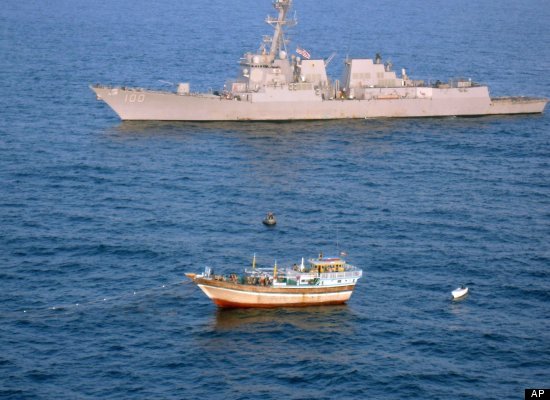
The fishermen were rescued by a U.S. Navy destroyer Thursday, more than 40 days after their boat was commandeered by suspected Somali pirates in the northern Arabian Sea. The rescue came just days after Tehran warned the U.S. to keep its warships out of the Persian Gulf – an irony not lost on U.S. officials who trumpeted the news on Friday.
“We think it’s very doubtful that the Iranians or the pirates were aware of recent events of the last couple days,” Rear Adm. Craig S. Faller, commander of the U.S. Navy Carrier Strike Group involved in the rescue, told reporters by phone Friday. “Once we released them (the fishermen) today they went on their way very happily, I might add, waving to us wearing USS Kidd Navy ball caps.”
Faller, speaking from the aircraft carrier USS John C. Stennis in the Arabian Sea, said the fishermen, who had been living off the fish they could catch, expressed their thanks and are believed to be headed back to their homeport in Iran.
The rescue was carried out by American forces flying off the guided-missile destroyer USS Kidd, after crew on the Iranian fishing vessel, the Al Molai, made it clear they were in trouble.
The USS Kidd, part of the Stennis carrier group, was sailing in the Arabian Sea, after leaving the Persian Gulf, when it came to the sailors’ aid. It was alerted to the hostage situation when the captain of the fishing boat spoke by radio to the Americans in Urdu – a Pakistani dialect that he hoped the pirates near him would not understand – and managed to convey that he needed help.
A U.S. Navy team helicoptered to the ship, boarded it without any resistance, and detained 15 suspected Somali pirates. They had been holding the 13-member Iranian crew hostage and were using the boat as a “mother ship” for pirating operations in the Persian Gulf.
“They were scared,” U.S. Navy Cmdr. Jennifer L. Ellinger, commander of the USS Kidd, said of the Iranians. “They pleaded with us to come over and board their vessel, invited us to come over. And we reassured them that we would be on our way.”
Amid escalating tensions with Tehran, the Obama administration reveled in delivering the news.
“This is an incredible story. This is a great story,” State Department spokeswoman Victoria Nuland said, explaining that the very same American ships the Islamic republic protested for recently traveling through the Strait of Hormuz were responsible for the Iranian vessel’s recovery.
“They were obviously very grateful to be rescued from these pirates,” Nuland said.
The episode occurred after a week of hostile rhetoric from Iranian leaders, including a statement by Iran’s Army chief that American vessels are no longer welcome in the Gulf. Iran also warned it could block the Strait of Hormuz, the strategic waterway that carries to market much of the oil pumped in the Middle East.
The Iranian threats, which were brushed aside by the Obama administration, were in response to strong economic sanctions against Iran over its disputed nuclear enrichment program. Last week, President Barack Obama signed into law new sanctions targeting Iran’s Central Bank and its ability to sell petroleum abroad.
According to Faller and Ellinger, the incident began Thursday morning when the Navy got a distress call from a Bahamian-flagged ship, and saw six individuals in a small boat next to it, throwing what appeared to be weapons into the water. They checked but found no evidence of piracy, so they released the small boat, but followed it by helicopter.
The small boat headed back to the Iranian-flagged ship, where U.S. Navy officials said it looked like there were both Middle Eastern and Somali on board.
The radio conversation with the Iranian captain made it clear his crew was under duress, so the USS Kidd launched a Navy search and seizure team. The suspected pirates hid on the ship, but the Iranian crew told the team where they were, Ellinger said, adding that the pirates surrendered quickly.
“The Al Molai had been taken over by pirates for roughly the last 40-45 days,” said Josh Schminsky, a Navy Criminal Investigative Service agent aboard the Kidd. “They were held hostage, with limited rations, and we believe were forced against their will to assist the pirates with other piracy operations.”
Schminsky said the Iranian boat’s captain thanked the U.S. for assistance. “He was afraid that without our help, they could have been there for months,” Schminsky said in a prepared release.
The U.S. team gave the crew food, water and medical care, and on Friday morning they moved the captured pirates to the Stennis. They will remain there while the U.S. considers options for prosecution and consults with other nations that have joined forces against piracy.
“Sadly, this is not a new thing,” Nuland told reporters, citing more than 1,000 pirates picked up at sea who are under prosecution in some 20 countries. “So this is always a question of where to send them and who will do the prosecution.”
Asked if the rescue mission could provide a chance for a thaw in relations with Iran, Nuland declined to comment. She said the Navy had made a “humanitarian gesture” to take the Iranians onboard, feed them and ensure they were in good health before setting them off. She said the U.S. and Iranian governments have had no direct contact over the incident.
Defense Secretary Leon Panetta called Faller on Friday to congratulate him on the rescue, adding that, “When we get a distress signal, we’re going to respond. That’s the nature of what our country is all about.”
Recent Comments
intlxpatr on Shampoo Ginger tigerbutterya0c5ff1d… on Shampoo Ginger intlxpatr on British Soldier Kidnapped, Esc… John on British Soldier Kidnapped, Esc… intlxpatr on British Soldier Kidnapped, Esc… Wikipedia Donate Button

Amazina


Early Voting in Florida


