Flash Mob Robberies
Found this today on AOL News:
http://o.aolcdn.com/videoplayer/AOL_PlayerLoader.swf
There is nothing scarier to me than what happens to morality in a mob. Look at their faces. They are robbing the stores, and they feel gleeful, and evidently they have no fear of being held accountable for their robberies.
I Need Your Trust . . .
Here is my scam letter for today, and here is part of what makes me so sad and so mad about these letters. IF they were true, which they are not, someone thinks I am the kind of person who would be a part of stealing a substantial sum of money. There may well be other relatives, or others who need that money – IF it were true, which it is NOT.
I NEED YOUR HELP WITH TRUST,
FROM: MR REDA ABDALLAH,
Please read carefully,
This message might meet you in utmost surprise. However, it’s just my urgent need for foreign partner that made me to contact you for this transaction. I got your contact from yahoo tourist search while I was searching for a foreign partner. I assured of your capability and reliability to champion this business opportunity when I prayed about you.
I am (MR Reda Abdullah) a banker by profession from Burkina Faso in west Africa and currently holding the post of Audits and Account manager at the foreign remittance department, i have the opportunity of transferring the left over sum of ($9.2 Million Dollars) that belongs to late Mr Rudi Harmanto from Indonesia who died along with his entire family in the Asia Earth Quake (TSUNAMI,DISASTER IN INDONESIA / INDIA. 2004, and since then the fund has been in a suspense account.
After my further investigation, i discovered that Mr Rudi Harmanto died with his next of kin and according to the laws and constitution guiding this banking institution, stated that after the expiration of (7) Seven years, if no body or person comes for the claim as the next of kin, the fund will be channel into national treasury as unclaimed fund. Because of the static of this transaction i want you to stand as the next of kin so that our bank will accord you their recognition and have the fund transfer to your account.
I don’t want the fund to go into our bank treasury account as unclaimed fund. So, this is the main reason why i have contacted you, so that we will release the fund to you as the nearest person to the deceased customer ( next of kin).Please, I would like you to keep this proposal as a top secret or delete it if you are not interested.
Upon receipt of your reply, I will send to you the full details on how the business will be executed, and an official copy of the ‘Application Form Of Claim’ of which you will fill, and send to the bank for the release of the fund into your receiving bank account. Also, note that you will have 40% of the above mentioned sum, if you agree to transact the business with me, and while 60% will be for me.
I won’t fail to bring to your notice that the risk to be taken is 100% free in this transaction, and that you should not entertain any atom of fear as all required arrangements have been made for the transfer of the fund into your bank account. Please, don’t ever forget to reply me this email urgently with your contact information’s like:-
(1)Name:……………………………………………
(2)Age:…………………………………………….
(3)Marital Status:…………………………………..
(4)Telephone Or Cell Phone Numbers:……………………
(5)Your Country:…………………………………….
(6)Your Occupation:…………………………………
I will like to receive the above following information’s from you as you reply this email to me for more trust, and better understanding of who you are. Looking forward to receive your reply urgently.
Thanks from,
Mr. Reda Abdallah
Adaobi Tricia Nwaubani: I Do Not Come to You by Chance
This book, the first novel from Adaobi Tricia Nwaubani, is hilarious, with moments of pathos, and a fresh point of view.
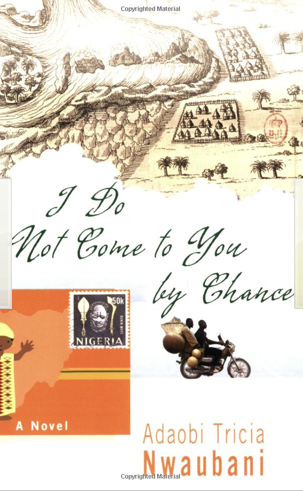
Amazon.com recommended it to me as I was busy buying books by author Chimamanda Ngozi Adichie; I thought ‘OK, I’ll read a series of Nigerian books as part of my summer reading.
Young Kingsley Ibe is the family’s first born male, and with that status goes many privileges – and responsibilities. After graduating with a Masters in Chemical Engineering, he has no success in his search for a job with an oil company in Nigeria, and consequently loses the love of his life, Ola, to another who has secure employment.
Worse, his retired father has a stroke, and the family discovers that with all the fees required, they haven’t enough for his continued care, so Kingsley must approach his uncle, Boniface Mbamalu, more familiarly known as Cash Daddy, for funds to transfer his father to a long term care facility, and, later, for his father’s funeral.
Serious Kingsley’s eyes nearly pop as he sees the life his uncle is living, cars, women, designer watches, shoes, suits and all the trappings of new wealth. Soon, his uncle makes a convincing case for Kingsley coming to work for him, the better to help out his family of mother, brothers and sister, now that he is the senior male in the family.
Kingsley discovers he has a gift for the work – which is writing 419s, those scam letters which I frequently publish in this column. I loved being on the inside, learning how strong possibility e-mail addresses are netted, how response e-mails are massaged – not unlike fund raising techniques by charitable organizations in the US. Kingsley’s education helps him achieve enormous financial success in a very short time – but he finds that all the cash and designer goods in the word do not solve his problems nor make him happy.
I learned a lot about how successful many of these scammers are, and how the money made is spread throughout the Nigerian communities. The author takes a balanced view, balancing the way the cash makes life easier for people – a lot of people, because the rich man has many obligations to his community, balanced against the disgust, and sick fear felt by his religious mother and aunt, and his one time girlfriend, when they learn the work he is doing. They are disappointed that a man of such promise has sunk to making so much money in a dishonest way. The book also does not deal sympathetically with those who have given or lost money to the scammers, nor, in my opinion, does the ending satisfy.
This is one of the funniest parts of the book – a group of Nigerian scammers is about to meet with a representative of a major US investment firm. He thinks he will be meeting with the Nigerian Minister of Transportation to discuss building a new airport; the reality is that Cash Daddy, in disguise, will be pretending to be the minister. Kingsley protests that Cash Daddy looks nothing like the minister, and Cash Daddy responds:
“Let me tell you something . . . Me, I really like these oyibo people. They’re very very nice people. See how they came and showed us that the ground where we’ve been dancing Atilogwu has crude oil under it. If not for them, we might never have found out. But Kings,” he dragged in his dangling foot and sat up in the tub, “white man doesn’t understand black man’s face. Do you know tht I can give you my passport to travel with . . . Even if your nose is ten times bigger than my own, they won’t even notice?”
It was a fascinating book. I understand better now why 419 scams work. (419 is the section of the Nigerian criminal code making scam e-mails a crime; thus the crime is called ‘a 419’) There are some very funny and very insightful moments in the book. It is no where near the level of literature that you experience with Chimamanda Ngozi Adichie, but there is more humor, and the book shows a more modern day Nigeria. Not a bad summer read, but not great literature.
Elderly Women Prime Targets for Cons
Found this fascinating article this morning on AOL News/finance There was a time when I worked with transitional homeless people, helping them to find ways to re-enter the mainstream. A percentage of them didn’t want to enter the mainstream, they didn’t like rules, and they were looking for an easier way. One of the paths was by being part of the elder-worker force. I would watch them take a job and then work their way into a position of dominance in an elderly person’s life. Partly, the elderly were lonely, and thrived on the new attention, and interpreted it as caring.
Then would come the sob stories. School starting and not enough money to buy shoes and books for the children. A broken-down car, and funds needed to get it fixed so she can get to her job. Once it starts, it never ends.
The key to prevention is staying engaged with friends, neighbors and family who are paying attention, and can give perspective to this new relationship. The one question I asked is “if there were not money involved, would this relationship exist?”
Elder Abuse: How to Protect Grandma From Con Men and Thieves
By Sheryl Nance-Nash Posted 9:00AM 06/03/11 Retirement, People, MetLife
See full article from DailyFinance: http://srph.it/lXHooJ
Who would pick the pocket of your grandma or grandpa? Apparently, any number of people. Older Americans are losing $2.9 billion annually to elder financial abuse, a 12% increase from the $2.6 billion estimated in 2008, according to The MetLife Study of Elder Financial Abuse: Crimes of Occasion, Desperation, and Predation Against America’s Elders, released Wednesday.
According to the study, 51% of these abusers are strangers, but 34% of the perpetrators were family, friends and neighbors. As for “trusted advisers,” exploitation from the business sector accounted for 12% of reported cases. Medicare and Medicaid fraud accounts for 4% of reported cases. As a subset, the percentage of robberies and crimes classified as “scams perpetrated by strangers” increased from 9% to 28% from 2008 to 2010.
Who’s on the top of the target list? Women. The study, produced by the MetLife (MET) Mature Market Institute in collaboration with the National Committee for the Prevention of Elder Abuse and the Center for Gerontology at Virginia Polytechnic Institute, shows women were nearly twice as likely to be victims of elder financial abuse as men.
Also prime for the picking were people between the ages of 80 and 89 who lived alone and required some help with either health care or home maintenance. Primarily, men were the menace: Nearly 60% of perpetrators were males, mostly between ages 30 and 59.
Predators lie in wait, watching: In the most common scenarios, strangers targeted victims who were out shopping, driving or managing the financial affairs, and often looked for particular flags of vulnerability like handicapped tags on cars, canes or displays of confusion. Crimes included cons, purse snatchings and associated physical assaults.
But that even those closest to an elderly person can give in to temptation or desperation. In cases involving a person known to the victim, trusted helpers like caretakers, handymen, friends, “sweethearts,” children, lawyers and others seized upon opportunities to forge checks, steal credit cards, pilfer bank accounts, transfer assets and generally decimate elders’ finances, the study revealed. The holidays apparently bring out the worst in people: At that time of year, overall dollar losses due to family and friends were higher than any other category.
Married to the Con Job
People can get quite creative with abuse. One unusual method — caregivers secretly marrying their elderly charges, says Susan Slater-Jansen, an attorney at Kurzman Eisenberg Corbin & Lever.
There have been numerous lawsuits over cases in which a caregiver married a mentally incapacitated older patient and the patient’s family didn’t learn about it until after the patient had died. Once a person is dead, it’s too late — in all but three states, you can’t void a marriage if one spouse has died, says Slater-Jansen. To help lower the odds of such a thing happening to your parent, adult children should make sure they receive duplicate monthly statements from all bank and brokerage accounts; install nanny cams; carefully and thoroughly check references for all caregivers; visit parents often, both while the caregiver is there and when they are not; and discuss with your parents the treatment they are receiving from caregivers.
If you discover such a fraudulent marriage has taken place, act quickly to get it annulled.
After the parent dies, heirs can sue to recover money from the “spouse.” More and more, courts have found ways to deny spouses if the marriage was fraudulent, says Slater-Jansen.
“The most flagrant abuse is perpetrated on the elder by the hired caregiver, neighbor, or ‘new’ friend,” warns Karen Maarse Fitzgerald, a principal in her own elder law practice. “A simple power of attorney signed by the elder can give to the “agent” broad and sweeping powers over the elder’s life savings. I have seen bank accounts drained within days, the money and perpetrator vanishing to another country.”
Protection Yourself and Your Relatives
The worst forms of elder abuse go beyond money: There can be physical abuse and sexual violence as well. “The vigilance of friends and family can help protect elders from those who are predatory, which may, unfortunately, include strangers or even other loved ones,” said Sandra Timmermann, Ed.D., director of the MetLife Mature Market Institute, in a prepared statement.
What can the elderly do to protect themselves? Among the guidance offered by the report’s authors:
“Stay active and engage with others; socialize with your family members and friends. Avoid isolation, as it can lead to loneliness, depression, and make you more vulnerable to financial abuse or exploitation.”
“Use direct deposit for Social Security and other payments to prevent mail theft. Sign your own checks whenever possible.”
“Stay organized and keep important papers and legal documents in a safe, secure location.”
“Review your legal documents (i.e., wills, trusts, and power of attorney), as well as other important documents (i.e., insurance policies) at least annually, to make certain they continue to represent your wishes.”
Ted Sarenski, who chairs the American Institute of Certified Public Accountants’ Elder Planning Task Force, would add to that list. His tips:
Subscribe to national and state Do Not Call lists;
Keep Social Security cards in a safe place;
Remove mail promptly from the mailbox;
Shred all confidential and financial information prior to discarding.
“Consider allowing the bank to send a duplicate copy of your bank statement to a trusted family member,” advises attorney Andrew Stoltmann, who has a large client base of seniors. “Usually, most financial elder exploitation cases are only reported or discovered six to 12 months after the initial losses have occurred.”
Elders whose sight is failing are at even greater risk because they may rely upon the very person who is stealing from them to ensure that their financial transactions are in order, says Stoltmann. “An independent pair of eyes that is able to review bank statements every 30 days will be able to catch suspicious activities in the early stages and cut it off. This is crucial.”
Advance Planning Can Help Dodge Dangers
When you are the responsible caregiver, know too, that your prudence can go a long way in preventing financial abuse.
Have some tough conversations. You need to know whether there is a will or a durable power of attorney, and where such documents are. Does your parent have a living will? If so, does it give you clarity about what your loved one’s wishes are? A health care power of attorney would permit a trusted individual make medical decisions if your elderly relative was unable to.
It’s important not to wait until the eleventh hour to have these talks. Ideally, those documents should be drawn up when your relative is of sound mind and body. It’s not a bad idea either, to have a trusted adviser, not only know where the documents are kept, but be able to get to them if needed.
Beware of the appearance on the scene of the “trusted new friend.” If mom and dad have a neighbor, caregiver or other outsider who is suddenly their best pal, running errands, going to the bank, and generally being around all the time when they never were before, it can be a warning sign that someone is taking advantage, warns Sarenski.
“Elder financial abuse invariably results in losses of human rights and dignity,” said Karen A. Roberto, Ph.D., director of the Center for Gerontology, at Virginia Polytechnic Institute. ” Despite growing public awareness from a parade of high-profile financial abuse victims, it remains under reported, under-recognized, and under-prosecuted. The 2010 Passage of the Elder Justice Act may bring more attention and resources to this crime leading to prevention among the expanding older population.”
The bottom line, says Maarse Fitzgerald: “Protect elders from isolation, which allows the perpetrators to take control of our elder’s lives.”
See full article from DailyFinance: http://srph.it/lXHooJ
Disable Your GPS Settings for Camera on Your Smart Phone
Thanks to my very savvy Kuwait friend for forwarding this timely reminder to be careful about what you post. What stalkers can learn from a photo on a social-networking site is frightening.
“Love Your Enemies and Pray for those who Persecute You”
Today’s reading in The Lectionary is the heart of the Christian faith. Jesus told us many things that turned the world upside down. If we as Christians, truly practiced the teachings of the Christ, what a different world this would be:
Matthew 5:38-48
38 ‘You have heard that it was said, “An eye for an eye and a tooth for a tooth.”
39 But I say to you, Do not resist an evildoer. But if anyone strikes you on the right cheek, turn the other also;
40 and if anyone wants to sue you and take your coat, give your cloak as well;
41 and if anyone forces you to go one mile, go also the second mile.
42 Give to everyone who begs from you, and do not refuse anyone who wants to borrow from you.
43 ‘You have heard that it was said, “You shall love your neighbour and hate your enemy.”
44 But I say to you, Love your enemies and pray for those who persecute you,
45 so that you may be children of your Father in heaven; for he makes his sun rise on the evil and on the good, and sends rain on the righteous and on the unrighteous.
46 For if you love those who love you, what reward do you have? Do not even the tax-collectors do the same?
47 And if you greet only your brothers and sisters,* what more are you doing than others? Do not even the Gentiles do the same?
48 Be perfect, therefore, as your heavenly Father is perfect.
If YOU were to pray for your enemies, who would you pray for?
I tried it one time, almost as a challenge to God, I didn’t believe it would change anything but I would do it because it was required – and it turned out well – for God. When you pray for your enemy, you open a door for change to happen, unexpected change, miraculous change, transformational change.
As a young woman, I studied power and it’s application, reading books from many cultures on strategies of winning. This gospel summarizes a totally unexpected and wildly successful use of the spiritual power in each one of us, the God-given power to turn evil to good, to bring friendship out of enmity.
So today I challenge you. Is there someone in your life whose very presence makes you miserable? Pray for that person. As often as that person comes to mind, send up a prayer. I challenge you to see what happens in your life.
What’s Really Hood: A Collection of Tales from the Streets by Wahida Clark, et al
Sometimes do you pick up a book and you don’t really know why you did? I saw this book in Target, and picked it up on an impulse. I read the cover and thought “you know, this is way out of my culture and out of my comfort zone” but then I thought hey – it’s a sub-culture in my own country, and like isn’t it hypocritical to be so interested in other cultures and then to ignore this sub-culture in my own country? Plus, I had a friend called Wahida, . . . well, it doesn’t have to make sense. It’s just the way it was.

I read the whole book. Some of what I read was frankly repellant. Some of the sex was so implausible that I can’t tell if my ideas are just way out of step with the changing times (and there are clues that this may be the problem) or that this sub-culture just has constant, earth-shaking sex.
The book contains five very different stories, but there are threads of similarity that appear in all five. Drugs are rampant, and destructive to individuals, couples, families, children, friendships, marriages, and the social context. Parenting skills are often fragile or non-existent. The male-female relationships are mostly exploitive.
And they all dream of a better life.
I think that’s what kept me reading. The stories are raw. You might not even like them at all, you might wish you had never heard of this book, but there is an honesty in the rawness, and a yearning to escape. The goal of all the easy money in the drug trade is mostly to GET OUT, to run away to some place safe, to live in a place where gunshots aren’t heard, and where kids can safely go to school.
I learned a lot from reading this book, but it was not an easy read. It is gritty, and characters you find yourself liking get killed off. It’s also stuck with me; I find myself thinking about things it brought to my attention. I’d love for you to read it too, and tell me what you think.
“So I Shot HIm . . . “
In Pensacola, people talk all the time about “carrying.” People have lots of weapons; even my tiniest little friend has a small revolver in her handbag when she goes out.
This old guy makes life a lot easier for the rest of us. Sometimes young guys get bad ideas, and these guys evidently thought they would hit and rob the old people. Guess they got quite a surprise. Guess they will think twice before doing another home invasion – once they get out of prison, which will probably be quite a while from now.
Resident shoots 2 teens in home invasion
Resident, 72, fends off 3 attackers; 1 suspect in hospital, 2 in jail
Two teenagers were shot Saturday night by a 72-year-old man they allegedly beat with a baseball bat during a home-invasion robbery in Ferry Pass.
About 8:45 p.m., three teenage males knocked on the door of a home in the 3300 block of Raines Street, Pensacola Police Department officials said.
When resident Jack Crawford, 72, answered the door, one of the teens hit him in the head with an aluminum bat and tried to force his way into the home.

“I opened it up, and he hit me right off. … Wham! Split my head open,” Crawford said.
“So I shot him and another guy,” Crawford said, chuckling as he told the story to a News Journal reporter Sunday evening. “I could have shot the third one, but I would have had to shoot him in the back as he ran away.”
The attackers fled the scene on foot, and Crawford’s 70-year-old sister, who also lives at the home, called the police, he said.
Earl Benard, 15, Nathaniel Nichols, 17, and Curtis Crenshaw, 18, all of Pensacola, have been charged with home-invasion robbery and aggravated battery in connection with the case, police said.
Crenshaw and Nichols were arrested at a local hospital after being dropped off for treatment with gunshot wounds to their torsos. Benard later was arrested at a nearby rental home.
Nichols remained hospitalized Sunday afternoon, police said. Crenshaw was treated and released and was being held Sunday evening at Escambia County Jail on $300,000 bond.
State Attorney Bill Eddins said he plans to try all three suspects as adults.
Crawford said he grabbed his handgun as a precaution and was holding it at his side when he opened the door Saturday night.
“At 9 o’clock at night, I never take any chances,” Crawford said.
The three teens had “hoods on and scarves around their faces,” Crawford said, and they hit him with the bat before anyone had a chance to speak.
Crawford stumbled back a step from the blow but didn’t fall, and he started shooting as the first attacker was coming through the door, he said.
“I didn’t go down, and I think it shocked him,” Crawford said.
Following the attack, Crawford was transported by ambulance to West Florida Hospital for treatment of injuries to his head. He said doctors stapled his scalp back together, and he was back at home and feeling fine Sunday evening.
“Yeah I’m fine. I’ve got a hard head,” Crawford said.
Police did not release any information Sunday about possible connections between Crawford and the teens. Crawford said he’s lived in the neighborhood about 12 years, and he suspects the attackers were acquaintances with a neighborhood boy who used to do odd jobs around his home.
Crawford said he wasn’t too rattled by the attack, and he still felt comfortable staying in the home.
He said he’s had a rough-and-tumble past that’s left him with a cool head in similar situations.
“I’m not that big of a boy, but I had a reputation,” Crawford said.
I live next door to a cop. His car isn’t marked, but it is a big dark Crown Vic with that cage thing that separates the front from the back seats. Not that criminals are very smart, but you would have to be REALLY stupid to invade my house.
This story is from today’s Pensacola News Journal.
The Glass Rainbow by James Lee Burke
“Here’s the book,” Sparkle said, sliding into the restaurant seat as we all poured over the menu, wafts of garlic, white wine and butter drifting our way. “I’m getting kind of tired of Dave and Clete.”
“What, you mean not just bending the envelope but tearing right through it?” I asked “Or all the gratuitous violence?”
“Mostly the scorn for official procedures,” she started, two little lines between her eyes as she took in all the delicious possibilities, “How about some of that Montepulciano?”
She passed the book along to me. I was in the middle of another book, but oh, the temptation to drop it and get on with a new James Lee Burke.

The book opens with Dave Robicheaux, our recovering alcoholic detective, meeting up with a convict on a work crew whose sister has disappeared and who was found murdered. Bernadette Latiolais’s remains are thought to be the work of a serial killer working the area who targets prostitutes, but Bernadette was an honor student, graduating with a full scholarship promised to a Louisiana university. She was also an heiress, in a small way, to some property at the edge of a swamp. She doesn’t fit the profile, and her brother wants justice – not for himself, he’s doing his time, but for his sister, who never did anything to anyone, and who wanted to create a conservation area to preserve bears.
Right off the top, Robicheaux is outside of his parish, investigating a case nobody cares about in an area out of his jurisdiction.
OK, OK, my sister is right, this is pretty much another formulaic James Lee Burke. There are the corrupt rich families, the amoral women, the voiceless victims. Instead of the old Italian organized crime families, this time there are hired mercenaries, equally creative in killing, but way more efficient in cleaning up afterwards.
I’m just a sucker for James Lee Burke’s writing. Here’s one sample, from his interview with a very rich old man who goes a long way back with Robicheaux’s family:
“Don’t get old, Mr. Robicheaux. Age is an insatiable thief. It steals the pleasures of your youth, then locks you inside your own body with your desires still glowing. Worse, it makes you dependent upon people who are half a century younger than you. Dont’ let anyone tell you that it brings you peace, either, because that’s the biggest lie of all.”
Burke’s Dave Robicheaux and his private-investigator friend Clete are flawed men, prone to violence, but I cut them a lot of slack because in each novel they are bright shining avengers of all the wrongs done to the weak and helpless. They are Quixotic. They fight the rich and powerful for the rights of the common man. They know the risks they take, and they are too old to think they are going to survive every bad guy they go after. It’s a good thing the law of averages doesn’t hold true in novels; they should have been dead a long time ago.
What keeps me coming back are the lyrical descriptions of life along the Atchafalaya Bayou, community life in New Iberia, Louisiana, and Robicheaux’s family life, wife Molly, daughter Alifair (now grown to young womanhood) and Snuggs their cat and Tripod their raccoon, as well as the knowledge that at the end of the book, in spite of every evidence to the contrary, Dave and Clete will emerge alive, if damaged, and their indirect and violent path will have achieved some semblance of justice.

(I ordered the spaghetti with a white-wine mussel sauce, and Sparkle ordered the chicken marsala. Mom had seafood diablo.)
Room by Emma Donoghue
Hardly ever do I order a book in hardcover; they weigh too much, I do a lot of reading when flying, I prefer paperbacks so I can pass them on when I am finished (and no, I do not yet have a Kindle, because I like to pass my books along.) I made an exception for Room when I heard a review on National Public Radio. It sounded so different, and I wondered how it could be written without it being so horrible I couldn’t read it.

The story is told from the point of view of a five year old boy who lives in Room, an 11 x 11 foot space. He was born there, he has never been out of there.
As you read, you gain such huge admiration for the human spirit. Jake’s mother was abducted off the streets and kept in this room, which is totally soundproofed, surrounded by a chain metal cage, and can be entered and exited only by a door with a code entry lock. She raises Jake as best she can, keeping him hidden from her abductor. She teaches him reading and math, she tries to raise him eating nutritious foods, they have hygiene rules and daily physical education. Every now and then, she has a day when she is “gone”, when Jake wakes up and his mother won’t ‘switch on’ and just stays in her bed, sleeping all day. On those days, he feeds himself and plays quietly, knowing that his Mom will be back ‘on’ the next day – or so. He doesn’t understand his Mother’s despair, and she shelters him from it as best she can.
And then comes the time when she realizes that life is only going to get more and more difficult as Jake gets older. She makes a plan, a plan that relies on Jake, a desperate plan.
The book is fascinating. I have already passed it along; once I read it, I wanted to share it. In many ways, it is a cross-cultural book, because the culture Jake spends his first five years in is so insular, so enclosed. Emma Donoghue did a great job describing his world from his point of view, and dealing with the aftermath. I can’t tell you much more without spoiling the book for you in a major way. 🙂
There is a Reader’s Guide section at the back, and this book would be an excellent selection for a book club.
Recent Comments
intlxpatr on Yellowstone: Old Faithful to C… Michelle on Yellowstone: Old Faithful to C… Cathy on No Grown-Ups in Charge intlxpatr on Waiting for Snow intlxpatr on Waiting for Snow Wikipedia Donate Button

Amazina


Early Voting in Florida


 Here There and Everywhere