Charity?
Today I found this in my spam. Again, folks, this is satire, not a recommendation that you “support me and send more and more money.” It is so straightforward and so manipulative and so fraudulent that it gave me a good laugh:
I WANT FINANCIAL HELP FROM ALL WORLD
DEAR SIR/MADAM,
I’M A INDIAN POOR AND LONG DISEASE MAN MY FINANCIAL CONDITION IS VERY POOR
MY LIFE DEPEND ON THE CREDIT SYSTEM BUT AT PRESENT ANY PERSON DON’T PAY ANY
MONEY SO I’M VERY STRESS AND SAD I’M ALONE IN THE WORLD. ANY BODY DOES’T HELP ME.
I WANT HELP FROM MONEY/DONATE MONEY. SO I APPEAL TO ALL WORLD PLEASE YOU HELP ME FROM
MONEY /DONATE MONEY YOU SEND ME CHEQUE/DEMAND DRAFT/MONEY TRANSFFER AT MY A/C NO.
9648 AT UNION BANK OF INDIA.
I’M GLAD TO YOURS ALL LIFE. YOU SUPPORT ME AND SEND MORE & MORE MONEY AT MY
A/C. NO. 9648. MY A/C BAL. IS $5 ONLY.
MY BANK ADD:
UNION BANK OF INDIA(SAVING A/C NO.9648)
PURANI MANDI, RAIWALA
DISTT: SAHARANPUR
STATE : U.P. PIN CODE- 247001
COUNTRY: INDIA
PH NO. 0091-132-9758559422
WWW.UNIONBANKOFINDIA.COM
THANKING YOU
Yours truly,
AYAZUDDIN
“Could be Very Fatal”
Last year, six officials resigned from Kuwait Air when an assistant pilot without proper credentials was promoted to pilot in spite of having failed the qualifying test. I wrote about it HERE.
This is from yesterday’s (1 october 2007) Kuwait Times. No, it was not in the crime section.
Assistant Pilot Promoted Without Proper Qualifications
KUWAIT: An assistant pilot at Kuwait Airways was recently promoted to become a captain pilot despite the fact that he had failed the tests qualifying him for the promotion for the maximum times allowed. Informed sources stressed that such a mistake of having incompetent and inexperienced pilots fly civilian flights could be very fatal.
The sources noted that his promotion could cost lives of at least the 300 passengers all because of this man has an influential wasta (backer). The sources explained that this particular promotion had been tried upon several times and that it only got through during the transitory period after the resignation of the previous board of directors and before appointing the new board.
“This inexperienced pilot has already started flying to various destinations,” warned the sources expressing astonishment of the approval of the Civil Aviation Authority of such a promotion, particularly since it was the highest control over following safety precautions by various carriers.
———————————————————————-
Last night, over dinner, Adventure Man looked at me sadly. We were discussing my blog, and I had asked him if he had any concerns. He said his only concern was for my safety. I asked him if he saw anything that made him uncomfortable. He said that he worries about my quoting newspaper articles, he has a concern in could get me in trouble.
I have promised I would not comment directly on the articles.
I am willing to bet that there is a possibility that there are unqualified pilots flying for other national airlines, in countries with less of a free press than Kuwait has. The difference in Kuwait is that the newspaper can report this and maybe the person writing it will not be fired for holding the airlines ACCOUNTABLE for providing safe flights for their customers.
We Share the Road
Look closely. Look at the third set of wheels back, second set from the right. I know, I know, it is very difficult to see the tread. That’s because there is NO tread left on this tire.

Other tires on this truck were already shredding. Look, the one just in front of the bare-tread tire had some kind of exterior coating kind of thing on it, like a whole tire patch of some kind, also shredding. He is carrying a heavy load load. This is a disaster waiting to happen.
To my left is a police car.
I can’t remember? Is Kuwait the #1 most dangerous country for driving in the world, or the #2?
Ayb! Ayb!* Parking Hall of Shame
I am not outraged just because I passed up these two spots, both empty, once I saw the sign, which you will notice is in Arabic, English and just in case you can’t read, also in sign language. NO PARKING!
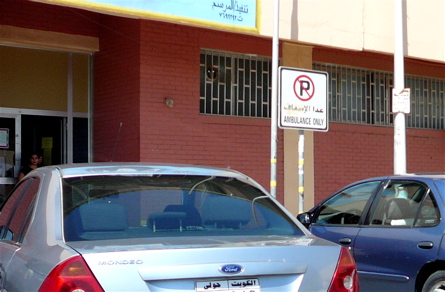
I am not outraged just because only about 20 feet from these two spots are also parking spots, it just means walking a few more feet in the hot sun, no, not rock star parking, but not like walking a couple hundred meters, either.
I am outraged because these were WOMEN. WOMEN! We know better! We have aging mothers and children, we sometimes NEED special treatment, but these women who parked here were both ample and able. Actually, in the first photo, I was so angry, I had the women as they got out of their cars, but I took a deep breath, and decided that would NOT be a good idea in case I ever want to go here again. They might beat me up! They might arrest me for insulting them!
But I am insulted. This is Ramadan, people are fasting, and it is hot hot hot, even though it is cooling down a little. Women faint, men get electrolyte imbalances, and people need ambulances. THIS is AMBULANCE PARKING.
There is something in each of us that believes in variations of Locard’s Exchange Principal where anytime two people come into contact they exchange some physical matter, no matter how small. On some level, when we say “what goes around comes around” we are applying the same physical properties to the spiritual world, and why not? Are we not taught that we are to treat our neighbors as we would want to be treated?
So my fear for these women who would park in an ambulance spot is that one day they would need an ambulance, and find that the ambulance cannot park because someone is parked in the ambulance spot. I wouldn’t wish that on anyone.
*Shame! Shame!
OJ Simpson Charged Again
And speaking of idiots, if you’ve committed a double murder and gotten away with it, why would you be so arrogant as to keep having run-ins with the cops? No matter how good the lawyers are that you hire, one day your luck runs out. With all my heart, I am hoping that this is the day for OJ Simpson.
God willing, your criminal arrogance will trip you.
The following is from CNN News, where you can read the entire story.
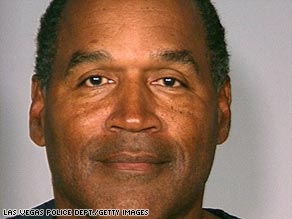
LAS VEGAS, Nevada (CNN) — Prosecutors on Tuesday filed numerous criminal charges against former NFL star O.J. Simpson and three other men in connection with an alleged armed robbery at a Las Vegas hotel last week.
The 11 charges include two counts of first-degree kidnapping with use of a deadly weapon; two counts of robbery with a deadly weapon; and two counts of assault with a deadly weapon.
Prosecutors say Simpson and his co-defendants — Walter Alexander, Clarence Stewart and Michael McClinton — committed kidnapping because they intended to hold or detain the two alleged victims using a weapon.
Not Too Bright
In yesterday’s Kuwait Times was a very dramatic telling of a drug bust. Police had sighted someone suspicious in a car, upon approaching, the suspect ran, the police chased. Now, it becomes very cinematic, as the police chase, the man runs up into a building and jumps off a second floor balcony, and the policeman follows him, injuring himself. Another policeman picks up the chase and eventually the suspect is captured, only to slip right through the fingers of the police.
Pretty exciting so far, huh?
In today’s Kuwait Times, the saga continues:
Escaped Drug Dealer Chats into Custody
Following up yesterday’s on foot chase of a drug dealer in Salwa where Lt. Hamad Al-Zuwayyed was injured when he jumped off a second floor balcony to catch up with the suspect, Al-Zuwayyed never thought that the second accomplice who managed to escape arrest would be his hospital roommate. Security sources explained that while receiving treatment at Adan hospital, another patient arrived and was placed in the bed next to Al-Zuwayyed’s. Then, on chatting at night to kill time, the man told Al-Zuwayyed that he was hit by a car while being chased by a policeman in Salwa. Al-Zuwwayed immediately called the police who raided the hospital and arrested the suspect.
Don’tcha just love it???
K-Ville premiers tonight
Notice today from Amazon:
we thought you’d like to know that K-Ville, the new crime action series starring Anthony Anderson and Cole Hauser, premieres Tonight at 9/8c on FOX.
From writer and executive producer Jonathan Lisco (NYPD Blue, The District) comes K-Ville, a new police drama set and filmed in New Orleans. Marlin Boulet (Anthony Anderson) is a brash veteran of the NOPD’s Felony Action Squad, the specialized unit that targets the most-wanted criminals. He also held his post during Hurricane Katrina, spending days in the water saving lives and keeping order, even after his partner deserted him. Boulet’s new partner, Trevor Cobb (Cole Hauser), was a soldier in Afghanistan before joining the NOPD. Though committed to his new job, he’s less than comfortable with Boulet’s methods – and is harboring a dark secret.
Here is the official website:
I don’t know how to get these things and it just isn’t that important to me, but you tech-savvy people might have some fun with this. And it IS New Orleans! The music is worth a visit, just to view “Anthony gives Cole some advice about gumbo.” 😉
Peter Bowen: Wolf, No Wolf
“You have to take this. You’ll really like it,” Sparkle insisted as I inwardly groaned, thinking of the TWO stacks of unread-must-reads by the side of my bed, and my already bulging suitcases.

“I know it doesn’t sound like something you’ll like,” she went on, slightly frustrated with me, with herself, “but once you start reading, you’ll get into it.”
Not exactly a ringing endorsement, but good enough for me. I always KNOW what I think she will love, and she has done me many a favor in return, introducing me to authors and series worth reading.
“It’s about Montana. The main character is mixed Indian and French and some other things, a grandfather, and it all takes place in a small town in Montana . . . ” she sort of fizzles out. “I’m really not doing a very good job of making this interesting.”
And she sighs in frustration.
So, about a month later, just because I love my sister, I pick the book up and start reading while waiting for my husband to get home for dinner. As it turns out, he is very very late – and I am very very glad. I don’t want to stop reading!
When you first jump into Wolf, No Wolf by Peter Bowen, it takes you a minute to adjust your ear to the way they talk. These aren’t people most of us have met before. Gabriel DuPre´ is m´etis, a mixed blood. His ancestors are French who came early to the great continent that is now the US, Canada and Mexico, and they trapped and hunted, married native American wives, and developed a culture all their own. His language pattern is similar to that of the Cajun in Louisiana.
He is a cattle brand inspector in this small Montana town. His children are grown, he has so many grandchildren he can’t remember all their names. Every now and then, he pins on his deputy sherrif badge to solve a mystery in the small town of Toussaint, Montana.

Here is how Wolf, No Wolf opens:
Du Pre´ fiddled in the Toussaint Bar. The place was packed. some of Madelaine’s relatives had come down from Canada to visit. It was fall and the bird hunters had come, to shoot partridges and grouse on the High Plains.
The bird hungers were pretty OK. The big game hunters were pigs, mostly. The bird hunters were outdoors people; they loved it and knew it, or wanted to. The big game hungers wanted to shoot at something big, often someone’s cows.
Bart had bought a couple thousand dollars’ worth of liquor and several kegs of beer and there was a lot of food people had brought. Everything was free.
Kids ran in and out. The older ones could have beers. Bart was tending bar. Old Booger Tom sat on one of the high stools, cane leaned up against the front of the bar.
“You do that pretty good for someone the booze damn near killed,” said Booger Tom. “I know folks won’t be in the same room with the stuff.”
“Find Jesus,” said Bart. “It’s not too late to save your life.”
He went down to the far end of the bar and took orders. Susan Klein, who owned the saloon, was washing glasses at a great pace.
One of Madelaine’s relatives was playing the accordion, another an electric guitar. They were very good.
Du Pre´ finished. He was wet with sweat. The place was hot and damp and smoky, so smoky it was hard to see across the room. The room wasn’t all that big, either.
Madelaine got up from her seat, her pretty face flushed from drinking the sweet pink wine she loved. She threw her arms around Du Pre´ and kissed him for a long time.
“Du Pre´,” she said, “you make me ver’ happy, you play those good songs.”
. . …
Someday this fine woman marry me, thought Du Pre´, soon as the damn Catholic church, it tell her OK, your missing husband is dead now so you can quit sinning, fornicating with DuPre´.
I’ve never hung out in a bar in Montana, fiddled, or had a girlfriend named Madeleine (!), but already I feel like I know these people and this life. Peter Bowen is the Donna Leon of Montana, introducing us to the kind of crimes that happen in those sleepy looking towns we drive past on the superhighways, glancing at, or stopping to fill our gas tanks.
DuPre´ is a good man, and, like many a good man, sometimes has to do a bad thing to protect those he is sworn to protect. Policing is not pretty business.
The first story has to do with the re-introduction of wolves back into the Montana highlands, something not at all popular with those who have been raising cattle there. The second book in this two-book collection has to do with serial killers, how they stay under the radar, and how very difficult it is to catch them.
In both books, it is as much about a new way of living and thinking as it is about solving the crime. DuPre´ consults often with his friend Benetsee, the local medicine man, who sees things we don’t see. One of the FBI Agents is Harvey Wallace, also more than half native American, whose real name is Harvey Weasel Fat. The books are about how men and women fight, the nature of male friendships and female friendships, and very much about the human condition wherever we may be.
Life is short. I can never live in all these places long enough to even scratch the surface of the flavor of each variety of life. But these books help, they give us glimpses into another way of thinking, another way of doing things, and stretches our little minds just a little so that we learn to think more flexibly.
So who is going to write the Kuwait detective series? Who will take us into the diwaniyyas seeking information, who will take us out on the shoowi to gather information against those delivering drugs to Kuwait, with whom will we camp in the desert, avoiding explosives left over from the Iraqi invasion? I think his name is Anwar al Kout (the light of Kuwait!) and his wife is Suhail (the Yemeni Star!) – somewhere out there is someone who can take us into Kuwait and bring it alive. Where are you?
(You were right, Sparkle. I loved it!)
Feeding Stranded Bangladeshis
In today’s Arab Times is an op-ed piece by the Rev. Andy Thompson on the continuing plight of Bangladeship workers, whose employers stopped paying their 20KD salary PER MONTH (can YOU imagine?) and who now – only want to go home.
Over the summer, many people from many walks of life in Kuwait worked together to help try to see that these men got some food, and then tried to find a more equitable and lasting solution.
By Rev Andy Thompson
St Paul’s Anglican Church, Ahmadi
JUST before the summer holidays started, the Arab Times recorded a disturbing story about the plight of over a thousand Bangladeshi workers who had not been paid their paltry KD 20 a month for many months and so they consequently went on strike. With no money, no hope and living in appalling conditions these workers were at the end of their tether. A subsequent Arab Times article called “You can make a difference”, challenged readers to respond by at least making sure that the Bangladeshi workers did not go hungry. The story had clearly touched the hearts of many Arab Times readers and the response was fantastic. Over the last two months, food has been flowing into the Bangladeshi workers residence. I wish I could publicly acknowledge the many people who helped, but typically they gave generously and anonymously. They include both Kuwaiti and expatriate, rich and poor, Christian and Muslim. They were united in their repulsion of the inhuman and unacceptable treatment by a greedy and unscrupulous company who traded human misery for profit
You can read the rest of the article (and it is worth reading) HERE.
Azan Insult
This is from last week’s Arab Times, one of those things I clip because they are interesting and then sometimes I forget. My Kuwait readers will wonder why I am even bothering, maybe this isn’t so interesting, but to me, it is one of those things that illustrate a difference in how we think.
Man Insulted in Azan Row:
Director of an unidentified department of the Ministry of Awqaf and Islamic Affairs has filed a complaint with the Andalus Police Station accusing a Kuwaiti man of humiliating him and threatening to cause him harm, reports Al-Rai daily.
A knowledgeable sourse said the man works as a muezzin at a mosque in Sulaibikhyat and the suspect accused him of calling the faithful for prayers earlier than the time assigned by the ministry.
The source added residents of the area had sent letters of complaints to the ministry stressing the muezzin should abide by prayer timings issued by the ministry.
A source added the man is a political activist and has a file at State Security.
The source also said the man visited the director and humiliated him in a very negative manner. The man reportedly called the official on the phone and called him a donkey and threatened to cause him harm.
Here’s what I love – in Kuwait, the muezzins are LIVE! In every other Islamic country in which I have lived, it has been recordings, but here, they are LIVE! One woman told me that their muezzin was fired because at the end of the call to prayer, music started playing, and everyone knew he had left a recording.
Each muezzin starts the call to prayer at a slightly different time, so you hear a chorus of individual voices raising their voices to say “God is great” and to call the people to prayer, a sound as beautiful as the church bells of western countries, which fulfill a similar function. You can hear the sound of the call to prayer here:
And in how many countries would exact time be an issue when calling people to prayer? Life is sweet, living in a country where time to pray is an important issue.
And here is what I find intriguing – in the west, when we call someone a donkey, it is a very mild insult. I have heard that here, being called a donkey is like one of the very worst things you can call a person. Please, local friends, can you tell me why donkey would be such a bad insult?
Recent Comments
intlxpatr on Shampoo Ginger tigerbutterya0c5ff1d… on Shampoo Ginger intlxpatr on British Soldier Kidnapped, Esc… John on British Soldier Kidnapped, Esc… intlxpatr on British Soldier Kidnapped, Esc… Wikipedia Donate Button

Amazina


Early Voting in Florida


