Men on Choosing a Wife: Pure Fluff
My husband hates what he calls “male bashing jokes.” I read this one to him this morning, and he snickered, so I guess it is safe to share with you. If you are very sensitive, however, skip to the next blog – I don’t want to hurt your feelings.
A man wanted to get married. He was having trouble choosing among three likely candidates. He gives each woman a present of $5,000 and watches to see what they do with the money.
The first does a total make over. She goes to a fancy beauty salon gets her hair done, new make up and buys several new outfits and dresses up very nicely for the man. She tells him that she has done this to be m ore attractive for him because she loves him so much.
The man was impressed.
The second goes shopping to buy the man gifts. She gets him a new set of golf clubs, some new gizmos for his computer, and some expensive clothes. As she presents these gifts, she tells him that she has spent all the money on him because she loves him so much
Again, the man is impressed.
The third woman invests the money in the stock market. She earns several times the $5,000. She gives him back his $5,000 and reinvests the remainder in a joint account. She tells him that she wants to save for their future because she loves him so much.
Obviously, the man was impressed.
The man thought for a long time about what each woman had done with the money he’d given her.
Then, he married the one with the biggest boobs.
(There is more money being spent on breast implants and Viagra today than on Alzheimer’s research. This means that by 2040, there should be a large elderly population with perky boobs and huge erections and absolutely no recollection of what to do with them.)
What is YOUR Comfort Food?
You know how it is. You’re not yourself. Your throat hurts or your tummy hurts and Mom fixes something something you love, and it happens so often throughout your childhood that when you get to be an adult, and you find yourself sick, it’s the food you think of.
And, of course, it depends on the illness. For tummy things, I remember chicken broth and jello. But for colds and flu, it was always tomato soup and grilled cheese sandwiches. Now, even if I just had a bad day, grilled cheese sandwich and tomato soup can still cheer me up.
For my husband, raised in another part of the country, it is vegetable soup and cornbread. After we married, I learned to make cornbread in an iron skillet, and it is pretty good. He breaks it up and puts it in a glass of milk, though, and I can’t even watch him eat it.

Our son grew up in Tunis – when he has a sore throat, nothing will do but mint tea.

So what is YOUR comfort food? What did your Mamma (or Papa) make you when you were sick as a child? What do you dream of even now, all grown up, but sick and miserable?
We Never Saw it Coming
Tomorrow, November 9th, is a very special anniversary for me. The night of November 9, 1989, I was in a car with three other women, escaping from our cold-warrior duties. We were on our way to the border towns of West Germany for some shopping in the crystal factories. We really needed the get-away.
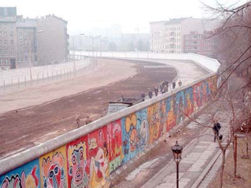
We had a drive of several hours, and on the way, we noticed the strangest thing – an unusually heavy numbers of cars coming FROM the border, and most of these cars were POS – old, slow, rusty, spewing black smoke, made of fiberglass – but full of people. The West Germans only drive new, shiny cars – where were these cars coming from?
We turned on the radio, and learned that the Czechoslovakian border had opened. When we got to our little gasthaus, we sat in the common room and watched, spellbound, as young people danced on the Berlin Wall. It was the most amazing, stunning sight you could imagine.
There were signs this was coming. No one seriously believed it really would happen, and happen so fast and so dramatically. The American government was pouring millions of dollars into Germany to renovate housing and offices and services, assuming the status quo would endure for the forseeable future, and American forces would be there a long long time. A mere fifteen years later, American presence had decreased dramatically, entire bases have closed, those renovated offices and houses turned back over to the Germans. Whoda thunk?
The reunification of Germany has been painful, continues painful. The integration of the former Soviet states into the European community moves at a snail’s pace, but it moves. It’s a new Europe, one currency, goods traded freely, young people from all countries free to move and work in other European countries. It’s an amazing new world.
The frustrations of getting the political system to work are mitigated by the occasional tipping point when the world changes in a heartbeat, and the people dance on the Wall.

Thanks to Wikipedia for sharing appropriate photos!
The Hem of His Garment
With one of my good friends, our conversations almost always veer to spiritual issues. If I am ever about to do something that a little voice tells me I might not want to do, I call her. I say “this is the situation, this is how I am thinking about handling it, but I want to check with you . . .”
She will always tell me the truth. She will say “hmmmn . . . why don’t you sit on that idea a couple days first?” or “sounds like the right thing to do, even if you think you might be doing it for the wrong motives” or . . . I may not want to hear it, but it will be the best truth she can give me.
She never repeats my confidences to others, and I trust that right or wrong, she will give me the best advice anyone would give. Friendships like that are priceless.
So this weekend, we were discussing how we can ALL be saved, i.e. how we will make it to heaven/paradise/jenna. Our book says we’re the only ones who are going to be there, and that unless you believe exactly the way we believe, sorry, you’re out. Most holy books say the same thing – this is the true path, and if you follow it, you’re in. If not, you’re out. It seems like a great cosmic gamble, with your soul and life everlasting at stake.
My friend told me about another friend of hers, a Native American woman, a wise woman, a very spiritual woman. One of her friends died from a virulent, fast-spreading cancer, and the Native American woman dreamed of her. In her dream, her friend appeared, radiant and shining and bright. The woman asked her friend “what is it like on the other side?” and her friend said “It’s SO BIG! We had NO idea! We were barely touching the hem of His garment!”
It’s just a dream. Just a vision. . . and yet, it sticks with me, I find myself taking great comfort in this story. I want us all to be there.
Prediction: Kuwaiti Best Sellers
(Whooping with laughter!) I’m on a roll today – again, Kuwaiti Times, page 6
There is no surer way to guarantee books make the best-seller list than to ban them. Imagine the fun you will have smuggling books by Kuwaiti writers Mohammed Abdul Qadar Al-Jassim (Sheikhs of Dignity) and Zaid Jlewi Al-Enezi (25 Constituencies . . . The Best Choice) into the country.
Al-Jassims book is banned because it “discusses taboos concerning Kuwait’s political leadership and the ruling family.” Al-Enezi’s book is banned “for discussing sectarian and tribal issues concerning the electoral system followed in Kuwait.
Even dull books are bought once they are banned. Maybe the Ministry of Information is using reverse psychology?
Judicial Staff Immunity (??) (!)
Page 6, Kuwaiti Times News In Brief
“Major General Thabit Al Muhanna has instructed officials of the traffic department not to issue any tickets against members of judicial staff such as judges, prosecutors and investigators, reported Al-Qabas. He said that they were also not authorized to report any of these members to police or any other officials for investigations. He said the traffic department officials in these cases should only record the civil ID details of said members.”
The judiciary is held to a LESSER standard than the average citizen? In most countries, the judiciary (my son is a prosecutor) is held to a HIGHER standard, because they are the ones who must dispense justice with wisdom . . . How can they prosecute, investigate, judge with clear conscience when they are exempt from the laws they implement?
Little Diamond
My neice is blogging! She started just as I did, without telling anyone. When I saw her on Friday, she very casually mentioned it in passing. Woooo Hoooooo! She is beautiful, and articulate, and always full of amazing information, and a lot of fun. Her website is A Diamond in Sunlight.
What Am I Missing Here?
“Yes to the waiver of loans” read the banners of 50 citizens rallying in silent protest in front of Parliament to request a bailout of private debt. What am I missing here? As I understand it, these are grown-up people who have taken out loans, many loans greatly out of proportion to their income, and who now don’t want to pay the loans back. Am I understanding this correctly?
So who pays? If the loans are waived, who pays the banks? If a loan is waived, does that person forfeit the right to ever borrow again? And what discourages a person whose repayment is waived from making the same mistake again, borrowing more than they can re-pay?
And who is making these huge loans to citizens with limited salaries? Why would they give a loan that the borrower could only repay with hardship? Are there laws governing banking practices in Kuwait?
The “A” Word: Accountability
My internet was out when I got up – waaaaaay too early this morning, totally jet lagging, so I read this morning’s Kuwait Times, which I usually save as my reward for getting work done. (Yep, total news geek.)
You can usually scan a politician’s speech quickly to tell if it is platitudes or substance – so Speaker of the National Assemply Jassem Mohammed al-Koraifi’s speech at the opening of the National Assembly yesterday caught my eye. For one thing, he used the “A” word – accountability – three times. That’s a very brave word for a government official to use, and he used it in impressive ways.
He may have used the “A” word more than three times – I am betting he was speaking in Arabic, and the full text of the speech is not printed, only excerpts. Still – three times!
First, I’m impressed that he encourage women who are interested in participating as elected officials to start running NOW. He’s right. It takes more than an electoral season to build a winning platform. You know there are good women out there qualified and capable of public office – encourage them, support them, and introduce them to your friends.
The KT quotes the Speaker as saying that “reform is a responsibility that lies with all, and that that both parliament and government are first to bear that responsibility. ‘I stress to the head and members of the government; you are responsible for laying policies and responsible for implementing legislation and are accountable for your institutions and bodies’ performance, and bear the responsibility before your superiors.'” (emphasis mine)
His next reported use of the word is in his section on reform: “Parliament is a constitutional partner in the planning of reform precedures and legislation, and an overseer over implementing reform programs and realization of its objectives, and a body those who abuse its means and tools shall stand accountable to.” (emphasis mine)
The last reported use was in the part of his address on building consensus. “This should all come within a positive relationship based on transparency, credibility, mutual respect, and guarantees for optimal use of supervisory and accountability tools and where the independence of the judicial authority is maintained with none interfering in its affairs and where its objectives are the interests of Kuwait and its future, its security and its stability.”
My favorite part of the speech, beyond the “A” word, is this: “When coming upon difference inopinion or disagreement over an issue, the matter should be dealt with in parliament and in its committees and with a keeness to preserve this partnership.
“Handling such issues should be as partners who disagree rather than as enemies with a dispute; none shall question the patriotism of another, it is not right for any to doubt another’s loyalty, and there cannot be hurling of accusations and abuse and settling of scores as that would strain the social fabric and dispel amicability and respect.”
I started reading blogs when I was coming to Kuwait, and trying to find out what the issues were. The papers are . . . ambiguous. Vague. I could catch glimpses, but it was following the blogs that I have learned the most. One blog helped me understand the issues in May The Ultimate with words and photos and a discussion of what the difference was between one voting district, five voting districts or ten voting districts – something I had never found in reading the English press.
I find committment, passion, insight and intelligence in your blogs. I find potential leadership, and an honesty when you are talking with one another that I don’t find when I ask questions myself. We are all so careful in our cross-cultural conversations, not to offend, not to give too much information which makes us look bad.
My country is also young – only 200 years. We have had our corrupt Presidents, scandals, lax standards and poorly enforced laws. Rule of Law is not something that happens overnight – it only happens when a good majority of the people have the conviction that the rule of the majority serves the greater good of all, while still protecting the interests of the minority. It takes time. It takes committment. And it takes accountability.
Morning Culture
In Kuwait, driving early Friday morning is a delight – everyone is sleeping in, things won’t get busy until around noon. Sometimes you have the whole road to yourself.
Here, in the land of the descendants of Scandinavians, the morning may dawn dark and foggy and damp, but by 8 this weekend morning the highways are already crowded with early birds, out to catch the worm. I can’t help but wonder where they are all going on a Saturday morning, so early.
Saying goodbye to my parents this morning was really heart wrenching. They have become so weak and so frail. They are already up, although I am stopping by early, and Dad is watching a football game and Mom is fixing coffee. It breaks my heart to know how hard they struggle to stay independent, and that there is nothing I can do to make them young and hearty again.
I remember when my Dad was always on the cutting edge of technology. Well into his 70’s, he was buying new computers and writing code to make them do what HE wanted them to do. Now in his late 80’s, we were all astonished when he showed no enthusiasm for the new laptop we bought him – until we discovered that his hands were now bothering him, and the keys on the laptop were too small for him. I wonder when we will no longer find new technologies so enticing, and will long for simpler days – and we will look back on the early 2000’s as the “good old days” when life was simple.
The flights are crowded today – it’s a full flight, and here is is, the end of October. Isn’t this usually low season?
Recent Comments
intlxpatr on Shampoo Ginger tigerbutterya0c5ff1d… on Shampoo Ginger intlxpatr on British Soldier Kidnapped, Esc… John on British Soldier Kidnapped, Esc… intlxpatr on British Soldier Kidnapped, Esc… Wikipedia Donate Button

Amazina


Early Voting in Florida


