I’m not a person who likes to be rushed, and I am a person who front-loads, who gets things done early, so as not to have to make decisions or preparations in a rush. If I can plan, and execute early, it all falls into place.
So when we had another early cold spell this week, our second ‘unseasonal’ cold spell, so cold we had to cover our more sensitive plants and bring others into protected areas, and with Thanksgiving coming so late this year, I decided I could let myself do a little early Christmas prep.
No, no tree, not yet, and no lights outside. Time enough for all that, just a little sparkle to get us started. As much as I love real greenery, real garlands, the temperatures here are too high for it it stay green longer than a week, so I use the artificial kind. You’d think the benefit would be no dropping needles, but this stuff also drops ‘needles’, and we laugh at where we find them hiding in August.
We bought our crêche many years ago in Germany, and it has gone with us everywhere we lived. It has lost a lot of its Germanic moss through the years, but I wouldn’t dream of replacing it:
The normal crêche occupants through the years have been supplemented by extra sheep and camels, and actually, by French santons, extra wise men, an angel ornament . . . hmmm, maybe it’s getting a little kitchy, but we wouldn’t sacrifice a single thing. One of our Saudi friends contributed a line of camels 🙂
In France and in Germany, crafters make the cutest sheep, and we found ourselves buying them at Christmas or crafts markets.
And, from Doha, The Church of the Epiphany, our “Aboona” or Our Father, the Lords Prayer written in Arabic calligraphy, one of our treasures.
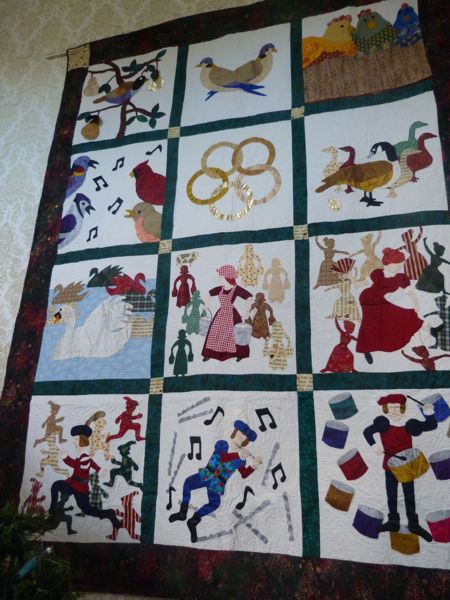
Last, but not least, time to change the hallway quilt, and The 12 Days of Christmas will reign for more like 40 days 🙂
Today’s reading in the Lectionary is from Sirach, one of the books of the Apocrypha, and features wisdom on faithful friends. I especially love “let your advisors be one in a thousand.” I have been greatly blessed to have found a few of those, and they stick with you for a lifetime.
Bless you, bless you, faithful friends!
Sirach 6:5-17
5 Pleasant speech multiplies friends,
and a gracious tongue multiplies courtesies.
6 Let those who are friendly with you be many,
but let your advisers be one in a thousand.
7 When you gain friends, gain them through testing,
and do not trust them hastily.
8 For there are friends who are such when it suits them,
but they will not stand by you in time of trouble.
9 And there are friends who change into enemies,
and tell of the quarrel to your disgrace.
10 And there are friends who sit at your table,
but they will not stand by you in time of trouble.
11 When you are prosperous, they become your second self,
and lord it over your servants;
12 but if you are brought low, they turn against you,
and hide themselves from you.
13 Keep away from your enemies,
and be on guard with your friends.
14 Faithful friends are a sturdy shelter:
whoever finds one has found a treasure.
15 Faithful friends are beyond price;
no amount can balance their worth.
16 Faithful friends are life-saving medicine;
and those who fear the Lord will find them.
17 Those who fear the Lord direct their friendship aright,
for as they are, so are their neighbours also.
I grew up in a small town, Juneau, Alaska, and not even in the main town, but on Douglas Island, across the Gastineau Channel from Juneau. My neighbors were fishermen, hunters, pilots, entrepreneurs and hard-working people struggling to make a living.
It was an upside down world. In most places, those who live there the longest are the leaders of society. In Southeast Alaska, those who lived there the longest were at the bottom of the heap, the Native Americans, the Tlingit, Haida and Tsimshian. I went to school with them. Yes, the boys carried knives. No, they were not dirty, and none of my little friends in elementary school were drunks. We were kids, we played together, we were all in the same classes all through elementary school – it was a small school.
Many of them did have family problems. There were problems of alcoholism, unemployment, domestic violence and hunger. They weren’t the only ones. The big problem was no respect. Although there were a few pieces of Native Art in the city museum, Native culture and Native craft were given little value. The Native way of life, living off the land, hunting and fishing, had greatly diminished as lands were apportioned off and hunting and fishing activities regulated.
In 1971 a huge lawsuit was settled and the Alaska Native Claims Settlement Act provided some restoration for the damaged peoples. Alaska Natives now have regional corporations to administer and grow funds to support the culture, to provide education for the children, to provide health clinics and hospitals. SEALASKA began to organize a biennial Celebration, a gathering of all the Alaska natives to share their stories, to celebrate their culture, to dance and to transmit culture to their children. It’s a great opportunity for people you might see every day in their western life to remember where they come from and to be proud of who they are. This Celebration is held every two years and includes Alaska Natives from all over Alaska who want to participate. It is a very inclusive Celebration. The next Celebration will be June 8 – 11, in 2016. You can read a little more about Celebration 2014 here.
They learn the legends of their clans – the Eagles, The Ravens, the Beavers, the Bears and a number of other clans. They spend the time between celebrations stitching together elaborate costumes for their parade and dance exhibitions, hollowing out canoes from trees, making elaborate hats and masks.
We first learned of the Celebration gathering in 2012, when we already had tickets to go back to Zambia at the exact time the Celebration was taking place, but my sweet husband promised we could go back for the 2014 Celebration. As we researched, we discovered just how much of Alaska we wanted to see, and did a reconnaissance trip in 2013. We loved our time there, and we were delighted to be able to return this last year for Celebration 2014.
It was one of the most thrilling moments of my life, to see the gathering, to see the old women cry as canoes came into sight full of young Alaskan natives, and say “I never thought I would see this again in my life”, to watch the exhilaration of the dancers, to feel the energy of the parade and especially – to see the children. To see the pride in marching, in dancing, to see the joy in being able to express who they are and to share that with others. I was moved beyond my ability to express in words; it was a feeling that in one small way, a train of events that had gone very off track had moved incrementally back in the right direction.
Here are some photos from the joyous Celebration of 2014:
We have had a choice of Old Testament readings this week in the Lectionary readings, either Esther or Judith, (Judith is in the Apocrypha). I like both stories 🙂 Judith is a tale to curl your hair, a tale not for children, but an amazing story within that culture, and telling. Meanwhile, I wondered, where is Susa?
As it turned out, I lived almost next door to Susa. So close I could spit across the Gulf. I wonder if I will ever have a chance to visit Iran? As hopeless as the current situation(s) in the Middle East look, I have seen amazing and wondrous things in my life – the fall of the Berlin Wall and the unification of South Africa sans apartheid – and I believe, by God’s grace, anything is possible.
The Islamic State of Iraq and Syria (ISIS), now threatening Baghdad, was funded for years by wealthy donors in Kuwait, Qatar, and Saudi Arabia, three U.S. allies that have dual agendas in the war on terror.
The extremist group that is threatening the existence of the Iraqi state was built and grown for years with the help of elite donors from American supposed allies in the Persian Gulf region. There, the threat of Iran, Assad, and the Sunni-Shiite sectarian war trumps the U.S. goal of stability and moderation in the region.It’s an ironic twist, especially for donors in Kuwait (who, to be fair, back a wide variety of militias). ISIS has aligned itself with remnants of the Baathist regime once led by Saddam Hussein. Back in 1990, the U.S. attacked Iraq in order to liberate Kuwait from Hussein’s clutches. Now Kuwait is helping the rise of his successors.As ISIS takes over town after town in Iraq, they are acquiring money and supplies including American made vehicles, arms, and ammunition. The group reportedly scored $430 million this week when they looted the main bank in Mosul. They reportedly now have a stream of steady income sources, including from selling oil in the Northern Syrian regions they control, sometimes directly to the Assad regime.
But in the years they were getting started, a key component of ISIS’s support came from wealthy individuals in the Arab Gulf States of Kuwait, Qatar and Saudi Arabia. Sometimes the support came with the tacit nod of approval from those regimes; often, it took advantage of poor money laundering protections in those states, according to officials, experts, and leaders of the Syrian opposition, which is fighting ISIS as well as the regime.
“Everybody knows the money is going through Kuwait and that it’s coming from the Arab Gulf,” said Andrew Tabler, senior fellow at the Washington Institute for Near East Policy. “Kuwait’s banking system and its money changers have long been a huge problem because they are a major conduit for money to extremist groups in Syria and now Iraq.”
Iraqi Prime Minister Nouri al-Maliki has been publicly accusing Saudi Arabia and Qatar of funding ISIS for months. Several reports have detailed how private Gulf funding to various Syrian rebel groups has splintered the Syrian opposition and paved the way for the rise of groups like ISIS and others.
“The U.S. has made the case as strongly as they can to regional countries, including Kuwait. But ultimately when you take a hands off, leading from behind approach to things, people don’t take you seriously and they take matters into their own hands.”
Gulf donors support ISIS, the Syrian branch of al Qaeda called the al Nusrah Front, and other Islamic groups fighting on the ground in Syria because they feel an obligation to protect Sunnis suffering under the atrocities of the Assad regime. Many of these backers don’t trust or like the American backed moderate opposition, which the West has refused to provide significant arms to.
Under significant U.S. pressure, the Arab Gulf governments have belatedly been cracking down on funding to Sunni extremist groups, but Gulf regimes are also under domestic pressure to fight in what many Sunnis see as an unavoidable Shiite-Sunni regional war that is only getting worse by the day.
“ISIS is part of the Sunni forces that are fighting Shia forces in this regional sectarian conflict. They are in an existential battle with both the (Iranian aligned) Maliki government and the Assad regime,” said Tabler. “The U.S. has made the case as strongly as they can to regional countries, including Kuwait. But ultimately when you take a hands off, leading from behind approach to things, people don’t take you seriously and they take matters into their own hands.”
Donors in Kuwait, the Sunni majority Kingdom on Iraq’s border, have taken advantage of Kuwait’s weak financial rules to channel hundreds of millions of dollars to a host of Syrian rebel brigades, according to a December 2013 report by The Brookings Institution, a Washington think tank that receives some funding from the Qatari government.
“Over the last two and a half years, Kuwait has emerged as a financing and organizational hub for charities and individuals supporting Syria’s myriad rebel groups,” the report said. “Today, there is evidence that Kuwaiti donors have backed rebels who have committed atrocities and who are either directly linked to al-Qa’ida or cooperate with its affiliated brigades on the ground.”
Kuwaiti donors collect funds from donors in other Arab Gulf countries and the money often travels through Turkey or Jordan before reaching its Syrian destination, the report said. The governments of Kuwait, Qatar, and Saudi Arabia have passed laws to curb the flow of illicit funds, but many donors still operate out in the open. The Brookings paper argues the U.S. government needs to do more.
“The U.S. Treasury is aware of this activity and has expressed concern about this flow of private financing. But Western diplomats’ and officials’ general response has been a collective shrug,” the report states.
When confronted with the problem, Gulf leaders often justify allowing their Salafi constituents to fund Syrian extremist groups by pointing back to what they see as a failed U.S. policy in Syria and a loss of credibility after President Obama reneged on his pledge to strike Assad after the regime used chemical weapons.
That’s what Prince Bandar bin Sultan, head of Saudi intelligence since 2012 and former Saudi ambassador in Washington, reportedly told Secretary of State John Kerry when Kerry pressed him on Saudi financing of extremist groups earlier this year. Saudi Arabia has retaken a leadership role in past months guiding help to the Syrian armed rebels, displacing Qatar, which was seen as supporting some of the worst of the worst organizations on the ground.
The rise of ISIS, a group that officially broke with al Qaeda core last year, is devastating for the moderate Syrian opposition, which is now fighting a war on two fronts, severely outmanned and outgunned by both extremist groups and the regime. There is increasing evidence that Assad is working with ISIS to squash the Free Syrian Army.
But the Syrian moderate opposition is also wary of confronting the Arab Gulf states about their support for extremist groups. The rebels are still competing for those governments’ favor and they are dependent on other types of support from Arab Gulf countries. So instead, they blame others—the regimes in Tehran and Damascus, for examples—for ISIS’ rise.
“The Iraqi State of Iraq and the [Sham] received support from Iran and the Syrian intelligence,” said Hassan Hachimi, Head of Political Affairs for the United States and Canada for Syrian National Coalition, at the Brookings U.S.-Islamic World Forum in Doha this week.
“There are private individuals in the Gulf that do support extremist groups there,” along with other funding sources, countered Mouaz Moustafa, executive director of the Syrian Emergency Task Force, a Syrian-American organization that supports the opposition “[The extremist groups] are the most well-resourced on the ground… If the United States and the international community better resourced [moderate] battalions… then many of the people will take that option instead of the other one.”
President Obama is laying out his strategy to counter the Islamic State, whose rampages across Iraq and Syria have riveted Americans’ attention on a zone of conflict that many had hoped to forget. Many are urging him to step up military action. But if Obama wants to defeat the jihadis, he will need more than airstrikes—he should follow the money.
For all that ideology, religious belief and perhaps a lust for violence and power might motivate those who fight for the Islamic State (known variously by the acronyms ISIS and ISIL), money is what keeps the group going. As with any state, ISIL has bills to pay and mouths to feed. Even for the world’s richest terrorist organization—which, by all available accounts, ISIL is—money doesn’t grow on trees, and nothing in the world comes for free.
So where does ISIL’s money come from? As part of my research at the RAND Corporation, since late 2006 I have been studying the finances, management and organization of the precursors to the Islamic State—Al Qaeda in Iraq and the Islamic State of Iraq—using their own documents, manuals and ledgers. More recently, Rand has teamed up with scholars from Princeton and Emory universities, as well as analysts from other organizations, to study more than 150 documents produced between 2005 and 2010. Although our work is still not yet done, we can draw a number of conclusions.
The most important thing for U.S. policymakers to remember is that ISIL now possesses the financial means to support a long-term fight—some $2 billion, according to a recent report in the Guardian, citing a British intelligence official. At the same time, ISIL’s preferred fundraising methods and many financial commitments create vulnerabilities. The organization was badly damaged by late 2009, thanks to a combination of coalition and Iraqi forces, as well as intervention by the Iraqi government, and it can be badly damaged again. But without the establishment of a widely accepted, legitimate political order in Iraq, ISIL cannot be eradicated—and will continue to seek out and mete out cash.
ISIL raises most of its money domestically in Iraq and Syria. Its income streams include oil smuggled to other countries in the region, extortion, taxes—especially on non-Muslim minorities—and other essentially criminal activities.
Oil is ISIL’s biggest source of revenue but also presents the biggest problem. ISIL controls about a dozen fields in Syria and Iraq, in addition to a number of refineries, including mobile refineries. Based on media accounts, RAND has estimated the total production capacity of these fields to be more than 150,000 barrels per day, although actual production is estimated to be much lower: The website Iraq Oil Report has reported that exports for the month of August at about 2.4 million barrels per day, for instance.
ISIL smuggles this oil out in tanker trucks—clearly visible from the sky should any drone pass overhead, so the smuggling is not particularly furtive. The group then sells the oil to whoever will buy it—reported in the media to be buyers in Syria, Turkey, the Kurdistan Region of Iraq and possibly in Iran and even Bashar Assad’s regime in Syria, among other countries. Sales take place at rates deeply discounted from world prices. But even so, revenues have been estimated in the media at $1 million, $2 million or even $3 million per day.
We have seen this before. From 2006 to 2009, ISIL’s predecessor, the Islamic State of Iraq, raised perhaps $2 billion through smuggled oil originating in the Baiji refinery in northern Iraq. This ended as a result of a concerted effort by U.S. and Iraqi forces to destroy the group and create the conditions in which the Iraqi government could exercise its law-and-order responsibilities, as well as vastly improved management at Baiji, owned by the Iraqi government.
So where does all of ISIL’s money go?
ISIL historically has paid its members (yes, it maintains payroll sheets) based on a flat monthly rate per person and then additional fixed amounts for each wife, child and dependent unmarried adult woman in the household. In Anbar, Iraq, the rate was $491 per year in 2005 and 2006, and then about $245 per year per dependent; the rate was similar in Mosul in 2007 and 2008. These payments to family are meant to continue if the ISIL member is captured or killed—a primitive form of life insurance. If enough members are captured and killed, however, these costs start to mount.
ISIL also pays rent for its members in some cases—payments that might be bonuses to high-performing members, although we cannot be sure—and medical expenses for some members and their families. In the past, the group has sometimes hired lawyers to help get captured members out of jail. And it runs safe-houses and has to buy equipment. Guidelines published by a predecessor of the group say that expense reimbursements should be filled out in triplicate and explain where each copy goes within the organization. We don’t know for sure whether ISIL today is making money or even breaking even, but at least in Anbar from 2005 to 2006, the money was being spent as fast as it came in.
As a cash-based organization, ISIL relies on couriers not only to deliver messages among its dispersed leadership but also to move money—follow the right courier and you get to the leadership. Because it deals only in cash, ISIL also needs to worry about the honesty of its members. We have seen instances of skimming for personal enrichment, as you might see in any cash-based criminal network.
As a state, albeit a twisted version of one, ISIL also has administrative expenses. It is responsible for making sure electricity and water flow and the roads stay repaired in the regions of Iraq it now controls—including parts of the Anbar, Ninewa Salah-al-Din, Kirkuk and Diyala governorates. Whether the group chooses to or is able to fulfill those responsibilities creates a vulnerability: A discontented population is unlikely to remain passive under ISIL’s leadership.
Even if ISIL is making $3 million per day—at the higher end of the various estimates out there—then it makes slightly more than $1 billion per year. Just to be conservative, in case ISIL is doing more business than we’re aware of, let’s double that to $2 billion per year. Although exact totals are difficult to find, in 2013, before ISIL’s advance, the Iraqi government spent far more than $2 billion per year running the governorates ISIL now controls, including salaries to civil servants, other costs of service provision and investment spending. That means ISIL likely isn’t keeping up the same level of service that the Iraqi government once did. True, ISIL need not maintain that level—it hardly rules with the consent of the governed. But it’s not only a problem that those under its rule can rebel, as happened in 2007 and 2008; with the exception of oil, the group’s continued revenue-raising also depends on there being enough money to skim and extort from the economy, and this requires some minimum level of services and economic activity.
There is little that outside forces can do to halt the extortion and skimming that take place within ISIL territory. Oil smuggling, though, can be disrupted, at least to an extent. Intelligence resources from the United States, Iraq and any other country that takes on ISIL should be focused on identifying middlemen and buyers for the smuggled fuel and using any means necessary to halt those purchases.
It would be counterproductive to destroy oil field infrastructure, since repairs would be expensive and legitimate governments will need those oil revenues when they reestablish control. But mobile refineries should be targeted, and roads and other pathways that tanker trucks use to transport oil to and from oil fields should be made impassable by military means. The refineries and roads can be easily repaired when the time comes, but for now, ISIL should find it very difficult to move oil from fields.
Stopping ISIL will of course require much more than disrupting its funding. It will have to be defeated militarily, and legitimate, trusted governments will have to be established in Iraq and Syria to defeat the group over time. There’s no simple path to achieving this, but as long as ISIL’s coffers remain full, the task will not get any easier.
A reading from today’s Forward Day by Day helps us to cope with the resonating horrors of that monstrous day. We are living in a world where we are more and more inextricably interconnected. Where I am living, I often hear people talk about how “Moslems are killing Christians all over the world!” and my heart breaks, thinking of the wonderful friends I have lived among is so many Moslem countries, their kindness, their hospitality, our long pleasant conversations. I learned so much.
I am glad we believe in a God who knows our hearts. I am thankful for grace, and forgiveness. When we talk about killing, we also need to take account for all the civilians we have killed, trying to bring about peace, trying to eradicate Al Qaeda, Al Shebaab, those who would harm us.
God asks us to love one another. He doesn’t say “Christians, you love just the Christians.” He shows us how to love the Samaritans, the lame, the blind, the mentally ill, the “other”. He tells us, clearly, to love our enemies. The Gospel that speaks the loudest is the gospel of our lives lived to honor him.
THURSDAY, September 11
Acts 15:8-9 [Peter said], “And God, who knows the human heart, testified to them…and in cleansing their hearts by faith he has made no distinction between them and us.”
Thirteen years ago, this day became one of those days that divide time into what life was like before, and after; one of those days when you will remember, always, where you were, what you were doing—this time when you heard the news that airplanes had crashed into the World Trade Center and thousands of people had died.
Job asks, “Does not calamity befall the unrighteous?” (31:3), but we learned, vividly, on September 11, 2001, that the righteous and the innocent suffer too.
Psalm 59:6 exhorts God to “show no mercy to those who are faithless and evil.” The terrorists who flew the planes on 9/11 forced us to confront the power of evil and challenged us to find a way to respond with forgiveness. Perhaps we can learn something about that in Peter’s response to the heated discussions about Jews and Gentiles, about who could be saved, and how: “God, who knows the human heart…has made no distinction between them and us” (Acts 15:8-9).
Then, as now, there were good people and evildoers on all sides, religions, and races. Now, as then, judgment and salvation comes only through the mercy and grace of God.
“Did she just say what I thought she said? my co-leader asked me, and I laughed.
“You mean ‘You’re not from around here?'” I said, which was not exactly what she had said but was exactly what she meant. He laughed.
“Exactly!” he said, and he laughed.
She had not used those exact words, but, uncomfortable with some of the questions our diplomats were asking, and clearly over her head, she had turned to me and asked me how long I’d been here, and dismissing me, told the group she had been here all her life, etc. I hadn’t been arguing with her. I hadn’t said a word. I was just the nearest dog to kick, someone on whom she could vent her frustration.
It’s so human. I’ve never lived anywhere that I didn’t hear some version of it, rarely to my face, usually about others, but it’s a fall-back position and it is present in every culture.
I told him about my many moves – 31 – and my cat theory. When you bring a new cat into a house with cats, you shut the new cat in a room (with food and litter, you know, cat things) until the other cats get used to the smell. Then you allow the new cat among the old cats for a short time and put it away again. You do this for a couple days, and then allow the cat to be among the other cats with you present to see how it goes. Sometimes it takes a while for the new cat to be accepted. Sometimes a cat just fits right in.
I told him I do the same thing, when I get to a new place I just quietly show up, in church, in a new group or two, and stay quiet. I watch who sits with whom, I listen to what they say. Sometimes one time with a group is enough, and I know it’s never going to be a good fit and I don’t go back. Other groups, I just keep showing up but I stay quiet . . you know, letting them get used to my “smell,” LOL.
Most of the time, I fit right in. It doesn’t take that long. Every now and then I run into a cat who doesn’t appreciate my presence, and I have to make a decision. Usually it is a bully-cat who can sniff our my independence and irreverence in spite of my deferential behavior; sometimes I will stick around, sometimes I back away. You’re not going to change a bully-cat, and I am not one for a cat-fight. The bully-cats often do themselves in and implode.
This woman was busy imploding.
My generally enthusiastic group was quiet when they got back on the bus, and I let them be. I really didn’t want to deal with this meeting, either.
The next day, we all talked. I asked what they had learned from the meeting and one diplomat, the most outspoken, said “Learned nothing! She talked and talked and talked (she was doing that hand thing that means a person is talking and talking) and she never answered a single question!”
A second diplomat laughed and said “Like a diplomat, only we are better at it” and everyone laughed.
The people in my group last week suffered greatly in the high temperatures and high humidity we are experiencing. I must be adapting a little; I remember being thankful for the breeze.
“What do you wear when it gets this hot?” they asked me, “like around the home?”
I laughed. I learned a thing or two in Tunis, in Amman, in Tabuk and Riyadh, in Kuwait and in Doha. At home, I dress like local women, in long loose dresses.
Or worse. I dress like their maids. In the souks you could find wonderful, 100% cotton dresss that were loose and flowing, and that is good in hot weather so the air can circulate. Some of the dresses were nicer, but the dresses I liked a lot for just being around the house doing what people do, like making sure the dishes are done and a meal prepped, doing a little quilting or reading . . . you could buy these great little dresses for about $3.00 in the souks. Not only were they practical – especially when you live in a house with a cat, and always put on “real” clothes just as you are about to run out the door so you don’t have any cat hair on you – but they came in great colors and prints, designs that made me happy to put them on.
Now, one of my all time favorite dresses, in purple and black, has bit the dust. I liked it because it had some geometrics, and the geometrics changed, and – it was purple. I have worn it for about six years now, and I have worn it out. I mended it several times when the underarm seams ripped:
But now, it has gotten all soft, so soft the material just rips easily with holes that cannot be mended.
I like this dress so much I am saving it and cutting it up so it will have another new life as a quilt 🙂
And I am thinking it is time to plan a trip back to Doha and Kuwait to replenish my hot weather dresses 🙂
I had a really super group of diplomats in town this week, really smart people dealing with serious topics – arms control, human rights, freedom of the press, immigration – and the appointments were fabulous. They were greeted at Baskervile-Donovan by a German speaker, coffee and cakes, and the presentation was a clear outline on corporate fund raisers, goals, and candidate selection.
We had a few extra minutes before our next appointment, and as we were just next door to Joe Patti’s, I took them there for a peek into life for “real” Pensacolians. Of course, they loved Joe Patti’s.
While I was there, my phone rang and it was a stranger, telling me she had a package for me from a friend in Kuwait. When could she bring it by?
You know how sometimes it’s hard to think? My mind was full with my delegation, but I set a time – and I was at Joe Pattis, so I quickly bought some cookies to serve and headed out for our next appointment.
When I said goodbye to the delegation for the last time and headed home, I put the coffee on and prepared for my Kuwait guests. They arrived and we had a wonderful visit, a friend in common and lots to talk about. And oh my, the packet my friend sent, full of fabrics from the Kuwait souks, a care package for my quilting addiction:
Even better – and it feels so wonderful to have a friend who understands me so well – look at the bag she sent them in! It is SO adorable! It is something I would have bought in a heartbeat, so unique, so special! My heart is dancing with ideas for a new quilt!
Thank you, Hayfa 🙂 for a real treat, both the fabrics and the friend you sent to carry the package 🙂










 Here There and Everywhere