Where is the Diocese of Cashel and Ossary, Ireland?
Today the church prays for the Diocese of Cashel and Ossory. Fascinating history these Irish people have, full of waves of immigrations and invaders and territorial squabbles. Here’s what Wikipedia had to say:
 When we visited Cashel, it was because of the legend of Saint Patrick, and it was one of the most beautiful and memorable places we have ever visited, lots of places to walk and see. Here’s more from Wikipedia:
According to local mythology, the Rock of Cashel originated in the Devil’s Bit, a mountain 20 miles (30 km) north of Cashel when St. Patrick banished Satan from a cave, resulting in the Rock’s landing in Cashel.[1] Cashel is reputed to be the site of the conversion of the King of Munster by St. Patrick in the 5th century.
The Rock of Cashel was the traditional seat of the kings of Munster for several hundred years prior to theNorman invasion. In 1101, the King of Munster,Muirchertach Ua Briain, donated his fortress on the Rock to the Church. The picturesque complex has a character of its own and is one of the most remarkable collections of Celtic art and medieval architectureto be found anywhere in Europe.[2] Few remnants of the early structures survive; the majority of buildings on the current site date from the 12th and 13th centuries

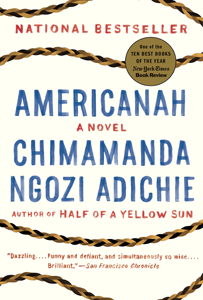
Chimamanda Ngozi Adichie: Americanah
“Ouch! Ouch, Chimanda! Stop!”
(Oh wait.)
Don’t stop.
It’s me who can’t stop. I read everything Chimamanda Ngozi Adichie writes. I only started reading her by accident, when I was facilitating the Kuwait Book Club I never intended to belong to, and found myself reading so many books by authors I had never heard of. We were reading Half Of a Yellow Sun and all of a sudden, I WAS Nigerian. She can do that. She uses the senses, she uses the thoughts in our head. We are really not so alien, us and the Nigerians I start to think. I have Nigerian friends, from the church. We all get along. We have a good time together.
“Not so fast!” Chimamanda tells me in Americanah, her newest book, which I put off buying until I could find it in paperback. “You are very different! You think differently! And growing up in a country where there are black and white, race becomes an issue that it is not when you are black, and everyone is black, and you are growing up in Nigeria.”
Hmmm. OK. That makes sense. I mean, I thought I was Nigerian because in Half of a Yellow Sun, I was Igbo, living in an academic community in Nigeria, and hmmmm. You’re right, Chimamanda, there were no white people around. Just us Nigerians.
Chimamanda, with her sharp, all-seeing eyes, her sharp ears and her sharp tongue make me cringe as she comes to the USA and comes up against assumptions many have about Africa. Do you even know where, exactly, Nigeria is? Do you know where Ghana is? Most Americans can find Egypt on a map of Africa, and MAYBE South Africa, but the rest is . . . mostly guesswork. Because we send clothing and food aid to African countries, we have the idea that all Africans are poor, but that is not so, and is insulting to the middle-class and upper class Africans who travel elsewhere for leisure – and education.
I don’t know how much of Chimamanda Ngozi Adichie’s book is autobiographical and how much is fiction. I know that her observations are acute, she nails expat friendships, she spotlights our blind spots and hypocricies, and she holds you in her grip because she is no less harsh with herself – if, indeed, her Ifemelu, the main character in Americanah, is reflecting Chimamanda’s own experience. The experiences, coming here, the overwhelming differences in manners and customs, even volume of voice and width of hand expression, are so immediate, so compelling, so well described that they have to have been experiences she herself had, and had the eyes to see. She must have taken notes, because she totally nails the expat experience.
Book ads and book reviews focus on Americanah as a book about being black in America, and it truly is that – as seen from the eyes of a non-American black, as she often reminds us.
She is hard on herself, returning to Nigeria, and quick to note that much of the change is in herself and her changed perspective. While I love the romantic storyline, I was disappointed by the fantasy ending, given how self-disciplined Adichie is at keeping it real in every other facet of the novel. On the other hand, I am still trying to think of an ending that would work for me, and I can’t. While her ending wraps it all up neatly, it’s the one part of the book where her sharpness dulls.
One of the things I liked best about the book was going behind the scenes, being Nigerian, going to school, having coffee, working, going to parties with other Nigerians, chatting with my girlfriends. We’ve done things with nationals of different countries before, but you know as soon as you walk in that your presence changes things. Chimamanda Ngozi Adichie takes me with her and no one knows I am there, observing, learning, figuring out how things are done when it’s “just us” Nigerians.
Here’s why I am a Chimamanda Ngozi Adichie addict. She keeps it real. She has eyes that see, and ears that hear, and a gift for capturing what she sees and hears and a gift for writing it down. She has insight, into herself, into others, into character and motivations. She is sophisticated and unpretentious, she admires and she mocks, but when she mocks, it is as likely to be self-mockery as mockery of another person, class, ethnicity or nation. Reading Adichie, I understand our similarities – and our differences. I believe she would be a prickly friend to have, but I would chose her as a friend.
Awards
● Winner of the 2013 National Book Critics Circle Award for Fiction
● One of The New York Times’s Ten Best Books of the Year
● Winner of the The Chicago Tribune 2013 Heartland Prize for Fiction
● An NPR “Great Reads” Book, a Washington Post Notable Book, a Seattle
Times Best Book, an Entertainment Weekly Top Fiction Book, a Newsday Top 10 Book, and a Goodreads Best of the Year pick.
Empowerment
I’m working with a group, one of whose goals is empowerment. They are all from the same country, but not the same parts of the country, nor the same ethnicities, but they all get along well with one another and the group does fine. I admire each of them, and even better, I like these women.
(Photo removed 17 Aug 2021 due to potential political impact on participants)
Here’s the LOL, empowered people have ideas and opinions. We have a format to adhere to, and empowered people come up with other ideas and alternatives. Here’s the problem: other ideas and alternatives, especially good ones, mean a lot of extra focus, it creates more work for facilitators and program managers. Sometimes you need permissions, sometimes you need transportation arrangements, and always, you need to assure a delegate’s safety. All this on top of the changes that will have to be made because of this unusual weather.
First, yesterday as I met the group, I had to apologize for the weather – usually mild, sunny Pensacola was having a howling storm; sheets of water being blown by a raging wind, tree limbs falling, the sky grim and dark and grey the entire day. In the midst of this, I was with one delegate on a tour of the Port of Pensacola, where it was like being in the middle of a huge storm at sea, with squalls. The man giving the tour carried on, they had a great discussion while the wind howled around us and at times the rain fell so hard on the tin roof that we couldn’t hear one another.
 (Those lines you see coming in through the door are wind blown rain. The drops on the camera lens – ditto)
Here is what I truly admire about this group, all their empowerment is for the good, their suggestions are making this visit even more productive and helping them exceed their goals. Their alternatives were doable, and will be accomplished. I can also tell you that at the end of a day dealing with a lot of good ideas and changes, my brain is happily fried. Guess the LOL is on me.
“Double French Fries, Please”
I was taking a group of International Visitor Leadership Program delegates around town, to their meetings, and they wanted to eat at a very nice local restaurant where they could have Southern Food, Soul Food, with some atmosphere. I discussed several options (Woooo HOOOO Pensacola, with an outsized selection of truly good restaurants for a town of 50,000) and they decided on Five Sisters.

We were so lucky. It was Friday, and just after noon. I walked in, there was a line. Looking past the line, however, I could see some empty tables, so I took a chance, asked for a table to be put together and it was just a few minutes before we were seated. I’ve waited a lot longer for a table at Five Sisters, so I felt God was smiling at me.
The women knew what they wanted, but when it came to sides, they were unfamiliar with the offerings, and several were automatically excluded, and they don’t like cole slaw, it’s just cultural. Finally, the perfect solution. The first one says “Double French Fries, please” and several others follow suit.
It’s actually not a bad choice from a taste point of view. Five Sisters french fries are tasty. I just had to keep my face straight, because everyone is so health conscious these days, and I have never heard anyone order “double french fries” before.
Only in Kuwait: The Original
Sigh. These are, sadly, true. I have seen them myself. I used to make people mad; I always carried a camera, and when I would see able bodied young men park in the handicapped spots, I would take their photos. They would get really mad. I knew I might be risking my life, so I tried to be careful, but I was also hoping they would feel shame, and stop doing it.

Talal Al-Ghannam is a very brave Kuwaiti for printing these “Only in Kuwait . . . ” columns.
Only In Kuwait
These are the things you won’t find in other modern countries or even ones that are poorer, but only in Kuwait.
1. Only in Kuwait people APPEAL to the government to apply the law.
2. Only in Kuwait handicapped parking places are seized by ordinary people.
3. Only in Kuwait many people like to park on the pavement and on green landscapes.
4. Only in Kuwait you could get killed for a parking space.
5. Only in Kuwait you could get beaten if you did not let a maniac driving behind you to pass.
6. Only in Kuwait policemen are beaten by mobs.
7. Only in Kuwait many policemen play with their smart phones rather than monitor the roads.
8 .Only in Kuwait many police stations have only one policeman.
9. Only in Kuwait you need a fancy car on the road to be respected.
10. Only in Kuwait you need three months to get an appointment in a hospital unless you are really sick.
11. Only in Kuwait the majority of Kuwaitis travel out of town when there is a two-day holiday.
12. Only in Kuwait the majority of employees get sick suddenly when there is a holiday coming up.
13. Only in Kuwait we see people spitting or urinating in the streets.
14. Only in Kuwait we see maniacs driving on the shoulder of the road, throwing up gravel to break your car’s windshield.
15. Only in Kuwait some Kuwaitis say ‘kaifi ana Kuwaiti’, meaning I am a Kuwait, I can do whatever I want.
16. Only in Kuwait you see many Kuwaitis able to deport expatriates. I will rest my pen for now until the next article.
By Talal Al-Ghannam
local@kuwaittimes.net
500,000 in Kuwait Banned from Travel
From the Kuwait Times:
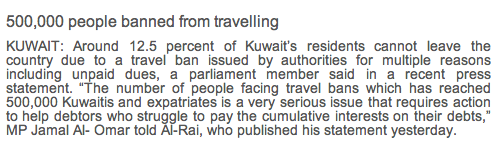
Mostly for people who have not paid interest on their loans? The banks have that much power, that they can put a travel ban on their customers?
“Why Do Americans Do This?”
AdventureMan and I were with a group of delegates from Iraq yesterday, taking them on a visit to a variety of Pensacola sites. They are here visiting through the GCCDC, on the IVLP program, studying elections and campaign strategies in the USA.
One stop we make with many delegates is the First Methodist program Serving the Hungry. Two days a week, led by Jerry Vititow and supported by many happy, willing volunteers, they serve a hot lunch to the hungry, varying in numbers but never less than fifty or so.
The delegates learn about the program, then don aprons and serve up the trays. It is often one of the highlights of the trip.
One delegate raises his hand to ask a question.
“We see this everywhere,” he starts, “Americans who are working for nothing and smiling. Why do they do this?” He was genuinely perplexed.
Jerry explained that it wells up from many sources, a yearning to give back some of the blessings we have received, an eagerness to serve those who have less, maybe just an eagerness to serve. “It’s part of what we believe in,” he sums it up.
The delegates had a wonderful time.
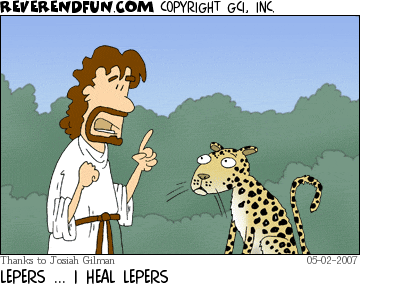
Jesus Heals Lepers
My friend Renee sent this one, along with several Christian cartoons, but this one really made me laugh. Yes, as Christians, it is OK to show the image of Jesus.
In our book, the Bible, there are even small jokes. In one verse, a man is told that Jesus, the Messiah, had come from Nazareth, and the man says “can anything good come out of Nazareth?” People are people, yes, it was meant to be humorous.
Recent Comments
intlxpatr on Yellowstone: Old Faithful to C… Michelle on Yellowstone: Old Faithful to C… Cathy on No Grown-Ups in Charge intlxpatr on Waiting for Snow intlxpatr on Waiting for Snow Wikipedia Donate Button

Amazina


Early Voting in Florida


 Here There and Everywhere