John of Damascus
This morning, as I read my Lectionary readings, I noticed I had skipped the Saint yesterday (I was trying to get a lot done) and it was John of Damascus. Checking the blog, I can see I printed this several years ago – 6 years! – but because it was new to me all over again, I am printing it again for you.
It is fascinating to me. John of Damascus defended the use of icons in worship. He distinguished between using an icon as an aide, and worshipping an icon. He was defended by his powerful position with a khalif, a Moslem who believes that images are forbidden. And we think WE live in interesting times . . . 🙂
JOHN OF DAMASCUS
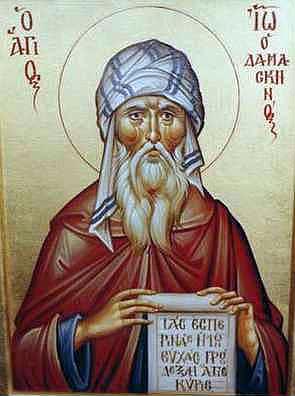
(I love this photo because he is wearing a gutra 🙂 )
HYMN-WRITER, DEFENDER OF ICONS (4 DEC 750)
John is generally accounted “the last of the Fathers”. He was the son of a Christian official at the court of the moslem khalif Abdul Malek, and succeeded to his father’s office.
In his time there was a dispute among Christians between the Iconoclasts (image-breakers) and the Iconodules (image-venerators or image-respectors). The Emperor, Leo III, was a vigorous upholder of the Iconoclast position. John wrote in favor of the Iconodules with great effectiveness. Ironically, he was able to do this chiefly because he had the protection of the moslem khalif (ironic because the moslems have a strong prohibition against the religious use of pictures or images).
John is also known as a hymn-writer. Two of his hymns are sung in English at Easter (“Come ye faithful, raise the strain” and “The Day of Resurrection! Earth, tell it out abroad!”). Many more are sung in the Eastern Church.
His major writing is The Fount of Knowledge, of which the third part, The Orthodox Faith, is a summary of Christian doctrine as expounded by the Greek Fathers.
The dispute about icons was not a dispute between East and West as such. Both the Greek and the Latin churches accepted the final decision.
The Iconoclasts maintained that the use of religious images was a violation of the Second Commandment (“Thou shalt not make a graven image… thou shalt not bow down to them”).
The Iconodules replied that the coming of Christ had radically changed the situation, and that the commandment must now be understood in a new way, just as the commandment to “Remember the Sabbath Day” must be understood in a new way since the Resurrection of Jesus on the first day of the week.
Before the Incarnation, it had indeed been improper to portray the invisible God in visible form; but God, by taking fleshly form in the person of Jesus Christ, had blessed the whole realm of matter and made it a fit instrument for manifesting the Divine Splendor. He had reclaimed everything in heaven and earth for His service, and had made water and oil, bread and wine, means of conveying His grace to men. He had made painting and sculpture and music and the spoken word, and indeed all our daily tasks and pleasures, the common round of everyday life, a means whereby man might glorify God and be made aware of Him. (NOTE: I always use “man” in the gender-inclusive sense unless the context plainly indicates otherwise.)
Obviously, the use of images and pictures in a religious context is open to abuse, and in the sixteenth century abuses had become so prevalent that some (not all) of the early Protestants reacted by denouncing the use of images altogether. Many years ago, I heard a sermon in my home parish (All Saints’ Church, East Lansing, Michigan) on the Commandment, “Thou shalt not make a graven image, nor the likeness of anything in the heavens above, nor in the earth beneath, nor in the waters under the earth — thou shalt not bow down to them, nor worship them.” (Exodus 20:4-5 and Deuteronomy 5:8-9) The preacher (Gordon Jones) pointed out that, even if we refrain completely from the use of statues and paintings in representing God, we will certainly use mental or verbal images, will think of God in terms of concepts that the human mind can grasp, since the alternative is not to think of Him at all.
(Here I digress to note that, if we reject the images offered in Holy Scripture of God as Father, Shepherd, King, Judge, on the grounds that they are not literally accurate, we will end up substituting other images — an endless, silent sea, a dome of white radiance, an infinitely attenuated ether permeating all space, an electromagnetic force field, or whatever, which is no more literally true than the image it replaces, and which leaves out the truths that the Scriptural images convey. (One of the best books I know on this subject is Edwyn Bevan’s Symbolism and Belief, Beacon Press, originally a Gifford Lectures series.[note – now out of print])
C S Lewis repeats what a woman of his acquaintance told him: that as a child she was taught to think of God as an infinite “perfect substance,” with the result that for years she envisioned Him as a kind of enormous tapioca pudding. To make matters worse, she disliked tapioca. Back to the sermon.) The sin of idolatry consists of giving to the image the devotion that properly belongs to God. No educated man today is in danger of confusing God with a painting or statue, but we may give to a particular concept of God the unconditional allegiance that properly belongs to God Himself. This does not, of course, mean that one concept of God is as good as another, or that it may not be our duty to reject something said about God as simply false. Images, concepts, of God matter, because it matters how we think about God. The danger is one of intellectual pride, of forgetting that the Good News is, not that we know God, but that He knows us (1 Corinthians 8:3), not that we love Him, but that He loves us (1 John 4:10).
(Incidentally, it was customary in my parish in those days for the preacher to preach a short “Children’s Sermon,” after which the children were dismissed for Sunday School, and the regular sermon and the rest of the service followed. What I have described above was the Children’s Sermon. I remained for the regular sermon, but found it a bit over my head — a salutary correction to my intellectual snobbery.)
In the East Orthodox tradition, three-dimensional representations are seldom used. The standard icon is a painting, highly stylized, and thought of as a window through which the worshipper is looking into Heaven. (Hence, the background of the picture is almost always gold leaf.) In an Eastern church, an iconostasis (icon screen) flanks the altar on each side, with images of angels and saints (including Old Testament persons) as a sign that the whole church in Heaven and earth is one body in Christ, and unites in one voice of praise and thanksgiving in the Holy Liturgy.
At one point in the service, the minister takes a censer and goes to each icon in turn, bows and swings the censer at the icon. He then does the same thing to the congregation — ideally, if time permits, to each worshipper separately, as a sign that every Christian is an icon, made in the image and likeness of God, an organ in the body of Christ, a window through whom the splendor of Heaven shines forth.
My prayer for us all for today is that we may each be that window through which the splendor of Heaven shines forth.
The Reciprocity Experiment
This is fascinating. I get these mailing labels every year from charities I’ve never heard of. I feel so GUILTY not sending them anything – they’ve spent their hard earned money sending me a gift! What to do? This man studied the phenomenon and discovered that we all find ourselves in this dilemma from time to time.
This is from National Public Radio, where I get the best news of things I might never hear about otherwise:
Give And Take: How The Rule Of Reciprocation Binds Us
by ALIX SPIEGEL
In 1974, Phillip Kunz and his family got a record number of Christmas cards. In the weeks before Christmas they came daily, sometimes by the dozen. Kunz still has them in his home, collected in an old photo album.
“Dear Phil, Joyce and family,” a typical card reads, “we received your holiday greeting with much joy and enthusiasm … Merry Christmas and Happy New Year’s. Love Lou, Bev and the children.”
The cards from that year came in all shapes and sizes, but the basic message was the same. The writers wanted Kunz to know that he and his family were cared for, and also they wanted to share their own news. They included pictures of family members and new homes and smiling graduates with freshly minted diplomas.
It all seems pretty normal, except for one thing: Kunz didn’t know any of them.
Kunz was a sociologist at Brigham Young University. Earlier that year he’d decided to do an experiment to see what would happen if he sent Christmas cards to total strangers.
And so he went out and collected directories for some nearby towns and picked out around 600 names. “I started out at a random number and then skipped so many and got to the next one,” he says.
To these 600 strangers, Kunz sent his Christmas greetings: handwritten notes or a card with a photo of him and his family. And then Kunz waited to see what would happen.

In 1974, Phillip Kunz, a sociologist at Brigham Young University, wanted to see what would happen if he sent Christmas cards to people he didn’t know.
Courtesy of the L. Tom Perry Special Collections at Brigham Young University
“It was just, you know, a shot in the dark,” he says. “I didn’t know what would happen.”
But about five days later, responses started filtering back — slowly at first and then more, until eventually they were coming 12, 15 at a time. Eventually Kunz got more than 200 replies. “I was really surprised by how many responses there were,” he says. “And I was surprised by the number of letters that were written, some of them three, four pages long.”
Why would someone send a three-page letter to a complete and total stranger?
Why did so many people write him back at all?
Following Rules
Robert Cialdini is an emeritus psychologist at Arizona State University who studies how our behavior is affected by social rules that we’re only vaguely aware of but which have incredible power over what we do. What happened to Kunz, he explains, is the direct result of one of the rules that most interest him: the rule of reciprocation. The rule, he says, is drilled into us as children.
“We are obligated to give back to others, the form of behavior that they have first given to us,” he says. “Essentially thou shall not take without giving in return.”
And so if someone passes you in the hall and says hello, you feel compelled to return their greeting. When you don’t, you notice it, it makes you uncomfortable, out of balance. That’s the rule of reciprocation.
“There’s not a single human culture that fails to train its members in this rule,” Cialdini says.
This is probably because there are some obvious benefits to the rule of reciprocation; it’s one of those rules that likely made it easier for us to survive as a species.
But what’s interesting about all this is how psychologists like Cialdini can actually measure the way the rule affects how we behave in all sorts of situations.
Exhibit A: those little pre-printed address labels that come to us in the mail this time of year along with letters asking for donations.
Those labels seem innocent enough, but they often trigger a small but very real dilemma. “I can’t send it back to them because it’s got my name on it,” Cialdini says. “But as soon as I’ve decided to keep that packet of labels, I’m in the jaws of the rule.”
The packet of labels costs roughly 9 cents, Cialdini says, but it dramatically increases the number of people who give to the charities that send them. “The hit rate goes from 18 to 35 percent,” he says. In other words, the number of people who donate almost doubles.
You can see the same thing when it comes to tipping.
If a server brings you a check and does not include a candy on the check tray, you will tip the server whatever it is that you feel the server deserves. “But if there’s a mint on the tray, tips go up 3.3 percent,” Cialdini says.
According to Cialdini, the researchers who did that study also discovered that if while delivering the tray with the mint the server paused, looked the customers in the eye, and then gave them a second mint while telling them the candy was specifically for them, “tips went through the roof.”
Servers who gave a second mint got a 20 percent increase over their normal tip.
Many decades ago Cialdini noticed a similar phenomenon when he studied Hare Krishnas in the U.S. He says that in the late 1960s the religion was really struggling financially; it seemed strange to many Americans, so it was hard for them to raise money.
But then they hit on a solution. In airports (and other public places), they would simply give the people passing by what they described as a gift: a flower, a book, a magazine. Then, after the person had the gift in his or her hand, they would ask for a small donation. Cialdini says he spent days in different airports observing these transactions, watching as recipients struggled to come up with the right solution.
“You would see many of them with frowns on their faces reach into a pocket or a purse, come up with a dollar or two, and then walk away angry at what had just occurred,” recalls Cialdini. But they would give, he believes, because of the rule of reciprocation. For years, he says, the Hare Krishna religion raised millions of dollars this way.
Reciprocating Influence
There are really dozens of ways that the rule of reciprocation affects us, some of them good, some of them bad. For example, politicians, like the rest of us, are subject to the rule of reciprocation. And so when organizations or interest groups give them money, though they might believe that money won’t influence their decisions, it’s sometimes hard for them, as it is for us, to be immune.
Cialdini believes you can also see the rule operate in the medical profession.
“You find doctors more willing to prescribe medication based on what gifts, favors and tips they have been given by one pharmaceutical company or another,” he says.
This doesn’t mean that the rule of reciprocation affects all of us all of the time. Cialdini says different situations trigger different people differently.
But it is powerful. One of those invisible powerful things that can subtly shape how we behave even years after someone has given us something.
Consider the case of Phillip Kunz, the sociologist who decided to send Christmas cards to random strangers.
For years his family got cards from the people he contacted in 1974.
“We got cards for maybe 15 years,” he says.
The Power of Kindness to Change Lives
This week AdventureMan and I have been blessed, greatly blessed. We have met some wonderful people and heard some amazing things. Two stories in particular have shaken the earth for me.
“How It Happened for Me”
The first story is about a friend we met from the newest country on earth, South Sudan. A group of us were sitting together when one woman turned to this man from the South Sudan and asked “How did you find Jesus?”
This was not a religious gathering, so it is an unusual question on a social evening. But this quiet, modest man responded “I will tell you. It is a long story. It starts when I was only five months, not a baby, five months in my mother’s womb.”
He told us of a life with no security. His parents and family fled to the forest, and were on the run continually most of his life – until recently. He told of a life trying to find safe places, sometimes being separated from his parents.

He told of a priest who, when he and his brothers and sisters were very young, taught them to say “God bless Mother and God bless Father and God bless my brothers and sisters and watch over us always.” He was kind to the children, and taught them that God loves them, that God is kind. He said they did not know who this God was, but he and his brothers and sisters said this prayer every night, to keep his family safe. He said they learned other simple prayers. There would be rare times when someone would teach them a letter, or some numbers, drawing in the sand, or the floor of the forest, simple, quick lessons.
“So I don’t know all the stories you do,” he said. “I don’t even know the bible very well, we never had educated priests, just simple men who taught us simple prayers. Only later did we become more educated.”
As we listened, we had huge lumps in our throats. I could hear Jesus’ voice saying that we must believe as little children, and this man had the pure simple faith of a child, a memory from his earliest years, as he prayed for his family to be safe in a world where life was continual chaos and a struggle to survive.
“When I understood about God,” he went on, “there wasn’t even a church or a pastor-man who could baptize me; I had to believe for many years before I could become a Christian.”
As a footnote, he told us that somehow, most of his village managed to survive, helping one another. His entire family made it through, his parents are still alive. The village children little by little gained education, becoming doctors, lawyers, professionals of all kinds. His village now has a church, a simple church, not always staffed, but a church. The war is ended. For him, the simplicity of peace is all he ever wanted.
We will never forget his, and his story. We have met an extraordinary human being.
Today, we went to a lunch, invited by a friend, to raise funds for public education. LOL, this is what I used to do; I worked for an education foundation and raised money for public education. I love this kind of thing. I knew just what to expect – lots of success stories, stellar achievements, and a gentle pitch.
Whoa! Wrong! Darling kids – check. Recognition of important guests – check. Gentle pitch – no way! They got right to business; you will see this form, please take your pens RIGHT NOW and fill it out and give what you can, education funds seem to get cut more every year and we are trying to do more with less and less. Give NOW. CHECK!
The final speaker was a local businessman and patron-of-just-about-everything, a man who also brought baseball to Pensacola. He talked about his own public education. He talked about his speech impediment, and his deafness, he talked about his short stature and his inability to sit still and concentrate. He talked about teachers who identified him and instead of treating him as an obstacle, made him believe they were glad to have him in their class. He talked about teachers who gave him special assignments, who taught him math by having him calculate baseball averages. He knew their names, these saints who kept him in school, no matter how discouraged he might be.
He graduated with a 1.9 grade point, and had no intention of going to college, but ended up astonishing everyone by doing well on the ACT test and having a guidance counselor who found him just exactly the right environment where he could flourish on the college level.
Important people usually enjoy telling you the great things they have done. This man focused on his disabilities, his humiliations and his weaknesses, and how the kindness of educators had pulled him out of a very dark place and set him on the road for the success he is today.
I am willing to bet that the education foundation gained a lot of donors today. We were caught by surprise. We can defend against the powerful and successful, but when the heart speaks from vulnerability and failure, our hearts respond. This man is a success, but he gives credit to those who looked at him with caring eyes, with caring hearts, who lifted him and helped him on his way to the incredible (wealthy) success he is today, with a flourishing business and innumerable local charities who are grateful for his support.
What a week! And it’s only Tuesday! I wonder what the rest of the week will bring?
Election Day Fun
No more same old, same old. Today, Pensacola had a group of up-and-coming leaders from twelve African countries in town studying Grassroots Democracy and the US Elections. There is nothing like questions from non-US citizens to keep you on your toes and even give you a good laugh as you try to explain the eccentricities of our electoral system. This group, brought to Pensacola by the Gulf Coast Citizens Diplomacy Council, asked some great, probing questions.

Their questions were thoughtful and open-ended. At the end of the session, one delegate from Uganda summarized his observation that although we are deeply polarized in this election, we have confidence in our civil servants and the bureaucracy. While the leaders at the top may change, and while policies MIGHT change, they have to go through processes to change. It’s not like one leader or the other comes in and overnight, everything is changed, everything is done a different way.
AdventureMan says he loves that we live in a country where power is transferred peacefully – no coup. No revolution. We might have ugly elections, but they are peaceful, and when one triumphs, thousands of people supporting the losing side are not killed.
Had not thought about it that way. 🙂
These visitors are in Pensacola at just the right time for them to observe our biggest election. They have questions about everything, from the signs in our front yards to voter fraud and deceptive wording on proposed amendments. They talked today with the Supervisor of Elections, with elected officials, and with normal, everyday citizens. Tonight they will attend some of the parties around town, as the votes are counted. It is a very special experience for us, to see ourselves as others might see us, as we hold our elections.
Doc by Mary Doria Russell

Mary Doria Russell is one of my favorite authors because she tackles large topics fearlessly, humorously and with great compassion. I first read her many years ago in a novel called Children Of God; you can read it stand-alone as I did, but I should have read The Sparrow, which preceded it. That one is about the Jesuits who take the Gospel into outer space, and has some laugh-out-loud moments in the midst of utter hopelessness. Yes. She’s that kind of author, my kind of woman.
Here is the ending Question and Answer from an interview at the back of Doc, an interview with John Connelly:
Q: Authors are often asked what advice they’d give young writers. I would like to ask you a similar question: What do you think the worst advice a young writer could get is?
Mary Doria Russell: Major in English. Join a writer’s group. Blog.
My advice is to major in and do something REAL. Have an actual 3-D life of your own. And please, shut up about it until you’ve got something genuinely wise or useful or thoughtful to share. Then again, I’m a cranky old lady! What the hell do I know?
Reading a book about legendary heroes of the Old West is not something I looked forward to, so the book languished on my “to read” pile until one day I picked it up just because it is written by Mary Doria Russell, and because she has knocked my socks off with every book I’ve read by her.
It starts off slow, summing up the early genteel years of John Henry Holliday in Georgia, just prior to, during and after the War Between the States. At 22 he is diagnosed with acute tuberculosis, and is advised that a drier climate out West might provide him with a more comfortable life, as short as it was likely to be. He had trained as a dentist, so he had a skill. Times were hard, and while he was a very very good dentist, it was a good thing he also had skills with card playing, to supplement his income when people didn’t have the money to go to the dentist.
Don’t skip over the early years, because what happens in the early years resonates into his years living in the West. The majority of the book takes place in Dodge, a border town where laws are made over a card game and by the men who will profit from them. Lives are hard, and short. While it is surely the wild west, the focus is on the relationships Doc builds – Wyatt and Morgan Earp (all the Earp brothers), Bat Masterson, the gals . . . here is where Russell’s artistry shines; the cardboard figures begin to become real people. We start to like one or two, admire another, despise one more.
Here’s what I love about Mary Doria Russell – without being at all preachy, she makes you stop and think about some of the values you hold most dear. Once you get west, 80% of the women featured in the book are prostitutes. Most of the characters drink heavily, and routinely use drugs which are today restricted to prescriptions. There is corruption, and murder, and arson, and abortion, and contraception, and adultery, and there is no one character who is purely good or purely evil, they are all complicated, just as we are. She can lead you to dislike a character, who at just the right moment knows just the right thing to say, and suddenly, you see that character differently, because another facet of his or her character has been revealed.
In the questions at the back of the book, we are asked if we were to meet Doc Holliday, would we like him? I had to ask the question the other way around – if I were to meet Doc Holliday, how would he perceive me? I found myself thinking outside the box, found myself thinking that if I knew my life were going to be very very short, would I want to hang around with normal people, dull, predictable people? Maybe people who look better on the outside than they are, or think more highly of themselves than they ought? Doc Holliday hung around with lawmen and gamblers and prostitutes and bartenders; his patients were law-abiding church-going citizens. Who gave greater color and meaning to his life? Who were more likely to be down-to-earth and practical and unpretentious?
There is an absolutely delightful segment about a Jesuit priest from an old Hungarian aristocratic family who finds himself riding out to visit all the small Catholic Indian parishes on a donkey, replacing a highly popular priest who is very sick; he is teased and mocked and treated with disrespect. One night, cold and wet, covered with dirt and filth in the desert, he has an epiphany that changes his life. Mary Doria Russell books have these luminous moments, worth reading the entire book for, and which will bring a smile of memory to your face long after you have finished reading the book.
Eid Mubarak! Blessings of Eid 2012
There is one God, and he created us all. May your worship draw you close to God, and may his blessings abound for you and for your families.

Benghazi Terrorist Suspect Extradited from Turkey to Tunisia
Turkey originally arrested two suspects early in October; you can read the article here. It is also from the HuffPost. Huff Post
By BOUAZZA BEN BOUAZZA 10/24/12 05:37 PM ET EDT
TUNIS, Tunisia — A Tunisian man who was arrested in Turkey this month with reported links to the attack on a U.S. consulate in Libya is facing terrorism charges, his lawyer said Wednesday, as an Egyptian official said a militant suspected of involvement was killed in clashes in Cairo.
Ali Harzi was repatriated to Tunisia on Oct. 11 by authorities in Turkey, and a judge issued his arrest warrant, lawyer Ouled Ali Anwar told The Associated Press. He said his client was told by a judge Tuesday that he has been charged with “membership of a terrorist organization in a time of peace in another country.”
A person who saw Harzi’s court dossier told The Associated Press that the file links him to the Sept. 11 attack on the U.S. consulate in Benghazi that left Ambassador Christopher Stevens and three other Americans dead.
He said Harzi is one of two Tunisians reportedly arrested Oct. 3 in Turkey when they tried to enter the country with false passports. The person spoke on the condition of anonymity because he was not authorized to release the information. Harzi’s alleged role in the attack is not clear.
Anwar denied there was any evidence that Ali was implicated in the attacks. He added his client was not using a fake passport, saying he was a “scapegoat to satisfy the Americans.”
The charge against Harzi is punishable by six to 12 years in prison, according to the provisions of the anti-terrorist law in force in Tunisia since 2003.
Earlier this month, Defense Secretary Leon Panetta said the U.S. has been looking into the arrests of two Tunisian men being detained in Turkey reportedly in connection with the attacks. The State Department in Washington had no further comment on Wednesday.
A U.S. intelligence official was cautious about the Tunisian arrest, saying that the Tunisians have so far not allowed American officials to interview the suspect, so the U.S. is not yet certain how directly he is connected to the attack.
The suspect has ties to both Ansar al-Shariah and Al Qaida in the Islamic Maghreb, as do most like-minded militants in the region, the official said, speaking on condition of anonymity because he was not authorized to discuss the investigation publicly.
Tunisian Interior Ministry spokesman Tarrouch Khaled confirmed that Harzi was in custody in Tunis. Khaled said “his case is in the hands of justice,” but he would not elaborate further.
In Egypt, a security official said a local militant suspected of involvement in the attack was killed in clashes in Cairo when he attacked approaching Egyptian forces.
The official said the man, known only by his first name, Hazem, recently returned from Libya and kept weapons in his hideout. The official, who spoke on condition of anonymity because he was not authorized to brief reporters, said an investigation into the man’s possible involvement in the consulate attack is under way.
This is the first time an Egyptian has been declared a suspect in the attack.
_____
Kimberly Dozier in Washington and Sarah El Deeb in Cairo contributed to this report.
Arian or Athanasian?
Remigius, today’s saint written up in The Lectionary, has so many interesting facets. Kiefer starts out explaining that the common Cajun name Remi is short for the French saint Remigius, who converted Clovis, one of the earliest kings of France, to Christianity. Not just to Christianity, however, but to Athanasian Christianity, the branch that believes Christ is of the same substance with God, and is one with God, as opposed to Arianism, a predominant belief at the time, which proposed Jesus was not the same as God.
REMIGIUS OF RHEIMS
BISHOP, APOSTLE OF THE FRANKS (1 OCTOBER 530)
by James Kiefer

(This photo cracks me up because one of the demons looks a lot like Ronald Reagan. I don’t know where it is, but it may be the Cathedral in Strassbourg)
St. Remi (or Remigius)
A 1987 motion picture, “The Big Easy” (a nickname for the city of New Orleans), and a current (1996) television series of the same name based on it, have as the male lead a Cajun police detective named Remy McSwaine. In the first episode of the series (I am not sure of the film) we are informed that “Remy” is short for “Remington.” I fear that this shows that the scriptwriters have not troubled to research Cajun culture. Remi is one of the three great national saints of France (the others are Denis (Dionysius) of Paris and Joan of Arc, or Joan the Maid (Jeanne la Pucelle)), and it is thoroughly natural for a Cajun to be named Remi. How is that for a topical introduction?
Remi (Latin Remigius) was born about 438 and became bishop of Rheims about 460, at the remarkably young age of 22. (Both he and the city were named for his tribe, the Remi.) In his time, the Roman Empire and the Christian church were jointly faced with a serious practical problem — the barbarian invasions. A series of droughts in central Asia had driven its inhabitants out in all directions in search of more livable territory. This brought the Goths, for example, across the Danube in the early 300’s.
Now the Emperor Constantine had died in 337, and during his lifetime the Church had debated the question of whether the Logos, the Word who was made flesh for our salvation in the person of Jesus of Nazareth, was (as Arius taught) the first and greatest of the beings created by God, but nevertheless not eternal, and not God; or was (as Athanasius taught) fully God, co-eternal and co-equal with the Father. At the Council of Nicea in 325, the Athanasian position had been endorsed by an overwhelming majority of the bishops assembled from throughout the Christian world. But the Arians refused to accept the decision, and there were attempts to re-negotiate and find a compromise that would make everyone happy.
Then Constantine died, and his Empire was divided among his sons, with Constantius Emperor of the East, and eventually of the whole Empire. And Constantius was an Arian, and made a serious attempt to stamp out the Athanasian position by banishing its leaders and pressuring churches into electing or accepting Arian bishops. During his reign, missionaries, led by one Bishop Ulfilas, were sent to convert the Goths. And naturally, Ulfilas was an Arian. He preached with great vigor and eloquence among the Goths, and translated the Bible into their language (omitting, we are told, the wars of the Hebrews, on the grounds that the Goths were quite warlike enough without further encouragement). In fact, the portions of his translation that have survived are the only material we have in the Gothic language, and as such are highly valued by students of the history of languages. So the Goths became Arian Christians, and so did the Vandals. And these two highly warlike peoples were most of the time either making war on the settled peoples of the Empire or hiring out as mercenaries to defend the borders of the Empire from the next wave of invaders.
You may remember that Ambrose, bishop of Milan (died 397, remembered 7 December), was commanded by the Empress Mother to hand over a church for the use of her soldiers, who were Goths and Arians, and that Ambrose refused, and filled the church with members of his congregation, who sang hymns composed by Ambrose for the occasion, and the soldiers did not attack. You may also remember that when Augustine lay on his deathbed in his town of Hippo in North Africa (near Carthage or modern Tunis), the city was under attack by Vandal troops, who had come into Africa out of Spain, and who captured and vandalized (that is where we get the term) the cities of North Africa, and Sicily and Sardinia and Corsica (which they made into bases for piracy) and the southern part of Italy. Long after Arianism had died out elsewhere, it was the religion of the Goths and Vandals and related peoples, and being an Arian was the mark of a good Army man.
Now a new people appeared on the scene, a pagan warrior tribe called the Franks. In the late 400’s, they were led by a chief called Clovis, a pagan but married to a Christian wife, Clotilda. His wife and Bishop Remi (remember him?) spoke to him about the Christian faith, but he showed no particular signs of interest until one day when he was fighting a battle against the Alemanni, and was badly outnumbered and apparently about to lose the battle. He took a vow that if he won, he would turn Christian. The tide of battle turned, and he won. Two years later, he kept his vow and was baptized by Remi at Rheims on Christmas Day, 496, together with about 3000 of his followers. (Rheims became the traditional and “proper” place for a French king to be crowned, as we learn from the story of Joan of Arc. It remained so until the French Revolution.)
Now Clovis was converted to the Athanasian (or orthodox, or catholic) faith rather than the Arian, and this fact changed the religious history of Europe. The clergy he brought to his court were catholic, and when the Franks as a whole became Christians, which did not happen overnight, they became catholic Christians, meaning in this context that they were Athanasian rather than Arian, and accepted the belief that it was God himself, and not a particularly prominent angel, who came down from heaven and suffered for our salvation.
During the preceding century, the Arians had had a near-monopoly on military power, and now this was no longer true. The conversion of the Franks brought about the conversion of the Visigoths, and eventually (about 300 years later) the empire of Charlemagne and the beginning of the recovery of Western Europe from the earlier collapse of government and of city life under the impact of plague, lead poisoning, currency inflation, confiscatory taxation, multiple invasions, and the assorted troubles of the Dark Ages.
As noted above, Clot(h)ilda, a Christian princess of Burgundy, married the pagan Clovis, King of the Franks, thus preparing the way for his baptism by Remi in 496, and for the conversion of the Franks. Their great-grandaughter, Bertha, married the pagan Ethelbert, King of Kent, thus preparing the way for his baptism by Augustine of Canterbury in 601, and for the eventual conversion of southeast England. Bertha and Ethelbert’s daughter, Ethelburga, married the pagan Edwin, King of Northumbria, thereby preparing the way for his baptism by Paulinus in 627, and for the eventual conversion of many in the North of England.
“I Want to See How they Handle the Israel Problem.”
AdventureMan zipped left across three lanes of traffic and into a parking lot.
“What are you doing?” I hollered, hanging on for dear life.
“Jordan Valley restaurant has a new sign up, a big map of the Middle East, and I want to see how they handle the Israel problem,” he answered.
That explains everything. No, really, it does. We’ve been married for a long time, I know what he means.
“Very clever,” we both agreed.

Recent Comments
ExpatAlien on What Country am I Living … intlxpatr on Yellowstone: Old Faithful to C… Michelle on Yellowstone: Old Faithful to C… Cathy on No Grown-Ups in Charge intlxpatr on Waiting for Snow Wikipedia Donate Button

Amazina


Early Voting in Florida


 Here There and Everywhere