Before the Blog: Arrival in Kuwait
After three years in Doha, AdventureMan transferred to Kuwait to take on a new position. I followed, spending a couple months dealing with a variety of authorities to get permission to take my cat, known as the Qatari cat in the blog, his real name was Pete.

When our Morgaine died, AdventureMan said “No more cats!” but six months later, on a plane back from our son’s wedding, I told him I needed a cat. He worked long, hard hours, and loved what he was doing. I loved that he loved what he was doing, and I was lonely in our huge house, just me, rattling around like a little pea in a big pod. Because he loves me, he agreed, and as soon as we got back to Doha, I went to the vet and found Pete. I brought him home. Pete didn’t love me to start with – he loved AdventureMan. When AdventureMan would leave for work, Pete would howl in anguish. Slowly, slowly while he came to find me an acceptable substitute, he always loved AdventureMan the best.
So I was trying to do everything I could to guarantee Pete would travel with us to Kuwait. Travel was complicated by an outbreak of Bird Flu. While it didn’t affect people traveling on Qatar Air with falcons (birds!) it seemed to complicate travel for cats. AdventureMan came back a few days ahead and I told him of my frustration – I had a veterinary certificate, I had been assured by the airlines that Pete would travel with us but every person gave me a different answer. He got involved, and the day before we travelled, he got a firm “yes.”
We’ve lived in the MIddle East for years. We know “yes” isn’t always yes. We got to the airport early, to check in, to make sure everything went smoothly. It didn’t. The woman at the check-in desk said “No,” Pete couldn’t travel because of the bird flu. I said “we have him on the reservation!” and the woman said “He’s just a cat. Don’t you know they have many cats in Kuwait?” AdventureMan got involved, invoked the name of the high poohbah he had dealt with and got permission from. After many a phone call, and almost at the very last minute, Pete was allowed to fly.

I use this image of Magic Kingdom because flying into Kuwait from Doha was flying into a whole new world. You might think all Gulf Arab countries are alike, but you would be very wrong. Kuwait and Qatar have many interrelationships, many of the same families, but the culture was very different.
AdventureMan had reserved a limo – not what you are thinking. Not a big fancy car, but a sort of beat-up big car that could handle all our luggage and the cat, and would be waiting for us. Coming into Kuwait, getting a residence visa, getting to the limo was easy. What happened next was unexpected, and part of why we chose this kind of life.
The beloved Emir of Kuwait had died, and we arrived on the day of the coronation of his son. Important people from all over the Gulf and from many other countries were attending this event. It didn’t affect our arrival at the Kuwait Airport, because there is a special VIP terminal for important people. Getting out of the airport, however, was unbelievably complicated as cavalcade after cavalcade of important people stopped traffic so they could be rushed to the events surrounding the coronation. Just as we were about to turn onto the road to Fintas, where we were to live, we were cut off by a big sand-colored official SUV with six men hanging on the outside in desert fatigue uniforms carrying automatic rifles. These were not friendly looking guys, in fact it was a little bit terrifying.
And this was part of the magic of Kuwait, the contrasts and the unpredictability. First rule, you never never mess with the police (and there seemed to be several different kinds of police.)
When I had flown to Kuwait to look at housing, they showed me one apartment and many many villas. The villas were huge, two or three had their own indoor swimming pools, two had elevators. I chose the apartment, which had more square footage than the house we live in now.
I loved living in this eyrie, with it’s huge view over the Arab Gulf.

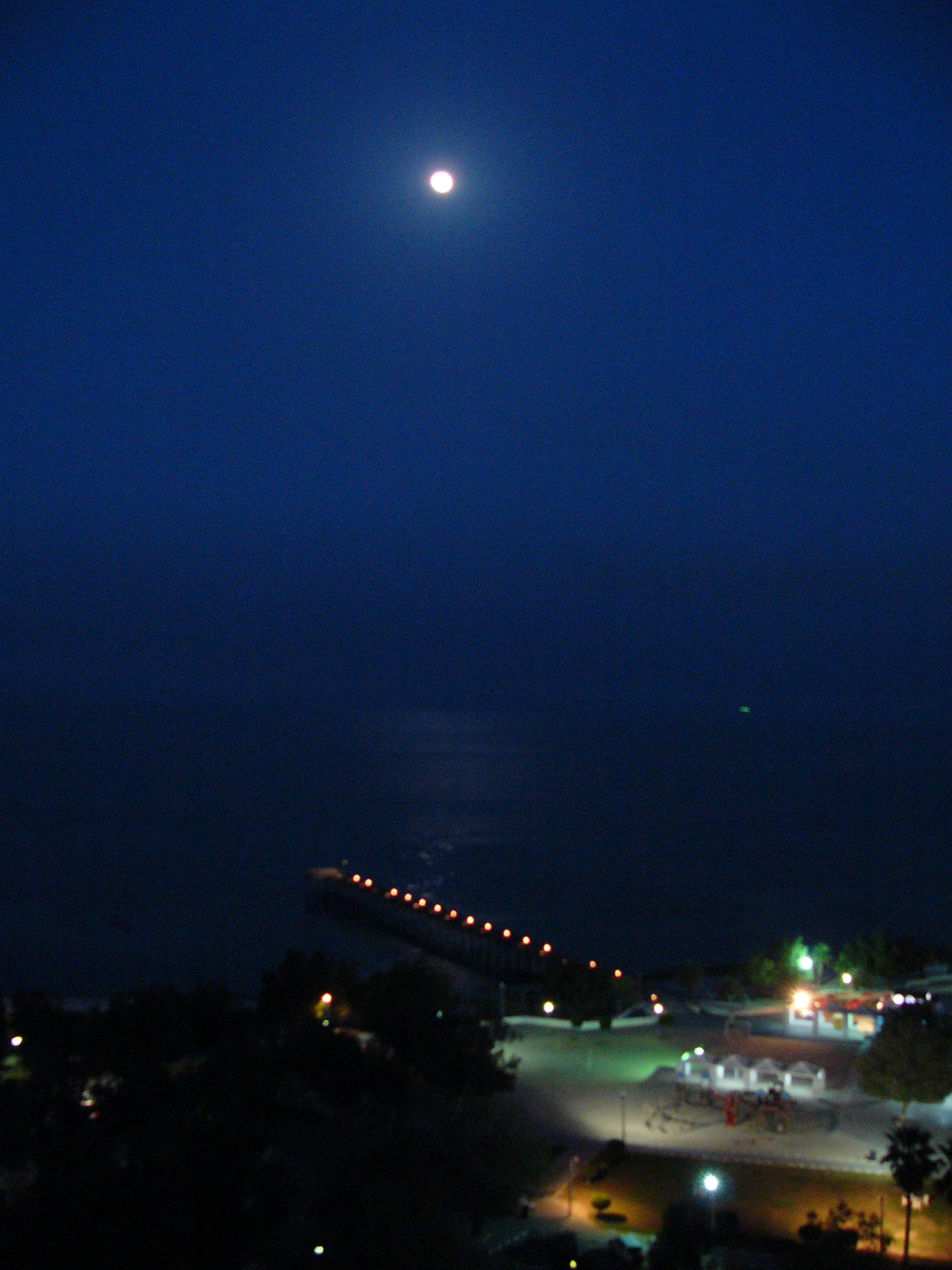
Scenes in Al Fintas

AdventureMan would never go out on our balcony. We would watch other high rises going up and know that the concrete was poured at night, but it was still very hot, the concrete often had more sand than was good, and many of these buildings are built at sea level. Like the collapsing buildings in Miami, we often had salt water in our underground parking garage. I had thought I could care for the apartment on my own, but the seals on the windows could not keep out the sand, and every day the tile floors were gritty with it. I couldn’t keep up. I was lucky to find a wonderful woman to help me; she also helped me understand many of the realities for expat-labor in Kuwait.

Some of the labor practices were horrifying. Kuwait and very modern laws and standards. Kuwait also has a system called “Wasta” which sort of translates to “who you know/who has influence” and depending on your “wasta” the standards may or may not have been maintained. Also, the fine, ever-present air-born sand creates engineering and maintenance difficulties that we can barely imagine.

We came to admire the laborers very much. They had a hard life. Most were sending everything they could back to families in their own countries, mostly to feed their families and to educate their children. Some were badly treated, some did not have jobs. You get used to thinking in a different way. We had regular beggers, men who waited outside our favorite restaurants knowing we would give them our bag full of food on our way back to the car. There were, of course, scammers, but most who asked for food or money were grateful, in a dignified way, for anything we could share. These men are building a fish trap – there is a way in, but no way out. It was fascinating to watch it being built.
In the late 1960’s, early 1970’s, Kuwait monitored their best male students, and sent these young men to study in different countries. Many went to the US and UK, and being young men, found themselves the kind of adventerous wives who would dare to marry a dashing foreigner and go to live with them in their country. (That is a topic for a whole other blog entry!)
I was fortunate to be friends with many of these women, who in turn introduced me to Kuwaiti women. These were all very fine women, a lot of fun, educated and skilled and sophisticated. It thrilled my heart to be an aging woman who still had so much to learn, and was blessed with these spirited mentors.
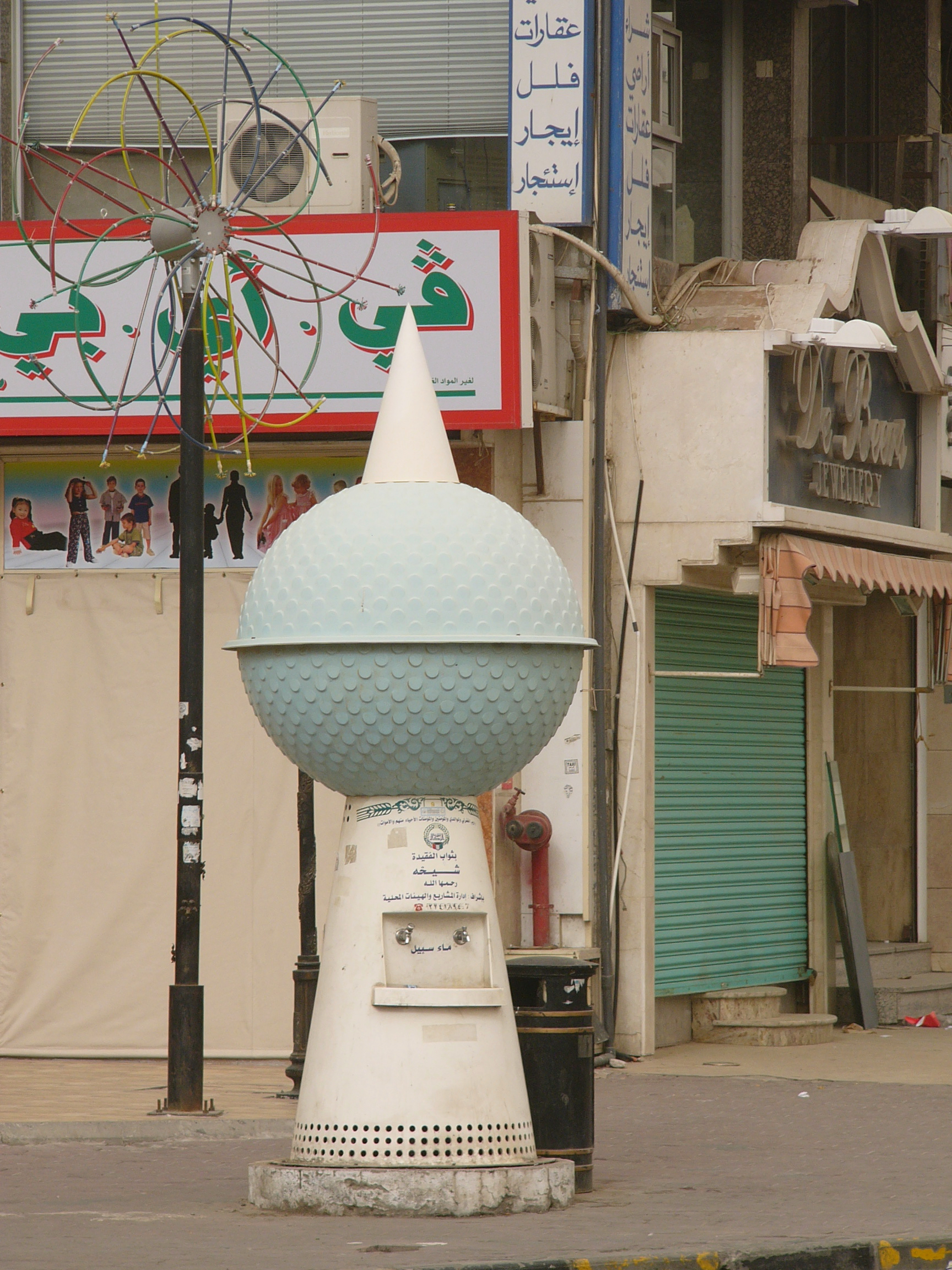
Below is a refrigerated water supply tower, put on the street by a generous and religious person to bless those who do not have access to cool water. You see them everywhere. I hope our country never becomes so desertified that we need to install these. I always loved that they are so joyful, so exuberantly creative. They are not only functional, they came in many different sizes, styles and shapes, and they always made me smile. This is what I call giving cheerfully!
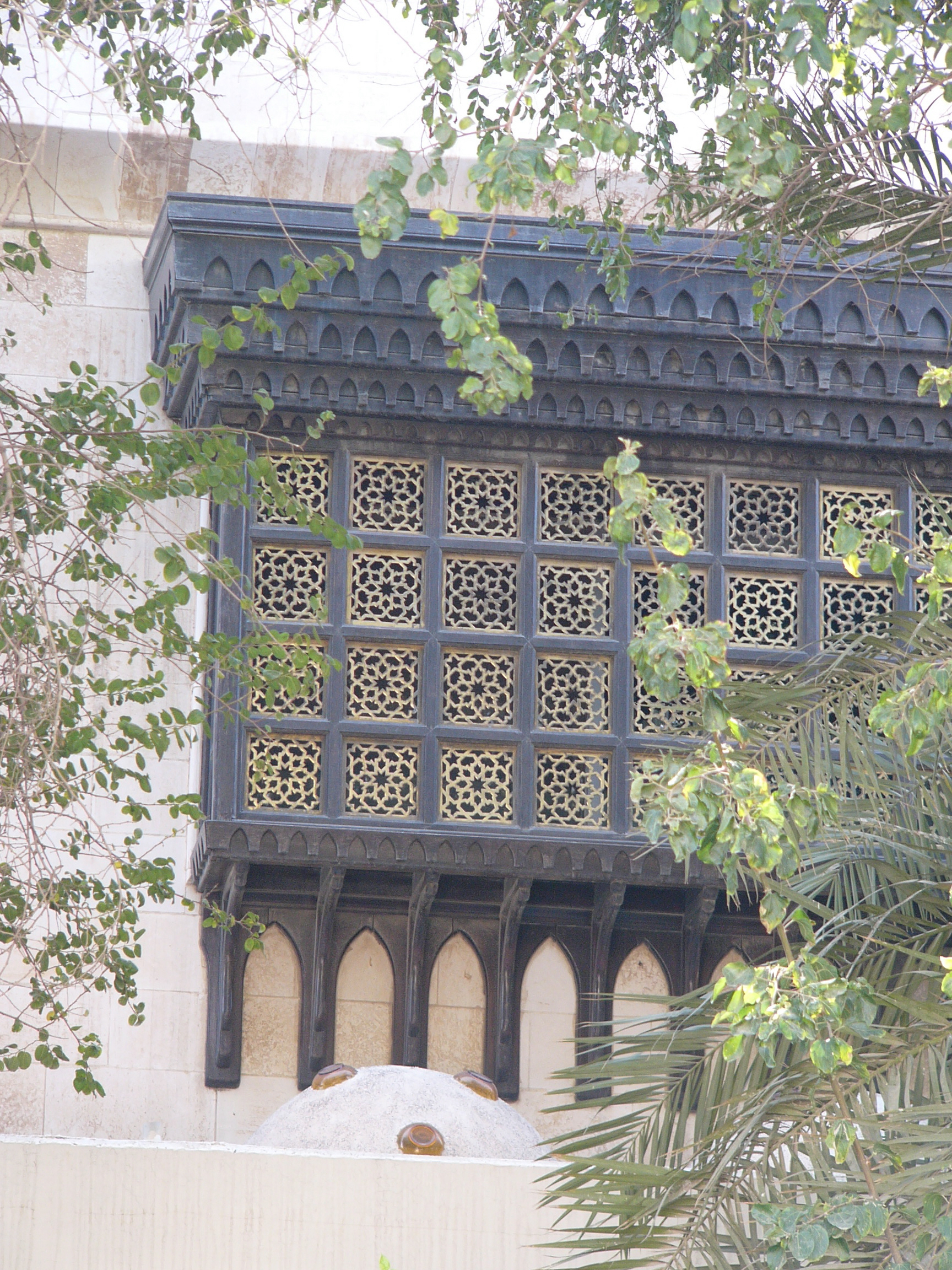
Kuwait was often beautiful. Below is a window called meshrabiyya, it provides light; it also provides privacy for the viewer. Many buildings in Kuwait incorporate homages to earlier architectural traditions.
“Regrets, I have a few . . . ” Mostly I don’t wear a lot of jewelry, mostly just earrings I pick up on my travels. My son was getting married; I offered to help the bride with bridesmaids gifts and a Kuwaiti woman guided me to the old gold souk where a jeweler made these necklaces for me, raw emeralds and pearls. I did not get one for myself. I wish I had! You could find real treasures, original and nothing less than 18K and real gems. The workmanship was exquisite.

One of the great joys for us was the Magreb (sunset) call to prayer. Everywhere in Kuwait there were mosques on almost every block. At sunset, each would have a call to prayer. They started seconds apart, so there was a sort of lovely cacaphony of sound, voices raised praising God and reminding everyone to worship and praise. We would watch the light change as the sun set and listen to this marvelous sound.

So many mosques! So like Pensacola! Some were small and simple, some larger and ornate and a few gigantic mosques. I think of Kuwait early in the morning when one church, I think the downtown Presbyterian church, has a carillon concert. It’s not the call to prayer, but it’s the same idea, calling our hearts to be thankful for our creation.
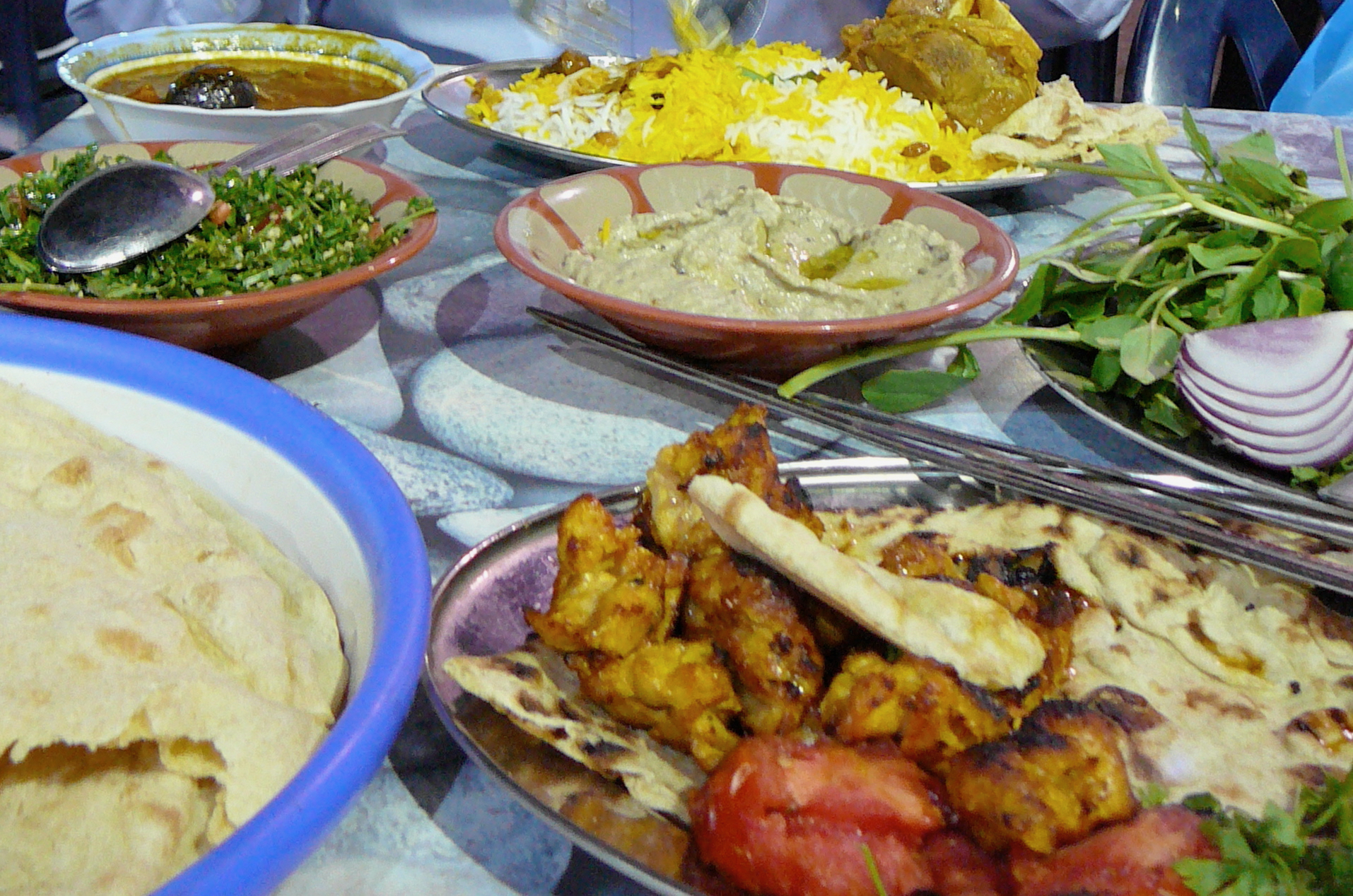
And now, my favorite haunt in Kuwait, the Mubarakiyya. Mubarak is blessing, and the Mubarakiyya was a blessing to me. This is where we would go for the best dates (the dates you eat, and entire street of date vendors), cottons and fabrics for our stitching and clothing (no Macy’s in Kuwait), and for some of the best eating in Kuwait. The stalls and kitchens were miniscule, most had outdoor seating, and the food was FRESH. Our friend Mohammed said that the reason the tea was so good (the large brass pot sitting on a heater at our table) was that they never washed the pot, so it had an aged tannin flavor, LOL. We would eat Kuwaiti shrimp, mezze, and oh, the freshly baked bread. We would take our visiting experts to this souk, a place they might never otherwise experience, and thrill their hearts with the sights and sounds and smells.



I didn’t always have a great view, and driving home one night alone in the middle of a sandstorm is one of lifes most adrenalin filled moments. You can’t see, and you can’t breathe.

I will end this with a big smile. Near the Kuwaiti airport was a store that sold electric palm trees. AdventureMan told me that he’s always wanted one and threatened to buy one to bring back and put in our yard in Edmonds, or Pensacola. Horrified, I just let it slide, and it never happened . . .

Tales from Before the Blog
Tonight we were eating Indian food, and talking about some of the truly great Indian restaurants where we had eaten in Doha. Our two favorite had separate veg and meat sections, and one, The Garden, even had them on two separate floors. The other, the Welcome, was a wonderful place, a place I would never dare to take my mother but a place we often went with friends. Once, we took another couple we liked, and we started with chots and dosas, and then ordered entrees. When the bill came, AdventureMan picked up and the other man objected – but only momentarily; AdventureMan showed him the total bill was 44 Qatari Dinar – somewhere around ten dollars.
Both The Welcome restaurant and the Garden were torn down to make way for a grand new walking street going down to the Souq al Waqif. We never saw prices like that again, or that kind of Indian-comfort-food-at-low-prices.
One story led to another.
“Take Her! Take Her!”
AdventureMan preceded me to Doha; I stayed behind and packed out, found new renters for our apartment, sold my car and arranged for my diabetic cat to fly with me to Doha.
When I got to Doha, I showed the veterinary papers showing Morgaine had the veterinary papers in order, but, as it turned out, I had not requested permission from the Qatar Department of Animal Health to bring in my cat, so I would have to leave her until I got permission. I discussed this politely with the customs official, a young soldier, and then I started pulling out my packets of syringes and vials of insulin, and I explained to him that she needed X amount of insulin injected at such and such a time, two times a day.
He looked at me in utter horror and said “Take her! Take her!” and I didn’t wait a single second but got everything back in my bag and walked out as fast as I could with my unpermitted cat. Things were easier then; there were always men with carts eager to take all your bags, so all I had to do was grab the cat and run.

“She’ll Have to Sign a Waiver”
No sooner had I arrived in Doha than a car showed up at my villa, a car I hadn’t requested nor chosen, but I guess the car I was meant to have. I had to learn to think in a whole new way. It was a really good thing I had the car because Operation Enduring Freedom was breaking out, and I knew I might not see my husband again for a while. He took an hour off the day after I arrived to show me where two grocery stores were; the one near us for the basics, and the French Carrefour, across town, but worth the drive.
But the company was horrified I wasn’t leaving. “We’ll pay your passage!” they said. “You can go anywhere! You don’t want to stay here, war is breaking out.”
I had just gotten to Doha. I was settling in. I had my abaya and scarf from our time in Saudi Arabia, and I knew the way to the airport; I could walk if I had to. My niece, Little Diamond, was coming to stay with me. We both spoke some Arabic, she spoke more than I did. I wasn’t afraid, and I didn’t want to leave.
“She’ll have to sign a waiver,” they told AdventureMan. I signed the waiver.

There were some dangers. While the USA and allies were gearing up to help the Kuwaitis take back Kuwait from the Iraqis, not everyone was on board. We learned to alter our body language, to walk and speak quietly, not to draw any attention to ourselves. We did our shopping calmly and efficiently. Even so, on occasion there was an occasional shop clerk who might ignore me and refuse to wait on me, but those occasions were rare, and the occasions of great hospitality from local citizens were many.

The day the war started, my sweet cat died. She had problems breathing early in the day, so I took her to the vet. Going to the Vet in Doha was not like any going-to-the-vet I’ve ever experienced before; you go, you sign in, you sit, if there is a chair left, and you wait your turn. It doesn’t matter how sick your animal is. It was chaos. Many people got very emotional and wanted to be taken out of turn. When I got to see the vet, who was always very kind, he gave her a shot and said “Now she will feel better.” I told him I thought she was close to the end, and he said maybe or maybe not. I took her home.
About three hours later she came and lay next to me quietly and I knew she was saying goodbye. She started gasping again, so I put her n her cage and drove as quickly as I could to the vet, but it was Friday afternoon, the day everything closes for mid-day prayer, he was closed, and could not be reached. By the time I got home, she was dead.
So the war is starting, my cat has died and I am not in a rational place. AdventureMan called and my niece talked to him. I think she told him the cat had died and I thought there was a chance it might just be a fit and she might come back to life, which was true. AdventureMan came home, I don’t know how he did it, but he did, and we drove out to the desert and buried our cat. He brought me back home and went back to the base and I didn’t see him for a while, except on television; as the CNN reporter stood in front of a sign at the press center on base, my husband sauntered behind him and gave me a wave. We still laugh about how he took a break to bury our cat just when war was about to break out, but managed to get back in time for the opening. He showed up when it mattered.
Welcome to Doha.
Afghani Interpreters Begin Arriving
First group of evacuated Afghan interpreters arrives in US
from BBC News
(This morning, Adventureman’s heart is lighter. He is a Vietnam vet, and for many years has carried the guilt of our country having left behind so many people who worked with our forces so loyally, and suffered terribly when we pulled out. While we believe Afghanistan was not a winnable war (just look at history), he had anxiety that once again we would leave our allies behind.
We have a soft spot for Afghanistan. While we worked with the Department of State, way back before the Taliban, Afghanistan was considered by many to be a great post. The Afghani people were educated, and had a long and fascinating history. Afghani food is delicious. Day trips around Afghanistan opened people’s eyes to new ways of thinking and doing things. Even the Afghan clothing was comfortable and loose, perfect for the great heat of the summers. Friends who had served in Afghanistan shared wonderful stories and memories, and would gather for “Afghan Night” where they would prepare food for 100 of their best friends, of which we were honored to be included.
So to read that the first flight of interpreters and their families have arrived gave us great hope. Hope for a new group of citizens in our country who will work hard and share the gifts of their heritage, hope for their wives and daughters who we know to be amazing women, and hopes that one day there might be an Afghani restaurant in Pensacola!)
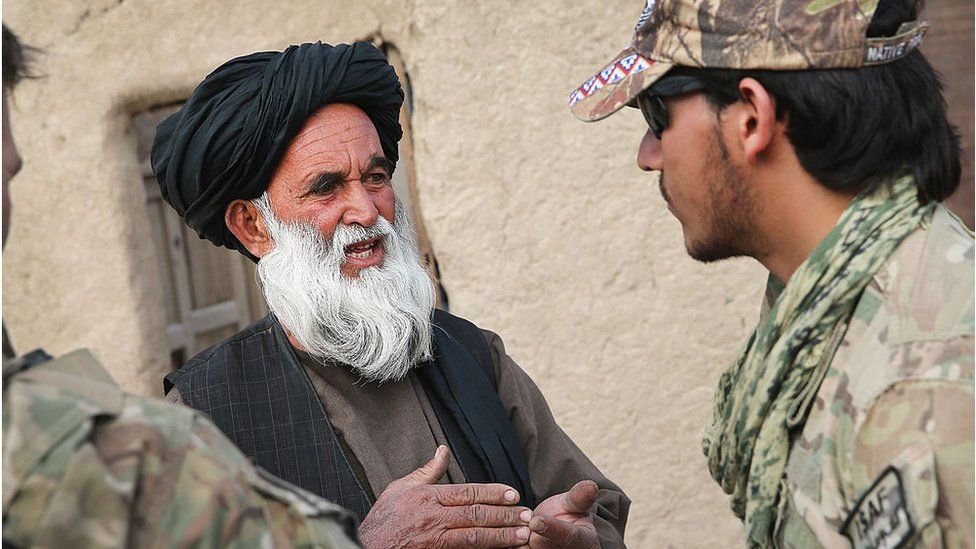
About 200 Afghan interpreters and their families have arrived in the US – the first of a group of 2,500 Afghans being evacuated as the Taliban advances.
The interpreters are being resettled under a visa programme for those who worked with the US during the recently ended 20-year war with the Taliban.
They arrived in the early hours of Friday morning and were taken to Fort Lee military base in Virginia.
They are expected to stay there for around a week while they are processed.
In a statement, US President Joe Biden called the arrivals “a milestone” and “the first of many” as US authorities work to relocate eligible Afghans out of harm’s way.
Afghans eligible for Special Immigrant Visas (SIV) will be transported either to the US, American facilities abroad or to third countries while they finish their applications. The most recent arrivals have already completed an extensive vetting process.
On Thursday, the US Senate approved more than $1bn (£719m) to pay for the evacuations, including housing and transportation.
The bill would also loosen applicant requirements and allow for 8,000 more visas in addition to the ones already allocated for.
The Taliban have been advancing Afghanistan following a decision by Mr Biden to withdraw the remaining American troops from the country.
With those advances have come danger to those who worked alongside US troops during the two-decade conflict.
Since 2008, approximately 70,000 Afghans have been resettled in the US on an SIV .
Last week, a senior state department official said that the total number of visa applicants now stands just over 20,000. About half have yet to complete the first steps of the process.
Those yet to go through the process face potential threats in attempting to secure a visa. Mike Jason, a former US Army battalion commander who was deployed to Afghanistan, told the BBC that travelling across Taliban-controlled areas with the documentation needed for SIVs puts interpreters in “mortal danger”.
“That’s basically an entire confession that you’re an interpreter working for the Americans. We’re asking them to travel with the evidence,” he said.
Not-for-profit group No One Left Behind estimates that at least 300 Afghans or their family members have been killed for working with the US.
The Taliban were removed from power by the US-led invasion in 2001, following the attacks on the World Trade Centre in New York.
Fighting between the insurgent Taliban and Afghan government forces has increased over the past two months as international troops pull out of the country.
Seek the Welfare of the City
Jeremiah 29:1,4-7
29These are the words of the letter that the prophet Jeremiah sent from Jerusalem to the remaining elders among the exiles, and to the priests, the prophets, and all the people, whom Nebuchadnezzar had taken into exile from Jerusalem to Babylon. 4Thus says the Lord of hosts, the God of Israel, to all the exiles whom I have sent into exile from Jerusalem to Babylon: 5Build houses and live in them; plant gardens and eat what they produce. 6Take wives and have sons and daughters; take wives for your sons, and give your daughters in marriage, that they may bear sons and daughters; multiply there, and do not decrease. 7But seek the welfare of the city where I have sent you into exile, and pray to the Lord on its behalf, for in its welfare you will find your welfare.
We are about to embark on a trip, and as I read the Lectionary readings this morning, I found a verse I found comforting in my life as a nomad, the verse above.
We kept ending up in the Middle East. I wasn’t unhappy about it, but I did wonder why. I trust God has a plan for each one of us; even late in life, however, mine appeared fuzzy, if not opaque. What was the purpose?
The verse above comforted me; I didn’t need to know my purpose, I just needed to live my life, and to pray for the people in the places we were posted. When you pray for people, you find yourself mixed in their lives, they become more real, more understandable. The exiles found themselves in an alien environment, and the Lord tells them to marry, build houses, plant gardens, live normal lives AND to seek the welfare of the alien country and the alien people among which they find themselves. It resonates in my soul.
Pantone Colors for Spring and Summer 2021
I love color. I work with color in my quilting. To me, color makes all the difference, and one of the best part of living in different cultures introduced me to widening my ideas about what colors can be used together. We all differ in our preferences. I don’t have to like all these colors, but there is one I like a lot.
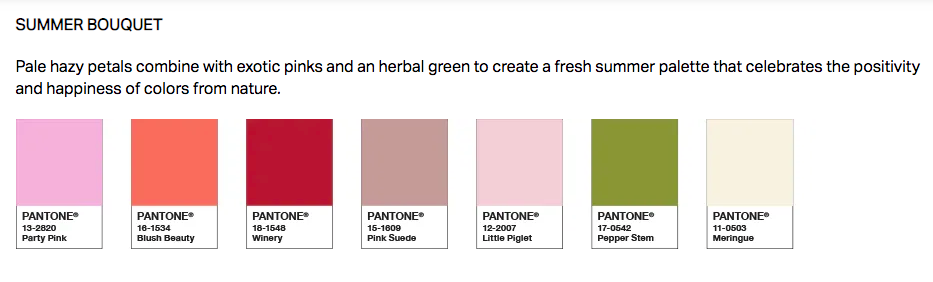


The one I like a lot is called Fairy Wing. I would have called it Rose Quartz; I’ve always loved the subdued natural stone. My Mom’s best friend in Alaska had a fireplace surround made out of Rose Quartz; it was a knock-out. I think countertops of Rose Quartz would be gorgeous.
Elizabeth Peratrovich

Sometimes I can get a little paranoid, and today was one of those times. Look at that gorgeous Google doodle for today. I spend a certain amount of time looking at Alaskan legend as a source of art images for my quilting, so when I saw the Google doodle, I thought it was one of those targeted things.
Not so.
As it turns out, it is a doodle honoring an Alaskan Tlingit woman, Elizabeth Peratrovich. I’ve taken the following from Wikipedia (to which I donate, so I am comfortable sharing what they have to say. I love that it is updated to show today’s doodle.) This woman was something special:
Elizabeth Jean Peratrovich (Tlingit name: Kaaxgal.aat; July 4, 1911 – December 1, 1958) was an American civil rights activist and member of the Tlingit nation who worked for equality on behalf of Alaska Natives.[1] In the 1940s, her advocacy was credited as being instrumental in the passing of Alaska’s Anti-Discrimination Act of 1945, the first state or territorial anti-discrimination law enacted in the United States in the 20th century. In 1988, the Alaska Legislature established February 16 as Elizabeth Peratrovich Day “for her courageous, unceasing efforts to eliminate discrimination and bring about equal rights in Alaska” (Alaska Statutes 44.12.065).[2] In March 2019, her obituary was added to The New York Times as part of their “Overlooked No More” series.[3]
Early life and education
Elizabeth Peratrovich, whose name at birth was Kaaxgal.aat[4], was born on July 4, 1911, in Petersburg, Alaska,[5] as a member of the Lukaax̱.ádi clan in the Raven moiety of the Tlingit nation. When she was young, she was adopted by Andrew and Jean Wanamaker (née Williams), who gave her the name “Elizabeth Jean”.[6][7] Andrew was a fisherman and Presbyterian lay minister. The Wanamakers raised Elizabeth in Petersburg, Klawock, and Ketchikan, Alaska. Elizabeth graduated from Ketchikan High School, and then attended Sheldon Jackson College in Sitka, and the Western College of Education in Bellingham, Washington (now part of Western Washington University).[a] In 1931, Elizabeth married Roy Peratrovich (1908-1989), who was also Tlingit, as well as of Serbian ancestry.[9]
Activism
In 1941, while living in Juneau, Alaska, Elizabeth and Roy Peratrovich encountered discrimination in their attempts to secure housing and gain access to public facilities. They petitioned the territorial governor, Ernest Gruening, to prohibit public places from posting the “No dogs or Natives allowed” signs that were common in Alaska during this time.[citation needed]
The Anti-Discrimination Act was proposed by the Alaska Native Brotherhood and the Alaska Native Sisterhood, but the first attempt to pass this legislation failed in 1943.[citation needed] However, in 1945, Roy and Elizabeth Peratrovich became the Presidents of the Alaska Native Brotherhood and the Alaska Native Sisterhood, respectively, and lobbied the territory’s legislators and Governor Gruening to pass the act.[citation needed]
Before the territorial Senate voted on the bill in 1945, Elizabeth Peratrovich, representing the Alaskan Native Sisterhood, was the last to testify, and her impassioned speech was considered decisive.[10] Responding to territorial senator Allen Shattuck of Juneau, who had earlier asked “Who are these people, barely out of savagery, who want to associate with us whites, with 5,000 years of recorded civilization behind us?,” she stated:[11]
I would not have expected that I, who am barely out of savagery, would have to remind gentlemen with five thousand years of recorded civilization behind them, of our Bill of Rights.[12]
Fran Ulmer, who represented Juneau in the Alaska House of Representatives (and who later became lieutenant governor of Alaska), in 1992 said the following about Peratrovich’s testimony:
She talked about herself, her friends, her children, and the cruel treatment that consigned Alaska Natives to a second-class existence. She described to the Senate what it means to be unable to buy a house in a decent neighborhood because Natives aren’t allowed to live there. She described how children feel when they are refused entrance into movie theaters, or see signs in shop windows that read “No dogs or Natives allowed.”[12]
The Senate voted 11-5 for House Resolution 14, providing “…full and equal accommodations, facilities, and privileges to all citizens in places of public accommodations within the jurisdiction of the Territory of Alaska; to provide penalties for violation.”[11] The bill was signed into law by Governor Gruening in 1945, nearly 20 years before the US Congress passed the Civil Rights Act of 1964. Acts of the territorial legislature required final approval from the U.S. Congress, which affirmed it (Bob Bartlett, Alaskan delegate, was known for his efficiency in passing legislation). Alaska thus became the first territory or state to end “Jim Crow” since 18 states banned discrimination in public accommodations in the three decades following the Civil War; not until 1955 would two more states, New Mexico and Montana, follow suit.[13]
The Peratrovich family papers, including correspondence, personal papers, and news clippings related to the civil rights work done by Elizabeth and Roy Peratrovich, are currently held at the Smithsonian National Museum of the American Indian.[14]
Personal facts
On December 15, 1931, Elizabeth married Roy Peratrovich (1908–1989), also a Tlingit, of mixed native and Serbian descent who worked in a cannery.[citation needed] They lived in Klawock, where Roy was elected to four terms as mayor.[citation needed]
Looking for greater opportunities for work and their children, they moved to Juneau, where they found more extensive social and racial discrimination against Alaska Natives. They had three children: daughter Loretta, and sons Roy, Jr. and Frank.[11]
The Peratrovich family later moved to Antigonish, Nova Scotia, Canada, where Roy pursued an economics degree at St. Francis Xavier University.[citation needed] From there they moved to Denver, Colorado, where Roy studied at the University of Denver.[citation needed] In the 1950s, the Peratroviches moved to Oklahoma, and then back to Alaska.[citation needed]
Elizabeth Peratrovich died after battling breast cancer on December 1, 1958, at the age of 47.[15] She is buried at Evergreen Cemetery, Juneau, Alaska, alongside her husband Roy.[citation needed]
Her son, Roy Peratrovich, Jr., became a noted civil engineer in Alaska. He designed the Brotherhood Bridge in Juneau, which carries the Glacier Highway over the Mendenhall River.[16]
Legacy and honors
- On February 6, 1988, the Alaska Legislature established February 16 (the day in 1945 on which the Anti-Discrimination Act was signed) as “Elizabeth Peratrovich Day,” in order to honor her contributions: “for her courageous, unceasing efforts to eliminate discrimination and bring about equal rights in Alaska” (Alaska Statutes 44.12.065).[17]
- The Elizabeth Peratrovich Award was established in her honor by the Alaska Native Sisterhood.[citation needed]
- In 1992, Gallery B of the Alaska House of Representatives chamber in the Alaska State Capitol was renamed in her honor.[12] Of the four galleries located in the respective two chambers, the Peratrovich Gallery is the only one named for someone other than a former legislator (the other House gallery was named for Warren A. Taylor; the Senate galleries were named for former Senators Cliff Groh and Robert H. Ziegler).
- In 2003, a park[18] in downtown Anchorage was named for Elizabeth and Roy Peratrovich. It encompasses the lawn surrounding Anchorage’s former city hall, with a small amphitheater in which concerts and other performances are held.[19]
- In 2009, a documentary about Peratrovich’s groundbreaking civil rights advocacy premiered on October 22 at the Alaska Federation of Natives convention in Anchorage. Entitled For the Rights of All: Ending Jim Crow in Alaska, the film was scheduled to air as a PBS documentary film in November 2009. The film was produced by Blueberry Productions, Inc. and was primarily written by Jeffry Lloyd Silverman of Anchorage.[20]
- In 2017, the theater in Ketchikan’s Southeast Alaska Discovery Center was named in honor of Elizabeth Peratrovich, and a companion exhibit exploring her role in the struggle for Alaska Native civil rights was unveiled.[21]
- In 2018, Elizabeth Peratrovich was chosen by the National Women’s History Project as one of its honorees for Women’s History Month in the United States.[22]
- On October 5, 2019, United States Mint Chief Administrative Officer Patrick Hernandez announced that Peratrovich would appear on the reverse of the 2020 Native American $1 Coin, making her the first Alaska Native to be featured on U.S. currency.[23][24][25]
- In December 2019, a 4-story apartment building called Elizabeth Place, named after Peratrovich, opened in downtown Anchorage.
- In July 2020, a new mural was unveiled in honor of Peratrovich in Petersburg Alaska.[26]
- On December 30, 2020, a Google Doodle in the United States and Canada honored Elizabeth Peratrovich. The Doodle was drawn by Tlingit artist Micheala Goade.[27]
Amazing Women Visiting Pensacola
When I first came to Pensacola, a woman at our church who is very welcoming and kind to newcomers told me she “wanted to find just the right place for me to plug in.” A couple of her suggestions were not exactly what I wanted, but then she introduced me to Jena Melancon, the founder and director of the Gulf Coast Citizens Diplomacy Council, and I found my niche.
Jena is an amazing woman. She has created this organization. She has a data base of resources that allow her to tailor visits for foreign delegates so that they can meet the needs of their missions – Election Transparency, Entrepreneurship, Environmental Protection, Leading an NGO, Military and Civilian Community Cooperation, Domestic Violence, Creating Fair Policies, Programs for Enriching Disadvantaged Children – you name it, Jena can create a program that will enrich their understanding from an American perspective.
At the same time, Pensacolians who come into contact with the delegates sent by the Department of State find that their lives are also enriched. Many times they, too, learn something new and unexpected. Both groups benefit.
Jena also has a group in GCCDC that studies Great Decisions, and creates events throughout the year for membership participation. Members of the Gulf Coast Citizens Diplomacy Council can volunteer in Jena’s office, can host dinners for delegates and have some one-on-one time learning about customs in another part of the world, can sponsor a Pensacola child in an international exchange, can host teenagers here on an international exchange, or attend the famous Mint Julep party in Spring. Many in the GCCDC are also resources; the exchange of ideas bringing inspiration to both sides.
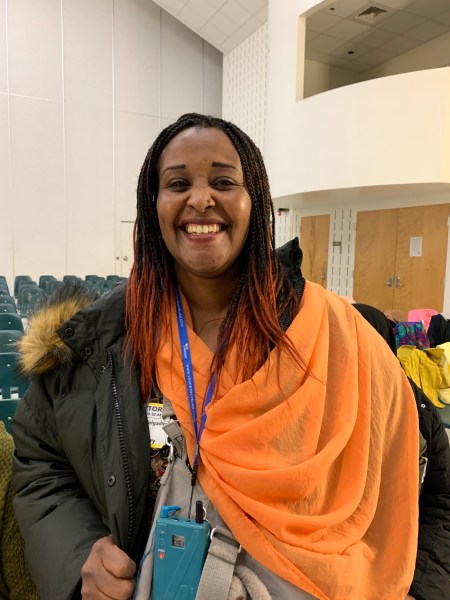
This week, I was honored to be able to work with a group of Women in Leadership, women from Chad, Iraq, Jordan, Saudi Arabia, Egypt and the Sudan. Each and every one of the women was a hero in her own right, making life better in their communities by stepping into leadership roles. Rehab, above, from the Sudan, works to empower women and to make the laws show greater equality in the treatment of men and women.

CPT Aseel is a police chief in Iraq.

Maki, from Chad, works to prohibit child marriages and female genital mutilation.

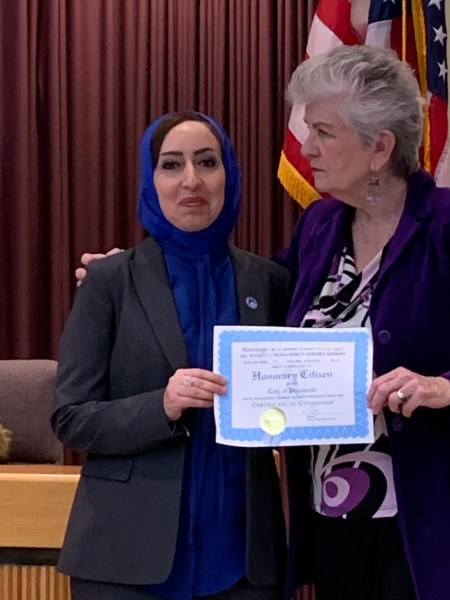
Mariam, from Saudi Arabia, is a high level journalist in the Saudi media industry, accepting honorary citizenship from the City of Pensacola city council chair Sherri Myers.
Wasfiya is a minister of parliament in Iraq.
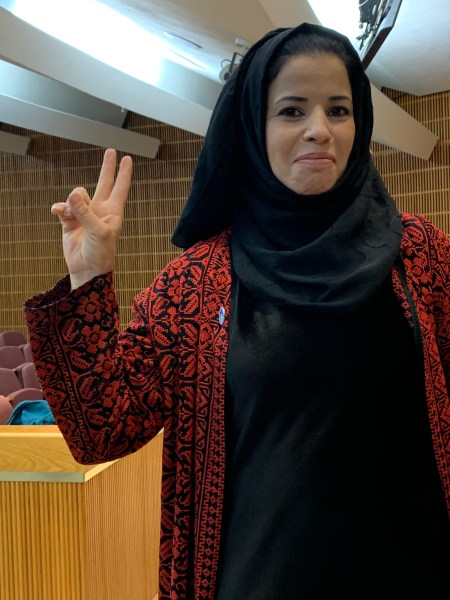
Ola is the delegate from Jordan.
I was honored to spend three days of my life with these women, and with Jena, and with other inspirational women of Pensacola at the Women in Leadership conference at UWF.
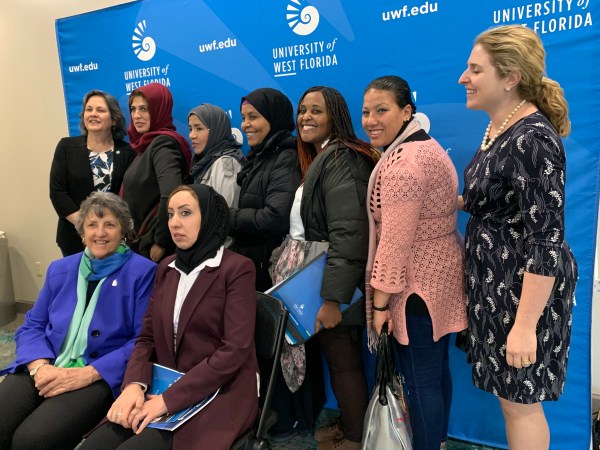
Here is most of the group with Judy Bense, President Emeritus of UWF, at the closing of the Women in Leadership conference, 2020. Life can be amazing when so many women of talent and confidence gather together to inspire one another.
Leaving the Perigord for Salers, in the Auvergne
Morning in Domme:

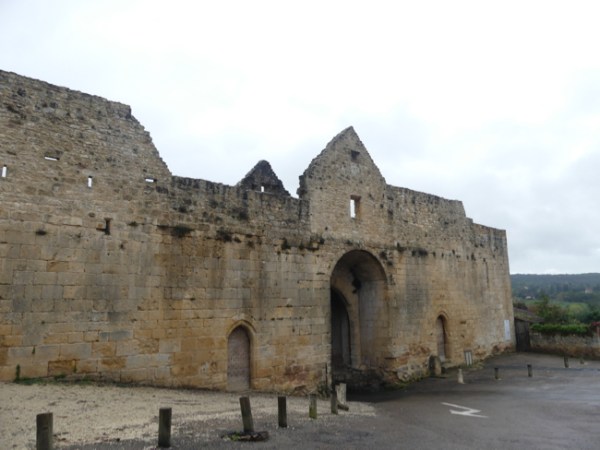
Major gate into Domme, the Porte de Tours:
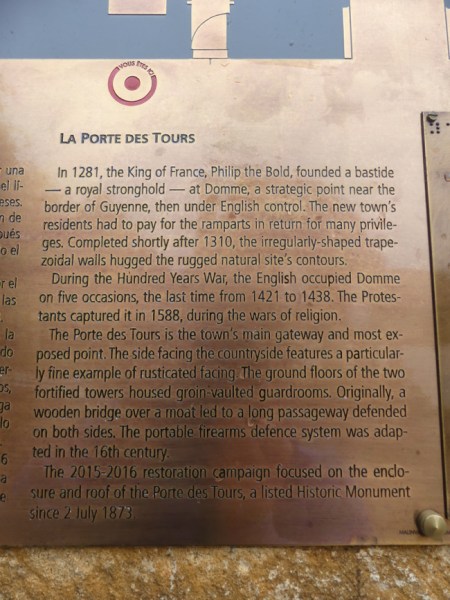
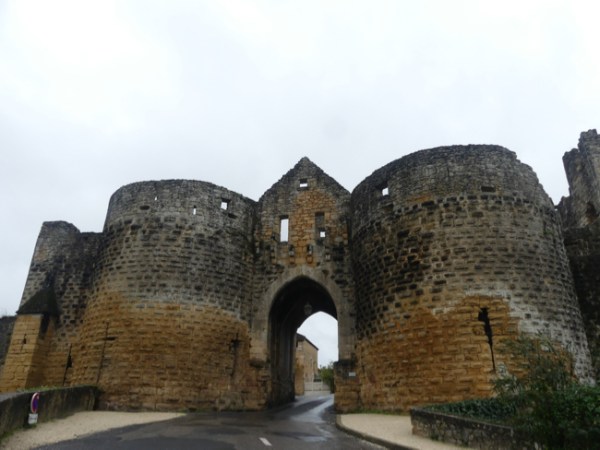
Around thirty five years ago, when our son was young, we visited this part of France, and spent a lot of time in the caves, and also at Castlenaud, a castle near Beynac with an impressive medieval war machines and weapons museum. It was July, and hot, and there were other visitors, but not a lot. Castlenaud was wired for sound, and the music was wonderful. I went to the ticket person and asked what the music was. It was Monteverdi, Un Concert Spirituel. Once back in Germany, I searched until I found it. It’s one of my favorite CDs to this day. I learned a little more about Monteverdi, that he was sort of the Jimi Hendrix of his day, mixing human voices in ways they had never been mixed before.
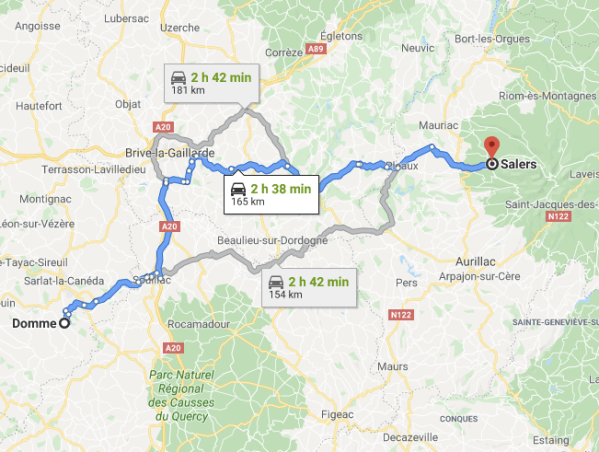
Here is a close up of one section. It is mountainous. The roads are tiny!
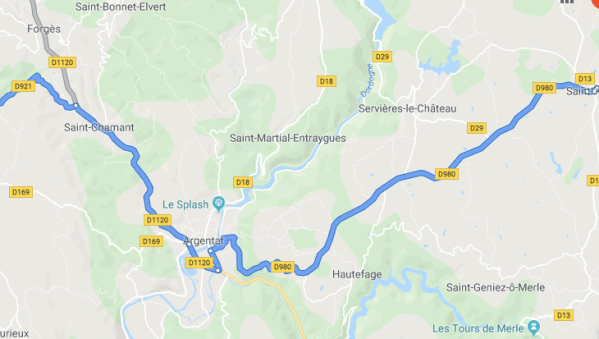
On our way to Les Eyzies, and Castlenaud, on that trip, we spent the night in Salers. I knew nothing of Salers other than that the town was roofed in slate; it was a poor area, but rich in slate.

We had stayed at a hotel called Hotel Les Remparts, which had a fairly simple menu with steaks from local cows; many of these same cows were in the valley below the hotel, busy munching and making the milk which goes into the famous Cantal cheese.
As the three of us walked through Salers after dinner, we came to a church entry where the door was open, and maybe five to seven people were in a candle lit entry hallway singing old sacred music – sounded a lot like Monteverdi, with wonderful echoes bouncing around off the old stone wall. It was magical. Even our ten year old son was spellbound.
It was a little bit of a drive from Domme, three hours, but I really wanted to visit that hotel once again.
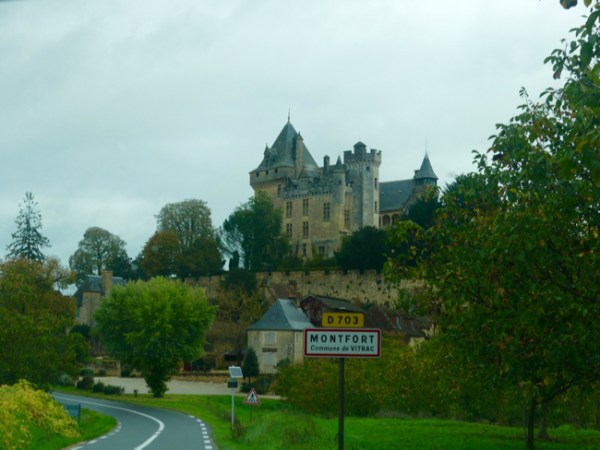
Once again, Google took us on some very strange roads until my husband begged me to use the map and stick to the main roads. Honestly, he was right. We had been on some mountain roads, one lane, with French drivers going must faster than we were comfortable. And here’s the thing. The French used to be crazy drivers, with terrible wrecks, and now, we can hardly believe it, but there has been a huge cultural shift and the French are law-abiding, safe drivers. We knew on these narrow, single-lane roads, with no protection from steep drop-offs, that WE were the problem, and I agreed with my husband, and we kept to the larger roads.
French bikers along the route:

(very careful, well-behaved bikers)
Even so, it took us longer that we had hoped, or maybe it seemed longer.
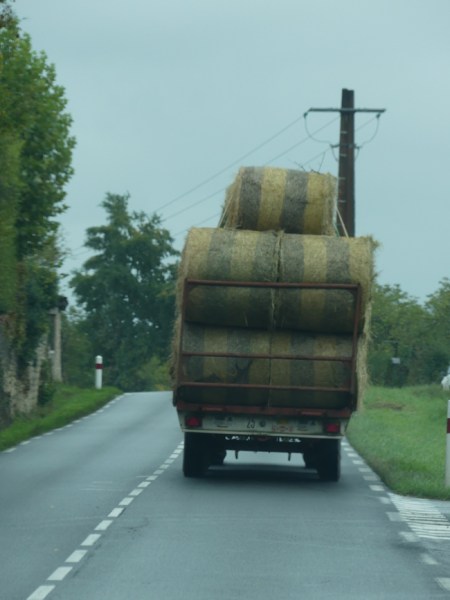
At one point, I remember AdventureMan pulling over and saying “Take that picture! It may be the only sun we see all day!” and he was right, it was drizzly and very dreary, and it colored our impression of the drive.

Our first sighting of one of the slate roofs. Can you see why I love them? Look how lovingly they have been cut to have a curved bottom. I try to imagine how to cut slate so that the thicknesses are so much alike.

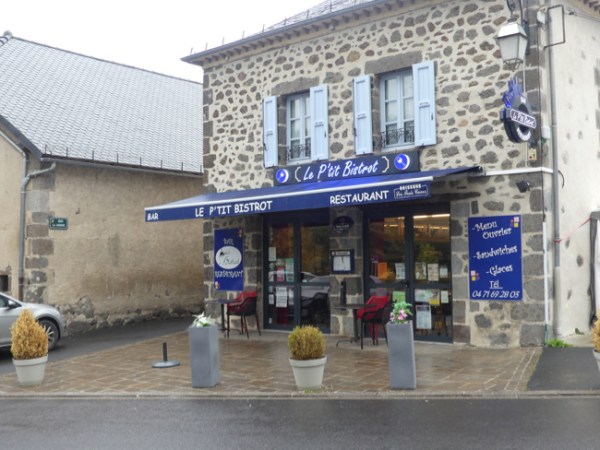
We are getting near to Salers, but we are tired and we need to stop. We stop in St. Martins, at a hotel and they tell us no, they don’t serve until dinner but that is a really good little Bistro just off the main road to Salers, and to stop there. We do, at Le P’tit Bistrot. The place is packed, but the waitress likes us. “You are American?” she asks, with a big smile. Some customers are leaving and she puts us at that table, and cleans it off.
“I’ll check with the chef to see what is left,” she tells us, and hurries to the kitchen. Coming back, she points to the daily special and tells us we are in luck, that there is still a little left. It is turkey. We are hungry. Fine with us.
This stuffed tomato was wonderful! Tasty, and artistically done. Simple salad, good local bread.

I apologize. We really were hungry. It’s a good thing my husband reminded me I had not taken a photo. The turkey was perfect, moist and fork-tender, with a home made gravy. Even the rice has flavor. So simple, and so good.

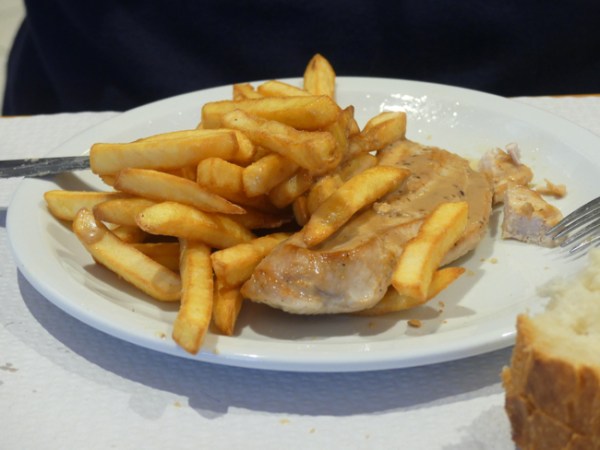
AdventureMan had french fries (actually, pommes frites) with his, and said they were hot and fresh.
The rain had not let up as we left (pardon the splotch on my lens) St. Martin’s.

And we arrive at the Hotel Les Remparts in Salers – still raining.
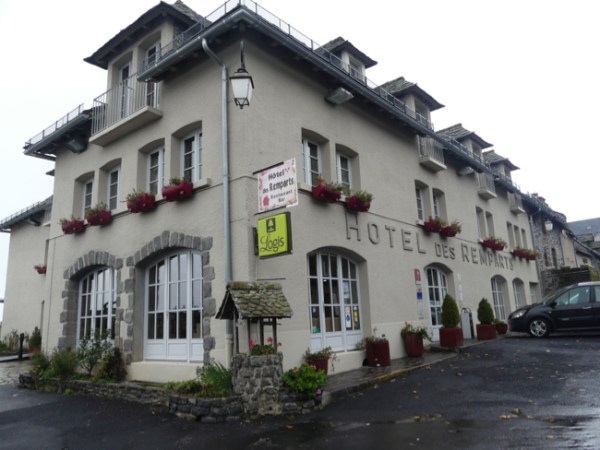
As we checked in, we could hear cow bells. When we got to our room, we opened the windows and the cow bells were so loud, I thought maybe it was a recording. No, then we spotted the cows, and as they munched the grass and raised their heads, the tinkle was incessant, in a good way. I loved the sound of those bells.

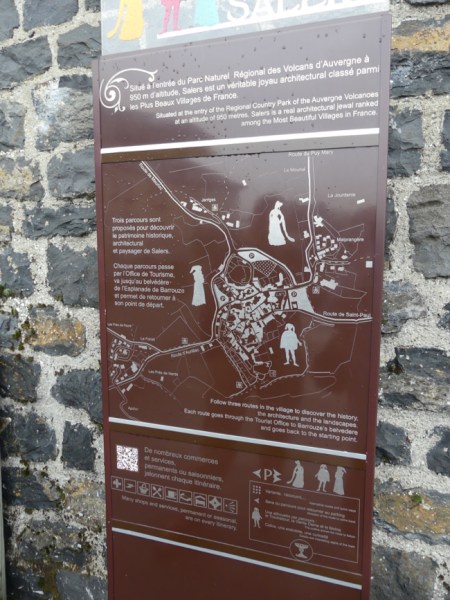
Salers is wonderful for walking, even though today it is a little dreary, and the cobblestones are slick. Salers is a little isolated, tourist season is over, and it is October 31st, which we think of as Hallowe’en, and it is in France, too, but it is also the night before All Hallows Day, which is a French national holiday, in the solemn religious sense of the word holiday. Almost everything will be closed.
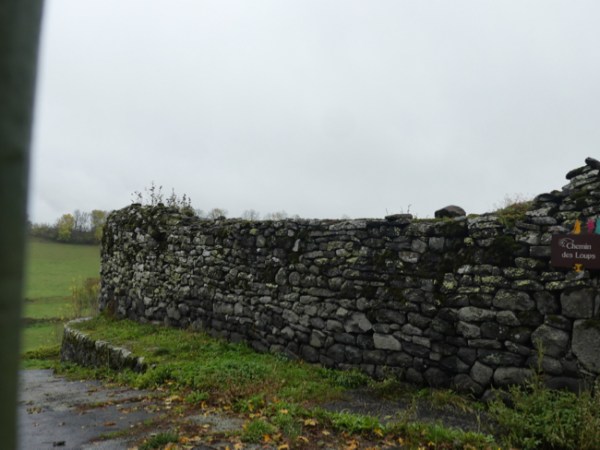

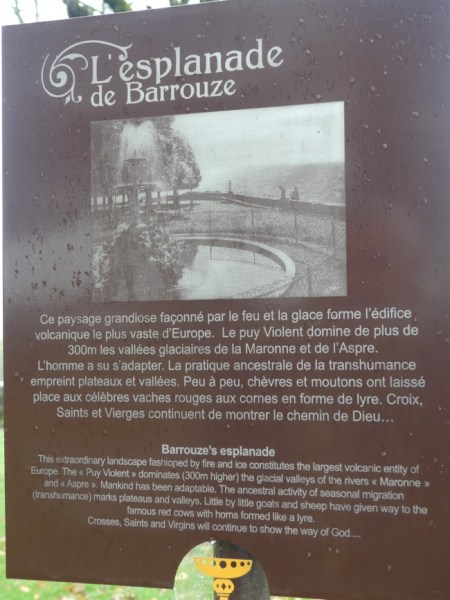
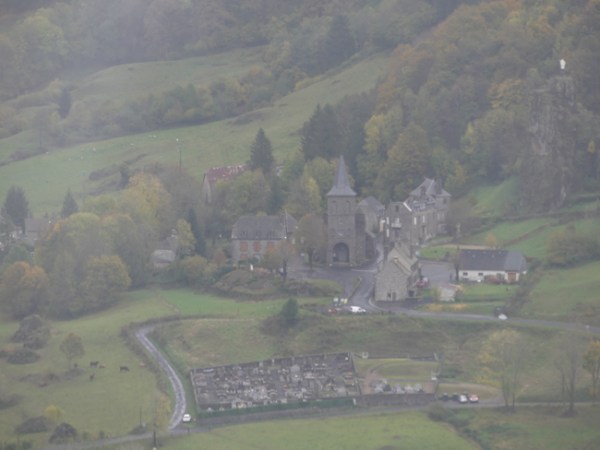


Just before dark, the sun lights up the clouds and we have a little brightness:
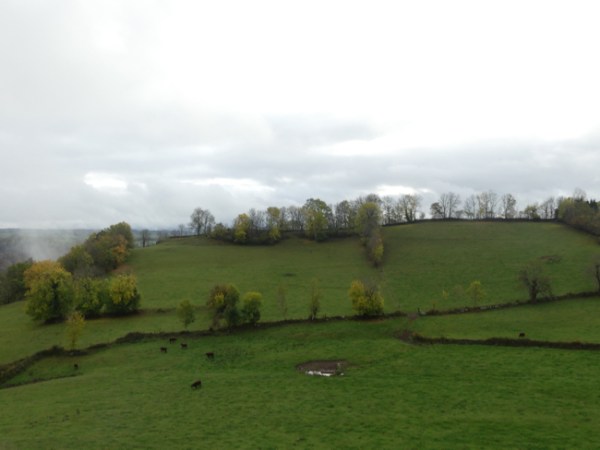
You can dimly see the cows.

There is a little white cat in the bottom right of this photo, as some hotel guests’ window saying “please, please, can I come in?”
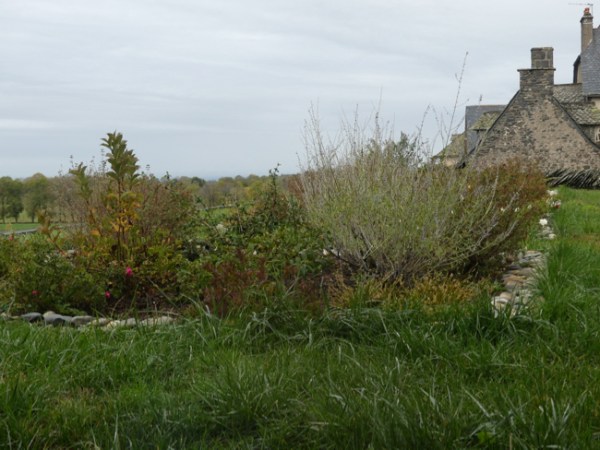
What I had originally been photographing was this roof, all planted with greenery and herbs, but the cat distracted me 🙂
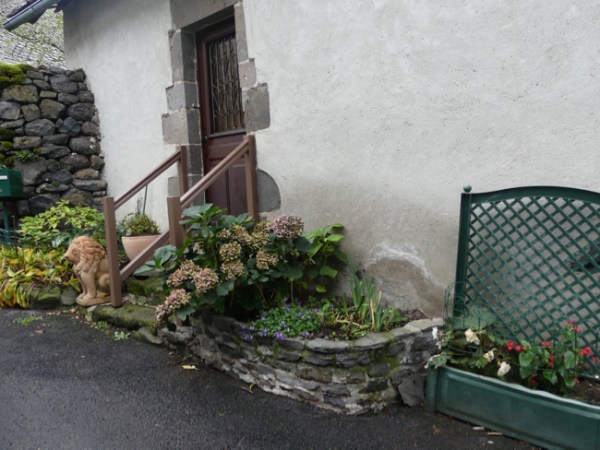
I love the way the French will find a way to grow a garden in the tiniest spot.
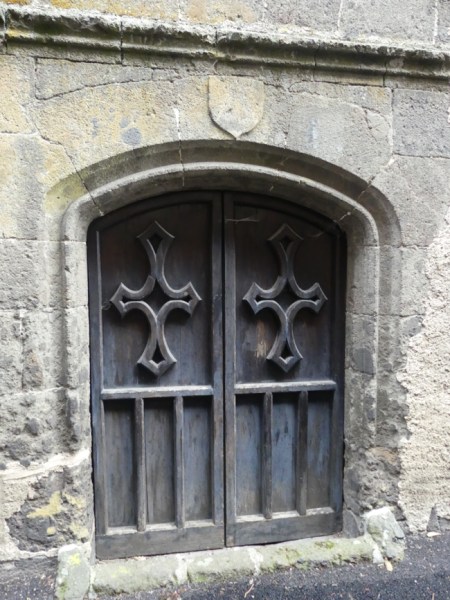


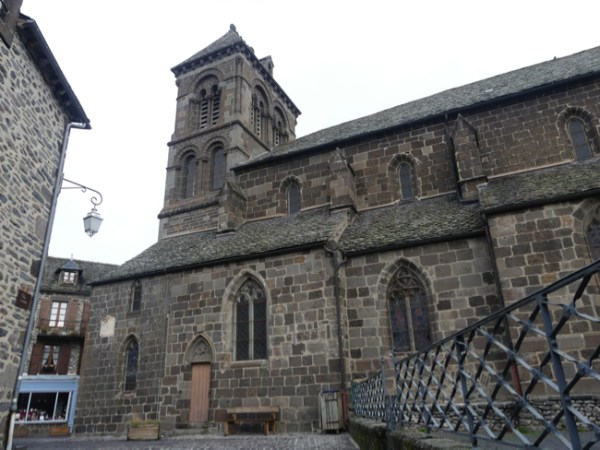
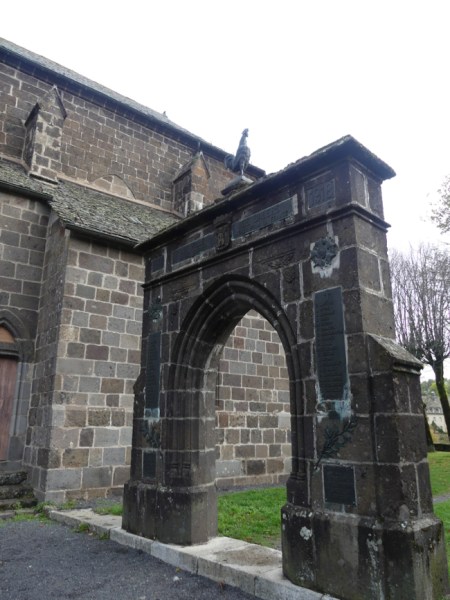
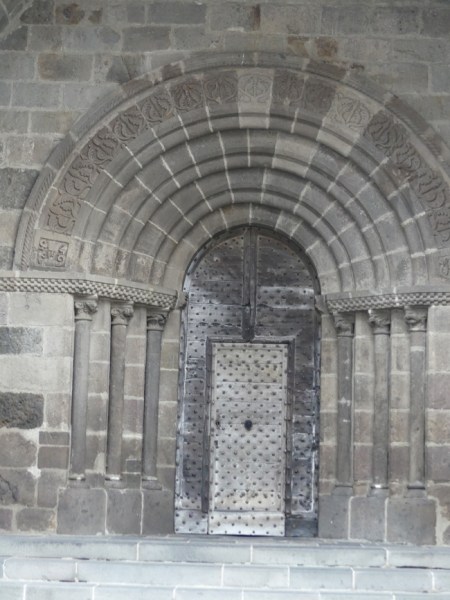

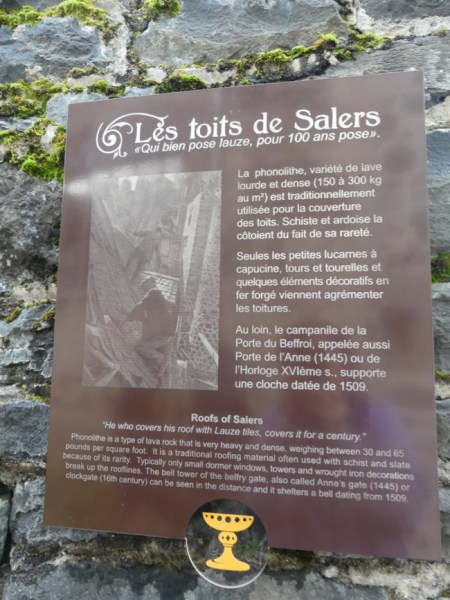
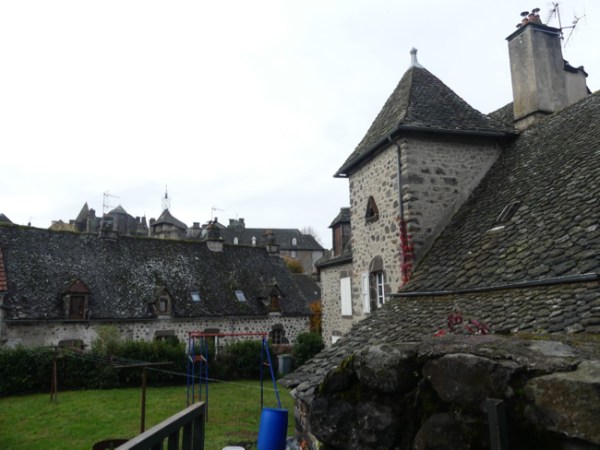

My dinner that night was disappointing. I had thought that pate’ cepes would be some kind of pate’ made out of mushrooms, but AdventureMan rightly guessed it would be pork with mushrooms, more pork than mushrooms. My main dish was pork, so much like barbecued pork that I might have been back in Pensacola, and it was accompanied by their famous truffade, which was a heavy potato and cantal cheese dish, so heavy and glue-y I couldn’t eat it. For dessert I ordered the pear torte, which turned out to be a little bit of pear on top of a custard. My bad, I ordered these things, but I didn’t have to eat them, so I didn’t.
When I was young, and we would dine in France and Germany, my father would say we had to eat things or we would hurt the chef’s feelings. I love being a grown up. I don’t have to eat it if I don’t want to, LOL.
Domme: One of the Best Days in the Dordogne
That title is misleading. We had so many best days, but later in this post you will learn why this one sticks out in my memories. Some days of the trip are cloudy, like “which day did we do this?” Other memories come out crystal clear.
(I just spent an hour of my life learning about Google’s Activity record – holy smokes! – and how, if I had had my location tracker turned on, I might have been able to provide you with the hilariously indirect routes we ended up on getting from place to place in the Dordogne. I am tempted. I don’t live a life with anything I need to hide. And yet, the thought of being TRACKED and a record being kept makes me uneasy.)
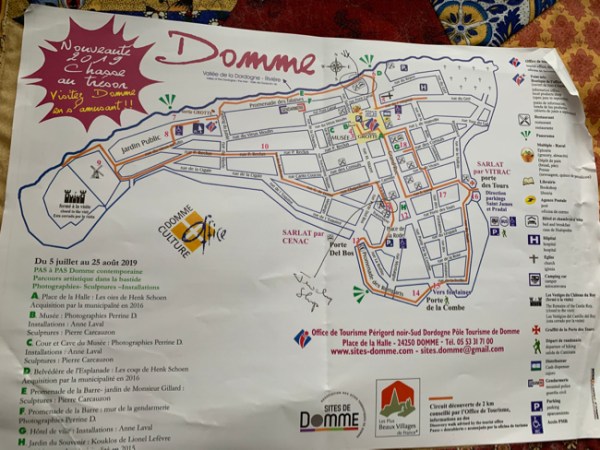
So arriving in Dome is kind of Wizard-of-Oz-y. It’s a very old city, built on a high hill, and streets are old and narrow. It’s sort of like those labyrinth puzzles you used to do as a kid when you needed to get from here to there. In this case, we totally depended on the Google lady, who said “turn right here” or “go 100 feet, turn left and then immediately right at the next street.” Getting from the entry gate, at the bottom of the hill, to L’Esplanade, at the top of the hill, was an exercise in indirection and circularity.
We got to the top. We could see our hotel. We had read about the parking, that there was no parking at the hotel and if you were very lucky, there might be parking on the street. There was not a single parking spot on the street. Even this late in the season, there were many tourists, and tourist buses, and some had drivers parked in no-parking places, with the engine on, ready to go and circle the city if the police came.

We decided to park in the pay lot, which had a lot of spaces. The night before, we had prepared our carry-bags with enough clothes for dinner and the next day, so we didn’t have to carry in our bags. It took us about 15 minutes to figure out the instructions. We put in the maximum in coins – I think 5 Euro, and that would take us to seven PM, when if we saw a parking space, we would move the car, and if we didn’t, we would put more money into the machine.
When we walked in, we received a very cordial and friendly greeting; the receptionist was Dutch and spoke English wonderfully. She told us that at seven, the parking machines are no longer monitored, and we are safe until ten the next morning, so that was a relief. She showed us to our room. You can see our room in the photo of L’Esplanade from the path, above; it is the corner room, one story up, and has a balcony.
The room was gorgeous. Maybe not quite so spacious as our room(s) at Domaine de la Vitrolle, but very spacious for France, and beautiful. And just wait until you see the view. My heart sang. I wanted to stay on that balcony and just soak in that view.


We can see all the way to La Roque-Gageac!

Beautiful Perigord farmlands . . .

Day is fleeting, and AdventureMan wants to explore, and rightly so. We are only in Domme for this one night. It was hard for me to leave that balcony; the view just sang to my heart.
Domme is walkable, and beautiful. There is something else about Domme – there are cats, lots of cats, and there are dishes out, hidden under benches, or visible on a step up to a house, or at the side of a doorway into a church. I imagine the cats keep the rats away, but it is lovely to see them repaid so generously and lovingly. The cats all looked very well fed.
Here is another church built in the same style as that of the church we saw in Audrix. I’m going to have to find out about this architecture. Domme is an old Templar town; I am wondering if this style is an indication of a Templar population?
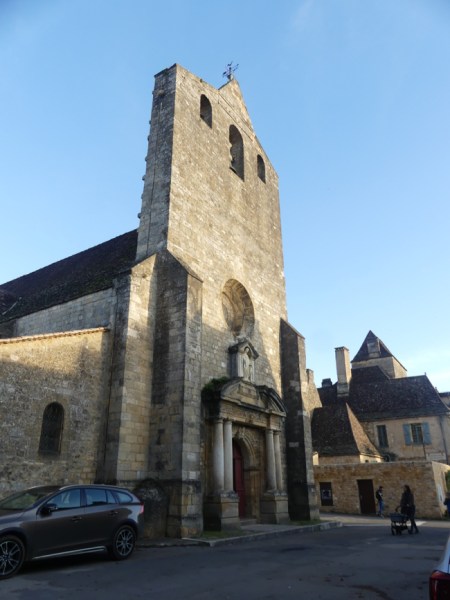

Look at this barrel roof! Is that not beautiful?


A view of the church from the market square. We attended the market the next morning, but it was very small, and there is only so much hand-made soap I can buy!

The above photo was taken from in front of a very cool bookstore, which even had a large English section. They had thousands of books in all genres, all languages, and new and used books all together. It was a little bit of heaven, right there on the main square.


Actually, I lost my husband. He went into the bookstore, I took photos. I went into the bookstore, he wasn’t there! I tried to call him, and it did not go through. I knew if I went back to the hotel, we would eventually fine one another, but I kept looking, and we were both on the main square, just in different places. I too this photo in front of the wonderful book store.
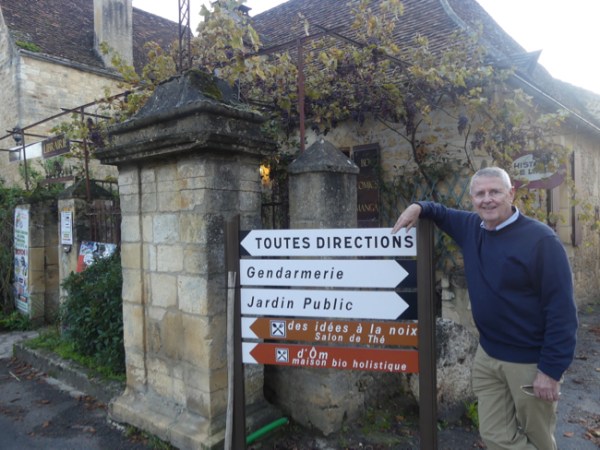
Beautiful city coat-of-arms, no?

This was a wonderful place for us. We found this building, with these arched windows (which I love) and my husband found a plaque telling us it was the former mint, the man who struck the coinage for the area. As we went around the corner, looking in the window, AdventureMan said (very brave man!) “I think we need to go in there.” I had not been paying a lot of attention, I was looking in a window where the you could see the jeweler’s studio, with works in progress, which was fascinating. My husband was right, there were some beautiful pieces. I tend to buy jewelry in places just like this, where you can find original pieces, and, well, jewelry and silk scarves transport well. 😉
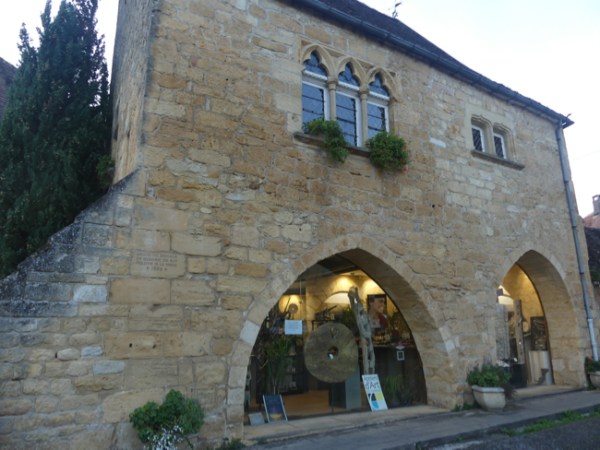
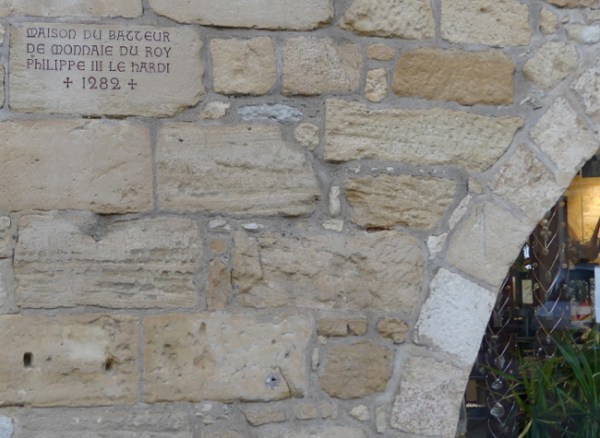
Inside, we met the jeweler’s son. As I picked out some pieces, my husband and him started a conversation, and as it got more interesting, I joined in. He talked about his family coming to Domme to seek new opportunities and new markets, and how wonderfully it had worked out for them.
I found the lovely chain-mail inspired neck;ace below in the tip of my stocking on Christmas morning 🙂

We talked about all kinds of social issues in France, and economic issues. We were all very cordial. At one point, Julien paused and then asked us, very haltingly, “You seem to be such nice people. How could you have elected a President like Trump?” We grimaced; it is a question Europeans ask us a lot. How could a country with the values we claim to share elect a man with no moral compass? He was horrified at what is happening in our country, and sad at our descent into corruption.
It was a hard conversation, and we all hung in there. At the end, we all hugged, and hoped for a better, more peaceful, less greedy world in the months and years to come. Sometimes the hardest conversations are those most worth having.
Meanwhile, back at L’Esplanade, we were eager to see what dinner would have to offer. L’Esplanade is well known for excellent cuisine, and we had reserved for dinner back when we made our hotel reservation. The dining room is lovely.
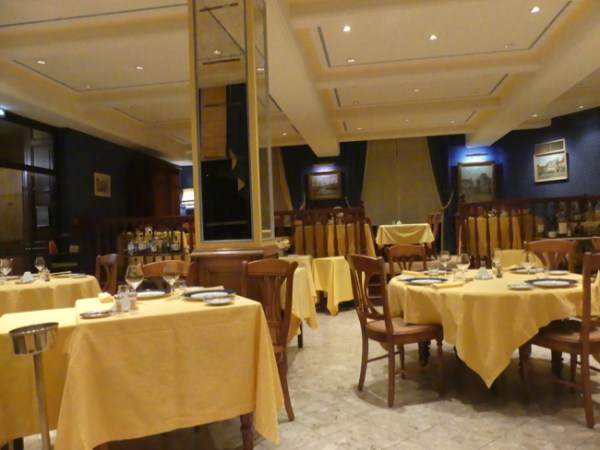

We think the settings are beautiful. There is a room where you can go have cocktails if the dining room is crowded and you have to wait, but tonight we only share the dining room with four other parties.

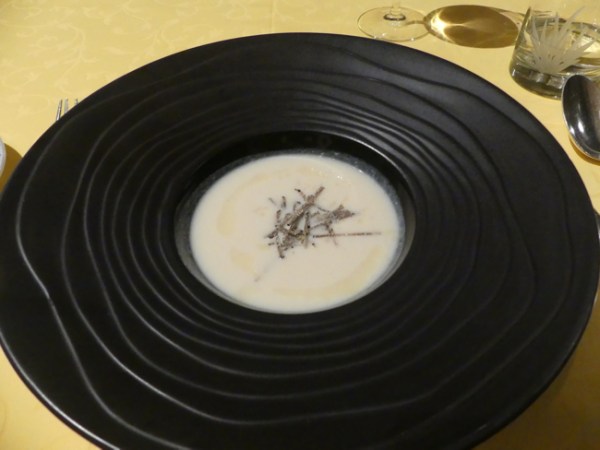
We order from the fixed menus. Our first course comes, a celery veloute’. It is a cream of celery soup, you can see it in the center of that great big black plate with a little recess in the center for the soup.
This was my main course, a little trout steak, decorated with a . . .potato chip. The little cubes of sweet potato were delicious.

AdventureMan had duck, again, decorated with a potato chip. He said the taste of the duck was exquisite.

His dessert was “Fig Three Ways” or maybe five, we couldn’t figure it out.
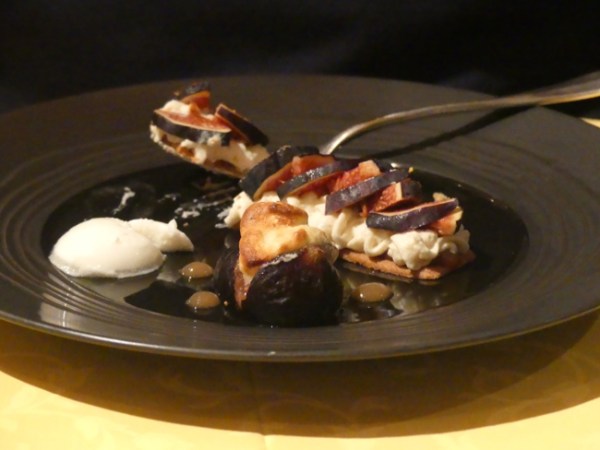
I loved my dessert, the raspberry sorbet part. It was decorated with passion fruit.

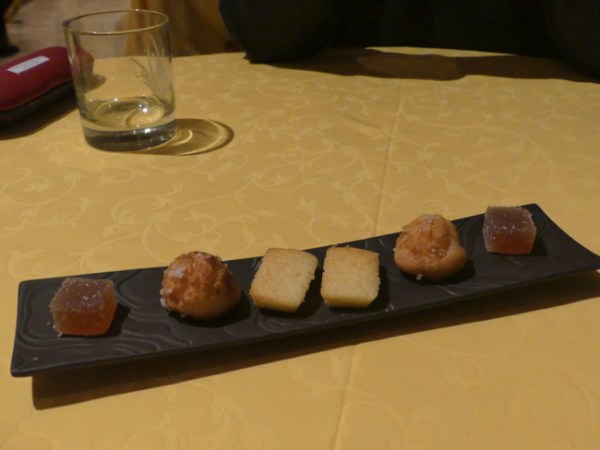
At the end of the meal, we were served this perfect little cookies.
This was another very quiet, very dark night of great sleep.
The next morning, we had breakfast in what I would call the garden room, and the owner’s family were all there, too, eating breakfast on their way to school, work, etc. It was really fun just being able to see them all eat, converse, be a normal family eating their breakfast together in the hotel. I loved it.
Viking Forseti: Dawn Cruise to Cadillac

(The map above shows the land time to Cadillac; I couldn’t make it show boat time. We were not on land, we were on the river 🙂 )
It’s Sunday morning, and a whole new world for us. We gave in to jet lag the night before, so at four a.m. when we can no longer sleep, we have the whole ship to ourselves. The ship will sail at 6:30 a.m., en route down the Garonne River to Cadillac, home of the famous Sauternes. We feel like a great adventure has begun.
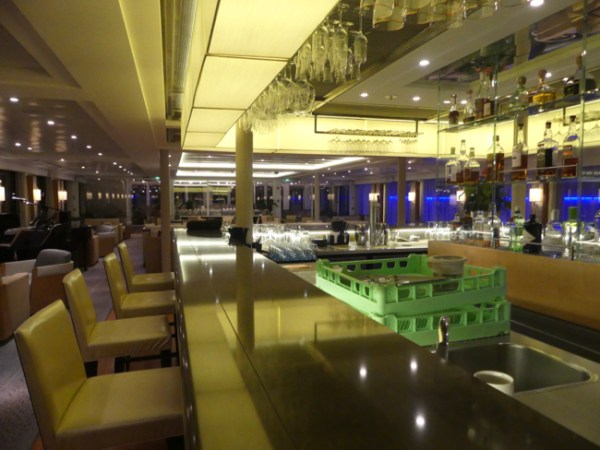
Above is a view of the lounge (LOL around 5 a.m., not a creature is stirring) from the wrap around bar.
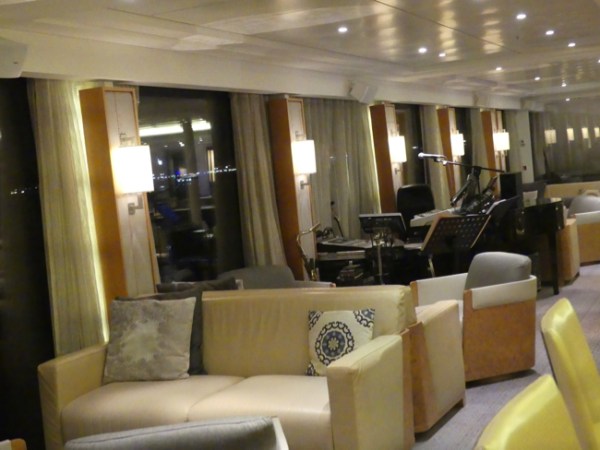
More lounge, and where the night time entertainment takes place. The entertainment is wasted on us; after a long day, and a dinner that stretches a couple hours, we are in our cabin making notes, reading, or crashing 🙂

The dining room, above, with a variety of tables for six or more people at each meal.
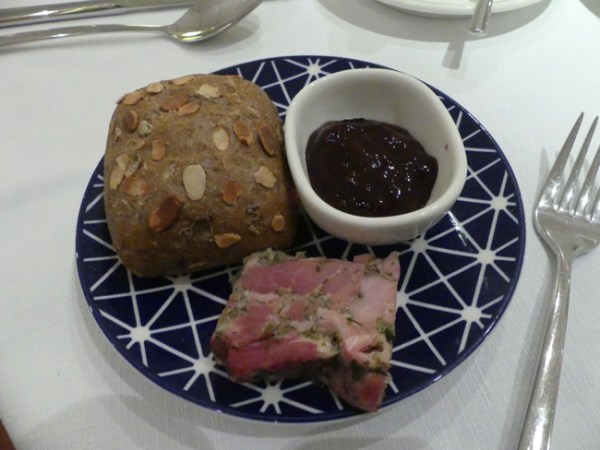
Breakfast is semi-buffet style. The wait staff are there to bring us coffee, tea, hot chocolate or anything we want off the extensive special order menu, which includes French Toast and Eggs Benedict, as well as eggs to order, etc. The buffet is enough for us, and more than enough. There are many kinds of rolls, and at least two home made jams, in addition to butter, and other spreads.

The chef will do omelets to order, scrambled eggs, whatever you wish.

For me, I am delighted every day to find smoked salmon or herring, just thrills my little Scandinavian heart. People always ask “Don’t you gain weight on these cruises?” and I say “No” because there is a secret. Many of the portions are tiny, just a taste, to prevent waste. Usually the small taste is enough for me. With all the walking we do, I actually lose weight on these trips, in spite of some truly fine eating.

The tables are beautifully set, even at breakfast. Our attendant this morning, Roxana told us that one of her favorite stops on this ship is Bordeaux. “Better than Paris?” we asked her, and she just laughed and said “Paris is full of rats! Have you ever seen rats bigger than cats? Paris has rats the size of DOGS!”
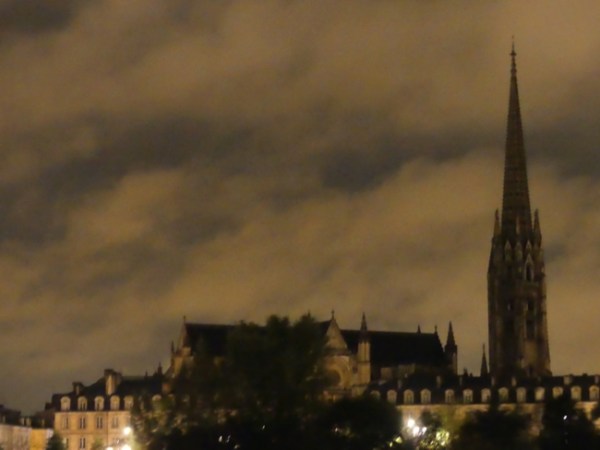
As we finish breakfast, the Forseti moves away from the dock, headed in the direction of downtown Bordeaux.


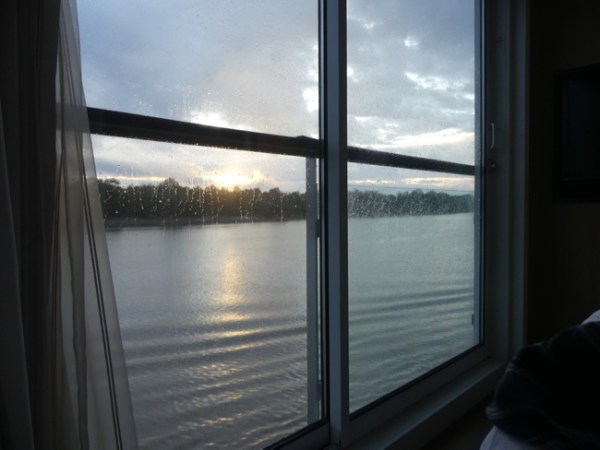
Sunrise from our bedroom window.

Along the route are fishing camps, and these nets when lower down right into the river to catch fish. The Gironde flows into the Atlantic Ocean, and the Atlantic Ocean sends tides up the rivers, a tide called the Mascaret. The Mascaret can cause a huge lift, enough to make going under bridges difficult for ships, and, alternatively, can cause very low water, making it possible for ships to go aground, so the ship captains have to be very aware of the tidal forecasts on these associated rivers.
We are told that this is the first ship in months able to go as far as Cadillac.

We have a fire drill, put on our life vests, show up at our emergency posts, then go back to the cabins to stow the life vest and get ready to go ashore in Cadillac.
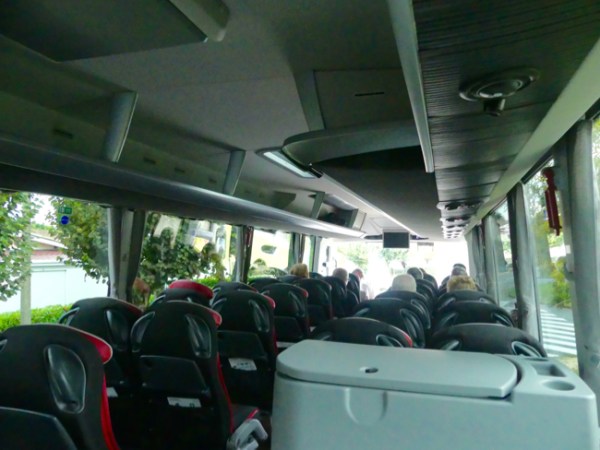
This is the interior of one of the Viking buses. It is roomy and comfortable, and has it’s own toilet aboard. We aren’t on the buses long, but they take us to the various vineyards and wineries for educating us on wine production and tasting the wares. And selling the wines, of course. We are warned that this is a very good time to buy French wines before the new Trump French wine tariffs go into effect, pushing up the prices and limiting the availabilities of the finest wines.
Today is Sauternes.
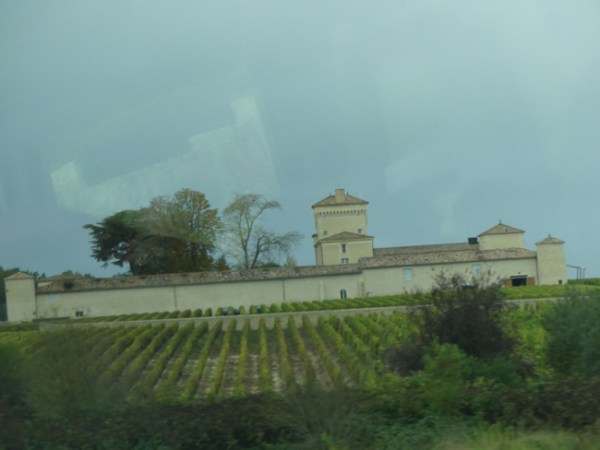

We arrive shortly at Domaine de Rayne, where we tour the wine storage area, and sip dry, semi-sweet and sweet Sauternes. I am not a fan of sweet wines, but I could understand how these could enhance the right pate’ or dessert. They were good, just not my favorite.
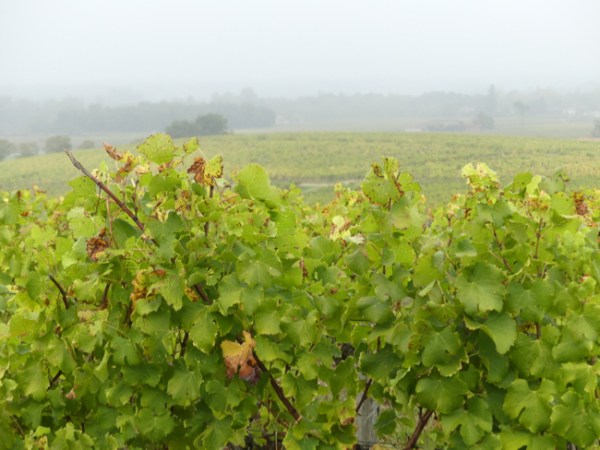
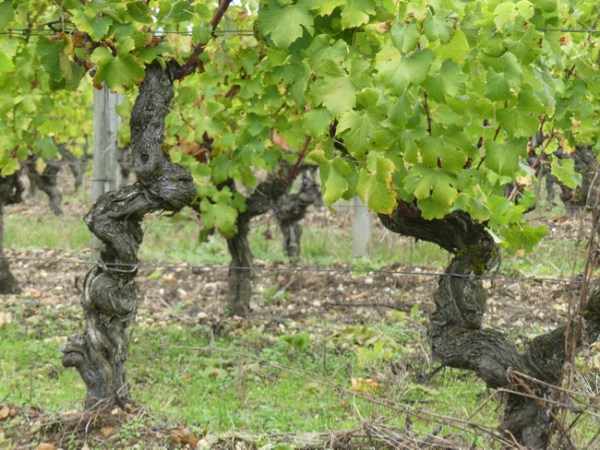
The late harvest is still continuing, and I loved that there were still grapes on this vine and at its foot.


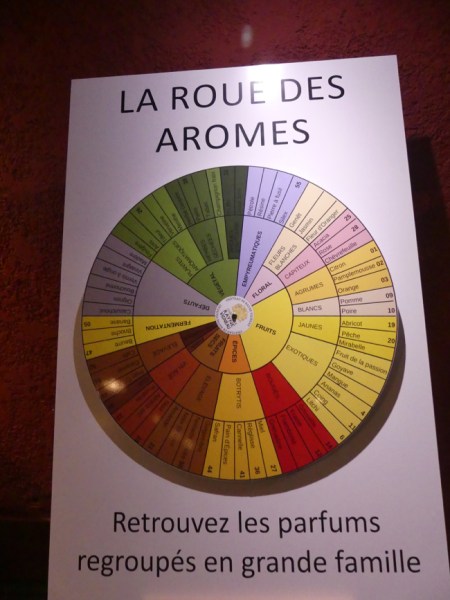
The tasting began. It is sad to see civilized people elbowing others aside.


We headed back outside where a rainbow appeared and brightened the day.


We are told that roses are planted with the vines so that if a fungus or disease shows up, it hits the roses first and most visibly, sort of like a canary in a mine can indicate when air flow is low.

On the bus, on the way back into Cadillac, our guide, whom we really liked, told us a cross cultural story we could really relate to. She and her husband had a good French friend, and they were invited to their house for dinner. The non-French couple wanted to make a really good impression; they really liked these people They didn’t know much about wine, so they bought a bottle with a beautiful picture on it and hoped it was a good one. She baked her famous chocolate cake to take with them and give to her, and they bought chrysanthemums from the florist. When they arrived for the dinner, and presented their gifts, they could see that the gifts did not have the intended results.
They later learned that the gifts were all wrong – the home made chocolate cake implied that the hostess wouldn’t have a dessert of that quality, the chrysanthemums are a flower used on graves in that part of France, and the wine implied their hosts did not know how to choose a wine. Fortunately, the hosts were not insulted, and over time, explained the local customs. They looked at the gifts with their hearts, and perceived that the intentions were for good. The two couples are fast friends to this day.
How often we’ve been in that position, and how easy it is to offend, when you don’t know what the customs and traditions are! We are so thankful for all the tolerance we have received, being welcomed as ignorant strangers into strange lands, welcomed into homes where we might unwittingly insult our hosts and hostesses. Thank God for their kind, forgiving hearts, and for their willingness to patiently educate us into the ways of their countries.
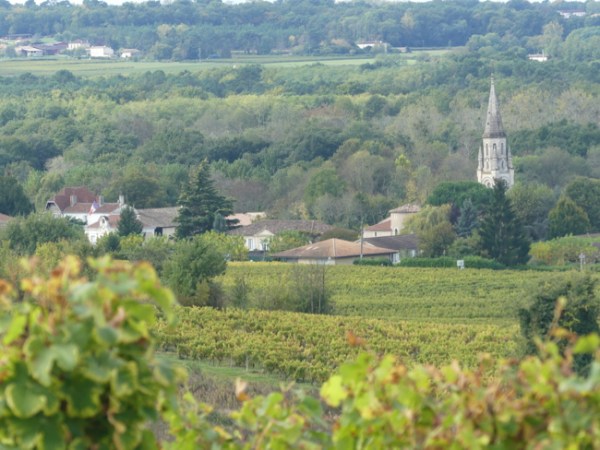
Back in Cadillac, we look for a good restaurant. Part of the reason we are on this trip is because we miss French food.


L’Entree Jardin is recommended by Viking, which says “Owner and chef Didier Bergey and his wife Helene Bergey welcome you to their little haven foreign of Cadillac’s finest gastronomic experiences. Centrally located in the heart of town, this quaint restaurant offers traditional regional cuisine with a modern flair – all made with fresh, seasonal ingredients. The delicious, tastefully plated dishes are served in a cozy setting. . . . Address 27 Avenue du Pont, 34410 Cadillac. ”
We did not have reservations, but they had one table left. They were very kind, very patient with my French. There was one other small group from the ship also eating there; we had to ask them about tipping as we knew the US practice of 20%+ is not the practice in France, but we didn’t know what a proper tip would be. They gave us their opinion, which seemed low. We opted for somewhere in-between.
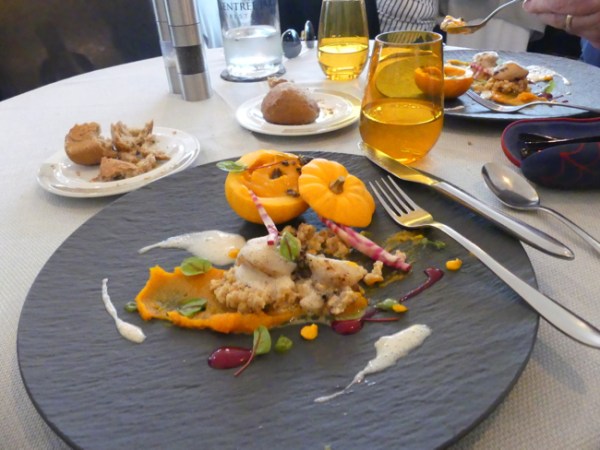
Our guide to the Domaine de Rayne had eaten there on the previous Sunday, and told us about the scallops and little pumpkins, which we ordered for the first course. This was my favorite part of the meal. I love scallops. I love pumpkin. What a fabulous combination.
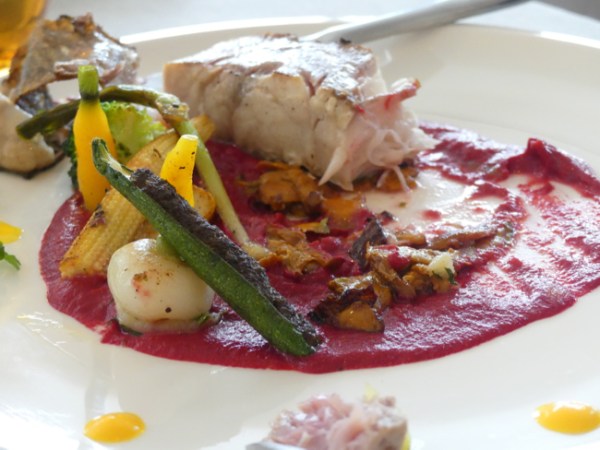
We both ordered fish; I had tuna and my husband had Maigre, which we looked up and it came back a fish called Croaker (U.S.) We found it later in the markets of Liborne and Bordeaux. I believe this is my husband’s main course; I think I ate mine without remembering to take a picture.
The desserts were all about the presentation. They were wrapped in caccoons of caramelized sugar strands. My husband had a Tarte Tatin (an apple pie that is cooked upside down)

I had a chocolate ganache with a raspberry coulis – delicious. We were both very happy with our first totally French meal in France. I saw that because although we are in France, all the people working on the Forseti are from somewhere else, not France. The cruise director, Jorge, is from Portugal, others are from Romania, Spain, Bulgaria, Austria – from anywhere but France. No one speaks French on board!

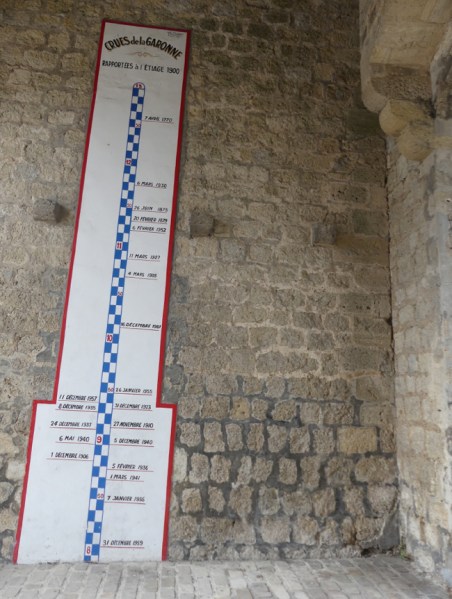
After lunch, we take a walk around Cadillac. Here, in the old tower, is a chart of where the river has risen during winter and spring storms. We have the same kinds of charts in Pensacola, thanks to hurricanes and water surges, so we understand, but this one measures over centuries. We are greatly impressed.

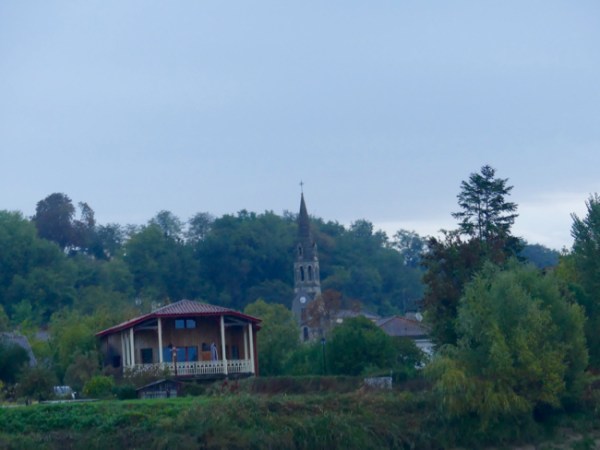
I am a total sucker for old walls and watch towers. You will see a lot of different walls and towers from this trip 🙂

This is the Chateau de Cadillac, home to the Dukes of Epernon:
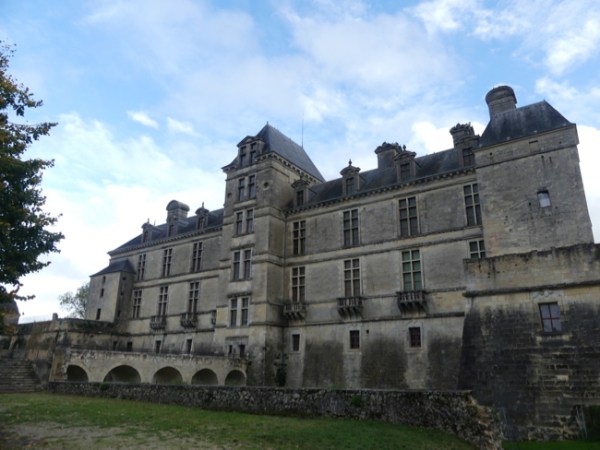
We were just strolling along feeling pretty good when we saw a Viking tour group doing a walking tour, but sort of hurrying. One of the group said to another “we have to be back by 3:45 because the ship is leaving to go back to Bordeaux” and we noticed a lot of different people sort of scurrying in the direction of the ship. So we scurried, too, and made it back. What we do not want is the walk of shame, the whole ship waiting and watching for the last ones to board.
From our balcony, we enjoy the sunny skies on the way back.


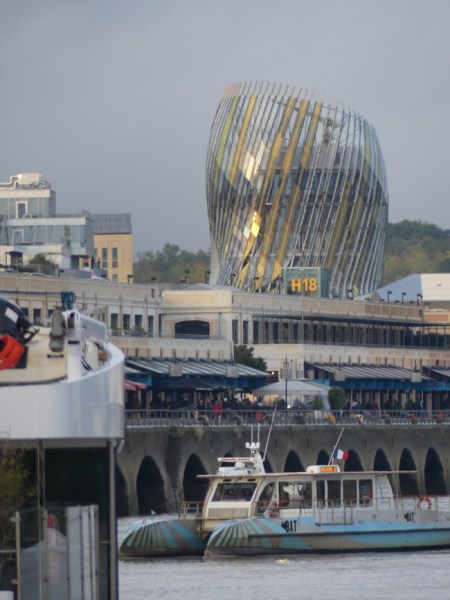
This is the Museum of Wine in Bordeaux, just northwest of where the ship is docked.
We had a lovely experience at dinner. We preferred to eat at the Aquavit Terrace, where they have TWO tables for two people, the only two person tables on the ship (there may be more when the outside terrace is open, but it is not warm enough in November). The tables were all taken. It is a more casual restaurant, few tables, very popular.
The head waiter, Anton, put us at a nearby table in the lounge, and made sure we had a good dinner. After the fabulous lunch we had, all I wanted was soup and the appetizer crab cakes. Anton made sure I got a huge bowl of soup and two crab cakes, so it was more like a full dinner. They were all so caring, and didn’t want to see us under eat. My husband had salad and scallops, which were also supposed to be an appetizer, but the portion was very generous. Anton was chastised for allowing us to eat in the lounge, but he stood his ground and we were very grateful to him for his kindness, wanting to make sure we had a good dinner and were happy.
We go on cruises, but we are introverts. We pay more for a cabin because we know we will spend a lot of time in the cabin, so it is good if it has a balcony and some space. It makes us happy. We usually prefer to eat by ourselves; we’ve been married for 46 years and we have good conversations. The Forseti is not equipped for room service.
We DO like other people, but until we’ve met someone we choose to eat with, we eat alone. On this cruise, we actually found people we liked eating with, and one group we actually adored, but that will come.
After our quiet dinner, we left the Forseti and walked into Bordeaux, just a short distance. We had a lot of fun just walking around, and then it started sprinkling, so we walked back. We were able to stay up until 10 this night, our second night in Bordeaux, so we feel pretty good.
Recent Comments
ExpatAlien on What Country am I Living … intlxpatr on Yellowstone: Old Faithful to C… Michelle on Yellowstone: Old Faithful to C… Cathy on No Grown-Ups in Charge intlxpatr on Waiting for Snow Wikipedia Donate Button

Amazina


Early Voting in Florida


 Here There and Everywhere
