US Embassy: Kuwait Low Threat fro Crimes
From today’s Al Watan
Kuwait 2009 Crime & Safety Report
U.S. Department of State rates Kuwait as low threat for crime
WASHINGTON: The Department of State rates Kuwait as low threat for crime. The incidence of crime in Kuwait City remains low. The government of Kuwait (GOK) maintains a high police profile with large numbers of uniformed and plainـclothes officers on the streets. Each district and governorate has police stations operating under the direction of the Ministry of Interior (MOI) Directorate of Public Safety. Incidents of crime do occur, with few instances reported to the U.S. Embassy”s Regional Security Officer (RSO).
Violent crime is primarily confined within the thirdـcountry national (TCN) community, which comprises the majority of the manual labor force in Kuwait ـ approximately twoـthirds of Kuwait”s residents are TCNs.
It is probable that a high percentage of crimes in the TCN community go unreported because of lack of police responsiveness.
The threat of immediate deportation looms large for many of these guest workers who generally prefer maintaining a low profile so as to avoid unwanted attention from the GOK.
Although several districts within Kuwait City are known to have higher incidences of crime, only one area (Jahra) remains generally offـlimits to official embassy personnel. One factor contributing to the high rate of crime in Jahra is the inability of the police to enforce laws in areas where tribal customs take precedence.
Residential crime remains low. There have been no reported breakـins at any official embassy residences within the past year, nor have any vehicles been stolen. It is not uncommon for embassy staff and dependents to report suspicious persons in their neighborhoods to the RSO, but the majority of these instances have been resolved without any criminal or other hostile intent discovered.
There are no reports of petty thefts against the official American community in any of the popular outdoor markets or shopping malls frequented by tourists and westerners living in Kuwait. However, the opportunity for such crime does exist. It is understood that individuals should not assume that they can maintain a carefree attitude in these venues even though the crime threat in Kuwait is rated low.
Last updated on Wednesday 18/3/2009
Don’t Call, Text, or Sign on to Internet . . .
until you arrive”

From today’s Kuwait Times
‘Avoid cell talk, SMS, life you save maybe your own’
KUWAIT, March 15, (KUNA): Ninety percent of road accidents are coupled with lack of attention while driving, Assistant Undersecretary for Traffic Affairs at the Ministry of Interior Major General Mahmoud Al-Dousari said Sunday.
His remarks came on the occasion of hoisting flags of Gulf Cooperation Council (GCC) countries, announcing the commencement of the unified GCC traffic week; themed “Don’t Call Until You Arrive”. The ceremony was attended by traffic directors and their deputies of all six governorates, as well as a host of senior officials in Kuwait and the Gulf. This year’s theme aim at conveying an awareness message, cautioning from the use of mobile phones while driving, and depending on other means such as hands’ free and Bluetooth in order to stay focused on road and steer clear of accidents, Al-Dousari noted, pointing out that more studies had proven the theory suggesting the association of lack of attention with using mobile phones while driving.
The issue was not limited to speaking on phone, it went beyond that to include text messaging, or even logging on to the Internet while driving; which would turn them into major distracters, Al-Dousari said, adding that consequences of such behavior would eventually lead to tragic endings.
Al-Dousari advised that the best way to remain focused on road was to divert all incoming calls to voice mail, as well as receiving and sending SMS messages after pulling off the road. Some 18,773 violations were registered since the law that prohibited the use of mobile phones while driving was implemented last year, he noted.
“The Traffic Week aims to raise awareness, as it includes a host of various educational programs. It is not a week of firmness, stake out and issuing tickets like some might think,” Al-Dousari said, pointing out that injuries resulting from accidents had significantly decreased in the past two years. There are strict orders to deport any expatriate who commits serious traffic violations such as reckless driving, driving on the wrong side of the road, speeding, violating the red signal and assaulting security men, Al-Dousari concluded.

General al-Dousari, how many expatriates have you exported for serious traffic violations?
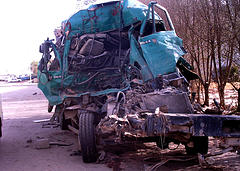
If you want to see fewer people on mobile phones, texting, signing on the the internet, running red lights, weaving while overspeeding, and assaulting security men, enforce your laws, enforce them all the time, and enforce them equally against every offender. If you enforce your laws, equally, against all offenders, traffic violations will decrease, traffic deaths will decrease, and all our lives, and those of our children, will be much safer.
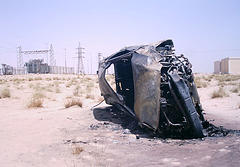
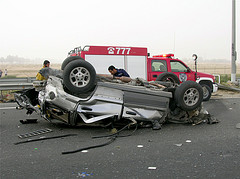
These photos are from a Flikr search for car wreck/Kuwait and, unfortunately, it is just a random selection among many. many. many.
Requiring New Contracts
This is from today’s Al Watan, and is pertinent to the labor issues we have been discussing on Here, There and Everywhere. Bad surprises happen from top to bottom.
This applies to everyone – the contract you think you are signing when you come to Kuwait may not be what really happens. It depends a lot on the company, on how you are recruited, etc. For example, if you are recruited by a US company doing business with the government here, things are fairly straight-forward. Read your contract carefully before you sign. If you are recruited by one of the manpower agencies – be very very very careful.
Expat workers protest job contract fraud
Ricky Laxa
Staff Writer
KUWAIT: Embassies in Kuwait have been receiving many complaints from expatriate workers of being forced by employers to sign new job contracts with salaries that are far lesser than what they had initially agreed upon back in their countries before arriving in Kuwait. A number of Filipino workers, who recently arrived in Kuwait, have resorted to the Philippines Overseas Labor Office to file complaints against the agency that was responsible for their employment in Kuwait.
In an exclusive interview with Al Watan Daily on Thursday the complainants provided copies of contracts and other documents, which have been signed by the employer and the employees in the Philippines, in addition to another set of contracts, which indicate that their salaries have been reduced by more than half with totally different job descriptions.
A complainant said she has been asked to settle the amount of 40,000 Philippine pesos (335 Kuwaiti dinars) as placement fees. This amount does not include other expenses like medical checkـup, health insurance and other expenses. She added that most of the fees have been overpriced on receipts that are handwritten on ordinary sheets of paper “The receipts issued are not official ones as required by the Philippines” government, and the concerned authorities have ignored their malpractices,” she said. An embassy official indicated that most of these placement agencies are registered under Filipino representatives, who are usually the owners” wives, girlfriends or Filipino nationals who had previously worked in Kuwait and these are the people who make the manipulation of contracts an easy task.
Al Watan Daily managed to acquire some original copies of the contracts, which have been signed by the employers and the employees. In one of the job contracts, a salary of KD 200 has been signed by both parties with the job description cited as ”Receptionist” and in another contract bearing the same name the salary has been slashed to KD 100 with the job description cited as “Cashier.”
“Two hours prior to our departure, we were asked to sign letters of undertaking stating that we have agreed to the alterations on the contracts. We refused to sign the new contract s yet for some of us, we had no choice but to agree to the amount,” added another complainant.
Al Watan Daily spoke to the agency”s representative who was asked by the Philippines labor official to meet the complainants and resolve the cases. The representative initially denied the allegations but fearing being exposed she admitted to the change in contracts.
She stated that the employer called a few hours before the scheduled flights and she was told to reduce the salaries under the pretext of the global economic crisis, which the labor official ignored and dismissed.
Al Watan Daily also found out that the license of the said agency to recruit workers from the Philippines has been suspended for unknown reasons. “Our company is employing fifty medical staff at the end of the month and we have signed agreements with other big companies,” said the representative.
A settlement has been reached between the complainants and the employer in the presence of the labor official on Thursday and some of the complainants have agreed to accept KD 150 instead of KD 200. Other workers opted to be repatriated without a refund of the placement fees that were paid to the Philippine agency.
“How many more agencies such as this will continue to mislead and cheat overseas workers? Agencies are literally taking undue advantage of the poor situation that these people are faced with back in their countries. Most of them leave their countries after paying huge amounts just to be able to finance the requirements needed to work abroad. These agencies should not be allowed to recruit locally and internationally. Strict legal measures must be taken against those who violate the terms and conditions drawn in the original contracts,” stressed an embassy official.
Informed sources also told Al Watan Daily that an alarming number of Western nationals also experience similar situations. In a lecture concerning employees and employers” rights that was held recently by a local organization, a relatively large number of Western nationals raised questions on the alteration of articles drafted in contracts.
“My contract stipulates specified allowances for house rent and education fees for my children. I agreed to sign the contract and came to Kuwait with my family only to find out that education fees for my children will not be provided,” complained a British national who attended the lecture.
He also said that school fees allowance is an important factor, which made him agree to sign the contract knowing that the salary he agreed on will not be sufficient to finance the education of his children. The company eventually agreed to provide half of the amount.
Meanwhile, an American teacher complained that the accommodation provided by the school is being relocated to a remote area and that traveling between the two places is very time consuming. She was also said that she would be given her own flat only to find out that she would have to share with another teacher.
“These conditions were not mentioned in the contract and we were informed that the situation is temporary but it has been a year since. I am definitely not renewing my contract,” stressed the teacher. Similarly, a South American manager of a spa complained about extra working hours being imposed on her, in addition to a 24ـhour onـcall policy. Her contract clearly stipulates nine working hours and a day off per week. During an orientation, she was handed over a company handbook, which defines her job functions. Rules require her to manage the spa and administer treatments as well. She recently resigned from work.
When you read articles like these, you can understand how some employer/employee relationships are doomed from the start. A family asks an agency for a maid, and when she arrives, having been told she will earn far less than she expected, she will not be a receptionist or a cashier, but a housecleaner / cook / nanny, and her working conditions are not covered nor guaranteed by labor law, she shows up sullen and angry. The family, expecting someone who is happy to be earning a good salary, (and who often paid those fees that the maid is also being charged for) are dismayed at this ill-tempered and sullen employee, and the employee is resentful and depressed at being tricked and in servitude. It’s not a great start for a good relationship.
The same is true for higher level professional positions. Once hired, some employers here seem to think that the employee is a human resource – on call. It’s like they think the contract implies some kind of ownership. When people complain, salaries are late, conditions worsen and the employee is STUCK. Worst case, you have a travel ban placed against you and you can’t even get out of Kuwait.
About 85 – 90% of the population of Kuwait is from somewhere else. You have few rights. This is a true story – a western employee driving on a ring road – a fast road – hit a man who ran across the road. The western employee had to go to jail while they waited to find out if the man hit would survive. The man survived, and was discovered to be here in Kuwait illegally, and was deported. The western man was allowed out of jail, but when his contract ended, could not leave the country because a travel ban was posted against him. He could not be brought to trial because the witness against him – the man who had run in front of his car – could not be found. He could not be found because he had been deported. It took forever for this poor man to leave Kuwait, and it was pressure brought by the newspapers publishing his story that finally got the case . . . resolved? dropped? There is no explanation. Maybe someone had to cross an official’s palm, who knows?
It doesn’t matter who you are, or where you are from, it doesn’t matter if you are a maid, a cashier, a waiter, an accountant, a teacher, a consultant; if you are an expat worker, the law and the enforcement of the law, at the current time in Kuwait, is not your friend.
Honored Guest
In every country where I have lived, we have felt like honored guests. This week, I have been truly honored, my blogging friend Hilaliya has asked me to be an occasional guest blogger on his revamped blog, now featuring a Kuwait Blogging Diwaniya. Pretty cool, huh? I have to admit it, I have a smile from ear to ear.
The revered blogger Don Veto led the way with an article yesterday, and I jumped in today.
In honor of my ear-to-ear smile, it’s called Smile for me Baby – Let Me See Your Grill but fair warning – it’s political polemic, about parliamentary gridlock, so you will see a grittier side of Intlxpatr.
The Most Dangerous Job in Kuwait
From today’s Al Watan:
KUWAIT: The operations room received a call informing them that an Asian domestic maid tried to commit suicide by stabbing herself while at her sponsor”s house in the Salmiya area. Police officers and medical teams rushed to the scene where paramedics administered emergency medical aid and rushed her to Mubarak Hospital, where she was admitted to the intensive care unit. However, on interrogating her, she alleged that she did not attempt suicide but that she had been stabbed. Investigations are underway to ascertain the authenticity of the statement.
OK. Stop and think about it. How do you stab yourself? I can imagine, if I were wanting to commit suicide, a hundred ways easier than trying to stab oneself. Don’t you think the police would have been suspicious from the very beginning?
Every time I read about another domestic committing suicide, I wonder. I have heard many many things.
I wonder how many women commit suicide by “jumping” off the balcony? Those who survive often say they were thrown, or pushed, by “the madam.”
One girl told me that every maid brought into the household where she works immediately has to have her hair cut very short (and unflattering) and to wear voluminous and ugly uniforms, because “the madam” is afraid her husband and sons will be attracted to the maids.
I wonder how many slaps, how much screaming, how many humiliations, how many approaches or attacks from male members of the household one endures before absconding?
Think about it. You’re from a really really poor country, and you leave behind family, even your own children, for the hope of earning enough money so that the children can go to school, and have a better life, so that maybe you can build your own little bungalow one day, not fancy, just a roof over your head. People who come here to earn a living have a lot of incentive to make it work. They will endure a great deal before seeking a way out.
I have so many friends who treat their household help like members of the family, teaching them new skills, helping them earn extra money, giving them food and clothing. I believe they are in the majority, the kind employers.
But so many stories of domestics being abused! Even if it is a mere, say 5%, what options does the domestic have? The brave ones, the self-confident ones, might go to the police, only to have her employers state that she stole something, and she finds herself under arrest, or quickly deported. Many cannot even leave the house, and have no telephone with which to call a friend in an emergency situation.
Will the new labor law have anything to say about protecting these very vulnerable family helpers from a dangerous or abusive employer? What effect does it have on children to see their parents treating employees like mere possessions? How does it impact our souls and our entrance into paradise when we don’t (as the Quran instructs) pay our employees their promised salary at the agreed upon time?
What will happen to this poor woman, stabbed, in a strange hospital, whose employers claim she stabbed herself?
In Xanadu: A Quest by William Dalrymple
This book was on my (huge) “Read Me” stack, and I picked it up for a change of pace. As I started reading, I wondered “how did this get there?” My first instinct was it was a recommendation from Little Diamond. As I was reading, however, I came across a segment that was what our priest had read in church around the Feast of the Epiphany about the birthplace of the wise men who came seeking the Christ Child after his birth. I wrote down the title and ordered it from amazon.com (which has some copies used from 72 cents).

William Dalrymple wrote this book when he was a mere 22 years old. He and a travelling companion took off to trace Marco Polo’s journey from Jerusalem to Xanadu, where he was taking oil from the sanctuary lamp to Kubla Khan.
In a world where we have all been taught to be so careful, they take incredible risks. They travel on the cheap – staying in fleabag hotels, sometimes sleeping “rough”, i.e. out in the open. They travel any way they can – an occasional train, but more often a truck, a bus, whatever is going their way. One very long segment they travelled on top of a pile of coal.
They travel from Jerusalem up through Syria and into Turkey, then turn east and cross Iran, Pakistan and Afghanistan to China. They have some amazing adventures, see some astounding scenery and because of their mode of travel, have a lot of time to talk with their travelling companions or people in the cities where they are staying.
I am blown away that an unmarried couple would cross Iran, Pakistan and Afghanistan. I guess they told people they were married to share a room (they were on a budget) and they were only friends, not a couple, but what a risk. I am astonished that they were never asked to produce a marriage license or any proof of marriage when they stayed in hotels. I am astonished at the girls (one left in Lahore and another joined him, but these are girls who are friends, not anything more) would travel on the backs of trucks full of men, and never blink an eye.
The book is occasionally hilarious. Most of the hilarity results from foods they have to eat – sometimes it is the only food available – or from misunderstandings because of lack of a common language, or due to their frequent bouts of diarrhea, what I really liked about the author was that he was rarely pompous, and when he is funny, it is usually about some conversation he has had, or some mistake he has made.
One of my favorite parts of the book happens in Iran:
As we sat waiting for the bus to Tabriz, the next town on Marco Polo’s itinerary, we watched the mullahs speeding past in their sporty Renault 5s. Iran was proving far more complex than we had expected. A religious revolution in the twentieth century was a unique occurence, resulting in the first theocracy since the fall of the Dalai Lama in Tibet. Yet this revolution took place not in a poor banana republic, but in the richest and most sophisticated country in Asia. A group of clerics was trying to graft a mediaeval system of government and a pre-medieval way of thinking upon a country with a prosperous modern economy and a large and highly educated middle class. The posters in the bus station seemed to embody these contradictions. A frieze over the back wall of the shelter spoke out, in the name of Allah, against littering. On another wall two monumental pictures of the Ayatollah were capped with the inscriptions in both Persian and English:
BEING HYGENIC IS DIRECTLY RELATED ON THE MAN’S PERSONALITY
and:
ALLAH COMMANDS THE RE-USE OF RENEWABLE RESOURCES.
We had expected anything of the Ayatollah. But hardly that he would turn out to be an enthusiastic ecologist.
The challenge of this journey is to follow as closely as possible the path Marco Polo took, but two segments of the journey go through off-limits areas. They find a way into one, to discover later it is an atomic testing area, and the second, at the very end, around Xanadu, they find receptive Chinese officers who take them to have a brief glimpse of the ruins of Xanadu while booting them out of the area. As they stand in Xanadu, they repeat a poem that every American child grows up with in English Literature:
In Zanadu did Kubla Khan
A stately pleasure-dome decree:
Where Alph, the sacred river, ran
Through caverns measureless to man
Down to a sunless sea.
So twice five miles of gertile ground
With walls and twoers were girdled round:
And there were gardens bright with sinuous rills.
Where blossom’d many an incense-bearing tree:
And here were forests ancient as the hills,
Enfolding sunny spots of greenery.
(Coleridge)
I liked this book. Dalrymple is a history major, and often quotes from historical – even obscure – texts to illuminate what he observes. I think I may look at a couple more he has written since.
Kuwait to Provide Assistance in Dharfur
From today’s Arab Times:
Kuwait Red Crescent ready to fill aid agencies gap in Darfur
KUWAIT CITY, March 7, (KUNA): Kuwait Red Crescent Society (KRCS) said Saturday it was ready to fill the aid agencies gap caused by the withdrawal of a number of humanitarian organizations from Darfur.
KRCS Chairman Barjas Al-Barjas said in a letter he sent to Secretary-General of the International Federation of Red Cross and Red Crescent Societies (IFRC) Bekele Geleta, that KRCS believed the federation should cover the needs caused by the withdrawal of 16 non-governmental organizations from Darfur due to bad security conditions. He called IFRC to urge all humanitarian and charitable bodies, national societies, and the International Committee of the Red Cross (ICRC) to contribute to ending the deterioration of the humanitarian situation in Darfur. Al-Barjas said KRCS was ready to provide aid, as it always did to the needy around the world.
Meanwhile, the Arab League Council has decided to send an Arab-Afro delegation to the UN Security Council (UNSC) to defer the International Criminal Court’s (ICC) arrest warrant against Sudanese President Omar Al-Bashir. The council, meeting urgently at the foreign ministers’ level to discuss ICC arrest warrant, expressed dismay for the ICC decision and said it did not consider justice, stability and peace in Sudan. The council voiced solidarity with Sudan against any plans undermining the sovereignty, unity and independence of Sudan.
The foreign ministers underlined in a statement importance of the independence of the Sudanese judiciary. They refused any attempt to politicize the principles of the international justice which would jeopardize the unity, sovereignty and independence of countries around the world. They regretted the fact that article 16 of the Rome statute of the ICC was not provoked thus delay the arrest warrant for 12 months. They asserted that heads of state enjoy immunity in accordance with the 1961 Vienna agreement.
The arrest warrant does not consider the implementation of the peace agreement in Southern Sudan and preparation for the general elections in the second half of this year, said the ministers. The Arab foreign ministers urged the UN Security Council (UNSC) to live up its responsibility to preserving peace and stability in Sudan. They called on regional and international parties to provide suitable atmosphere for the political settlement between the Sudanese government and rebel groups in Darfur.
May God bless the work of their hands and their hearts.
Eliot Pattison: Beautiful Ghosts
It almost always takes me a little while to get into Eliot Pattison’s books, and I can figure out why. He sets you down right in the middle of something going on, so you start off a little confused. You can read each of his Inspector Shan Tao Yun books as a stand-alone, but it helps to have read them in order – as I have.

Even though I have read them in order, I still find myself disoriented each time I start a new book. New names, a new situation, and it takes a few pages to get back in the rhythm of thinking about things in a new way. Within thirty pages, I am in a new world, and I am totally addicted. When I am reading one of the Inspector Shan Tao Yun books, I can hardly wait to get back to the book. My household chores suffer, my projects suffer – even AdventureMan suffers, as I seek to return to Tibet, the Tibetan Monks and the world of Chinese bureaucracy.
One of the things I love in this book – we saw a hint of it in the last book I reviewed, Bone Mountain – is that the worst of the bad characters can have a hint of humanity, and develop a full-blown redemption, as we are watching happen with the prison warden, Captain Tan. The process continues in Beautiful Ghosts. In this book, Pattison strikes several additional chords – he combines a good mystery with art, art thefts, public art and a little bit of history, a family reunion, father-son problems, and a lot of action. I’m a happy reader.
In Beautiful Ghosts, a murder happens, but it is hard to understand, at first, who was murdered, why the murder was committed, where the murder was committed as well as who committed the murder. One answer leads to another, and ultimately, to long buried treasures and long kept secrets.
A great tickle, for me, is that in this book Inspector Shan Tao Yun goes to my home town, Seattle, which he finds very strange, and grey and rainy. Pattison describes Chan’s bewilderment at how Americans live, and as Chan leaves Seattle, he comments on how he has not seen the sunshine in his entire time visiting there, working in co-ordination with an FBI office trying to track down some missing and stolen Tibetan art pieces, stolen from the hidden monasteries by corrupt Chinese bureaucrats.
Shan still stood, studying the strange buildings and the dozens of people who were wandering in and out of the open doorways off the huge main hall. There were shops, he realized, dozens of shops, two floors of shops. When he looked toward Corbett, the American was already ten feet in front of him. Shan followed slowly, puzzling over everything in his path. Adolescents walked by, engaged in casual conversation, seemingly relaxed despite the brass rings and balls that for some reason pierced their faces. He looked away, his face flushing, as he saw several women standing in a window clothed only in underwear. He saw more, nearly identical women, in another window adorned in sweaters and realized they were remarkably lifelike mannequins. One of the sweaters was marked at a few cents less than three hundred dollars, more than most Tibetans made in a year.
“Why did you bring me here?” Shan asked, as Crobett led him into a coffee shop and ordered drinks for both of them. “This place of merchants.”
“I thought you’d want to see America,” Corbett said with an odd, awkward grin, gesturing to a table, then sobored. “And this is where Abigail worked, before getting the governess job. People here knew her, told me stories about her, made her real for me.”
. . . .
Shan began to marvel at the rain itself. Beijing was a dry place, most of Tibet a near desert. He had not experienced so much rain since he was a boy, living near the sea. There were many qualities of American rain, and many types of rain clouds. One moment they were in a driving rain, like a storm, the next in a shower, the next in a drizzle that was little more than a thick fog. Once the water came down so violently, in such a sudden wind, that it struck at the car horizontally. . . .
You learn so much reading Eliot Pattison, more than I can absorb! There are detailed art works, there are geographic features, there are Buddhist customs, there are bureaucratic networks, there are mysteries of Chinese history and dynasties. There are tribal customs and learning to think like Tibetan monks.
Eliot Pattison is a gifted and poetic writer. If you like mysteries that turn out to be very complicated and which teach you a lot about a culture you have never experienced (or would like to learn more about) I would suggest you start at the beginning. These are the books about Inspector Chan in chronological order:
Skull Mantra
Water Touching Stone
Bone Mountain
Beautiful Ghosts
Underwear Uproar in Saudi Arabia
There is an article today on BBC News (you can read the entire article by clicking here) on the underwear uproar in Saudi Arabia – that to buy underwear, women have to deal with male clerks. And more – there is nowhere to try on a bra to make sure you get the right fit! You have to pay, go to the public restroom, try it on and bring it back if it is not right.
One of the most amazing things to me, besides having only men selling underwear in Saudi Arabia, was the fact that the most amazing lingerie was in the most public windows. My favorite I-would-love-to-take-this-photo moments was watching abayed and niqabed women standing next to some of the tiniest, most sexy underwear you could imagine.
i know you think we are looser in the west, but you would laugh to know how restrained we really are. For the most part, we just don’t discuss underwear.
And have you noticed – in the United States, the mannekins don’t have nipples? I was shocked the first time I saw mannekins in Europe and the Middle East – the females had nipples! I had to look away! We are prudish in funny ways, in ways you can’t begin to imagine, and in ways we don’t even realize until we are confronted with our own what-we-think-is-normal.
I cannot imagine men in the ladies lingerie section. I buy all my underwear back in the US; I am too shy to buy underwear from a man! In Kuwait, they have females selling La Perla, very nice underwear, but most of the really good ready-made clothing in Kuwait is for size 00 – 2 girls – not for grown up women. It’s just easier buying my “unmentionables” discreetly on my trips back home. I carry a list. Most of us do. 😉
Here is the article:
Saudi lingerie trade in a twist
By Stephanie Hancock
BBC News, Jeddah
It would be bizarre in any country to find that its lingerie shops are staffed entirely by men.
But in Saudi Arabia – an ultra-conservative nation where unmarried men and women cannot even be alone in a room together if they are not related – it is strange in the extreme.
Women, forced to negotiate their most intimate of purchases with male strangers, call the situation appalling and are demanding the system be changed.
“The way that underwear is being sold in Saudi Arabia is simply not acceptable to any population living anywhere in the modern world,” says Reem Asaad, a finance lecturer at Dar al-Hikma Women’s College in Jeddah, who is leading a campaign to get women working in lingerie shops rather than men.
“This is a sensitive part of women’s bodies,” adds Ms Asaad. “You need to have some discussions regarding size, colour and attractive choices and you definitely don’t want to get into such a discussion with a stranger, let alone a male stranger. I mean this is something I wouldn’t even talk to my friends about.”
In theory, it should be easy enough to get women to staff lingerie shops, but parts of Saudi society are still very traditional and don’t like the idea of women working – even if it’s just to sell underwear to each other.
Rana Jad is a 20-year-old student at Dar al-Hikma Women’s College, and one of Reem Asaad’s pupils and campaign supporters.
“Girls don’t feel very comfortable when males are selling them lingerie, telling them what size they need, and saying ‘I think this is small on you, I think this is large on you’,” she says.
“He’s totally checking the girls out! It’s just not appropriate, especially here in our culture.”
Kuwait Attorneys Defend Constitution
From today’s Al Watan:
Attorneys defend the Constitution
A group of young attorneys gather in front of the Palace of Justice on Tuesday to declare a new movement to defend the Constitution and its values. Nearly 100 female and male lawyers took part in the gathering. (Al Watan)
Last updated on Wednesday 18/2/2009
That’s it. That’s all there is. This photo, and the above two-sentence article:

It feels significant, but the significance is opaque to me. Can someone give me an idea why this group formed, and against what encroachments are they are defending the Kuwait Constitution?
Recent Comments
ExpatAlien on What Country am I Living … intlxpatr on Yellowstone: Old Faithful to C… Michelle on Yellowstone: Old Faithful to C… Cathy on No Grown-Ups in Charge intlxpatr on Waiting for Snow Wikipedia Donate Button

Amazina


Early Voting in Florida


 Here There and Everywhere