December Great Kuwait Holiday Challenge
Yes, I know, we are not even totally finished with the Great Kuwait Sand and Surf Challenge, but the holidays are coming – this year for many of us at the same time, with the big Eid and Christmas both falling in December.
If you are celebrating, be sure to have your cameras with you. This next challenge is more inclusive – The Great Kuwait Holiday Challenge is coming up next!
How To Turn Kuwaiti Youth Into Law Breakers:
Lord, have mercy! Who doesn’t know that the quickest way to get young people to want to read a book or watch a movie is to BAN it?? It’s just human nature! So you take smart, tech-savvy young people and FORBID them to watch YouTube, or hey! even better – block it – and watch how fast they find a way around every attempt to block it.
There are a lot of sayings that come to mind – like “That train done left the station” or “Like getting ketchup back in the bottle” – you might as well ban water from running downhill.
Lawyer to file case against ministry over failure to ban YouTube
Al Watan staff
and agencies
KUWAIT: A leading Kuwaiti lawyer Mubarak AlـTasha has said that he intends to file a case against the Ministry of Information for not blocking the Web site YouTube or at least blocking infamous clips that are considered as insulting to Islam and the Prophet Mohammed (PBUH).
The lawyer said that since the ministry failed to carry out its promises, a law suit will be filed against it in order to ensure that this is legally binding, and added that the Kuwaiti Constitution protects freedom of expression, press and publication however such freedoms should not in any way insult Islam.
He added that the State needs to uphold the Constitution and respect it since law 70/2002 issued by the Information Ministry states that internet providers should not promote or encourage pornographic, indecent and antiـIslamic material.
A few months ago local newspapers reported that the ministry ordered local Internet service providers to block the Web site over clips that could offend Muslims.
“Since the Web site displays the Quran in the form of songs sung with the oud … and displays disrespectful pictures of the Prophet Mohammed … please proceed with immediate effect in blocking the Web site http://www.youtube.com,” read a copy of a memo obtained by Reuters.
However, following the circulation of this memo, the ministry went back on its decision and the site was subsequently not banned.
Last updated on Monday 24/11/2008
Somalia: Pirates – and Dumping
This is a report from BBC News. I published a piece previously on Somalia on March 11, and blogger Shafi said the following:
“When wealthier nations align their fleet of vessels at Somali coast to fish illegally (estimated at around $6 million as the article says) and dump toxic waste in some parts of the water, aren’t they doing a greater evil and a major harm to the shell-shattared country and her people than the pirates for whom piracy is itself a survival method?”
The statement caught me totally by surprise. I went looking to see if it was true, and it was.
Shafi has a fascinating blog, and if you have some time, go take a look. Meanwhile, I am happy to see glimpses of a fuller picture coming forth in the news:

Ex-Somali Army Colonel Mohamed Nureh Abdulle lives in Harardhere – the town closest to where the hijacked Saudi oil tanker, Sirius Star is moored. He tells the BBC, via phone from his home, that the town’s residents are more concerned about the apparent dumping of toxic waste than piracy.
The Harardhere-born military man advises the town’s elders on security matters and is in his fifties.
Somalia has been wracked by conflict since 1991 – when its last national government was forced from power.
The super-tanker is close to our coast. It is a very, very long ship. Some time ago we had our own problems of piracy in our town but that has not happened lately.
The people who have been hijacking these ships in our seas are not from our region. We do not know any of the guys on the super-tanker and they haven’t made any contact with us.
You know, our problem is not piracy. It is illegal dumping.
These problems have been going for sometime and the world knows about it. The Americans have been here in the region for a long time now – they know about the pollution.
Instead, no, the world is only talking about the pirates and the money involved.
Mysterious illnesses
Meanwhile, there has been something else going on and it has been going on for years. There are many dumpings made in our sea, so much rubbish.
It is dumped in our seas and it washes up on our coastline and spreads into our area.
A few nights ago, some tanks came out from the high sea and they cracked it seems and now they are leaking into the water and into the air.
The first people fell ill yesterday afternoon. People are reporting mysterious illnesses; they are talking about it as though it were chicken pox – but it is not exactly like that either. Their skin is bad. They are sneezing, coughing and vomiting.
This is the first time it has been like this; that people have such very, very bad sickness.
The people who have these symptoms are the ones who wake early, before it is light, and herd their livestock to the shore to graze. The animals are sick from drinking the water and the people who washed in the water are now suffering.
TimesOnline ran an article on Somalia after the tsunami, and the contaminants that had been washed ashore:
“The current situation along the Somali coastline poses a very serious environmental hazard not only in Somalia but also in the eastern Africa sub-region,” the report says. Toxic waste was first dumped in Somalia in the late 1980s, but accelerated sharply during the civil war which followed the 1991 overthrow of the late dictator Mohamed Siad Barre.
Local warlords, many of them former ministers in Siad Barre’s last government, received large payments from Swiss and Italian firms for access to their respective fiefdoms.
Most of the waste was simply dumped on remote beaches in containers and leaking disposable barrels.
Somali sources close to the trade say that the dumped materials included radioactive uranium, lead, cadmium, mercury and industrial, hospital, chemical and various other toxic wastes. In 1992, Unep said that European firms were involved in the trade, but because of the high level of insecurity in the country there were never any accurate assessments of the extent of the problem.
In 1997 and 1998, the Italian newspaper Famiglia Cristiana, which jointly investigated the allegations with the Italian branch of Greenpeace, published a series of articles detailing the extent of illegal dumping by a Swiss firm, Achair Partners, and an Italian waste broker, Progresso.
The news is so much more complicated than it appears. How do we stop all these wrongful, hurtful things? Do not we have a responsibility toward the poorest nations? If we – meaning the richest nations – don’t stop this dumping now, is there not every chance in the world that it will come back to haunt us?
GKS&S Challenge: You Can Do Better!
See, it’s my challenge, I make up the rules, and wow. I am so glad I did. The first challenge came because I truly could not find a decent sunset photo, and you showed me they exist, and you showed me they could be totally WOW.
The second challenge, Sand and Surf, is because I love Sand and Surf, and I am so glad I cannot compete (it’s my contest, remember? Like it would be dirty pool for me to compete, and how would you know if I won fair and square, or if I used wasta with myself?
So just to encourage you, I am going to show some of my favorite sand and surf photos, but now that I have seen yours, I know that these are not particularly good, I just like them. YOU can do better. It’s OK with me. 🙂
Here is sand and surf and everything I love on Mnemba Island, a CCAfrica camp, off the coast of Zanzibar:

Here is a scene I found here in Kuwait:

Here is another shot from Kuwait . . . well there is surf . . .

Here is a shot from another favorite place I visit, Oman, near Sur:

Here is a shot taken in Seattle:

And here is a shot from the Oregon beaches with a little bit of everything – sand, surf, sunset and even a dancing dog:

Have a great weekend, Kuwait.
You still have time to get your photos in. The contest will close this coming Saturday, and the poll will go up, insh’allah, the same day. (Are you thinking of ideas for the next one? I am! 🙂 )
Sharing Faith
Several years ago, a woman put a book in my hands and said “I got this for you because I think you will love it.” It was kind of a shock; I didn’t know this woman all that well, but she knew me better. I loved the book, and I ordered a workbook to go with it, and I loved doing it. It was a forty day study called The Purpose Driven Life.
If you think I am trying to convert you, I’m not. Just as this woman wasn’t trying to convert me. The Purpose Driven Life is all about trying to make your walk in faith more meaningful. It starts with the premise that each one of us is uniquely created, and has a unique function to fill. The book has changed how I live my life. Intrigued? Go read the book!
I also subscribe to their daily e-mail, and today it was all about gaining wisdom from reading THE BOOK, learning from our own experiences and those of others:
Write down the major life lessons you’ve learned so you can share them with others. We should be grateful Solomon did this, because it gave us the books of Proverbs and Ecclesiastes, which are filled with practical lessons on living. Imagine how much needless frustration could be avoided if we learned from each other’s life lessons.
Mature people develop the habit of extracting lessons from everyday experiences. I urge you to make a list of your life lessons. You haven’t really thought about them thoroughly unless you’ve written them down. Below are a few questions to jog your memory and get your started:
So what?
What has God taught me from failure?
What has God taught me from a lack of money?
What has God taught me from pain or sorrow or depression?
What has God taught me through waiting?
What has God taught me through illness?
What has God taught me from disappointment?
What have I learned from my family, my church, my relationships, my small group, and my critics?
It felt like a jolt of electricity going through me when I read those questions. Sometimes, I think I am not very bright; sometimes I don’t even learn from my own experiences and mistakes! As I read these questions, I started thinking how the financial crisis has energized us and changed our plans. We thought we would have a hunk of money to work with when we retire, and suddenly that hunk has shrunk! Meanwhile, we are instigating all kinds of new strategies to make our money go farther. You would think it would be depressing, but the truth is . . . we are having fun! I’d forgotten the thrill of the hunt; getting items for good prices, finding substitutes . . . and the questions above reminded me that at one time we knew a lot about stretching money.
AdventureMan is a great cook, and truly, if we ate fewer meals out, we probably wouldn’t have to worry about our waistlines. I used to bake all our bread, when we lived in Tunis, and only had access to wonderful baguettes. I even baked English muffins, my favorite.
Every one of the questions he asked today reminded me of a lesson I had learned . . . and then kind of let go. I didn’t exactly forget, but now all these life-lessons are fresh again!
You don’t have to be Christian, or Moslem, or a even a believer to think about these questions. Take a look at the questions and see what YOU have learned from life’s circumstances.
Where do YOU find wisdom?
First Female Police Class Graduates
Congratulations to the first class of female police academy graduates! I remember when women were first integrated into the US Military, my husband was assigned one of the first female lieutenants in Europe. I remember him saying, a year or two later that many of his best soldiers were women. I expect that that it will take some getting used to in Kuwait – just as it does in any country – and that the country will be the better for it in the long run.
These brave women have had the courage to break a barrier. God bless their work!

Al Watan staff
KUWAIT: The Support Authority at the Ministry of Interior held an open day on Wednesday for the parents of the first group of female cadets who joined the police academy this year. The event was held under the patronage of Undersecretary for Training and Education Brigadier Sheikh Ahmad AlـNawaf AlـSabah.
Brigadier Yusuf AlـMudhika welcomed the parents and sponsors of the event and said that Kuwait is grateful to the Kingdom of Bahrain for “making this dream a reality.” Bahrain has provided Kuwait with muchـneeded expertise in this field as it has already established a police academy for female cadets.
AlـMudhika explained that the new training for women has been designed to conform with Islamic teachings, customs and traditions and that the female cadets have proved to be as efficient and punctual as their male counterparts. He also referred to the curriculum and their daily timetable and said that their uniform has also been carefully selected to suit the cadets and that military accessories are being used to give a professional and disciplinary appearance.
He also mentioned the CCTV cameras within the academy and said that the parents had toured the cadets” dorms and shown satisfaction with their daughters” daily activities and their living quarters.
Last updated on Friday 14/11/2008
The Feast of St. Martin, and St. Martin’s Goose
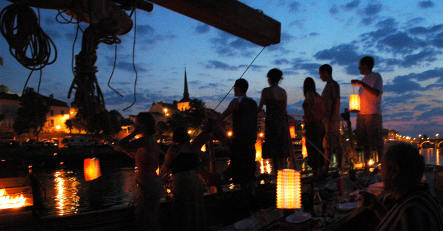
I’ve always loved St. Martin’s Day because the children of the villages in Germany gather with laterns and walk the cobbled streets singing a song “Laterne! Laterne! . . . .” There is usually someone dressed in a large red cloak who rides a horse, as St. Martin.
Something else happens on St. Martin’s Day – it is the beginning of goose season! There is only about one month, in Germany, when you can eat this speciality, St. Martin’s Goose. It is baked, served with a very fatty gravy (sounds horrible, but it is delicious), red cabbage and potatoes. You can get a quarter goose, a half goose or you can go as a group and have an entire goose feast. The smell of roasting goose is yummy, and the goose itself, when well prepared, is succulent and tasty.
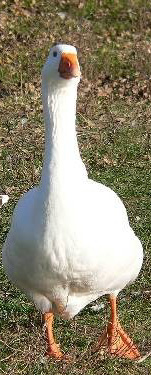
Here is how to roast a St. Martin’s goose:
Preparation: 1 hour
Cooking: 1/2 a hour by kg
Ingredients (for 6 persons):
– 1 goose of 6kg approximately
– 500 g of chopped pork – 1 egg – 4 shallots
– 1 small stalk of thym
– 200 g of crumb of bread (or gingerbread!)
– salt, pepper, nutmeg, parsley
– 100g of walnuts and chopped hazelnuts
Mix the various ingredients of the practical stuffing. Stuff, and let it gild on all the surface in its fat of goose, in the owen. Put then the goose in the oven and cook in its own juice (half an hour by kg). It came from This Website on European Cultures.
The stuffed goose uses surrounded with purée of chestnuts or with whole chestnuts cooked in a little broth then in the juice of the goose and accompanied with a Riesling of Moselle region.
Here is the story of St. Martin by James Kiefer from the Lectionary.
(I’ve always wondered why St. Martin tore his cloak in half, and didn’t give the whole cloak to the begger, since he probably had on warm clothing underneath.)
MARTIN OF TOURS
BISHOP AND THEOLOGIAN (11 NOV 397)
Martin was born around 330 of pagan parents. His father was a soldier, who enlisted Martin in the army at the age of fifteen. One winter day he saw an ill-clad beggar at the gate of the city of Amiens. Martin had no money to give, but he cut his cloak in half and gave half to the beggar. (Paintings of the scene, such as that by El Greco, show Martin, even without the cloak, more warmly clad than the beggar, which rather misses the point.) In a dream that night, Martin saw Christ wearing the half-cloak. He had for some time considered becoming a Christian, and this ended his wavering. He was promptly baptized. At the end of his next military campaign, he asked to be released from the army, saying: “Hitherto I have faithfully served Caesar. Let me now serve Christ.” He was accused of cowardice, and offered to stand unarmed between the contending armies. He was imprisoned, but released when peace was signed.
He became a disciple of Hilary of Poitiers, a chief opponent in the West of the Arians, who denied the full deity of Christ, and who had the favor of the emperor Constantius. Returning to his parents’ home in Illyricum (Yugoslavia, approximately), he opposed the Arians with such effectiveness that he was publicly scourged and exiled. He was subsequently driven from Milan, and eventually returned to Gaul. There he founded the first monastary in Gaul, which lasted until the French Revolution.
In 371 he was elected bishop of Tours. His was a mainly pagan diocese, but his instruction and personal manner of life prevailed. In one instance, the pagan priests agreed to fell their idol, a large fir tree, if Martin would stand directly in the path of its fall. He did so, and it missed him very narrowly. When an officer of the Imperial Guard arrived with a batch of prisoners who were to be tortured and executed the next day, Martin intervened and secured their release.
In the year 384, the heretic (Gnostic) Priscillian and six companions had been condemned to death by the emperor Maximus. The bishops who had found them guilty in the ecclesiastical court pressed for their execution. Martin contended that the secular power had no authority to punish heresy, and that the excommunication by the bishops was an adequate sentence. In this he was upheld by Ambrose, Bishop of Milan. He refused to leave Treves until the emperor promised to reprieve them. No sooner was his back turned than the bishops persuaded the emperor to break his promise; Priscillian and his followers were executed. This was the first time that heresy was punished by death.
Martin was furious, and excommunicated the bishops responsible. But afterwards, he took them back into communion in exchange for a pardon from Maximus for certain men condemned to death, and for the emperor’s promise to end the persecution of the remaining Priscillianists. He never felt easy in his mind about this concession, and thereafter avoided assmblies of bishops where he might encounter some of those concerned in this affair. He died on or about 11 November 397 (my sources differ) and his shrine at Tours became a sanctuary for those seeking justice.
The Feast of Martin, a soldier who fought bravely and faithfully in the service of an earthly sovereign, and then elisted in the service of Christ, is also the day of the Armistice which marked the end of the First World War. On it we remember those who have risked or lost their lives in what they perceived as the pursuit of justice and peace.
Veteran’s Day Sunrise

This is for you, AdventureMan, your own Veteran’s Day sunrise.
To anyone who has ever served in a nation’s armed forces. We salute you. Today and every day, we honor the service you gave to your country.
If you talk to any Kuwaiti veteran of the Gulf War and Liberation in Kuwait, you will learn that even a very short time in service can be a transformational experience. Those memories are vivid, and last the rest of your life.
Have a great day, Kuwait.
Blood Spatter and Persephone’s Pomegranates
This morning I was hulling pomegranates. I’m not very good at it, and I was imagining the cooks at someplace like Shebastan could make quick work of what took me quite a while. My hands were thoroughly stitcky, but I had a nice healthy bowl of seeds, which I now know are called Aril, that I will eat like candy, and pop into my morning oatmeal – makes it edible and it tastes like health in a bowl.
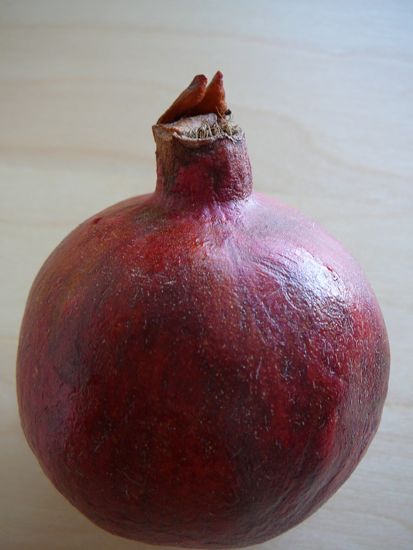
Pomegranate - Just look at that beautiful color!
My very cool Mom bought me my first pomegranate – here in Kuwait, they are called Roman’, which my husband said is because they came in with the Romans, but that seems very strange to me because clearly they are Iranian in origin. It took me forever to dig the seeds out. Now I know to just lightly cut the skin in a few places, tear off a hunk and start separating. I read on Wikipedia that it goes faster in water, the seeds sink and the pulp floats. I’ll have to try that next time.

Pomegranate seeds - again - look at those colors!
Mom bought me the pomegranate because I was crazy about Greek mythology, and Persephone had to spend six months in hell every year because (it’s a long story, this is just the short version) she had been tempted to eat and she ate just six pomegranate seeds, and so when she was freed from hell she still has to go back for six months and that’s why we have winter (well, I was just a kid and it made sense to me) but I always wondered what a pomegranate would be like.
I’ve loved them ever since. But when I was done, I noticed I had spots and streaks like something out of Dexter all over the walls. I think I have it all cleaned up, but I keep finding places I missed!
But you know how one thing leads to another, and then leads to Wikipedia. I wanted to make sure I got the legend of Persephone right, but instead, I learned that pomegranates have symbolism in all three religions of the book – Judaism, Christianity and Islam. Click on the blue type above and you can learn more about Pomegranates. Read below for what Wikipedia tells us about the pomegranate’s symbolism in different religions:
Pomegranates and symbolism
[edit]Judaism
Exodus 28:33–34 directed that images of pomegranates be woven onto the hem of the me’il (“robe of the ephod”), a robe worn by the Hebrew High Priest. 1 Kings 7:13–22 describes pomegranates depicted on the capitals of the two pilars (Jachin and Boaz) which stood in front of the temple King Solomon built in Jerusalem. It is said that Solomon designed his coronet based on the pomegranate’s “crown” (calyx).[31]
Jewish tradition teaches that the pomegranate is a symbol for righteousness, because it is said to have 613 seeds which corresponds with the 613 mitzvot or commandments of the Torah. For this reason and others, many Jews eat pomegranates on Rosh Hashanah. However, the actual number of seeds varies with individual fruits.[32] It is also a symbol of fruitfulness.[33] The pomegranate is one of the few images which appear on ancient coins of Judea as a holy symbol, and today many Torah scrolls are stored while not in use with a pair of decorative hollow silver “pomegranates” (rimmonim) placed over the two upper scroll handles. Some Jewish scholars believe that it was the pomegranate that was the forbidden fruit of the Garden of Eden.[33] Pomegranate is one of the Seven Species (Hebrew: שבעת המינים, Shiv’at Ha-Minim), the types of fruits and grains enumerated in the Hebrew Bible (Deuteronomy 8:8) as being special products of the Land of Israel.
[edit]Christianity
For the same reasons, pomegranates are a motif found in Christian religious decoration. They are often woven into the fabric of vestments and liturgical hangings or wrought in metalwork. Pomegranates figure in many religious paintings by the likes of Sandro Botticelli and Leonardo da Vinci, often in the hands of the Virgin Mary or the infant Jesus. The fruit, broken or bursting open, is a symbol of the fullness of his suffering and resurrection.[33] In the Eastern Orthodox Church, pomegranate seeds may be used in kolyva, a dish prepared for memorial services, as a symbol of the sweetness of the heavenly kingdom.
[edit]Islam
According to the Qur’an, pomegranates grow in the gardens of paradise (55:068). According to Islamic tradition, every seed of a pomegranate must be eaten, because one can’t be sure which aril came from paradise. The Prophet Mohammed is said to have encouraged his followers to eat pomegranates to ward off envy and hatred.[33] The Qur’an also mentions (6:99, 6:141) pomegranates twice as examples of good things God creates.
[edit]Greece and Greek mythology
The wild pomegranate did not grow natively in the Aegean area in Neolithic times. It originated in eastern Iran and came to the Aegean world along the same cultural pathways that brought the goddess whom the Anatolians worshipped as Cybele and the Mesopotamians as Ishtar.
The myth of Persephone, the chthonic goddess of the Underworld, also prominently features the pomegranate. In one version of Greek mythology, Persephone was kidnapped by Hades and taken off to live in the underworld as his wife. Her mother, Demeter (goddess of the Harvest), went into mourning for her lost daughter and thus all green things ceased to grow. Zeus, the highest ranking of the Greek gods, could not leave the Earth to die, so he commanded Hades to return Persephone. It was the rule of the Fates that anyone who consumed food or drink in the Underworld was doomed to spend eternity there. Persephone had no food, but Hades tricked her into eating four pomegranate seeds while she was still his prisoner and so, because of this, she was condemned to spend four months in the Underworld every year. During these four months, when Persephone is sitting on the throne of the Underworld next to her husband Hades, her mother Demeter mourns and no longer gives fertility to the earth. This became an ancient Greek explanation for the seasons.
Dante Gabriel Rossetti’s painting Persephona depicts Persephone holding the fatal fruit. It should be noted that the number of seeds that Persephone ate varies, depending on which version of the story is told. The number of seeds she is said to have eaten ranges from three to seven, which accounts for just one barren season if it is just three or four seeds, or two barren seasons (half the year) if she ate six or seven seeds. There is no set number.
The pomegranate also evoked the presence of the Aegean Triple Goddess who evolved into the Olympian Hera, who is sometimes represented offering the pomegranate, as in the Polykleitos’ cult image of the Argive Heraion (see below). According to Carl A. P. Ruck and Danny Staples, the chambered pomegranate is also a surrogate for the poppy’s narcotic capsule, with its comparable shape and chambered interior.[34] On a Mycenaean seal illustrated in Joseph Campbell’s Occidental Mythology 1964, figure 19, the seated Goddess of the double-headed axe (the labrys) offers three poppy pods in her right hand and supports her breast with her left. She embodies both aspects of the dual goddess, life-giving and death-dealing at once. The Titan Orion was represented as “marrying” Side, a name that in Boeotia means “pomegranate”, thus consecrating the primal hunter to the Goddess. Other Greek dialects call the pomegranate rhoa; its possible connection with the name of the earth goddess Rhea, inexplicable in Greek, proved suggestive for the mythographer Karl Kerenyi, who suggested that the consonance might ultimately derive from a deeper, pre-Indo-European language layer.
Pomegranate — opened up
In the 6th century BC, Polykleitos took ivory and gold to sculpt the seated Argive Hera in her temple. She held a scepter in one hand and offered a pomegranate, like a ‘royal orb’, in the other. “About the pomegranate I must say nothing,” whispered the traveller Pausanias in the 2nd century, “for its story is something of a mystery.” Indeed, in the Orion story we hear that Hera cast pomegranate-Side (an ancient city in Antalya) into dim Erebus — “for daring to rival Hera’s beauty”, which forms the probable point of connection with the older Osiris/Isis story. Since the ancient Egyptians identified the Orion constellation in the sky as Sah the “soul of Osiris”, the identification of this section of the myth seems relatively complete. Hera wears, not a wreath nor a tiara nor a diadem, but clearly the calyx of the pomegranate that has become her serrated crown.
The pomegranate has a calyx shaped like a crown. In Jewish tradition it has been seen as the original “design” for the proper crown.[31] In some artistic depictions, the pomegranate is found in the hand of Mary, mother of Jesus.
In modern times the pomegranate still holds strong symbolic meanings for the Greeks. On important days in the Greek Orthodox calendar, such as the Presentation of the Virgin Mary and on Christmas Day, it is traditional to have at the dinner table “polysporia”, also known by their ancient name “panspermia,” in some regions of Greece. In ancient times they were offered to Demeter[citation needed] and to the other gods for fertile land, for the spirits of the dead and in honor of compassionate Dionysus.
When one buys a new home, it is conventional for a house guest to bring as a first gift a pomegranate, which is placed under/near the ikonostasi (home altar) of the house, as a symbol of abundance, fertility and good luck. Pomegranates are also prominent at Greek weddings and funerals. When Greeks commemorate their dead, they make kollyva as offerings, which consist of boiled wheat, mixed with sugar and decorated with pomegranate. It is also traditional in Greece to break a pomegranate on the ground at weddings and on New Years. Pomegranate decorations for the home are very common in Greece and sold in most homegoods stores.[35]
The photos, by the way, are of Indian pomegranates, but I bought Indian ones, Iranian ones and Egyptian ones; some are great big and very red, some are more orangey-red. These Indian ones are delightfully sweet!
Google can help you find all kinds of pomegranate recipes, but there is actually an organization called Pomegranates.org that lists lots of recipes in one easy location. 🙂 This must be pomegranate season, because they are plentiful, and reasonably priced, and oh, what luxury!
Here is one of their recipes:
Chicken with Pomegranate and Walnuts
2-3/4 pound fryer chicken
2 cups walnuts, finely chopped
3 tablespoons shortening
3-1/2 cups water
1/2 teaspoon poultry seasoning
1 teaspoon salt
1/2 teaspoon cinnamon
1/2 teaspoon pepper
2 teaspoons lemon juice
1 large onion, finely chopped
1 cup fresh pomegranate juice
3 teaspoons butter
2 teaspoons tomato sauce
1 teaspoon sugar
Prepare chicken for frying. Saute chicken with poultry seasoning in shortening until light brown, set aside. In a large pot saute the onion in 3 teaspoon butter until golden brown. Add tomato sauce and saute for a few minutes. Add walnuts to the onions and saute over meduim heat about 5 minutes, stirring constantly. Add water, remaining seasonings, lemon juice, and pomegranate syrup. Cover and let cook on low about 35 minutes. Taste the sauce and add sugar if needed. Arrange browned chicken pieces in the sauce, cover and let simmer 20-25 minutes. Serve over white rice.
Serves 6.
Election Joke: Today, You Voted
A good friend sent this non-partisan joke just in time for election day:
While walking down the street one day a US senator is tragically hit by
A truck and dies.
His soul arrives in heaven and is met by St. Peter at the entrance.
‘Welcome to heaven,’ says St. Peter. ‘Before you settle in, it seems
There is a problem. We seldom see a high official around these parts,
You see, so we’re not sure what to do with you.’
‘No problem, just let me in,’ says the man.
‘Well, I’d like to, but I have orders from higher up. What we’ll do Is
have you spend one day in hell and one in heaven. Then you Can choose
where to spend eternity.’
‘Really, I’ve made up my mind. I want to be in heaven,’ says the
Senator.
‘I’m sorry, but we have our rules.’
And with that, St. Peter escorts him to the elevator and he goes Down,
down, down to hell. The doors open and he finds himself In the middle
of a green golf course. In the distance is a clubhouse And standing in
front of it are all his friends and other politicians Who had worked
with him.
Everyone is very happy and in evening dress. They run to greet him,
Shake his hand, and reminisce about the good times they had while
Getting rich at the expense of the people.
They play a friendly game of golf and then dine on lobster, caviar And
champagne.
Also present is the devil, who really is a very friendly guy who Has a
good time dancing and telling jokes. They are having such a Good time
that before he realizes it, it is time to go.
Everyone gives him a hearty farewell and waves while the elevator
Rises…
The elevator goes up, up, up and the door reopens on heaven where St.
Peter
Is waiting for him.
‘Now it’s time to visit heaven.’
So, 24 hours pass with the senator joining a group of contented souls
Moving from cloud to cloud, playing the harp and singing. They have a
Good time and, before he realizes it, the 24 hours have gone by and St.
Peter returns.
‘Well, then, you’ve spent a day in hell and another in heaven. Now
Choose your eternity.’
The senator reflects for a minute, then he answers: ‘Well, I would Never
have said it before, I mean heaven has been delightful, but I think I
would be better off in hell.’
So St. Peter escorts him to the elevator and he goes down, down, Down
to hell.
Now the doors of the elevator open and he’s in the middle of a Barren
land covered with waste and garbage.
He sees all his friends, dressed in rags, picking up the trash and
Putting it in black bags as more trash falls from above.
The devil comes over to him and puts his arm around his shoulder.
‘I don’t understand,’ stammers the senator. ‘Yesterday I was here And
there was a golf course and clubhouse, and we ate lobster and Caviar,
drank champagne, and danced and had a great time. Now there’s just a
wasteland full of garbage and my friends look miserable.
What happened?’
The devil looks at him, smiles and says, ‘Yesterday we were
campaigning.. .
Today you voted.’
Recent Comments
ExpatAlien on What Country am I Living … intlxpatr on Yellowstone: Old Faithful to C… Michelle on Yellowstone: Old Faithful to C… Cathy on No Grown-Ups in Charge intlxpatr on Waiting for Snow Wikipedia Donate Button

Amazina


Early Voting in Florida


 Here There and Everywhere