Blood Spatter and Persephone’s Pomegranates
This morning I was hulling pomegranates. I’m not very good at it, and I was imagining the cooks at someplace like Shebastan could make quick work of what took me quite a while. My hands were thoroughly stitcky, but I had a nice healthy bowl of seeds, which I now know are called Aril, that I will eat like candy, and pop into my morning oatmeal – makes it edible and it tastes like health in a bowl.
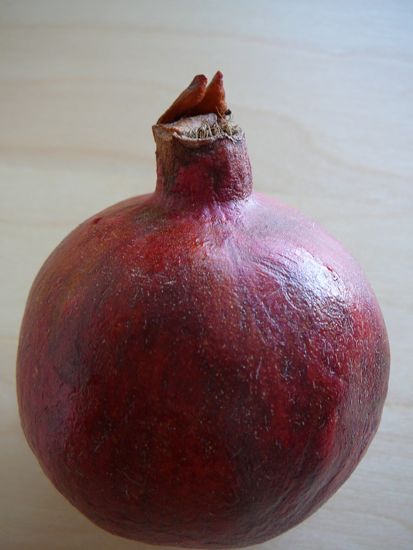
Pomegranate - Just look at that beautiful color!
My very cool Mom bought me my first pomegranate – here in Kuwait, they are called Roman’, which my husband said is because they came in with the Romans, but that seems very strange to me because clearly they are Iranian in origin. It took me forever to dig the seeds out. Now I know to just lightly cut the skin in a few places, tear off a hunk and start separating. I read on Wikipedia that it goes faster in water, the seeds sink and the pulp floats. I’ll have to try that next time.

Pomegranate seeds - again - look at those colors!
Mom bought me the pomegranate because I was crazy about Greek mythology, and Persephone had to spend six months in hell every year because (it’s a long story, this is just the short version) she had been tempted to eat and she ate just six pomegranate seeds, and so when she was freed from hell she still has to go back for six months and that’s why we have winter (well, I was just a kid and it made sense to me) but I always wondered what a pomegranate would be like.
I’ve loved them ever since. But when I was done, I noticed I had spots and streaks like something out of Dexter all over the walls. I think I have it all cleaned up, but I keep finding places I missed!
But you know how one thing leads to another, and then leads to Wikipedia. I wanted to make sure I got the legend of Persephone right, but instead, I learned that pomegranates have symbolism in all three religions of the book – Judaism, Christianity and Islam. Click on the blue type above and you can learn more about Pomegranates. Read below for what Wikipedia tells us about the pomegranate’s symbolism in different religions:
Pomegranates and symbolism
[edit]Judaism
Exodus 28:33–34 directed that images of pomegranates be woven onto the hem of the me’il (“robe of the ephod”), a robe worn by the Hebrew High Priest. 1 Kings 7:13–22 describes pomegranates depicted on the capitals of the two pilars (Jachin and Boaz) which stood in front of the temple King Solomon built in Jerusalem. It is said that Solomon designed his coronet based on the pomegranate’s “crown” (calyx).[31]
Jewish tradition teaches that the pomegranate is a symbol for righteousness, because it is said to have 613 seeds which corresponds with the 613 mitzvot or commandments of the Torah. For this reason and others, many Jews eat pomegranates on Rosh Hashanah. However, the actual number of seeds varies with individual fruits.[32] It is also a symbol of fruitfulness.[33] The pomegranate is one of the few images which appear on ancient coins of Judea as a holy symbol, and today many Torah scrolls are stored while not in use with a pair of decorative hollow silver “pomegranates” (rimmonim) placed over the two upper scroll handles. Some Jewish scholars believe that it was the pomegranate that was the forbidden fruit of the Garden of Eden.[33] Pomegranate is one of the Seven Species (Hebrew: שבעת המינים, Shiv’at Ha-Minim), the types of fruits and grains enumerated in the Hebrew Bible (Deuteronomy 8:8) as being special products of the Land of Israel.
[edit]Christianity
For the same reasons, pomegranates are a motif found in Christian religious decoration. They are often woven into the fabric of vestments and liturgical hangings or wrought in metalwork. Pomegranates figure in many religious paintings by the likes of Sandro Botticelli and Leonardo da Vinci, often in the hands of the Virgin Mary or the infant Jesus. The fruit, broken or bursting open, is a symbol of the fullness of his suffering and resurrection.[33] In the Eastern Orthodox Church, pomegranate seeds may be used in kolyva, a dish prepared for memorial services, as a symbol of the sweetness of the heavenly kingdom.
[edit]Islam
According to the Qur’an, pomegranates grow in the gardens of paradise (55:068). According to Islamic tradition, every seed of a pomegranate must be eaten, because one can’t be sure which aril came from paradise. The Prophet Mohammed is said to have encouraged his followers to eat pomegranates to ward off envy and hatred.[33] The Qur’an also mentions (6:99, 6:141) pomegranates twice as examples of good things God creates.
[edit]Greece and Greek mythology
The wild pomegranate did not grow natively in the Aegean area in Neolithic times. It originated in eastern Iran and came to the Aegean world along the same cultural pathways that brought the goddess whom the Anatolians worshipped as Cybele and the Mesopotamians as Ishtar.
The myth of Persephone, the chthonic goddess of the Underworld, also prominently features the pomegranate. In one version of Greek mythology, Persephone was kidnapped by Hades and taken off to live in the underworld as his wife. Her mother, Demeter (goddess of the Harvest), went into mourning for her lost daughter and thus all green things ceased to grow. Zeus, the highest ranking of the Greek gods, could not leave the Earth to die, so he commanded Hades to return Persephone. It was the rule of the Fates that anyone who consumed food or drink in the Underworld was doomed to spend eternity there. Persephone had no food, but Hades tricked her into eating four pomegranate seeds while she was still his prisoner and so, because of this, she was condemned to spend four months in the Underworld every year. During these four months, when Persephone is sitting on the throne of the Underworld next to her husband Hades, her mother Demeter mourns and no longer gives fertility to the earth. This became an ancient Greek explanation for the seasons.
Dante Gabriel Rossetti’s painting Persephona depicts Persephone holding the fatal fruit. It should be noted that the number of seeds that Persephone ate varies, depending on which version of the story is told. The number of seeds she is said to have eaten ranges from three to seven, which accounts for just one barren season if it is just three or four seeds, or two barren seasons (half the year) if she ate six or seven seeds. There is no set number.
The pomegranate also evoked the presence of the Aegean Triple Goddess who evolved into the Olympian Hera, who is sometimes represented offering the pomegranate, as in the Polykleitos’ cult image of the Argive Heraion (see below). According to Carl A. P. Ruck and Danny Staples, the chambered pomegranate is also a surrogate for the poppy’s narcotic capsule, with its comparable shape and chambered interior.[34] On a Mycenaean seal illustrated in Joseph Campbell’s Occidental Mythology 1964, figure 19, the seated Goddess of the double-headed axe (the labrys) offers three poppy pods in her right hand and supports her breast with her left. She embodies both aspects of the dual goddess, life-giving and death-dealing at once. The Titan Orion was represented as “marrying” Side, a name that in Boeotia means “pomegranate”, thus consecrating the primal hunter to the Goddess. Other Greek dialects call the pomegranate rhoa; its possible connection with the name of the earth goddess Rhea, inexplicable in Greek, proved suggestive for the mythographer Karl Kerenyi, who suggested that the consonance might ultimately derive from a deeper, pre-Indo-European language layer.
Pomegranate — opened up
In the 6th century BC, Polykleitos took ivory and gold to sculpt the seated Argive Hera in her temple. She held a scepter in one hand and offered a pomegranate, like a ‘royal orb’, in the other. “About the pomegranate I must say nothing,” whispered the traveller Pausanias in the 2nd century, “for its story is something of a mystery.” Indeed, in the Orion story we hear that Hera cast pomegranate-Side (an ancient city in Antalya) into dim Erebus — “for daring to rival Hera’s beauty”, which forms the probable point of connection with the older Osiris/Isis story. Since the ancient Egyptians identified the Orion constellation in the sky as Sah the “soul of Osiris”, the identification of this section of the myth seems relatively complete. Hera wears, not a wreath nor a tiara nor a diadem, but clearly the calyx of the pomegranate that has become her serrated crown.
The pomegranate has a calyx shaped like a crown. In Jewish tradition it has been seen as the original “design” for the proper crown.[31] In some artistic depictions, the pomegranate is found in the hand of Mary, mother of Jesus.
In modern times the pomegranate still holds strong symbolic meanings for the Greeks. On important days in the Greek Orthodox calendar, such as the Presentation of the Virgin Mary and on Christmas Day, it is traditional to have at the dinner table “polysporia”, also known by their ancient name “panspermia,” in some regions of Greece. In ancient times they were offered to Demeter[citation needed] and to the other gods for fertile land, for the spirits of the dead and in honor of compassionate Dionysus.
When one buys a new home, it is conventional for a house guest to bring as a first gift a pomegranate, which is placed under/near the ikonostasi (home altar) of the house, as a symbol of abundance, fertility and good luck. Pomegranates are also prominent at Greek weddings and funerals. When Greeks commemorate their dead, they make kollyva as offerings, which consist of boiled wheat, mixed with sugar and decorated with pomegranate. It is also traditional in Greece to break a pomegranate on the ground at weddings and on New Years. Pomegranate decorations for the home are very common in Greece and sold in most homegoods stores.[35]
The photos, by the way, are of Indian pomegranates, but I bought Indian ones, Iranian ones and Egyptian ones; some are great big and very red, some are more orangey-red. These Indian ones are delightfully sweet!
Google can help you find all kinds of pomegranate recipes, but there is actually an organization called Pomegranates.org that lists lots of recipes in one easy location. 🙂 This must be pomegranate season, because they are plentiful, and reasonably priced, and oh, what luxury!
Here is one of their recipes:
Chicken with Pomegranate and Walnuts
2-3/4 pound fryer chicken
2 cups walnuts, finely chopped
3 tablespoons shortening
3-1/2 cups water
1/2 teaspoon poultry seasoning
1 teaspoon salt
1/2 teaspoon cinnamon
1/2 teaspoon pepper
2 teaspoons lemon juice
1 large onion, finely chopped
1 cup fresh pomegranate juice
3 teaspoons butter
2 teaspoons tomato sauce
1 teaspoon sugar
Prepare chicken for frying. Saute chicken with poultry seasoning in shortening until light brown, set aside. In a large pot saute the onion in 3 teaspoon butter until golden brown. Add tomato sauce and saute for a few minutes. Add walnuts to the onions and saute over meduim heat about 5 minutes, stirring constantly. Add water, remaining seasonings, lemon juice, and pomegranate syrup. Cover and let cook on low about 35 minutes. Taste the sauce and add sugar if needed. Arrange browned chicken pieces in the sauce, cover and let simmer 20-25 minutes. Serve over white rice.
Serves 6.
Election Joke: Today, You Voted
A good friend sent this non-partisan joke just in time for election day:
While walking down the street one day a US senator is tragically hit by
A truck and dies.
His soul arrives in heaven and is met by St. Peter at the entrance.
‘Welcome to heaven,’ says St. Peter. ‘Before you settle in, it seems
There is a problem. We seldom see a high official around these parts,
You see, so we’re not sure what to do with you.’
‘No problem, just let me in,’ says the man.
‘Well, I’d like to, but I have orders from higher up. What we’ll do Is
have you spend one day in hell and one in heaven. Then you Can choose
where to spend eternity.’
‘Really, I’ve made up my mind. I want to be in heaven,’ says the
Senator.
‘I’m sorry, but we have our rules.’
And with that, St. Peter escorts him to the elevator and he goes Down,
down, down to hell. The doors open and he finds himself In the middle
of a green golf course. In the distance is a clubhouse And standing in
front of it are all his friends and other politicians Who had worked
with him.
Everyone is very happy and in evening dress. They run to greet him,
Shake his hand, and reminisce about the good times they had while
Getting rich at the expense of the people.
They play a friendly game of golf and then dine on lobster, caviar And
champagne.
Also present is the devil, who really is a very friendly guy who Has a
good time dancing and telling jokes. They are having such a Good time
that before he realizes it, it is time to go.
Everyone gives him a hearty farewell and waves while the elevator
Rises…
The elevator goes up, up, up and the door reopens on heaven where St.
Peter
Is waiting for him.
‘Now it’s time to visit heaven.’
So, 24 hours pass with the senator joining a group of contented souls
Moving from cloud to cloud, playing the harp and singing. They have a
Good time and, before he realizes it, the 24 hours have gone by and St.
Peter returns.
‘Well, then, you’ve spent a day in hell and another in heaven. Now
Choose your eternity.’
The senator reflects for a minute, then he answers: ‘Well, I would Never
have said it before, I mean heaven has been delightful, but I think I
would be better off in hell.’
So St. Peter escorts him to the elevator and he goes down, down, Down
to hell.
Now the doors of the elevator open and he’s in the middle of a Barren
land covered with waste and garbage.
He sees all his friends, dressed in rags, picking up the trash and
Putting it in black bags as more trash falls from above.
The devil comes over to him and puts his arm around his shoulder.
‘I don’t understand,’ stammers the senator. ‘Yesterday I was here And
there was a golf course and clubhouse, and we ate lobster and Caviar,
drank champagne, and danced and had a great time. Now there’s just a
wasteland full of garbage and my friends look miserable.
What happened?’
The devil looks at him, smiles and says, ‘Yesterday we were
campaigning.. .
Today you voted.’
Rosy Rainfall in Kuwait
It’s been a long day, a productive day, and at last I can take a deep breath. My friend tells me it is cold out, but I have had the oven on much of the day, and our place is warm and cozy. I would love some fresh air, so I quietly close the door to the kitchen and step out on the balcony.
It is beyond fresh. It is fresh, and raining, and off in the distance, the sun is setting and the muezzin is calling everyone to prayer and it is purely a beautiful moment.

We didn’t have rain like this last year, or the year before. We had some rain two years ago, in December mostly, but still – not like this. This has been a wonderful, continuous, soaking rain, blessing Kuwait and preparing us for an amazing winter growing season. I would love to be able to see the flowers people tell me are blooming in the desert when it rains.
In Saudi Arabia, we spent a whole day travelling to see the tiny irises that would bloom in Tumayr. Here, there are still places you can’t go, because there are explosives left over from the Gulf War, and now and then a shepherd loses a leg by stepping in the wrong place.
The Great Kuwait Sand and Surf Challenge
OK, so here it is, the new photo challenge. You will have three weeks. All your photos must be in to me or posted on your blog and linked to me by Saturday, November 22. The poll will go up then, and voting will continue to November 29, when the polls will close and new winners will be announced.
Sand and Surf can be anything related to beach activities – tidal pools, boating . . . this contest is open to Kuwaitis, residents of Kuwait, and people who have an attachment to Kuwait. We don’t require that the scene be recognizably Kuwait, because well, sand is sand and surf is surf. The photos do not have to be Kuwait, but we want them to be entered by someone remotely Kuwait-related.
Ready on the right!
Ready on the left!
Photographers, take your target!
Fire!
Off topic but related – on the top floor of the Al Rayya Shopping Center (attached to the Marriott Hotel near Dasman Circle) is a really intriguing photo exhibit. It looks to me like all Kuwaiti, and some of the photos are purely spectacular. Some are very moving. I don’t want to give too much away, but if you enjoy photography, this exhibit is worth a visit.
Heading for the Desert
Every now and then I wish I were a man. When I was a little kid, our dads would all head out on a big boat, going hunting. Mostly, women stayed home. Some women hunted, but it is hard work, and, I think, maybe men don’t always want women along when they go out hunting, they want to (in Alaska) drink and party and play cards and talk crude and don’t want anyone around reminding them to mind their manners.
The truth is I don’t know what they do. I can only imagine, based on things I’ve heard, movies, my imagination.
Today, my neighbors are headed out to hunt. How do I know? They have their falcon with them. It is perfect weather – clear, relatively cool, the heat has definitely broken, it is wonderful to be able to drive without any air conditioning. . . .
I know, I know, there is still this kid in my heart that thinks that going hunting with a FALCON is very very cool.

Rain in Kuwait
Lots of rain, peals of thunder, lightning strikes and lots of rain! The Qatteri Cat is totally freaked out, running from the leaking window with it’s new drip drip drip to the windows – he thinks the rain drops are bugs or something, and makes that eh-eh-eh-eh-eh sound cats make when they see birds. Rain!
I am laughing; who would think this PacificNorthwest gal would be celebrating rain – we get so much rain out there in the PNW. But even when there was a huge rainstorm here in Kuwait last year, we didn’t see any where we live, or only a drop or two, not even enough to smear a window or create a puddle. Now Rain! Real rain!

When it started, I was driving. We got home as soon as we could; the first rains turn the highways into grease slicks.

Remember – this is not California, where people might stop and dance for joy at the parking lights. (California has droughts, too.) Dancing for joy only allowed in the privacy of your own home!
Update – an hour later it is still raining, and I have towels under several of my windows to collect the intrusion!
New Buses, Mixed Blessing
As many of you may remember, I am a supporter of public transportation. I would SO much rather have the time to read a book or magazine than to be stuck in traffic. When I saw the bright, modern, fast new buses hit the streets recently in Kuwait – during the last year – instead of the clunky slow, old buses they had, my heart rejoiced.
Hmm. Not so fast.
I drive on a major local road regularly. The buses have become a menace. They drive way fast. They halt, and then merge back into traffic as if they have the right of way, which as we all know, in Kuwait there is no right of way. I guess they figure that because they are big, and faster, they are king of the road. I can tell you for a fact, they don’t like being passed by a woman. Imagine, being chased down by a bus!
Buses cause accidents on Sixth Ring Road
KUWAIT: Sixth Ring Road was the scene of two accidents caused by public buses.
A man driving a small car suffered serious injuries when he hit a public bus after the bus driver lost control of his vehicle and hit the barrier and then stopped at the middle of the road. The man was taken to the hospital by a fellow citizen to seek medical assistance.
Ten minutes later, another bus driver repeated the same scenario of the first accident except as he hit the barrier he also hit a small car. The car driver suffered serious injuries and was taken to hospital to seek medical assistance. The two buses caused serious traffic congestion but police officers managed to move them to the side of the road and continue the traffic flow.
I don’t know what training the drivers receive before they head out in their buses. I have a suspicion that it isn’t much. I think they need to be trained in safe driving practices, and warned against aggression on the roads. I think they need to use their rear view mirrors, their signals, and they need to be an example of proper driving, because they are a visible, public model of state policy.
Fighting for Muslim Women’s Rights
BBC News reports on a fascinating conference taking place right now in Barcelona regarding Women’s Rights in Islam:
Fighting for Muslim women’s rights
Some of the world’s leading Islamic feminists have been gathered in Barcelona for the third International Congress on Islamic Feminism, to discuss the issues women face in the Muslim world.
Some of the women taking part in the conference explained the problems in their home countries, and where they hoped to make progress.
ASMA BARLAS, Author, Pakistan
Religions always come into cultures, they don’t come into abstract and pure spaces. Islam came into a very patriarchal, tribal and misogynistic culture. One of the deepest damages to Islam has been its reduction to “Arabisation”.
I’m not going to say that the Arabs are particularly misogynistic in a way that nobody else is, but I do think there are very particular traits and attitudes towards women that have crept into Islam.
I have a friend who has been studying the interface between what he calls the Persian models and the Arabist models of Islam in the subcontinent and surprise, surprise: the Arabist models are misogynistic, authoritarian, unitarian and the Persian models are much more plural and tolerant.
This is a fight on two fronts – on the one hand we are struggling against the kinds of oppression dominant in Muslim patriarch societies and, on the other, Western perceptions of Islam as necessarily monolithic, and confusing the ideals of Islam with the reality of Muslim lives.
If we read the Koran as a totality rather than pulling out random verses or half a line, that opens all kinds of possibilities for sexual equality.
RAFIAH AL-TALEI, journalist, Oman
Oman is relatively liberal, women are free to choose what to wear, and can choose their jobs and education. And the law does not require us to wear any particular form of clothing. But there are strong social and cultural factors – coming from the fact that we are in Arabia – that limit women.
As a journalist, it has not been hard for me to work among men, but it has been hard for some of my colleagues whose families told them this was not “appropriate” work for them.
The biggest difficulties are the social and cultural factors, and some aspects of law. For example, women who marry a foreigner cannot pass on their nationality to their children, whereas men in that situation can.
Religion is not an issue in our struggle, although there are problems with family law about divorce and marriage status. Omani laws are based on sharia law. Sharia is fair, but it is the wrong interpretations that are the problem. Male judges often don’t understand the principal goals of sharia.
We feel the law is fair, but ends up being unfair for women because of how judges interpret it.
Cultural and social factors often get mixed up with religion. Educated women can be more empowered and separate the two, but many don’t dare challenge the conventions.
NORANI OTHMAN, Scholar-activist, Malaysia
I don’t think it is any more difficult to be an Islamic feminist than a non-Muslim, or secular feminist.
Asian Muslim states have very different traditions to Middle Eastern countries
Feminists in general have to face up to political and cultural obstacles, to achieve our objectives of women’s rights. Even Western feminists have had a similar history – having to engage with certain religious beliefs not conducive to gender equality.
Perhaps the only distinctive difference peculiar to Muslim feminists is that we are caught in the cross-currents of modernisation and a changing society, due to a modern economy on the one hand and the global resurgence of political Islam on the other.
Political Islam wants to impose a world view about the gender order that is not consistent with the realities and the lived experiences of Muslim men and women in contemporary society.
Our detractors would hurl empty accusations at us – calling us Western, secular or anti-Islamic
There is a difference between South East Asian Muslim countries and the ones in the Middle East – culturally we are less patriarchal, we can always respond to our detractors by pointing out we don’t have the cultural practices that they do.
Our detractors would hurl empty accusations at us – calling us Western, secular or anti-Islamic.
Our arguments are rooted within Islam – we want renewal and transformation within the Islamic framework. They don’t like that.
We have a holistic approach, seeking gender equality within the Islamic framework, supported by constitutional guarantees. We see that these are not inconsistent with the message of the Koran, particularly during its formative stages. We have to understand the history and cultural context and extract the principle that will be applicable in modern times.
SITI MUSDAH MULIA, Academic, Indonesia
In my experience, I find that it is very difficult to make Indonesian Muslim women aware that politics is their right.
In Indonesian society, politics is always conceived as cruel and dirty, so not many women want to get involved, they think it is just for men.
According to the [radicalist] Islamic understanding, women should be confined to the home, and the domestic sphere alone
We try to make women understand that politics is one of our duties and rights and they can become involved without losing their femininity.
Personally, I’m non-partisan, I’m not linked to one political party because, in Indonesia, the political parties often discriminate against women.
I struggle from outside the political sphere to make it women-friendly, to reform political parties and the political system.
One day, I hope to be involved more directly, if the system becomes more women-friendly. We have passed a law about affirmative action and achieving 30% female representation, but we won’t see if it is implemented until after 2009 elections. We are waiting.
In Indonesia, some groups support us, but some radical groups oppose what we are trying to achieve. They accuse me, accuse feminist Muslims, of being infidels, of wanting to damage Islamic affairs.
According to their Islamic understanding, women should be confined to the home, and the domestic sphere alone.
AMINA WADUD, Academic, United States
There are many more conversations going on today between different interpretations of Islam. Some interpretations are very narrow, some are more broad, principled, ethically-based.
Unless we have sufficient knowledge about Islam, we cannot bring about reform of Islam. I am not talking about re-interpretation, I am talking more about gender-inclusive interpretation.
Islam and feminism are not mutually exclusive
We have a lot of information about men’s interpretations of Islam, and of what it means to be a woman in Islam. We don’t have equal amounts of information about what women say it means to be a good woman in Islam.
Now it’s time for men to be active listeners, and after listening, to be active participants in bringing about reform.
There is a tendency to say that it is Islam that prohibits women from driving a car, for example, when women drive cars all over the world except in one country. So then you know it is not Islam. Islam has much more flexibility, but patriarchy tends to have the same objective, and that is to limit our ability to understand ourselves as Muslims.
I have always defined myself as pro-faith and pro-feminism.
I do not wish to sacrifice my faith for anybody’s conception of feminism, nor do I sacrifice the struggle and actions for full equality of women, Muslim and non-Muslim women, for any religion. Islamic feminism is not an either/or, you can be Muslim and feminist and strive for women’s rights and not call yourself a feminist.
FATIMA KHAFAJI, Consultant, Egypt
In Egypt, Islamic feminism is a way for women activists to reach a large number of ordinary women in the villages and in urban low-income areas, using a framework of Islam. So there would be a reference to Islam when talking about women’s rights. Experience has shown that that is an easy way to get women to accept what you’re saying.
Not many women get information about women’s rights easily, so you have to counter what has been fed to them, to both men and women, from the strict, conventional, religious people who have more access to women.
They have their own idea of women’s rights in Islam – that is, patriarchal, still limiting opportunities for women. But women have been receiving this concept for ages, through the radio, TV, mosques, so the challenge is how to give them another view, of enlightened Islam, that talks about changing gender roles. It’s not an easy job.
Historically, in Egypt in the feminist movement, there have been both Muslim and Christian women. It has never been a problem. Unfortunately nowadays, it has become a problem. Religious discrimination has been dividing people very much. We have to think carefully about how to supersede the differences.
With family law, we’re aiming to change the philosophy of the law itself. Traditional family law puts women down. I can see this whole notion of “women do not have control over their bodies” in so many laws, in the penal code and family law. For example, sexual harassment is happening because men think the control of women’s bodies is a matter for them. Even the decision whether to have children is the decision of men. This whole notion has to be changed in a dramatic way if we are really going to talk about women’s rights in Egypt.
Interesting Twist on Hijab
From today’s Al Watan:
”Policewomen must comply with Islamic attire”
Al Watan staff
KUWAIT: In reaction to a statement by the Director General of Sheikh Saad AlـAbdullah Academy on policewomen”s uniforms, MP Mohammed Hayef noted that the current uniform requirements for female police contravene with the spirit of Islamic law as well as the Constitution, which guarantees personal freedom.
According to him, the announced uniform will ban policewomen for wearing a veil, even if they chose to do so.
The lawmaker reiterated his resolve to stand against the uniform to ensure that Islamic law is observed.
He also criticized the period during which policewomen will undergo training, arguing that 12 hours is too long for the female conscripts, considering their physical abilities.
Describing the training period as similar to hard labor, he called on the relevant authorities to reconsider their decision on this particular matter.
Last updated on Tuesday 28/10/2008
What do you think? I think that there are ways of covering your hair that are not inconsistent with being a policewoman. If the uniform forbids hijab, in my mind, that is as bad as the parliament requiring hijab, for the same reason – wearing hijab or not wearing hijab is a personal decision between a woman and her God. It is not to be mandated by state or mankind. Instead of getting into a big fracas about it, why not have a fashion-design contest to design a professional headgear that a covered woman could CHOOSE to wear as part of her uniform?
As to the 12 hours – well LLLLOOOLLLL! How many hours of hard labor per day do women put in with taking care of children, cleaning, shopping and meal preparation, not to mention family obligations? Working a 12 hour day training to be a policewoman? Piece of cake!
Women in all parts of the world are working as soldiers, police, fire protection, etc. They train as hard as the men, and they get the job done. Think of the female doctors in Kuwait, and the hours they work! Think of their sacrifice! Our estrogen issues are no more diverting and/or debilitating than male testosterone issues!
(thank you, thank you, I’ll get off my soapbox now)
Aware Center: November Schedule
If you are feeling a little clueless in Kuwait, the Aware Center is a great place to get started. They offer classes in Arabic, in addition to multiple opportunities to understand the culture and all that Kuwait has to offer.
AWARE Center November Calendar
“Advocates for Western-Arab Relations”
The AWARE Center is a non-profit and non-governmental organization that was established in 2003 by a group of Arabs and Westerners whose aim was to promote positive relations between Westerners and Arabs through dialogue and friendship. Since our opening in 2003, individuals from more than 50 countries have visited AWARE to take part in our cross-cultural activities.
We hope you will join us as we share the culture of the Arabs and Muslims through a variety of programs scheduled during the month of November.
For further details on any of our programs, you may contact our staff by telephone at
2 5335280 or by email at info@www.aware.com.kw or delores.aware@gmail.com or view our webpage atwww.aware.com.kw
November at AWARE:
Nov. 2-8
Tues. 4th Nov. Diwaniya: “The Status of Women in the World and Islam’s Response”, by Dr Teresa, 7:00pm
Wed. 5th Nov. Cultural Orientation Course: “Cultural Clothing of Kuwait” by Iman Martin, 7:00pm
Thurs. 6th Nov. Arabic Winter Courses Begin (Please refer to the attachment for a full schedule of class offerings)
Nov. 9-15
Mon. 10th Nov. Tour: Tareq Rajab Museum Please note: This tour meets directly at the Museum at 5pm. For directions and further details, contact amina@aware.com.kw
Tues. 11th Nov. Diwaniya: “What is the Real Jihad?” by Shayma Mahmoud, 7:00pm
Wed. 12th Nov. Cultural Orientation Course: “Etiquette when visiting Kuwaiti Homes” by Wadha, 7:00pm
Thurs. 13th Nov. International Friends Film and Coffee Social: “Inside Mecca“, A National Geographicdocumentary film, 7:00pm
Sat. 15th Nov. Tour: Grand Mosque 9.30am Please note: This tour meets directly at the Grand Mosque at 9:15am. For directions and further details, contact amina@aware.com.kw
Nov. 16-22
Tues. 18th Nov. Diwaniya: “Globalization Vs Universalism“ by Kevin Stoda, 7:00pm
Wed. 19th Nov. Cultural Orientation Course: “Kuwaiti Weddings & Islamic Married Life” by Iman Martin, 7:00pm
Nov. 23-30
Tues. 25th Nov. Diwaniya: “Why are human beings different?”, by Hassan Taha, 7:00pm
Thurs. 27th Nov. Carpet Exhibition & Lecture, “The Art of Persians Carpets”, by Nazi Riasati Al-Dashti, 7:00pm
Recent Comments
intlxpatr on Shampoo Ginger tigerbutterya0c5ff1d… on Shampoo Ginger intlxpatr on British Soldier Kidnapped, Esc… John on British Soldier Kidnapped, Esc… intlxpatr on British Soldier Kidnapped, Esc… Wikipedia Donate Button

Amazina


Early Voting in Florida


 Here There and Everywhere