“Madam, This is MY Job”
I had all kinds of ideas for my new garden – new climate, new challenges. Yes, I had been told that the climate was too hot for orange trees, but I want to give it a try. Yes, my gardening friends haven’t had much luck with lavendar, but maybe I will have better luck. I toted huge pots and bags of fertilizer, clipped bougainvillia and started more plants, wanting that half/half color, rising early to work in the cool of the day. Rosemary! Basil! Lemon trees! As soon as the weather began to cool, I planted my seeds to see what would sprout, what I could transplant, what would thrive. I’m willing to risk a little failure, but I was hoping for some spectacular results.

Inside once the sun had risen, having a glass of water, my front doorbell rang. Who could it be at this hour of the morning? I checked the security peephole, and it was the compound’s chief gardener. With him was the man assigned to take care of our house. He really didn’t know a lot about gardening.
“Madam,” the chief gardener started, with a wave of his hand indicating all the new potted flowers on my entry stairs, “this is MY job.”
I stood there, looking stupid.
“Madam, your job is to tell us what you want. You don’t want to take our work from us.”
I was stunned. People who garden, all over the world, share a sheer love of getting our hands dirty and watching gardens grow and thrive, we love the patterns, we love the floozies who get all the attention, we love the characters who give depth and texture, and we create the backgrounds, the stage, on which they dance.
Slowly, slowly, we worked out an arrangement. I would bring in pots and plants, the gardener would actually pot them – but I would show him exactly how I wanted it done. From time to time, I would pot one up myself, late at night when no gardeners were around, and he would pretend not to notice. I would do the starts from seeds, he would tend them. On a hot afternoon, he would occasionally drop by and take a rest in the garden, and I would pretend not to notice.


I didn’t achieve spectacular. I had some failures – lavendar and orange trees. I sometimes wonder whether we form the garden, or the garden forms us? My results were not what I had envisioned, but it had its’ own beauty.
Working together, the gardener and I created a lush paradise, a backyard retreat where my husband and I would sit in privacy and enjoy the bougainvillia, and the lemon trees, the pots of rosemary and basil and jasmine, making the garden aromatic as well as beautiful. The Qateri cat would enjoy the marvellous smells, and track the occasional bird who dropped by.
With the cooling temperatures in Kuwait, my hands are just itching to get dirty. 🙂
P.S. Those are illustrations, not my real garden.
Grandma’s Ginger Cookies (for 3baid)

This is a very soft dough. It is easier to work with if you chill it before rolling, but even then the rolling pin and rolling board should be well floured, and you need to work fast, before the dough gets too soft again.
Preheat the oven to 400°F / 200°C
1 cup molasses (Brer Rabbit Green Label)
1 cup sugar
1 cup hot water
3 teaspoons baking soda
3 teaspoons baking powder
2 teaspoons ground ginger
1 teaspoon cinnamon
1 teaspoon salt
5 cups flour
Add hot water to molasses, sugar and shortening. When well mixed, and cool, stir in sifted dry ingredients.
Roll out to 3/8″ thick, sprinkle with sugar and cut with cookie cutters. Place on lightly greased cookie sheet.
If you are making gingerbread boys and girls, use raisins or small hard decorations for eyes and buttons, and a small slice of candied cherry for the mouth.
(Grandma said use Brer Rabbit Green Lable Molasses, but here in Kuwait, use whatever molasses you can find! I have seen some honey-molasses that looks like it would make a good gingerbread cookie.
Pop in the oven, bake for 10 minutes – maybe a little longer if your cookies are thick. They should be soft and chewy, but cooked through.
Rape in Dubai
I saw this in ChillNight’s blog yesterday with a link to the Herald Trib, which wouldn’t work for me. Today, my niece,Little Diamond, sent me the same article with a link to the New York Times which did work. This is the third most e-mailed article this week; it is attracting a lot of attention world wide. About time.
DUBAI, United Arab Emirates, Oct. 31 — Alexandre Robert, a French 15-year-old, was having a fine summer in this tourist paradise on the Persian Gulf. It was Bastille Day and he and a classmate had escaped the July heat at the beach for an air-conditioned arcade.
Just after sunset, Alex says he was rushing to meet his father for dinner when he bumped into an acquaintance, a 17-year-old native-born student at the American school, who said he and his cousin could drop Alex off at home.
There were, in fact, three Emirati men in the car, including a pair of former convicts ages 35 and 18, according to Alex. He says they drove him past his house and into a dark patch of desert, between a row of new villas and a power plant, took away his cellphone, threatened him with a knife and a club, and told him they would kill his family if he ever reported them.
Then they stripped off his pants and one by one sodomized him in the back seat of the car. They dumped Alex across from one of Dubai’s luxury hotel towers.
Alex and his family were about to learn that despite Dubai’s status as the Arab world’s paragon of modernity and wealth, and its well-earned reputation for protecting foreign investors, its criminal legal system remains a perilous gantlet when it comes to homosexuality and protection of foreigners.
You can read the rest of the article at The New York Times.
Of course, I am sick for the victim, sick for his parents, and sick for a nation that can’t and won’t prosecute the rapists, even with evidence, and warns the victim to leave the country because he is about to be accused of the crime of homosexuality.
Rape is an invisible crime. You can’t look at someone and see they have been raped. Many, many rape victims never report the crime. This 15 year old kid has the courage to go public with probably one of the most humiliating crimes that can happen to a person and HE is threatened with prison?
Bad News Fortune Cookies
In our family, Chinese food is often a big family event. At the end of a magnificent meal, we each have to choose a cookie and read it out loud. One time, my son got such a good fortune that he refused to take another fortune cookie for about a year, saying that he wants the fortune he was saving to continue!
From The New York Times
Don’t Open this Cookie!
The messages in fortune cookies are typically vague, banal and optimistic. But some cookies are now serving up some surprisingly downbeat advice.
“Today is a disastrous day. If you can’t beat ’em, join ’em,” reads one fortune showing up around the country.
“It’s over your head now. Time to get some professional help,” advises another.
As the messages, contained in cookies made by Wonton Food in Queens, have spread across the country, some diners have registered their reactions online. As a result, the company has a marketing challenge on its hands.
One blogger, who got the “professional help” fortune, wrote: “I shot the audacious baked item a dirty look and proceeded to eat it. And I hope it hurt.”
You can read the rest of the article at New York Times
Al Fresco in Kuwait
I have had several requests to know what we were eating when we eat in the open courtyard at the Mubarakiya. You Kuwaitis can skip this entry; to you this is not exciting or exotic. To my stateside, European and African readers, this is how it goes:
As soon as you are seated, the waiter brings a little charcoal stove to the table with a steaming hot pot of tea. There is a row of restaurants behind you, one of which has huge gold colored pots of tea brewing at all times. Our Kuwaiti friends tell us that the reason the tea is so strong is that they never wash the pots, just keep brewing tea in them. The tea is STRONG, served in tiny glasses on saucers, and is usually drunk with a good amount of sugar.
Then a plate of greens and onions arrive. The greens taste a lot like basil, very licorice-y, but they don’t look like basil.
You order. We don’t always have the same thing, but what you are seeing here is an order of shish ta-ook (chicken chunks, marinated and grilled, served on a skewer), fresh bread (comes with every order) tabouli ( a salad made mostly of chopped parsley and lemon), muttabel (a salad/dip made of roasted eggplant, tahina and olive oil), roasted lamb with rice, and a sauce made of okra, with a great big ball in it that is some kind of spice we don’t usually use, but enjoy in this sauce.
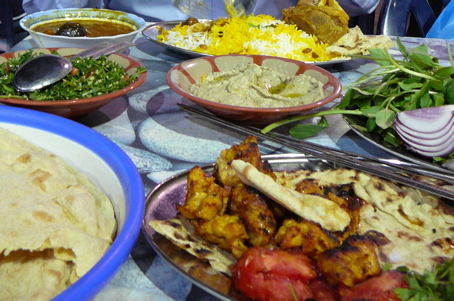
There are people at all the surrounding tables; usually one adult comes first, or maybe two, and tables get moved together or apart, depending on the size of the family coming. Then more women come drifting in, laden with shopping bags. They all greet one another and sit, and finally when the food comes, the children show up, eat a few bites, and then are up playing while the adults finish and drink their tea.
Adventure Man has a little black cat friend who likes the fatty pieces of the lamb he doesn’t eat. When he is finished with one offering, he will pat AM’s leg with his little paw, and AM will give him another piece. This is not a skinny, scrawney little cat, but a plump little cat with shiny fur. Guess he gets enough to eat!
At some point during your meal, you will hear the call to prayer, which we like even better now that we know that the muezzins (the ones who do the call to prayer) are all live, not recorded.
A lavish meal for four – more food than you can eat – with tea, and with excellent service, comes to around 8KD – around $30. How is that for a night on the town?
More Mubarakiya Art
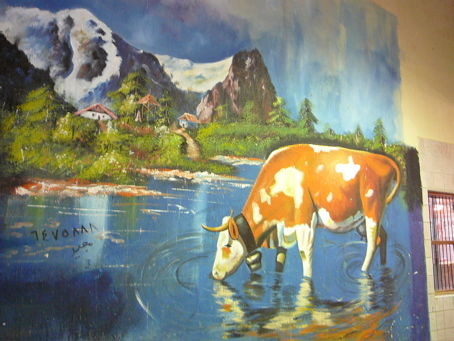
I think this is a total hoot! Along with the Pacific Coast scenery and fish, we have a Swiss Cow, with a bell, and Alpine scenery.
Here is one I love, a genuine Kuwaiti butcher – I love the glasses! Faces and hands are hard to do, and this artist caught his individuality. I wonder if he is still in one of the smaller meat market shops? Also note the bloodstains on the cutting table!

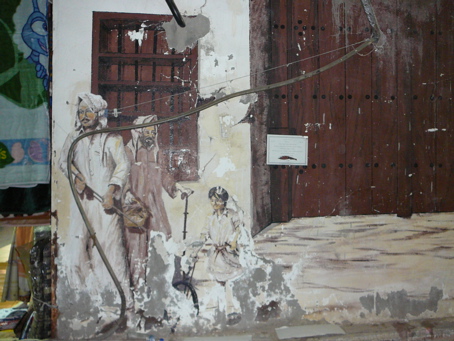
And here is a treasure, just outside the older section, near the date souk, badly damaged, and someone has strung a power cord across it, but one of the best pieces in the market. Love the colors, and look at the stone entry – the artist truly captured the feeling of stone. Look at the depths in the door and the window, the shadows and highlights. Look at the folds in the men’s thobes. This artist had some training.
The Olive Oil Scandal

A good friend gave me a subscription several years ago to The New Yorker, and at the time I didn’t know how lucky I was. First, I loved the cartoons. A couple magazines later, I got pulled in by some of their excellent travel and political writing. Later, the fiction issues pulled me in and introduced me to authors I had never read before. In no time at all, I was totally addicted.
Now, when The New Yorker arrives, Adventure Man and I fight to see who gets to read it first! Often he wins; he skims it. He knows I will take too long getting through it.
It was the New Yorker magazine who informed me about the great olive oil scandal.
I love olive oil. I only use other oils in baked goods, where the olive oil might give an odd taste, we use olive oil almost exclusively. Or so I thought.
In the August 13 Issue of the New Yorker, Tom Meuller starts like this:
On August 10, 1991, a rusty tanker called the Mazal I docked at the industrial port of Ordu, in Turkey, and pumped twenty-two hundred tons of hazelnut oil into its hold. The ship then embarked on a meandering voyage through the Mediterranean and the North Sea. By September 21st, when the Mazal II reached Barletta, a port in Puglia, in southern Italy, its cargo had become, on the ship’s official documents, Greek olive oil. It slipped through customs, possibly with the connivance of an official, was piped into tanker trucks, and was delivered to the refinery of Riolio, an Italian olive-oil produce based in Barletta. There it was sold—in some instances blended with real olive oil—to Riolio customers
Between August and November of 1991, the Mazal II and another tanker, the Katerina T., delivered nearly ten thousand tons of Turkish hazelnut oil and Argentinean sunflower-seed oil to Riolio, all identified as Greek olive oil.
Riolio’s owner, Domenico Ribatti, grew rich from the bogus oil, assembling substantial real-estate holdings, including a former department store in Bari. He bribed two officials, one with cash, the other with cartons of olive oil, and made trips to Rome, where he stayed at the Grand Hotel, and met with other unscrupulous olive-oil producers from Italy and abroad. As one of Italy’s leading importers of olive oil, Ribatti’s company was a member of ASSITOL, the country’s powerful olive-oil trade association, and Ribatti had enough clout in Rome to ask a favor—preferential treatment of an associate’s nephew, who was seeking admission to a military officers’ school—of a high-ranking official at the Finance Ministry, a fellow-pugliese.
However, by early 1992 Ribatti and his associates were under investigation by the Guardia di Finanza, the Finance Ministry’s military-police force. One officer, wearing a miniature video camera on his tie, posed as a waiter at a lunch hosted by Ribatti at the Grand Hotel. Others, eavesdropping on telephone calls among Riolio executives, heard the rustle of bribe money being counted out. During the next two years, the Guardia di Finanza team, working closely with agents of the European Union’s anti-fraud office, pieced together the details of Ribatti’s crime, identifying Swiss bank accounts and Caribbean shell companies that Ribatti had used to buy the ersatz olive oil.
The investigators discovered that seed and hazelnut oil had reached Riolio’s refinery by tanker truck and by train, as well as by ship, and they found stocks of hazelnut oil waiting in Rotterdam for delivery to Riolio and other olive-oil companies.
The investigators also discovered where Ribatti’s adulterated oil had gone: to some of the largest producers of Italian olive oil, among them Nestlé, Unilever, Bertolli, and Oleifici Fasanesi, who sold it to consumers as olive oil, and collected about twelve million dollars in E.U. subsidies intended to support the olive-oil industry. (These companies claimed that they had been swindled by Ribatti, and prosecutors were unable to prove complicity on their part.)
You can read this entire fascinating article here: Tom Meuller: Slippery BusinessGive yourself plenty of time. It is an article well worth reading.
There is another good reference here: The Great Olive Oil Scandal from PalestinianOliveOil.org
Investigators have gathered evidence indicating that the biggest olive oil brands in Italy — Bertolli, Sasso, and Cirio — have for years been systematically diluting their extra-virgin olive oil with cheap, highly-refined hazelnut oil imported from Turkey. [1]
A 1996 study by the FDA found that 96 percent of the olive oils they tested, while being labeled 100 percent olive oil, had been diluted with other oils. A study in Italy found that only 40 percent of the olive oil brands labeled “extra-virgin” actually met those standards. Italy produces 400,000 tons of olive oil for domestic consumption, but 750,000 tons are sold. The difference is made up with highly refined nut and seed oils. [2]
EVEN THE BIGGEST OF THEM WILL MISLEAD THE PUBLIC…
“In 1998, the New York law firm Rabin and Peckel, LLP, took on the olive oil labeling misnomer and filed a class action suit in the New York Supreme Court against Unilever, the English-Dutch manufacturer of Bertolli olive oil. The firm argued that Bertolli’s labels, which read “Imported from Italy,” did not meet full disclosure laws because, even though the oil had passed through Italian ports, most of it had originated in Tunisia, Turkey, Spain or Greece. “Bertolli olive oil is imported from Italy, but contains no measurable quantity of Italian oil,” according to court documents.”
Curezone lists manufacturers of adulterated olive oil and marketers of the same oil. It is disgusting. We pay high prices for junk-olive oil. From Curezone.com/forums
The Guilty
Below is a list of known adulterated brands and dishonest distributors with links to information about their cases.
Adulterated brands of extra virgin olive oil
with country of origin
Andy’s Pure Olive Oil (Italy)
Bertolli (Italy)
Castel Tiziano (Italy)
Cirio (Italy)
Cornelia (Italy)
Italico (Italy)
Ligaro (Italy)
Olivio (Greece)
Petrou Bros. Olive Oil (California)
Primi (Italy)
Regale (Italy)
Ricetta Antica (Italy)
Rubino (Italy)
San Paolo (Italy)
Sasso (Italy)
Terra Mia (Italy)
Distributors caught selling adulterated olive oil
Altapac Trading
AMT Fine Foods
Bella International Food Brokers
Cher-Mor Foods International
D&G Foods
Deluca Brothers International
Gestion Trorico Inc.
Itaical Trading
Kalamata Foods
Les Ailments MIA Food Distributing
Lonath International
Mario Sardo Sales, Inc.
Petrou Foods, Inc.
Rubino USA Inc.
Siena Foods Ltd.
Vernon Foods
So who do we trust? How do we know that we are getting a quality, unadulterated product? This is fraud in an international scale!
“Can You Help Me Get to Bangladesh?”
I have a dilemma. I don’t know how to handle it.
I carry small bills with me, because I am often asked for money. I keep it so I always have money to give to the people who help me get groceries to my car, the people who deliver propane, people who give good service – I don’t mind. Part of the blessing of having work is the obligation to pass that blessing along to others. We know that God Almighty knows where there is real need, and he moves us to give where giving is needed; he gives us a little shove in our hearts.
Yesterday, a well dressed man with a steady job told me he wants to go home to Bangladesh to see his parents. Could I help him?
I understand about aging parents. I’ve made a few trips myself. I totally understand what it is like to be far away when crises strike. We have always had funds set aside for emergency trips, and, by the grace of God, we haven’t had to dip into those funds often.
“How can I help you?” I asked.
“I need money,” he responded.
Money for a ticket to Bangladesh – that’s not small change. Along with that thought is the thought that were I to “help” this man, word would get around, and I would have many people knocking on my door for serious help with funds.
I don’t think he wants the kind of help I could easily give – showing how to set up an account and contribute to it faithfully, letting the money accumulate until you reach your goal. I don’t think he wants to do what my parents did with me, and what we did with our son – matching funds. (You save up half and we will match your savings dollar for dollar.) He wants an outright big gift.
In our church, we sing a song that says “Freely, freely, you have received, Freely, freely give.” I’ve always believed that with all my heart, it is like a magnified spiritual Locard Exchange Principal especially for blessings; what you have received you give, and it comes back to you doubled, tripled, magnified.
We tend to give larger charitable donations to organizations that make the money work hard – Medicins Sans Frontiers, African schools, our church fund. I consider a ticket to Bangladesh a relatively large charitable donation, large especially for one individual, one individual who is well employed.
So I ask for your prayers for clear guidance. I am not feeling that shove in my heart.
Community
Jeremiah is one of the great prophets of our Old Testament. The Wikipedia article on Jeremiah tells me that his name in Arabic is Eremiya. The problem with being a prophet is that not everyone wants to hear what God tells you to say. Jeremiah spent time in jail for telling people what they didn’t want to hear.
God told Jeremiah, “You will go to them; but for their part, they will not listen to you”.
Today’s reading in the Lectionary has this verse from Jeremiah. My blogging friend Kaos asked me why I care about Kuwait when I am only an expat, passing through. When I saw this verse in the reading for today, as the Jews are being sent into exile in Babylonia, I knew for myself the answer:
From Jeremiah 29 7But seek the welfare of the city where I have sent you into exile, and pray to the Lord on its behalf, for in its welfare you will find your welfare.
Wherever we find ourselves – it’s up to us to make the best of our lives. There are reasons for every expat to care about Kuwait and what happens to Kuwait. Kuwait belongs to the Kuwaitis, and 67% of the population is “expat” or “visitor” or “laboror”(whatever lable you choose.) As long as we live and work side by side, we are a community, diverse and conglomerate, but all wanting to live in peace as best we can. Kuwait belongs to Kuwaitis, and the lives we lead as individuals make up a community that belongs to us all.
Visitors, Not Residents?
From yesterday’s Arab Times:
The General Immigration Department of the Ministry of Interior is studying a proposal to replace the term ‘resident’ — the status given to expatriates working in Kuwait, reports Al-Watan daily. The daily added this has been done to ‘fight’ attempts by international organizations asking Kuwait to grant citizenship to expatriates who have been working in the country for a long time. Meanwhile, a reliable source said ‘visitor’ will replace the term ‘resident’. The source also said the General Immigration Department has stopped receiving applications for self sponsorship after noticing an increasing number in applications over the past few months. According to knowledgeable sources the Assistant Undersecretary for Citizenship Affairs Major-General Sheikh Ahmad Al-Nawaf has issued instructions to take into account the demographic structure of the country while issuing work permits because Kuwaitis account for only 33 percent of the population compared to 67 percent expatriates.
Calling all us guest-workers “visitors” is just a dumb idea. Call us guest-workers, call us workers, but if you call us “visitors” then you run into problems with folks who are just coming in for a VISIT, i.e. visitors.
I have always preferred being a resident. When I come into Qatar or Kuwait and all the lines are long except the GCC lines, I can always take a chance that the guards will think I am married to one of you when I step into the GCC line. If the person at the desk says I am in the wrong line, I can always look confused and say “I am a resident!” It has worked – well, most of the time. 😉
This issue is hand-in-hand with the school issue. Times are changing, old traditions are not being observed, and the blame is falling on foreign influences. It’s kind of like that train has left the station – if you want to go back to old ways, you’ll have to get rid of automobiles, computers, mobiles, supermarkets, and most of all, that demon of all forces of modernization – television.
The Taliban managed to reinstate old traditions, and in doing so, to take Afghanistan right back to the stone age. It was not just the women who suffered – men who didn’t want to wear beards, men whose hair was too long, men who wanted to listen to music, men who wanted to discuss politics – all were punished, some were killed.
The real challenge here is how Kuwait, as a modern nations state with a lot of money, is going to move with the modern world, not against it.
Recent Comments
ExpatAlien on What Country am I Living … intlxpatr on Yellowstone: Old Faithful to C… Michelle on Yellowstone: Old Faithful to C… Cathy on No Grown-Ups in Charge intlxpatr on Waiting for Snow Wikipedia Donate Button

Amazina


Early Voting in Florida


 Here There and Everywhere