Edmonds, Washington Street Gardens
In a time where states and counties and cities and towns are cutting back, I am infinitely grateful to my little home town that they find the resources to maintain the street gardens. In the town, you find huge baskets of flowers hanging from poles along the main streets (one of which is called Main Street, in true small town fashion). These are from the street level gardens; they are so beautiful.


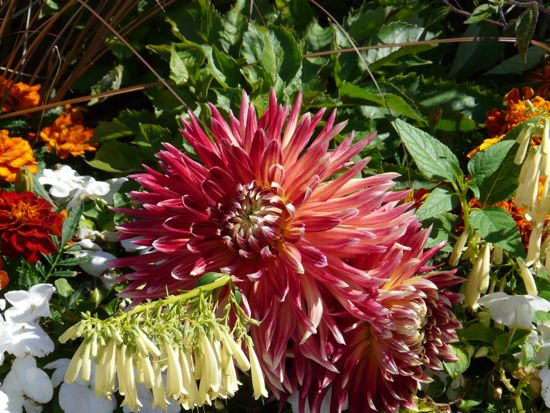
Nearby, two of our favorite stores are side by side:

Woo HOOO, Half Price Books is having their annual Labor Day Sale, 20% off everything in the store. Like we need more books. 😉
“Why Are Barns Painted Red?”
This is what I love about long road trips with AdventureMan. We have hours together in the car, and you just never know where the conversations will go.
We saw a lot of barns. Most of them are red.
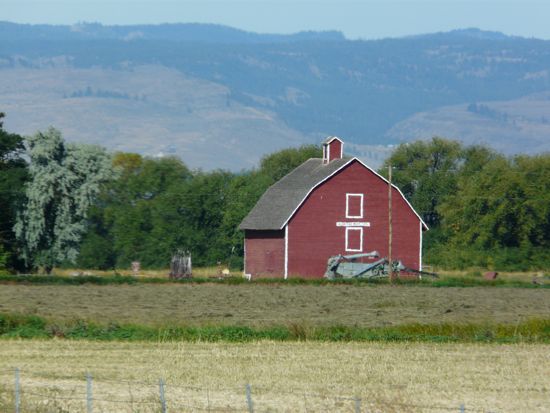
“Why are barns red?” AdventureMan asked. “Like we just accept that barns are red, when we are kids and we are told to draw a barn, we reach for the red crayon, why is that? Why red?”
So we looked it up at the next wireless stop and found the answer on Wiki answers:
Centuries ago, European farmers would seal the wood on their barns with an oil, often linseed oil — a tawny-colored oil derived from the seed of the flax plant. They would paint their barns with a linseed-oil mixture, often consisting of additions such as milk and lime. The combination produced a long-lasting paint that dried and hardened quickly. (Today, linseed oil is sold in most home-improvement stores as a wood sealant).
Now, where does the red come from?
In historically accurate terms, “barn red” is not the bright, fire-engine red that we often see today, but more of a burnt-orange red.
Farmers added ferrous oxide, otherwise known as rust, to the oil mixture. Rust was plentiful on farms and is a poison to many fungi, including mold and moss, which were known to grown on barns. These fungi would trap moisture in the wood, increasing decay.
Regardless of how the farmer tinted his paint, having a red barn became a fashionable thing. They were a sharp contrast to the traditional white farmhouse.
As European settlers crossed over to America, they brought with them the tradition of red barns. In the mid to late 1800s, as paints began to be produced with chemical pigments, red paint was the most inexpensive to buy. Red was the color of favor until whitewash became cheaper, at which point white barns began to spring up.
Today, the color of barns can vary, often depending on how the barns are used.
My dad and grandpa have been farmers their entire lives and they used to tease us kids that the barn was red because it was the most noticeable when the snow was falling sideways and you could barely see because of the sleet and hail.
Sunday in South Dakota
We were on the road out of St. Joseph by 7:09 a.m. and I was driving. Conditions could not have been better – few cars, we zip from Missouri into Iowa, up into South Dakota, turning west at Sioux Falls, where we learn that South Dakota has a speed limit of 75 mph, wooo HOOOO!
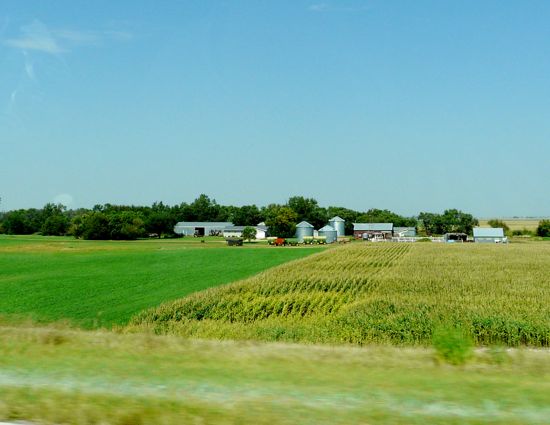
We have been watching all the American farmland – we’ve seen a lot of farmland:

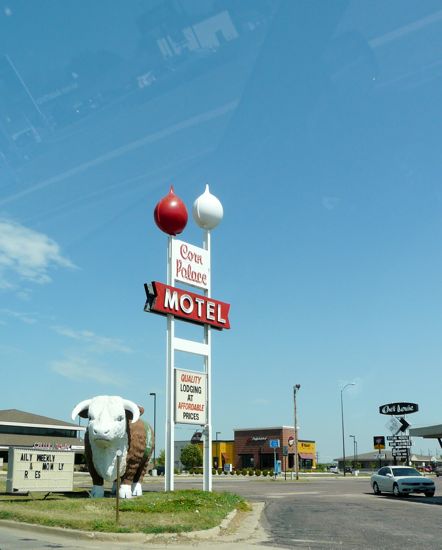
Once we got into South Dakota, we began seeing signs for the Corn Palace. You may not have heard about the Corn Palace, but it is built every year from corn, by local artists, and is a big deal in Mitchell, South Dakota. We can’t drive by Mitchell without going to see it; it changes every year, but is always . . . hmm . . . sort of spectacular, in a very corny sort of way. It really does grow on you.
So we exit the highway to go see the Corn Palace and discover that it is also a big street festival this weekend, so it was really a fun place to be as I was snapping a few photos of this year’s Corn Palace decorations . . .
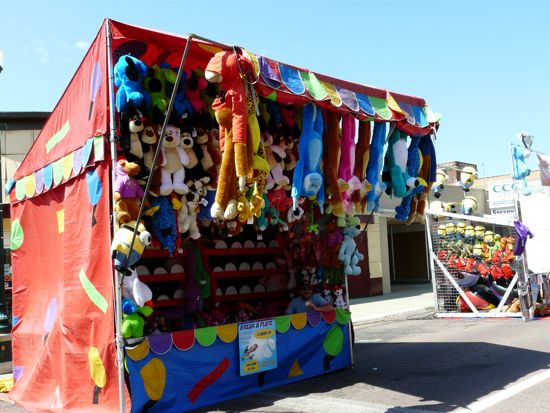

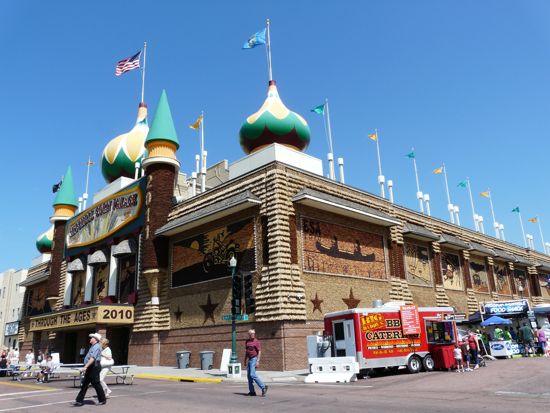
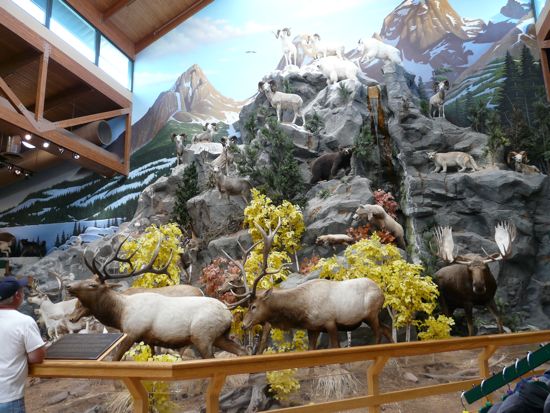
And then we ran across town to visit the big Cabelas so AdventureMan could buy a new hat:
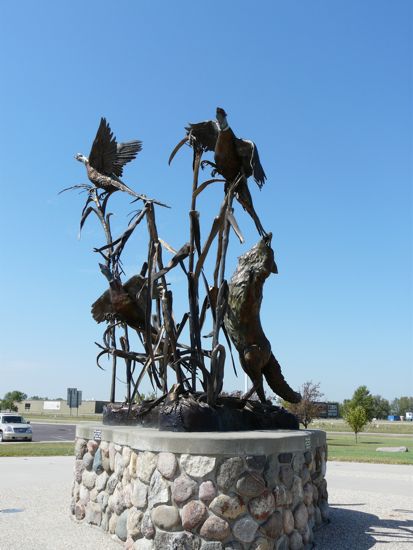
There are dead stuffed animals everywhere, displayed . . .

From there, some of our joy of arriving in South Dakota paled as we slogged all the way to Wall. It’s my fault. I had found a town called Kadoka, at the head of the Badlands Loop, and I was sure there would be hotels there, but since we don’t really know where we are going to land every night, I hadn’t really checked or made any reservations.
It gets worse. AdventureMan carefully got all the AAA information for our trip, but then somehow left the travel books by his side of the bed. I was supposed to get an iPhone so I could find places and make reservations as we travelled, but I never got one, mostly because no one ever has any. So sometimes AdventureMan will tell me to look it up on my iPhone and sometimes I will tell him to look it up in the AAA books, but that is a really, really bad idea when we are both tired and wishing we had a place to stay.
So I did what I often did, and prayed for a miracle.
I feel kind of bad wasting God’s time on my frivolous needs, like a nice place to spend the night, when he has a lot of more important things on his plate, but in desperation, I flat out prayed.
And a miracle happened. When we drove into Wall, we went left, and there were some little cabins and a man who wanted to show them to us. They were brand new, and utterly clean, and full of charming attention to detail, with a great big good bed, and TV, and wireless internet and . . . well, everything, including a discount. Now that, my friend, is the grace of God, a miracle, a prayer answered even better than anything I could have asked for.

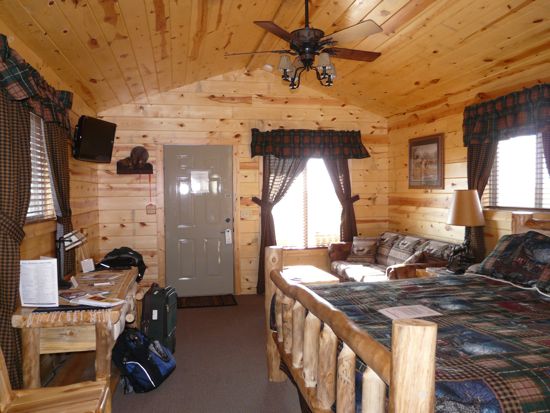
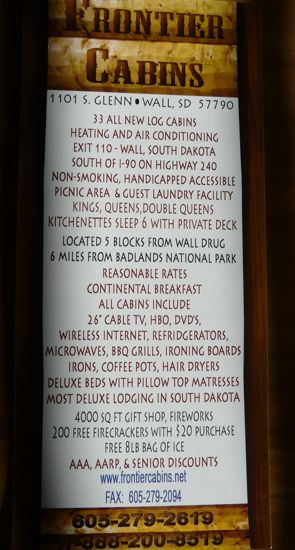
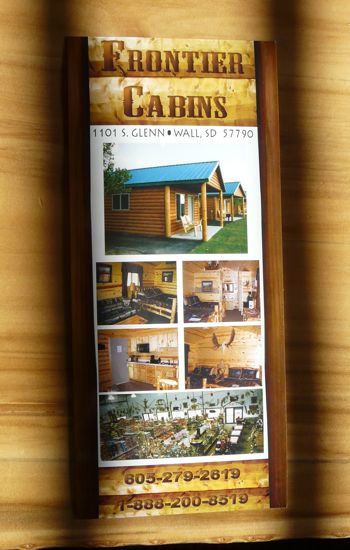
We love the Badlands. This is our second time in the area; it has a weird, ascetic kind of beauty. It is the passion and fury of weather and seasons against natural elements and stone loses. Tomorrow we will drive through, and end up at a spa in Hot Springs, SD, where all these hours of driving will be massaged away. You can check it out here: Red River Rock Resort Hotel and Spa. Come visit the Badlands. Come stay in these lovely cabins and drive through the haunting environment.
Just How Emirati Do You Have to Be? (Mixed Marriages)
Thank you, Little Diamond, for sending the article from The National. I totally love this article, and hats off to it’s author, Sultan Al Qassemi.
Mixed marriages bring strength upon strength to the UAE
Sultan Al Qassemi
Not too long ago, I boarded a plane in Dubai bound for the United States. There were a number of Emirati families on board, some of whom I recognised and greeted. After a 14-hour direct flight, we descended from the plane and made our way to passport control.
One Emirati family walked towards the line for US citizens and, in my naivety, I almost told them they were standing in the wrong queue. I hesitated, correctly it turned out. They were American citizens and obliged to stand in the US citizens section.
Many people who hear this story immediately assume that the mother was a foreigner. Not only is that incorrect – the mother is a true-blue Emirati – but she also works in the UAE government.
In the past week, I was reminded of this by an article in The National relating to mixed parentage. The Grand Mufti of Dubai, Dr Ahmed al Haddad, made controversial comments questioning whether there should be restrictions on Emiratis marrying outside their nationality.
In truth,a substantial number of talented Emiratis have been born to mixed marriages, a point that Dr al Haddad’s comments did not seem to take into consideration. According to one person who was present at the panel discussion, Emiratis from mixed marriages may have “mixed loyalties”. So are they Emirati enough?
Well, let us take a look at some of these Emiratis to find out. Ali Mostafa, the director behind City of Life, is the product of a mixed marriage. City of Life, which depicts contemporary life in Dubai in a powerful and realistic fashion, has become an international ambassador for the UAE after opening in Australia and Canada with a screening scheduled in Washington DC. Is its director Emirati enough?
Omar Saif Ghobash and Yousef al Otaiba, the UAE ambassadors to Russia and the United States respectively, both have foreign-born mothers and yet they serve the UAE with as much attention and dedication as any other Emirati ambassador. I have written before about how Mr al Otaiba has worked tirelessly on behalf of the country, in particular on the nuclear 123 agreement with the United States. Mr Ghobash speaks six languages and was heavily involved in bringing New York University to the UAE’s capital. Are they Emirati enough?
Razan al Mubarak is also a product of a mixed marriage. Her late father, like Ambassador Ghobash’s, gave his life for the country. Ms al Mubarak, in her roles as assistant secretary general of the Environment Agency – Abu Dhabi and managing director of the Emirates Wildlife Society, is busy protecting the country’s wildlife on both land and sea. Is she Emirati enough?
At Abu Dhabi’s strategic investment arm Mubadala, the chief operations officer, Waleed al Mokarrab al Muhairi, also happens to be chairman of Yahsat, Advance Technology Investment Company and Cleveland Clinic Abu Dhabi. But perhaps most importantly, he is credited with being “one of the principal architects behind the Abu Dhabi 2030 Economic vision”. And yes, Mr al Mokarrab comes from a mixed family.
Wael Al Sayegh is a writer, poet, translator and founder of the consultancy firm Al Ghaf, which delivers “inter-cultural induction programmes to multinational organisations serving the region”. Mr Al Sayegh has spoken to many multinational corporations about UAE culture and offered a Dubai perspective to foreign news outlets, including the BBC, during recent high-profile criminal cases. Is he Emirati enough?
Sarah Shaw, an Emirati whose biological father is English, currently works at the General Secretariat of the Abu Dhabi Executive Council and is a huge supporter of Emiratisation. Is she Emirati enough?
Other Emiratis from mixed families who have made substantial contributions include the director general of the Dubai World Trade Centre, Helal Saeed al Marri, the film director Nawaf Janahi and the columnist Mishaal al Gergawi, among many others.
There are examples in my immediate circle of Emirati friends who genuinely care about this country, not despite one of their parents being foreign born but perhaps because of it.
Should the UAE, and specifically Dubai, known for being hospitable and welcoming to people of all ethnicities, backgrounds and cultures, make our very own citizens feel unwelcome?
The truth is the UAE is a richer country because of these individuals of mixed backgrounds. What we should concentrate on is strengthening the ties that people have to this great nation. I have previously suggested military service for Emirati high school graduates, cultural immersion and social volunteering as ways to build civic participation.
Frankly, it would be insulting to question the loyalty of Emiratis who are born to a foreign parent. It is also unfair, un-Islamic and ultimately in this case un-Emirati to generalise about people of any background. The Emirates is a vibrant country of many colours – only seeing a single shade excludes too many of its strengths.
(The author, Sultan Sooud Al Qassemi is a non-resident fellow at the Dubai School of Government)
Day Two, Mostly Missouri
Day two started early in Arkansas, and I cajoled AdventureMan into telling me university stories as we drove into Missouri, where we stayed the entire day, driving north, driving west, and driving north again, the whole day. AdventureMan spent a lot of time in this area around Memphis while at university, and hung out at Beale Street with his other music and blues loving friends. The early morning highways were a delight:

Just outside St. Louis, we crossed the great Missouri:
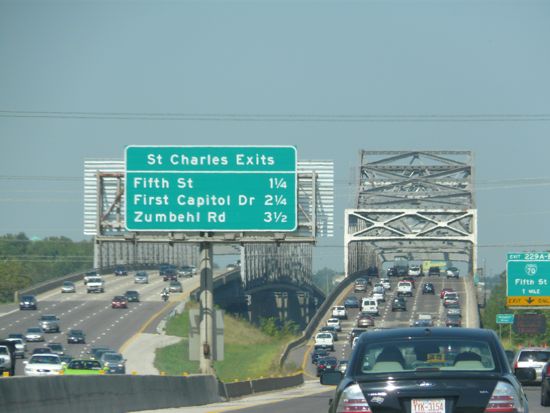
We like to stop at least every couple hours, buy a coffee, stretch our legs, take a rest stop. Around lunch time, AdventureMan saw a sign for 2 Dudes BBQ, and we couldn’t resist the name and the fact that it was only two blocks off the interstate. We found it without a problem:
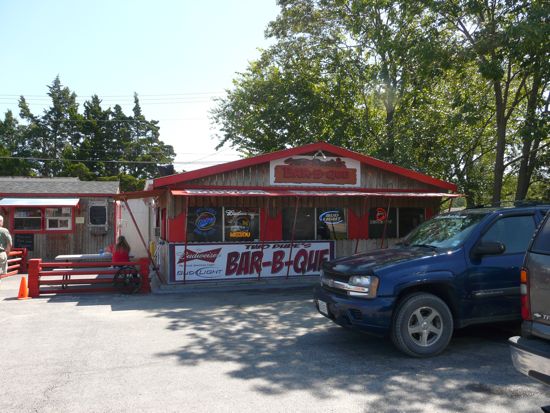
It had our kid of menu – simple, and the food was the same – simply GOOD.
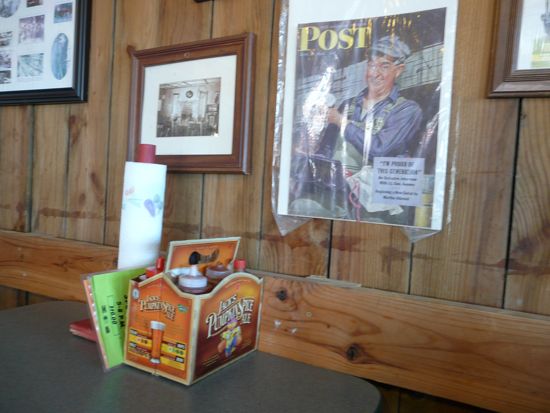

AdventureMan had the pulled pork sandwich with cole slaw and beans – ALL good:

I ordered the smoked half chicken (that was the smallest chicken they had) and it was smokey, cooked, and moist – it is really really hard to get all three. Plus, while I normally go for the really spicy sauce, the Two Dudes normal barbecue sauce was both vinegary-tangy and sweet, and knocked my socks off. (I didn’t eat the bread) and the cole slaw was apple-y tasting with poppy seeds – oh YUMMMM.

Outside, I caught one of the dudes grilling up some ribs, and he laughed when I asked if I could take his picture, and said “sure” and even arranged the ribs for me:
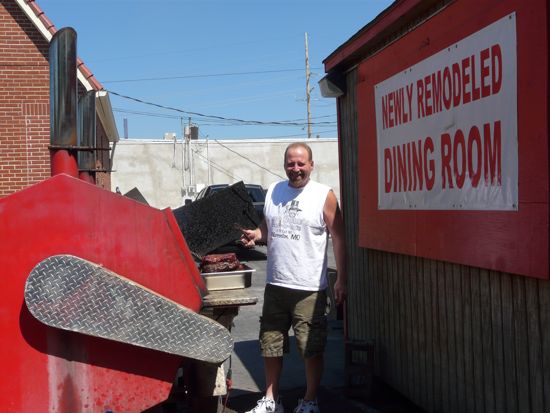

If you are driving on 1-70 between St. Louis and Kansas City, you will find the Two Dudes BarBQue at exit 193, in Warrenton, MO. You will see signs, follow those directions. 🙂
About an hour up the road, in Fulton, we saw the Visitor’s Center across from where we were buying gas, and AdventureMan had a burning question he needed answered: Was this where Winston Churchill had made his “iron curtain” speech, and was this why they had a museum devoted to Winston Churchill? The answer, from the delighted and helpful ladies, was ‘yes’.
Fulton also has this moving and meaningful monument to fallen heroes – one of my weak spots.
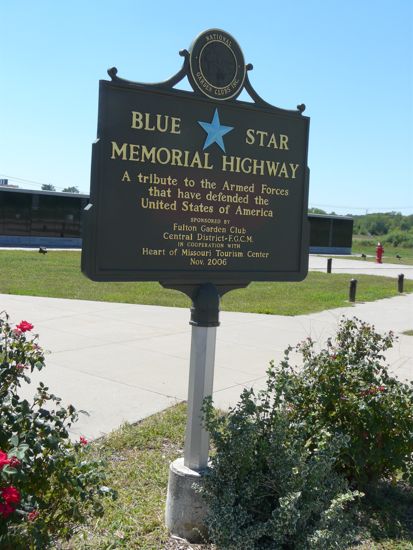

We skirted Kansas City, zipped past Fort Leavenworth, where we had a wonderful year back a long time ago, and landed in St. Joseph, birthplace of Jesse James, where we found a hotel with a great pool so we could kick back and kick some laps, kicking out all those kinks and aches that driving all day can bring.
After dinner, mostly lettuce (LOL) AdventureMan helped me get a photo of this wonderful ice-cream vendor; I adore this old fashioned kind of commercial art:

And then we had a great adventure, trying to find the historical center of St. Joseph. We found the center, full of stately and gracious mansions and impressive and imposing old buildings, most in fairly good condition, and we found a lovely city park, down by the river, where the sun was setting . .. and you know me, and sun, and water . . .


Too soon, we had to leave, the mosquitos were eating me alive. I actually bought repellent today, but did I remember to put it in my purse???
Looking for Ebonics Masters
I haven’t heard a word about ebonics for a long time, and then this, in today’s AOL News. I had thought it was one of those flash-in-the-pan things, here today and gone tomorrow. Have not heard a serious word about ebonics in, literally, years.
DEA Seeking Ebonics Experts for Narcotics Investigations
Allan Lengel
Contributor
(Aug. 23) — If you speak Ebonics, the federal government may have a job for you.
The Drug Enforcement Administration wants to hire people fluent in Ebonics to help monitor, transcribe and translate secretly recorded conversations in narcotics investigations, according to the website The Smoking Gun and DEA documents.
The Smoking Gun reports that up to nine Ebonics experts will work with the DEA Atlanta Division after obtaining “DEA Sensitive” security clearance.
Ebonics, or “Black English,” generally is defined as a nonstandard form of English spoken by African-Americans.
According to the job description, Ebonics experts will decipher the results of “telephonic monitoring of court ordered nonconsensual intercepts, consensual listening devices, and other media,” the website reported.
Why People Give
An urgent message came out today asking us to help the homeless people in Pensacola – and there are a lot of them, thanks to the warm climate. With all the rain recently, sleeping rough has been doubly rough, and it has been made worse by a sudden humidity-moisture related surge in the mosquito population.
As I talked with AdventureMan about our donation, he laughed. I was in fund-raising for a while, and was unexpectedly good at it. One thing I learned, there are a lot of ways to persuade people to donate, and then again, sometimes people will donate and you haven’t a clue as to why they felt this urge to be generous.
AdventureMan laughed; he totally got it. I used to work with a homeless, a long time ago, so I have a soft spot where they are concerned. Mosquitos also love me, and I get these horrid great but huge itchy bumps any time I am anywhere near a mosquito, AdventureMan always says he keeps me nearby because they head straight for me and ignore him.

Of course we donated. Wet homeless people and mosquitos, it was a golden combination. If you would like to donate, too, you can, through the EscaRosa Coalition on the Homeless (Working to Eliminate Homelessness). They will hold an Annual Fundraiser on Saturday September 11th from 7pm – 11pm at The Garden Center.
Welcome Home Dinner and Empress Rice Recipe
We had a dinner yesterday, to welcome AdventureMan home, and just to gather together friends and family in the area to have a good time.
AdventureMan stuns me with his ability to transfer all those time zones with no effect. He slept through every night, no problems. Amazing resilience. He also bought a great big watermelon, and made juice from it – delicious!

The Happy Baby is now big enough for a high chair. A high chair is a really good thing now, because he has started crawling, and he is really, really fast, especially when he is going after a cat!

Now that he is crawling and jumping and going to school, his little baby fat is turning into muscle:

(Sorry if this one is a little fuzzy, but he is jumping so fast I can’t get a clear photo)
Following traditional Middle Eastern / Southern customs, we had way too much food:

Including several long time favorites, one of which was Autumn Plum Torte:

One old favorite I am making again (I lost the recipe for a while) is Empress Rice. This recipe is so easy, so rich, so so good:
Empress Rice
1 large onion, chopped
1/4 cup butter
2 cups rice, raw
2 cans consomme
1 Tablespoon soy sauce
1 cup sliced mushrooms, drained
2 cups grated sharp cheddar cheese
1/2 cup chopped walnuts
Set oven for 325°F / 160°C
Saute onion in butter until golden brown. Brown raw rice with onion, then add all the rest of the ingredients. (How easy is that??) Grease a 3 quart/litre casserole, cover, and bake in oven for 1 hour and a half, or until liquid is absorbed. 8 – 10 servings.
(I did not make this with mushrooms, because our son doesn’t like mushrooms, but mushrooms make it richer. For church suppers, I sometimes add in some sausage, like smoked turkey sausage, or some chicken chunks.)
Some of the things I served I have shared with you before:
Autumn Plum Torte
Cauliflower Salad
Soused Apple Cake
Rotkohl
It was a great gathering, lots of stories exchanged, lots of laughing, and sweet little Happy Baby went to sleep just as lunch was served, freeing his parents to relax and enjoy a couple hours of socializing. 🙂 My old friend in Germany slipped into my kitchen and functioned as my second right hand; I actually enjoyed having her help because it’s like she knew what I needed before I knew I needed it. We could hardly believe so much time had passed when our last guests left; time just flew by, the sign of a truly memorable gathering.
The Camel Bookmobile by Masha Hamilton
It took me a while to get into this book, because it is, in my opinion, badly written. The characters are thin, the story is thin, and yet . . . it is a book I will never forget.

Masha Hamilton writes of a girl with a dream of going to a faraway place; she writes a grant proposal for a Camel Bookmobile, to take books from a remote library in Garissa, Kenya, out to nomadic groups in even more remote locations. As it turns out, the book features a device I like very much – a discussion of what is knowledge, what is learning, what happens when cultures clash and how in every interaction, there is something left that changes those interacting.
As Fiona (“Just call me Fi”) McSweeny follows her dream, there are her actions, how she sees her actions, how her actions are seen from an alternate culture, and how Fi feels she may be missing something in the interaction.
Anyone who has tried to finesse their way living in an alien environment knows that feeling, and the disasters you can bring on with only good intentions. Words, tone of voice, body language – all can be interpreted in ways you never dreamed, blinded by the wisdom of your own culture.
The star of the book is the Kenyan desert. While we do get to know the characters in the small arid desert village of Mididima, it is the way of life that Hamilton captures and which captivates us. The traditional ways are already passing, and the village elders are fighting a losing battle, trying to maintain their old ways. At the same time, there is a lot of wisdom to be learned and stored before the old ways pass, if there is anyone to document, to capture the details.
How can a book be both badly written, so badly written that you are constantly aware of it, and so breathtakingly vivid, so unforgettable?
There is a real Camel Bookmobile, started in 1996, and after visiting, Hamilton began a Camel Book Drive which garnered over 7000 books for the nomadic library. You can visit the website and learn where to donate books for other schools in the Garissa area by clicking here.
That Cheeky Woman at the Well
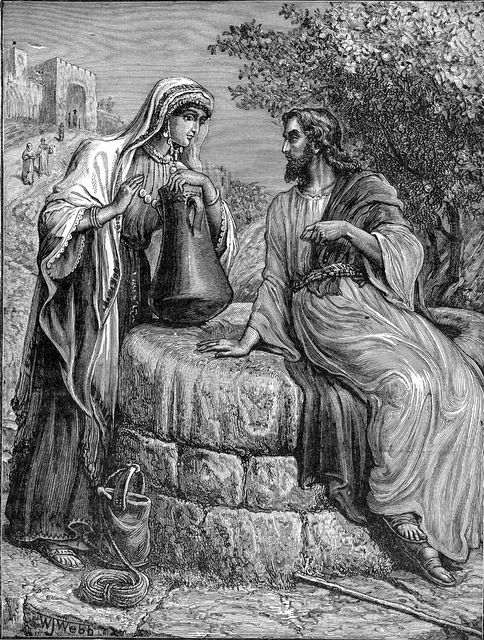
I love this story. I love all the stories about these women, who just won’t stay in their place. What was Jesus thinking? Why would he start a conversation with this woman, a woman not even married to the man with whom she is living? Listen to her tone, can’t you hear her words, barely bordering on mockery?
It doesn’t take long, and the women to whom Jesus speaks sees the light – that this man is something special, and has something special to offer her, even her, the most humble of the humble.
If I had never lived in the Middle East, I would never have understood the nuances of this story, how men just don’t speak to women, how speaking to this woman, not a Jew, a very unclean woman, could make him unclean, how taking anything from her, much less asking for a drink of water was just unthinkable.
Jesus turned it all upside down. He often did the unthinkable – working on the sabbath, speaking to women as if they were real people, talking about how it is what is in our hearts that matters more than looking good in public . . .
John 4:1-26
4Now when Jesus* learned that the Pharisees had heard, ‘Jesus is making and baptizing more disciples than John’— 2 although it was not Jesus himself but his disciples who baptized— 3he left Judea and started back to Galilee. 4But he had to go through Samaria. 5So he came to a Samaritan city called Sychar, near the plot of ground that Jacob had given to his son Joseph. 6Jacob’s well was there, and Jesus, tired out by his journey, was sitting by the well. It was about noon.
7 A Samaritan woman came to draw water, and Jesus said to her, ‘Give me a drink’. 8 (His disciples had gone to the city to buy food.)
9 The Samaritan woman said to him, ‘How is it that you, a Jew, ask a drink of me, a woman of Samaria?’ (Jews do not share things in common with Samaritans.)*
10 Jesus answered her, ‘If you knew the gift of God, and who it is that is saying to you, “Give me a drink”, you would have asked him, and he would have given you living water.’
11 The woman said to him, ‘Sir, you have no bucket, and the well is deep. Where do you get that living water? 12 Are you greater than our ancestor Jacob, who gave us the well, and with his sons and his flocks drank from it?’
13 Jesus said to her, ‘Everyone who drinks of this water will be thirsty again, 14but those who drink of the water that I will give them will never be thirsty. The water that I will give will become in them a spring of water gushing up to eternal life.’
15 The woman said to him, ‘Sir, give me this water, so that I may never be thirsty or have to keep coming here to draw water.’
16 Jesus said to her, ‘Go, call your husband, and come back.’
17 The woman answered him, ‘I have no husband.’ Jesus said to her, ‘You are right in saying, “I have no husband”; 18for you have had five husbands, and the one you have now is not your husband. What you have said is true!’
19 The woman said to him, ‘Sir, I see that you are a prophet. 20 Our ancestors worshipped on this mountain, but you* say that the place where people must worship is in Jerusalem.’
21 Jesus said to her, ‘Woman, believe me, the hour is coming when you will worship the Father neither on this mountain nor in Jerusalem. 22 You worship what you do not know; we worship what we know, for salvation is from the Jews. 23 But the hour is coming, and is now here, when the true worshippers will worship the Father in spirit and truth, for the Father seeks such as these to worship him. 24 God is spirit, and those who worship him must worship in spirit and truth.’
25 The woman said to him, ‘I know that Messiah is coming’ (who is called Christ). ‘When he comes, he will proclaim all things to us.’ 26 Jesus said to her, ‘I am he,* the one who is speaking to you.’
Recent Comments
ExpatAlien on What Country am I Living … intlxpatr on Yellowstone: Old Faithful to C… Michelle on Yellowstone: Old Faithful to C… Cathy on No Grown-Ups in Charge intlxpatr on Waiting for Snow Wikipedia Donate Button

Amazina


Early Voting in Florida


 Here There and Everywhere