Barbara Nadel: The Ottoman Cage
I got the recommendation for this book from Little Diamond; we have a long family tradition of trading books back and forth, my sisters, our children, even my mother; we are all sending books and exchanging suggestions all the time. I know I can count on Little Diamond and Sparkle for particularly good recommendations, and they never disappoint me.
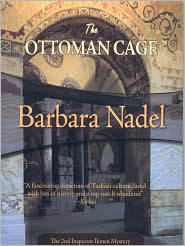
When The Ottoman Cage arrived, I was put off by the cover. “Who’s Likely to Like This?” the cover asked – it seemed like screaming to me – “Fans of Donna Leon and exotic, atmospheric locales”
Remember, I am in a dark time, taxes, turbulence, destabilization. . . I am easily disgruntled when I am vulnerable like this. I don’t want to think I am so predictable. I love reading Donna Leon! So I am predisposed (grumble grumble grumble) NOT to like Barbara Nadel.
I fail miserably. The first five pages I am resisting. By the sixth page, I am ready to stay up all night to read this book (I don’t really, but I did finding myself making more time to read so I could find out what happens next.)
It is like the Donna Leon series in that while the plot is original and interesting, the real focus is on the police inspector, his crew, the relationships with friends and characters, the bureaucracy, and the way systems and institutions function in modern day Turkey.
One particular relationship was of great interest to me, that of Suleyman, who dutifully married his first cousin. They both tried very hard to make it work, but when we meet him, we discover that the marriage has become a painfully dry and desolate place, where each lead their individual lives, with very little of the relationship together.
Another character is detective Cohen, a rare Jew in the police force described as follows:
When one has been known and admired as a prolific womanizer for most of one’s adult life, any change in that situation can come rather hard. Although Cohen had been married since the age of nineteen, he had never let that fact or indeed his rather short stature and dishevelled apearance hold him back from the most ardent pursuit of other women. Jokey charm, of which he possessed copious amounts, had always seen him through. The knowledge that women love a man who can make them laugh had successfully taken him to many bedrooms and had, quite frequently, resulted in his being asked back again. Until this year.
Whether it was because now he was on the ‘wrong’ sied of forty five or just a patch of ill fortune, Cohen didn’t know but the fact was beyond dispute. Women, it seemed, didn’t want him any more. The rbuffs and even in one notable case the cruel sound of mocking laughter were hideously painful for him to bear. Even his long-suffering wife, who had for so many years pleaded with him to leave other women alone and attend to her, had lost interest. He’d tried to find a little comfort in her arms the previous night when he found that he couldn’t sleep, but she, like all the lithe little girls that he still so desired, had just sent him on his way, back to his customary couch, flinging her curses in his unfaithful wake.
It was, Cohen would have been the first to admit, his own fault. Had he bothered to try and be faithful to Estelle he would now, in his middle years, have both a friend and a over with whom he could take comfort as the lines overwhelmed his face and the loose skin around his middle began to sag. His wife was, after all, ageing like himself and, unlike the pretty little tarts he hankered after, unable to point mocking fingers at his inadequacies.
The plot hinges on a dead boy, a beautiful boy, found dead, alone, on a bed in an empty, tasteful but unlived in home. Who is he? Why is he here? Why is he dead?
We meet the gossipy neighbors, we meet the Armenian community, we meet some of the lowest characters you would ever hope to meet, the kind the police deal with every single day. Nothing is simple, one single clue leads slowly, painfully to another. I give credit to Nadel; she relies on good honest police work, chasing down the clues, going through the stacks of old files, interviewing unsavory lowlifes; the things good police really do to solve their cases.
More than the plot, I loved the rich and intricate textures of this mystery novel, I loved the descriptions of the interiors and the interior lives of the characters. Nadel has that in common with the other writers I read serially – Leon, Pattison, Qiu Xiaolon, James Burke and Peter Bowen. It is another rich entry into the genre of the “mystery novel set in exotic, atmospheric locations.”
Definitely worth a read!
Icons Challenge, The Locard Principle 2: The Middle East and Me
The best thing, the very best thing about blogging, for me, is what I learn from my commenters. The old Locard’s Exchange Principle is a constant in life – with every interaction, a part of you rubs off on me, and a part of me rubs off on you. It’s why we’re careful about the people, books, movies, blogs and ideas we spend time with. . . we either feel better for hanging around them, or slightly uncomfortable. Sometimes, hugely uncomfortable. The internet is a microcosm, good and evil all mixed in together and we make our choices.
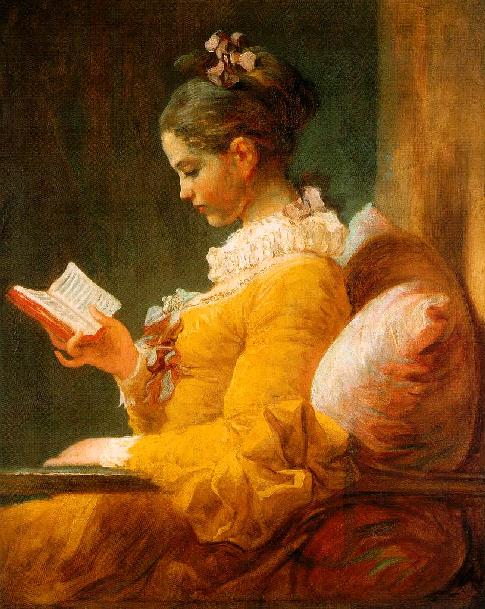
Fragonard: The Reader
Above: that is me. That’s pretty much who I am. I am quiet, I am a reader. I still get input, from newspapers, books, e-mails, the internet, friends, groups, etc.
What I love about blogging is that I throw something out, and you throw something back. Many many times, what I get back is unexpected, and forces me to re-examine my assumptions. Many times, I have to force myself to stop. Not to respond. I have to force myself to let the new information, new point-of-view sink in, percolate, settle. Minds don’t change in an instant, but . . . they do change. New information brings new, often surprising, perspectives. When I find myself getting angry, I have to step back and ask myself “what is going on here? What are you reacting to?” It helps me to know myself better, and it helps me to understand whatever-little-corner-of-the-world-I-am-living-in better, too.
There are about six different blog entries radiating out like a spider’s web from the thoughts I am now thinking, fed by your input and comments, and behind the scenes e-mails back and forth with new thoughts.
So here is my challenge for today. I’ve shown you one of my life icons, this Fragonard paining, The Reader.
Your mission, your challenge – identify / find a piece of art that shows us who you are. Post it on your blog and link here with a comment, or send it to me, and I will publish it.
(No graphic violence or pornography; I won’t publish it and I will break the link if you publish it on your blog and link to me.)
Another Martyr For Olde Ireland
Thanks be to God, the brutal, ceaseless battles in Ireland have ended and peace prevails. So many innocent were lost – and for what? The recent bombing is thought to be a hiccup left over from those desperate, sad days. We can only hope that is true, and that peace can also break out in places like Gaza, like Dharfur, where entire peoples are oppressed and dealt with brutally by those in power.
For blogger Mathai; one of the songs the Irish sing in the pubs on St. Patrick’s day – and others. Whenever the beer is flowing, you’ll hear Kevin Barry. They know all the words.
This is the version I used to hear; the one above has slightly different words.
In Mountjoy jail one Monday morning
High upon the gallows tree,
Kevin Barry gave his young life
For the cause of liberty.
But a lad of eighteen summers,
Still there’s no one can deny,
As he walked to death that morning,
He proudly held his head on high.
2. Just before he faced the hangman,
In his dreary prison cell,
The Black and Tans tortured Barry,
Just because he wouldn’t tell.
The names of his brave comrades,
And other things they wished to know.
“Turn informer and we’ll free you”
Kevin Barry answered, “no”.
3. “Shoot me like a soldier.
Do not hang me like a dog,
For I fought to free old Ireland
On that still September morn.
“All around the little bakery
Where we fought them hand to hand,
Shoot me like a brave soldier,
For I fought for Ireland.”
4. “Kevin Barry, do not leave us,
On the scaffold you must die!”
Cried his broken-hearted mother
As she bade her son good-bye.
Kevin turned to her in silence
Saying, “Mother, do not weep,
For it’s all for dear old Ireland
And it’s all for freedom’s sake.”
5. Calmly standing to attention
While he bade his last farewell
To his broken hearted mother
Whose grief no one can tell.
For the cause he proudly cherished
This sad parting had to be
Then to death walked softly smiling
That old Ireland might be free.
6. Another martyr for old Ireland;
Another murder for the crown,
Whose brutal laws to crush the Irish,
Could not keep their spirit down.
Lads like Barry are no cowards.
From the foe they will not fly.
Lads like Barry will free Ireland,
For her sake they’ll live and die.
MP Al-Muhaibi Condemns Male Teaching Female Students
From today’s <a href=”“>Al Watan
MP Jaber AlـMuhailbi condemns school incident
Staff Writer
KUWAIT: MP Jaber AlـMuhailbi has denounced the fact that grade 12 girls at AlـSabahiya High School are being taught by a foreign, male teacher. According to him, “the incident reveals a great amount of recklessness on the part of the Ministry of Education,” which he says disregards the traditions and values of Kuwaiti society.
AlـMuhailbi expressed his apprehension that there might be forces planning to replace the conservative educational system in the country with a system that openly encouraged ”mixed” schools for boys and girls.
He held Minister of Education Nouriya AlـSubaih solely responsible for the incident, said that it proved she was incompetent to shoulder her responsibilities as a minister.
He finally announced that he would put forward a number of questions concerning the aforementioned incident to the minister, and would inquire as to whether this was an occurrence seen in other schools, and asserted that there were plenty of female teachers capable of teaching female students in Kuwait.
He expressed his displeasure about the presence of a male teacher in a girls” school, calling it “unacceptable.”
Last updated on Tuesday 17/3/2009
12th grade? Isn’t that like the year girls graduate and go on to university classes (God willing/insh’allah) where they will be taught, as likely as not, by male professors?
Do these girls go to restaurants with male waiters?
Do they shop in stores with male cashiers? Male customer service agents? Male managers?
Learning self-control is like any other skill; it requires practice. You practice by confronting the realities of the situation. Society – in and out of Kuwait – is mixed. We sit next to each other on airplanes, we are seated next to one another in restaurants, our paths cross, daily. Kuwaiti girls are well brought up and can control themselves; they also have skills at turning aside the unwanted attention of the rare teacher who might overstep.
Mr. MP, we must be suspicious of those who see sexual issues lurking in every corner; what is in the heart of a man who sees sex everywhere? Give these girls a little credit. They are after an education, not some male teacher.
In Xanadu: A Quest by William Dalrymple
This book was on my (huge) “Read Me” stack, and I picked it up for a change of pace. As I started reading, I wondered “how did this get there?” My first instinct was it was a recommendation from Little Diamond. As I was reading, however, I came across a segment that was what our priest had read in church around the Feast of the Epiphany about the birthplace of the wise men who came seeking the Christ Child after his birth. I wrote down the title and ordered it from amazon.com (which has some copies used from 72 cents).

William Dalrymple wrote this book when he was a mere 22 years old. He and a travelling companion took off to trace Marco Polo’s journey from Jerusalem to Xanadu, where he was taking oil from the sanctuary lamp to Kubla Khan.
In a world where we have all been taught to be so careful, they take incredible risks. They travel on the cheap – staying in fleabag hotels, sometimes sleeping “rough”, i.e. out in the open. They travel any way they can – an occasional train, but more often a truck, a bus, whatever is going their way. One very long segment they travelled on top of a pile of coal.
They travel from Jerusalem up through Syria and into Turkey, then turn east and cross Iran, Pakistan and Afghanistan to China. They have some amazing adventures, see some astounding scenery and because of their mode of travel, have a lot of time to talk with their travelling companions or people in the cities where they are staying.
I am blown away that an unmarried couple would cross Iran, Pakistan and Afghanistan. I guess they told people they were married to share a room (they were on a budget) and they were only friends, not a couple, but what a risk. I am astonished that they were never asked to produce a marriage license or any proof of marriage when they stayed in hotels. I am astonished at the girls (one left in Lahore and another joined him, but these are girls who are friends, not anything more) would travel on the backs of trucks full of men, and never blink an eye.
The book is occasionally hilarious. Most of the hilarity results from foods they have to eat – sometimes it is the only food available – or from misunderstandings because of lack of a common language, or due to their frequent bouts of diarrhea, what I really liked about the author was that he was rarely pompous, and when he is funny, it is usually about some conversation he has had, or some mistake he has made.
One of my favorite parts of the book happens in Iran:
As we sat waiting for the bus to Tabriz, the next town on Marco Polo’s itinerary, we watched the mullahs speeding past in their sporty Renault 5s. Iran was proving far more complex than we had expected. A religious revolution in the twentieth century was a unique occurence, resulting in the first theocracy since the fall of the Dalai Lama in Tibet. Yet this revolution took place not in a poor banana republic, but in the richest and most sophisticated country in Asia. A group of clerics was trying to graft a mediaeval system of government and a pre-medieval way of thinking upon a country with a prosperous modern economy and a large and highly educated middle class. The posters in the bus station seemed to embody these contradictions. A frieze over the back wall of the shelter spoke out, in the name of Allah, against littering. On another wall two monumental pictures of the Ayatollah were capped with the inscriptions in both Persian and English:
BEING HYGENIC IS DIRECTLY RELATED ON THE MAN’S PERSONALITY
and:
ALLAH COMMANDS THE RE-USE OF RENEWABLE RESOURCES.
We had expected anything of the Ayatollah. But hardly that he would turn out to be an enthusiastic ecologist.
The challenge of this journey is to follow as closely as possible the path Marco Polo took, but two segments of the journey go through off-limits areas. They find a way into one, to discover later it is an atomic testing area, and the second, at the very end, around Xanadu, they find receptive Chinese officers who take them to have a brief glimpse of the ruins of Xanadu while booting them out of the area. As they stand in Xanadu, they repeat a poem that every American child grows up with in English Literature:
In Zanadu did Kubla Khan
A stately pleasure-dome decree:
Where Alph, the sacred river, ran
Through caverns measureless to man
Down to a sunless sea.
So twice five miles of gertile ground
With walls and twoers were girdled round:
And there were gardens bright with sinuous rills.
Where blossom’d many an incense-bearing tree:
And here were forests ancient as the hills,
Enfolding sunny spots of greenery.
(Coleridge)
I liked this book. Dalrymple is a history major, and often quotes from historical – even obscure – texts to illuminate what he observes. I think I may look at a couple more he has written since.
Woo HOOO, Q8Dutchie: The Great Kuwait National Holiday Challenge
Don’t you love it? All these different view, what the eyes are seeing? People around the world who have never been here are catching a glimpse of the two day – and in this case, because it was added on to a week-end, a four-day extravaganza of a holiday, for Kuwait National Day and Kuwait Liberation Day.
Thank you, Q8Dutchie, for sharing your eyes with us!
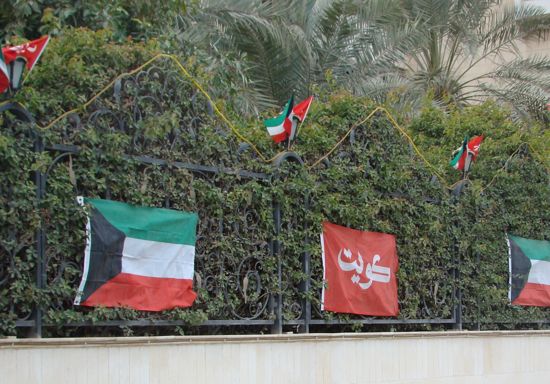


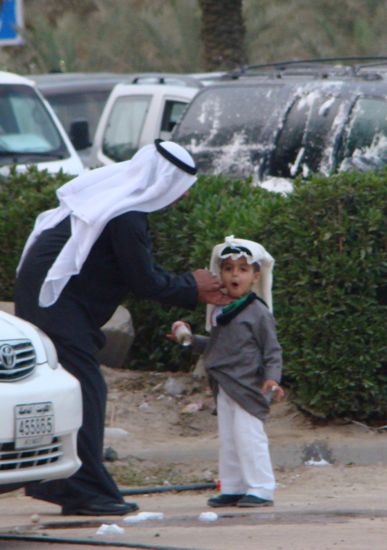

The best photo of all I can’t share – Q8Dutchie’s child, covered head to toe with foam, eyes gleaming and grinning from ear to ear/ 🙂
“I’m Melting! I’m Melting!”
At our church this weekend, our priest was making a point, using water, and he sprinkled various members of the congregation, to a series of “eeeeekks!”
I was reminded of several years ago – we had bought a new house, and our church has a special ceremony of blessing for a residence. As the priest carefully points out, he/she is not actually blessing the house, but blessing the inhabitants – nonetheless, every room has a special prayer, and the priest sprinkles a little holy water in each room.

more animals
As he sprinkled the water in one room, some hit my youngest sister, Sparkle. I watched her struggle not to do it, but she couldn’t resist.
“Ohhhh, I’m melting, I’m melting!” she cried out, like the Wicked Witch of the West in The Wizard of Oz.
Thank God, the priest was a good friend. He paused, looked at me and said “she is YOUR sister?” I nodded. He sighed, before continuing, and said “why am I not surprised?”
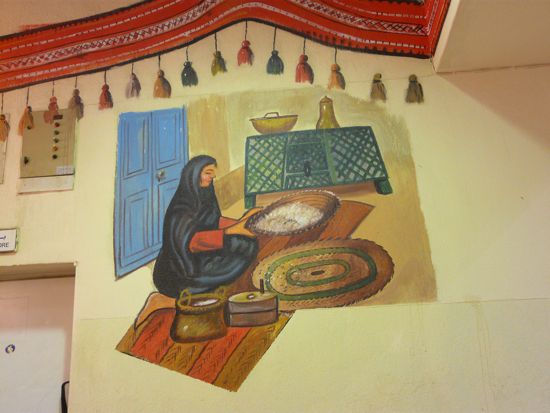
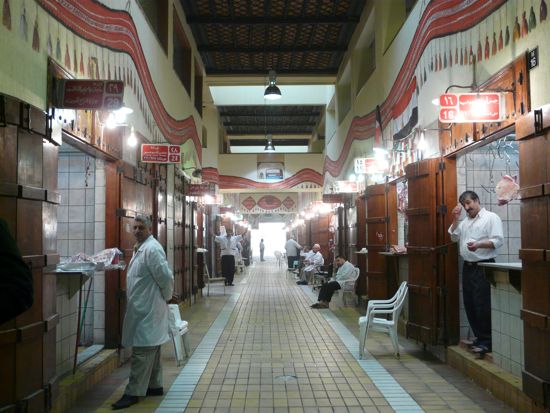
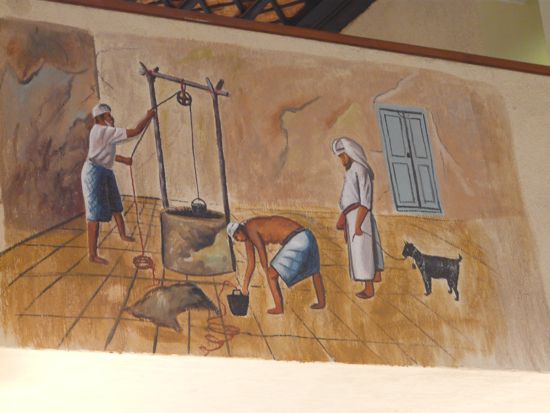
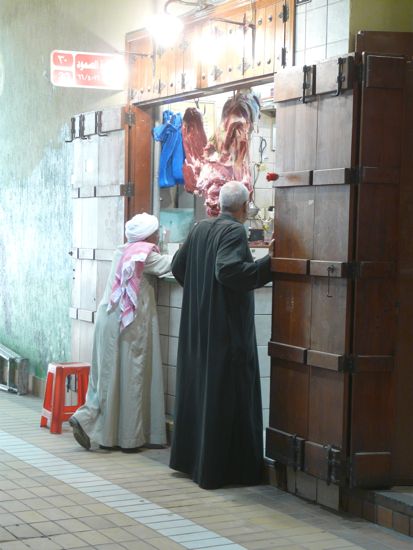
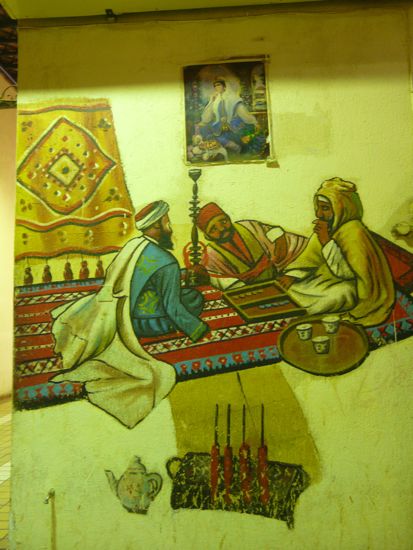
Mubarakiyya Glimpses and Public Art
Every time I go to Mubarakiyya, I see something I haven’t seen before. We found some scenes in the meat market – see if you can find them.




Dewey: The Small-Town Library Cat Who Touched the World
I’ll admit it, I was looking for a quick read, and after resisting this book for months, I picked it up. As much as I love cats, I am not that much into cute, nor am I particularly sentimental, and I don’t like having my emotions manipulated. Just one look at the adorable cat on the cover told me it was going to be one of those slick, fairly superficial feel-good kind of books.

See what I mean? Just look at that cover. Look how that cat just looks right into your eyes. This book is going to suck you in.
This book was a surprise. Yes, it was touching. Yes, it was about a tiny little kitten who almost died, stuffed in a below freezing book-return box in an northern Iowa country library in the middle of one of the coldest nights of the year, and yes, he ends up living in the library for almost 20 years and brightening the life of the people who come into the library. Yes, Dewey is adorable, and funny, and loveable. Yes, the book is an easy read.
It is also, surprisingly, an uncomfortable read. It is not overly sentimentalized. It is also the story of a woman, Vicky Myron, who grew up on one of the northern Iowa farms, and she tells us about the quality of a life that is no longer available in America, how the safe, secure, intertwined family life of rural Iowa has greatly disappeared. The hard times we are working our way through in 2009 is an echo of hard times suffered in rural America, as small farms are gobbled up by the more efficient super-farms, owned by conglomerates, not by families.
She tells us about her physical struggles with a disastrous childbirth, and its two year aftermath, and she tells us about how her marriage to a lovable alcoholic died, almost without her being aware it was dying. She doesn’t spare herself, as she discusses her problems, as a single mother, on welfare, trying to get a college education and raising her daughter, who couldn’t wait to move away from her. She talks about her challenges remodeling an old cement reading library into a modern, airy information resources center serving the town and the surrounding community, at the same time she is working on her Masters in Library Science. She describes her challenges dealing with the town bureaucracy. It is not always comfortable, or feel-good reading. It takes the book out of the superficial, and gives you something to think about.
Intertwined in all of this is Dewey Readmore Books, the cat who comes to live in the Spencer, Iowa, library, and who is eventually featured on TV shows around the world. He responds to requests that he pose, that he perform, he seems to know who needs a little love and is quick to give it – he is a great main character. For me, some of it was also uncomfortable, kind of a stretch – like that the cat would be in the window waving to her every morning when she came to work. Well . . . maybe . . . I’ve almost always had cats in my life, and few have every shown such consistent loyalty. Cats are . . . well, cats. It’s the way God made them. 😉
What I love is that this book is about libraries, and the amazing (mostly) women who run them. These librarians have had a huge influence on my life, and the life of AdventureMan, challenging us to explore outside our boundaries and supporting our aspirations, recommending new ideas and new ways of serving their communities. Librarians are part of the backbone of America.
I read this book in just a few hours. It just isn’t that complicated or challenging; it is an easy read. It has been a #1 New York Times bestseller, and copies of the book are still selling strongly. It currently ranks #105 in all time book sales on Amazon.com – can you imagine how many books that must be? The book is sweet, but #1? I can only imagine so many people are buying and reading it because it looks like 1) a Feel-Good book and 2) an easy read.
Eliot Pattison: Beautiful Ghosts
It almost always takes me a little while to get into Eliot Pattison’s books, and I can figure out why. He sets you down right in the middle of something going on, so you start off a little confused. You can read each of his Inspector Shan Tao Yun books as a stand-alone, but it helps to have read them in order – as I have.

Even though I have read them in order, I still find myself disoriented each time I start a new book. New names, a new situation, and it takes a few pages to get back in the rhythm of thinking about things in a new way. Within thirty pages, I am in a new world, and I am totally addicted. When I am reading one of the Inspector Shan Tao Yun books, I can hardly wait to get back to the book. My household chores suffer, my projects suffer – even AdventureMan suffers, as I seek to return to Tibet, the Tibetan Monks and the world of Chinese bureaucracy.
One of the things I love in this book – we saw a hint of it in the last book I reviewed, Bone Mountain – is that the worst of the bad characters can have a hint of humanity, and develop a full-blown redemption, as we are watching happen with the prison warden, Captain Tan. The process continues in Beautiful Ghosts. In this book, Pattison strikes several additional chords – he combines a good mystery with art, art thefts, public art and a little bit of history, a family reunion, father-son problems, and a lot of action. I’m a happy reader.
In Beautiful Ghosts, a murder happens, but it is hard to understand, at first, who was murdered, why the murder was committed, where the murder was committed as well as who committed the murder. One answer leads to another, and ultimately, to long buried treasures and long kept secrets.
A great tickle, for me, is that in this book Inspector Shan Tao Yun goes to my home town, Seattle, which he finds very strange, and grey and rainy. Pattison describes Chan’s bewilderment at how Americans live, and as Chan leaves Seattle, he comments on how he has not seen the sunshine in his entire time visiting there, working in co-ordination with an FBI office trying to track down some missing and stolen Tibetan art pieces, stolen from the hidden monasteries by corrupt Chinese bureaucrats.
Shan still stood, studying the strange buildings and the dozens of people who were wandering in and out of the open doorways off the huge main hall. There were shops, he realized, dozens of shops, two floors of shops. When he looked toward Corbett, the American was already ten feet in front of him. Shan followed slowly, puzzling over everything in his path. Adolescents walked by, engaged in casual conversation, seemingly relaxed despite the brass rings and balls that for some reason pierced their faces. He looked away, his face flushing, as he saw several women standing in a window clothed only in underwear. He saw more, nearly identical women, in another window adorned in sweaters and realized they were remarkably lifelike mannequins. One of the sweaters was marked at a few cents less than three hundred dollars, more than most Tibetans made in a year.
“Why did you bring me here?” Shan asked, as Crobett led him into a coffee shop and ordered drinks for both of them. “This place of merchants.”
“I thought you’d want to see America,” Corbett said with an odd, awkward grin, gesturing to a table, then sobored. “And this is where Abigail worked, before getting the governess job. People here knew her, told me stories about her, made her real for me.”
. . . .
Shan began to marvel at the rain itself. Beijing was a dry place, most of Tibet a near desert. He had not experienced so much rain since he was a boy, living near the sea. There were many qualities of American rain, and many types of rain clouds. One moment they were in a driving rain, like a storm, the next in a shower, the next in a drizzle that was little more than a thick fog. Once the water came down so violently, in such a sudden wind, that it struck at the car horizontally. . . .
You learn so much reading Eliot Pattison, more than I can absorb! There are detailed art works, there are geographic features, there are Buddhist customs, there are bureaucratic networks, there are mysteries of Chinese history and dynasties. There are tribal customs and learning to think like Tibetan monks.
Eliot Pattison is a gifted and poetic writer. If you like mysteries that turn out to be very complicated and which teach you a lot about a culture you have never experienced (or would like to learn more about) I would suggest you start at the beginning. These are the books about Inspector Chan in chronological order:
Skull Mantra
Water Touching Stone
Bone Mountain
Beautiful Ghosts
Recent Comments
ExpatAlien on What Country am I Living … intlxpatr on Yellowstone: Old Faithful to C… Michelle on Yellowstone: Old Faithful to C… Cathy on No Grown-Ups in Charge intlxpatr on Waiting for Snow Wikipedia Donate Button

Amazina


Early Voting in Florida


 Here There and Everywhere