Underwear Uproar in Saudi Arabia
There is an article today on BBC News (you can read the entire article by clicking here) on the underwear uproar in Saudi Arabia – that to buy underwear, women have to deal with male clerks. And more – there is nowhere to try on a bra to make sure you get the right fit! You have to pay, go to the public restroom, try it on and bring it back if it is not right.
One of the most amazing things to me, besides having only men selling underwear in Saudi Arabia, was the fact that the most amazing lingerie was in the most public windows. My favorite I-would-love-to-take-this-photo moments was watching abayed and niqabed women standing next to some of the tiniest, most sexy underwear you could imagine.
i know you think we are looser in the west, but you would laugh to know how restrained we really are. For the most part, we just don’t discuss underwear.
And have you noticed – in the United States, the mannekins don’t have nipples? I was shocked the first time I saw mannekins in Europe and the Middle East – the females had nipples! I had to look away! We are prudish in funny ways, in ways you can’t begin to imagine, and in ways we don’t even realize until we are confronted with our own what-we-think-is-normal.
I cannot imagine men in the ladies lingerie section. I buy all my underwear back in the US; I am too shy to buy underwear from a man! In Kuwait, they have females selling La Perla, very nice underwear, but most of the really good ready-made clothing in Kuwait is for size 00 – 2 girls – not for grown up women. It’s just easier buying my “unmentionables” discreetly on my trips back home. I carry a list. Most of us do. 😉
Here is the article:
Saudi lingerie trade in a twist
By Stephanie Hancock
BBC News, Jeddah
It would be bizarre in any country to find that its lingerie shops are staffed entirely by men.
But in Saudi Arabia – an ultra-conservative nation where unmarried men and women cannot even be alone in a room together if they are not related – it is strange in the extreme.
Women, forced to negotiate their most intimate of purchases with male strangers, call the situation appalling and are demanding the system be changed.
“The way that underwear is being sold in Saudi Arabia is simply not acceptable to any population living anywhere in the modern world,” says Reem Asaad, a finance lecturer at Dar al-Hikma Women’s College in Jeddah, who is leading a campaign to get women working in lingerie shops rather than men.
“This is a sensitive part of women’s bodies,” adds Ms Asaad. “You need to have some discussions regarding size, colour and attractive choices and you definitely don’t want to get into such a discussion with a stranger, let alone a male stranger. I mean this is something I wouldn’t even talk to my friends about.”
In theory, it should be easy enough to get women to staff lingerie shops, but parts of Saudi society are still very traditional and don’t like the idea of women working – even if it’s just to sell underwear to each other.
Rana Jad is a 20-year-old student at Dar al-Hikma Women’s College, and one of Reem Asaad’s pupils and campaign supporters.
“Girls don’t feel very comfortable when males are selling them lingerie, telling them what size they need, and saying ‘I think this is small on you, I think this is large on you’,” she says.
“He’s totally checking the girls out! It’s just not appropriate, especially here in our culture.”
Kuwait Independence / Liberation Holiday Treat
My friends, run to the nearest newsstand and pick up a copy of today’s Arab Times. On page 3, one of Kuwait’s most eminent bloggers, Amer al Hilal, has a full page article; his diary as a soldier during the Liberation.
It is an awesome article. He brings the liberation period, with its thrills and challenges, to life. He is a very readable writer, and his story is compelling. Now! Right now! Go read the paper! Its YOUR history!
#1 Entry: NWB – Great Kuwait Liberation Day Challenge
OK, OK, the rest of you might as well just give up. It will be really, really hard to find more adorable children than these celebrating Independence and liberation! Thank you, NWB!
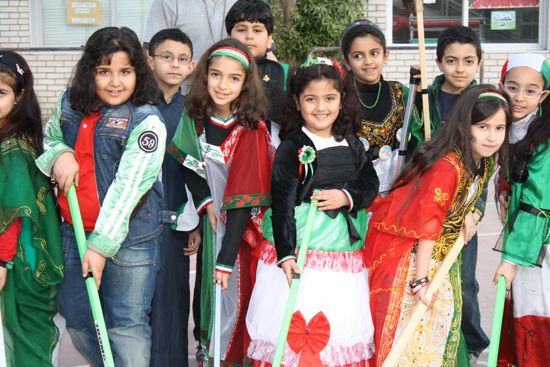
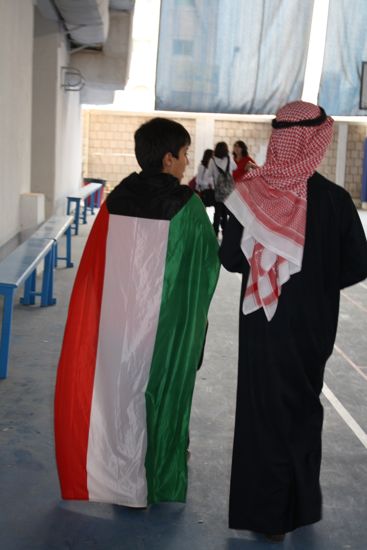
Just kidding – the children are adorable AND I want more entries!


Khaled Aljenfawi: Tolerance Begins at Home
An extraordinary article from today’s Arab Times:
Tolerance usually begins at home
By Khaled Aljenfawi
Verbally or physically abusing some domestic servants, stone pelting some expatriate passengers and drivers, lack of patience toward some expatriate doctors and teachers, by some individuals, certainly indicate that tolerance usually begins at home.
Already known for its tolerance toward strangers, foreigners and non-citizens, our Kuwaiti traditional society stands upon certain pillars of morality. These moral ideals usually advocate mercy, compassion and understanding toward others. As such, as Kuwaiti citizens, many of us already understand the importance of such moral ideals and many of us live by them. Therefore, we realize that we are integral parts of a larger human family; many of us in fact continue to refuse anti-social behavior directed toward some expatriates.
This being said yet certain individuals in our society continue to verbally or physically torment some helpless domestic servants. Some youngsters pelt expatriate passengers while they ride in public buses; perhaps just because they believe they can do so!
One can add to this the other negative phenomenon common these days of not being patient with some expatriate doctors and teachers and simply opting for the more reckless behavior: verbally and sometimes physically assaulting these expatriate professionals. Such behavior go against our national law and against the teachings of our national heritage. Such negative behavior in fact go against our Islamic tenets!
As a case in point, borrowing from already accepted international laws about human rights, and relying basically on our genuine Kuwaiti heritage of tolerance, officials in the Ministry of Education continue to update our national curriculum to adapt to a changing world. For example, primary, middle and secondary schooling emphasizes tolerance as a way of life in a modern society. Yet what the younger generations are learning at school about tolerance continues to be threatened by the behavior of some.
Intolerance actually goes against the basic teachings of our Islamic faith. As a Muslim society, Kuwait has been welcoming strangers, foreigners and expatriates for tens of years without apparent conflict. This tolerance toward those who are different springs from our Islamic faith, in addition, it originates from our national heritage. For example, one of the most enduring tenets of Islam is the equality among humans: in the Holy Quran, the Almighty say: “We have created you from male and female, and have made you nations and tribes that ye may know one another. Lo! the noblest of you, in the sight of Allah, is the best in conduct. Lo! Allah is Knower, Aware.” (Al-Hujraat-13).
One cannot instill by force tolerance in the mind of a child unless the whole family believes in the legitimacy of tolerance and its importance to its general wellbeing. If a young child learns about tolerance at school and then encounters daily situations of intolerance at home, he/she will find it hard to believe in tolerance. In other words, tolerance in addition to being a moral concept, which reflects the morality of a whole society, will take its roots if the ordinary family considers it as an accepted code of conduct. A Tolerant young person for example, will subsequently be a tolerant father or mother for these parents are already used to tolerance and will ultimately help shape the mentalities of their children.
A child who is already used to voicing his points freely in a safe family environment will find it much easier to accommodate tolerance and accept it as a way of life. Indeed, a child raised in a Tolerant family will eventually become a good neighbor, a good friend and certainly a Tolerant person toward those who are different from him.
khaledaljenfawi@yahoo.com
Wooo Hooo on you, Khaled Aljenfawi!
Camel Racing Championship – Who Knew?
From today’s Al Watan:

Camel racing championship kicks off
Camels ridden by robot jockeys take off at the beginning of a race that was held on the martyr Fahad AlـAhmad AlـSabah track in Kabad on Sunday. The competition marked the start of the Kuwait Ninth Camel Racing Championship which is being held from Feb. 15ـ19. (Al Watan)
Last updated on Monday 16/2/2009
My whine: This is the kind of event that thrills our little western souls. We love your cultural events, and camel racing – like how exotic does it get? Robot riders? oh WOW. We would have gone in a heartbeat, but you all kept it a SECRET! (whining whining whining) We only find out the day AFTER it happens!
Saudi Arabia: Valentine’s Day
I just love this photo, from today’s Al Watan

A Saudi man shows how members of the Saudi vice squad (Religious police) crush red roses with their feet as they enforce a law banning Valentine”s Day celebrations in the conservative kingdom at a flower shop in Riyadh. The Western version of Valentine”s Day ـ lovers raining flowers, chocolates and toys, all with a red theme, on each other ـ would be a challenge in Saudi Arabia at any time of the year. Strict Islamic religious rules keep men and women separate until they are married ـ and marriages are usually arranged by their families. There is no taking a girlfriend out to a coffee shop or restaurant: the cafes and restaurants all have separate sections, one for single men and the other for women and families. (AFP)
Last updated on Sunday 15/2/2009
Valentine’s Day Word Play
Happy Valentine’s Day!
What did the caveman give his wife on Valentine’s Day?
Ughs and kisses!
What did the boy sheep say to the girl sheep on Valentine’s Day?
I Love Ewe!
What did the stamp say to the envelope on Valentine’s Day?
I’m stuck on you!
Knock knock!
Who’e there?
Frank
Frank who?
Frank you for being my friend!
Knock knock!
Who’s there?
Howard
Howard who?
Howard you like a big kiss?
What did the boy owl say to the girl owl on Valentine’s Day?
Owl be yours!
What kind of flowers do you never give on Valentine’s Day?
Cauliflowers!
What do you call a very small Valentine?
A Valentiny!
What did the boy squirrel say to the girl squirrel on Valentine’s Day?
I’m nuts about you!
What did the girl squirrel say to the boy squirrel on Valentine’s Day?
You’re nuts so bad yourself!
Knock knock!
Who’s there?
Sherwood
Sherwood who?
Sherwood like to be your valentine!
Knock, knock
Who’s there?
Pooch
Pooch who?
Pooch your arms around me, baby!
Thank you, KitKat!
The Doha Museum of Islamic Arts – first visit
It’s Friday afternoon, and I can hardly believe it. We are here. Now THIS is my idea of a romantic getaway – please! Keep your chocolates (although I do love chocolate!) and your roses, keep your long lingering dinners and fabulous wine, but take me someplace where I have really wanted to go, and I will be your slave forever. You da man, AdventureMan. You know how to win my heart. 🙂
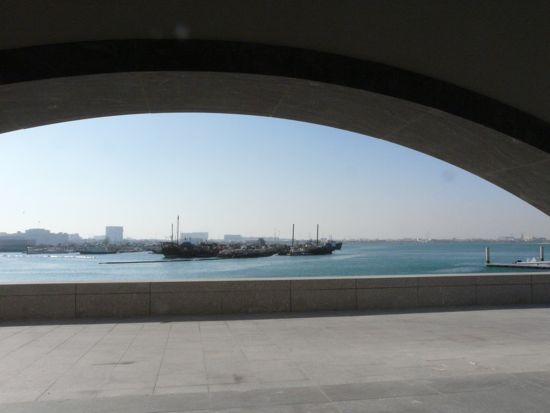

It is a glorious day and the museum has just opened. There is a huge parking lot and little carts ferrying the older people and women with small children to the entrance, but it is a nice walk, not a hard walk. Families are streaming in, and (gasp!) admission is FREE! You have to go get a ticket; I guess maybe that is how they keep track of admission statistics, but this beautiful museum, floating out over the gulf, all white and clean and gorgeous, filled with priceless objects of art, it’s free? Amazing.
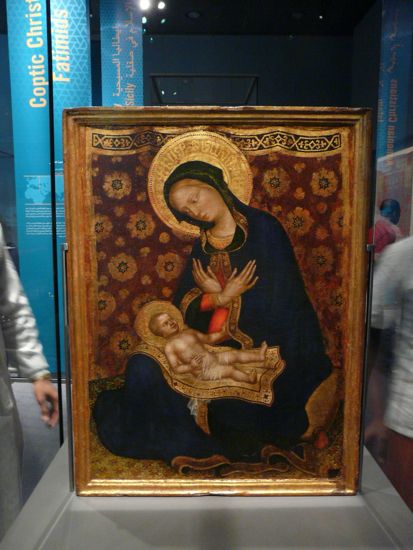
We decide to start with the Beyond Borders exhibit, a special collection of art that integrates Jewish, Christian and Islamic traditions in an art collection. There are so many pieces that make me gasp in awe. I see one, and I can’t resist, the camera is out of my bag, I see others snapping photos with cell phones, but I know the rules . . . hmmm. But there is nothing posted here saying “no photos!” I ask the guard if I am allowed to take photos and he tells me “You are welcome, madame, all through the museum, you may take photos.”
I am in total shock. All through the museum? I can take photos?
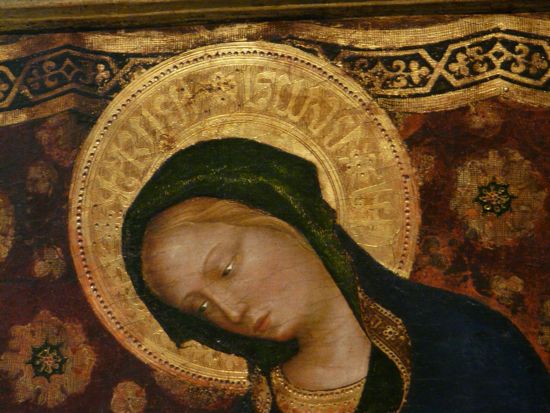
Here is the piece that moved me so much that I gathered up the courage to ask. It is a Madonna, painted in Aleppo, Syria, I believe, and it has an Quranic sura written in her halo:
The museum is my oyster, and my battery is dead. I didn’t bring another. Some things happen for the best, and I tuck my camera back in my purse and AdventureMan and I try to absorb what the Doha Museum of Islamic Art has to offer.
It is an impossible task. There is SO much. Not everything is well documented, and then there are sections which are amazing. There is so much to learn, and so much beauty in this museum.
If I had to choose my favorite thing of all, it would be some tiles from Kashan. In an earlier post, commenter Daggero mentioned that the word for tile used in Kuwait is “kashi” and now I know that it comes from these tiles, made in Kashan around the 1300’s (Gregorian calendar) which were famed for their intricacy, their interlocking designs, and their high quality. There are also Iznik tiles in the museum, which are thought to be greatly influenced by these tiles from Kashan.
I had no idea, but the tiles just blow me away. I would love to create some tiled rooms back in my Seattle house, with reproductions of some of these amazing star shaped tiles. For me, that was the highlight of this trip. I know there will have to be many more – this museum is filled with treasures. Free – for all the people. And yes – the gift shop is awesome!
Recent Comments
ExpatAlien on What Country am I Living … intlxpatr on Yellowstone: Old Faithful to C… Michelle on Yellowstone: Old Faithful to C… Cathy on No Grown-Ups in Charge intlxpatr on Waiting for Snow Wikipedia Donate Button

Amazina


Early Voting in Florida


 Here There and Everywhere