


Mary Nell’s Secret
“I’m coming in tonight,” says AdventureMan, “but not on my original flight. My flight from Denver to Chicago was cancelled, so I missed that flight. I’ll be on the flight coming in at around 10.”
“Oh, I’m so glad you called; I would have been waiting at the airport!” I replied.
“There’s an e-mail waiting for you – I had (our son) send you an e-mail to let you know,” AdventureMan continues, “I was lucky to get a flight at all – they had re-booked me for tomorrow night! I used Mary Nell’s technique, and they found me a seat on another flight.”
I laughed in delight.
If we are very very lucky, we learn from our friends. I have several friends who are flowers of the South, but Mary Nell takes the crown as the Queen of the South. Mary Nell and I would be on the road to France in a heartbeat, any excuse would do. We had our favorite stores, we introduced one another to new favorites, new villages, new restaurants. Even better, our husbands liked each other, too, so now and then we would hit a very lovely restaurant, the four of us.
Mary Nell is polite and well-mannered. Always. Polite and well-mannered, and she always gets her way. When someone gives her information she doesn’t like, she pauses, gathers her forces, looks them directly in the eye and says the magic words: “That won’t do.” She shakes her head sadly as she delivers the words.
She follows up firmly, “No, that won’t do at all. We have a problem here. (Names what she wants, like the shoes she likes in a color not available in that shop) What are we going to do?” and she looks deeply into the other person’s eyes.
She uses the same techniques on the bullies she counsels in the guidance office, the out-of-control parents, the crazy teacher. They all back down in the face of Mary Nell’s relentlessly polite confrontation.
AdventureMan and I could only watch in absolute astonishment as Mary Nell worked her magic. After a while, we tried it, too. It took a few tries, but – it really does work!
Again, at the airport, as the ticketing guy explains that with the downsized plane, they have had to put my husband on a later flight. “No! That won’t do!” says Adventure Man. “People are counting on me! We have to fix this problem!”
The ticketing guy thought he had it fixed, but this technique forces him to search out new possibilities. Once again, Mary Nell’s technique prevails.
She never gets aggressive. She never raises her voice. And whoever is working with her knows, with utter conviction, that she is not going to go away until this problem is solved to her satisfaction. Woooo Hoooooo, Mary Nell.
Three Cups of Tea
My best-friend-from-college and I were chatting the other day and I asked her “what are you reading?” because we have always exchanged book recommendations back and forth.
“I’m reading a biography of Teddy Roosevelt,” she started, and I groaned, because most of the time biographies don’t interest me that much. “And I am reading Three Cups of Tea . . . “ and I interrupted her (rudely) to exclaim “so am I!”

Three Cups of Tea is a must-read in the US. It was actually published in 2006, and has sold more and more books every month, and has been on the New York Times best seller list almost since it was published.
The book begins with a failure. A mountaineer, attempting a climb on K2 runs into problems, including evacuating two severely injured fellow climbers from the mountain. Exhausted, and devastated by his failure to capture the summit, he gets lost on his way back to the base camp, and ends up in a village where the people are very kind to him. He is treated as an honored guest, he regains his strength, and on his last day in the village, learns the children have no school. He rashly promises to come back and build a school for them.
One of the great redeeming features in this book is Greg Mortenson’s endless humility. He has a co-author, to whom he gave a long list of people he could talk with, including all his enemies and people who thought he was crazy. He’s that kind of guy. He talks about his life’s personal failures and his toughest moments, and he moves on.
He doesn’t take credit for the dogged persistence with which he keeps his promise, in spite of daunting obstacles. He doesn’t take any credit for the good will he builds.
Several years ago, I read another book which has changed my life, The Purpose Driven Life (which, by the way, the hardcover is $9.99 and the paperback is $10.19, go figure) in which the basic premise of the book is that we are each created uniquely, individually, by a loving creator, for a purpose. As I read Three Cups of Tea, I thought this man is greatly blessed; he discovered his purpose and nothing kept him from fulfilling it!
The book deserves every single one of it’s Amazon Five Star ratings.
I had a hard time putting the book down. Even though my life is full of other demands, once I had the chance, I spent an entire afternoon finishing this great book.
Greg Mortenson isn’t discouraged that his first school takes three years, and first he has to build a bridge. His second, third and fourth schools take just . . . three months! He has a gift for inspiring others, and people give what they can. The villagers give their time and their efforts, and western supporters donate funds.
By the end of the book, 24 school have been built, in the very poorest mountain villages in Pakistan, where money from the government for education doesn’t trickle at all, until near the end of the book. He doesn’t build the schools himself – he meets with the villagers, they donate a plot. He buys the materials, and together, they all build a school. These villagers are hungry for their children to become educated, to have a chance for a better life. Mortenson learns to focus on the girls.
He learns that as the boys become educated, they leave the villages for the city, but as the girls become educated, they come back, and like yeast, they raise the standard of living for the entire village, providing health care services and information, providing education for the newest crop of children, learning new skills, bringing them back and sharing them.
One of Mortenson’s gifts is that he isn’t interested in changing these mountain people into westerners. He likes them, and he learns from them, just the way they are. He dresses like them, he prays with them, he learns their language, and he has no western agenda for the curriculum in these schools. He also helps the government schools – building an additional room here for an overflowing school, paying a teacher’s salary there – his goal is to educate children. That’s it. No political agenda. The people of the villages love him for it, and give him their full support.
You cannot undertake a project like this without a lot of help. Mortenson had some extraordinary experiences, experiences that to me look like the grace of God, that drew together teams of people to help build and supply his schools.
“I looked at a sign in front of the school and saw that it had been donated by Jean Hoerni, my cousin Jennifer’s husband,” Bergman says. “Jennifer told me Jean had been trying to build a school somewhere in the Himalaya, but to land in that exact spot in a range that stretches thousands of miles felt like more than coincidence. I’m not a religious person,” Bergman says, “but I felt I’d been brought there for a reason and I couldn’t stop crying.”
A few months later, at Hoerni’s memorial service, Bergman introduced herself to Mortenson. “I was there!” she said, wrapping the startled man she’d just met in a bruising hug. “I saw the school!”
“You’re the blonde in the helicopter,” Mortenson said, shaking his head in amazement. “I heard a foreign woman had been in the village, but I didn’t believe it.”
“There’s a message here. This is meant to be,” Julia Bergman said. “I want to help. Is there anything I can do?”
“Well, I want to collect books and create a library for the Korphe School,” Mortenson said.
Bergman felt the same sense of predestination she’d encountered that day at the school. “I’m a librarian,” she said.
After struggling for many years, seeking donors who would help to build a school, Mortenson now has a foundation eagerly supported by many Americans, and especially the mountaineers, who continue to build schools. At the end of the book, the foundation is moving into the poorest sectors in Afghanistan, and building schools there. They have children’s programs in many of the schools in the United States, where children donate pennies to help pay for books for the schools, and for the teacher’s monthly salaries, where salaries are not reaching the teachers. You can donate to the school building fund, teacher’s salaries and books using your credit card, online, at the website Three Cups of Tea. You can order this book there, too, as well as music CD/s and learn more about the work being done.
Bush Tours America To Survey Damage Caused By His Presidency
Hilarious video from The Onion.
Wrong, So Wrong
I was wrong, so wrong, and I admit it. I had scanned the news online. When I finally got my hands on a hard copy paper, I discover there IS news, news you don’t find online, and so much of it. Because I can’t copy it online, you will have to bear with my hand-typed-in renditions of the page 2 “In the News” section from the Kuwait Times.
1. Rehab Centers
Kuwait: Dr Haya al Metairi called for establishing a specialized health center to treat and rehabilitate homosexurals. She urged the authorities to impart moral guidance and offer psychological counseling to affected people (sic) instead of incriminating the phenomenon of homosexuality. She said she has already submitted a demand of establishing the center to the parliamentary committee for curbing negative invluences. She also called for the implementation of a draft law to evaluate the degree that the patient is psychologically affected. (sic)
Once diagnosed, appropriate psychological treatments should then be administered accordingly after referring those ailing from sexual deviation to the relevant health centers. She also called for subjecting them to periodic checkups as well as conducting awareness campaigns to expedite their rehabilitation.
Al Metairi urged the Ministry of Health to subject local pharmacies to strict surveillance, reported Al Watan. She said most pharmacies sell banned female hormone inducting drugs over the counter that could fatally endanger the lives of consumers. She said such pills activate female hormones, leading to weakening the male sexual organs. Prolonged use of such drugs transforms a man’s physical appearance to resemble that of a woman and also negatively reduced the power of their sexual organs.
2. Diplomatic Appointments
Kuwait: Undersecretary at the Ministry of Foreign Affairs Khalid Al-Jarallah denied the involvement of wasta in admission tests held for inducting diplomats. He refuted reports that the ministry resorts to wasta, saying “The ministry never subjects itself to pressure from anyone, nor does it accept wasta in any form.”
He said appointing diplomats is a very sensitive issue as this select group represents the country abroad. Speaking on qualifications required to qualify for the posts, he said the maximum age required to qualify for the examinations is 24. No applicant under 24 has ever qualified for the written tests, he added. All candidates then have to mandatorily undergo a series of other appraisals and examinations before being finally accepted as diplomats, reported Al-Wasat. Written exams, which are graded by an expert panel of officials from the ministry are then followed by personal interviews and stringent brain storming sessions while grading the applicants on their personal capabilities.
3. No Blackouts
Kuwait: Fears of impeding electricity outages this summer dominated the Cabinet’s recent weekly meeting, officials said. The Ministry of Electricity and Water Mohammed Al-Olaim briefed the Cabinet with a detailed report on the current situation as well as details of the expected consumption as compared with the actual production.
He assured the Cabinet that he does not expect any electricity outage; scheduled or otherwise. He said the overall situation was under control with production exceeding the state’s consumption. “We are safely within the parameters of the green consumption line.” he added. He however slammed some local dailies of sparking unconfirmed reports of a power crisis, reported Al-Wasat. He said the reason electricity in some areas, was disrupted recently was due to technical snags leading to an overload, resulting from an excessive increase in day temperatures.
He said residents do not have to worry as technicians are on standby around the clock to deal with any contingency that might arise at any given time or place.
4. Donkey Ordered Out
Kuwait: The Minister of State for Municipa Affairs Dr. Fadel Safar saw a donkey grazing on a green patch while travelling through the capital recently. He called municipal officials and snstructed them to clear the mule off, reported Al-Watan. The officials in turn called capital police who arrived and took the animal to the Capital Security Directorate.
Laugh? Or cry?
The Wire, Season 4
This show, The Wire, is one of our all time favorites, all the more so because our son also loves this show and passes along the entire season when he has finished watching.
Season 4 is the very best so far. The major theme is a subject near and dear to my heart – the schools, keeping kids in school, and trying to find ways to help them learn. Two former policemen end up in Tilghman Middle School, working with the poorest kids in the Baltimore school system.
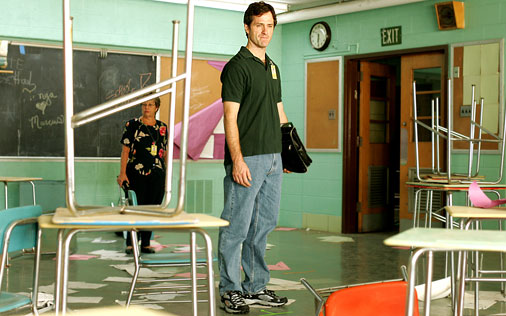
First, you need to know that teaching middle school is the stuff of heroes. At very best, middle school kids are dealing with those raging hormones of adolescence. They can’t sit still. They are so full of energy, and sitting and reading is the last thing they want to do.
New teacher “Prez” suffers total loss of control over his class on his first day, but slowly finds ways to engage their attention – such as teaching them to use math to figure odds rolling dice. Once they understand the value of the new information, they are enthusiastic learners . . . or at least, they co-operate with the boring stuff because he finds ways to reward them with interesting information, relevant to helping them cope with their lives. The teachers learn from the students – to keep it real, keep it relevant.
The teachers in Tilghman Middle School are HEROES. Most of the children they deal with have huge problems outside the school, poverty being the smallest of the problems. For many, their parents are their worst problems, literally stealing the food out of their mouths for another fix. The kids bring their baggage into the schools every day, their anger, their acting out. The teachers have to be a mix of tough, compassionate and flexible. They know they are going to lose some of them, and they have to keep on, hoping a few will make it. It is truly a war zone, and the teachers are the stand-up soldiers in this season.

We follow a tough race for the Mayor’s office, the rise of a drug lord, two stone-cold killers who figure out how to “disappear” their victims, and one very clever schemer who manages to pull off a major drug heist, and then sells the product back to his victims. It’s an amazing show.
If you follow this season via DVD, choose to use the subtitles. A lot of the language is slang, much of it is street talk, mumbled, garbled – real speech. It helps to use the subtitles.
Maitland and The Company of Liars: A novel of the plague
I had just finished The Swallows of Kabul and still had a long flight to go. Fortunately, I was in the Johannisburg airport, with it’s truly wonderful bookstore, and came across The Company of Liars: a novel of the plague. Well, it isn’t exactly a novel of the plague. The story opens in 1348, a year in which le morte bleu hit the British Isles, only later to be called the plague. The author captures the times, the filth, the lack of bathing, the superstitions, the ways of life.
The plot centers around a group who wanders through the island, just trying to stay alive. The spreading plague impacts on their wandering, but to call this a novel of the plague is just not accurate. The plague is the reason for the journey, but the journey is the center of the novel, not the plague.
Before I started reading the book, I read the Historical Notes in the back, and that is where I came across the most interesting information in the entire book:
The 1348 plague was only the latest in a series of disasters to hit Britain. The period between 1290 and 1348 had seen a rapid and drastic climate change which was so noticeable that the Pope ordered special prayers to be said daily in every church. Eyewitness accounts claimed that 1348 was a particularly bad year, for it rained every day from Midsummer’s Day to Christmas Day. Climate change brought about crop failure, liver fluke in sheep and murrain in cattle, as well as causing widespread flooding which virtually wiped out the salt industry on the east coast. This, combined with a population explosion, meant that as many people died from starvation as from the plague itself.
Interestingly, the book will not be released in the US until September 2008. The cover shown is nothing like the cover of the book I bought.
American issue cover:

Cover on book bought in Johannisburg:

I like the cover of mine better.
Some reviewers call this book “enthralling” or “gripping.” I wans’t all that enthralled or gripped, but it did make good airplane reading. I learned a lot about the grim brutality of life in 1348, but as I told AdventureMan, this is more a book about a slice of time than a book with a great plot. The plot isn’t that great, it is the historical detail that is interesting, and fiction just makes it more easily absorbed. (my opinion)
Jody Shields and The Fig Eater
This is one of those books I picked up off the staff recommendations shelf at Barnes and Noble – one of the very best sources for cult classics like Wicked: The Life and Times of the Wicked Witch of the West, books that don’t get a lot of press hype but whose readership grows slowly by word-of-mouth.
The cover caught my eye. This woman is dressed modestly enough, all the important parts are covered, but look at her eyes – there is a sultriness there, and a challenge that I find intriguing. This shows signs already of being an-out-of the-ordinary book.

The book opens in the early 1900’s with a murder. We follow the investigations of the chief Inspector, and we follow the parallel investigations of his wife, a Hungarian, Erszebet, and her ally, the English Wally. It’s a mystery, and in this exquisite book, the process of solving the mystery is so much more interesting than who actually did it, or even why.
The most fascinating character in The Fig Eater is the nature of fin de siecle Vienna, it’s customs, it’s caste system, it’s manners, and the fusion of East and West. Entire meals are described, cafe’s, cakes, cooking methods. Clothing is described in loving detail, and we visit a tuburculosis sanitarium as well as an insane asylum.
We study Kriminalistics with the Inspector and his assistant, we learn the fundamentals of early photography from an three fingered photographer. We experience early Viennese medical practices.
We learn all kinds of Hungarian superstitions and beliefs, we dance at the Fasching Balls of Vienna, and we simmer with the repressed sexuality of the times. We mourn with the bereaved, we shiver in the cold winter, and we steam in the brutal heat of an extended summer.
The end is so totally unexpected that I had to go back and read it again. My bet is, that if you accept the challenge of reading this book, you will have to, too. Even after you have read it again, you will not be totally sure what has happened, and yet . . . it is a satisfying ending.
This was a wonderful read.
I will leave you with a quote:
The Inspector has always prided himself on his ability to listen, as a good Burger is confident of his business acumen. During interrogations, he can distinguish the different qualities of the witnesses silence, as if it were a tone of voice.
He had admonished Franz more than once for interrupting him. Don’t be so hasty. Slow down and listen. In the Pythagorean system, disciples would spend five years listening before they were allowed to ask a single question. That was in the 4th Century BC. Another philosopher, Philo of Alexandria, wrote about Banquets of Silence, where even the correct posture for listening was determined.
In Kriminalistic there is a text on the subject. He orders Franz to read it as part of his lesson. “To observe how the person question listens is a rule of primary importance, and if the officer observes it he will arrive at his goal more quickly than by the hours of examination.”
Rape for Chatting
Also from today’s Arab Times – rape is every big as horrifying when it happens to a man. I am glad this young man had the courage to report it to the police, and to prosecute his attackers.
I wonder how they found out their sister was chatting with this man?
Brothers kidnap, rape man in revenge for ‘chatting’ with their sister
KUWAIT CITY : The Criminal Court Monday dismissed an objection latter submitted by a bedoun identified only as Ali A., requesting the court to cancel a five-year jail sentence which has been issued against him in absentia in a case filed against him and his brother for kidnapping and molesting a Kuwaiti man.
During a previous session the defense lawyer had told the court there was no evidence to prove his client had committed the crime.
He added the victim’s testimony was contradictory and requested the court to cancel the verdict of the Court of First Instance and acquit his client.
Case papers indicate the victim filed the case against two brothers accusing them of kidnapping and molesting him after learning about his relationship with their sister via the Internet.
The victim explained he chatted with the sister of two men on the Internet and they exchanged messages on their cell phones. When the girl’s brothers learnt about this relationship, one of them called him and said he wanted to meet him.
When the victim met one of them, identified only as Essa, the latter asked him to get into his car and drove off. On the way, Essa stopped the car and his brother Ali got in.
The two men took the victim to a building under construction and ordered him to take off his clothes and molested him. They threatened to kill him if he talked to anybody about the incident.
On April 2, 2005, the Court of First Instance sentenced Essa to five years in jail to be followed by deportation and Ali to five years in absentia because he was not arrested or interrogated.
The session was presided over by Judge Abdullah Al-Sane.
By Moamen Al-Masri
Special to the Arab Times
Saved by a Scream
This woman had a close call. I am re-assured that the family was taking her to Saudi Arabia to kill her; it implies that the climate in Kuwait does not support honor killings. Another tidbit from the Arab Times:
Screams help officers thwart bid to kill girl for soiling family name
KUWAIT CITY : The Saudi immigration officers manning the Al-Riqei border post are said to have reportedly foiled an attempt by an unidentified GCC family to kill their daughter to save their honor, reports Al-Watan Arabic daily.
According to a security source the parents with the daughter and another sibling traveled to Salmi post and to prevent the ‘victim’ from screaming for help the family’s relative who allegedly works at the post hurried through the process of stamping the passports to help the family cross into Saudi Arabia as the family waited in their car.
When the girl reached the Saudi border post she screamed for help and told the immigration officers that her father planned to kill her.
The family was temporarily detained at the post until the Saudi authorities contacted the authorities in Kuwait. After the family was returned to Kuwait under guard, the relative who helped them at the Salmi post was arrested and detained for interrogation.
The daily said it is a case of ‘honor killing’. The girl was reportedly involved in an affair with an unidentified youth inside an apartment in Salmiya and she became pregnant.
Meanwhile, the Al-Anba daily added, when the girl was in police custody the brother grabbed his younger sister and threatened to shoot her in front of the building of the Criminal Investigations Department.
He was demanding the release of his other sister who was caught having fun with the youth inside an apartment after a missing person report was filed against her.
A police sniper shot the man in the arm and rescued the younger sibling.
I can’t imagine her life will be easy, if she is pregnant, unmarried, and has a family who wants her dead. I can’t imagine that Kuwait has social services that can help her negotiate a path. Life will be difficult, but it sure beats what was about to happen to her in Saudi Arabia.
Recent Comments
ExpatAlien on What Country am I Living … intlxpatr on Yellowstone: Old Faithful to C… Michelle on Yellowstone: Old Faithful to C… Cathy on No Grown-Ups in Charge intlxpatr on Waiting for Snow Wikipedia Donate Button

Amazina


Early Voting in Florida


 Here There and Everywhere