Clever Solution: When Men Refuse to Salute Women
That gives me a huge grin – for every subordinate who refuses to salute a female superior officer, she gets an extra KD50 in her paycheck! This is a very clever solution.
Kuwaiti policemen refusing to salute female officers
Published Date: April 02, 2009
KUWAIT: Only shortly after the graduation of the first batch of female police officers, a large number of their male colleagues have put the Ministry of Interior (MoI) in an awkward position by insisting that they will refuse to salute any female officer, no matter how superior her rank to their own. The male officers cited local social values, cultural norms and traditions to justify their stance, reported Al-Jarida.
The ministry must now decide whether to strictly implement the law and force these officers to perform their duties in a professional manner or to take the policemen’s concerns into account and accept their refusal. A recent fatwa issued by Dr Ajil Al-Nashmi which stated that saluting a woman is contrary to local and tribal traditions, is believed to have aggravated the situation, making the male officers’ determination to accept no compromise on the issue even stronger.
One MoI official said that the ministry is considering the options of paying female officers an additional KD 50 on top of their wages for every salute which male colleagues refuse to give them or imposing administrative penalties on the male police officers in question.
56,660 Kuwait Car Accidents: 2008
This is a totally breathtaking statistic. Kuwait just isn’t that big. That is more than one thousand car accidents, every week, in Kuwait.
We had three accidents in front of my house this morning. One included a school bus. Thank God, there were no children on board.
I would love to see a statistical breakdown on age groups, nationality, whether speed was involved, and whether the person was using a mobilephone while driving when the accident occurred.
One of my readers reported she had been in a car accident shortly after her arrival in country. A car going too fast rear-ended them. In almost every country in the world, if someone hits you from behind, they are charged, immediately, with following too closely and inattentive driving. You are supposed to be driving carefully enough to anticipate the car in front of you slowing down. Here, after six months, and several trips to the police station, it was determined that her husband was at fault. Unbelievable.
She adds that thanks be to God, no harm came to the infant traveling in the front seat of the car that hit them, on his mother’s lap, or they would have been liable for that, too. Unbelievable.
56,660 car accidents in 2008 alone
Staff Writer Al Watan
KUWAIT: Head of the Traffic Safety Department Bader AlـMatar has warned that the number of annual traffic accidents is on the rise. An estimated 56,660 car accidents and 410 cases of accident related fatalities occurred in 2008. AlـMatar added that the United Nations reports that car accidents claim more than 1,300,000 fatalities around the world each year, most of whom are young men.
Jazeera Customer Service
“Hello! Hello! Do you speak English?”
“Yes, my dear, I do! How can I help you?”
“I am trying to book a flight to Larnaca!”
“What date?”
“I’m flexible. I am trying to book for April 16 to April 23, but when I try to book, they tell me that no flights are available for that day! I have tried every day in April and May! How can there be no flights?”
“One moment, my dear.” (sound of typing and clicks and humm of distant voices)
“The first flight will be in July!”
“Oh no! It shows that Larnaca is a destination NOW!”
“No, my dear, the first flight will be in July. July 4th!”
“No, no, I don’t want July, thank you. How about flights to Salalah? I get the same message!”
“Yes! Yes, my dear, we have flights to Salalah! I can book it for you now! What dates?”
“Do I have to connect through Bahrain?”
“No, no, flights direct from Kuwait.” (sounds of typing, clicking, voices humming . . .)
“How about those same dates – April 16 – April 23?”
“The first flight will be in June!”
(Me, laughing) “It’s a little HOT in Salalah in June! I was hoping for something in April!”
“No, no, my dear, the first flight will be in June!”
“Thank you!” (I hang up laughing. I may not like the news he gives me, but his undisturbable good humor gives me a huge grin.)
Gardening Leads to a Longer Life
Back when The Fonz was still blogging, he ran this free test from REAL AGE which I took, full of pride because I lead such a healthy life. Man, did I get a bad surprise, the first of many. First the REAL LIFE people told me my body was one year OLDER than my real age because I don’t like to exercise, and then at my annual physical, my doctor looked me in the eye and said I had to make some changes.
I have. I’ve made some changes. One of the changes is I don’t take tests like that any more!
But REAL AGE doesn’t give up on me. They send me helpful newsletters every week, and I have to admit, they really are interesting, and they really do help me stay on track, like eating oatmeal and drinking green tea.
Today they talk about a hobby that lengthens your life – gardening:

The Hobby That Leads to a Longer Life
A hobby is more than a way to pass the time. It may be a way to get more of it.
Know which hobby has probably added years to the longest-lived people in the world? It’s gardening. Okinawans — whose men typically live to age 78, women to age 86 — have a long tradition of working with soil.
Flex Your Green Thumb
The benefits of gardening reach body and soul, according to Dan Buettner and his book The Blue Zones: Lessons for Living Longer from the People Who’ve Lived the Longest. “It’s a source of daily physical activity that exercises the body with a wide range of motion and helps reduce stress,” he writes. So, as the ground thaws and the seed catalogues start arriving, make a pact to plan — and plant — a plot this year.
Grow for Years
It’s not a coincidence: There are lots of other wonderful side benefits to gardening besides the body and mind boost. Here are the other garden goodies Buettner notes in his book:
A veggie-packed life. Okinawan centenarians eat a plant-based diet, often incorporating vegetables that they grow.
A bit of sun. Vitamin D, produced by the body when it’s exposed to sunlight, promotes stronger bones and better health. Vitamin D also helps your body fight cancer.
A dash of spice. Mugwort, ginger, and turmeric are staples of an Okinawan garden, and all have proven medicinal qualities.
Older Okinawans are active gardeners and walkers. Walk your way to a healthier, fitter life.
Word Lovers: New LOLs from the Washington Post
Thank you, KitKat, for your always great contributions:
Once again, The Washington Post has published the winning submissions to its yearly neologism contest, in which readers are asked to supply alternative meanings for common words.
The winners are:
1. Coffee (n.), the person upon whom one coughs.
2. Flabbergasted (adj.), appalled over how much weight you have gained.
3. Abdicate (v.), to give up all hope of ever having a flat stomach.
4. Esplanade (v.), to attempt an explanation while drunk.
5. Willy-nilly (adj.), impotent.
6. Negligent (adj.), describes a condition in which you absentmindedly answer the door in your nightgown.
7. Lymph (v.), to walk with a lisp.
8. Gargoyle (n), olive-flavored mouthwash.
9. Flatulence (n.) emergency vehicle that picks you up after you are run over by a steamroller.
10. Balderdash (n.), a rapidly receding hairline.
11. Testicle (n.), a humorous question on an exam.
12. Rectitude (n.), the formal, dignified bearing adopted by proctologists.
13. Pokemon (n), a Rastafarian proctologist.
14. Oyster (n.), a person who sprinkles his conversation with Yiddishisms.
15. Frisbeetarianism (n.), (back by popular demand): The belief that, when you die, your soul flies up onto the roof and gets stuck there.
16. Circumvent (n.), an opening in the front of boxer shorts worn by Jewish men.
The Washington Post’s Style Invitational also asked readers to take any word from the dictionary, alter it by adding, subtracting, or changing one letter, and supply a new definition.
Here are this year’s winners:
1. Bozone (n.): The substance surrounding stupid people that stops bright ideas from penetrating. The bozone layer, unfortunately, shows little sign of breaking down in the near future.
2. Foreploy (v): Any misrepresentation about yourself for the purpose of having sex.
3. Cashtration (n.): The act of buying a house, which renders the subject financially impotent for an indefinite period.
4. Giraffiti (n): Vandalism spray-painted very, very high.
5. Sarchasm (n): The gulf between the author of sarcastic wit and the person who doesn’t get it.
6. Inoculatte (v): To take coffee intravenously when you are running late.
7. Hipatitis (n): Terminal coolness.
8. Osteopornosis (n): A degenerate disease. (This one got extra credit.)
9. Karmageddon (n): its like, when everybody is sending off all these really bad vibes, right? And then, like, the Earth explodes and it’s like, a serious bummer.
10 Decafalon (n.): The grueling event of getting through the day consuming only things that are good for you.
11. Glibido (v): All talk and no action.
12. Dopeler effect (n): The tendency of stupid ideas to seem smarter when they come at you rapidly.
13. Arachnoleptic fit (n.): The frantic dance performed just after you’ve accidentally walked through a spider web.
14. Beelzebug (n.): Satan in the form of a mosquito that gets into your bedroom at three in the morning and cannot be cast out.
15. Caterpallor (n.): The color you turn after finding half a grub in the fruit you’re eating.
And the pick of the literature:
16. Ignoranus (n): A person who’s both stupid and an a$$hole.
Barbara Nadel: The Ottoman Cage
I got the recommendation for this book from Little Diamond; we have a long family tradition of trading books back and forth, my sisters, our children, even my mother; we are all sending books and exchanging suggestions all the time. I know I can count on Little Diamond and Sparkle for particularly good recommendations, and they never disappoint me.
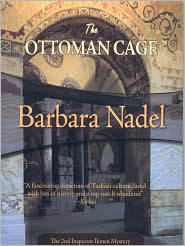
When The Ottoman Cage arrived, I was put off by the cover. “Who’s Likely to Like This?” the cover asked – it seemed like screaming to me – “Fans of Donna Leon and exotic, atmospheric locales”
Remember, I am in a dark time, taxes, turbulence, destabilization. . . I am easily disgruntled when I am vulnerable like this. I don’t want to think I am so predictable. I love reading Donna Leon! So I am predisposed (grumble grumble grumble) NOT to like Barbara Nadel.
I fail miserably. The first five pages I am resisting. By the sixth page, I am ready to stay up all night to read this book (I don’t really, but I did finding myself making more time to read so I could find out what happens next.)
It is like the Donna Leon series in that while the plot is original and interesting, the real focus is on the police inspector, his crew, the relationships with friends and characters, the bureaucracy, and the way systems and institutions function in modern day Turkey.
One particular relationship was of great interest to me, that of Suleyman, who dutifully married his first cousin. They both tried very hard to make it work, but when we meet him, we discover that the marriage has become a painfully dry and desolate place, where each lead their individual lives, with very little of the relationship together.
Another character is detective Cohen, a rare Jew in the police force described as follows:
When one has been known and admired as a prolific womanizer for most of one’s adult life, any change in that situation can come rather hard. Although Cohen had been married since the age of nineteen, he had never let that fact or indeed his rather short stature and dishevelled apearance hold him back from the most ardent pursuit of other women. Jokey charm, of which he possessed copious amounts, had always seen him through. The knowledge that women love a man who can make them laugh had successfully taken him to many bedrooms and had, quite frequently, resulted in his being asked back again. Until this year.
Whether it was because now he was on the ‘wrong’ sied of forty five or just a patch of ill fortune, Cohen didn’t know but the fact was beyond dispute. Women, it seemed, didn’t want him any more. The rbuffs and even in one notable case the cruel sound of mocking laughter were hideously painful for him to bear. Even his long-suffering wife, who had for so many years pleaded with him to leave other women alone and attend to her, had lost interest. He’d tried to find a little comfort in her arms the previous night when he found that he couldn’t sleep, but she, like all the lithe little girls that he still so desired, had just sent him on his way, back to his customary couch, flinging her curses in his unfaithful wake.
It was, Cohen would have been the first to admit, his own fault. Had he bothered to try and be faithful to Estelle he would now, in his middle years, have both a friend and a over with whom he could take comfort as the lines overwhelmed his face and the loose skin around his middle began to sag. His wife was, after all, ageing like himself and, unlike the pretty little tarts he hankered after, unable to point mocking fingers at his inadequacies.
The plot hinges on a dead boy, a beautiful boy, found dead, alone, on a bed in an empty, tasteful but unlived in home. Who is he? Why is he here? Why is he dead?
We meet the gossipy neighbors, we meet the Armenian community, we meet some of the lowest characters you would ever hope to meet, the kind the police deal with every single day. Nothing is simple, one single clue leads slowly, painfully to another. I give credit to Nadel; she relies on good honest police work, chasing down the clues, going through the stacks of old files, interviewing unsavory lowlifes; the things good police really do to solve their cases.
More than the plot, I loved the rich and intricate textures of this mystery novel, I loved the descriptions of the interiors and the interior lives of the characters. Nadel has that in common with the other writers I read serially – Leon, Pattison, Qiu Xiaolon, James Burke and Peter Bowen. It is another rich entry into the genre of the “mystery novel set in exotic, atmospheric locations.”
Definitely worth a read!
Icons Challenge, The Locard Principle 2: The Middle East and Me
The best thing, the very best thing about blogging, for me, is what I learn from my commenters. The old Locard’s Exchange Principle is a constant in life – with every interaction, a part of you rubs off on me, and a part of me rubs off on you. It’s why we’re careful about the people, books, movies, blogs and ideas we spend time with. . . we either feel better for hanging around them, or slightly uncomfortable. Sometimes, hugely uncomfortable. The internet is a microcosm, good and evil all mixed in together and we make our choices.

Fragonard: The Reader
Above: that is me. That’s pretty much who I am. I am quiet, I am a reader. I still get input, from newspapers, books, e-mails, the internet, friends, groups, etc.
What I love about blogging is that I throw something out, and you throw something back. Many many times, what I get back is unexpected, and forces me to re-examine my assumptions. Many times, I have to force myself to stop. Not to respond. I have to force myself to let the new information, new point-of-view sink in, percolate, settle. Minds don’t change in an instant, but . . . they do change. New information brings new, often surprising, perspectives. When I find myself getting angry, I have to step back and ask myself “what is going on here? What are you reacting to?” It helps me to know myself better, and it helps me to understand whatever-little-corner-of-the-world-I-am-living-in better, too.
There are about six different blog entries radiating out like a spider’s web from the thoughts I am now thinking, fed by your input and comments, and behind the scenes e-mails back and forth with new thoughts.
So here is my challenge for today. I’ve shown you one of my life icons, this Fragonard paining, The Reader.
Your mission, your challenge – identify / find a piece of art that shows us who you are. Post it on your blog and link here with a comment, or send it to me, and I will publish it.
(No graphic violence or pornography; I won’t publish it and I will break the link if you publish it on your blog and link to me.)
Another Martyr For Olde Ireland
Thanks be to God, the brutal, ceaseless battles in Ireland have ended and peace prevails. So many innocent were lost – and for what? The recent bombing is thought to be a hiccup left over from those desperate, sad days. We can only hope that is true, and that peace can also break out in places like Gaza, like Dharfur, where entire peoples are oppressed and dealt with brutally by those in power.
For blogger Mathai; one of the songs the Irish sing in the pubs on St. Patrick’s day – and others. Whenever the beer is flowing, you’ll hear Kevin Barry. They know all the words.
This is the version I used to hear; the one above has slightly different words.
In Mountjoy jail one Monday morning
High upon the gallows tree,
Kevin Barry gave his young life
For the cause of liberty.
But a lad of eighteen summers,
Still there’s no one can deny,
As he walked to death that morning,
He proudly held his head on high.
2. Just before he faced the hangman,
In his dreary prison cell,
The Black and Tans tortured Barry,
Just because he wouldn’t tell.
The names of his brave comrades,
And other things they wished to know.
“Turn informer and we’ll free you”
Kevin Barry answered, “no”.
3. “Shoot me like a soldier.
Do not hang me like a dog,
For I fought to free old Ireland
On that still September morn.
“All around the little bakery
Where we fought them hand to hand,
Shoot me like a brave soldier,
For I fought for Ireland.”
4. “Kevin Barry, do not leave us,
On the scaffold you must die!”
Cried his broken-hearted mother
As she bade her son good-bye.
Kevin turned to her in silence
Saying, “Mother, do not weep,
For it’s all for dear old Ireland
And it’s all for freedom’s sake.”
5. Calmly standing to attention
While he bade his last farewell
To his broken hearted mother
Whose grief no one can tell.
For the cause he proudly cherished
This sad parting had to be
Then to death walked softly smiling
That old Ireland might be free.
6. Another martyr for old Ireland;
Another murder for the crown,
Whose brutal laws to crush the Irish,
Could not keep their spirit down.
Lads like Barry are no cowards.
From the foe they will not fly.
Lads like Barry will free Ireland,
For her sake they’ll live and die.
MP Al-Muhaibi Condemns Male Teaching Female Students
From today’s <a href=”“>Al Watan
MP Jaber AlـMuhailbi condemns school incident
Staff Writer
KUWAIT: MP Jaber AlـMuhailbi has denounced the fact that grade 12 girls at AlـSabahiya High School are being taught by a foreign, male teacher. According to him, “the incident reveals a great amount of recklessness on the part of the Ministry of Education,” which he says disregards the traditions and values of Kuwaiti society.
AlـMuhailbi expressed his apprehension that there might be forces planning to replace the conservative educational system in the country with a system that openly encouraged ”mixed” schools for boys and girls.
He held Minister of Education Nouriya AlـSubaih solely responsible for the incident, said that it proved she was incompetent to shoulder her responsibilities as a minister.
He finally announced that he would put forward a number of questions concerning the aforementioned incident to the minister, and would inquire as to whether this was an occurrence seen in other schools, and asserted that there were plenty of female teachers capable of teaching female students in Kuwait.
He expressed his displeasure about the presence of a male teacher in a girls” school, calling it “unacceptable.”
Last updated on Tuesday 17/3/2009
12th grade? Isn’t that like the year girls graduate and go on to university classes (God willing/insh’allah) where they will be taught, as likely as not, by male professors?
Do these girls go to restaurants with male waiters?
Do they shop in stores with male cashiers? Male customer service agents? Male managers?
Learning self-control is like any other skill; it requires practice. You practice by confronting the realities of the situation. Society – in and out of Kuwait – is mixed. We sit next to each other on airplanes, we are seated next to one another in restaurants, our paths cross, daily. Kuwaiti girls are well brought up and can control themselves; they also have skills at turning aside the unwanted attention of the rare teacher who might overstep.
Mr. MP, we must be suspicious of those who see sexual issues lurking in every corner; what is in the heart of a man who sees sex everywhere? Give these girls a little credit. They are after an education, not some male teacher.
In Xanadu: A Quest by William Dalrymple
This book was on my (huge) “Read Me” stack, and I picked it up for a change of pace. As I started reading, I wondered “how did this get there?” My first instinct was it was a recommendation from Little Diamond. As I was reading, however, I came across a segment that was what our priest had read in church around the Feast of the Epiphany about the birthplace of the wise men who came seeking the Christ Child after his birth. I wrote down the title and ordered it from amazon.com (which has some copies used from 72 cents).

William Dalrymple wrote this book when he was a mere 22 years old. He and a travelling companion took off to trace Marco Polo’s journey from Jerusalem to Xanadu, where he was taking oil from the sanctuary lamp to Kubla Khan.
In a world where we have all been taught to be so careful, they take incredible risks. They travel on the cheap – staying in fleabag hotels, sometimes sleeping “rough”, i.e. out in the open. They travel any way they can – an occasional train, but more often a truck, a bus, whatever is going their way. One very long segment they travelled on top of a pile of coal.
They travel from Jerusalem up through Syria and into Turkey, then turn east and cross Iran, Pakistan and Afghanistan to China. They have some amazing adventures, see some astounding scenery and because of their mode of travel, have a lot of time to talk with their travelling companions or people in the cities where they are staying.
I am blown away that an unmarried couple would cross Iran, Pakistan and Afghanistan. I guess they told people they were married to share a room (they were on a budget) and they were only friends, not a couple, but what a risk. I am astonished that they were never asked to produce a marriage license or any proof of marriage when they stayed in hotels. I am astonished at the girls (one left in Lahore and another joined him, but these are girls who are friends, not anything more) would travel on the backs of trucks full of men, and never blink an eye.
The book is occasionally hilarious. Most of the hilarity results from foods they have to eat – sometimes it is the only food available – or from misunderstandings because of lack of a common language, or due to their frequent bouts of diarrhea, what I really liked about the author was that he was rarely pompous, and when he is funny, it is usually about some conversation he has had, or some mistake he has made.
One of my favorite parts of the book happens in Iran:
As we sat waiting for the bus to Tabriz, the next town on Marco Polo’s itinerary, we watched the mullahs speeding past in their sporty Renault 5s. Iran was proving far more complex than we had expected. A religious revolution in the twentieth century was a unique occurence, resulting in the first theocracy since the fall of the Dalai Lama in Tibet. Yet this revolution took place not in a poor banana republic, but in the richest and most sophisticated country in Asia. A group of clerics was trying to graft a mediaeval system of government and a pre-medieval way of thinking upon a country with a prosperous modern economy and a large and highly educated middle class. The posters in the bus station seemed to embody these contradictions. A frieze over the back wall of the shelter spoke out, in the name of Allah, against littering. On another wall two monumental pictures of the Ayatollah were capped with the inscriptions in both Persian and English:
BEING HYGENIC IS DIRECTLY RELATED ON THE MAN’S PERSONALITY
and:
ALLAH COMMANDS THE RE-USE OF RENEWABLE RESOURCES.
We had expected anything of the Ayatollah. But hardly that he would turn out to be an enthusiastic ecologist.
The challenge of this journey is to follow as closely as possible the path Marco Polo took, but two segments of the journey go through off-limits areas. They find a way into one, to discover later it is an atomic testing area, and the second, at the very end, around Xanadu, they find receptive Chinese officers who take them to have a brief glimpse of the ruins of Xanadu while booting them out of the area. As they stand in Xanadu, they repeat a poem that every American child grows up with in English Literature:
In Zanadu did Kubla Khan
A stately pleasure-dome decree:
Where Alph, the sacred river, ran
Through caverns measureless to man
Down to a sunless sea.
So twice five miles of gertile ground
With walls and twoers were girdled round:
And there were gardens bright with sinuous rills.
Where blossom’d many an incense-bearing tree:
And here were forests ancient as the hills,
Enfolding sunny spots of greenery.
(Coleridge)
I liked this book. Dalrymple is a history major, and often quotes from historical – even obscure – texts to illuminate what he observes. I think I may look at a couple more he has written since.
Recent Comments
Kitchen on Isiais: Winding Down intlxpatr on Shampoo Ginger tigerbutterya0c5ff1d… on Shampoo Ginger intlxpatr on British Soldier Kidnapped, Esc… John on British Soldier Kidnapped, Esc… Wikipedia Donate Button

Amazina


Early Voting in Florida


