Qurain Fest – Information Where?
Here is what bugs me. There is this perfectly wonderful festival going on. I only know because the newspapers print photos and stories – after each event. I cannot figure out WHERE the event is taking place, WHAT TIME an event will take place . . . these are perfect opportunities to go and learn something, to experience the culture, and we have no idea – in advance – where to go, how to find these things.
I would love to see this dancing!
So, if it is cultural, music and dancing are allowed? 🙂 Is it always just men dancing, or do women dance, too?
Isn’t this camel racing season? When are the camels raced? Where?
From Al Watan
Kuwaiti folk dancing troupe entertains audience
KUWAIT: As part of the Qurain Cultural Festival”s festivities, the Red Palace group, a folk dancing troupe, performed in Jahra on Sunday.
The performance, which was attended by Deputy Director of the festival Mohammed AlـAsousi, lasted for two hours. The dancers presented a wide spectrum of national and patriotic themes much to the enjoyment of the audience.
Head of the folklore group, Nasser Suleiman AlـFaraj explained that their participation in the event came as a result of the group”s strong belief in reviving an old heritage and folklore. He stressed that the past would always be relevant in the present.
Last updated on Tuesday 30/12/2008
Slaughter of the Innocents

In our Lectionary readings for today we pray for the Innocents, slaughtered by King Herod, in the land that is now Israel.
PRAYER (traditional language)
We remember this day, O God, the slaughter of the holy innocents of Bethlehem by the order of King Herod. Receive, we beseech thee, into the arms of thy mercy all innocent victims; and by thy great might frustrate the designs of evil tyrants and establish thy rule of justice, love, and peace; through Jesus Christ our Lord, who liveth and reigneth with thee and the Holy Spirit, one God, for ever and ever.
There is nothing so maddening as to be helpless to intervene in the huge crush of political events among nations. On the other hand, we have been given this very powerful weapon – prayer – and the knowledge that God can do anything, and that he listens to our prayers, especially prayers for the weak, the helpless, women and children.
We can also raise our voices where it counts – to our governments – to say “this is wrong” and “this must be stopped.”
This is wrong. This must be stopped.
It is neither good nor right for bullies to impose their will on those with less power, just because they can. (That applies also to my own country.) It is not good for the victims – but it is also not good for the health of the bully! Countries where minority rights are not considered find themselves weakened from internal disorders, like a body eaten with cancer. If minorities can be likened to bacteria – a little bacterial makes us healthier and stronger. Tolerance of diversity makes us as nations healthier and stronger.
Don’t you wonder what might be accomplished if the Palestinians and Israelis could find some way to live together in peace?
Vigilante Volunteers
“Helping out the Ministry of Interior”
From today’s Kuwait Times
Kuwaiti activist establishes voluntary religious police
Published Date: December 27, 2008
KUWAIT: Islamist activist Mubarak Al-Bathali announced that he has established a voluntary Kuwaiti Committee for the Promotion of Virtue and the Prevention of Vice, like the Saudi Mutaween or religious police.
Al-Bathali said the Kuwait committee would begin its religious tasks in the Sulaibikhat area before spreading to other areas of the country. He explained that he was inspired to adopt the idea after a number of devout young people complained to him about seeing inappropriate and immoral behavior in Kuwait’s streets.
He emphasized that the committee members would focus only on advising people to avoid irreligious and immoral behavior and would never implement harsh or violent treatment on anyone.
Among the types of treatment which Al-Bathali protested against was the alleged drinking of alcohol, banned in Kuwait, at Christmas parties in the country. He reiterated that those who wished to drink alcohol should go outside Kuwait to do so.
Al-Bathali emphasized that the committee’s work would not conflict with the Ministry of Interior’s, saying that on the contrary it would help the MoI to uphold public morality and values.
From today’s Arab Times:
WE DON’T WANT YOUR HELP GUARDING PUBLIC MORALITY! responds MOI
Interior Ministry hits out at new ‘guardians of freedom’
KUWAIT, Dec 26, (KUNA): “Kuwait is an institutional state governed by law”, a statement by the Ministry of Interior said on Friday. The statement came in response to a press statement published on the front page of a local daily earlier today. The press statement talked about a group that allocated itself as “guardian” of people’s personal freedoms guaranteed by law, the ministry statement noted. The statement stressed that the ministry was the only directorate tasked with implementing and preserving the law in the country through imposing security and order, as well as safeguarding public morals. “The Kuwaiti society is a conservative, Arab and Muslim one that maintains refined morals and abides by its customs and traditions,” it pointed out.
“The ministry will counter such ‘radical’ calls with firmness,” the statement said, adding that the ministry would not allow anyone, whether individuals or groups, to interfere in the public’s personal freedoms, describing the calls as a “loud” infringement of the law as it also defied the state’s constitutional institutions. The statement concluded by saying that the ministry would take needed legal and security procedures to counter these calls and maintain the nation’s safety under the leadership of His Highness the Amir Sheikh Sabah Al-Ahmad Al-Jaber Al-Sabah.
Meanwhile, the Citizenship and Passport Affairs Department at the Ministry of Interior has announced that citizenship will not be granted to Kuwaiti children born abroad, if they hold any other nationality, reports Al-Rai daily. The department said since Kuwait doesn’t accept dual citizenship, children born abroad, especially in western countries where citizenship is given on birth, will not be granted Kuwaiti citizenship if they accept another country’s citizenship. It applies even on children of diplomats and “the department will not grant citizenship to such children unless they give up their previous citizenship.”
It is easy to discover nationality from birth certificates, say sources. In another development, Iraqi authorities have extended invitation to Kuwait officials to visit Baghdad to locate the whereabouts of their compatriots captured during the August 1990 Iraqi invasion, reports Arrouaih daily quoting reliable Kuwaiti Foreign Ministry sources as saying. Sources added the step demonstrates the serious determination of Iraqis to see to an amicable resolution of the issues and to put to end the lingering suffering of many families who lost their loved ones during the war.
PS. I don’t want your help, either, morality volunteers, guarding my morality. My morality is between me and God. I obey the laws of the country I live in – the laws of the country, not your idea of what the laws should be. “Volunteers” guarding morality are vigilantes, pure and simple.
“Generation of Spoiled Idiots”
I have a dear friend who sends me the most amazing things. This started my day with a howl of laughter:
I am embarrassed to tell you – I remember rotary phones. I even remember party lines, where you had to wait for your neighbor to finish his call before you could make your own, and you never knew who might be listening to your conversation. I remember planes that had large, beautiful lady’s lounges, with a seating area for nursing mothers. I remember when living in Germany was a huge problem to many young people who ran up huge phone bills, calling their families when they were lonely – no internet, no VOIP. I remember transistor radios, and Walkmen! LLLOOOLLLL!
Christmas Ornaments from Here, There and Everywhere
Ten years ago when we put almost our entire life into storage, we had no idea we would be gone this long. We had no idea we would live in four different countries, and that we wouldn’t see our things again for lo, these many years.
Our first contract, I was allowed one thousand pounds. Do you know how little one thousand pounds is? Think clothing, think basic necessities – 1000 lbs. just isn’t very much.
I packed just a very few Christmas ornaments, figuring I could pick things up along the way. Fortunately for us, the next country, after Saudi Arabia, was Germany, the land of Christmas ornaments. Our tree is eclectic. It’s not necessarily a tree with appeal to anyone else; it is a very personal Christmas tree, with lots of memories and stories. Lucky for you, I won’t bore you will all of them. 😉
We are sentimental. When we can, we decorate the tree together, and we remember with each ornament. . . When he was young, our son would get so impatient with us, and our remembering!
Here is the very first ornament our son ever made in school – it is a dreamcatcher; his teacher was very into the American Southwest and American Indian traditions:

We met and married in Heidelberg, so we always have that ornament with us:

My ties to the Pacific Northwest:


AdventureMan’s love of Africa and the Middle East:


Religious symbols:




Beautiful German antique silver walnuts and pinecones:


And memories of places we’ll remember . . .





Whew! I’m tired, too! Think I will go join the Qatteri Cat in a catnap!
The Apple Store Christmas
Just before leaving, we make one last stop at the Apple store; AdventureMan needs a tune-up. All the Apple employees have on shirts with Christmas related sayings, very clever, wish I could remember a few to share with you.
In an instant, AdventureMan has an appointment, and with another instant, the glitch is fixed and we are on our way.
Love their display windows:


The other stores at the mall may look a little ghost-town-y, but not the Apple store (although this is NOT busy for the Apple store):

The air is crisp, to say the least, and no relief is in sight. Guess it’s time to get on back to Kuwait, where the temperatures are above zero F. 🙂
An Eye for an Eye in Iran – Penalty for Acid Disfigurement?
I found this today in the Washington Post
Woman Blinded by Spurned Man Invokes Islamic Retribution
By Thomas Erdbrink
Washington Post Foreign Service
Sunday, December 14, 2008; Page A01
TEHRAN — Ameneh Bahrami once enjoyed photography and mountain vistas. Her work for a medical equipment company gave her financial independence. Several men had asked for her hand in marriage, but the hazel-eyed electrical technician had refused them all. “I wanted to get married, but only to the man I really loved,” she said.
Four years ago, a spurned suitor poured a bucket of sulfuric acid over her head, leaving her blind and disfigured.
Late last month, an Iranian court ordered that five drops of the same chemical be placed in each of her attacker’s eyes, acceding to Bahrami’s demand that he be punished according to a principle in Islamic jurisprudence that allows a victim to seek retribution for a crime. The sentence has not yet been carried out.
You can read the rest of the article Here.

You may think you know how I feel about this. The man stole from this woman. He violated her very life. He stole her ability to see, her ability to support herself, he disfigured her for life and stole the likelihood of the love match she was holding out for. He treated her like property – if he can’t have her, then he will have revenge.
She fought – and won – for him to be blinded with the same acid she has been blinded with. She doesn’t ask that he be disfigured, only blinded. The court in Iran agreed. The sentence has not yet been carried out.
I’m interested in what YOU think. I feel sympathy for the woman, Ahmena Bahrami. I love the way she went after her attacker in the courts. I love it that she didn’t just collapse and be a victim.
On the other hand, I wish she had gone after something different. The thought of purposely blinding someone is SO repugnant to me, I can’t support it. I wish she had gone after his money, forcing him to support her at the level she was earning, for the rest of her life – and his. I find myself thinking – what good does it do to blind him?
He committed a heinous act. Hideous, unthinkable. And yet I find the punishment equally hideous, and unthinkable. I worry that in the future, she will regret having enforced this upon her assailant. I think that revenge, getting revenge, can extract it’s own price from our character. Do you think she will feel better? Do you think she will be happier knowing he was blinded in retrubution? I kinda sorta doubt it.
What do you think?
Joe Patti’s and Joey Patti’s in Pensacola
My son’s wife looked at me thoughtfully, and said “Has anyone ever told you about Joey Patti’s?”
“I’ve seen his ads,” I replied.
“Pensacola people say his seafood is the BEST,” she says. “I’ve eaten there once, and I thought it was pretty good. You might want to give it a try.”
I understand what she means. She knows that wherever I go, I like to look behind the curtains, to know where the locals go, what they talk about, how they think. I like to know what makes peoples tick. We are all more alike than we are different, but the differences are so interesting.
Joe Patti runs his own fishing fleet. He processes and sells some of the freshest seafood in the Gulf. He is a big feature on the Pensacola waterfront, and nearby is Joey Patti’s restaurant. We saw lots of happy seagulls and pelicans around the boats and seafood plant, and the parking lot at the restaurant was totally full.


We followed the signs for Joey Patti’s, connected – we don’t know exactly how – one is a seafood seller, one is a restaurant. We were given the very last available booth in the very large restaurant, which was totally bustling with customers – all of Pensacola seemed to be eating lunch there the same day we were there. We soon learned why – the food was simple Southern seafood at its best – fresh, hot and oh, so good.

Clam chowder

Crab Cake Sandwich

Oyster Po'Boy Sandwich

Hush Puppies (actually, there were more, but we couldn't wait)
If you get to Pensacola, look down on the waterfront for Joey Patti’s. You’ll be in for a treat.
Southern Thanksgiving Photos
First, apologies – No matter how many photos I take, you can’t begin to imagine the scope of this event. Three sisters, out of a family of ten brothers and sisters, gather the clan and provide a truly old fashioned Southern Thanksgiving on a large country estate. While the photos are mostly of food, the most important element of the gathering is the love that brings and binds this family together.


The weather was magnificent, allowing people to be inside and out, the kids out playing chase, football, exploring the grounds, sitting on the old swing, etc. Out in the way-back, men started shucking oysters for the pre-meal appetizers around 9 in the morning.

While the three sisters are pulling together all the last minute details, there is already an abundance of food to keep people nibbling while anticipating the main meal, served around 1:00 in the afternoon.

As people arrive, they bring more food – mashed potatoes, sweet potato casseroles, green beans, turnip greens, collard greens, creamed corn, creamed onions, all in slow cookers to keep them warm until dinner-time.


Meanwhile, things are heating up in the command center (kitchen) as time nears to get the food on the groaning tables:
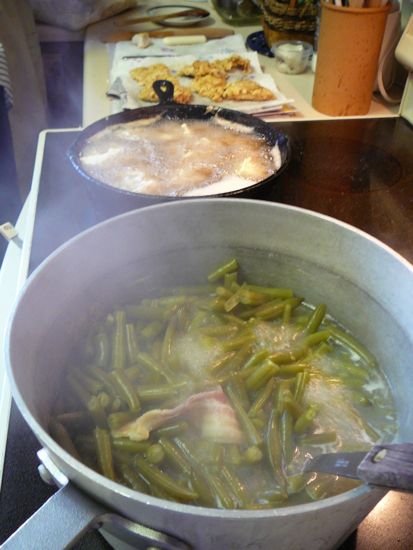
Frying up turkey breast meat:

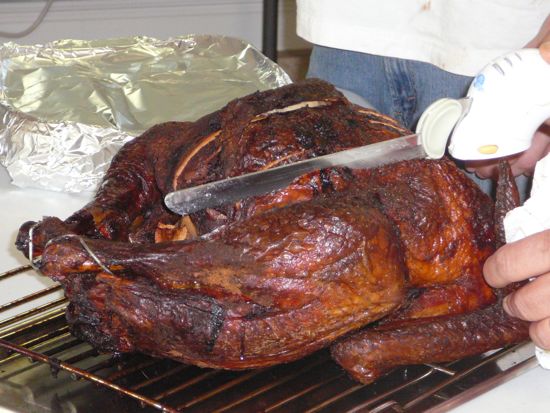
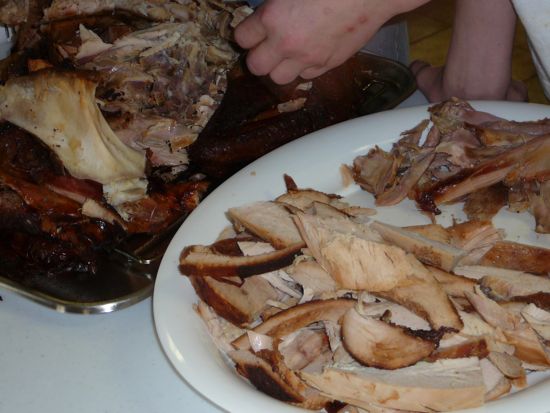
Usually, the men carve the turkeys – this year, a smoked turkey and a deep fried turkey:
Getting close to dinner time, people start gathering closer to the house:

Just before the dinner is served, the organizers thank the guests for coming and the food is blessed. Now here is where I really need to apologize – there are no dessert photos, and the desserts were magnificent. But once you have filled your place with turkey, dressing, vegetables, salads – and you have to take a little bit of everything so you don’t hurt anyone’s feelings – then you need to sit a while before you think about dessert. Actually, I didn’t even have any room for dessert! So I missed out on taking dessert photos, and for that, I totally apologize.
Then, about an hour after dessert, the family photos are taken. First, all the surviving and attending brothers and sisters, then each family, with various children and their families attending. This tradition is a lot of fun, but takes another hour or so. At the very end, we take photos of the three sisters who spend weeks and hours organizing the annual event, coordinating all the food, cooking for days and cleaning up afterwards. These women are my heroes – it is an unbelievable amount of work, and they do it out of love for their family:

Internal Revenue Service Scam
This was in my mailbox this morning:
After the last annual calculations of your fiscal activity
we have determined that you are eligible to receive
a tax refund under section 501(c) (3) of the
Internal Revenue Code. Tax refund value is $189.60.
Please submit the tax refund request and allow us 6-9 days
in order to IWP the data received.
If u don’t receive your refund within 9 business
days from the original IRS mailing date shown,
you can start a refund trace online.
If you distribute funds to other organization, your records must show wether
they are exempt under section 497 (c) (15). In cases where the recipient org.
is not exempt under section 497 (c) (15), you must have evidence the funds will
be used for section 497 (c) (15) purposes.
If you distribute fund to individuals, you should keep case histories showing
the recipient’s name and address; the purpose of the award; the maner of
section; and the realtionship of the recipient to any of your officers, directors,
trustees, members, or major contributors.
To access the form for your tax refund, please click here
This notification has been sent by the Internal Revenue Service,
a bureau of the Department of the Treasury.
Sincerely Yours,
John Stewart
Director, Exempt. Organization
Rulings and Agreements Letter
Internal Revenue Service
The IRS uses “u” for “you?”
An IRS e-mail signed by a real person?
Hahahahahahahahahahahahahahahahahahahahahahahahaha!
Just another scam.
Recent Comments
Kitchen on Isiais: Winding Down intlxpatr on Shampoo Ginger tigerbutterya0c5ff1d… on Shampoo Ginger intlxpatr on British Soldier Kidnapped, Esc… John on British Soldier Kidnapped, Esc… Wikipedia Donate Button

Amazina


Early Voting in Florida


