SOUTH; A South-of-the-Border, But Not Mexican restaurant in Pace/Milton
There is a new restaurant in Pace/Milton, there only a few months, and the flavors are south-of-the-border, without being Mexican. The owner is American, married to a Colombian woman, and she and her mother do the prepping and all the cooking, every day, and it is all fresh, fresh, fresh.
The tastes are fresh, too. Lots of vegetables, and fresh presentation.
The front of the menu:
This is what it looks like from the outside. It is in a small strip mall, just off highway 90:

This is what it looks like on the inside – very very clean and well kept:

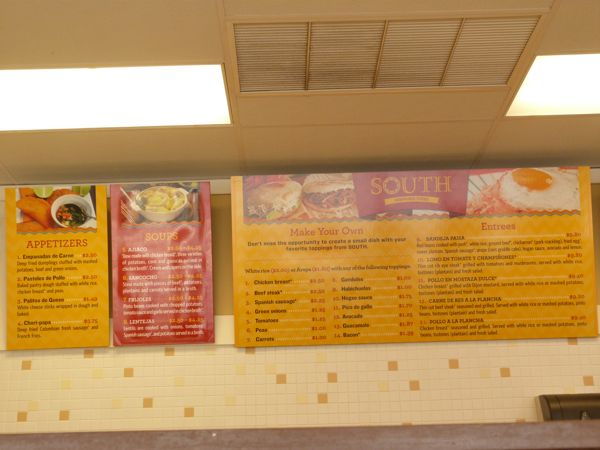
They understand some of the food is a little strange for us, so they have explanations and photos on the walls:

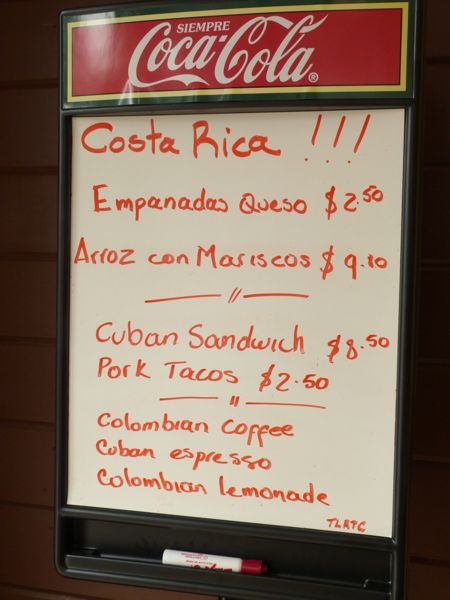
I particularly love the designation for the ladies’ room 🙂

Now for the downside. AdventureMan and I each had different soups, both very different from one another and both delicious. Mine was more stewish, and his was more light. Then we split a main meal; it had like eight different items on the plate (we were so glad we decided to share!), things like roasted plantain and other veggies, pork, beer and rice. The downside is that we were so busy exclaiming and sampling that . . . I forgot to photograph the food. What was I thinking????? If you want to see some of the wonderful foods for yourself, check out their FaceBook page.
SOUTH
4865 HWY 90
Pace, Florida
(850) 910-4330
ISIS War Against Women
I was told – by Saudi women, Qatari women and Palestinian women of faith, that Allah wants women to be educated. The first wife of Muhammed was a businesswoman and a prominent leader in her time. Perhaps the ISIS extremists need to spend a little more time reading the Qu’ran and hadith.
From today’s AOL News/ Huffpost
BAGHDAD (AP) — Militants with the Islamic State group tortured and then publicly killed a human rights lawyer in the Iraqi city of Mosul after their self-proclaimed religious court ruled that she had abandoned Islam, the U.N. mission in Iraq said Thursday.
Gunmen with the group’s newly declared police force seized Samira Salih al-Nuaimi last week in a northeastern district of the Mosul while she was home with her husband and three children, two people with direct knowledge of the incident told The Associated Press on Thursday. Al-Nuaimi was taken to a secret location. After about five days, the family was called by the morgue to retrieve her corpse, which bore signs of torture, the two people said, speaking on condition of anonymity because of fears for their safety.
According to the United Nations Assistance Mission in Iraq, her arrest was allegedly connected to Facebook messages she posted that were critical of the militants’ destruction of religious sites in Mosul. A statement by the U.N. on Thursday added that al-Nuaimi was tried in a so-called “Sharia court” for apostasy, after which she was tortured for five days before the militants sentenced her to “public execution.” Her Facebook page appears to have been removed since her death.
“By torturing and executing a female human rights’ lawyer and activist, defending in particular the civil and human rights of her fellow citizens in Mosul, ISIL continues to attest to its infamous nature, combining hatred, nihilism and savagery, as well as its total disregard of human decency,” Nickolay Mladenov, the U.N. envoy to Iraq, said in a statement, referring to the group by an acronym. The statement did not say how she was killed.
Among Muslim hard-liners, apostasy is thought to be not just conversion from Islam to another faith, but also committing actions that they believe are so against the faith that one is considered to have abandoned Islam.
Mosul is the largest city held by the Islamic State group in the self-declared “caliphate” it has carved out, bridging northern and eastern Syria with northern Iraq. Since overrunning the once-diverse city in June, the group has forced religious minorities to convert to Islam, pay special taxes or die, causing tens of thousands to flee. The militants have enforced a strict dress code on women, going so far as to veil the faces of female mannequins in store fronts.
In August, the group destroyed a number of historic landmarks in the town, including several mosques and shrines, claiming they promote idolatry and depart from principles of Islam.
Al-Nuaimi’s death is the latest in a string of attacks by the militant group to silence female activists and politicians. In July in the nearby town of Sderat, militants broke into the house of a female candidate in the last provincial council elections, killed her and abducted her husband, the U.N. said. On the same day, another female politician was abducted from her home in eastern Mosul; she remains missing.
Hanaa Edwer, a prominent Iraqi human rights activist, said at least five female political activists have been killed in recent weeks by the Islamic State group in Mosul, including al-Nuaimi, who Edwer said was also running for a seat on the provincial council.
“But it is not just women being targeted,” Edwer said. “They will kill anyone with a voice. It is terrifying.”
The Gulf Center for Human Rights said Wednesday that al-Nuaimi had worked on detainee rights and poverty. The Bahrain-based rights organization said her death “is solely motivated by her peaceful and legitimate human rights work, in particular defending the civil and human rights of her fellow citizens in Mosul.”
The Islamic State extremists’ blitz eventually prompted the United State to launch airstrikes last month, to aid Kurdish forces and protect religious minorities in Iraq.
This week, the U.S. and five allied Arab states expanded the aerial campaign into Syria, where the militant group is battling President Bashar Assad’s forces as well as Western-backed rebels. Despite making gains in some of the country’s more isolated areas, where airstrikes have paved the way for successful ground operations by Kurdish and Iraqi forces, the cities of Mosul and Fallujah remain major strongholds of the group, which has buried itself among large civilian populations.
The militant group recently killed 40 Iraq soldiers and captured 68 near Fallujah and then paraded their captives through the city in a show of brawn.
Nearly a dozen countries have also provided weapons and training to Kurdish peshmerga fighters, who were strained after months of battling the jihadi group.
In other developments Thursday, German Defense Minister Ursula von der Leyen visited northern Iraq for talks with Kurdish leaders about the fight against Islamic State extremists and Berlin’s efforts to help with arms deliveries.
Thursday also marked the start of German arms deliveries to the semi-autonomous Kurdish region, with the ultimate goal of supplying 10,000 Kurdish fighters with some 70 million euros ($90 million) worth of equipment.
“We are involved with relief shipments and the airlift, but we know that this is not sufficient,” said von der Leyen. “Much more is needed to get these (millions of people) through the winter.”
___
Associated Press writer David Rising in Berlin and Bram Janssen in Irbil and an Associated Press reporter in Mosul contributed to this report.
1984, A Question of Irony, and a Brief Discussion of Privacy
From yesterday’s USA Today, a very brief article in the USA Round Up:
Alaska: Fairbanks
The number of security cameras in Alaska schools is going up. The Fairbanks Daily News-Mirror reported video cameras are being installed in Fairbanks middle and elementary schools and it’s part of a statewide trend aimed at making schools safer.
As I raised our son, I was – well, most of the time – an attentive parent. I would listen, and when necessary, I would correct. It’s a mother’s job to help her children navigate the pitfalls of life, and to have a tool-box full of resources with which to cope.
Perhaps I did my job too well. Our son became a lawyer, and he is very particular about the things I say, especially when I use a term incorrectly, such as irony.
Here is what Wikipedia says irony is:
event characterized by an incongruity, or contrast, between what the expectations of a situation are and what is really the case, with a third element, that defines that what is really the case is ironic because of the situation that led to it.
I am about to use the term “irony” correctly. 🙂

When I read the above article, I remembered the horror of Orwell’s 1984, the book, and then the movie. The movie was terrifying, the presence of cameras everywhere, hidden, not hidden, just knowing they were everywhere and everything you did could be monitored.
The irony comes in that here we are, with cameras everywhere, and we are glad for it. The irony is that our society has slipped so far from its ideal that we cannot trust our neighbor to behave him or herself, and we protect ourself by placing cameras so as to encourage people to behave.
I am not so sure that our moral codes have ever worked well; I think it seems to be the nature of humanity to claim a moral code, but not to adhere strictly to it. I think of people who talk about the safety of the ’50’s, but I don’t believe that safety was truly that safe. I think children disappeared. I think wives were beaten, women raped. I think robberies and assaults happened, and I think the law was more lax than it is today.
But it is an irony, IMHO, that we welcome cameras today as a low-cost policing of ourselves, our neighbors, and those we fear will hurt us or take our property. We trust ourselves and one another so little that we are increasingly installing cameras. We’ve been considering installing them through our home security company; we have motion detectors, cameras are just the next upgrade. Have we exchanged a high value on privacy for a heightened perceived need for protection of life and property?
“Pesto; The Quiche of the ’80’s”
It’s still hot, hitting the nineties, but something is changing. You can see it in the angle of the sunlight, especially at sun rise and sun set, the directions have changed, the angles have changed, and the colors are richer.
Time to harvest the basil. This is not my garden, nor my basket, nor my garden, but the resemblance is uncanny, and this is a great photo for illustrative purposes.


We grow a lot of basil, pots and pots of basil. After early church, I hit the pots with my garden shears. I trim off all the little flowers on top (I’ve been doing this all summer, but I never seem to keep on top of it) and then I trim back the branches, laden with basil. I have an entire basket full of Genovese, which, after picking off the leaves, washing them and spinning them dry, come to 12 cups of basil.
Doesn’t everything go better with a little pesto? I love to smear a little on my BLT’s, I love to pop a spoonful into a soup, and oh my holy tomato, basil pesto on pasta, to die for. I know what I want to do, but I want to be sure I get proportions right, so I go to The Silver Palate Cookbook, it came out years and years ago and has a lot of basic but really really good recipes. So, how old is this cookbook? When I was looking at the Pesto page, there was a box that said “Pesto – the quiche of the ’80’s” or something like that which implied pesto was the newest, most wonderful thing – in the ’80’s.
“????” I thought.
Isn’t pesto one of those classics? Maybe it’s because we frequented Italian restaurants when I was going to high school in Germany, but I remember pesto. It’s not like quiche (which, by the way, is my grandson’s favorite thing), it’s no passing trend, pesto is classico!
I made all the batches with garlic, lots of garlic, about triple what the recipe calls for, and I roasted it before I tossed it in. One batch I made with almonds, one batch with sunflower seeds and the last batch with my all time favorite, walnuts. I labeled little snack bags, put globs of pesto in them, sealed them up, put them all in one big gallon sized plastic bag and sealed that up and put the whole lot in the freezer, to pull on on those days when I need a pop of flavor and a taste of the long hot summer.
Here is my variation on the Silver Palate recipe:
Basil Genovese Pesto
4 cups basil, packed, washed, dried in salad spinner (or whatever) still fresh and green
8 – 12 cloves garlic, peeled, roasted
2/3 cup really good olive oil
some salt and some pepper. The best thing is coarsely ground salt and coarsely ground pepper that you’ve ground yourself.
about 1/2 cup nuts. Pine nuts are classic, as are walnuts, but pesto is one of those dishes with a lot of variation based on what God’s great earth hath provided. I don’t even measure the nuts, just eyeball it. I used walnuts, almonds, and sunflower seeds in separate batches.
In a nice large food processor, put in nuts, garlic, salt, pepper, oil and then pack in 4 cups of basil. Process until you have a gritty ball. You won’t be able to see any leaves, but you will be able to see specks of white. Spoon into freezer containers in usable amounts and freeze.
ISIS: Follow the Money
I wish I could say that I had written this, but no, this is an article by Howard Shatz, published in Politico and brought to my attention by Digg, who sends me remarkable items:

President Obama is laying out his strategy to counter the Islamic State, whose rampages across Iraq and Syria have riveted Americans’ attention on a zone of conflict that many had hoped to forget. Many are urging him to step up military action. But if Obama wants to defeat the jihadis, he will need more than airstrikes—he should follow the money.
For all that ideology, religious belief and perhaps a lust for violence and power might motivate those who fight for the Islamic State (known variously by the acronyms ISIS and ISIL), money is what keeps the group going. As with any state, ISIL has bills to pay and mouths to feed. Even for the world’s richest terrorist organization—which, by all available accounts, ISIL is—money doesn’t grow on trees, and nothing in the world comes for free.
So where does ISIL’s money come from? As part of my research at the RAND Corporation, since late 2006 I have been studying the finances, management and organization of the precursors to the Islamic State—Al Qaeda in Iraq and the Islamic State of Iraq—using their own documents, manuals and ledgers. More recently, Rand has teamed up with scholars from Princeton and Emory universities, as well as analysts from other organizations, to study more than 150 documents produced between 2005 and 2010. Although our work is still not yet done, we can draw a number of conclusions.
The most important thing for U.S. policymakers to remember is that ISIL now possesses the financial means to support a long-term fight—some $2 billion, according to a recent report in the Guardian, citing a British intelligence official. At the same time, ISIL’s preferred fundraising methods and many financial commitments create vulnerabilities. The organization was badly damaged by late 2009, thanks to a combination of coalition and Iraqi forces, as well as intervention by the Iraqi government, and it can be badly damaged again. But without the establishment of a widely accepted, legitimate political order in Iraq, ISIL cannot be eradicated—and will continue to seek out and mete out cash.
ISIL raises most of its money domestically in Iraq and Syria. Its income streams include oil smuggled to other countries in the region, extortion, taxes—especially on non-Muslim minorities—and other essentially criminal activities.
Oil is ISIL’s biggest source of revenue but also presents the biggest problem. ISIL controls about a dozen fields in Syria and Iraq, in addition to a number of refineries, including mobile refineries. Based on media accounts, RAND has estimated the total production capacity of these fields to be more than 150,000 barrels per day, although actual production is estimated to be much lower: The website Iraq Oil Report has reported that exports for the month of August at about 2.4 million barrels per day, for instance.
ISIL smuggles this oil out in tanker trucks—clearly visible from the sky should any drone pass overhead, so the smuggling is not particularly furtive. The group then sells the oil to whoever will buy it—reported in the media to be buyers in Syria, Turkey, the Kurdistan Region of Iraq and possibly in Iran and even Bashar Assad’s regime in Syria, among other countries. Sales take place at rates deeply discounted from world prices. But even so, revenues have been estimated in the media at $1 million, $2 million or even $3 million per day.
We have seen this before. From 2006 to 2009, ISIL’s predecessor, the Islamic State of Iraq, raised perhaps $2 billion through smuggled oil originating in the Baiji refinery in northern Iraq. This ended as a result of a concerted effort by U.S. and Iraqi forces to destroy the group and create the conditions in which the Iraqi government could exercise its law-and-order responsibilities, as well as vastly improved management at Baiji, owned by the Iraqi government.
So where does all of ISIL’s money go?
ISIL historically has paid its members (yes, it maintains payroll sheets) based on a flat monthly rate per person and then additional fixed amounts for each wife, child and dependent unmarried adult woman in the household. In Anbar, Iraq, the rate was $491 per year in 2005 and 2006, and then about $245 per year per dependent; the rate was similar in Mosul in 2007 and 2008. These payments to family are meant to continue if the ISIL member is captured or killed—a primitive form of life insurance. If enough members are captured and killed, however, these costs start to mount.
ISIL also pays rent for its members in some cases—payments that might be bonuses to high-performing members, although we cannot be sure—and medical expenses for some members and their families. In the past, the group has sometimes hired lawyers to help get captured members out of jail. And it runs safe-houses and has to buy equipment. Guidelines published by a predecessor of the group say that expense reimbursements should be filled out in triplicate and explain where each copy goes within the organization. We don’t know for sure whether ISIL today is making money or even breaking even, but at least in Anbar from 2005 to 2006, the money was being spent as fast as it came in.
As a cash-based organization, ISIL relies on couriers not only to deliver messages among its dispersed leadership but also to move money—follow the right courier and you get to the leadership. Because it deals only in cash, ISIL also needs to worry about the honesty of its members. We have seen instances of skimming for personal enrichment, as you might see in any cash-based criminal network.
As a state, albeit a twisted version of one, ISIL also has administrative expenses. It is responsible for making sure electricity and water flow and the roads stay repaired in the regions of Iraq it now controls—including parts of the Anbar, Ninewa Salah-al-Din, Kirkuk and Diyala governorates. Whether the group chooses to or is able to fulfill those responsibilities creates a vulnerability: A discontented population is unlikely to remain passive under ISIL’s leadership.
Even if ISIL is making $3 million per day—at the higher end of the various estimates out there—then it makes slightly more than $1 billion per year. Just to be conservative, in case ISIL is doing more business than we’re aware of, let’s double that to $2 billion per year. Although exact totals are difficult to find, in 2013, before ISIL’s advance, the Iraqi government spent far more than $2 billion per year running the governorates ISIL now controls, including salaries to civil servants, other costs of service provision and investment spending. That means ISIL likely isn’t keeping up the same level of service that the Iraqi government once did. True, ISIL need not maintain that level—it hardly rules with the consent of the governed. But it’s not only a problem that those under its rule can rebel, as happened in 2007 and 2008; with the exception of oil, the group’s continued revenue-raising also depends on there being enough money to skim and extort from the economy, and this requires some minimum level of services and economic activity.
There is little that outside forces can do to halt the extortion and skimming that take place within ISIL territory. Oil smuggling, though, can be disrupted, at least to an extent. Intelligence resources from the United States, Iraq and any other country that takes on ISIL should be focused on identifying middlemen and buyers for the smuggled fuel and using any means necessary to halt those purchases.
It would be counterproductive to destroy oil field infrastructure, since repairs would be expensive and legitimate governments will need those oil revenues when they reestablish control. But mobile refineries should be targeted, and roads and other pathways that tanker trucks use to transport oil to and from oil fields should be made impassable by military means. The refineries and roads can be easily repaired when the time comes, but for now, ISIL should find it very difficult to move oil from fields.
Stopping ISIL will of course require much more than disrupting its funding. It will have to be defeated militarily, and legitimate, trusted governments will have to be established in Iraq and Syria to defeat the group over time. There’s no simple path to achieving this, but as long as ISIL’s coffers remain full, the task will not get any easier.
Why Not Pensacola?
Big article in AOL news about Dan Gilbert going to Silicon Valley to pitch moving their offices to Detroit because it’s way cool.

Excuse me?
While I appreciate his loyalty to Detroit, the things he is pitching all apply to Pensacola – AND. And in Pensacola you don’t have harsh winters. And in Pensacola you are minutes from one of the most beautiful sugar-white sand beaches, uncrowded, in the world. And Pensacola is family oriented. And Pensacola has affordable housing. And Pensacola has a way-cool culture, with parades, symphony, ballet, opera, theatre and restaurants, and world class National Naval Aviation Museum. And people spend thousands of dollars to come visit Pensacola when they could be living the dream – in Pensacola.
Dan Gilbert is a powerful man – in Detroit. Now he wants to convince Silicon Valley to move to America’s Motor City where they’ll have wide open offices, inexpensive living, and access to amazing talent.
Gilbert, the chairman of Rock Ventures and the owner of Quicken Loans, owns 60 buildings in downtown Detroit that house 12,000 employees. He is also an active backer in startups and has been inviting small companies to come bloom in Detroit over the past half-decade.
Why should you move to Detroit?
“The perception doesn’t do it justice. You have a huge talent pool,” said Gilbert. “And the people are way cooler.”
Gilbert believes that the Midwest work ethic isn’t a myth. He said that, despite the rumors to the contrary, the city has an innovative city government and, thanks to his extensive purchases in Detroit, there is space to spare for new startups. He is also working hard to reduce blight around the city, ensuring that city doesn’t look like it does in the popular “desolation porn” that characterizes the city.
The result is a smaller, more compact city that allows smaller companies to gain a foothold in the tech economy.
The city is, arguably, entering a period of renaissance. Thanks to Quicken Loans and Gilbert’s work in the city, most of the blight has been converted to cheap office space. While it does still seem like a wasteland to the average graduate, we saw a city reborn when we visited in 2012 and things are improving immensely.
In short, he said, Detroit is all about opportunity.
“We have great bones,” said Gilbert.
Detroit has good bones? Pensacola has office space, room to grow, a population of workers that can be trained to fill high tech jobs, several colleges, a university, and low stress living. It’s such an easy sell.
The Real Housewives of Disney
And these are wonderful, such send-ups of the Real Housewives series, dying laughing! These are the talented comedians on Saturday Night Live:
If Disney Princes Were Real . . .
I just laughed myself silly! People are so funny and so creative, and you can see the dancers in the Aladin segment are puffing they worked so hard. This is a VERY witty group of people, and the Princes come off so creepy and pathetic!
Pensacola Drug Sweep Arrests 13 with Warrants for 20 More
Wooo HOOOO Pensacola, getting those dealers off the streets. It’s not like its permanent, but it’s a start. There is one funny thing you will spot in this write-up in the Pensacola News Journal, that the next to last man named had charges that include selling cocaine within 1000 feet of a place of worship.
If you’ve ever been to Pensacola, you will understand how hilarious that is. You can’t go 1,000 feet away from one house of worship and not be within 1,000 feet of the next. It’s just like the mosques in Qatar and Kuwait, if you are lost, you can’t call someone and when they ask where you are, you can’t say “I’m by the big mosque/church on the corner!” because there are mosques/churches on EVERY corner! Pensacola has churches everywhere! I just think that’s interesting, that it seems to be an additional charge on the sheets in Pensacola.
An approximate 4-month-long investigation targeting street-level drug dealers resulted in the arrests of 13 people for selling crack cocaine to undercover Pensacola Police officers Friday.
Warrants for selling cocaine also have been issued for an additional 20 people, said Sgt. Marvin Miller, who supervises the department’s Vice & Narcotics Unit. Miller said the investigation targeted areas notorious for narcotics sales.
All of the charges are third-degree felonies punishable by up to five years in prison. Additional prison time can be added for selling within 1,000 feet of a specified area such as convenience stores, schools, and places of worship, or if the person is a repeat offender.
Officers from various units within the Pensacola Police Department spent approximately 12 hours today making the arrests.
Arrested today and charged with sale of cocaine and conspiracy to sell cocaine were:
Alfred Peasant, 34, of 1300 block of North Sixth Avenue, Pensacola
Sharon Pickett, 49, of 100 block of North J Street, Pensacola.
David Jones, 24, of 3600 block of Swan Lane, Pensacola.
Demarko Weathers, 21, of 2000 block of West Chase Street, Pensacola.
Minnie Mae Sapp, 54, of 100 block of South N Street, Pensacola.
Terry Crenshaw, 28, of 1000 block of West Hillary Street, Pensacola.
Larry Dornall Knight, 52, of 3600 block of North Ninth Avenue, Pensacola.
Antoine Booker, 34, of 1100 block of West Hope Drive, Pensacola.
Also arrested today were:
Donte A. Brazile, 36, of 3000 block of Torres Avenue, Pensacola. Charged with sale of cocaine.
Dominique Blackwell, 19, of 600 block of North B Street, Pensacola. Charged with possession of cocaine with intent to sell within 1,000 feet of a place of worship.
Kernist Ferrell, 57, address unavailable; Robert Lee Watts, 23, address unavailable; and Michael Coleman, 33, of 600 block of North A Street, Pensacola.
All three, who are currently in jail, were charged with sale of cocaine.
The First Pensacola Dragon Boat Races
Dragon Boat races! What fun! Oh wait – what exactly is a dragon boat? What is a dragon boat race? This is the first time we have seen this done, benefiting the Gulf Coast Kid’s House, but what is it? Organized by the Northeast SERTOMA (Service to Mankind), there are so many people involved, racers, helpers, supporters, cheering squads, food providers, live music, DJ’s, dogs, children, now this is a Pensacola kind of day. 🙂
AdventureMan invited our grandson to spend the night, and after breakfast we headed over to Bayview Park, where the dragon boats were loading up with 20 rowers and one drummer/leader in each boat for the first heat of the race:




There was a drone flying over the races. I am guessing it was a local news drone, but I find drones creepy and intrusive. I think I would like crime-prevention drones, flying around neighborhoods looking for suspicious activity, but in general, drones creep me out.
I liked this team; they were called the Justice Dragons and were sponsored by a local law firm. Every team had distinctive T-shirts, but this team also had these colorful hats, which as the day goes on, they will seriously be thankful to have.

It is a GREAT day for a race. And for such a good cause!
Coming in for a finish – I don’t know who is having a better time, the rowers or the audience. Hoots and hollers and bells and whistles and yelling . . . . there is a huge crowd at Bayview, and it is barely 8 in the morning.
Three teams are really close as they near the finish line . . . 
and then THIS team, below, picks up the pace in a serious way and totally WHOOPS the other two teams, catching them by surprise.
By ten, it is getting steamy and we head home. There so many great teams and they are having such a great team. This is a really fun event, and they are having a lot of fun. How cool is that, having so much fun, meeting a lot of people and it’s all going towards a great cause?
Below is the big win 🙂
Recent Comments
ExpatAlien on What Country am I Living … intlxpatr on Yellowstone: Old Faithful to C… Michelle on Yellowstone: Old Faithful to C… Cathy on No Grown-Ups in Charge intlxpatr on Waiting for Snow Wikipedia Donate Button

Amazina


Early Voting in Florida


 Here There and Everywhere