The Clothes Dryer

I was talking to my Mom last night, asking her how her mother coped with having twins. She was trying to remember if her mother even had a washing machine, and thought not. She was only four, but she remembers a woman who came in and did ironing every day, and she thought maybe she also did all the laundry.
Imagine. Imagine doing diapers for twins by hand, in a wash tub with a wash board. It gives me shudders, but women worked harder in those days, life was physical. They also died a lot younger. Hmmm . . . having said that, my grandmother lived to 105.
Clothes dryers came much later. Even today, most women in the world hang their clothes to dry, some even lucky enough to have special racks or lines for that purpose, others hang them over shrubs and bushes and fences surrounding their homes.
Today’s meditation from Forward Day by Day caught my attention; in Germany the last time I lived there, I did without a dryer, hanging my clothes on racks, and I did just fine. I had the time, I had the space and it was just a different pace of life.
Mark 8:34. If any want to become my followers, let them deny themselves and take up their cross and follow me.
A few years ago, a young husband and wife started an intentional community in rural Ohio. They share the house with others committed to simple living, to daily prayer and worship, and to issues of justice, especially around hunger and care of the earth. The farm not only yields enough to feed the members of the house and volunteers, but also supplies thousands of pounds of food each year to the local pantries.
I was struck by one story about their common life. They decided to get rid of the clothes dryer. After all, it’s not a vital machine, they determined. They could use a clothesline and conserve energy and money. Hanging clothes to dry would be an exercise in patience, in slowing down, as well as in planning and coordinating the wash with others in the house.
This small sacrifice provides powerful insight into the faithful witness of this group of people. I don’t know if God wants me to give up my clothes dryer (please, God, I hope not). But I do believe God calls us to sacrifice, to make hard decisions, to give up important things, so that we can take up the cross and follow Jesus.
Swapnil Chaturvedi: Private Excretion
There really are everyday heros, if you have the eyes to see. This man is bringing dignity to the poor, who have no place to pee and poop privately. He left a fine job in the United States to start a campaign to provide private toilets for the countless poor in India who live without any toilets at all, and are forced to perform their daily functions in public.
Swapnil Chaturvedi’s life had all the trappings of the American dream — a college degree, prestigious engineer job, wife and daughter.
But when he returned home to India in 2007 after four years of living comfortably in the U.S., he was horrified by the country’s lack of basic sanitation, and decided to leave his cushy life behind to help, Mental Floss reported.
Fifty-three percent of Indian households defecate in the open, because they don’t have access to working toilets — a practice that leads to malnutrition, stunted growth, poor cognition, disease and other hampering conditions, according to the World Bank.
Even when there are toilets available, many locals decline to use them because they’re not vented properly. Women and girls often choose to defecate outside because the communal restrooms aren’t secure — leaving users vulnerable to getting harassed and attacked by onlookers.
“Men often gather around toilets and if we ignore them they try to touch and feel us,” Afsana, a young resident of Bawana, told CNN-IBN.
Women like Afsana are the reason that Chaturvedi has committed to his work.
“If somebody asked me why I started this business, there is only one reason: for women’s dignity,” Chaturvedi said in an interview about his company.
In 2011, he launched Samagra Sanitation –- a program based in Pune that works with existing communal restrooms and incentivizes locals to change their hygiene habits.
The company improves ventilation, accessibility and cleanliness in communal bathrooms. It also turns locations into community centers that offer rewards program for users, among other perks, to inspire people to take advantage of the facility, according to the company’s website.
Samagra, which is a Gates Foundation grantee, dubbed its program the “LooRewards Model.” It has already gotten involved in three slums in Pune, providing services to more than 3,300 people daily.
But Chaturvedi says he’s just getting started. He wants to see his program expand to help more than 50,000 people daily, which is why he launched an IndieGoGo campaign in the hopes of raising $50,000 to achieve his goal.
“We can live without Facebook, we can live without smartphones,” he said. “But we cannot live without relieving ourselves.”
Happy Heidelberg
My high school stomping grounds; this video makes my heart flutter seeing all those wonderful sights with wonderful memories:
The Creole Nature Trail

In the next to the last episode of True Detective, at the very beginning of the episode, you see this sign, old and beaten, alongside a narrow country road.
And here is one reason AdventureMan and I have been married over 40 years. He looked at me, and I looked at him, and we knew where our next mini-adventure would take us. The Creole Nature Trail is mere hours away, in a part of Louisiana we love.
Even better, this is so cool, you can download an app for The Creole Nature Trail, free, and using your geo-tracking capabilities in your smart phone, it can tell you about each stop along the 180+ miles of natural wilderness along the trail. I love technology.
True Detectives was atmospheric; the atmosphere was so thick it was like it was a character in the series. The cameras loved the bayous, and the shacks, and the run-down bars; the cameras loved the trees and the semi-swampy lowlands – and they made Woody and Matthew run through them often, LOL. The end comes in a fortification that looks a whole lot like our own Fort Pickens, but is one of what must be several colonial forts, some abandoned, some maintained, along the Gulf coastline.
The Creole Nature Trail is just past the area we know from our visit to the James Lee Burke sites around New Iberia, one of our favorite trips. We know it will be wild, and beautiful, and in some places, a little bit bleak. We know to take insect repellant, as they have world famous mosquitoes in Louisiana. This photo is from our trip to Avery Island, where they make the world’s most famous Tabasco Sauce.

I’m just thankful to be married to a man who is up for the same adventures I’m up for 🙂
Only in Kuwait: The Original
Sigh. These are, sadly, true. I have seen them myself. I used to make people mad; I always carried a camera, and when I would see able bodied young men park in the handicapped spots, I would take their photos. They would get really mad. I knew I might be risking my life, so I tried to be careful, but I was also hoping they would feel shame, and stop doing it.

Talal Al-Ghannam is a very brave Kuwaiti for printing these “Only in Kuwait . . . ” columns.
Only In Kuwait
These are the things you won’t find in other modern countries or even ones that are poorer, but only in Kuwait.
1. Only in Kuwait people APPEAL to the government to apply the law.
2. Only in Kuwait handicapped parking places are seized by ordinary people.
3. Only in Kuwait many people like to park on the pavement and on green landscapes.
4. Only in Kuwait you could get killed for a parking space.
5. Only in Kuwait you could get beaten if you did not let a maniac driving behind you to pass.
6. Only in Kuwait policemen are beaten by mobs.
7. Only in Kuwait many policemen play with their smart phones rather than monitor the roads.
8 .Only in Kuwait many police stations have only one policeman.
9. Only in Kuwait you need a fancy car on the road to be respected.
10. Only in Kuwait you need three months to get an appointment in a hospital unless you are really sick.
11. Only in Kuwait the majority of Kuwaitis travel out of town when there is a two-day holiday.
12. Only in Kuwait the majority of employees get sick suddenly when there is a holiday coming up.
13. Only in Kuwait we see people spitting or urinating in the streets.
14. Only in Kuwait we see maniacs driving on the shoulder of the road, throwing up gravel to break your car’s windshield.
15. Only in Kuwait some Kuwaitis say ‘kaifi ana Kuwaiti’, meaning I am a Kuwait, I can do whatever I want.
16. Only in Kuwait you see many Kuwaitis able to deport expatriates. I will rest my pen for now until the next article.
By Talal Al-Ghannam
local@kuwaittimes.net
Donna Leon and The Golden Egg
“What are manners?”
“What is ‘nice’, what does it mean?”
“What is ‘kind’?” the most adorable little boy in Pensacola asked me. It was bath time, a time when we have some of our best conversations, and you never know where the conversation will go.
I love these conversations because I have to think, too, but most of all, because I love to watch this little boy’s mind grow in grasping concepts and perceptions. He is four; his class in school is on the letter “U” this coming week, and already he can sound out words in the books we read together. He knows what a globe is, and how it differs from a map. He knows his address, and he can point to Pensacola on the globe.
He knows things because we talk to him, and because he goes to school and his teachers talk to him. His mind is wide open and he is eager to learn, and he asks the most wonderful questions.

Donna Leon’s Commissario Guido Brunetti has a new case that troubles him. He knows the dead man, not well, but he would see him in his quarter, and he often saw him helping out at the local laundry. He assumed the man was deaf and retarded, everyone knew that. When the dead man has no papers, in bureaucratic Italy, no birth certificate, no medical records, no finance records, no record of social aid (he is poor as well as disabled) Brunetti is troubled. How could such a familiar figure be so undocumented?
His mother is no help; her stories are transparent lies about travel to France and her son having grown up in the country with people whose name she cannot remember.
It is a troubling book. If you read Donna Leon, you will understand how close and wonderful and articulate Brunetti’s family is, how loved and cherished their children. We eat meals with them, we understand how the Venetian vernacular distinguishes those to whom one speaks more frankly and those to whom one lies. Brunetti’s a detective; the things he sees often trouble him, but this case troubles him more than most.
I can’t tell you more without spoiling the ending. All I can tell you is that it will encourage you to love your children, hold them closely, and give them all the benefits in their life-toolbox of attention, instruction and loving discipline that a parent (and grandparent!) can give.
Iraqis Draft Law Allowing 9 Year Old “Women” to Marry
From AOL News:
BY SAMEER N. YACOUB AND SINAN SALAHEDDIN
BAGHDAD (AP) — A contentious draft law being considered in Iraq could open the door to girls as young as nine getting married and would require wives to submit to sex on their husband’s whim, provoking outrage from rights activists and many Iraqis who see it as a step backward for women’s rights.
The measure, aimed at creating different laws for Iraq’s majority Shiite population, could further fray the country’s divisions amid some of the worst bloodshed since the sectarian fighting that nearly ripped the country apart after the U.S.-led invasion. It also comes as more and more children under 18 get married in the country.
“That law represents a crime against humanity and childhood,” prominent Iraqi human rights activist Hana Adwar told The Associated Press. “Married underage girls are subjected to physical and psychological suffering.
Iraqi law now sets the legal age for marriage at 18 without parental approval. Girls as young as 15 can be married only with a guardian’s approval.
The proposed new measure, known as the Jaafari Personal Status Law, is based on the principles of a Shiite school of religious law founded by Jaafar al-Sadiq, the sixth Shiite imam. Iraq’s Justice Ministry late last year introduced the draft measure to the Cabinet, which approved it last month despite strong opposition by rights groups and activists.
The draft law does not set a minimum age for marriage. Instead, it mentions an age in a section on divorce, setting rules for divorces of girls who have reached the age of 9 years in the lunar Islamic calendar. It also says that’s the age girls reach puberty. Since the Islamic calendar year is 10 or 11 days shorter than the Gregorian calendar, that would be the equivalent of 8 years and 8 months old. The bill makes the father the only parent with the right to accept or refuse the marriage proposal.
Critics of the bill believe that its authors slipped the age into the divorce section as a backhanded way to allow marriages of girls that young. Already, government statistics show that nearly 25 percent of marriages in Iraq involved someone under the age of 18 in 2011, up from 21 percent in 2001 and 15 percent in 1997. Planning Ministry spokesman Abdul-Zahra Hendawi said the practice of underage marriage is particularly prevalent in rural areas and some provinces where illiteracy is high.
Also under the proposed measure, a husband can have sex with his wife regardless of her consent. The bill also prevents women from leaving the house without their husband’s permission, would restrict women’s rights in matters of parental custody after divorce and make it easier for men to take multiple wives.
Parliament must still ratify the bill before it becomes law. That is unlikely to happen before parliamentary elections scheduled for April 30, though the Cabinet support suggests it remains a priority for Prime Minister Nouri al-Maliki’s administration. Al-Maliki is widely expected to seek a third term.
Baghdad-based analyst Hadi Jalo suggested that election campaigning might be behind the proposal.
“Some influential Shiite politicians have the impression that they should do their best to make any achievement that would end the injustice that had been done against the Shiites in the past,” Jalo said.
The formerly repressed Shiite majority came to power after the 2003 U.S.-led invasion that ousted Saddam Hussein’s Sunni-led regime. Since then, Shiite religious and political leaders have encouraged followers to pour in millions into streets for religious rituals, a show of their strength.
Iraqi Justice Minister Hassan al-Shimmari, a Shiite, has brushed off the criticism of the bill. His office introduced a companion bill that calls for the establishment of special Shiite courts that would be tied to the sect’s religious leadership.
Al-Shimmari insists that the bill is designed to end injustices faced by Iraqi women in past decades, and that it could help prevent illicit child marriage outside established legal systems.
“By introducing this draft law, we want to limit or prevent such practices,” al-Shimmari said.
But Sunni female lawmaker Likaa Wardi believes it violates women’s and children’s rights and creates divisions in society.
“The Jaffari law will pave the way to the establishments of courts for Shiites only, and this will force others sects to form their own courts. This move will widen the rift among the Iraqi people,” Wardi said.
New York-based Human Rights Watch also strongly criticized the law this week.
“Passage of the Jaafari law would be a disastrous and discriminatory step backward for Iraq’s women and girls,” deputy Middle East director Joe Stork said in a statement. “This personal status law would only entrench Iraq’s divisions while the government claims to support equal rights for all.”
It is unclear how much support the bill enjoys among Iraqi Shiites, but Jalo, the analyst, believes that it would face opposition from secular members of the sect.
Qais Raheem, a Shiite government employee living in eastern Baghdad, said the draft bill contradicts the principles of a modern society.
“The government officials have come up with this backward law instead of combating corruption and terrorism,” said Raheem who has four children, including two teenage girls. “This law legalizes the rape and we should all reject it.”
When Strangers First Kiss
Fascinating video from Huffpost on AOL News:
In seconds, a first kiss can go from insanely awkward to completely perfect.
Filmmaker Tatia Pilieva managed to capture that transformation in her short film, where she pairs off 20 strangers and asks them to kiss.
Watch above as the couples’ uncomfortable introductions turn into small, sweet romantic moments.
UPDATE 3:50 p.m. Tuesday, March 11: Wren studio, a womenswear brand based in Los Angeles, announced on Twitter that this video was shot as part of an ad campaign for their Fall 2014 collection
The Last True Detective
Every now and then AdventureMan and I find a series we really like, and True Detective, Sunday nights on HBO, is one of those. From the first notes of the melancholy theme song playing over shots of rural Louisiana sights, cane processing plants, bayous, angst-ridden detectives, and shots of the crime scenes, you know this is not going to be your typical detective series.
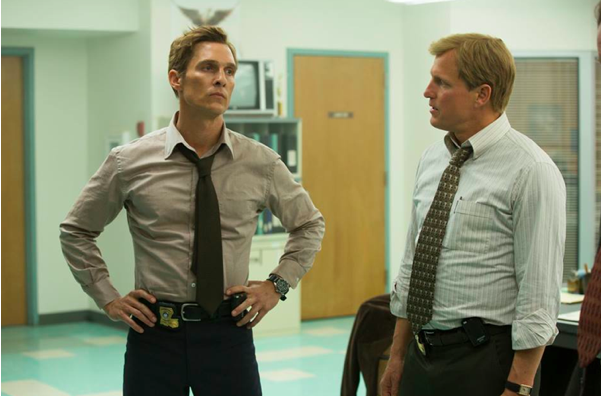
It is pure HBO, not-suitable-for-children kind of stuff. The two detectives investigating the murder in episode one are damaged, flawed men, each haunted by different but equally destructive demons. These are the good guys, trying to get the job done in spite of all the barriers thrown up to prevent them digging too deeply where it might inconvenience the bad guy(s).
Tonight is episode 8, the last episode. We have been waiting all week, hoping they will tie all the dangling, intriguing threads together. Hoping that neither of these two detectives, whom we have grown to like and maybe even admire, are involved with the crime.
It’s HBO. You never know.
“Why Do Americans Do This?”
AdventureMan and I were with a group of delegates from Iraq yesterday, taking them on a visit to a variety of Pensacola sites. They are here visiting through the GCCDC, on the IVLP program, studying elections and campaign strategies in the USA.
One stop we make with many delegates is the First Methodist program Serving the Hungry. Two days a week, led by Jerry Vititow and supported by many happy, willing volunteers, they serve a hot lunch to the hungry, varying in numbers but never less than fifty or so.
The delegates learn about the program, then don aprons and serve up the trays. It is often one of the highlights of the trip.
One delegate raises his hand to ask a question.
“We see this everywhere,” he starts, “Americans who are working for nothing and smiling. Why do they do this?” He was genuinely perplexed.
Jerry explained that it wells up from many sources, a yearning to give back some of the blessings we have received, an eagerness to serve those who have less, maybe just an eagerness to serve. “It’s part of what we believe in,” he sums it up.
The delegates had a wonderful time.
Recent Comments
ExpatAlien on What Country am I Living … intlxpatr on Yellowstone: Old Faithful to C… Michelle on Yellowstone: Old Faithful to C… Cathy on No Grown-Ups in Charge intlxpatr on Waiting for Snow Wikipedia Donate Button

Amazina


Early Voting in Florida


 Here There and Everywhere