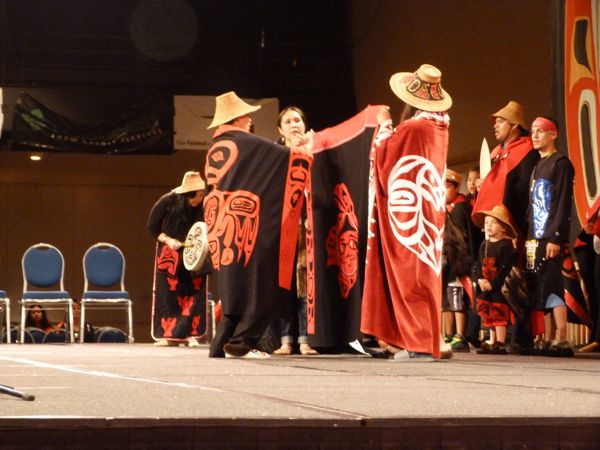
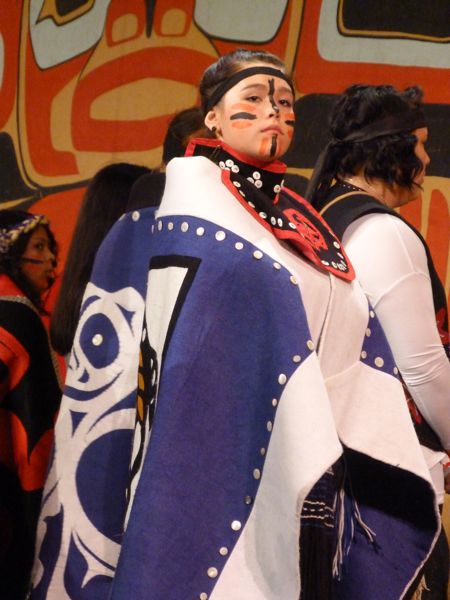
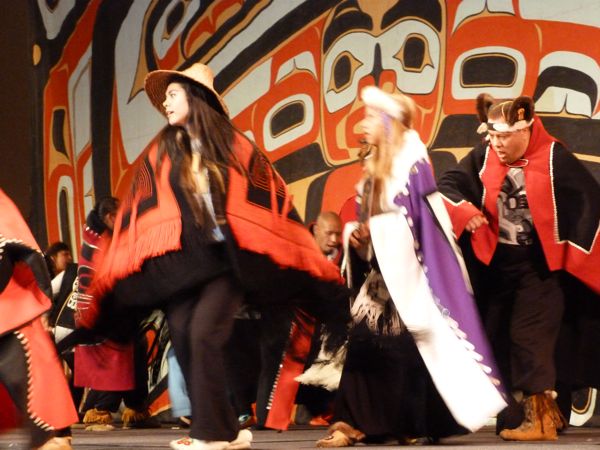
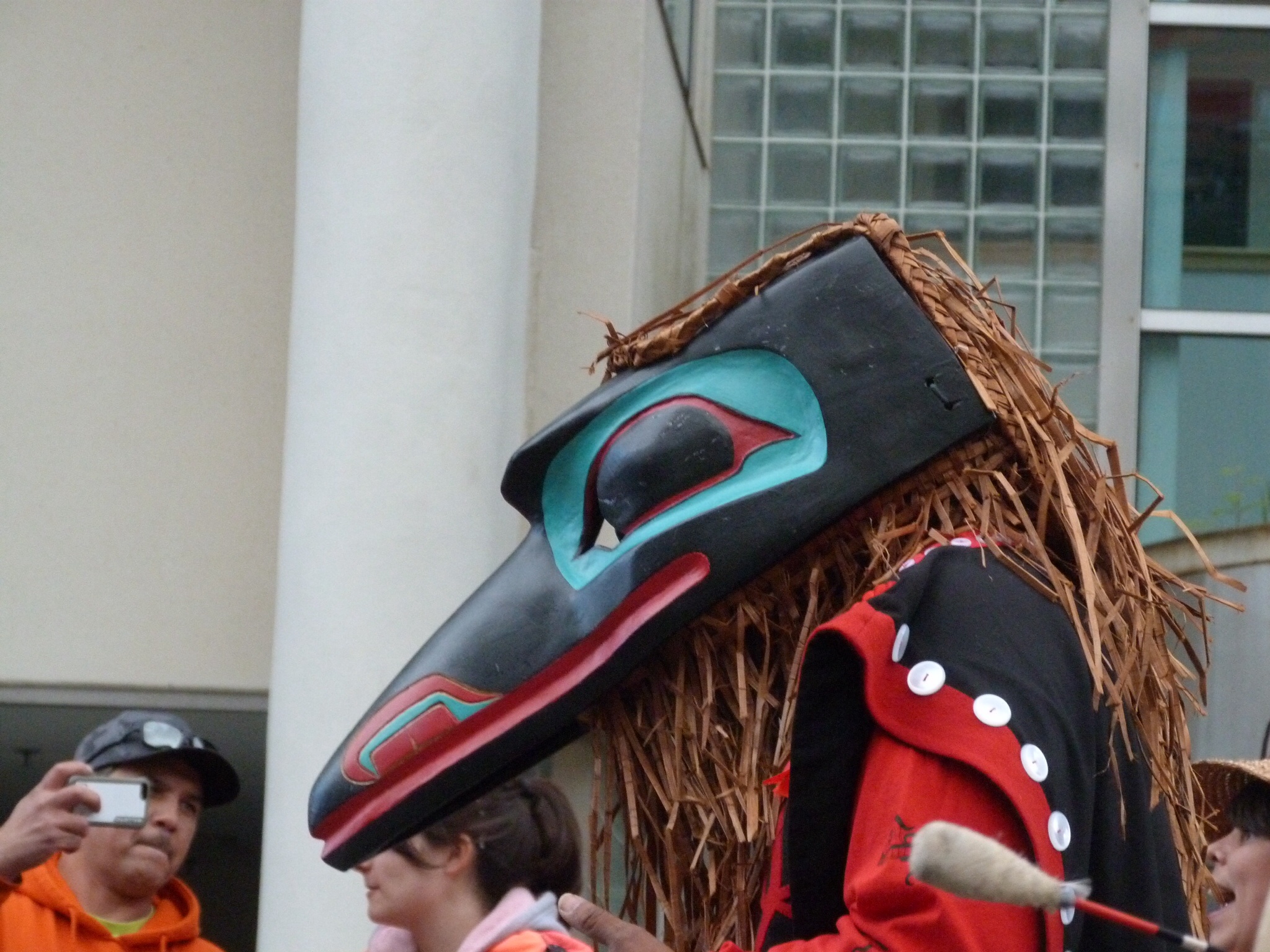
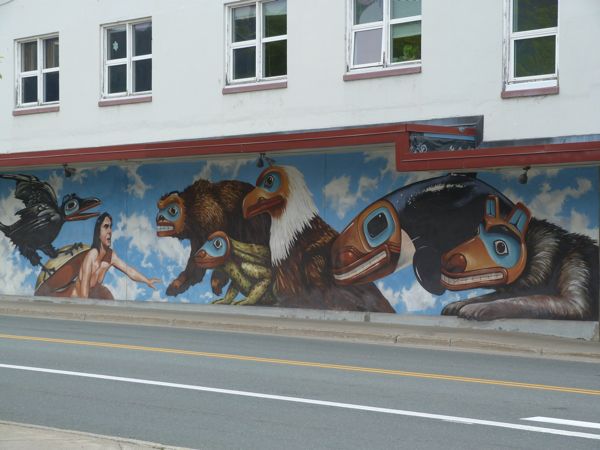
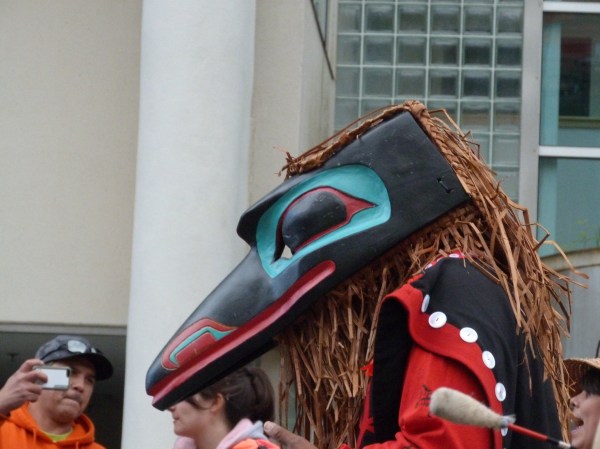
I am getting questions about the clans and tribes. I can’t answer your questions. I know there are the Ravens, and the Eagles, and I know they are not hostile but two halves of a whole. I know the raven legend; raven steals the sun – knowledge – and shares it with everyone. He is often shown with a long beak and/or curled around a ball. Eagles have short curved sharp beaks. But, with dispensation, an Eagle may marry a Raven. There are also subgroups, so you can be at once a Raven and a Bear, or a Killer Whale, or maybe a Wolf.
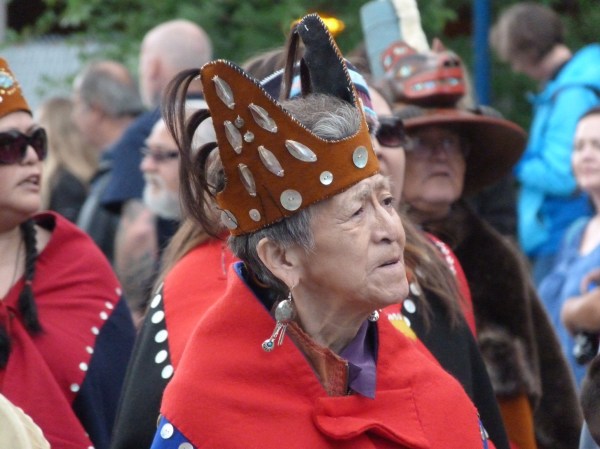
I try to understand, but it is a lot to absorb, and sort of complicated and flexible. As I look at my photos, I can see I was most interested in focusing on the costumes / textiles and less interested in the story. I wish I could tell you more, but you will have to read it for yourselves!
Here is a mural in downtown Juneau that demonstrates some of the artistic traditions of some of the various clans:
It’s important to remember – this is about them. It’s about holding on to traditional values and core beliefs, and transmitting knowledge of the culture to children and grandchildren. It’s not about us. As I said, we are there to witness and observe and celebrate, but they are there to celebrate who they are. Meanwhile, you can share the experience with these photos:


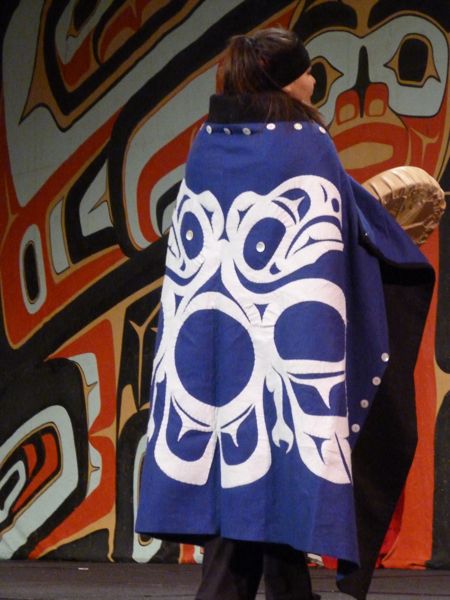

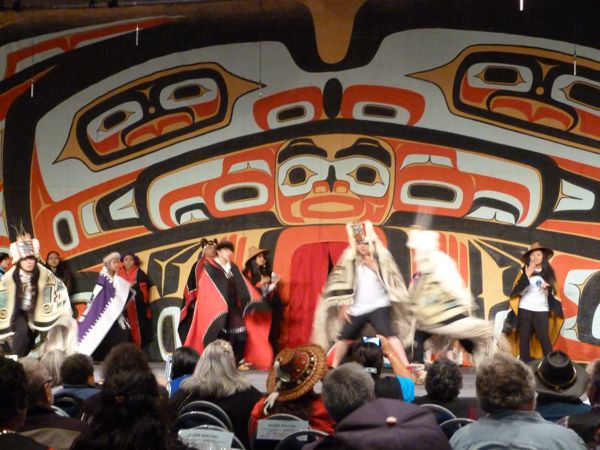
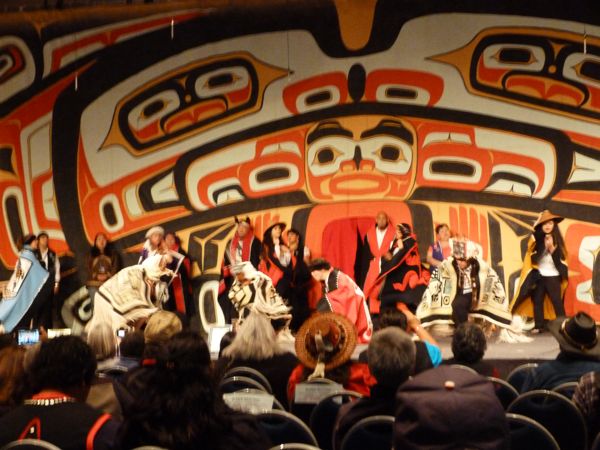


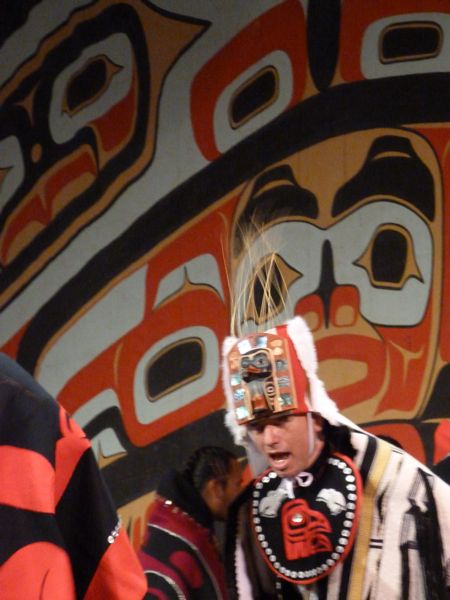
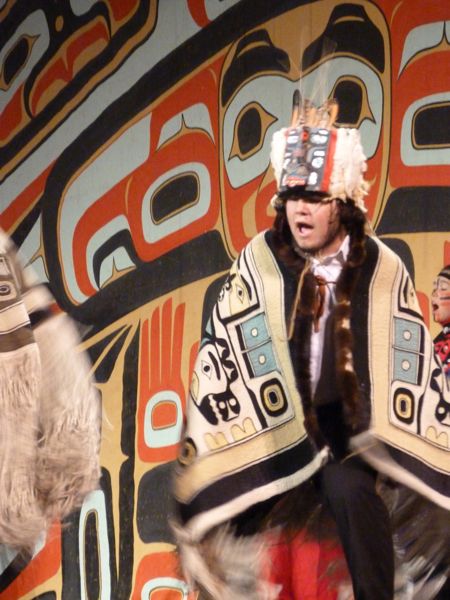


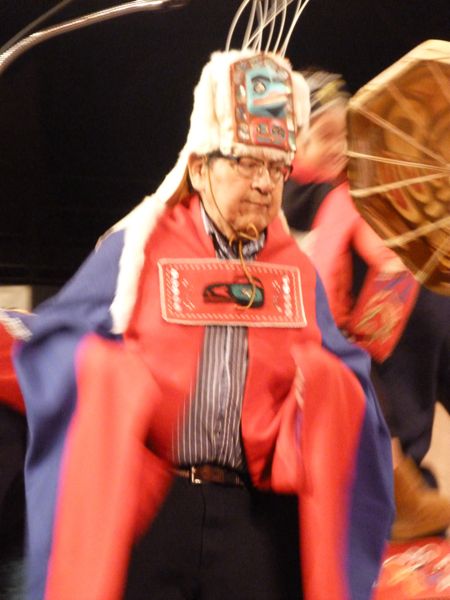
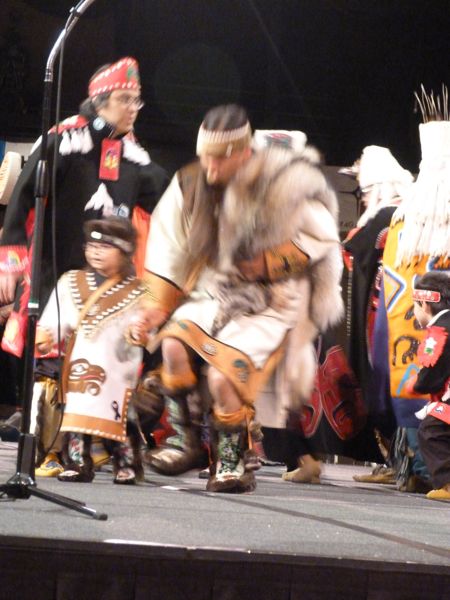

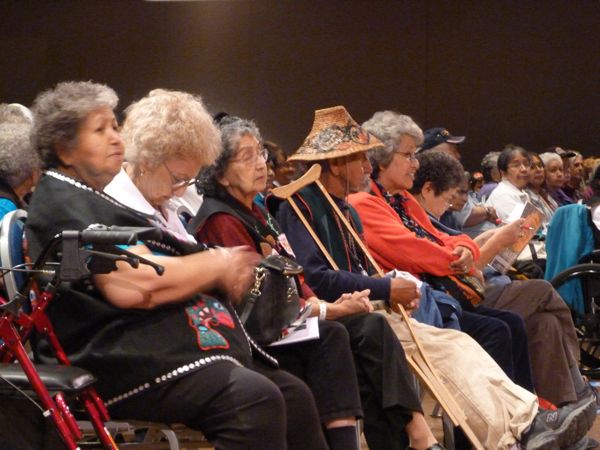
The front and center rows were reserved for the elders, and once the dancers started, every seat was filled. There were wet eyes, and open weeping. There were joyful moments, too, when the dancers would invite ‘all the Eagles’ or (something I didn’t understand) to rise and join them in their dance. My own heart swelled to witness their joy.


June 24, 2014
Posted by intlxpatr |
Alaska, Arts & Handicrafts, Beauty, Community, Cultural, Exercise, ExPat Life, Family Issues, Public Art, Quality of Life Issues, Travel | AK, Celebration 2014, Haida, Juneau, Sealaska, Tlingit, Tsimshian |
Leave a comment
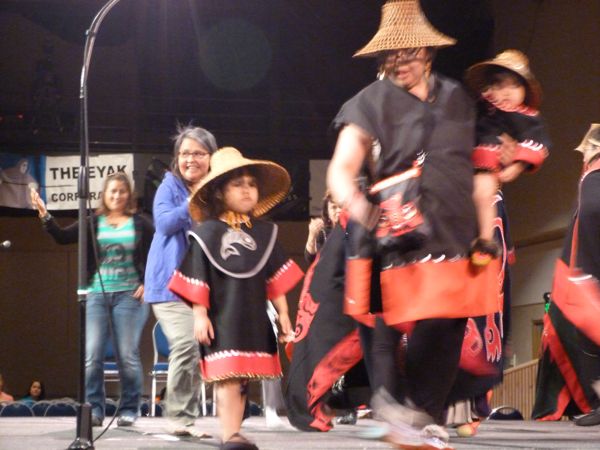
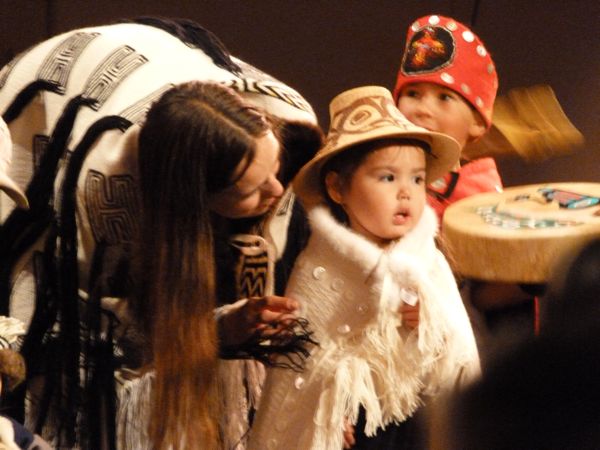
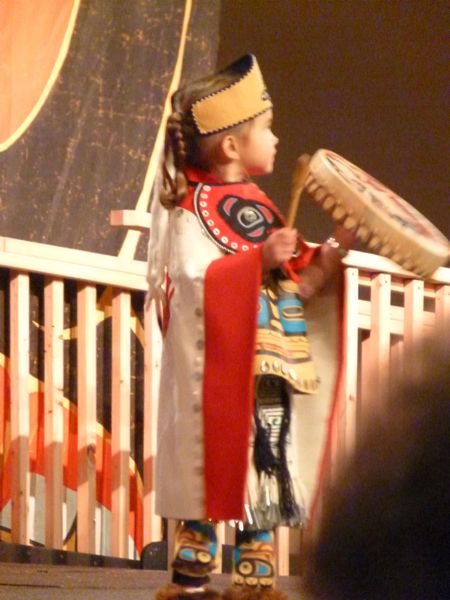
One of the sweetest events at Celebration 2014 is scheduled early early in the morning, so early, we missed a part of it. The families of the clans take great pride in creating their ceremonial robes with clan markings, and get the children started in the tradition early.
These children were SO adorable, and their costumes finely and lovingly wrought. They had an enthusiastic – if fairly sparse – audience at the early hour, but it was necessary with all the many different groups dancing throughout the day.

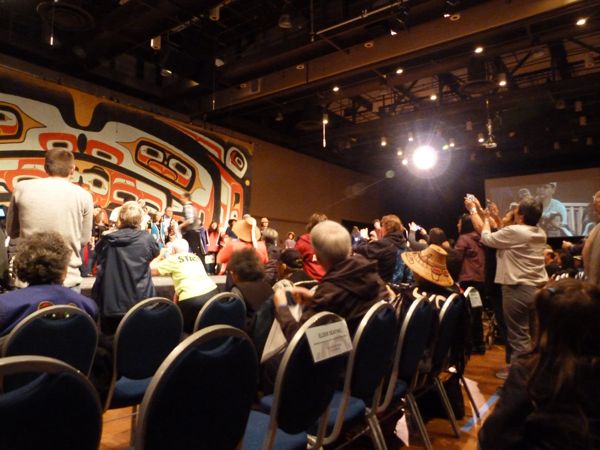


I THINK this might have been the winner, but I am not sure. Not everything was in English, and sometimes I couldn’t understand what was said. Winner or not – adorable 🙂
June 24, 2014
Posted by intlxpatr |
Alaska, Arts & Handicrafts, Beauty, Cultural, ExPat Life, Generational, Travel | Celebration 2014, Childrens' costumes |
Leave a comment
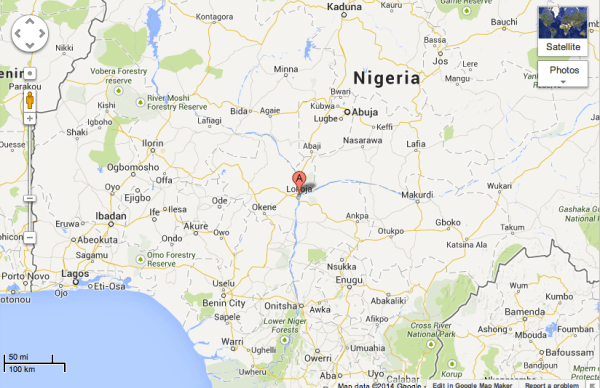
Today the church celebrates the Birth of John the Baptist, whom the Moslems call Yahyah, and who has a much-visited tomb in the Ummayyad Mosque in Damascus, Syria. The church also prays today for the diocese of Lokoja, Nigeria, which is just south of Abuja, from where 300 girls were kidnapped by Boko Haram, people who believe girls should not be educated. Most of those girls are still missing. Three hundred girls . . . Lokoja . . . John the Baptist . . . Syria . . . so much need for prayer. . . The reading is from Forward Day by Day.
TUESDAY, June 24 The Nativity of Saint John the Baptist
Isaiah 40:11. He will feed his flock like a shepherd; he will gather the lambs in his arms,
and carry them in his bosom, and gently lead the mother sheep.
So much of our scripture is violent and distressing, yet there are many passages like this, full of comfort and assurance that the trouble is over. Others might look at it and say, “Your God is violent and terrible, and the reassurances are flat and silly.”
Maybe that’s true. I tend to look at them more as descriptions of how we experience our lives rather than declarations of God’s nature. Our lives are difficult and often catastrophic—earthquakes, malaria, civil wars, and dangerous militias, to name only a few issues—and our lack of control means we blame God for it. But I don’t think God acts that way. And in the face of catastrophe, we say meaningless things: “Everything happens for a reason.” That’s no comfort at all.
Isaiah speaks peace to his people, trying his hardest to take their pain seriously and to offer the truth that everything will be okay in the end. When it’s not okay, it’s not yet the end. That “okayness” might be justice here or it might be eternal life, but this present trouble is not the end of the story.
PRAY for the Diocese of Doko (Lokoja, Nigeria)
Today the Church remembers The Nativity of Saint John the Baptist.
Ps 85 or 85:7-13; Isaiah 40:1-11; Acts 13:14b-26; Luke 1:57-80
June 24, 2014
Posted by intlxpatr |
Africa, Cultural, Faith, Geography / Maps, GoogleEarth, Lectionary Readings, Nigeria, Spiritual, Survival, Women's Issues |
Leave a comment
First, we really love eating at the Hanger at the Wharf. So does just about everyone else. Twice, we got really lucky. It is easier getting a table if you are just two people, and it is easier getting a table if you eat early. As we are still on Pensacola tummy time, we are in luck. As the Celebration 2014 parade ended, we zipped straight over and as larger groups waited, we were immediately shown to a table for two.
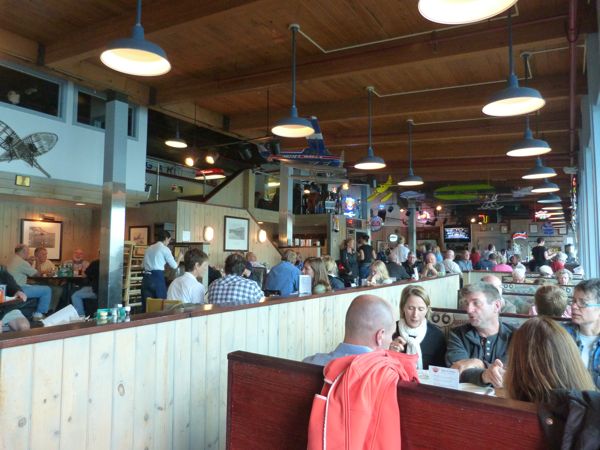
No wonder The Hanger is so popular. The food is terrific and this is the view – straight down the Gastineau channel with Douglas and the cruise ships. As the sun slides behind the mountain, it is a stunning view:

Some hardier souls were eating outside on the deck. I used to be this hardy, but my years in the Middle East have softened me, made me not so good at eating in cool and drafty places, even in the middle of the Alaskan summer.

Inside The Hanger: great, courteous, friendly and efficient employees

Every table taken, the bar is packed, and people are waiting in the hallway to be seated:

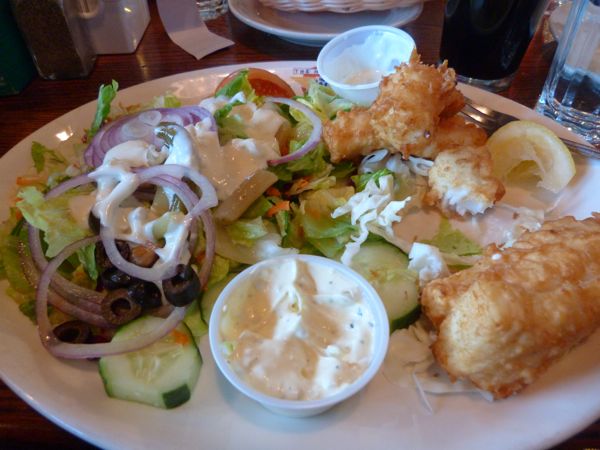
My halibut tempura:

AdventureMan’s halibut burger and fries:
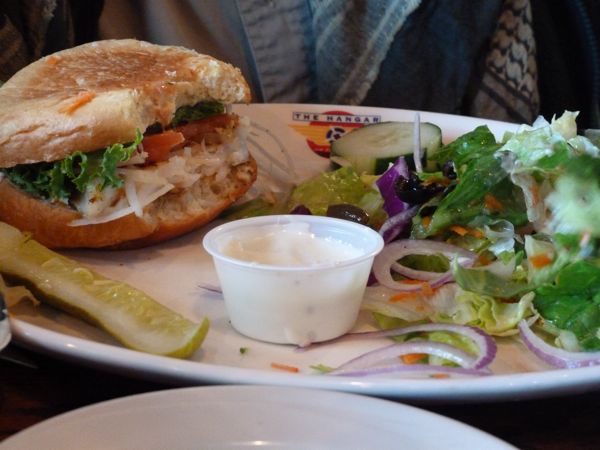
We liked the food and atmosphere so well that we went back a second time during the ceremonial dances and were happy to see a lot of the dancers eating there, too. I had the first mate’s plate, with salmon and halibut and a berry chutney and AdventureMan had grilled halibut. We both left happy. We would go there again in a heartbeat.
There is only one little thing about The Hanger that makes me uneasy, and it has nothing to do with The Hanger. When I was a little girl, living across the channel, I would watch for my Dad to come home – this was the airport for the amphibious planes, Alaska Coastal Airlines (now part of Alaska Airlines) and Ellis Airlines. When his plane would land, we would all rush to the car and drive like crazy across the bridge to pick him up (no cell phones then, LOL). So I still feel a little frisson and feel the ghosts of the past when I eat there.

June 23, 2014
Posted by intlxpatr |
Alaska, Arts & Handicrafts, Circle of Life and Death, Community, Cultural, Customer Service, Eating Out, ExPat Life, Food, Interconnected, Living Conditions, Local Lore, Photos, Restaurant, Road Trips | AK, Celebration 2014, Juneau |
2 Comments
I hope you will forgive me; I am not able to do the same work on the iPad I can do on my computer, so these photos are uncropped, unenhanced, they are what they are. It isn’t about the photos, it is about the people they are celebrating. These are more photos from the opening parade, which was rich with colors and sounds:






June 19, 2014
Posted by intlxpatr |
Adventure, Alaska, Cultural, Events, ExPat Life, Generational, Heritage, Local Lore, Travel | AK, Celebration 2014, Juneau, Sealaska |
Leave a comment
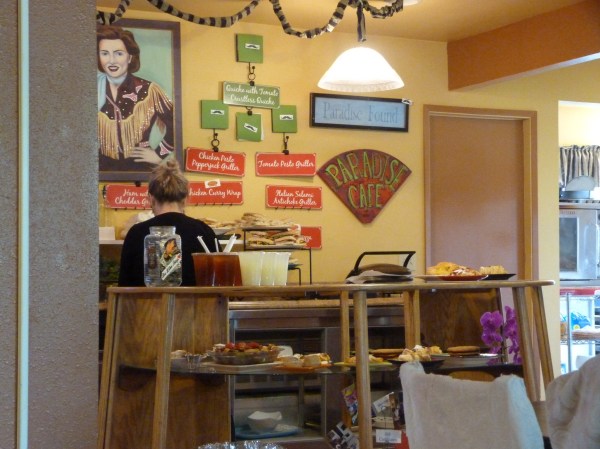
AdventureMan spotted this gem, near the airport, and said “I want to eat there!” We went inside, and what a surprise – it is eccentric, and quirky, and full of local people eating lunch. We noticed that thanks to the gorgeous display of sweet desserts and pastries, everyone also left with a box for ‘later on’ like coffee break.
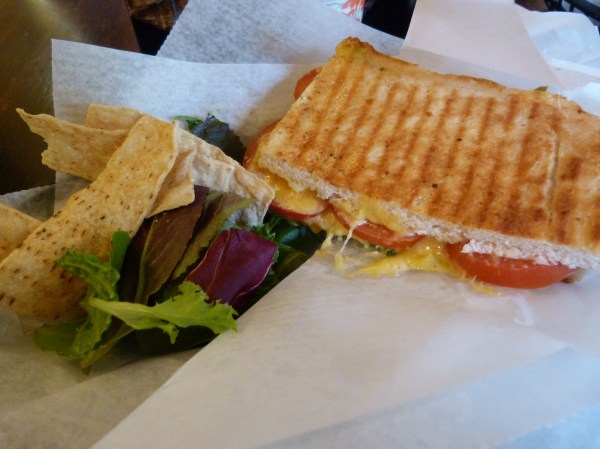
They had a selection of ‘grillers’, no menu, everything is listed on the board or on display. It is so hard to focus on lunch when you are looking at flaky pastry confections . . .
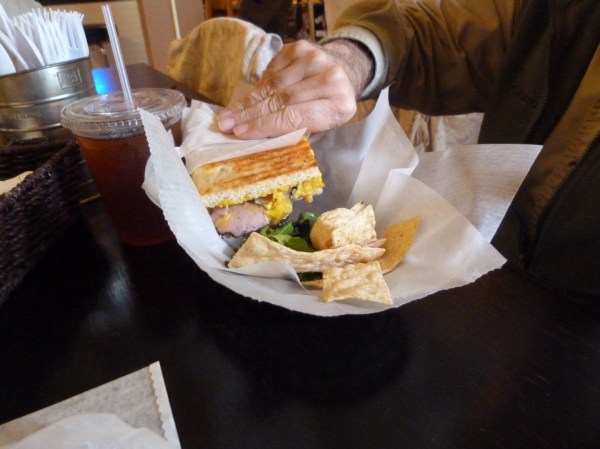
I had the tomato pesto sandwich, and AdventureMan had a ham and cheese griller – both rich and filling. We sat at one of the tables, each table different, sometimes people share tables. On each table is a carafe of water, but we also saw a lot of people ordering specialty coffees and teas.
The Paradise Cafe is not a well-kept secret. You and I, as tourists, may not recognize it is there, but all the local helicopter pilots and airport workers know it is there 🙂 It is a well loved and busy place!
June 18, 2014
Posted by intlxpatr |
Alaska, Community, Cooking, Cultural, Food, Living Conditions, Local Lore, Restaurant, Travel | AK, Juneau |
Leave a comment
O
Airports are so much more interesting and varied than they used to be (except the Pensacola ‘International’ Airport that went in the opposite direction, with chains instead of local specialties . . . )
If you are familiar with Seattle, you wii know Uwajumaya, a wonderful supermarket in the International district. Now, you can get your favorite to-go from Waji’s, wooooo hoooooo.
June 17, 2014
Posted by intlxpatr |
Cultural, ExPat Life, Food, Living Conditions, Restaurant, Seattle, Travel | airport food, Seattle Airport, Uwajumaya |
Leave a comment
AdventureMan and I have a soft spot for South Africa, not the least of which for the dramatic and radical way they transformed from apartheid government to democratic government. It is not to say South Africa has been without problems – there are still problems. But the manner in which they confronted and dealt with their past and then moved on allows change to happen, change in the heart.
Today’s meditation from Forward Day by Day:
FRIDAY, May 30
Psalm 85:3. You withdrew all your wrath; you turned from your hot anger. (NRSV)
But for the grace of God and the work of extraordinary leaders such as Nelson Mandela and Desmond Tutu, the fall of apartheid in South Africa could have been marked by one of the worst bloodbaths ever seen.
The incendiary ingredients were all present: a repressive minority regime that ruled by violence, fear, and fiat over a majority population denied fundamental human rights and forced to live a subservient existence.
There was upheaval, but the nation never fell into anarchy as it radically changed its government, thanks largely to the Truth and Reconciliation Commission.
Chaired by Tutu, then the Anglican Archbishop of Cape Town, the commission held hearings throughout the country. Victims told their stories of torture, killing, and degradation, sometimes confronting the accused.
The goal was not vengeance or justice but truth-telling to clear a path for healing. Powerful emotions were released. There were tearful confessions and apologies. There was forgiveness. The people of South Africa managed to turn from their hot anger and begin building a new nation.
Can we do the same? Where can we forsake our anger for the liberating power of forgiveness?
May 30, 2014
Posted by intlxpatr |
Bureaucracy, Character, Civility, Community, Counter-terrorism, Cross Cultural, Cultural, Faith, Living Conditions, Political Issues, Relationships, South Africa |
Leave a comment
From AOL Huffpost Business:
Where are the worst places on the planet to be a worker?
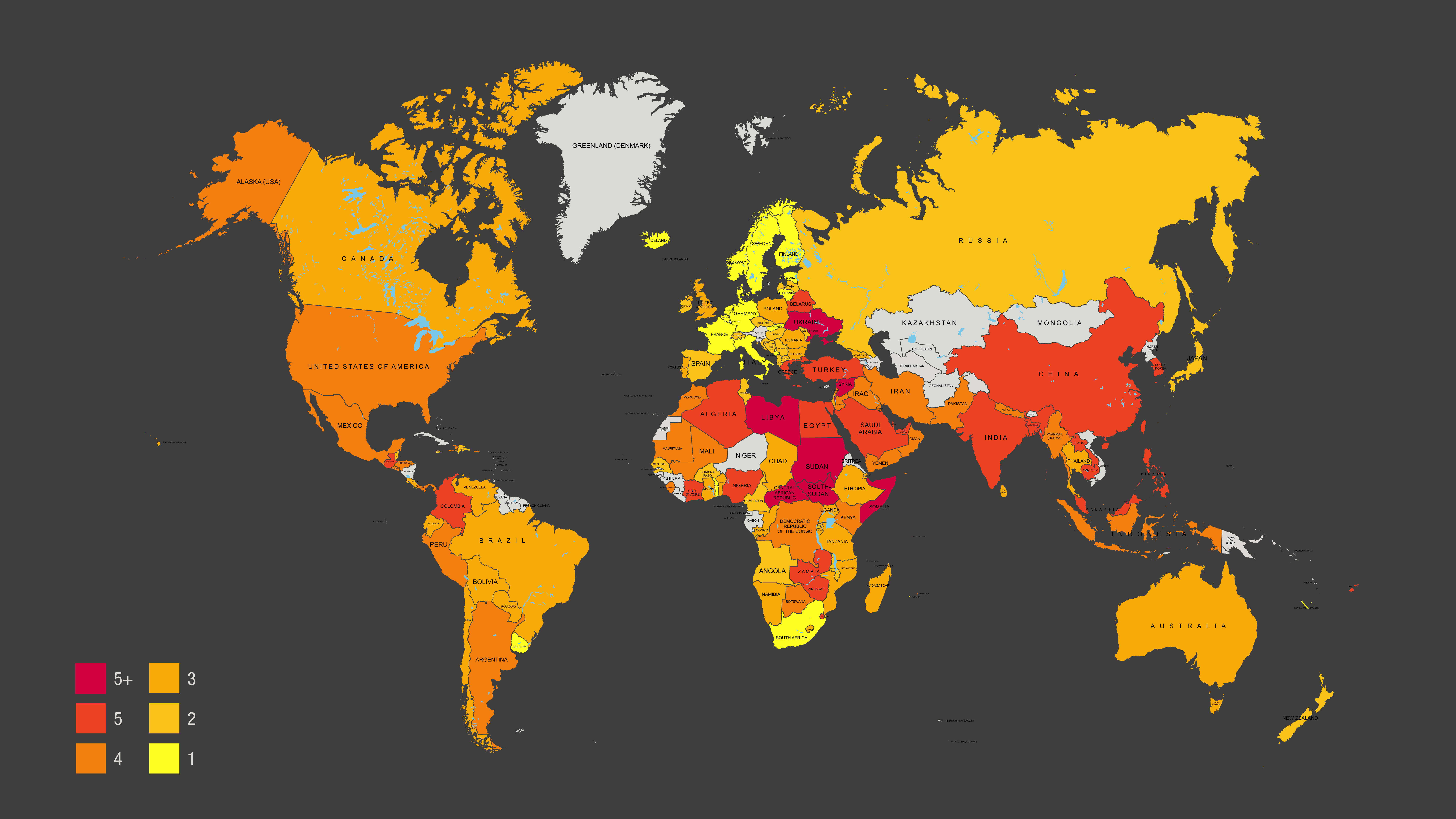
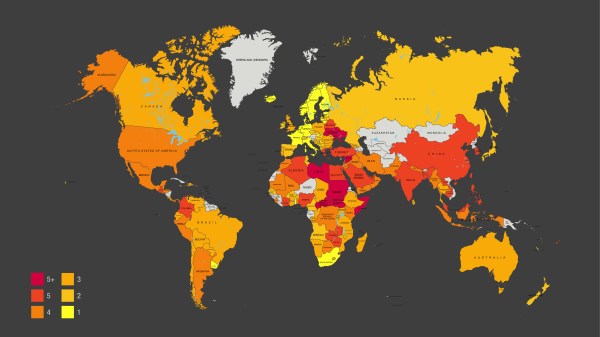
A new report by the International Trade Union Confederation, an umbrella organization of unions around the world, sheds light on the state of workers’ rights across 139 countries. For its 2014 Global Rights Index, the ITUC evaluated 97 different workers’ rights metrics like the ability to join unions, access to legal protections and due process, and freedom from violent conditions. The group ranks each country on a scale of 1 (the best protections) to 5 (the worst protections).
The study found that in at least 35 countries, workers have been arrested or imprisoned “as a tactic to resist demands for democratic rights, decent wages, safer working conditions and secure jobs.” In a minimum of nine countries, murder and disappearance are regularly used to intimidate workers.
Denmark was the only country in the world to achieve a perfect score, meaning that the nation abides by all 97 indicators of workers’ rights.
The U.S., embarrassingly, scored a 4, indicating “systematic violations” and “serious efforts to crush the collective voice of workers.”
“Countries such as Denmark and Uruguay led the way through their strong labour laws, but perhaps surprisingly, the likes of Greece, the United States and Hong Kong, lagged behind,” wrote ITUC general secretary Sharan Burrow in a statement about the report. “A country’s level of development proved to be a poor indicator of whether it respected basic rights to bargain collectively, strike for decent conditions, or simply join a union at all.”
Here’s a look at the world rankings. Darker shades represent worse protects for workers. A score of 5+ means that active conflicts, like those in Syria or Sudan, block any legal protections for workers.
May 29, 2014
Posted by intlxpatr |
Bureaucracy, Circle of Life and Death, Civility, Cultural, ExPat Life, Statistics, Values, Work Related Issues | decent wages, Global Rights Index, International Trade Union Confederation, living wage, wokers' rights metrics |
2 Comments
From AOL Breaking News:
Pregnant Pakistani woman stoned to death by family
May 27th 2014 3:29PM
Pakistan
Mohammad Iqbal, right, husband of Farzana Parveen, 25, sits in an ambulance next to the body of his pregnant wife who was stoned to death by her own family, in Lahore, Pakistan, Tuesday, May 27, 2014. Nearly 20 members of the woman’s family, including her father and brothers, attacked her and her husband with batons and bricks in broad daylight before a crowd of onlookers in front of the high court of Lahore, police investigator Rana Mujahid said. (AP Photo/K.M. Chaudary)
LAHORE, Pakistan (AP) – A pregnant woman was stoned to death Tuesday by her own family outside a courthouse in the Pakistani city of Lahore for marrying the man she loved.
The woman was killed while on her way to court to contest an abduction case her family had filed against her husband. Her father was promptly arrested on murder charges, police investigator Rana Mujahid said, adding that police were working to apprehend all those who participated in this “heinous crime.”
Arranged marriages are the norm among conservative Pakistanis, and hundreds of women are murdered every year in so-called honor killings carried out by husbands or relatives as a punishment for alleged adultery or other illicit sexual behavior.
Stonings in public settings, however, are extremely rare. Tuesday’s attack took place in front of a crowd of onlookers in broad daylight. The courthouse is located on a main downtown thoroughfare.
A police officer, Naseem Butt, identified the slain woman as Farzana Parveen, 25, and said she had married Mohammad Iqbal, 45, against her family’s wishes after being engaged to him for years.
Her father, Mohammad Azeem, had filed an abduction case against Iqbal, which the couple was contesting, said her lawyer, Mustafa Kharal. He said she was three months pregnant.
Nearly 20 members of Parveen’s extended family, including her father and brothers, had waited outside the building that houses the high court of Lahore. As the couple walked up to the main gate, the relatives fired shots in the air and tried to snatch her from Iqbal, her lawyer said.
When she resisted, her father, brothers and other relatives started beating her, eventually pelting her with bricks from a nearby construction site, according to Mujahid and Iqbal, the slain woman’s husband.
Iqbal said he started seeing Parveen after the death of his first wife, with whom he had five children.
“We were in love,” he told The Associated Press. He alleged that the woman’s family wanted to fleece money from him before marrying her off.
“I simply took her to court and registered a marriage,” infuriating the family, he said.
Parveen’s father surrendered after the attack and called his daughter’s murder an “honor killing,” Butt said.
“I killed my daughter as she had insulted all of our family by marrying a man without our consent, and I have no regret over it,” Mujahid, the police investigator, quoted the father as saying.
Mujahid said the woman’s body was handed over to her husband for burial.
The Human Rights Commission of Pakistan, a private group, said in a report last month that some 869 women were murdered in honor killings in 2013.
But even Pakistanis who have tracked violence against women expressed shock at the brutal and public nature of Tuesday’s slaying.
“I have not heard of any such case in which a woman was stoned to death, and the most shameful and worrying thing is that this woman was killed outside a courthouse,” said Zia Awan, a prominent lawyer and human rights activist.
He said Pakistanis who commit violence against women are often acquitted or handed light sentences because of poor police work and faulty prosecutions.
“Either the family does not pursue such cases or police don’t properly investigate. As a result, the courts either award light sentences to the attackers, or they are acquitted,” he said.
May 27, 2014
Posted by intlxpatr |
Cultural, ExPat Life, Family Issues, Generational, Living Conditions, Marriage, Mating Behavior, Pakistan | Farzana Parveen, honor killing |
2 Comments