Iraqis Draft Law Allowing 9 Year Old “Women” to Marry
From AOL News:
BY SAMEER N. YACOUB AND SINAN SALAHEDDIN
BAGHDAD (AP) — A contentious draft law being considered in Iraq could open the door to girls as young as nine getting married and would require wives to submit to sex on their husband’s whim, provoking outrage from rights activists and many Iraqis who see it as a step backward for women’s rights.
The measure, aimed at creating different laws for Iraq’s majority Shiite population, could further fray the country’s divisions amid some of the worst bloodshed since the sectarian fighting that nearly ripped the country apart after the U.S.-led invasion. It also comes as more and more children under 18 get married in the country.
“That law represents a crime against humanity and childhood,” prominent Iraqi human rights activist Hana Adwar told The Associated Press. “Married underage girls are subjected to physical and psychological suffering.
Iraqi law now sets the legal age for marriage at 18 without parental approval. Girls as young as 15 can be married only with a guardian’s approval.
The proposed new measure, known as the Jaafari Personal Status Law, is based on the principles of a Shiite school of religious law founded by Jaafar al-Sadiq, the sixth Shiite imam. Iraq’s Justice Ministry late last year introduced the draft measure to the Cabinet, which approved it last month despite strong opposition by rights groups and activists.
The draft law does not set a minimum age for marriage. Instead, it mentions an age in a section on divorce, setting rules for divorces of girls who have reached the age of 9 years in the lunar Islamic calendar. It also says that’s the age girls reach puberty. Since the Islamic calendar year is 10 or 11 days shorter than the Gregorian calendar, that would be the equivalent of 8 years and 8 months old. The bill makes the father the only parent with the right to accept or refuse the marriage proposal.
Critics of the bill believe that its authors slipped the age into the divorce section as a backhanded way to allow marriages of girls that young. Already, government statistics show that nearly 25 percent of marriages in Iraq involved someone under the age of 18 in 2011, up from 21 percent in 2001 and 15 percent in 1997. Planning Ministry spokesman Abdul-Zahra Hendawi said the practice of underage marriage is particularly prevalent in rural areas and some provinces where illiteracy is high.
Also under the proposed measure, a husband can have sex with his wife regardless of her consent. The bill also prevents women from leaving the house without their husband’s permission, would restrict women’s rights in matters of parental custody after divorce and make it easier for men to take multiple wives.
Parliament must still ratify the bill before it becomes law. That is unlikely to happen before parliamentary elections scheduled for April 30, though the Cabinet support suggests it remains a priority for Prime Minister Nouri al-Maliki’s administration. Al-Maliki is widely expected to seek a third term.
Baghdad-based analyst Hadi Jalo suggested that election campaigning might be behind the proposal.
“Some influential Shiite politicians have the impression that they should do their best to make any achievement that would end the injustice that had been done against the Shiites in the past,” Jalo said.
The formerly repressed Shiite majority came to power after the 2003 U.S.-led invasion that ousted Saddam Hussein’s Sunni-led regime. Since then, Shiite religious and political leaders have encouraged followers to pour in millions into streets for religious rituals, a show of their strength.
Iraqi Justice Minister Hassan al-Shimmari, a Shiite, has brushed off the criticism of the bill. His office introduced a companion bill that calls for the establishment of special Shiite courts that would be tied to the sect’s religious leadership.
Al-Shimmari insists that the bill is designed to end injustices faced by Iraqi women in past decades, and that it could help prevent illicit child marriage outside established legal systems.
“By introducing this draft law, we want to limit or prevent such practices,” al-Shimmari said.
But Sunni female lawmaker Likaa Wardi believes it violates women’s and children’s rights and creates divisions in society.
“The Jaffari law will pave the way to the establishments of courts for Shiites only, and this will force others sects to form their own courts. This move will widen the rift among the Iraqi people,” Wardi said.
New York-based Human Rights Watch also strongly criticized the law this week.
“Passage of the Jaafari law would be a disastrous and discriminatory step backward for Iraq’s women and girls,” deputy Middle East director Joe Stork said in a statement. “This personal status law would only entrench Iraq’s divisions while the government claims to support equal rights for all.”
It is unclear how much support the bill enjoys among Iraqi Shiites, but Jalo, the analyst, believes that it would face opposition from secular members of the sect.
Qais Raheem, a Shiite government employee living in eastern Baghdad, said the draft bill contradicts the principles of a modern society.
“The government officials have come up with this backward law instead of combating corruption and terrorism,” said Raheem who has four children, including two teenage girls. “This law legalizes the rape and we should all reject it.”
When Strangers First Kiss
Fascinating video from Huffpost on AOL News:
In seconds, a first kiss can go from insanely awkward to completely perfect.
Filmmaker Tatia Pilieva managed to capture that transformation in her short film, where she pairs off 20 strangers and asks them to kiss.
Watch above as the couples’ uncomfortable introductions turn into small, sweet romantic moments.
UPDATE 3:50 p.m. Tuesday, March 11: Wren studio, a womenswear brand based in Los Angeles, announced on Twitter that this video was shot as part of an ad campaign for their Fall 2014 collection
The Last True Detective
Every now and then AdventureMan and I find a series we really like, and True Detective, Sunday nights on HBO, is one of those. From the first notes of the melancholy theme song playing over shots of rural Louisiana sights, cane processing plants, bayous, angst-ridden detectives, and shots of the crime scenes, you know this is not going to be your typical detective series.
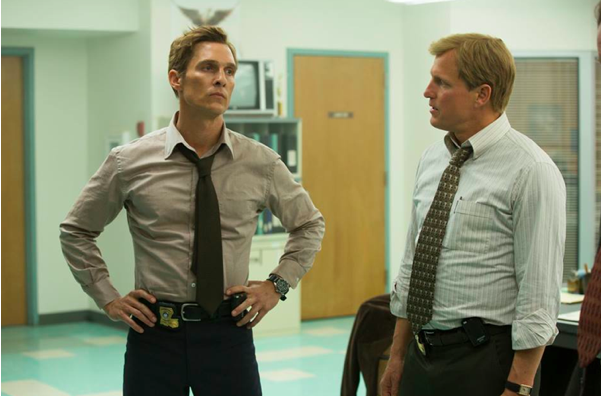
It is pure HBO, not-suitable-for-children kind of stuff. The two detectives investigating the murder in episode one are damaged, flawed men, each haunted by different but equally destructive demons. These are the good guys, trying to get the job done in spite of all the barriers thrown up to prevent them digging too deeply where it might inconvenience the bad guy(s).
Tonight is episode 8, the last episode. We have been waiting all week, hoping they will tie all the dangling, intriguing threads together. Hoping that neither of these two detectives, whom we have grown to like and maybe even admire, are involved with the crime.
It’s HBO. You never know.
“Why Do Americans Do This?”
AdventureMan and I were with a group of delegates from Iraq yesterday, taking them on a visit to a variety of Pensacola sites. They are here visiting through the GCCDC, on the IVLP program, studying elections and campaign strategies in the USA.
One stop we make with many delegates is the First Methodist program Serving the Hungry. Two days a week, led by Jerry Vititow and supported by many happy, willing volunteers, they serve a hot lunch to the hungry, varying in numbers but never less than fifty or so.
The delegates learn about the program, then don aprons and serve up the trays. It is often one of the highlights of the trip.
One delegate raises his hand to ask a question.
“We see this everywhere,” he starts, “Americans who are working for nothing and smiling. Why do they do this?” He was genuinely perplexed.
Jerry explained that it wells up from many sources, a yearning to give back some of the blessings we have received, an eagerness to serve those who have less, maybe just an eagerness to serve. “It’s part of what we believe in,” he sums it up.
The delegates had a wonderful time.
Pensacola Grand Mardi Gras Parade 2014
We love having a grandson, not that we need an excuse, but it’s always more fun to go to a parade when you have a youngster with you. Today was particularly fun, he is four and totally gets the whole parade thing, we found a great parking place with no driving around and we had a great place to watch the parade from. Some kids sitting in front of us knew our grandson, and we were all invited “up front” to be with them.
Parades are always more fun with fun people, and these people were fun. The parade was fun. This is a family parade, lots and lots of children, and the bead throwers and gift givers are most generous to the children. While grown-ups compete to catch the beads, they turn around and give them to the little ones almost immediately. It’s a gentle spirit, and everyone has fun.
Our favored place is very near our church. You can see how crowded it is as the parade begins. It only gets worse; Mardi Gras parades attract more than 50,000 people. Imagine, 50,000 people all behaving themselves, families, children, and when it ends, the street looks normal within an hour or so. Thank God for civility.
Our church and the Mardi Gras revelers waiting for the parade. If you look closely, you can see beads hanging in the tree from the Krewe of Lafitte Parade the night before. Pensacola has LOTS of parades 🙂 :

I watched this guy in this crazy-wonderful horse head get LOTS of beads during the parade:

Everyone has a gimmick to try to get more beads, but it is a FAMILY parade, so there are no drunks (not that I saw anyway) and no one lifting up their shirts for beads. Several people had “targets” for bead throwers:



McGuires throws green beads, and our grandson got one with a medallion, very special 🙂 We’ve hung them all – all this treasures – in his room at our house so his little baby sister doesn’t chew on them by accident and he can visit them every time he stays 🙂 :

As you can see, it was a fabulous day for a parade, maybe 70 degrees F. and a slight breeze. We say “when March comes in like a lamb, it goes out like a lion” so we are expecting that the end of March may be cold and dreary, perfect Lent weather.
Jesus Heals Lepers
My friend Renee sent this one, along with several Christian cartoons, but this one really made me laugh. Yes, as Christians, it is OK to show the image of Jesus.
In our book, the Bible, there are even small jokes. In one verse, a man is told that Jesus, the Messiah, had come from Nazareth, and the man says “can anything good come out of Nazareth?” People are people, yes, it was meant to be humorous.

Sugar Eight Times More Addictive than Cocaine
This is from AOL News: “The rats go for the sugar and it is eight times more addictive than cocaine” in studies done on sugary foods.
A U.S. doctor is making it his mission to publicly highlight some scary effects sugar has on the body. The chairman of the Institute for Functional Medicine says we’re becoming more dependent on sugary foods and drinks – saying they’re even more addictive than cocaine.
On”CBS This Morning,” Dr. Mark Hyman said, “In animal studies, they find that the rats go for the sugar and that it’s eight times as addictive as cocaine. Small amounts of sugar can be part of a normal diet, but most of us are addicted to sugar and don’t know it.”
Hyman himself has gone as far as calling sugar and sugary foods “deadly.”
He told the New York Daily News that “sugar is the new nicotine. And worse, sugar actually causes diabetes and obesity.”
The doctor’s trying to help people find ways to lessen their dependence on sugar with tips from his book, “The Blood Sugar Solution 10-Day Detox Diet.”
On the book’s website, Dr. Hyman says 600 people took part in the diet, which encourages healthier eating habits. Together, they lost more than 4,000 pounds, and their average blood pressure fell by about 10 points.
Dr. Hyman told New York Daily News the average American eats 152 pounds of sugar a year. Whoa.
Happy National Day Kuwait

Happy Liberation Day and Happy National Day to all my friends in Kuwait. Party hearty 🙂
Almost twenty-five years since the Invasion of Kuwait. Imagine. There are young Kuwaitis graduating from college who weren’t even alive when Iraq invaded.
My New Closest Friend: FitBit One
My sister was bouncing around as I stayed at her house in August, and showed me the reason: she was wearing a FitBit. It is tiny, it clips right on to your clothing, and it syncs with your computer – or your smart phone – and helps you see your daily activity level.

You remember the 10,000 Steps program? I wrote about it in 2008? The FitBit counts your steps. It tells you how many flights of stairs you have gone up. (We bought a two story house on purpose, and today my FitBit tells me I am a CHAMP on the stairs. I guess it doesn’t know that going up and down the stairs is just what you do when you have a two story house, but hey, I get credit!) It is so much better than the pedometer, it counts better. It can also monitor my sleep, if I figure it out.
My sister loved this device; claims it keeps her motivated to keep moving, and all the latest studies show that we really, really need to keep moving. It is, literally, a matter of life or death. You move it – or you lose it.
I finally got one. I was kind of reluctant to have this little fitness nanny prodding me all the time, but actually, it is turning out to be more fun than annoying.
Thanks, Sis. Great recommendation.
Idaho Legislators to Vote on Ag-Gag Bill

In this April 22, 2010 file image from video provided by the United States Humane Society, a Hallmark Meat Packing slaughter plant worker is shown attempting to force a “downed” cow onto its feet by ramming it with the blades of a forklift in Chino, Calif. (Humane Society of the United States via AP)
Idaho’s legislature is considering what’s been dubbed the “ag-gag bill” that would impose penalties for trespassing and filming without permission in farming facilities.
What prompted the push is a video by animal activists, showing workers stomping on cows, beating and dragging them at the Bettencourt Dairy in Hansen, Idaho in 2012.
The bill’s sponsor says this video is the work of “agri-terrorists” bent on harming the industry. The activists counter that they’re just exposing animal abuse.
The penalty would be a misdemeanor charge punishable by a year in jail and a $5,000 fine.
Scott Graf of Boise State Public Radio in Idaho joins Here & Now’s Jeremy Hobson with details.
I will tell you truthfully, I cannot even watch this video, taken by Mercy for Animals. They are doing brave and compassionate work, check out all their films on YouTube. People being cruel or negligent to those who cannot defend themselves – children or animals, prisoners, the elderly – make me physically sick. The Idaho bill would prohibit anyone filming – under threat of penalty of law – under false pretenses.
So like people who KNOW they are being filmed are going to abuse the animals? Abuse occurs when there is no penalty, or when no one will know. I know Mercy for Animals will continue their work, but will be fined, heavily, if caught and prosecuted.
NPR reports that the owner had no idea about the abuse and himself was sickened when he saw the film, immediately firing five people. He has installed his own video cameras to monitor his employees.
Who are we? What is in our hearts that would allow us to cause hurt and pain to the helpless?
Recent Comments
intlxpatr on Shampoo Ginger tigerbutterya0c5ff1d… on Shampoo Ginger intlxpatr on British Soldier Kidnapped, Esc… John on British Soldier Kidnapped, Esc… intlxpatr on British Soldier Kidnapped, Esc… Wikipedia Donate Button

Amazina


Early Voting in Florida


