Florida Crazy: Killed for Texting in a Movie Theatre
The man who killed the texting man was a retired police captain. I suspect he had a permit to carry a weapon. Lord have mercy.
WESLEY CHAPEL, Fla. (AP) — An argument over texting in a Florida movie theater ended with a retired Tampa police captain fatally shooting a man sitting in front of him, authorities said.
The former police captain, Curtis Reeves, 71, has been charged with second-degree murder. It’s not immediately clear whether he has retained an attorney.
“Somebody throws popcorn. I’m not sure who threw the popcorn,” said Charles Cummings, who, as a birthday treat, was about to watch the movie “Lone Survivor” at The Grove 16 Theater on Monday.
“And then bang, he was shot.”
Pasco County Sheriff’s officials said the shooting happened when Reeves asked 43-year-old Chad Oulson to stop texting at the theater in Wesley Chapel, a suburb about a half hour north of downtown Tampa.
Reeves and his wife were sitting behind Oulson and his wife. Oulson told Reeves he was texting with his 3-year-old daughter, Cummings said.
“It ended almost as quickly as it started,” said sheriff’s spokesman Doug Tobin. The sheriff’s office says an off-duty Sumter County deputy detained Reeves until police arrived.
Cummings and his son Alex – who both had blood on their clothes as they walked out of the theater – told a group of reporters Monday afternoon the show was still in previews when the two couples started arguing.
Cummings said the man in the back row – later identified as Reeves – got up and left the auditorium, presumably to get a manager. But he came back after a few minutes, without a manager and appearing upset. Moments later, the argument between the two men resumed, and the man in the front row stood up.
Officials said Oulson asked Reeves if he reported him to management for using his phone.
Cummings said the men started raising their voices and popcorn was thrown. Authorities said Reeves took out a gun, and Oulson’s wife put her hand over her husband, and that’s when Reeves fired his weapon, striking Nichole Oulson in the hand and her husband in the chest.
“I can’t believe people would bring a pistol, a gun, to a movie,” Cummings said. “I can’t believe they would argue and fight and shoot one another over popcorn. Over a cellphone.”
Cummings, who said he was a combat Marine in Vietnam, said Oulson fell onto him and his son.
“Blood started coming out of his mouth,” said Alex Cummings. “It was just a very bad scene.”
Charles Cummings said his son went to call 911, while Cummings and another patron who claimed to a nurse began performing CPR on the victim.
A man sitting next to the shooter grabbed the gun out of his hand, and the suspect did not attempt to get away, Cummings said.
Oulson and his wife were taken by ambulance to a Tampa-area hospital, where the Chad Oulson died, Tobin said. His wife’s injuries were not considered life-threatening.
Tampa Police spokeswoman Laura McElroy said in a news release that Reeves was a captain when he retired from the department in 1993. She added that he was instrumental in establishing the agency’s first tactical response team. After he retired, Reeves worked security for the Busch Gardens theme park and was on the board of a neighboring county’s Crime Stoppers organization. Reeves’ son also is a Tampa officer, police said.
Study Shows Muslim Nations Differ on How Women Should Dress
Digg started sending me articles, I don’t know why, but every now and then something turns up truly interesting. This is a Pew Research Center Study found in Slate Online Magazine:

Charted: How People in Seven Muslim Countries Believe Women Should Dress
By Joshua Keating
As the chart above, created by the Pew Research Center, goes, there’s quite a bit of variation over what constitutes proper dress for women in the Islamic world. The data for the chart come from the Middle Eastern Values Survey conducted by the University of Michigan’s Institute for Social Research. (Several hundred people comprising what the researchers describe as a nationally representative sample in terms of education, religion, and social class were polled in each country. The gender breakdown was close to 50–50 in each of them.)
As you’ll see, the majority overall said that a woman should completely cover her hair but not her face. The majority in conservative Saudi Arabia favored the face-covering niqab, while relatively liberal Lebanon and Turkey had the highest support for no covering at all. (Hijabs are still prohibited for women in a number of jobs in Turkey.)
Overall, Tunisia had the highest number of respondents (56 percent) saying it is “up to a woman to dress whichever way she wants.” Only 14 percent of Egyptians agreed. Interestingly, given that it has the most stringent legal dress codes of any country sampled, 47 percent of Saudis said women should be able to dress how they wish.
Pensacola Named ‘Toughest City in America’
This is from the Pensacola News Journal, I think. I realized I hadn’t attributed it.
Just because our mayor is a pretty boy doesn’t mean Pensacola ain’t got grit.
And if you say otherwise, we’ve got a knuckle sandwich for you.
Pensacola has received this dubious honor via PolicyMic.com says the Pensacola News Journal:
Yes, little ol’ Pensacola has been named the Toughest City in America by the online news site PolicyMic (www.policymic.com).
Writer Akil Holmes used a variety of statistics to determine the “toughness” ranking, including the number of first round NFL draft picks, boxing champions, Medal of Honor and other military service citations, violent crime rates, and the percentage of workers employed in protective service, farming, fishing, construction and other tough-guy occupations.
Pensacola ranked No. 1 on the list, followed by Miami, Memphis, Detroit and Washington D.C.
Find story and see the other cities, visit policymic
.com. Look for the headline, “If You Can’t Stand Hipsters, These 11 Cities Are For You.’’ Pensacola might be tough, but it’s far from hipster-free. (Hello, Sluggo’s!)



A TCK Wedding (Third Culture Kids)
Several years ago, back in my earlier blogging years, a Kuwaiti friend, Amer al Hilaliya wrote a wonderful post: I Am a Third Culture Kid, Are You? He never anticipated the result – comment after comment, some short, some a little bitter, some longer and insightful. The Third Culture Kids know who they are, and are eager to share their insights and experiences – but mostly with other Third Culture Kids, who understand.
Others . . . don’t get it.
This weekend, we went to a wonderful Third Culture Kids wedding. It wasn’t billed that way, but it was so thoroughly that way that I couldn’t stop seeing it. It doesn’t hurt that we are reading the seminal work on Third Culture Kids by David C. Pollock and Ruth E Van Renken called, yep, you guessed it, Third Culture Kids.

It’s almost like reading a whole new book. It has all the Third Culture Kids stories, but has expanded to include third culture kids cousins, like the adult third culture kids, ATCKs (those who have lived a goodly share of their lives in a non-native culture), cross culture adoptees, cross cultural marriages, etc. One of the points they make is that being third culture kids cuts across a lot of boundaries and makes for odd – odd by normal standards – friendships. Once again, across the boundaries – countries, old, young – friendships are determined by a commonality in experiences outside the native culture. It is a fascinating read.
People don’t think of how LONG Florida is, tip to tip, but from Pensacola to Fort Myers is a fuuur piece, as they say, even if it is on an inside curve. Thank God it wasn’t Key West! We thought it would be an eight hour drive, and it turned into thirteen, with heavy traffic from Lake City to Ft Myer.
The wedding was sweet, simple and heart felt. Both sets of parents had done significant missionary work in foreign countries, and the kids were definitely third culture kids. The groom would speak Turkish in his sotto voce asides to his best man, who grew up with him on the streets of Ankara. The bride’s brother read all the greetings and best wishes to the bride from her friends in Hungary – and he read them all in Hungarian.


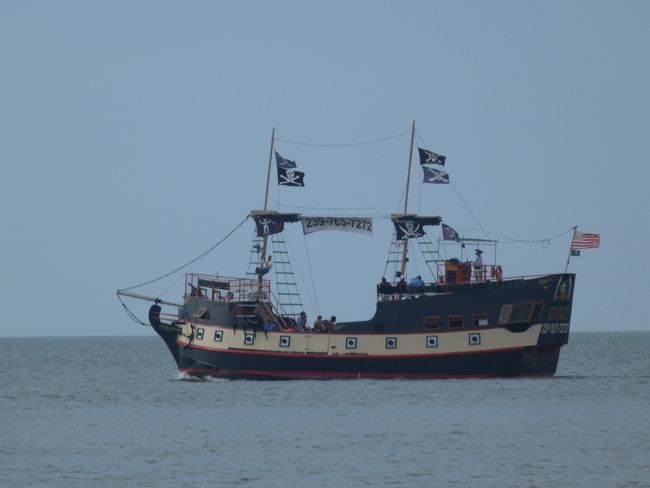
Just as the ceremony started, along came a pirate ship! Some things, you just can’t plan, they just happen.
They all told family stories, and one of them stuck in our hearts because it reflects our own experiences growing up in the Moslem world. The groom, as a young man, came home flustered because a woman on the metro, as he was coming home, noticed he was not wearing an undershirt under his T-shirt, and assumed he was a homeless child. She started talking with all the other passengers, and they marched him off the train to the souks, where they insisted on buying him an undershirt (who knew that you were not properly dressed in Turkey unless you were wearing a sleeveless undershirt?) and also a sweater, to keep him warm on the streets. All this, in spite of the fact that this homeless boy spoke excellent Turkish and kept telling them he had a home! No! No undershirt, he has to be homeless.
Few people in America know the kindnesses we experience living in the Moslem world. It may not always make sense to us – in Tunis, we always wondered if we were getting the annual Eid platter of lamb and couscous showed up because we were thought to be poor or because we were strangers? There has always been a sweetness and generosity to our Moslem neighbors that humbled us. Because of the layering upon layering of these kindnesses, we see Islam, and the Middle East, differently from most of our American friends who have never lived among Moslems. Maybe if we all knew one another a little better, we would have less cause to fear one another, and maybe without all that fear, we could manage a little less hatred.
What is a wedding without babies and children to remind us of the Circle of Life (which AdventureMan calls The Circle of Death). This little one speaks English and Turkish already, and loved the sugar white sands of Ft. Myers Beach and the little seashells, just her size.

As more and more people cross borders, for work, for play, for marriage, for education, as we live in ‘alien’ cultures and learn other ways of thinking, maybe we are growing into an entire world with a larger viewpoint?
Kuwait: Operation Hope Keeps on Giving
Brava, Sheryl Mairza, brava for the good work you are doing that makes so much difference in so many lives. May God bless the work of your hands! From the Kuwait Times:
Spreading cheer in the land
Sheryll Mairza
Operation Hope, an NGO established by Sheryll Mairza, is touching people’s lives throughout the world. A grassroots humanitarian outreach that is motivated by compassion to alleviate suffering in Kuwait, Operation Hope serves those in the greatest of need through the support of the local and international community. Since 2005, more than 50,000 bags of winter clothing have been distributed to impoverished workers in Kuwait.
Operation Hope is now slowly reaching out to people around the world through organizations and individuals. After the recent typhoon in the Philippines, Operation Hope contributed relief goods for the affected areas.
“For the Philippines, we contributed some of our collected goods when we were approached by organizations and individuals to help them in their relief efforts. We have a lot of gently used clothes ready to be sold, but we gave it to third party organizations that shipped it to typhoon victims in Philippines,” Mairza said.
Another instance where Operation Hope reached out to people of other countries was through a proxy. Mairza said a Gambian woman who wanted to stock her library with books had her wish fulfilled. “We were approached by a woman from Gambia who had started a drive to fill her local library with books so she could help boost the literacy rate of adults there. We have an abundance of books here, so we helped her and shipped the books to Gambia,” she said.
According to Mairza, Operation Hope has a very limited budget and people to do international relief efforts, but through third party organizations, they can reach people on the other sides of the world. “We cooperate with people in areas where need arises. If people there want to start volunteering work similar to Operation Hope, they can do so. I allow the use of Operation Hope’s plans,” she mentioned. “I don’t personally want to go to different places to set up Operation Hope. If volunteers like to spread it in other countries and set up their own NGOs, they can take my blueprint and apply it there. They can be founders of Operation Hope for example in Malaysia, Indonesia or Philippines. I will be happy to share the formula I used to set up this NGO,” she said.
Creative Ways
Mairza admitted Operation Hope was affected by the global financial crisis of 2008, which saw a great decline of support from donors. “When it became evident that support was dwindling, we came up with more creative ways to keep the funds flowing. We started Christmas bazaars and sold used clothes and kitchenware to raised funds. With the support of locals and expats, we opened a boutique inside a compound of my in-laws’ house to sell gently used household items.
The need is great and extended beyond winter, so we organized more frequent bazaars. A vast place in my in-laws’ property in Rumaithiya was utilized to display the products. We received so many donations – from toys to clothes to household things – that we didn’t know where to put them; even the embassy shelters had no place to store all of it, so I thought of selling these items,” Mairza said. “With the help of the British Society of Kuwait, we renovated the facility and opened it on January 12, 2012. We are generating income from it and we distribute it in the form of tickets for the repatriation of runaway maids. We also regularly send toiletries and sanitary products for women in the shelters of the Ethiopia, Nepal, Philippines and Sri Lanka embassies,” she explained.
A few months ago, according to Mairza, an Ethiopian woman fell from the third floor of her employer’s house, and her leg was amputated. “Operation Hope provided her with a prosthetic leg, and we helped her rehabilitation,” she noted.
Asked on how he she was able to monitor and control the flow of donations to Operation Hope, she said, “We don’t keep a substantial amount of money in the bank. Whatever we get we give it right away to the needy. We need donations to flow regularly to carry out the work at Operation Hope. We are also lucky to have the support of a woman from the Behbehani family, who has a heart of gold. She is always ready to contribute; always ready to support us financially and emotionally and with words of encouragement. She is a shining star, and one of the Kuwaitis who have been contributing to our cause. This woman calls us and asks what else she can contribute. She is very passionate about helping and serving others
Charity Work
The need for a charity work is great according to Mairza. Apart from individuals and organizations, she is also thankful for the support given to her by educational institutions in Kuwait. “I get phenomenal support from schools. They are very helpful and volunteer time and effort to collect things,” she added.
Mairza dreams a time will come when Operation Hope is no longer needed. “I know this dream is very idealistic, that the gap between the haves and have-nots will narrow,” she said. Realistically, her vision is to continue moving forward to raise the younger generation to be aware of realities and look beyond their personal goals and ambitions.
“I want them to see the persons to their left and right, because at the end of the day, we are brothers and sisters. We come from different places, but we are all brothers and sisters. We need to continue to strive to support and help one another,” she mentioned.
In May 2013, she was presented with $10,000, an award she received for inspiring women of the GCC, sponsored by Philadelphia cheese. “It was a very amazing award which I used to add to our winter program. It was a huge blessing for us,” she concluded.
By Ben Garcia
A King is Given

It is the sweetest, quietest morning in the year; the Qatari Cat awoke me early – well actualy, he awoke me often as the temperatures have dropped dramatically and he wanted my body heat. He is a BIG cat, and takes up a lot of room wherever he stretches out, so I end up sleeping cramped much of the night, LOL. He is such a sweet cat, who can complain?
Yesterday, our church started a new service, a noon service, to help drain off some of the 4:00 and crush of good Episcopalians wanting to start Christmas with a moment of holiness and order before the chaos. Noon was a perfect time for me, and it was a perfect service, full of great readings and music, a goodly crowd, many people I know, and cold enough to wear one of my vintage German coats, coats I considered ‘investments’ when I thought we would be living in Seatte after retirement. If I get to wear them one day each year, they still look new at the end of this century.
A little later in the day, the festivities began, friends arriving from out of town, a family gathering and Christmas Eve dinner where my beloved daughter in law made some of the best crab cakes with Remoulade sauce I have ever eaten, the children were adorable, and the conversation full of laughter and memories. This morning has dawned clear and cold, the Qatari Cat is fed, AdventureMan still snoozing, and I have a few minutes to share a Psalm from today’s lectionary with you. Life is sweet.
Happy, happy Christmas to all!
Psalm 2
1 Why do the nations conspire,
and the peoples plot in vain?
2 The kings of the earth set themselves,
and the rulers take counsel together,
against the Lord and his anointed, saying,
3 ‘Let us burst their bonds asunder,
and cast their cords from us.’
4 He who sits in the heavens laughs;
the Lord has them in derision.
5 Then he will speak to them in his wrath,
and terrify them in his fury, saying,
6 ‘I have set my king on Zion, my holy hill.’
7 I will tell of the decree of the Lord:
He said to me, ‘You are my son;
today I have begotten you.
8 Ask of me, and I will make the nations your heritage,
and the ends of the earth your possession.
9 You shall break them with a rod of iron,
and dash them in pieces like a potter’s vessel.’
10 Now therefore, O kings, be wise;
be warned, O rulers of the earth.
11 Serve the Lord with fear,
with trembling 12kiss his feet,*
or he will be angry, and you will perish in the way;
for his wrath is quickly kindled.
Happy are all who take refuge in him.
Saudi Women Working in Shops
This weeks New Yorker, with a delightful cartoon of Pope Francis on the cover, making snow angels (Isn’t it great to see a powerful man having so much fun doing his job?)

. . . there is also a truly wonderful article, sympathetic and well written, about Saudi women being allowed to work in select shops. New Yorker only allows me to print an few lines from the article, but I loved how it captured the delight these women take in having a little bit of life outside the home to call their own. It also covers the dilemma of dealing with the religious police, the Muttawa, who are in a fit because now women will be in contact with MEN and who knows what might happen?
I had not read anything in the papers – our papers rarely cover smaller details of life in the Middle East. We were there when men were in every shop, selling underwear, selling abayas, and not a woman to be seen. This is a major change, done so so quietly, and women who need more space to breathe are finding a little bit of that space.
Not every woman wants to work outside the home, but many are bored and restless. When they talk about working, they talk about the friendships they form with other women, the pride they take in having a purpose to their daily life, and the increased respect with which they are treated by family members – all good things. The article is sensitively and sympathetically written.
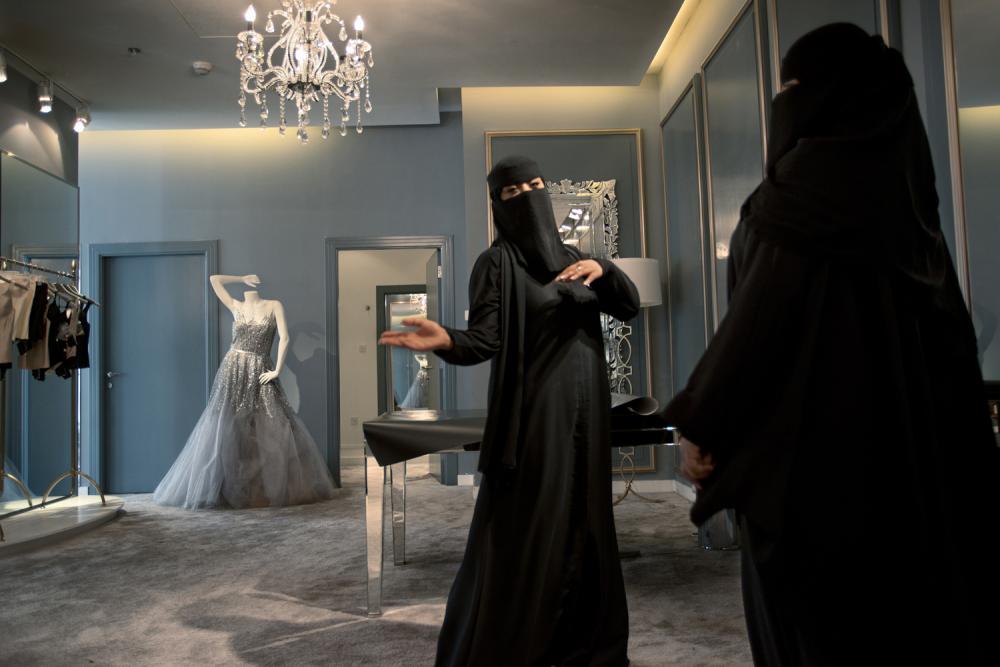
LETTER FROM RIYADH SHOPGIRLS: The art of selling lingerie.
BY KATHERINE ZOEPF
DECEMBER 23, 2013
A women’s revolution has begun in Saudi Arabia, although it may not be immediately evident. This fall, only a few dozen women got behind the wheel to demand the right to drive. Every female Saudi still has a male guardian—usually a father or husband—and few openly question the need for one. Adult women must have their guardians’ permission to study, to travel, and to marry, which effectively renders them legal minors. It took a decree from King Abdullah to put tens of thousands of them into the workforce. For the first time, they are interacting daily with men who are not family members, as cashiers in supermarkets and as salesclerks selling abayas and cosmetics and underwear.
One afternoon in late October, at the Sahara Mall, in central Riyadh, the Asr prayer was just ending. The lights were still dimmed in the mall’s marble corridor, but the Nayomi lingerie store had been unlocked. The rattle of steel and aluminum could be heard as security grilles were raised over nearby storefronts. Twenty-seven-year-old Nermin adjusted a box of perfume on a tiered display near the entrance, then turned to greet six saleswomen as they filed out of a storeroom, preparing to resume their shift. Nermin started working at Nayomi eighteen months ago, as a salesclerk herself. She was warm and engaging with customers, and was recently promoted to a position in which she oversees hiring and staff training for Nayomi stores across four Saudi provinces. All the employees wore long black abayas and niqabs, which revealed nothing but their eyes. They positioned themselves among the racks of bras, underpants, nightgowns, and foundation garments—black-cloaked figures moving against a backdrop of purples, reds, and innumerable shades of pink.
Nermin is one of the Nayomi chain’s longest-serving female employees. She was hired nearly a year after King Abdullah issued a decree, in June of 2011, that women were to replace all men working in lingerie shops. Early in 2012, on a visit to the Nayomi store in a mall near her house with her younger sister, Ruby, Nermin noticed a poster advertising positions for saleswomen. The sisters had never considered working, since there were virtually no jobs for women without a college degree or special skills. Nermin and Ruby mostly spent their days watching television, exercising, and surfing the Internet. In a blisteringly hot city with few parks, the mall was one of the only places to go for a walk. They filled out applications on the spot, and their family encouraged the idea. “I was surprised to find that I like to work,” Nermin said. Ruby, who got a job at the same store, is now the manager there. She wore its key on a yellow lanyard around her neck; pink-trimmed platform sneakers were visible beneath the hem of her abaya. After graduating from high school, she had spent four years feeling increasingly trapped at home, she said. “Nayomi gave me the chance to go on with life.” . . .
Recent Comments
intlxpatr on Shampoo Ginger tigerbutterya0c5ff1d… on Shampoo Ginger intlxpatr on British Soldier Kidnapped, Esc… John on British Soldier Kidnapped, Esc… intlxpatr on British Soldier Kidnapped, Esc… Wikipedia Donate Button

Amazina


Early Voting in Florida


