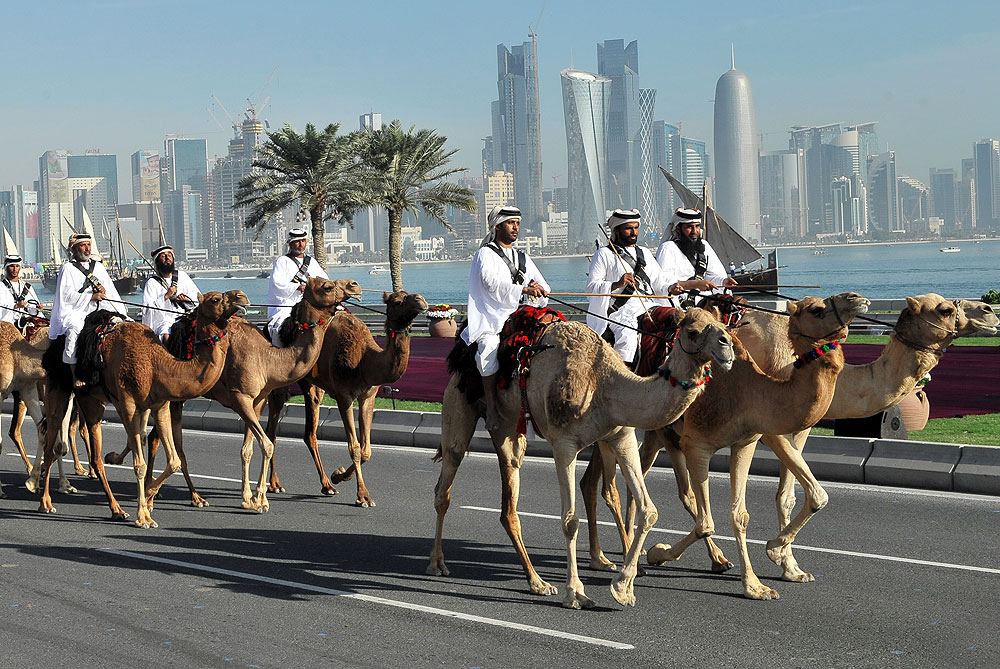
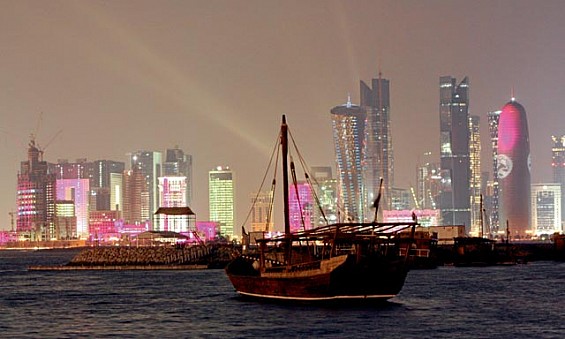
Mabruk Qatar: Qatar National Day 18 December
Congratulations, Qatar, greatly blessed with abundant supplies of natural gas and thoughtful leaders using the new wealth of the nation to benefit Qatari citizens through education and culture.
We thoroughly enjoyed our time living in Qatar, and the unique experience of watching a sleepy little village transform itself into a metropolis.

Pensacola, A Very Middle Eastern City
We had no idea when we left home this morning that when we got to the school, all the parking spaces would be full and it would be almost impossible to find a seat in the auditorium. It was only 8:45 in the morning, and it was only the Pre-K 3’s who would be performing.
We had forgotten – Pensacola is like the Middle East. Family first, and time off for a Christmas Pageant – well, of course!
Pensacola is not like Seattle, or any of the larger cities. While spread out, it is only around 50,000 people, and the worst traffic is never that bad, not if you’ve driven in Amman, or Seattle, or Qatar, or Kuwait. You may not have to stop while the shepherd and his sheep cross the road, but you can get to downtown Pensacola from almost any part of the city in under 15 minutes.
The parking spaces were GONE. The auditorium was PACKED. Friends were greeting friends, all dressed in the reds and greens of Christmas time.
And then the children marched in, and it was barely controlled bedlam as these young stars spotted parents and grandparents and yelled “Grandpa! Here I am!” and angels and sheep and shepherds and wise men all were carefully lined up to sing their songs and tell us the Christmas Story as only 3-years-old can. Oh, it was not to be missed!


We love it that Pensacola is not a city with a lot of rushing about; people have time to go see their children in the school Christmas pageant, that the teachers take the time to herd these cats so that they can sing the songs, do the motions, and probably, if asked, give a rough outline of what happened on that first Christmas.
It’s all a matter of priorities. Pensacola, like our homes in the Middle East, places a high value on family activities, family time, and a balance of work and family where family time has a cherished place.
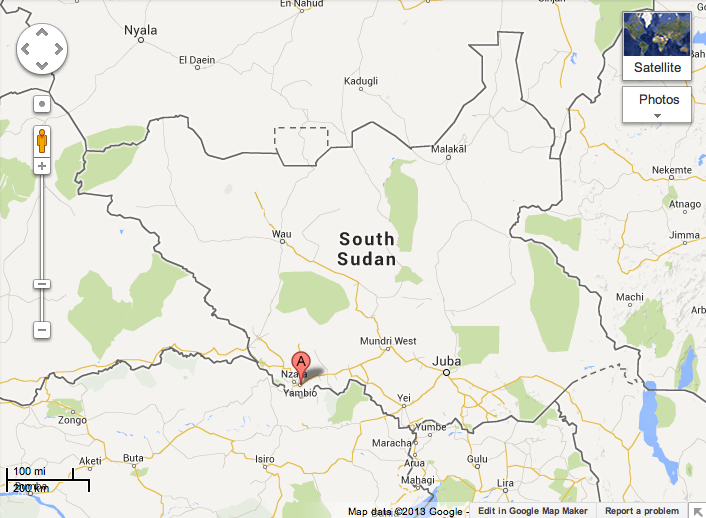
David, and Where is Yambio, South Sudan?
A year ago, we had an extraordinary experience. We often entertain delegates visiting from other countries, and this time we had three African journalists, and, strictly by chance, they all turned out to be Christian. Most of our gatherings are strictly ecumenical, but these were joyful, praying Christians, and the evening took a turn we never anticipated.
“So how did you find Jesus?” one woman asked David, from the newest country in the world, South Sudan. Inside, I was shocked, and when I am shocked, my tendency is to laugh, I don’t know why, it is just the way I am wired. Every culture is so different. In the South, people might ask that of one another, particularly if you worship in a fundamental sect, but our sect is more formal, and to inquire into another’s spiritual life can be perceived as intrusive.
David, however, was not taken aback. “It’s a long story,” he said, and we all settled into comfortable chairs to listen better. It was Christmas, the decorations were up, the lights all twinkling and we had eaten. A good time for a story.
It was a long story. It started with a little boy in a happy family, who one day was told to run! Run! Run into the forest and hide! The riders were coming! His family grabbed a very few things and ran.
His family ran for years. His family ran into forests, across borders, into dry arid spaces. Sometimes some of the children would get separated from their parents for a while, but they would keep asking, and eventually meet up again, only to face separation again. Their whole lives were running, from the Janjaween, from border police, from robbers.
At one point, he and a brother stayed in a church, and a priest taught them about Jesus. Simple stories, simple songs, and he drew letters and numbers in the dirt – that was his early schooling. It was a haven of peace for him.
Many years later, the family was reunited in their village in the new country of South Sudan. Miraculously, every member of his family survived, indeed, most of his village survived. They had maintained lines of communication through all those years of running and separation, and were so thankful. Most of all, now, they were thankful – they had a church in their village. David had learned to love learning, and had completed his education and had found a wonderful job.
“I don’t know the book like you do,” he told us, “I only know it like a little child sitting at the feet of that priest, but I am learning.”
I can’t help but think that David knows more than he thinks. David holds his belief in Jesus like a child, simple and direct. His testimony is powerful and unforgettable. I am in awe, even a year later, of his story and testimony.
Today the church prays for the diocese of Yambio, in the South Sudan:
Qatar Wins Guiness Record for Largest Flag

As Qatar goes into National Day frenzy, they capture the title for World’s Largest Flag. Mabruk, Qatar!
As the country gears up for National Day celebrations, a Qatar national flag measuring 101,000+sqm was yesterday recognised by the Guinness World Records as the largest flag in the world, beating current record holder Romania, which created a 79,000sqm flag last year.
The flag, described as the “Flag of Gratitude and Loyalty”, is currently spread across a large area on the outskirts of the capital.
The announcement was made in the presence of a huge gathering of Qatari citizens at a glittering ceremony held at the Katara amphitheatre.
A Guinness World Records official flown in from the UK presented the certificate of recognition to a representative of the “Flag of Gratitude and Loyalty” team at the event.
Speaking about the flag, the Guinness World Records official said: “This is a big challenge and one of the most difficult records I have seen. The record grew many times from 1976 and the current record to break is almost 80,000sqm. It was established in Romania last year with a flag that set the record of 79,000sqm.”
He described the Qatari flag as “a very large engineering project involving a lot of challenges”, which must follow the Guinness World Records guidelines.
“More than 2,000 people have taken part in this project, which is supported by Brooq Qatari Magazine and Katara. Yesterday, I went to see the flag on location and was impressed by the quality of manufacturing, stitching, material and quality of fabric – all were of very high standards, as well as the participation of the people involved as nobody wanted to leave after the work was done. The flag means so much to them than just its size,” he pointed out before announcing the size of the flag.
The audience at the unveiling event were later serenaded by the Qatar Armed Forces orchestra.
Zabbaleen Cave Church in Cairo
My friend Hayfa sends me the most amazing things. Her mind is another Here, There and Everywhere Kind of mind. 🙂
This article resonates with me because when we moved to Tunis, the garbage collectors would fight over our trash. I felt horrible, we had an infant, and there were diapers in the trash. 😦 Our maid would take cans and jars and especially jars with lids out of the trash, and ask if she could take them. We learned before throwing anything away to see if she wanted it first. They used, and re-used, everything. We learned to look at our consumption in a whole new way. It was one of the best things about living in an ‘alien’ community; we learned to see ourselves with different eyes.
Thank you, Hayfa, for this fascinating article.
The Cave Church of the Zabbaleen in Cairo
The Monastery of Saint Simon, also known as the Cave Church, is located in the Mokattam mountain in southeastern Cairo, Egypt, in an area that is known as ‘garbage city’ because of the large population of garbage collectors or Zabbaleen that live there. The Zabbaleen are descendants of farmers who started migrating from Upper Egypt to Cairo in the 1940s. Fleeing poor harvests and poverty they came to the city looking for work and set-up makeshift settlements around the city. Initially, they stuck to their tradition of raising pigs, goats, chickens and other animals, but eventually found collecting and sorting of waste produced by the city residents more profitable.
The Zabbaleen would sort through household garbage, salvaging and selling things of value, while the organic waste provided an excellent source of food for their animals. In fact, this arrangement worked so well, that successive waves of migrants came from Upper Egypt to live and work in the newly founded garbage villages of Cairo.
For years, the makeshift settlements of the Zabbaleen were moved around the city trying to avoid the municipal authorities. Finally, a large group of Zabbaleen settled under the cliffs of the Mokattam or Moquattam quarries at the eastern edge of the city, which has now grown from a population of 8,000 in the early 1980s, into the largest garbage collector community in Cairo, with approximately 30,000 Zabbaleen inhabitants. Egypt is a Muslim-majority country, but the Zabbaleen are Coptic Christians, at least, 90 percent of them are. Christian communities are rare to find in Egypt, so the Zabbaleen prefer to stay in Mokattam within their own religious community even though many of them could afford houses elsewhere.
The local Coptic Church in Mokattam Village was established in 1975. After the establishment of the church, the Zabbaleen felt more secure in their location and only then began to use more permanent building materials, such as stone and bricks, for their homes. Given their previous experience of eviction from Giza in 1970, the Zabbaleen had lived in temporary tin huts up till that point. In 1976, a large fire broke out in Manshiyat Nasir, which led to the beginning of the construction of the first church below the Mokattam mountain on a site of 1,000 square meters. Several more churches have been built into the caves found in Mokattam, of which the Monastery of St. Simon the Tanner is the largest with a seating capacity of 20,000. In fact, the Cave Church of St. Simon in Mokattam is the largest church in the Middle East.
 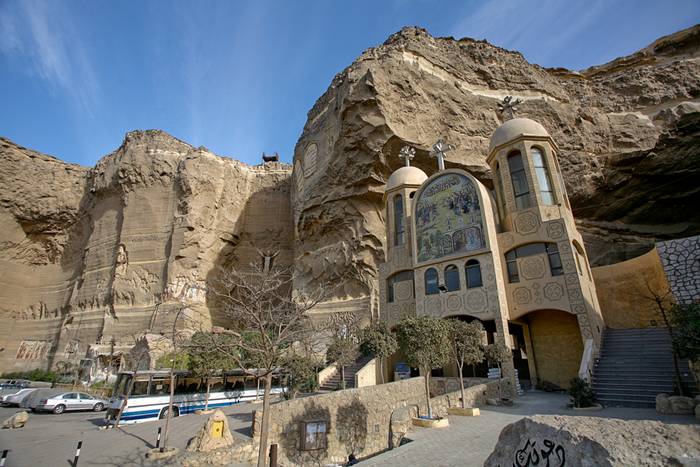 Photo — Link
 Photo — Link
 Photo — Link
 Photo — Link
 Photo — Link
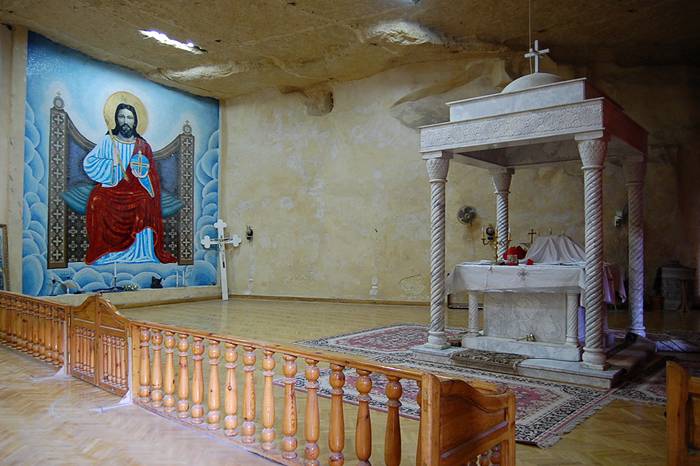 Photo — Link
 Photo — Link
 Photo — Link
 Photo — Link
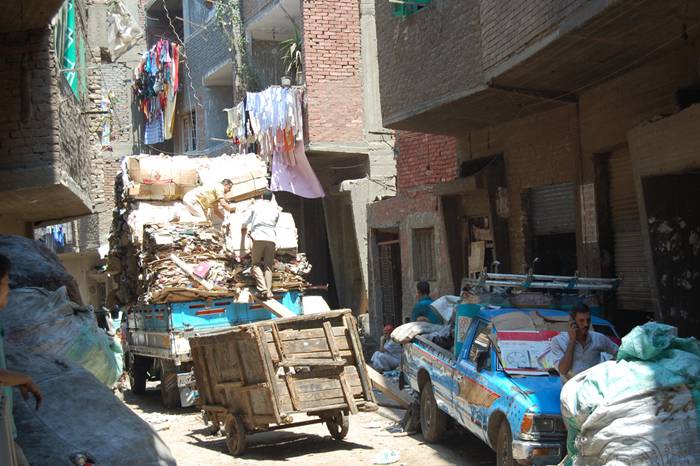 Photo — Link
|
USAF Band Flash Mob at National Air and Space Museum
Once again, Hayfa, you have found a total winner. Wonderful music, wonderful surprise for the museum visitors 🙂
Christmas Mercies
By the grace of God, we got through the first week of December. By the grace of God, we managed to enjoy our first week in December!
The first week in December this year followed directly after Thanksgiving. Often, there is a weekend between Thanksgiving and December, but this year, December started on Sunday, and there goes one weekend before Christmas. You might wonder why this is even important, but for some reason, there are so many things scheduled the first week of December, on top of the normal things scheduled for the first week of every month – you know, small things like bill paying and making sure your finances are in order 🙂
So we had our normal first week of the month – Book Club, babysitting, exercise classes, bible study – AND. And we had a house guest, a very old friend, a friend from all the way back in Tunis, when we were all studying languages, our guest and my husband learning Arabic and me learning French. Our guest and I sang in the community choir together, and he was very much a part of our small expat family. Having him in our home was so easy, we came and went, fortunately at different times. On top of all this, we also had a couple of annual Christmas related events, social events, we had to attend. By the grace of God, it all went smoothly, and – this is the mercy – enjoyably. We weren’t stressed.
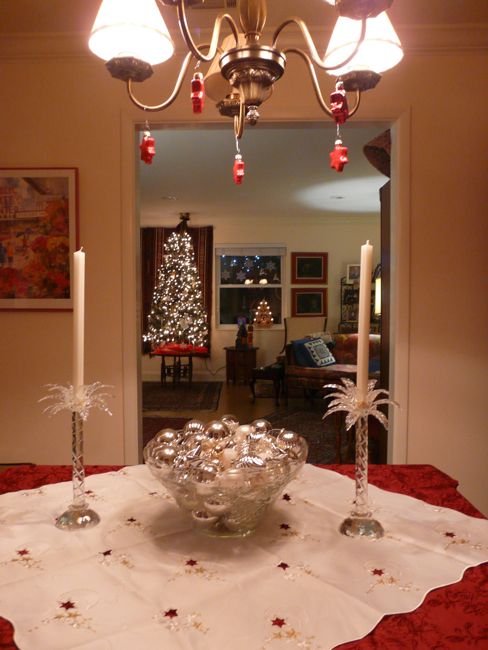
I was stressed a little yesterday. The last two days have been horrible for me, in terms of climate. You know, I like NO air conditioning, I like temperatures in the 60s and 70s (F) but the temperatures were almost 80 and HUMID. Bad enough I had to turn on our A/C last night so I could sleep, and feeling so grumpy. I really need to get the Christmas decorations up this weekend so I can get on with my December, enjoy the Christmas ambiance and not have to stress about getting things done. But how do you get Christmas decorations up when you are hot and sweaty, it just isn’t right.
Major mercy – when I woke up this morning, I was wrapped warmly in my quilts and . . . I wasn’t feeling hot or sweaty. As as matter of fact, overnight the temperatures had fallen into the 40’s! Woooo HOOOO, out came all the Christmas boxes and tubs; AdventureMan got busy putting up the lights, I pulled out the other things and we got busy. Around lunch time we had a wonderful lunch, and then went searching for more light; I hadn’t bought enough to cover the length of our porch. After four fruitless stops (the lights had to match or it was all for nothing) we came home empty handed and I checked online for where this brand was sold. It was Home Depot, the one store we hadn’t stopped at because I was so sure I hadn’t bought them there. Wooo HOOOO, one quick trip and we have all the lights we need and AdventureMan got them all up.
AdventureMan is more scrupulous than I am about some things. He . . . . read the instructions on the lights. Have you ever done that? Like where it talks about amps and resistance and fire warnings? LOL, I love a lot of lights, and will string lights on lights on lights. Somewhere in the dim recesses of my mind I sort of knew it might be dangerous, but AdventureMan takes those things seriously. The good thing is that we are still married, and much more safely wired than when I was doing it.
I can hear my son scoffing when I say that today was God’s mercy on me, but to him I say God makes it to rain on the righteous and the unrighteous, and as undeserving as I am, today he gave me exactly what I needed – a chilly, Christmas-decorating kind of day. Thanks be to God.
Killing the Golden Goose in Pensacola
Every place we have ever lived in has it’s own politics, and the politics in Pensacola are opaque, and to me, bizarre. We have a very pretty mayor – great for photo ops – but WHAT IS HE THINKING???? He displays some of the very worst traits of the old-boy way of doing business. What are those traits? How about telling one of the top grossing restaurants in Pensacola that they now owe $5M because they haven’t been paying a percentage of their revenue to the City of Pensacola? How about voting a Dollar Store into an upper level residential neighborhood? Singlehandedly re-naming a small airport without a single international flight Pensacola “International” airport? How about allocating all the food services at our “International” airport to bland chains, rather than some of our really good local vendors?
Lots of behind the scenes machinations, not putting items on the agenda – countering the spirit of the Sunshine Laws and making the deals in public – giving those who will be impacted some input on the measures.
It’s killing the golden goose. When something is working – and the Fish House restaurant is a go-to place in Pensacola, a place you meet up with friends and a place you take your out-of-town visitors to show off the city – LEAVE IT ALONE! When good people like the Studers and Collier Merrill are investing in downtown Pensacola, and building downtown up as a destination, let them make a buck or two – they are breathing life into the city! Do not kill the golden goose!

“The Emperor Has No Clothes!”
In contrast to some of the places we have lived, Pensacola has an outspoken paper – Our favorite newspaper, Rick Outzen’s Independent News has several wonderful articles this week. It’s where you find out what is really going on in Pensacola. His paper will bravely call out when the emperor has no clothes. I have shamelessly copied and pasted from his website at the Independent News:
How Not To Do Business
 City vs. The Fish House
By Rick Outzen
The title of the Pensacola News Journal’s (PNJ) article on Tuesday, Nov. 26 could have easily been “Mayor Accuses Fish House of Cheating City Out of Millions.” It wasn’t, but that is how some interpreted the article about the default notice sent on behalf of Mayor Ashton Hayward to Collier Merrill, co-owner of the restaurant.
But PNJ readers didn’t know what Merrill knew—that the notice was a negotiation ploy by the city, unsupported factually or legally, according to his attorney. They also didn’t know that the notice itself was leaked, Merrill believed, to the media to hurt his business.
The notice demanded that Seville Harbour, Inc. (owned by Ray Russenberger) and Merrill Land LLC (owned by Burney, Collier and Will Merrill) pay as additional rent payments five percent of The Fish House and Atlas Oyster House’s gross sales since April 2000, plus interest—an amount that could total well over $5 million.
Seville Harbour, Inc. has the ground lease for Pitt Slip, the name given to the three parcels owned by the city that include the anchorage between the Port of Pensacola and Bartram Park. Merrill Land LLC bought in April 2000 the building on the property from Seville Harbour for $1.3 million and subleased the parcel upon which it was built.
The default notice stated that the two companies had 90 days to pay up or the city would terminate the master lease, which would shut down the two restaurants on Feb. 13, 2014.
The impact of the article on The Fish House was immediate. Merrill tried to prepare his staff for any questions from customers.
“I had a meeting with the managers the next morning at 9:30 after the written article came out,” he said. “As much as you can say everything is fine, a few were a little hesitant. They were getting calls from other restaurants; one guy was offered a job.”
Jean Pierre N’Dione, the general manager of the two restaurants, said that the holiday business has been slower than prior years. He’s also dealt with questions from customers.
“The day of the article, a couple came in and said they were here to get a meal before the restaurant closed,” said N’Dione. “They were thinking we were going to be shut down in a few days. It was difficult to say if they were jokingly saying that or if they really believed it.”
The restaurant’s party and catering businesses have also been hurt by the city’s threat.
“We’ve definitely lost business,” said Merrill. “Over Thanksgiving weekend, there were brides in town booking their parties for next October. They didn’t want to take the chance that we might not be in business next year. People are now hesitant to book their Christmas parties with us.”
Why would the mayor’s office resort to such strong-arm tactics? Many would expect a default notice to be sent by Mayor Hayward only after his negotiations with Seville Harbour and Merrill Land had hit an impasse, especially when the notice is a public record that could hurt two landmark restaurants.
However, there had been no negotiations with the city, though Russenberger’s attorney asked for the leases to be combined in 2009. The leases were properly renewed in July 2011, and the mayor had never sent them any written proposals for the properties.
Merrill told the IN that he had only two meetings with the Hayward administration on the lease—one in 2011 with City Attorney Jim Messer and then Chief of Staff John Asmar, the other this past September with City Administrator Colleen Castille. Neither time did the city officials bring up anything about the restaurants owing millions in back rent. Never did the city ask for five percent of his restaurants’ sales.
“We have been waiting for the city to get back to us,” said Merrill. “We had no idea this was an issue or the mayor’s position on the leases.”
Pensacola Landmark
For many, The Fish House is an iconic Pensacola landmark.
The restaurant has hosted presidents, governors, senators, congressmen and other celebrities. During the 2008 presidential election, John McCain, Rudy Giuliani and Fred Thompson held campaign fundraisers there. This past election cycle, GOP presidential hopeful Mitt Romney, with McCain, actor Jon Voight and Mayor Hayward, held a rally on The Fish House deck, pictures of which appeared in the Washington Post and New York Times.
Chef and co-owner Jim Shirley has served his famous Grits a Ya Ya for dignitaries in Washington, D.C. and New York City. Pensacola native, former congressman and author Joe Scarborough has hosted his MSNBC show “Morning Joe” several times from the restaurant.
Three reality shows have been filmed there. The Travel Channel aired an episode of “Bizarre Foods” that featured The Fish House’s grouper throats. “American Pickers” also filmed an episode from The Fish House, which featured the Merrill brothers trading some of their memorabilia for a model of the USS Atlanta. This past August, Chef Emeril Lagasse showcased The Fish House as part of his show “Emeril’s Florida” on the Food Network.
The Fish House and Atlas Oyster House have made Pitt Slip a destination for many visiting our area, serving an estimated 500,000 customers a year. They also are part of what was one of the city’s first public-private development projects.
In the 1980s, the Pensacola City Council wanted a marina built on Pitt Slip, the inlet across from the town’s historic district and outside the gates of the Port of Pensacola. Three parcels were combined—the water area for the docks (Parcel 1), the area along Barracks Street that the city leased from the state (Parcel 1A) and the lot south of the marina (Parcel III).
The intent was to lease to a developer the parcels for 30 years with a renewal option for an additional 30 years. When the original lease was executed in 1985, the city learned that its lease for Parcel 1A with the state only had 27 years remaining. The city had to amend the original lease to adjust its end date. The state required that it be renewed for five successive five-year periods.
The history of the development was filled with ownership changes and business failures. The project never was as successful as the council had hoped until Russenberger and the Merrills got involved.
In January 1998, Chef Jim Shirley rented the space formerly used by the closed Beef & Ale House in the Seville Harbour building on Parcel 1A. He opened the Fish House with Brian Spencer and Dr. Roger Orth as his investors. By the spring, Merrill brothers stepped in as investors in The Fish House, forming Great Southern Restaurant Group of Pensacola, Inc. that put about $2 million into the restaurant, according to Merrill. Spencer and Orth focused on Jackson’s, a restaurant they were opening on Palafox.
“At the time, my brothers and I had invested in several businesses downtown,” said Merrill. “We bought the Bass building on the corner of Palafox and Gregory and were the landlord to Jim Shirley and the Screaming Coyote. We bought Seville Tower on the corner of Palafox and Government streets, which is where my grandfather had his offices in the 1940s.”
He said, “We wanted to move downtown. At the time, our offices were near the mall at Madison Park. Though not a lot was going on downtown, we loved it and saw the potential.”
In 2000, Merrill learned Russenberger was looking to sell the Seville Harbour building. Merrill Land LLC, the brothers’ real estate development company, bought it for $1.3 million and agreed to sublease the ground lease for parcel 1A upon which it was built at the same terms of the master lease. The purchase and sublease were both recorded with the clerk of courts.
Great Southern Restaurant Group went from renting from Seville Harbour, Inc. to renting from Merrill Land LLC.
“Merrill Land got a loan to buy the building, on which it is still making payments,” said Merrill. “It’s like any business. It rents out spaces. We charge rent and hope that those collections are enough to cover our mortgage, lease payment to Russenberger for the ground lease, utilities, repairs and maintenance. At the end of the day, we hope to make a profit like any landlord does.”
Merrill admitted he has been surprised by how much he has come to like the restaurant business. He enjoys the positive feedback he receives from customers and is proud of the role The Fish House plays in the community.
“Maria Goldberg, our marketing director, and I get together once a week,” said Merrill. “We go over all the requests for donations from charities, and there’s always a stack of them. We try to help every one of them, from the high school booster clubs to the NICU at Sacred Heart.”
The Fish House caters events for charities, hosts parties and donates appetizers and the services of its chefs for other fundraising events. He said, “We’ve tried to be good citizens by giving back to the community, trying to get downtown going and helping to promote Pensacola.”
Legal Battle
The default notification from the city asserted that it was entitled to five percent of the gross sales of the restaurants because Merrill Land had been partially assigned the master lease when it bought the Seville Harbour building. The city claimed Great Southern Restaurant Group was a subsidiary or business combination of Merrill Land and therefore should have paid rent based on its gross sales.
Attorney Bruce Partington responded on Nov. 27 on behalf of Seville Harbour and Merrill Land LLC.
First, he made it clear that the leases had been properly renewed. According to Partington, the renewals required nothing more than delivery of a written notice. The letter exercising the renewals was sent July 21, 2011 by Leo Cyr on the behalf of Seville Harbour.
Seville Harbour never partially assigned its lease to Merrill Land.
“Seville Harbour retains multiple rights and duties with respect to the property sub-leased to Merrill Land,” said Partington. “The fundamental concept of an assignment is that the assignor’s entire interest is transferred to the assignee which did not occur here.”
He pointed out that the city had refused in 2000 to approve any assignment to Merrill Land, which is why the transaction was done as a sublease. He asserted that the city’s new position of the relationship between the two companies being an assignment was “irreconcilable and fundamentally inconsistent” with its position 13 years ago.
He pointed out the two restaurants are not owned by Merrill Land. The owner, Great Southern Restaurant Group, “is not, and has never been, a ‘subsidiary or business combination’ of Merrill Land.”
“Merrill Land has no ownership or other interest in Great Southern Restaurant Group, nor does Merrill Land receive any portion of the revenues from the operation of the restaurants on the property.”
Partington believed that the city’s position is without merit and based on “two dubious propositions which are unsupported factually or legally.”
He expressed Merrill’s concerns about how the daily newspaper got wind of the letter one day after the certified letter was received.
“It is extremely troubling that Seville Harbour’s multiple attempts over several years to meet with representatives of the city to discuss the lease were ignored,” wrote Partington, “and then, after years without a response, receive a notice of default, which was then leaked by the city to the media for dramatic effect.”
He put the city on notice that it was responsible for any damage that the leak may have caused Great Southern Restaurant Group.
The Leak
Merrill admitted that when he first received the letter from Daniel he was not that concerned. He was surprised the attorney brought up gross sales, but believed that the restaurants were on solid legal ground.
He said, “I wasn’t really worried about it. I don’t even think I told my brothers about it because I knew it was baseless.”
He sent the letter to Stephen Moorhead, Russenberger’s attorney, to review. Then on the afternoon of Thursday, Nov. 21, Merrill received a call from the PNJ saying that they had heard about a letter sent to him saying The Fish House owed the city millions of dollars. The reporter would not tell him how they got that information, but he admitted they had not yet seen the letter.
Merrill called City Administrator Colleen Castille, who denied any responsibility for the leak. “Colleen, I don’t think you understand the severity of this. This is going to be a front-page story and I’m going to lose business immediately.”
A meeting was set up for the following morning between the daily newspaper, Castille and Merrill. He hoped that the City Administrator, whom he had given the details of the leases in September, would say the letter was wrong. That did not happen.
According to Merrill, she said the letter was a negotiating tool.
“I said that’s fine if you want to sit down at the negotiation table. We’ve been wanting to do it for years,” Merrill recalls what he told Castille at the meeting.
“But to say something that bad about my business is just wrong. I told the City Administrator that to send out a totally baseless letter with inaccurate facts to hurt my business is almost criminal.”
The IN asked the city for an interview with Castille for this article. The city’s communications director, Tamara Fountain, replied the following week, “Colleen has decided not to do any further interviews.”
The city did not offer for anyone else to explain the mayor’s decision to send the default notice or talk about the negotiations and did not give the paper permission to talk to its attorney Nix Daniel.
Who does Merrill think leaked the letter?
“Obviously it had to come from the city. It was either someone with the city or they gave the information to someone who then leaked it to the News Journal,” he said. “The last thing I wanted was this inaccurate letter to come out, because it’s hard to get that genie back in the bottle. I knew people were going to think The Fish House owes the city millions and the city was going to shut us down.”
Merrill said that the city knows the letter is totally inaccurate. “We’ve paid every bit of rent we owe. We’ve shared our financial information. I’m shocked that the mayor’s office would use this tactic. We sat down with Colleen, explained all the details of the leases and we thought it was all good—until we got the default notice.”
He said for the city to send out a default notice demanding millions of dollars without any discussion is unconscionable. “We properly and legally renewed our leases in July 2011. We got a letter from the city attorney that our attorney responded to almost immediately. We received nothing in writing until two years later and it’s a baseless default notification about something that the city has never mentioned to us was even an issue.”
Merrill asked, “What kind of message does this to send to businesses looking to invest in Pensacola and possibly partner with the city?”
Editor’s notes: •Collier Merrill owns a five percent interest in the Independent News. Ray Russenberger owns 2.5 percent of the paper. Neither has, or has ever had, any control over the paper’s editorial coverage.
•At the time of print, the mayor and his attorneys had scheduled a meeting for Monday Dec. 9 to discuss Pitt Slip with Ray Russenberger, Collier Merrill and their attorneys.
———————————————
Don’t Forget The Airport
Mayor Hayward has been in a dispute with The Fish House over the food services contract at the Pensacola International Airport.
Hayward recommended to the city council at its Sept. 26 regular meeting the 10-year concession contract should be awarded to OHM Concessions—which included Chick-fil-A, Einstein Bros. Bagels, Surf City Squeeze and Corona Beach House. Collier Merrill’s The Fish House had joined forces with Bagelheads, Varona’s, and Pensacola Bay Brewery to offer a more local option that had placed second to OHM during the selection process.
The issue was tabled at the meeting when Merrill, the other local business owners, their employees and citizens spoke out in favor of their proposal. Since then, Mayor Hayward has pulled the item off the council’s agenda twice.
Those familiar with council politics say the mayor simply doesn’t have the votes to win approval for OHM. Did the mayor’s office leak the default notice to the daily newspaper to tarnish the image of Merrill and The Fish House to gain the one or two votes needed to bring Chick-fil-A to the airport?
“I certainly hope not,” said Merrill, “because I would hate to see them use those tactics (the notification of default and subsequent leak to the media) to win on a completely separate issue and to punish my 250 employees and my family.”
The next week in his “Upwords” newsletter Hayward criticized Merrill and the others who spoke out at the council meeting claiming they “ambushed” the council.
“It is a terrible idea to disregard our objective business processes in response to a few influential people politically strong-arming our elected officials,” said the mayor.
Merrill was dumbfounded by the mayor’s comments.
“I spoke before the city council because City Administrator Colleen Castille said that was what I should do,” he said. “She said she was going to let the Airport Director, Greg Donovan, stand on his own. We could make our argument and then we let the council make the decision.”
After the newsletter, he met with Castille and City Attorney Jim Messer and asked for explanation of the mayor’s comments.
“I asked Colleen, didn’t I do what you told me do?” he told the IN. “Basically she told me that she didn’t think we would be that organized.”
On Tuesday, Oct. 15 at his first “Mornings with the Mayor” session, Hayward bristled when asked about his “ambush” comment.
“That’s what I called it,” said Hayward, “It was an ambush.”
The IN asked how so, especially since Merrill had been instructed by the City Administrator to make his case at the council meeting.
“They did, but in my opinion I said it was an ambush,” said the mayor.
Mayor Hayward said of the upcoming council vote on the issue, “We will see what happens. They might win. If they do, we will move on. We’re going to support them and we’re going to say let’s make Pensacola a better place. I’m a big boy. Sometimes you win ’em; sometimes you lose ’em.”
When the council agenda for its Oct. 24 meeting was released, the food services contract was on it. The following Sunday, Hayward supporter Bob Kerrigan wrote a viewpoint in favor of OHM getting the contract. Ads appeared in the daily newspaper supporting the mayor’s proposal. A website was set up for Hayward supporters to send emails to council members.
Then at the council’s agenda review meeting, City Administrator Castille, on the mayor’s behalf, unexpectedly pulled it off the agenda. The mayor appeared no longer willing to lose on the issue.
The airport food services recommendation was not on any of the council’s agenda. On Dec. 2, Merrill received an email from the city that stated the issue would not come up in December either.
“Please be advised that the Airport Director will not be bringing the Food and Beverage concession lease agreement to the Pensacola City Council during its December, 2013 meeting,” wrote Airport Administration & Contracts Manager Michael Laven. “Both the Director and the Mayor will be out of the country on business. We believe that the scheduling of this concession will take place in January or February of 2014.”
Stay tuned.
American Shedding Reliance on Cars
. . . in bigger cities where good public transportation is available, at least. But across the board, Americans are driving less. When I was a young woman living in Seattle, I took the bus to work. It was fast, reliable and I got to read going to and fro. A generation later, my son would park his car at the park and ride lot and take the bus into downtown. When you have GOOD public transportation, it makes a lot of sense. Found this article on AOL Auto News:
Commuters are shedding their reliance on cars.
They’re not driving to work in their own vehicles as often as they once did. They’re not carpooling with other workers as often. They’re increasingly using public transportation or simply working from home.
Those are the conclusions of a study released this week by U.S. PIRG, which reviewed data from the Federal Highway Administration, Federal Transit Administration and U.S. Census figures.
It says the proportion of workers commuting in private vehicles, either alone or in a car pool, declined in 99 of the 100 largest urban areas in America between since 2000.
Newark, New Jersey saw the greatest percentage of workers put down their keys, with a 4.8 percent drop, followed by Washington D.C., down 4.7 percent and Austin, Texas, down 4.5 percent.
In recent years, there have been numerous indications that Americans overall are shifting away from driving. The number of per capita vehicle miles traveled reached its peak in 2004. This study claims to be the first to specifically look at the decline in American cities.
“Many existing transportation plans continue to reflect outdated assumptions that the number of miles driven will continue to rise steadily over time,” wrote Phineas Baxandall, senior analyst at U.S. PIRG and the study’s author. “Officials at all levels should revisit transportation plans to ensure they reflect recent declines in driving and new understandings of the future demand for travel.”
The U.S. PIRG study details changes that on a market-by-market basis. Among its other findings:
– The proportion of residents working form home has increased in every one of the 100 largest urban areas since 2000
– The proportion of households without cars increased in 84 of the 100 largest markets between 2006 and 2011
– The proportion of households with two cars or more decreased in 86 of the 100 largest markets between 2006 and 2011
One of the more notable trends appears to be the death of carpooling as a commuting option. Between 2000 and 2011, carpooling declined 17.8 percent, according to the U.S. PIRG study. Only 9.7 percent of workers now report they share rides to work.
The results are not entirely surprising: The number of Americans who work from home increased 45 percent between 1997 and 2010, according to an earlier study conducted by the U.S. Census Bureau.
Curiously, the decline in driving hasn’t dampened demand for cars. Automakers expect to sell approximately 16.4 million vehicles this year, according to the latest projections released earlier this week. It’s the best year for auto sales since 2007, when more than 17 million cars were sold.
Pete Bigelow is an associate editor at AOL Autos. He can be reached via email at peter.bigelow@teamaol.com and followed on Twitter @PeterCBigelow.
Qatar National Day: What Not to Do

LOL, This is exactly what everyone does. Not doing any of these things will not prevent the absolute gridlock that develops as everyone in the country drives into Doha.
From Qatar Gulf News:
The Traffic Department has urged motorists not to violate traffic norms while celebrating National Day.
In this connection, the department has reminded motorists of certain common violations that are seen during this time and asked them not to commit the same during this year’s celebrations.

These violations include placing pictures, posters and flags on the entire car, thereby completely changing the look and colour of the vehicle; shading the windshield and rear window of the car, obstructing the driver’s view (both of the road in front of him and behind the car) and hiding the car plates; climbing on to the roof and bonnet of a car; getting out through the car’s windows and sunroof, which exposes passengers to the risk of falling down, besides affecting the control of the driver; and blocking traffic and parking in no-parking zones.
The department has appealed to all motorists to celebrate the occasion in a safe and secure manner and not to commit violations that may jeopardise the safety of other road users.
Recent Comments
intlxpatr on Shampoo Ginger tigerbutterya0c5ff1d… on Shampoo Ginger intlxpatr on British Soldier Kidnapped, Esc… John on British Soldier Kidnapped, Esc… intlxpatr on British Soldier Kidnapped, Esc… Wikipedia Donate Button

Amazina


Early Voting in Florida


