Arabs wary of expressing their opinions online
Fascinating study results published in Qatar’s Gulf Times:

Northwestern University in Qatar has released new findings from an eight-nation survey indicating many people in the Arab world do not feel safe expressing political opinions online despite sweeping changes in the aftermath of the Arab Spring.
From over 10,000 people surveyed in Lebanon, Tunisia, Egypt, Saudi Arabia, Bahrain, Qatar, Jordan and the UAE, 44% expressed some doubt as to whether people should be free to criticise governments or powerful institutions online.
Over a third of Internet users surveyed said they worry about governments checking what they do online.
According to the report, “The implied concern (of governments checking what they do online) is fairly consistent in almost all countries covered, but more acute in Saudi Arabia, where the majority (53%) of those surveyed expressed this concern.”
The study – titled ‘Media Use in the Middle East – An Eight-Nation Survey’ – was undertaken by researchers at NU-Q to better understand how people in the region use the Internet and other media. It comes as the university moves towards a more formalised research agenda and is the first in what will be a series of reports relating to Internet use.
The survey includes a specific chapter on Qatar, the only country where those surveyed regarded the Internet as a more important source of news than television. “We took an especially close look at media use in the State of Qatar – a country with one of the highest Internet penetration rates in the Arab world—and internationally,” said NU-Q dean and CEO Everette Dennis.
These findings follow a preliminary report NU-Q released last April that showed web users in the Middle East support the freedom to express opinions online, but they also believe the Internet should be more tightly regulated. “While this may seem a puzzling paradox, it has not been uncommon for people the world over to support freedom in the abstract but less so in practice,” Dennis explained.
Among other findings, the research shows: 45% of people think public officials will care more about what they think and 48% believe they can have more influence by using the Internet.
Adults in Lebanon (75%) and Tunisia (63%) are the most pessimistic about the direction of their countries and feel they are on the ‘wrong track.’
Respondents were far more likely to agree (61%) than disagree (14%) that the quality of news reporting in the Arab world has improved in the past two years, however less than half think overall that the news sources in their countries are credible.
Online transactions are rare in the Middle East, with only 35% purchasing items online and only 16% investing online.
The complete set of results from the survey is available online at menamediasurvey.northwestern.edu. The new interactive pages hosting the survey on the website have features that allow users to make comparisons between different countries, as well as between different demographics within each country.
Dennis confirmed that the research report is the first in an annual series of reports produced in collaboration with the World Internet Project; one of the world’s most extensive studies on the Internet, in which NU-Q is a participating institution.
NU-Q and WIP signed an agreement earlier in the year, providing a global platform for the current research.
Lamborghini Aventador: Qatari Royal’s £350k supercar towed in Knightsbridge
LLOOOLLLLL! Great story, thanks John Mueller!
Little cross cultural problem going on . . . no license? No registration? No problem, you know my uncle, right, the Amir of Qatar . . . LOL!
Batman wouldn’t stand for it: Police peer inside the garish car’s doors (Picture: SWNS)

It’s hard not to notice a bright purple Lamborghini with orange trim. So the driver of this £350,000 supercar was asking for trouble when he went for a spin without a front numberplate.
Police spotted the infringement and impounded the vehicle after its 24-year-old owner – thought to be a member of the Qatari royal family – was unable to produce evidence that he had a driving licence or insurance.
Crowds gathered as the 220mph Aventador was towed away in London’s Knightsbridge.

Arab playboys descend on the wealthy neighbourhood each summer in costly cars flown from home and often hit trouble for lacking the correct papers.
The mean machines are a draw for petrolheads but the roaring engines annoy residents.
Off we tow: The Lamborghini Aventador is loaded onto a truck (Picture: SWNS)
Dozens of onlookers gathered to photograph the scissor-doored supercar, which has been customised by a Japanese tuning company.
One fan said: ‘It is great when the wealthy foreign tourists come over to London every summer as you always see these amazing supercars.
‘The Lamborghini looked like something out of Tron, it was absolutely stunning.
‘Hopefully there was just some confusion over the correct paperwork and it will be back on the road
UPDATE:
First it was carted off on the back of a truck, then it faced the crusher, now glow-in-the dark Lamborghini is ticketed in Mayfair
- Police impounded £350k supercar after owner failed to produce documents
- But he was slapped with ticket just hours after retrieving it from police
- Purple Lamborghini Aventador customised to glow in the dark
- Owner believed to be Nasser Al-Thani, 24, of Qatar’s ruling family
PUBLISHED: 04:49 EST, 5 July 2013 | UPDATED: 14:32 EST, 5 July 2013
He was only a hair’s breadth away from seeing his beloved £350,000 supercar crushed to a pulp after it was seized by police for driving offences.
So you might think the owner of this glow-in-the-dark Lamborghini would be a bit more careful next time.
But within hours of retrieving his purple sports car from the Metropolitan Police, he found himself on the wrong side of the law again after being slapped with a parking ticket.
Americanah and Chimamanda Ngozi Adichie
Rushing from one meeting to another yesterday, I had just an hour – but during that hour, Terry Gross was interviewing one of my favorite authors, Chimamanda Ngozi Adichie, and Chimamanda Ngozi Adichie does GREAT interviews. She is funny, and educated and insightful; she can talk about painful topics and make you laugh and cry with her. That interview was a blessing on my day.
I started reading Chimamanda Ngozi Adichie when I was in Kuwait. A good friend approached me and asked me to form a book club. LOL. This is a friend I can’t say no to. Every introverted bone in my body was screaming “NO! NO!” and I smiled at her and said “Yes.”
God is good. He laughed when I said “yes” and through the book club, introduced me to authors I might never otherwise read. The club was made up of many nationalities, and we read books from everywhere, unforgettable books. We read Chimamanda Ngozi Adichie “Half of a Yellow Sun.” Once you read Chimamanda Ngozi Adichie, there is no going back. I wonder if I will be able to hold out on Americanah until it comes out in paperback?
This is from the National Public Radio website, so you can actually listen to the interview yourself, should you want to get to know this delightful author a little better.
‘Americanah’ Author Explains ‘Learning’ To Be Black In The U.S.

When the novelist Chimamanda Ngozi Adichie was growing up in Nigeria she was not used to being identified by the color of her skin. That changed when she arrived in the United States for college. As a black African in America, Adichie was suddenly confronted with what it meant to be a person of color in the United States. Race as an idea became something that she had to navigate and learn.
The learning process took some time and was episodic. Adichie recalls, for example, an undergraduate class in which the subject of watermelon came up. A student had said something about watermelon to an African-American classmate, who was offended by the comment.
“I remember sitting there thinking, ‘But what’s so bad about watermelons? Because I quite like watermelons,’ ” Adichie tells Fresh Air‘s Terry Gross.
She felt that her African-American classmate was annoyed with her because Adichie didn’t share her anger — but she didn’t have the context to understand why. The history of the trans-Atlantic slave trade was not taught to students in Nigeria. Adichie had yet to learn fully about the history of slavery — and its continuing reverberations — in the U.S.
“Race is such a strange construct,” says Adichie, “because you have to learn what it means to be black in America. So you have to learn that watermelon is supposed to be offensive.”
Adichie is a MacArthur Fellowship winner and author of the novels Purple Hibiscusand Half of A Yellow Sun. Her new novel, Americanah, explores this question of what it means to be black in the U.S., and tells the story of a young Nigerian couple, one of whom leaves for England and the other of whom leaves for America.
The title, she says, is a Nigerian word for those who have been to the U.S. and return with American affectations.
“It’s often used,” she says, “in the context of a kind of gentle mockery.”
Fait Maison – Home Made – Label to be Required in French Restaurants
I love this article – protecting the essential nature of French cooking by requiring a home-made label on food actually prepared in the restaurant, so people will know that if it doesn’t say home-made, it isn’t. We were shocked, one year, to discover that the ravioli we loved at a little Italian restaurant in Germany came from big huge bags of frozen ravioli . . . . and although it was not a conscious decision, we never ate there again.
In another Italian restaurant in Germany, in Landstuhl, I still remember the surprise of Pumpkin Ravioli, so savory, so delicious, such a delightful eye-opener! And of course, home made.
This is from BBC News:

France ‘home-made’ label to combat reheated dishes
French MPs have approved a bill forcing restaurants to label as “home-made” dishes which were prepared from raw ingredients in their kitchen. The “fait maison” label on menus is aimed at curbing the practice of buying in pre-cooked meals from outside, microwaving them and passing them off as freshly made.
Restaurants marking dishes as “fait maison” fraudulently will be fined. The Senate (upper house) still has to back the bill for it to become law. MPs from both the ruling Socialist Party and opposition centre-right UMP called for the measure to be obligatory, overruling Business and Tourism Minister Sylvia Pinel, who did not want it to go that far. “We’re making things more transparent and restoring our trade’s respectability,” said Didier Chenet, head of restaurant federation Synhorcat. “Clients will know what to expect. The problem right now is that you push the door of a restaurant and you don’t know if there’s actually a chef in the kitchen,” he told Reuters news agency.
Countdown
“We’ve started the count-down calendar,” said my beautiful and very pregnant daughter-in-law, “We have so many things we want to get done before the baby comes.”
We were gathered at one of our favorite casual lunch places, a place where we could eat well and our 3 year old could be both free to roam a little, and safe to roam, while the grown-ups talked.
“We’ve started, too,” I smiled at her, “I need to finish up her baby quilt, and two quilts for the homeless project I have due in September. And of course, we will be out of the loop the last two weeks before she is born, so I need to keep motivated now.” I know she will call on me once the new baby is here; I am the back-up, the “can you fix dinner / wash the dishes / hold the baby while I shower / clean up the baby spit / run to the grocery store/ feed the cats” person. I love it. It’s why we moved here, to be here when they need us, when they need the help. Being close to family, being there to help when they need the help – this is one of the great lessons we learned from our friends in Amman, in Kuwait, in Doha, in Tunis.
We also have an Alaska adventure in store, planned before any of us knew the new baby was en route. It’s not Africa, but we aren’t up for another of those 17 hour rides from Atlanta to Johannesburg this year. Alaska will be fun, a sentimental journey back to my origins for me, and a whole new environment for AdventureMan.
“We’ll also have the school break to cover,” beautiful D-I-L added, “but I know there is going to be a cousin’s camp; I just don’t know when it is going to be.”
Cousins camp – oh what fun. All the little like-aged cousins get together for a week of hell-bent-for-leather activities, from water parks to fire departments to scavenger hunts, they keep those little rascals so busy that they just fall into bed at night. It’s all good.
“I know it’s all going to fall into place,” she sighed, smiling at our son, “but we need that calendar to keep us on track.”
Yeh. Us too!
And The Mountains Echoed by Khaled Hosseini
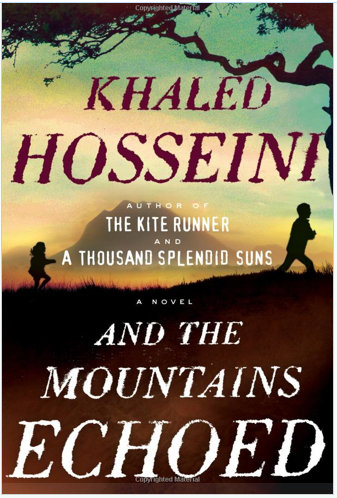
I danced when I saw the Amazon box; rarely do I buy hardcover (hurts too much when they fall over if I fall asleep reading, too bulky to carry on planes) but this one I was on the waiting list for, mail it as soon as it is published! Khaled Housseini, author of Kite Runner and A Thousand Splendid Suns has a new runaway best-seller; thanks to him I’ve just spent three days in Afghanistan, Paris and Los Angeles.
As the book opens, I am big brother to a baby sister whose Mom died in childbirth, living in a remote village in Afghanistan. Life is tough, but through the eyes of these children, life is idyllic, even though food is scarce and winters are cold. We have a huge oak tree with a swing, we play with the other children, and we have each other. Our father’s new wife is kind enough, but is busy with her own children, and the drudgery of cooking, cleaning and making do in a very small, poor Afghan village.
Later, I am Pari, living in Paris with an alcoholic, self-absorbed mother, making a life for myself, but always with a nagging feeling of something just outside my peripheral vision, another life . . .
The tale is told through the eyes of many, and on the way to the end of the tale we meet a wide spectrum of humanity, suffer the ills of war, callousness and unintended cruelties. We find that the man with superficial charm also saves and changes the lives of many, we find a doctor who finds fulfillment serving in the poorly resourced hospitals of Afghanistan, and we feel the agonies of a dutiful daughter watching her father fade into the world of Alzheimer’s.
It’s a wonderful, wild ride, richly textured, and when it finishes, you are not ready for it to end.
The Secret Lives of Baba Segi’s Wives by Lola Shoneyin

I don’t know what it is about summer reading, but now and then I go on a theme-fest; a couple years ago it was Nigerian literature, and, once hooked . . . when my friend who is now living in Lagos recommended The Secret Lives of Baba Segi’s Wives, I ordered it right away, thinking from the title it would be maybe light and sweet and humorous.
From the start, that assumption was blown. This is a direct and edgy Nigeria, darker, rougher and full of family secrets, domestic details and messy relationships.
It is a very Nigerian book – this is a good thing. There are cultural things that are not explained, but it all ends up making sense in the end. There are foods I have never heard of – ekuro with shrimp sauce, asun. There is a rudeness in the way they speak to one another, (“Is this a parking lot?” “Do I look like a parking attendant?”), a crudeness in the constant need to carry small bills for bribes, even on public streets. People speak their minds, with little or no mitigation, depending on the status of the person and their own personal goals and agendas.
At the weekly meeting of wives, the senior wife, Iya Segi, doles out rations of household supplies to the other wives, including chocolate powder and hair conditioner . . . and as the senior wives complain about the new wife thrown in their midst, she says:
“You will trip over in your hate if you are not careful, woman. Your mouth discharges words like diarrhea. Let Bolanle draw on every skill she learned in her university! Let her employ every sparkle of youth! Let her use her fist-full breasts. Listen to me, this is not a world she knows. When she doesn’t find what she came looking for, she will go back to wherever she came from.”
There is a whole other world in that one paragraph – a whole other way of seeing life and expressing thoughts. The culture may be alien, but I thoroughly enjoyed being a tiny mouse in the corner at that meeting – and others – and inside the minds of the wives, of Baba Segi, of the driver – so many good stories, so many points of view, and I learned things from behind those high compound walls and closed and locked doors that I might never otherwise have learned. Alien as it was, for me, this was a very good book, new ways of looking at things, and a great recommendation from my friend in Lagos.
The Festival of BERNARD MIZEKI
(Play the video of the Soweto Gospel Choir as you read this summary from today’s Lectionary Readings How I would love to be able to attend this festival!)
BERNARD MIZEKI
CATECHIST AND MARTYR IN AFRICA (18 JUNE 1896)
Bernard Mizeki was born in Portuguese East Africa (Mozambique) in about 1861. When he was twelve or a little older, he left his home and went to Capetown, South Africa, where for the next ten years he worked as a laborer, living in the slums of Capetown, but (perceiving the disastrous effects of drunkenness on many workers in the slums) firmly refusing to drink alcohol, and remaining largely uncorrupted by his surroundings. After his day’s work, he attended night classes at an Anglican school.
Under the influence of his teachers, from the Society of Saint John the Evangelist (SSJE, an Anglican religious order for men, popularly called the Cowley Fathers), he became a Christian and was baptized on 9 March 1886. Besides the fundamentals of European schooling, he mastered English, French, high Dutch, and at least eight local African languages. In time he would be an invaluable assistant when the Anglican church began translating its sacred texts into African languages.
After graduating from the school, he accompanied Bishop Knight-Bruce to Mashonaland, a tribal area in Southern Rhodesia (now Zimbabwe), to work there as a lay catechist. In 1891 the bishop assigned him to Nhowe, the village of paramount-chief Mangwende, and there he built a mission-complex. He prayed the Anglican hours each day, tended his subsistence garden, studied the local language (which he mastered better than any other foreigner in his day), and cultivated friendships with the villagers. He eventually opened a school, and won the hearts of many of the Mashona through his love for their children.
He moved his mission complex up onto a nearby plateau, next to a grove of trees sacred to the ancestral spirits of the Mashona. Although he had the chief’s permission, he angered the local religious leaders when he cut some of the trees down and carved crosses into others. Although he opposed some local traditional religious customs, Bernard was very attentive to the nuances of the Shona Spirit religion. He developed an approach that built on people’s already monotheistic faith in one God, Mwari, and on their sensitivity to spirit life, while at the same time he forthrightly proclaimed the Christ. Over the next five years (1891-1896), the mission at Nhowe produced an abundance of converts.
Many black African nationalists regarded all missionaries as working for the European colonial governments. During an uprising in 1896, Bernard was warned to flee. He refused, since he did not regard himself as working for anyone but Christ, and he would not desert his converts or his post.
On 18 June 1896, he was fatally speared outside his hut. His wife and a helper went to get food and blankets for him. They later reported that, from a distance, they saw a blinding light on the hillside where he had been lying, and heard a rushing sound, as though of many wings. When they returned to the spot his body had disappeared. The place of his death has become a focus of great devotion for Anglicans and other Christians, and one of the greatest of all Christian festivals in Africa takes place there every year around the feast day that marks the anniversary of his martyrdom, June 18.
Good Marketing Campaigns – What’s Your Favorite?
“Red Robin!” I sang, and AdventureMan responded “YUMMMMMMMM!” I had mentioned I am getting ready for my annual hamburger, and he became obsessed with Red Robin and we had to go there. I had the Whiskey River Chicken Salad. If I only have one hamburger a year, I want it closer to the 4th of July. It doesn’t have to make sense to you, but it matters to me. If you only eat one hamburger a year, it has to be a really good hamburger. 🙂
Back to the “YUMMMMMMM!”
Now, that’s good marketing. There is nothing not good about “YUMMMMMMM”
A campaign where you train people to think “YUMMMMM!” every time you hear Red Robin – brilliant!
We love good marketing. We love good ads; we notice good ads and good marketing techniques. We also scorn the bad ones.
Here’s what we love:
Mayhem – the entire series for Allstate, also the Allstate commercials when suddenly the black-guy-who-was-President-in-24’s voice comes out of an unlikely person.
Gecko/Geico – anytime you smile and you remember who the ad is for, that’s a good ad.
“What’s in Your Wallet?” Those hilarious Vikings make the point for Capitol One.
There are ads we like, but they don’t win our awards because while we like them, we can’t remember who they are for. If you can’t remember who an ad is for, the ad isn’t effective.
Campaigns I hate:
COX TV ads, all of them, just dumb.
Direct TV ads, just dumb.
Toilet Paper ads
As you can imagine, AdventureMan and I can have this conversation over a lot of long-distance drives and over a lot of meals.
So – what’s your favorite ad campaign? And why? Worst?
Recent Comments
ExpatAlien on What Country am I Living … intlxpatr on Yellowstone: Old Faithful to C… Michelle on Yellowstone: Old Faithful to C… Cathy on No Grown-Ups in Charge intlxpatr on Waiting for Snow Wikipedia Donate Button

Amazina


Early Voting in Florida


 Here There and Everywhere