God Laughs; Life’s Craziness
One of my favorite Psalms is Psalm 2, which advises us to humbly submit to the will of Almighty God or suffer the consequences of our own actions. I’ve heard God laughing all week, sometimes at me, sometimes with me.
Psalm 2
1 Why do the nations conspire,
and the peoples plot in vain?
2 The kings of the earth set themselves,
and the rulers take counsel together,
against the Lord and his anointed, saying,
3 ‘Let us burst their bonds asunder,
and cast their cords from us.’
4 He who sits in the heavens laughs;
the Lord has them in derision.
5 Then he will speak to them in his wrath,
and terrify them in his fury, saying,
6 ‘I have set my king on Zion, my holy hill.’
7 I will tell of the decree of the Lord:
He said to me, ‘You are my son;
today I have begotten you.
8 Ask of me, and I will make the nations your heritage,
and the ends of the earth your possession.
9 You shall break them with a rod of iron,
and dash them in pieces like a potter’s vessel.’
10 Now therefore, O kings, be wise;
be warned, O rulers of the earth.
11 Serve the Lord with fear,
with trembling 12kiss his feet,*
or he will be angry, and you will perish in the way;
for his wrath is quickly kindled.
Happy are all who take refuge in him.
I’m a planner. I figure out what I want, and then I figure out how to get it. When we decided we wanted to take a trip to Alaska, we booked – and paid – a year in advance to get the kind of room we wanted. We also planned to buy a new car, and started saving for that, being pay-cash kind of people.
Then, early in the year we discovered we were going to become grandparents to a granddaughter! She would arrive shortly after we get back from our Alaska trip.
This week, God laughed. The doctors told our son and his wife that she needed to go on bedrest, and that this baby will be coming early. All the grandparents have been helping with childcare through the summer, now we just ratcheted it up a notch.
Do you know why God gives children to YOUNG parents? LOL, a three year old has SO much energy! So much curiousity! We have such a good time with him and when at the end of the day, we return him to his parents – we need a nap!
We are also trying to pack and prepare for our trip, get the Qatari Cat prepared for the cat hotel, get the guest suite prepared for the people who will stay while we are gone, and oh yes, finish up the purchase of that new car.
I had thought the first week in August would be a snooze, isn’t it always? Those long, hot humid days hit Pensacola, often one of those violent and emotional thunderstorms that clears the air in the late afternoon, lazy day after lazy day, right?
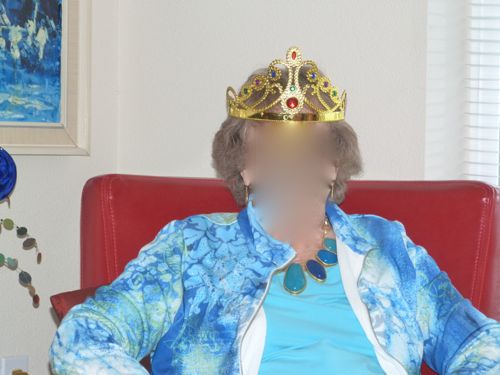
Not this year. This year was fly to Seattle for my Mom’s 90th birthday celebration, fly back, take care of our grandson for a week, do whatever we can to help out our son and his wife while she is on bed rest, buy and sell two cars, do our normal volunteer work – oh, and we had scheduled two meetings at our house, so we had to be presentable, and have some delicious things available. I could hear God laughing.

In the midst of all this, we are healthy. We have a good roof over our heads. We have the means to get a new car and travel to Seattle for Mom’s birthday. We pre-paid much of the Alaska vacation. Our little grandson is happy, and strong, and articulate, and fun to be around. Our son and his wife are wonderful, loving parents, and hard workers, and are preparing for this sweet new arrival. God laughs, and we thank him for his abundant blessings, and his abundant patience with us thinking we have any control over the months that come. We pray for the safe and healthy arrival of this little granddaughter who may arrive while we are gone, for a safe delivery, and a speedy recovery for her mother, and for strength and courage for her father, our son, who is a valiant man. We welcome your prayers.
I am an internet fraudsters and a terrorist (suicide bomber)???
Holy Smokes! The head of the FBI writing to me! Accusing me of internet fraud and terrorism (suicide bomber)! All I have to do is wire my service fee to Cletus in Nigeria and all will be well and my record will be cleared. Only $98.00, such a small, reasonable fee to prevent all this mayhem. (LOOOLLL!)
Scammers: Grammar! Usage! Craftsmanship! You can do so much better than this!
Anti-Terrorist and Monetary Crimes Division
Federal Bureau of Investigation
FBI Headquarters in Washington, D.C.
J. Edgar Hoover Building,
935 Pennsylvania Avenue, NW Washington, D.C. 20535-0001
Attention: Beneficiary
This is the final warning you will receive from me. This notice has been sent to
you several times but you ignored it.
I have warned you so many times and you decided to ignore my e-mails because you
believe we have not been instructed to get you arrested, if you fail comply this
time around, then we will first of all send a letter to the MAYOR of the city
where you reside and also instruct the bank to close your account until you
comply with our directives. Note that all your properties will be confiscated by
the Federal Bureau of Investigation. We would also send a letter to the
company/organization where you work and instruct them to issue you a “SACK
LETTER” because a suspect is not supposed to be working for the government or
any private organization.
From our investigations, we discovered that you were the person that forwarded
your identification to internet fraudsters in Nigeria and other countries when
they had a deal with you in regards to the transfer of some illegal funds into
your bank account which is valued at the sum of $10,500,000.00 only. Your ID
which we have in our database has been sent to all the crimes agencies in
America for them to upload you in their website as an internet fraudsters and a
terrorist (suicide bomber). I will also warn people to stop having any dealing
or friendly communication with you anymore. This would have been solved all this
while if you have gotten the NECESSARY TRANSFER DOCUMENT ENDORSED AND SEALED
legally.
I, ROBERT S. MUELLER III, Director of the Federal Bureau of Investigation (FBI)
wish to inform you that there is no more time left to waste because you have
been given enough grace, therefore you have been mandated to comply immediately
you read this e-mail if you don’t want to be arrested. As stated earlier, to
have the document endorsed and sealed without any delay, you must adhere to this
directives to avoid you from blaming yourself at last when we must have arrested
and sentenced you to life imprisonment. Note that all your properties will be
seized and bank account will be confiscated too.
However, I have decided to see how I can be of help to you because I will not be
happy to see you end up in jail and all your properties got confiscated because
your information was used to carry out fraudulent transactions. I called the
EFCC NIGERIA and they directed me to a qualified attorney who can help you get
the process done and when I called the atorney he told me that he will go to the
bank and sign the documents on your behalf and put his “SEAL” on those documents
at the sum of $98 service fee and I believe this process is cheaper for you. Be
informed that I pleaded on your behalf to the board of directors of this agency
to give you till 08/20/2013 to make the payment. Bear it in mind that this is
the only way that I can be able to help you at this juncture. But if you fail to
comply, you will find yourself in a severe field of dilemma.
You need to try as much as you can to send the money today because I have been
informed by the ARREST WARRANT ISSUANCE DEPARTMENT that the warrant of arrest
has been prepared against you and once is being signed by me as the FBI
DIRECTOR, then the arrest will be carried out if you fail to send the money
within the given deadline and we shall apply for litigation against you
immediately. Thereafter, you will appear before the ADMINISTRATIVE DISTRICT
COURT OF WASHINGTON D.C for terrorism, money laundering and drug trafficking
charges. I believe you know that it will be a shameful thing to you and your
entire family. Also it will be announced and published in all the local channels
and newspapers that you are wanted by the FBI. Therefore, you are advised to
make the payment for the signing of the documents immediately you read this
e-mail. Be warned, we are monitoring you from our satellite.
You will have to make the payment through western union money transfer with the
below information then Send the payment details to me as stated below.
NAME: UZOUKWU CLETUS
ADDRESS: LAGOS, NIGERIA
TEXT QUESTION: BETTER
ANSWER: BEST
AMOUNT: $98
SENDER’S FULL NAME:
SENDER’S FULL ADDRESS:
DIRECT PHONE NUMBER:
MTCN:
Do not hesitate to make the payment today with the above outlined information so
that the attorney will go to the paying bank and have all the necessary transfer
documents endorsed on your behalf as soon as you send the money. After all this
process is being carried out, then the transfer of your funds valued at
$10,500,000.00 only which should have been transferred to your bank account
before legally will now take place legitimately and hitchlessly.
Note: As you can see below, all the crimes agencies have been contacted on this
regard and we shall trace and arrest you if you disregard or ignore this
instructions. You have been given a grace till 08/20/2013 to make the payment
for the attorney to endorse the necessary transfer documents on your behalf and
put his “SEAL” on it.
Expecting your anticipated co-operation. You can also contact me here.
rssmusa@aol.com
Yours in service,
Robert S. Mueller III
FBI Director
CC: Canadian Police Association
CC: Central Intelligence Agency (CIA)
CC: GENERAL INTELLIGENCE DEPARTMENT (GID)
CC: Asia Pacific Group on Money Laundering (APG)
CC: Egmont Group
CC: FEDERAL BUREAU OF INVESTIGATION (FBI USA)
CC: European Bank for Reconstruction and Development (EBRD)
CC: Financial Action Task Force (FATF)
CC: International Monetary Fund (IMF)
CC: International Organization of Securities Commissions (IOSCO)
CC: International Banking Security Association (IBSA)
CC: International Air Transport Association (IATA)
CC: Institute de Formation Interbancaire (INSIG)
CC: World Customs Organization (WCO)
CC: Inter-American Development Bank (IADB)
CC: Offshore Group of Banking Supervisors (OGBS)
CC: WORLD CENTRAL BANK (WCB)
CC: NIGERIA POLICE FORCE (NPF)
CC: NORTH YORKSHIRE POLICE (UK)
CC: ECONOMIC FINANCIAL CRIME COMMISSION (EFCC)
Seattle: A Beautiful Farewell
“Oh! Look! The mountain is out!”
When someone says ‘the mountain,’ everyone knows what mountain you are talking about. It’s the granddaddy of all mountains, Mount Rainier:

Mount Rainier often shrouds itself in clouds and fog. A day when the mountain is out lifts everyones spirits. It was a beautiful last sight of Seattle.
ReVisit Mr. and Mrs. T’s in Edmonds, WA
You wouldn’t think such a good restaurant would be in a strip mall, but it’s a good thing we got there early. Within half an hour of our sitting and ordering, the place was packed. It’s a large place, but people just kept coming in. Friday night, and truly great Chinese food is also comfort food in Seattle. The clientele was probably 75% Chinese descent and 25% the rest of us.
“Let’s try something new,” I suggested. We eat at this restaurant almost every time I am in town. I miss GOOD Chinese food. “I read that we can forestall dementia by forging new neural connectors in our brains, and you do that by making yourself do something new. Let’s all try a dish we’ve never had before.”
My friends ordered. Actually, they laughed, they eat there more often than I do, and have tried almost everything on the menu. They said unless it were jellyfish or something of that ilk, it would be hard to find something they hadn’t tried, but they would find some things less ordered, but good.
This is what they came up with:
Fish Shanghai Style

Spicy Ginger Beef
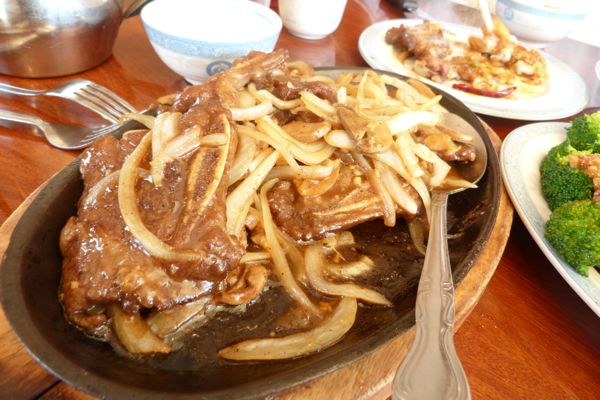
Clams and Black Bean Sauce (this was my favorite!)
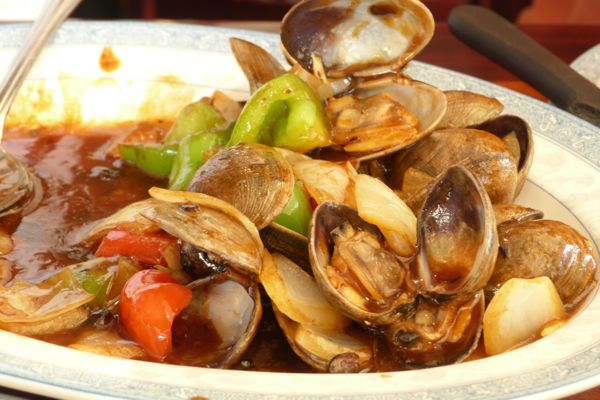
Delicious! Every bite! Or maybe that it is seasoned with a friendship that goes back thirty years or so 🙂
Some Peeks in Edmonds, Washington
You would love Edmonds, Washington.
It is a picturesque village. Along Main Street, and Fifth Avenue there are corner gardens, maintained by the city. This year, they are planted primarily with white flowers, big, fluffy flowers which make all the other flowers POP! with color. Overhead, from the lamp posts, are huge hanging baskets, full of a variety of plants, mostly purples, blues and fuchsias. The overall effect is stunning.
On our way to her manicure-pedicure, I drove Mom around looking at the sights. Down at the Edmonds Beach, I was shocked to see an eagle, perched on a piling. The shot isn’t very good, I jumped out of the car in a hurry and snapped, not taking enough time, but I was so surprised – I had never seen an eagle there before.

After lunch, as we headed out, we saw people touching up one of the murals Edmonds has painted on the sides of buildings there:

Here is another one, nearby:

I love it that this sweet little town, with its ferry coming faithfully in and out, preserves its identity and character in the face of changing times.
Family Culture Early Rising

There are some great things about being with family. You know how things are done. You know what people mean when they say things. You exchange ‘looks.’
When I am with my family, there are some funny things that make me feel at home. Both my sisters have smashing views, one looking southeast at Lake Washington and Mt. Rainier and the other at Puget Sound and the Olympics. Growing up on the side of a mountain with a view of water, game and mountains, it just feels ‘right.’ Not a lot of mountains in Florida to build a house on the side of. Or to view . . . sigh.
Staying at my sister’s house, I was the last one up. My body time was two hours earlier then all of theirs, but I was the last one up. They are early-to-rise people. I totally love it – for so many years, I’ve been an early riser living in countries where the day starts around noon and runs well past midnight . . . especially during Ramadan. In Kuwait, I took photos of the sunrises for this blog; my friends told me it was the only sunrise they ever saw, LOL.
Being around other early risers – aw, what a joy. As I left the house for the airport, Little Diamond was already up eating breakfast and I was able to hug her one last time before departing.
The photo above is the view of the I-90 bridge crossing Lake Washington in a cool, breezy pre-dawn.
Non-Essential State Department Personnel Ordered to Leave Yemen
I know, I know, it is not a funny headline. But here is the thing. People have egos. You might wonder why anyone would stay in the face of a threat so grave. It isn’t by coincidence that so many prisoners were busted out of prison – hundreds in Iraq, in Yemen, also if I remember correctly, in Pakistan.
These countries, under international understandings and agreements, provide security for one another’s embassies. Like WE provide security for the Saudi and the Yemeni and French diplomats in the United States. When a country suffers massive prison breaks, it is only prudent to wonder how well they might be able to protect international diplomats – it’s all security.
But – and here is why a very serious headline can make me laugh so early in the morning – who wants to be “non-essential?” I’ve lived through similar situations; people want to think themselves important – you would be surprised how many people will choose to stay, knowing the dangers, because they want to consider themselves “mission-essential”. 🙂

WASHINGTON — The State Department on Tuesday ordered non-essential personnel at the U.S. Embassy in Yemen to leave the country following the threat by al-Qaida that has triggered temporary shutdowns of 19 American diplomatic posts across the Middle East and Africa.
The department said in a travel warning that it had ordered the departure of non-emergency U.S. government personnel from Yemen “due to the continued potential for terrorist attacks” and said U.S. citizens in Yemen should leave immediately because of an “extremely high” security threat level.
“As staff levels at the Embassy are restricted, our ability to assist U.S. citizens in an emergency and provide routine consular services remains limited and may be further constrained by the fluid security situation,” the travel warning said.
The U.S. Embassy is located in Sanaa, the capital of Yemen.
The State Department on Sunday closed a total of 19 diplomatic posts until next Saturday. They include posts in Bangladesh and across North Africa and the Middle East as well as East Africa, including Madagascar, Burundi, Rwanda and Mauritius.
This is only an excerpt from AOL/Huffpost World News where you can read the rest of the story by clicking the blue type here.
Worse Than Crack Cocaine? Growing up Poor
From AOL Daily Finance Poverty damages children more than being born to a crack addicted mother. Poverty keeps children from attaining their full potention, and hurts us all as a society as a huge waste of potential resource:

In the 1980s, the crack baby epidemic was hard to ignore. Television show after television show, article after article proclaimed that children born to addicts of the increasingly prevalent “crack” cocaine were all-but-guaranteed to have birth defects, including extremely low IQs and severe emotional problems. This “lost generation,” commentators emphasized, would be incapable of forming relationships or reaching full emotional maturity. They would be, in the words of Washington Post columnist Charles Krauthammer, condemned to “a life of certain suffering, of probable deviance, of permanent inferiority.”
A little over 20 years later, Krauthammer’s predictions have proven almost embarrassingly inaccurate. Last week, the findings of a 24-year-long study of crack babies revealed that parental use of the drug had little or no direct effect on the children. In the process of investigating the babies, however, researchers discovered another environmental problem that did, in fact, lead to problems with depression, anxiety, cognitive functioning, and a host of other issues: poverty.
In 1989, Dr. Hallam Hurt, chair of the neonatology department at Philadelphia’s Albert Einstein Medical Center, began tracking 224 near-term or full-term children who were born to crack addicts. In the ensuing years, her longitudinal study followed the children, finding that, overall, their IQs were about the same as a control group of children of non-addicted mothers. Further, the children in Hurt’s study had comparable outcomes when it came to educational and emotional development.
That having been said, Hurt’s study found that children raised in poverty — regardless of whether or not their mothers were addicted to crack — tended to have lower IQs and lower school readiness than those who weren’t raised in poverty. A big part of the problem, she argues, is environmental: Of the children in her study, “81 percent of the children had seen someone arrested; 74 percent had heard gunshots; 35 percent had seen someone get shot; and 19 percent had seen a dead body outside.” The children themselves acknowledged the effect of these events: “Those children who reported a high exposure to violence were likelier to show signs of depression and anxiety and to have lower self-esteem.”
In other words, while prenatal crack abuse may not have a major effect on children, the societal conditions in crack-ravaged communities most certainly do. As Hurt emphasized, “Given what we learned, we are invested in better understanding the effects of poverty. How can early effects be detected? Which developing systems are affected? And most important, how can findings inform interventions for our children?” Or, to put it another way, now that we understand that poverty is more dangerous for children than crack, what can we do to protect our children from its effects?
In Florida, the worst schools are those serving the poor. Many fell a full grade point in the Florida evaluations and would have fallen further if there were not a law – I am not kidding – that says they can only fall one grade point in a year. We are failing in the two most important areas that can help children pull themselves out of poverty – good health care, and good education.
Uwem Akpan and Say You’re One of Them

This is a very troubling book, and, for me, a difficult book to read. It has taken me weeks, and I will admit I have often interrupted the reading of it to read other, easier books. This book makes me very uncomfortable. The stories and images trouble my sleep.
Uwem Akpan is of the tribe of Annang, from Nigeria, and has committed to an even larger tribe, the Catholic Church, of which he is a priest, and this gives him a unique perspective. The stories in this book often focus on tribal differences, including religious differences, and although they are set in different African states, have parallels in lives lived elsewhere. Those tribal differences are between Moslem and Christian, but also between Pentecostal and Catholic, Tutsi and Hutu, and, most significantly, the differences between to tribe of the very poor and the very rich.
Each story is told through the eyes of a child living in a different African state – Kenya, Benin, Ethiopia, Nigeria, Rwanda.
In one of my favorite segments of the book, strife has broken out in Nigeria, strife between the Moslems and the Christians, but also throw in the Pentecostals and the Pagans and really mix it up. A bus is waiting in the bus station to take people back to the southern part of Nigeria, and on this bus is a young man, half Moslem, half Christian. The bus stands idle for hours, while the bus driver seeks fuel to make the trip. During this time on the bus, many conversations take place, and what I loved was how alliances shifted with each conversation. The people on the bus were from different traditions, but came together as a community. No community is without arguments and dissensions, however, and consensus builds, diminishes, shifts – it is a microcosm of the tensions and stressors pulling apart the Nigerian nation state.
Uwem Akpan treats the children in each story lovingly, treasuring their innocent perspective and the sweetness of their hearts and vision. The adults don’t come off so well, passing their days in drug-induced stupors, drunk, selling children into slavery and prostitution, chopping off their limbs with machetes, and closing themselves off into groups which protect themselves and exploit others.
It would be an easier book to read if it were about aliens, or if these stories were confined to Africa, but the stories of these abused, neglected and exploited children echo in every continent, country and city in the world.
Uwem Akpan writes prose that is poetry; the surroundings are described with such detail that you feel in the moment, you see through the eyes of each child, and you see things that are beautiful as well as scenes you did not want to see. As you can see, I have a lot of ambiguous feelings about this book. At the same time I can admire the writing, the stories have left images in my mind that cannot be erased. Dark images. There is hope in the persistence and resilience of many of the children, but concern about their long term survival. It leaves a heavy weight on my heart.
Recent Comments
intlxpatr on Shampoo Ginger tigerbutterya0c5ff1d… on Shampoo Ginger intlxpatr on British Soldier Kidnapped, Esc… John on British Soldier Kidnapped, Esc… intlxpatr on British Soldier Kidnapped, Esc… Wikipedia Donate Button

Amazina


Early Voting in Florida


