Pensacola Sunset
We’ve had a few days of low humidity and warm temperatures, perfect for all the Spring Breakers here in Pensacola. We don’t even complain about the clog on the highways and lines in the restaurants, after the big oil spill devastated the tourist industry, we’re just glad to see them back. 🙂
AdventureMan said “Hey, let’s go watch the sunset down at DeLuna Park” and so we did. It was a glorious sunset. In the other direction was a HUGE boat!




Rape Victim Commits Suicide After Being Forced to Marry Rapist
Aon AOL-Huffpost:
Amina Filali, Morocco Rape Victim, Commits Suicide After Forced Marriage To Rapist
By PAUL SCHEMM
RABAT, Morocco — The case of a 16-year-old girl who killed herself after she was forced to marry her rapist has spurred outrage among Morocco’s internet activists and calls for changes to the country’s laws.
An online petition, a Facebook page and countless tweets expressed horror over the suicide of Amina Filali, who swallowed rat poison on Saturday to protest her marriage to the man who raped her a year earlier.
Article 475 of the Moroccan penal code allows for the “kidnapper” of a minor to marry his victim to escape prosecution, and it has been used to justify a traditional practice of making a rapist marry his victim to preserve the honor of the woman’s family.
“Amina, 16, was triply violated, by her rapist, by tradition and by Article 475 of the Moroccan law,” tweeted activist Abadila Maaelaynine.
Abdelaziz Nouaydi, who runs the Adala Assocation for legal reform, said a judge can recommend marriage only in the case of agreement by the victim and both families.
“It is not something that happens a great deal – it is very rare,” he said, but admitted that the family of the victim sometimes agrees out of fear that she won’t be able to find a husband if it is known she was raped.
The marriage is then pushed on the victim by the families to avoid scandal, said Fouzia Assouli, president of Democratic League for Women’s Rights.
“It is unfortunately a recurring phenomenon,” she said.”We have been asking for years for the cancellation of Article 475 of the penal code which allows the rapist to escape justice.”
The victim’s father said in an interview with an online Moroccan newspaper that it was the court officials who suggested from the beginning the marriage option when they reported the rape.
“The prosecutor advised my daughter to marry, he said ‘go and make the marriage contract,'” said Lahcen Filali in an interview that appeared on goud.ma Tuesday night.
In many societies, the loss of a woman’s virginity outside of wedlock is a huge stain of honor on the family.
In many parts of the Middle East, there is a tradition whereby a rapist can escape prosecution if he marries his victim, thereby restoring her honor. There is a similar injunction in the Old Testament’s Book of Deuteronomy
Morocco updated its family code in 2004 in a landmark improvement of the situation of women, but activists say there’s still room for improvement.
In cases of rape, the burden of proof is often on the victim and if she can’t prove she was attacked, a woman risks being prosecuted for debauchery.
“In Morocco, the law protects public morality but not the individual,” said Assouli, adding that legislation outlawing all forms of violence against women, including rape within marriage, has been stuck in the government since 2006.
According to the father’s interview, the girl was accosted on the street and raped when she was 15, but it was two months before she told her parents.
He said the court pushed the marriage, even though the perpetrator initially refused. He only consented when faced with prosecution. The penalty for rape is between five and 10 years in prison, but rises to 10 to 20 in the case of a minor.
Filali said Amina complained to her mother that her husband was beating her repeatedly during the five months of marriage but that her mother counseled patience.
A Facebook page called “We are all Amina Filali” has been formed and an online petition calling for Morocco to end the practice of marrying rapists and their victims has already gathered more than 1,000 signatures.
Signs of Spring in Pensacola
Coming home from a meeting last night, I head into Joe Patti’s to pick up some crab for dinner, and holy smokes! The parking lot is full! There is no line coming out the door, and a car pulls out so I get a space, but what is going on?
Once I get in, I know. The place is PACKED, and most of these folk are wearing beach clothes or short sleeves, a couple young women in strapless sun dresses . . . I get it. It’s Spring Break time in Pensacola, and Joe Patti’s is as packed as it was on Christmas Eve Day. Lines to pay are snaking around everywhere, and I get the last loaf of multigrain French bread.
At least the lines are civil. The locals smile at one another – we’re all wearing long sleeves, it’s cloudy and a little on the cool side. Part of me smiles to think of myself as ‘local.’ Guess I’m getting there.

When I get home, AdventureMan is all smiles, and not just because I’m going to make Open Faced Crab Sandwiches for dinner. No! One of his Monarch butterflies has hatched! We’ve had such a mild winter that we’ve had a few hatching here and there all winter, but this is the first butterfly of spring, and he is fresh out of the cocoon. After losing two cocoons to hungry birds, he devised a protective shoe box. AdventureMan is fast becoming a local expert on creating a safe environments for butterflies to feed, lay eggs, cocoon and hatch. He’s also having a lot of fun with it.
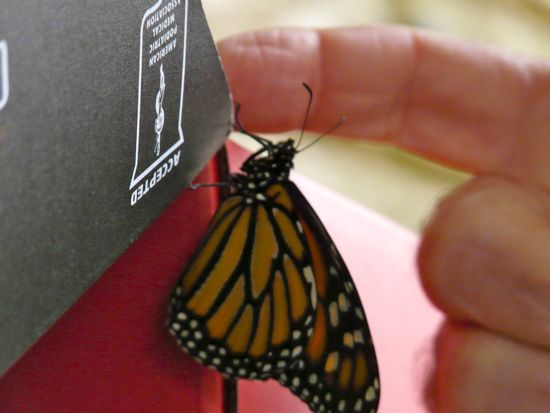
On our back fence, a vine we planted last October is taking root and taking off. I think it is a coral honeysuckle, also called a coral trumpet honeysuckle, or coral trumpet vine. It attracts both butterflies and hummingbirds. 🙂


This is not particularly a Spring photo, but it is a seasonal photo. The oysters right now at the Marina Oyster Barn are HUGE! I had a bowl of oyster stew, AdventureMan had six raw oysters and the little lady sitting behind us had a full dozen. “I can’t get these in Illinois!” she exclaimed; AdventureMan could barely eat all six, they were so huge, so we had a hard time believing she could eat 12, but she did!

Just as the weather is perfect for getting outdoors and cleaning out the weeds, the pollen also starts flying. I get out while it is cool, weed a selected area and come back in and shower all the pollen off. It doesn’t do that much good; my eyes are still watering and I am sneezing, but who knows how bad it would be if I didn’t wash the pollen off?
Bullying and Community
I found this on AOL/Huffpost Parenting: it contains a line – I italicized it – that I need to think about. In America, we tend to think of the individual over the community. For the most part, we don’t encourage our children to continue with an activity they don’t like ‘for the good of the group,’ we tend to take them out of the activity. I’ve lived in cultures where obligations to the group are much stronger, and I’ve always felt confined and constricted by the burden of those expectations, but it does make for a more peaceful situation when we consider the needs of others and the needs of the group.
Preventing Bullying Begins With Us
Richard Weissbourd and Stephanie M. Jones
On Feb. 29, Lady Gaga will launch a foundation dedicated to creating caring communities and stopping bullying. Hosted by the Harvard Graduate School of Education and Harvard’s Berkman Center, Lady Gaga will be joined by Oprah and other celebrities. A powerful new film, “Bully,” will be widely released at the end of March, and many Americans in recent years have been galvanized by a blizzard of tragic bullying stories.
Yet too often in the past a problem plaguing children like bullying has received huge waves of public attention that simply never translates into any positive changes in kids’ lives. What will it take to capitalize on this attention? How can we curb this problem once and for all?
We can start by recognizing where the main solution lies. There is a tendency to simply blame bullying on “bad” kids or peer groups or destructive media. But bullying often has deep roots in parents’ attitudes and behavior, and stopping bullying begins with us.
How can parents prevent bullying? Parents in recent years have been flooded with articles and books that guide them in shielding, or “bully-proofing,” their own child. But just protecting our own kids won’t stop bullying, and this guidance reinforces the damaging tendency of many parents to just focus on their own children. The best way to prevent bullying — and many other forms of cruelty and harassment — is to encourage and enable children to care for and take responsibility for each other. Research indicates that bullying is greatly reduced in particular when children who witness bullying stand up for the victim. Bullying brings home to parents our fundamental moral responsibilities. How can we help our children widen their circle of concern and stand up for other children? How can we help our children build more just and caring communities?
Bullying, unlike more typically developmental teasing and hurtful remarks, is commonly defined as prolonged or frequent cruelty to others, often characterized by imbalances of power. This kind of cruelty can produce intense and often lasting feelings of shame in children, a sense that they are defective in some core way. About 30 percent of children are bullied each year on school property alone. Adults’ understandable reflex is to curb this kind of bullying by punishing perpetrators. Yet this strategy alone usually fails to stop bullying, and sometimes it backfires.
On the other hand, bystanders — especially a friend of the bully — tend to be far more effective. A bystander is present in 85 percent of bullying situations, and bystanders who intervene appear to prevail over half the time. Yet in the vast majority of cases bystanders elect not to intervene.
What can we do as parents to help our children stand up for others? Research suggests that parents bolster their children’s ability to act independently and to withstand disapproval when they respect their children’s capacity as independent thinkers from early ages and give them input into family decisions. All the things parents do to build in their children a sturdy sense of self make it easier for children to hold their ground against a powerful peer. As parents we strengthen the self, for example, when we praise appropriately, know and appreciate who our children are and maintain their trust and respect. Nurturing empathy in children from early ages certainly matters as well. That means in part helping children appreciate people who may not be on their radar, whether a bus driver, a custodian or a new child in class. It means helping children consider the perspectives of those they’re in conflict with as well as people who are different from them in customs or background or other characteristics.
While it’s vital that we convey high moral expectations and underscore the importance of sticking up for others, we also must listen carefully to our children and understand the complexity of their social worlds and ethical decisions. We as parents will be more real and valuable to children if we pay careful attention to their perceptions and experiences of bullying and discuss when and how to stand up for someone else. We need to talk to them about the complexities of balancing our needs with others and what consequences are worth and not worth bearing. We need to help them figure out how to challenge someone else constructively.
But perhaps most important, stemming bullying will require us to seriously examine our parenting priorities. As a good deal of research now indicates, we live in an era when many parents are intensely focused on their children’s self-esteem, happiness and achievements, not on how well they care for others. And in all sorts of subtle ways we can prioritize happiness over taking responsibility for others. Too many of us, for example, don’t push our children to fulfill obligations that might distress them. We let our children write off friends they find annoying, or fail to reach out to a friendless child on the playground, or quit a team or chorus without asking them to consider what it means for the group. How many of us simply tell our children that their classrooms, schools and neighborhoods are communities to which they have obligations?
Just as worrisome, many of us as parents are failing to model for our children a sense of responsibility for others. Over and over we have heard from teachers that many parents are occupied with their own child and care little about other children in the classroom. “It’s a dog fight,” one recently retired teacher says, driven out of the profession in part by his fatiguing battles with parents. “Parents are out of control. They’re always seeking an advantage for their own kid… they lobby for a gifted class or they want their kid to get extra attention… and they don’t care how they might be hurting other kids.” Some parents say they want kids with behavior problems immediately removed from the classroom because they believe their own child’s learning is compromised. But that message certainly doesn’t convey responsibility for others and the community. At least for some period of time, we as parents ought to encourage teachers to work with that child and ask our own child how she/he might support the struggling child.
It is, of course, a great deal easier and tidier for us as parents to simply wrap our attention around our own child or to periodically remind our child to respect others. But such bland reminders will never get us where we need to go. Our children’s moral development is deeply interwoven with our own. If we want our children to be fair, courageous and humane, we have to take a close, hard look at whether those values are priorities in our parenting, and whether we are living those values day to day.
Upcoming Execution in Iran?
Thank you, John Mueller 🙂
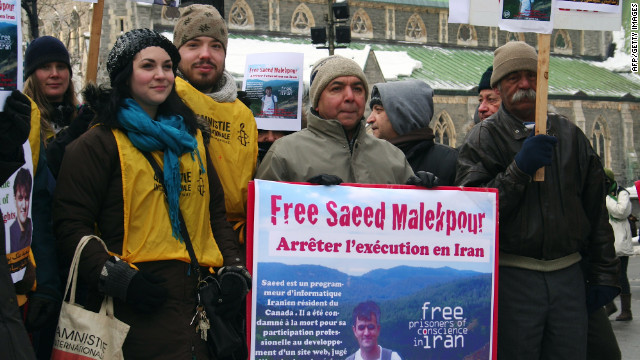
Supporters demonstrate in January for the release of Saeed Malekpour in Montreal, Quebec.
(CNN) — A computer programmer from Canada faces imminent execution in Iran for the actions of another person, which he had no control over, a human rights group says.
Saeed Malekpour wrote a program to upload photos to the Internet, an accomplishment that could cost him his life, Amnesty International reported Friday. Authorities in the Islamic Republic claimed his program was used by someone else to upload pornography and charged him with “insulting and desecrating Islam.”
Malekpour, who is a Toronto resident, was arrested in October 2008 while visiting relatives in Iran. He was convicted in a short trial and was sentenced to death in October 2011, according to Amnesty International.
Iran’s Supreme Court confirmed the sentence on January 17. Malekpour’s lawyers have been unable to ascertain the whereabouts of his court files since Tuesday and fear this could be an indicator that an executioner could carry out the sentence soon, Amnesty said. A court official suggested to the lawyers that the file had been sent to the Office for the Implementation of Sentences, according to Amnesty.
Malekpour sent a letter from prison detailing beatings and other mistreatment at the hands of Iranian prison officials to obtain a confession, said Hadi Ghaemi, executive director of the International Campaign for Human Rights in Iran.
“A large portion of my confession was extracted under pressure, physical and psychological torture, threats to myself and my family, and false promises of immediate release upon giving a false confession to whatever the interrogators dictated,” the letter says.
Malekpour’s supporters have created Facebook pages and websites in his support dating to at least 2009.
Amnesty International has requested on its website that concerned individuals write Iranian authorities inside and outside the country to demand that Malekpour not be executed.
Scanning Obituaries
Who knew? I certainly didn’t, and yet I find that I’m not alone. AdventureMan does it, too, and other friends. One friend says she thinks she scans the obituaries to celebrate the fact that she is still alive. That may be it for most of us, but in addition, I find that there are people living among us with amazing histories, and we don’t even know. Sometimes when you read an obit, you can tell that the person wrote it himself or herself, and what that person considered important in his/her life. Sometimes the obituary is not very loving.
Southern newspapers, in my experience, are much richer in extraordinary detail that newspapers in bigger cities, like Seattle. In bigger cities, only the rich and famous or notorious get much space; it may be that the space is far more expensive in the bigger cities, or that families are less willing to shell out from the estate for the bigger coverage. Southerners value family, and history; it’s a part of the culture.
Yesterday, when I took the Pensacola News Journal in to AdventureMan, I had circled something in one of the obituaries, knowing that he, like me, only reads them now and then. I didn’t want him to miss this line:
(Name) was a Past Mighty Chosen One of the Zelica Daughters of Mokanna, Ladies Auxiliary to the Grotto.
Holy smokes! I thought it might be one of the Mardi Gras Krewe things, but AdventureMan googled, and discovered that is a Masonic offshoot, and their larger groups are called Cauldrons. (!)
In America of the early 1900’s, social affiliation groups were important. People belonged to religious groups like Knights of Columbus, Ladies of the Church, etc, quasi-religious groups like Masons and Shriners, and social groups like the Elks and Moose and Lions Club. Some groups still exist, and are still going strong, like Rotary Club, and special interest groups. In Pensacola, there is a Tea Party AND a Coffee Party. There is a Philipino-American Republican Club. When people gather together regularly to share something in common, they can form a group. All of these groups help people be connected in their communities and in their lives, and help people to look after one another.
I belonged to a group once that called ourselves the Aqua-Babes. To be perfectly honest, we might not be total babes, but hey – it’s our group, we can call ourselves what we want, right?
But oh, my, to be a Mighty Chosen One . . .
Abraham Buys a Cave and a Field
When I was an undergrad in college, I was majoring in political science, and there weren’t a lot of women in the field. You’d think that would be heaven for a young woman, but many of these political scientists had political aspirations, or an ax to grind, and were constantly standing up and making speeches. It was annoying; I needed some balance, so I took on another major, in English Literature, to give my academic life some balance.
It’s not like that was without its own problems; English Lit was full of these really OLD women, like in their thirties, who had come back to school to earn or finish up a degree, and they took it seriously. Aarrgh! Didn’t they know that this was university? This was supposed to be fun? Having those women in class competing for grades forced the rest of us to work harder . . . not such a bad thing.
One of the things you learn in studying Lit is that there are things that are important, or the author wouldn’t include them. As I read today’s Old Testament reading from The Lectionary, I found myself reading as literature, asking “where is the significance?” “why was this story included?” The Hittites are so very gracious to grieving Abraham; they sound like loving friends. Abraham insists on paying for the land, the cave where Sarah would be buried. Why was it so important to pay for the land? Was it so that there would be no question later as to whether the land was his?

Genesis 23:1-20
23 Sarah lived for one hundred and twenty-seven years; this was the length of Sarah’s life. 2And Sarah died at Kiriath-arba (that is, Hebron) in the land of Canaan; and Abraham went in to mourn for Sarah and to weep for her. 3Abraham rose up from beside his dead, and said to the Hittites, 4‘I am a stranger and an alien residing among you; give me property among you for a burying-place, so that I may bury my dead out of my sight.’ 5The Hittites answered Abraham, 6‘Hear us, my lord; you are a mighty prince among us. Bury your dead in the choicest of our burial places; none of us will withhold from you any burial ground for burying your dead.’ 7Abraham rose and bowed to the Hittites, the people of the land. 8He said to them, ‘If you are willing that I should bury my dead out of my sight, hear me, and entreat for me Ephron son of Zohar,9so that he may give me the cave of Machpelah, which he owns; it is at the end of his field. For the full price let him give it to me in your presence as a possession for a burying-place.’ 10Now Ephron was sitting among the Hittites; and Ephron the Hittite answered Abraham in the hearing of the Hittites, of all who went in at the gate of his city, 11‘No, my lord, hear me; I give you the field, and I give you the cave that is in it; in the presence of my people I give it to you; bury your dead.’ 12Then Abraham bowed down before the people of the land. 13He said to Ephron in the hearing of the people of the land, ‘If you only will listen to me! I will give the price of the field; accept it from me, so that I may bury my dead there.’ 14Ephron answered Abraham, 15‘My lord, listen to me; a piece of land worth four hundred shekels of silver—what is that between you and me? Bury your dead.’ 16Abraham agreed with Ephron; and Abraham weighed out for Ephron the silver that he had named in the hearing of the Hittites, four hundred shekels of silver, according to the weights current among the merchants.
17 So the field of Ephron in Machpelah, which was to the east of Mamre, the field with the cave that was in it and all the trees that were in the field, throughout its whole area, passed 18to Abraham as a possession in the presence of the Hittites, in the presence of all who went in at the gate of his city. 19After this, Abraham buried Sarah his wife in the cave of the field of Machpelah facing Mamre (that is, Hebron) in the land of Canaan. 20The field and the cave that is in it passed from the Hittites into Abraham’s possession as a burying-place.
Egyptian Synchronized Swimmers, Montreal 2009
What I totally love about this YouTube clip (Thank you, Hayfa!) is that the swimmers are so original and have a great sense of humor about what they are doing. They also manage to infuse their performance with their own culture and make it all uniquely their own.
Recent Comments
ExpatAlien on What Country am I Living … intlxpatr on Yellowstone: Old Faithful to C… Michelle on Yellowstone: Old Faithful to C… Cathy on No Grown-Ups in Charge intlxpatr on Waiting for Snow Wikipedia Donate Button

Amazina


Early Voting in Florida


 Here There and Everywhere