Speaking Truth to our Neighbor
Oh aaarrgh. I do my morning readings, and then I go to Forward Day by Day for a short meditation and to find out what part of the world we are praying for today. Today, the commentary hits on our neighbor . . . my weak point. We are to love God and to love one another. Even in traffic, even in lines in the bank. We are to love that obnoxious woman talking loudly about her personal life on her cell phone, and the aggressive guy who barges in front of you as if he were entitled. Oh aarrgh.
Thursday, may 24
Ephesians 4:17-32. Let all of us speak the truth to our neighbors, for we are members of one another.
How well do you know your neighbors? Do you know their names, their heritage, or anything more than what they drive and a vague awareness of their schedule?
Our busy schedules and desire for privacy often keep us from getting to know the people who live close to us. And why not speak the truth to them? We are neighbors after all.
We might want to expand our definition of neighbor to include those driving next to us on the road, anyone sitting next to us on the bus or train, the person standing next to us in line at the bank. How do we speak the truth to them? Do we tell them the truth, or do we tell them something else? For instance, if you are in a hurry and someone seems to be taking a long time at the teller’s window, would you say, “What is taking you so long?” or would you say, “I am really in a hurry and feeling really impatient at this moment. Would you mind if I go ahead of you?”
When we speak the truth in love to someone, we gain respect and grow closer to being one with each other.
PRAY for the Diocese of Chotanagpur (North India) http://www.anglicancommunion.org/tour/diocese.cfm?Idind=425
The Lord Looks on the Heart
From today’s Lectionary reading:
It’s a common failing, when we study scriptures, to believe we get it right. The more you study, the more surprises you get, and the less sure you become about dogma, i.e. what your tribe believes is true. One of the things that comforts me is that the Lord loved Moses, who murdered a man on an uncontrolled impulse, and David, who had another man killed in battle so he could marry his wife, carrying his illegitimate child.
The Lord sees things differently.
We make things more complicated than they need to be. Jesus told us to believe simply, as a child. Jesus told us to love God with all our being, and to love our neighbor. He did not say love your fellow Christian and hate the Moslem, or love those who love you and don’t worry about the others. He pretty much said that we are to love – and serve – those with whom we come into contact.
To me, the good news is that the Lord loves sinners, even though we grieve him. If we confess, if we are truly sorry, if we ask for his forgiveness, he gives it to us. The great gift of grace – it’s a comfort to me.
1 Samuel 16:1-13
16The Lord said to Samuel, ‘How long will you grieve over Saul? I have rejected him from being king over Israel. Fill your horn with oil and set out; I will send you to Jesse the Bethlehemite, for I have provided for myself a king among his sons.’ 2Samuel said, ‘How can I go? If Saul hears of it, he will kill me.’ And the Lord said, ‘Take a heifer with you, and say, “I have come to sacrifice to the Lord.” 3Invite Jesse to the sacrifice, and I will show you what you shall do; and you shall anoint for me the one whom I name to you.’ 4Samuel did what the Lord commanded, and came to Bethlehem. The elders of the city came to meet him trembling, and said, ‘Do you come peaceably?’ 5He said, ‘Peaceably; I have come to sacrifice to the Lord; sanctify yourselves and come with me to the sacrifice.’ And he sanctified Jesse and his sons and invited them to the sacrifice.
6 When they came, he looked on Eliab and thought, ‘Surely the Lord’s anointed is now before the Lord.’* 7But the Lord said to Samuel, ‘Do not look on his appearance or on the height of his stature, because I have rejected him; for the Lord does not see as mortals see; they look on the outward appearance, but the Lord looks on the heart.’ 8Then Jesse called Abinadab, and made him pass before Samuel. He said, ‘Neither has the Lord chosen this one.’ 9Then Jesse made Shammah pass by. And he said, ‘Neither has the Lord chosen this one.’ 10Jesse made seven of his sons pass before Samuel, and Samuel said to Jesse, ‘The Lord has not chosen any of these.’ 11Samuel said to Jesse, ‘Are all your sons here?’ And he said, ‘There remains yet the youngest, but he is keeping the sheep.’ And Samuel said to Jesse, ‘Send and bring him; for we will not sit down until he comes here.’ 12He sent and brought him in. Now he was ruddy, and had beautiful eyes, and was handsome. The Lord said, ‘Rise and anoint him; for this is the one.’ 13Then Samuel took the horn of oil, and anointed him in the presence of his brothers; and the spirit of the Lord came mightily upon David from that day forward. Samuel then set out and went to Ramah.
Tribal Affiliations

When we first got to Qatar, and started attending church there, we had a wonderful priest, T. Ian Young, whose Friday morning services (Friday was the Qatari Sunday) were exactly 60 minutes long, and the music was always uplifting. I learned some great children’s songs from him, and he always gave a children’s sermon before sending them out for children’s Sunday School while he gave an adult level sermon to the older attendees, like us.

During the service, Father Ian would pray, including the phrase “from whom every tribe in heaven and earth get their name” (from Ephesians 3:15) and it got my attention, it was my first awareness thinking of myself as from a tribe. I had always heard it as “from whom every family on heaven and earth . . . ” but living in Qatar, where family and tribe were the same, it made sense. It’s just one of those situations where we think of “tribes” as THOSE people, not as us. When you include yourself as a tribal member, things start to look a little different. (Thank you, Father Ian)

So recently AdventureMan has been pointing out local tribal affiliations on people’s cars. People have specialized license plates that tell us of their concern for Florida’s environment, or schools, or support of the arts, etc. People have stickers that show they are from the Auburn tribe, or the Seminole Tribe, or Gator people, or graduated from such-and-such university. They might be from this neighborhood, so says the sticker on their bumper, or they might support the orchestra, or the ballet, or they might belong to this Krewe or that. Once we become aware that we, too, are tribal, and have tribal affiliations, there is no going back.
Alaskan Heritage Celebration
I’m researching the Inuit / Eskimo / Yup’ik mask my Mother bought lo, these many many moons ago, and like anyone born to research, I am hopelessly lost, and enjoying every minute of the journey.
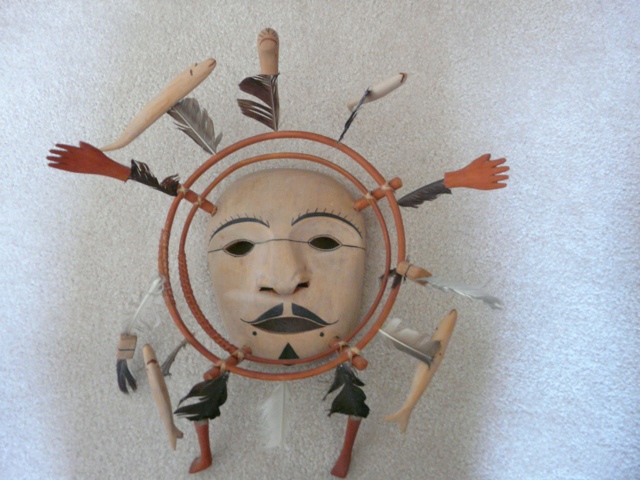
I’m not Alaskan. I was born in Alaska, and so many times through the years when I see blocks that need ticking, I have been tempted to tick “native Alaskan” but I know that they don’t mean me, and that there are people who really deserve those preferences. I FEEL Alaskan, even though I’ve been gone a long time.
(My Mother used to tell us not to play with the “natives” because “they had knives!” (Big scary eyes). LLLOOOLLLL! Can you think of any quicker way to get your kids to play with the forbidden group? They had knives! Plus, they were our neighbors, and our classmates, and we all played together. Skied together. Played Cowboys and . . . Indians. Yes! We did! LLOOOLLL!)
I found this fabulous video of segments from the “Celebration 2010” There is a reason I am sharing this – first, for all my friends of all nations who love textiles and handwork as I do – and our name is legion – I want you to see this video and to see the magnificant ceremonial robes they are wearing. They have to be hand made; they are each so individual, even among people of the same clan, the bear is different, one from the other, the fish – different, the raven – fabulously different, I even saw a sun! I hope your heart goes pitter patter, just as mine is going.
I wish I could bring this entire celebration to Kuwait and do a presentation with the KTAA (Kuwait Textile Arts Association.) They would LOVE these crafts, and the dancing. Look at the wonderful drums!
Second – did you hear them ululate? This is what I love about my travels; no matter what our differences, we have some amazing similarities.
Celebration, a First Nation heritage event taking place in Juneau, Alaska, originated and was sponsored in 1982 by Sealaska. The gathering takes place every other year and is the biggest event for Native Americans in Alaska for Tlingit, Haida and Tsimshian peoples.
To me, the coolest thing of all is that this is not done for tourists, but for the First Nation peoples, to transmit their culture to their children, and to celebrate themselves. This second video focuses on the clans and their special dances:
Now here is the exciting thing. It only happens every two years. This year it will take place June 6 – June 9. Here’s the information:
Celebration Native Cultural Conference
June 06, 2012 to June 09, 2012
A biennial Native cultural celebration featuring colorful costumed processions, dance performances, authentic arts and crafts and gatherings. Held in various venues including Centennial Hall Convention Center.
907-463-4844
http://www.sealaskaheritage.org
We already have plans for this June (I’ll share more about that later) but I talked to AdventureMan and said I really, really want to go in 2014. He said (are you sitting down?) “That’s just the kind of thing I LOVE! We’ve been planning to go to Alaska anyway, let’s go for that celebration!”
And that is why, after all these years of being married, I still adore my husband. He is a man with a heart for Adventure, and he gets all excited about the same things I do, well, some of the time. There was a falcon fest once in Tunisia that he dragged his feet on because he had just gotten in from a long trip, but once we got there, we all agreed it was one of those things that we would have regretted forever if we missed it. He is always up for a new adventure!
Wooooo HOOOOOOOOO!
See you there?
When Does Ramadan Start in 2012?
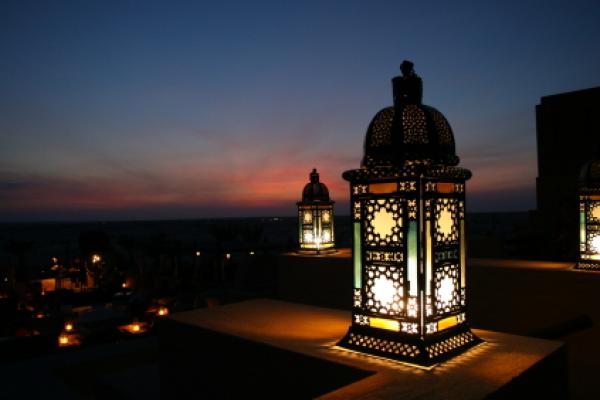
The Islamic Calendar website Godweb says Ramadan in 2012 will start July 20th. Time and Date (which is where I found this beautiful photo) agrees.
Sometimes it depends on the country where you are living. Wikipedia tells us this:
Many Muslims insist on the local physical sighting of the moon to mark the beginning of Ramadan, but others use the calculated time of the new moon or the Saudi Arabian declaration to determine the start of the month. Since the new moon is not in the same state at the same time globally, the beginning and ending dates of Ramadan depend on what lunar sightings are received in each respective location. As a result, Ramadan dates vary in different countries, but usually only by a day. This is due to the cycle of the moon. When one country sees the moon, mainly Saudi Arabia, the moon travels the same path all year round and that same moon seen in the east is then seen traveling towards the west. All the countries around the world see the moon within a 24 hour period once spotted by one country in the east.
Each year, Ramadan begins about eleven days earlier than in the previous year.[3] Astronomical projections that approximate the start of Ramadan are available.[4] It takes about 33 years for Ramadan to complete a twelve month move across the yearly calendar plus 5 days. As Ramadan March 28, 1990 to Ramadan March 22, 2023.
May In Seattle
From the bone chilliing 47 degrees mid-day on my arrival, the temperatures in Seattle flew up up and up. By Sunday, the American Mother’s Day, the temperatures were up 30 something degrees, in the mid to high 70’s, and Monday and Tuesday were the same. Good thing we got most of the heavy sorting and tossing andhauling done during the beautiful, but cooler weather before the weekend.
We had a lovely Mother’s Day, Mom got to sit out in the sun, under a huge umbrella, got to play with her great grandchildren, had all her children surrounding her. It was a gorgeous sunny day in a beautiful setting. We all had a lot of fun.
To add icing to the cake, I had the great luxury of time with my best friend from college, time to sit around and catch up, philosophize, all the things we did before husbands and children came along. Now we have as much to talk about as ever, and the great luxury of time in this trip to get to know all the little things, too. What a great blessing. Back to Pensacola, and gearing up for the next big trip!
Jesmyn Ward and Salvage the Bones

You are fifteen, poor, black, and motherless as this book opens. Dad drinks, and isn’t around much. You are the only girl in a family of brothers. Having sex is no big deal, and there is one guy you really like, Manny.
Your oldest brother’s pit bull is having puppies, and you are having trouble with throwing up most of what you eat, especially every morning. Dad says a hurricane is coming, but he’s said that before, no big deal.
As this book opens, it has the feel of a myth of the nightmare kind. We know, because we have the benefit of hindsight, that the impending storm, Katrina, will be catastrophic. The Batiste family has already suffered a catastrophic storm with the death of their Mama, just after the birth of her last child. Throughout the book, we watch these children suffer the daily absence of their mother, raising one another, squabbling, but tenderly looking after one another.
If someone had told me about this book, I don’t think I would have wanted to read it. Amazon.com kept telling me I needed to read it, so finally, I did. From the opening page, I was in a world utterly alien from my own, and yet a world I could understand and inhabit. There are worse things than being poor, and one of them is heartless. This family has heart; they are loyal to one another, they look after one another and they sacrifice for one another. For all the violence – and there is a lot of violence – there is also beauty.
There is the familial love, and there is the love between Skeet, the oldest brother, and his dog, China. There is friendship, and good people who give you refuge in the aftermath of the storm. There is the stunning numbness of surviving the worst hurricane ever.
Jesmyn West has a deft touch, with the language, with the interweaving of the Medea myth, with non-verbal communication, with the complexities of families and love. This is a book worth reading.
Saudi – Bahrain “Merge?”
Thank you, John Mueller for this article from The Press:
http://www.presstv.ir/detail/2012/05/14/241177/iran-raps-saudi-plans-bahrain-merger/
PressTV – Iran Majlis condemns merger of KSA, Bahrain
The Iranian Majlis (parliament) has condemned the Saudi proposal for merger with Bahrain, saying the “unwise” measure will further destabilize the region and multiply its problems.
The Saudi plans to annex Bahrain “will extend the Bahraini crisis to Saudi Arabia and push the region toward further unrest,” a statement, signed by 190 Iranian lawmakers, read on Monday.
The statement asserted that political force and pressure cannot silence the frustrated Bahraini people who have been holding anti-government demonstrations since mid-February 2011 and calling on the US-backed Al Khalifa family to leave power.
On March 14, 2011, more than 1,000 Saudi troops entered Bahrain to assist the Manama government in suppressing the peaceful popular protests in the Persian Gulf Island.
According to local sources, scores of people have been killed and hundreds have been arrested in the Saudi-backed regime crackdown.
In a report released on April 17, Amnesty International criticized the Bahraini regime for continuing the violation of human rights and the excessive use of force against the anti-regime protesters.
“The authorities are trying to portray the country as being on the road to reform, but we continue to receive reports of torture and use of unnecessary and excessive force against protests. Their reforms have only scratched the surface,” said Hassiba Hadj Sahraoui, Amnesty International’s Middle East and North Africa deputy director.
The Iranian lawmakers concluded by expressing their “all-out support for the brave nation of Bahrain as well as the independence and territorial integrity of the country.”
Saudi Arabia is reportedly seeking to merge with Bahrain in line with plans to unify the six Arab member states of the [Persian] Gulf Cooperation Council ([P]GCC).
The council members, Saudi Arabia, Kuwait, Bahrain, Qatar, the United Arab Emirates and Oman, are expected to meet and discuss closer union among the six countries on Monday.
In December 2011, Saudi King Abdullah called on the council member states to move “beyond the stage of cooperation and into the stage of unity in a single entity.”
However, some members of the council have expressed concern about Saudi Arabia’s possible dominance over the other five countries if the [P]GCC becomes unified.
HMV/HGH/AZ
Brrrrr! That Can’t be Right!
When I travel, I check with Weather Underground so I will know what to pack. While I barely had time to unpack and do mammoth piles of laundry to repack for the next trip, I did have time to check the weather. Lovely weather, highs in the high 50’s and 60’s, going up to 80 on Mother’s Day this coming Sunday.
So when we landed, and the pilot said “Welcome to Seattle, it is 47° out, my only possible response was “That can’t be right.” But as soon as I stepped out of the plane, I knew it was. I was wearing a little sleeveless silk and linen weave, with a lightweight cotton jacket over it. Not enough!
Arriving in Seattle mid-day is perfectl; traffic going north is calm and – for Seattle – light. I’m in an SUV; when I got to the rental pick up it’s all he had – that, or a Tundra or Yukon, which are just WAAYY too big for me. The car is a Captiva, not a large SUV, but one drive from the airport to Edmonds and I am down about an eighth of a tank, a far cry from my modest little Rav4. On our tip across the US, that sweet little car averaged 30.3 miles per gallon. In Seattle, where the gas prices are substantially higher, I am driving a gas hog. Aargh.
I am staying with my best friend from college. I’ve stayed in this house before, but it has been entirely renovated since then, and it is like staying in a boutique hotel – entirely lovely.
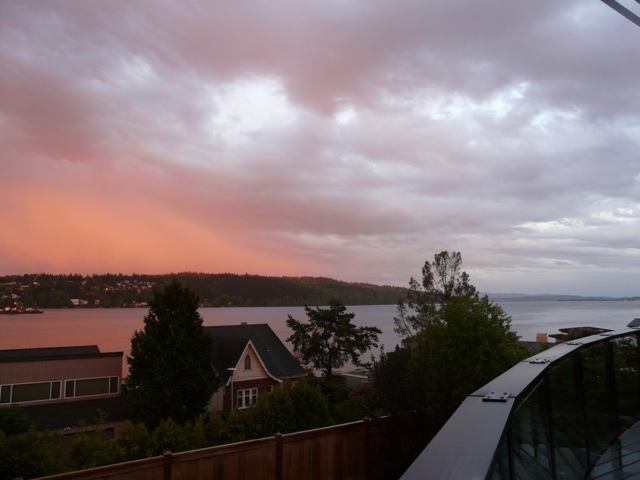
Here is the view just before dark from her house:
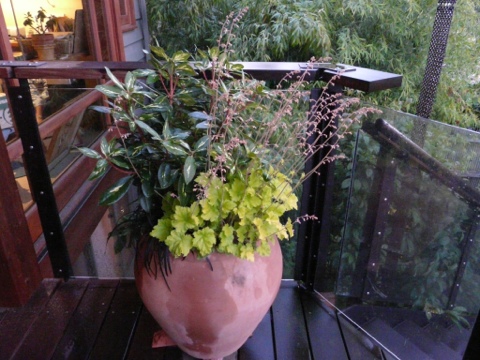
My friend has always been an inspirational gardener, and plants these gorgeous big pots:
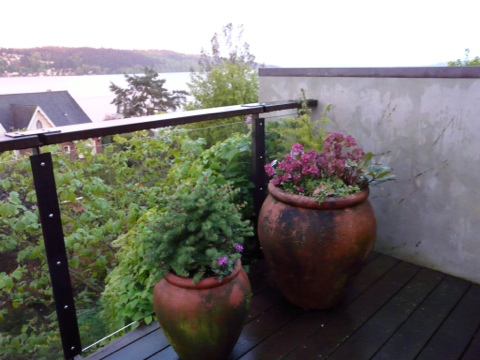
When I arrive, she is struggling with a connectivity problem, which gives me some time to gather myself from my early rising to my long flights. Every time, I still thank God it is only two timezones and half a day, as opposed to two long flights and about 24 hours travel time from Kuwait and Qatar.
We run out to buy a new wireless modem, and look for a spot for dinner. This is what I love about my old friend, she’s always up for something new. I spot a restaurant I read a review for a long time ago, and she is game to try it.
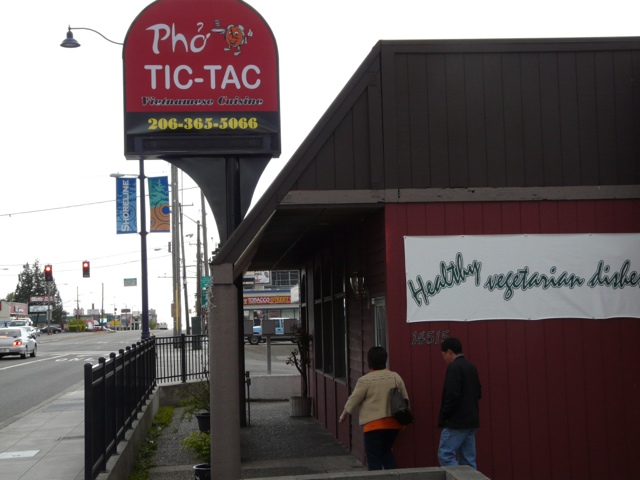
The prices were unbelievable. This is Seattle. How can you have a simple and serenely lovely interior, full of quietly and happily dining customers, and still charge these low prices? For dinner? I had the Tic Tac combo rice vermicelli dish, and my friend had a different combo. It was delicious! They are on Aurora / Highway 99, and have a steady stream of customers, families, couples, singles, take-out – there are a lot of people love this restaurant, including us. Sorry there are no photos of the meal, but old friends always have so much to talk about, and it never even crossed my mind. Sorry!
This is my lovely ‘hotel’ room, where I quickly fell into bed and was soon fast asleep 🙂

Absolute Favorite, in Mancos, Colorado

Every now and then pure unexpected magic happens, a blessing, pure grace. Every now and then you make a stop and all the right things happen.
We had not enjoyed our breakfast the previous morning at the Far View Lodge, so we decided to get on the road early, and find a place to eat on the road. We were up and out by seven, and it took about half an hour just to get off the mesa and down to the main road. Once we hit the main road, we start looking for a good place to stop.
We see a sign: The Absolute Bakery in Mancos, Colorado, just turn right at the next stop light.
We turn right. We find the bakery, which looks cute from the outside:

And then we found a place to park, in front of a Hat-Maker’s Shop guarded by a beautiful long-haired cat. For me, the magic has already started. Did you even know of a hat maker anymore? I thought they had all disappeared:
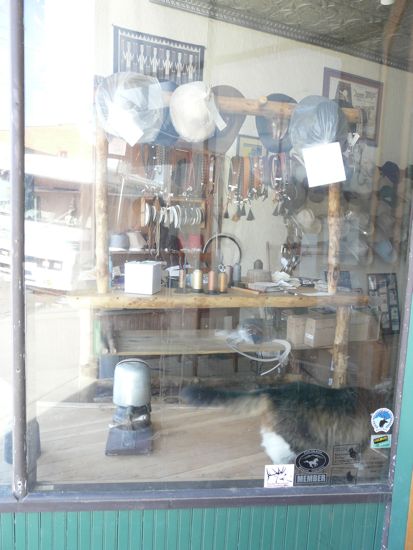
As we walked into the Absolute Bakery, we were enticed with smells, the odor of break baking with cinnamon, the fragrance of freshly brewed coffee, bacon frying . . . and inside, it is homey, and welcoming, and you are warmly welcomed, and we just feel so glad to be there on this sunny morning when we have so far to drive . . .


The breakfast menu has so many good things, you don’t know what to order.
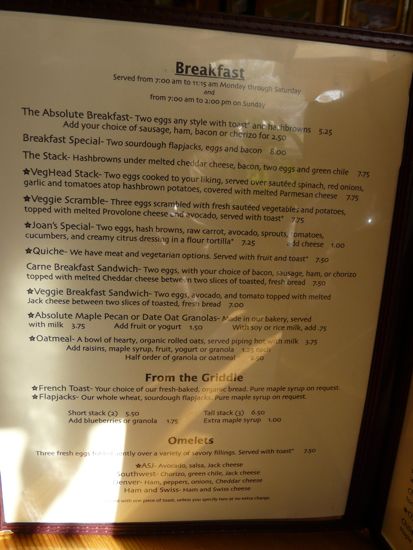
AdventureMan chose the VegHead Stack, which was totally wonderful:
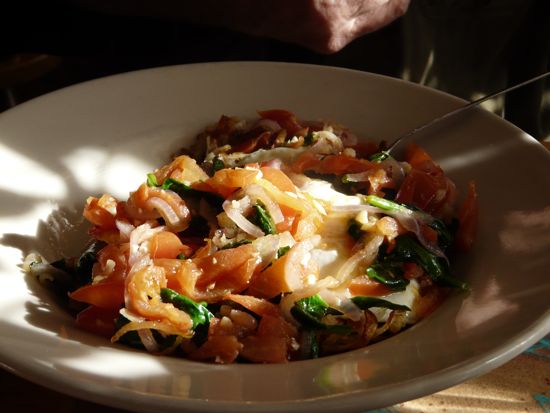
And I chose the Absolute Breakfast special with Chorizo – total YUMMMMM:
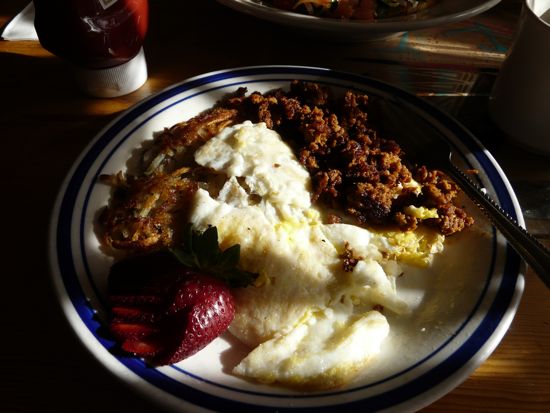
The breakfasts are delicious, and as we eat, the bakery fills up, travelers, locals, families . . . it has the feel of a place we would like to live, a community, people who know each other.
You know how it is sometimes when you have so much to do, and you really need to get started? As we paid for our breakfast, instead of getting on the road, we dawdled. We picked out cookies for the road – I had the most huge delicious macaroon I have ever had, just a bite now and then, and it lasted all the way to Amarillo. We got to talking with travelers headed the direction we had come from, just strangers crossing paths, but it was a great conversation, and we hated to pull ourselves away, to get back to the serious business of driving.
Lunch was OK. It was BBQ, but someone forgot our order, so we lost some time:

To add insult to injury, not only is it a long day on the road, but we also loose an hour, so we get in even an hour later than we would have. As we near the border, I am watching my phone to see if I can see the change, but it happened about six miles before the border and I missed it. AdventureMan’s on the same system, but his phone changed a little later.
The morning drive was mostly through the Navajo nation and backroads, full of ranches and horses and some drama. The afternoon, on Interstate 40, was just boring, with an occasional moment of hilarity:
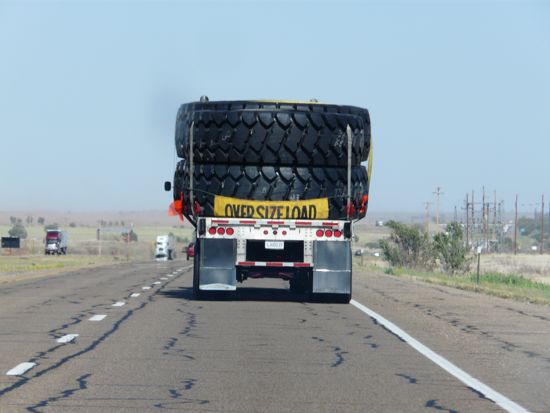
What can you imagine would use a tire that big?
We have reservations in Amarillo, and by the grace of God, our hotel is just off the highway, and my little iPhone tells us exactly how to get there. We hit the pool, and get some exercise. We split the last apple and some trail mix for dinner – we are still full from breakfast at the Absolute Bakery!
Recent Comments
intlxpatr on Shampoo Ginger tigerbutterya0c5ff1d… on Shampoo Ginger intlxpatr on British Soldier Kidnapped, Esc… John on British Soldier Kidnapped, Esc… intlxpatr on British Soldier Kidnapped, Esc… Wikipedia Donate Button

Amazina


Early Voting in Florida


