Kuwait Mode On a Hot Day in Pensacola

“On any given day in Kuwait, this would not have even registered on our ‘so-what’ scale” AdventureMan responded when I commented on the particularly bad driving we had experienced on our way back from the commissary. People were weaving, people were taking right-of-way-not-their-own and people were taking stupid chances.
What is it about heat that makes people crazy?
I wonder if any one has done a study to find out which crimes go up in very hot temperatures, if any?
I’m in my Kuwait mode these days; if there is anything I need to do outside the house, I do it early in the morning (occasionally, early morning is even pleasant) or after the sun has gone down. The rest of the day, I stay out of the sun and in the air conditioning as best I can. I always have projects, quilts to sew 🙂 and books to read, not to mention a floor to scrub and a dishwasher to unload, plenty to keep me busy inside.
My heart goes out to those in the eastern USA, hit by storms, hit by electrical outages and hit by the extreme heat. At least in Pensacola we have a sea breeze which keeps things bearable most of the time.
Confiscated Liquor in Kuwait Came in Under US Army Guise
From today’s Kuwait Times
Concerns About Liquor Smuggling
After stopping two containers loaded more than 1500 cartons of alcohol on June 12, 2012 by customs authorities and drug enforcement officials, it was learned that those containers were consigned to the US army. I have started researching that case and collected information with one question in my head, how smuggling happened through goods consigned to the US army and are there parties in the army involved in this smuggling or had this been a case of good intentions by the official who signed the order?
I collected too much information using official documents and am publishing this with the hope that officials in the US Army or Ministry of Interior stop this smuggling, which might harm the American army or our state. Today, the American Army seems to be penetrated, to some extent.
When the American army forces were in Iraq, they contracted with many local and international companies for logistics and transportation of its equipment and personnel and to provide basic services and foodstuff for the army.
In the beginning, the US army used to monitor every small thing happening, but after withdrawing from Iraq, and keeping their forces in Kuwait, things have changed. The army’s main concern is to guard its equipment and personnel, which arrives in Kuwait from outside and is brought to its camps in convoys. Similar concerns apply when they export this equipment from their camps to Kuwaiti ports. Up until loading equipment aboard vessels, the cargo remains under guard.
Regarding food supplies, this was assigned to local and international companies, and have deployed officers from the American army whose role was only to stamp the order papers, as those contracting companies brought whatever they wanted, claiming it was for the American army.
According to the information I received, about 1,000 containers are shipped daily from Kuwaiti ports to the American army, including 700 containers through Shuwaikh Shuaiba port, and these containers are loaded with whatever the American army needs.
Looking at carton declarations, I found large number of containers loaded with oil, battery water, and coolant water for radiators for the American army vehicles, though most of the vehicles do not move and have stopped in their place. These were the same cargo containers found to be loaded with liquor.
We do not know if other containers were smuggled before, although the information supports that theory. Also, there are several containers still in the port awaiting completion of customs formalities. The contents of the trailers stopped by Kuwaiti officials had been unknown, though they were monitored by drug enforcement officials beginning immediately after leaving the port of Shuwaikh and heading to Arifjan camp, along with a convoy of trailers.
When the trailer deviated from the convoy and headed to the Subhan area, it was stopped and the driver was arrested, along with the person who brought the shipment and another container was stopped after the completion of the formalities. When transporting containers to the American army, some contracting companies or persons might bring in whatever they want, under the guise that it is cargo for the American army and cannot be inspected, as per agreement with the two countries.
If the American army is careless in protecting itself, and the army knows very well that war is not only a showdown between two armies, but also of how an army can be harmed through keeping poisonous materials in their food or through chemicals in their equipment, even if those materials were not important.
We thank the ministry of interior for stopping the two containers, yet the ministry is requested to take necessary precautions to apprehend those containers which might be loaded with arms or explosives and can cause harm to the security of our state. The American army can monitor those containers loaded on trailers through convoys traveling to their camps and know the number of containers that left the port and the number that arrive at the camps. – Al-Anba
By Hamad Al Sarie
Rio Nuevo in Alpharetta, GA
Alpharetta, GA is a bedroom community of Atlanta, with a nice big mall with a Macy’s.
(Pensacola does not have a Macy’s.)
When we got to Alpharetta, it was 7 pm because we had lost an hour between Pensacola and Atlanta; we got settled and then we decided to look for a place to eat. I checked with TripAdvisor and Yelp, but we really didn’t see anything that interested us until we checked one of the sattelite strips around the Northpoint Mall, and found Rio Nuevo.
Rio Nuevo is a relatively new Mexican restaurant. I loved the hostess, who essentially looked at me and said “I don’t think you’re from around here” LOL; her Mother is European and she pegged me for European, too. She was surprised when I told her I am an Eskimo (not really true) and that I am a born Alaskan (true).
I loved the light fixtures. I wish I had the courage to put one of these gorgeous sparkly lights up in my entry hall instead of the traditional chandelier I have there, now. These light fixtures really give life to the restaurant; they sparkle!

It gave me something to think about besides the menu. The problem with the menu: too many good things to choose from, and a lot of them I have never heard of before, but they sound really really good.
Very good selection of beers and wine 🙂 I had ordered a Chateau Ste. Michelle Cabernet, but ended up with the house cab – and it was just fine.

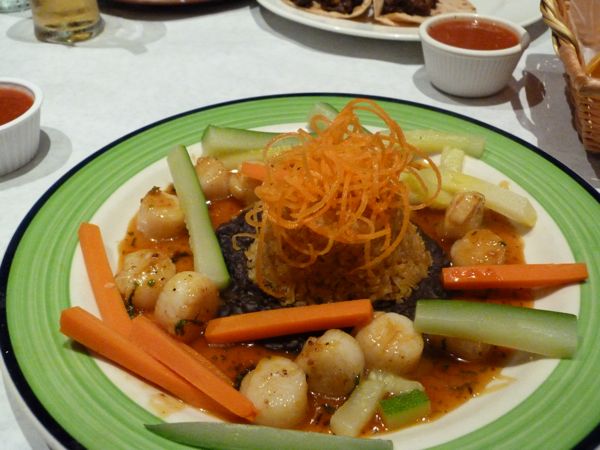
I ordered the Chili Seared Scallops. They were beautiful, and tasty, and surrounded by lovely vegetables, so I felt doubly good, eating tasty scallops AND vegetables. I was just a tiny bit taken aback that the chili sauce was sweet, so it reminded me a little of Thai food; I think I would prefer them sharp and salty, rather than sweet. They were, however, beautiful and delicious.
AdventureMan, however, was the big winner. He ordered a la carte Mexican tacos, one with a Pastore filling and one with a Barbacoa filling.
Here is what Wikipedia says about Tacos al Pastore:
A similar dish is served in Mexico known as tacos al pastor or “tacos de trompo”. The cooking is different from that of the kebab. The meat is cooked and then sliced into a corn tortilla. They can be found all over Mexico, especially in street corners. They are not new to Mexico, and it is unknown if there is a direct relationship with the Turkish Kebab. In Puebla, this was introduced by the numerous Middle-Eastern immigrants, mostly from Lebanon and Syria, but also Turkey and Iraq, in the early 1920s.[42] Since then, it has become a traditional dish of the city, locally known as taco árabe, “Arabian taco”, sold in taquerías orientales, “[Middle-]Eastern taco stands”.[43] Nonetheless, it is now usually made with beef and lamb and served either in pitas –locally called pan árabe, “Arabian bread”–, leavened bread –locally called torta árabe, “Arabian baguette”, also called cemita–, or simply in flour tortillas.
It is usually accompanied tahini and labneh –locally called jocoque–[44] even though the skhug (or kharif) has been replaced with a thick chipotle-garlic sauce.[45] In other parts of the country, most notably in Mexico City, the dish has adapted to the Mexican cuisine by replacing the pita with corn tortillas, in what is now called a taco al pastor, “shepherd taco”.[45] Unlike a taco árabe, the taco al pastor is served with pineapple, cilantro, chopped onions and green or red salsa, and marinated with annatto sauce.
Regardless of local adaptations, authentic middle eastern shawarma is available in the many middle eastern restaurants and kosher taquerias that cater to the large Mexican Lebanese and Mexican Sephardim communities. German style Doner Kebab can be found too but is not common, although is gaining popularity.
In some places of Northern Mexico, such as Nuevo Leon, Durango, Chihuahua, these are usually called Tacos de Trompo if served on maize flour tortillas, and gringas if they are served on wheat flour tortillas with cheese.
A similar dish is called Tacos Árabes, which originated in Puebla in the 1930s from Lebanese-Mexican cuisine. Tacos Árabes use shawarma-style meat carved from a spit, but are served in a pita bread called pan arabe. These tacos have been brought by Mexican immigrants to the United States in the past few years and have become popular in cities like Chicago and Los Angeles, the two largest Mexican and Mexican-American population centers in the United States.[46]
LLOOLLL – an Arab taco! Filed under doner kebab! And made with PORK! Well, they are delicious, and they have this taste like I imagine you could buy on a street in Mexico 😉 I have to imagine. I have never been to Mexico. Not yet 🙂
Here is what Wikipedia says about Barbacoa:
Throughout Mexico, from pre-Mexican times to the present, barbacoa (the name derives from the Caribbean indigenous Taino barabicu) was the original Mexican barbecue, utilizing the many and varied moles (from Nahuatl molli) and salsa de molcajete, which were the first barbecue sauces. Game, turkey, and fish along with beans and other side dishes were slow cooked together in a pit for many hours. Following the introduction of cattle, domestic pigs, goats, sheep, and chickens by the Spanish, the meat of these animals was cooked utilizing the traditional indigenous barbacoa style of cooking.
“Barbacoa” actually has its origins in all the countries that Tainos and other Indian populations inhabited, not just Mexico. The Tainos themselves were pre-Columbian Indians located throughout the Caribbean and which some believe included the Arawak Indians who especially dominated the most leeward Caribbean islands themselves.
The Arawak were first and foremost those who historically used the green and fire resistant flexible limbs of the hanging branches of the giant Bearded Fig Tree (Los Barbadoes) to cook meats and fish over an open fire while first marinating their foods in tropical herbs and spices found naturally throughout the southern islands to South America.
Unlike latter variations, the original and most authentic “Barbacoa” used herbs and spices, such as island prepared “cassareep” (derived from the root of the cassava plant), not only to enhance the natural flavors of meats, fish and vegetables, but preserve their cooked foods from spoiling in the heat of the tropics. The Arawak Indians called their preparations “Barbacoa,” accordingly, as these methods proved to be a boon of protection for keeping their foods from prematurely spoiling.
Rio Nuevo also had two different Mole’s I am dying to try, but when we went back for lunch the next day . . . . after hours at the Mall on the hottest day in Atlanta history ever, we BOTH ordered the tacos-a-la-carte: al pastore and barbacoa. They were SO good, served with bowls of fresh cilantro and chopped onion to sprinkle on – divine!
Service both times was excellent. This is not fast food, but there were a lot of people eating lunch there who were in and out quickly. The owner came by both times we ate there, and there are still things on the menu I would love to try.

Timbuktu Sufi Mausoleums Destroyed by Ansar Dine
From today’s Al Watan, Kuwait:
Mali Islamists destroy more holy Timbuktu sites
Monday,02 July 2012
Source : -Reuters
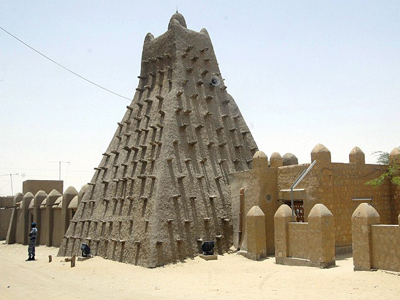
BAMAKO: Militants from the Al-Qaeda-linked Ansar Dine group destroyed mausoleums of Sufi saints with guns and pick-axes in the famed Mali city of Timbuktu for a second day, said witnesses on Sunday, ignoring international calls to halt the attacks.
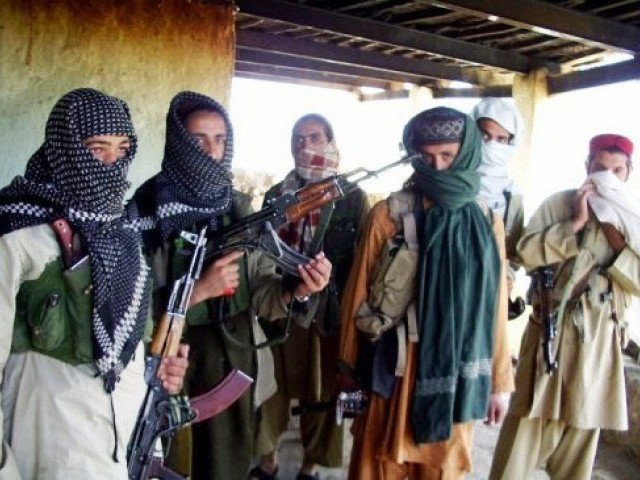
The salafist Ansar Dine backs strict sharia, Islamic law, and considers the centuries-old shrines of the local Sufi version of Islam in Timbuktu to be idolatrous.
Sufi shrines have been attacked by hard-line Salafists in Egypt and Libya in the past year.
The group has threatened to destroy all of the 16 main Sufi mausoleum sites in Timbuktu despite international outcry. UNESCO Director-General Irina Bokova has called for an immediate halt to the attacks.
Local journalist Yaya Tandina told Reuters that about 30 militants armed with Kalashnikovs and pick-axes destroyed three mausoleums of saints on Sunday.
“They had armed men guarding the door. Just like yesterday, the population did not react. They (local people) said we need to let them (the Islamists) do what they want, hoping that someday we will rebuild the tombs,” Tandina said.
Residents said the destruction was halted around midday when some of the militants went to a mosque in the centre of the city, but it was unclear if they would continue.
“We are subject to religion and not to international opinion. Building on graves is contrary to Islam. We are destroying the mausoleums because it is ordained by our religion,” Oumar Ould Hamaha, a spokesman for Ansar Dine, told Reuters by telephone from the northern Mali city on Sunday.
Timbuktu resident Hamed Mohamed said the Islamists destroyed the tombs of saints Sidi Elmety, Mahamane Elmety and Cheick Sidi Amar, all in the west of the city. -Reuters
Last Full Day at Chongwe; A Day of Wonderful Surprises
I’ve really dragged this out as long as I can; as long as I am telling you about the trip, I get to relive it. In truth, I don’t want to let it go. We’ve been to Africa so many times, but this was one of the best trips ever.
It’s a little colder in the lower Zambezi than in the South Luangwa, so we dress in multiple layers, and we wrap up our heads, too. Victor and CJ join us for light breakfast and we head off on our last game drive. We have had so much fun with Victor; he works so hard to find us what we want to see, even trying to track down a leopard on a limb, with one of our party is eager to see. This morning, first thing, he takes us to a giant Baobob tree, which looks like it has Christmas decorations on it:

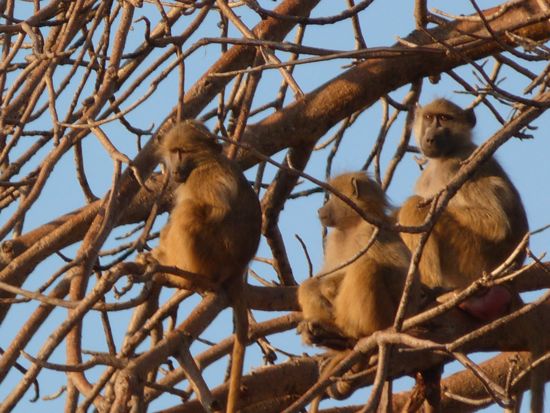
When you get a little closer, you can see it is full of Baboons, huddling together, trying to warm up after the chilly night.
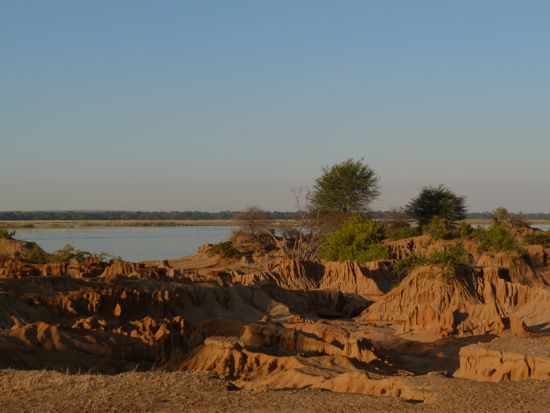
He takes us to a sector of the Zambezi with severe erosion that reminds me of Cappadocia and there we spot a group of Zambian anti-poaching rangers, heading off on their day’s duty. These guys are real heroes. They leave their families and live outdoors, spending their nights out among the wild animals. There are real dangers, not so much from the animals, but from the poachers, who will kill an elephant just to cut out the tusk.

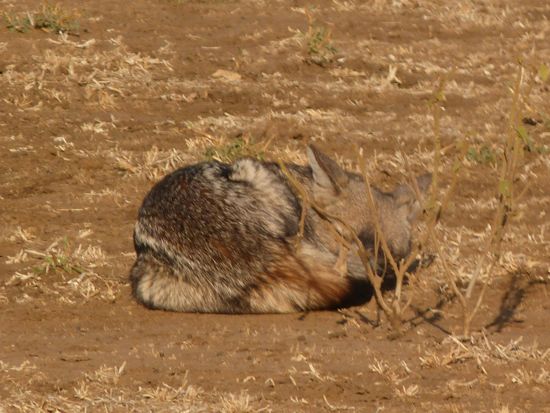
Victor spots a very cold little jackal, all curled up, trying to grab a couple winks:
We find a group of Cape Buffalo, still moving a little slowly so we can photograph them, but kicking up a lot of dust!


Yesterday, Victor found a leopard was on the limb but jumped down just as we arrived. Today, we see a beautiful large male leopard, being chased by an elephant. We get between them, not the smartest thing to do because the elephant is just behind us! I’ll show you photos of the elephant later – right now I want to talk about taking photos on safari.
You might guess I took a lot of photos. You might suspect you just get to see the best ones, and sometimes even the best ones aren’t all that good. Here is the problem. You don’t have a lot of control. You sometimes only get a quick glimpse. You can have an amazing experience, and then look at your photos and they are all too far away, or there is a small but important problem. I am going to be very very humble and show you the things that can prevent a good leopard shot:
Big male leopard, but you can barely see him in the shade and he’s heading off:
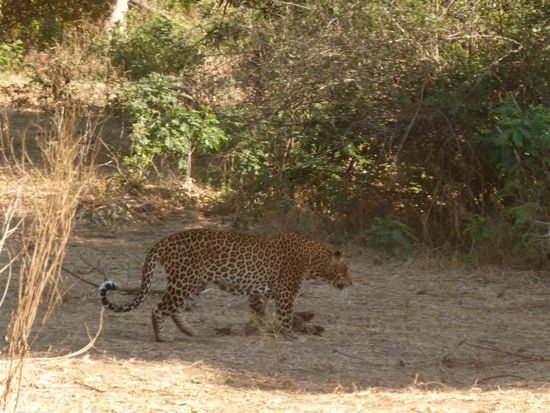
Now he’s walking into the bush:

You’re not going for perfect; you just keep shooting hoping for something good, but now he’s in the bush, behind the bush:

Now he is coming from behind a tree:

Then you get what might be the best photo you can get:

And then he walks away – leopard butt!
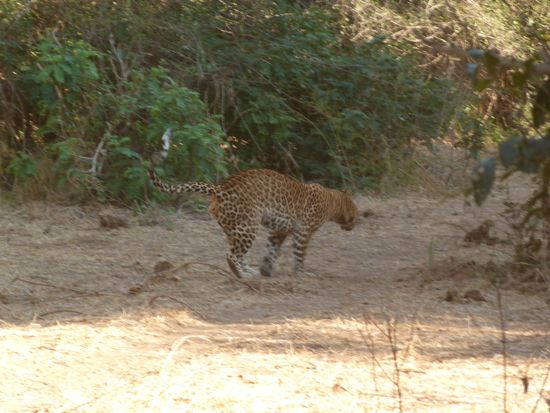
Are you getting the idea? You just really have to hang in there! Now, frustration, he has settled behind a bush:

Almost a great shot, if it weren’t for all that tall grass!
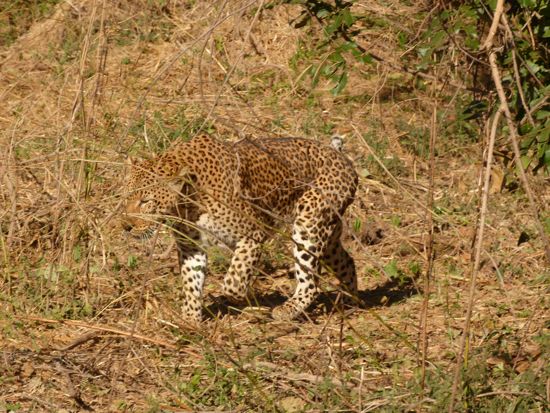
And here, he looks tawny and powerful, look at those muscles, but you can hardly distinguish him from the background:
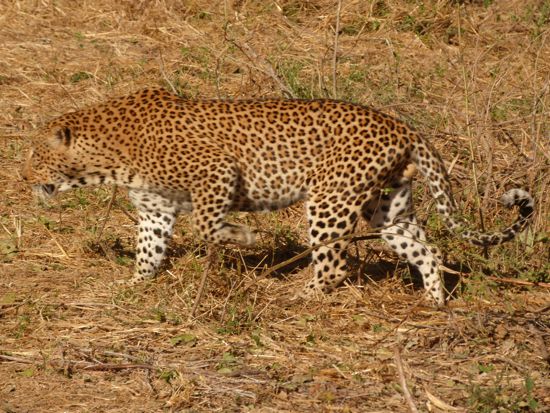
The perfect shot! Oh wait . . . he’s blurry:

And this might be good . . . if he weren’t walking away, and most shots of leopards are them walking away:

I’m not kidding you, that is the exact sequence of this day’s leopard shots. But! He who persists, prevails!
Now! The Payoff shots:
Wooo HOOOOOO!


Can you imagine our exhilaration? Of the four of us, I have the smallest camera, with the least capability. I can only imagine how beautiful my friends’ photos are. This was a special moment, the moment the leopard stood still, out in the clear. You cannot make those moments happen, you just have to cherish them when they do.
LOL, this is what comes next – more humility:
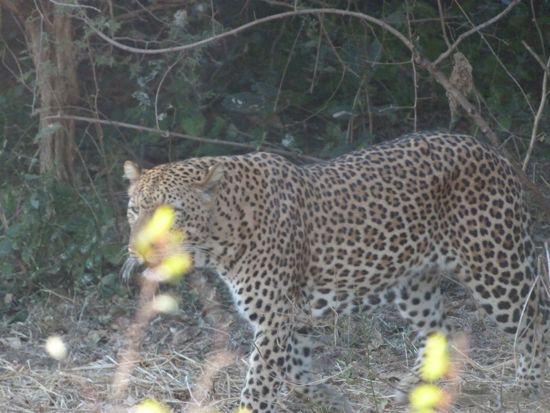
It’s time for coffee, and Victor knows just the place – a palm grove:
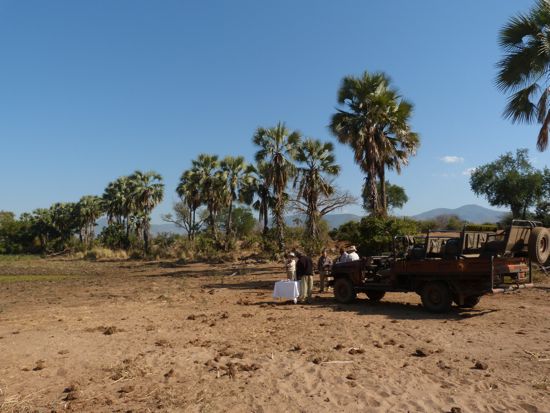
It looks warm, but we still have one long sleeved layer on.
We head on searching for lion, which we do not find today. We find other things:

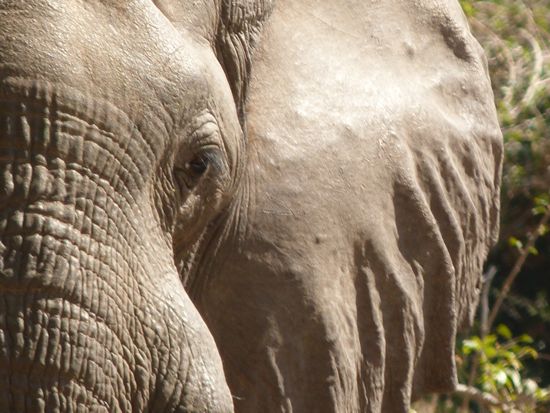

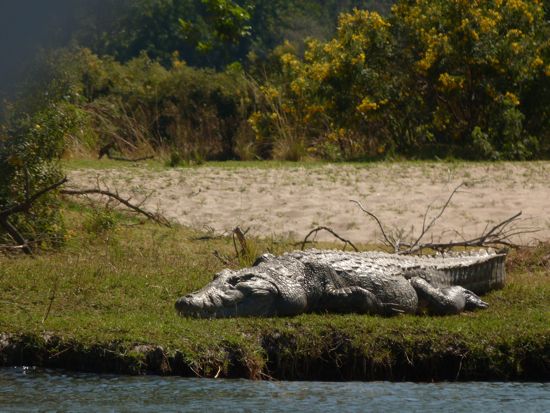
It is getting later, and we reach the camp boat waiting for us in Lower Zambezi National Park to head back for camp. . . About fifteen minutes into the drive, after spotting five huge crocodile sleeping on the riverbanks (each rolling off as we approached before the boat could stop rocking long enough for us to shoot until
the last one)
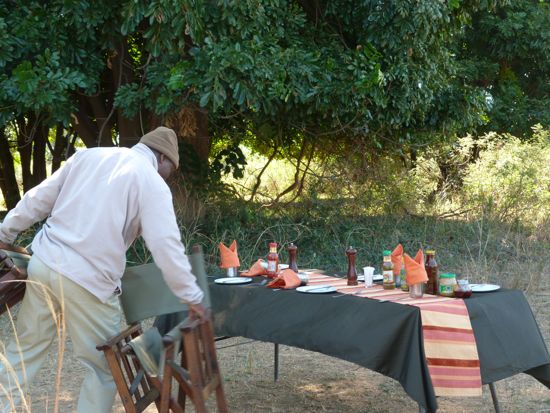
We approached a bank, not our camp, where a picnic was set up on an island – for us! We had no idea! Our Albida House butler, Steve, was there to greet us, as he is when we return to camp, and a crew including a chef, who is cooking a late breakfast with lamb steak, sausages, several salads, and fried eggs. We are set up out under a shady tree in camp chairs, at a table with tablecloth and napkins, and it is so elegant and so glorious, and it is a little paradise.



After our picnic, it is a five minute ride back to camp, where Victor drops us off

I have to wash my hair! I intended to yesterday, but there was a very cold breeze blowing and our bathroom is open to the elements, so I skipped a very chilly shower. Today, I must shower and wash my hair! It is a brighter, warmer day, so I do, and it is delightful, showering in the huge open bath area, nice hot water, a tiny chilly breeze, but big thick towels and a warm robe to wrap up in.
It feels so good to be clean! We get so dusty on our drives!
AdventureMan follows, showers and shaves. We are leaving tomorrow morning, and he knows it will be chilly in the morning and wants to get it done while it is warm, so while my hair dries in the soft breeze, we chat about how much we love this place.
For me, the greatest luxury is privacy. I do enjoy the people I am meeting, and at the same time, I need some quiet and some time alone. The great gift of being upgraded to this family suite has given us some wonderful dinner conversations, the ability to dine informally and earlier in the evening, and the joy of space and time. We have been less regulated here, more able to be ourselves. It is a great luxury.
After our quiet time, we had tea . . . well, really, I had mocha, decaf and cocoa. And cake. For all our protestations of wanting to eat healthy foods, they keep bringing us the most delicious cakes and desserts, along with a big bowl of fruit. We never choose the fruit. We are able to hold ourself to half portions. Well, some of the time we are.
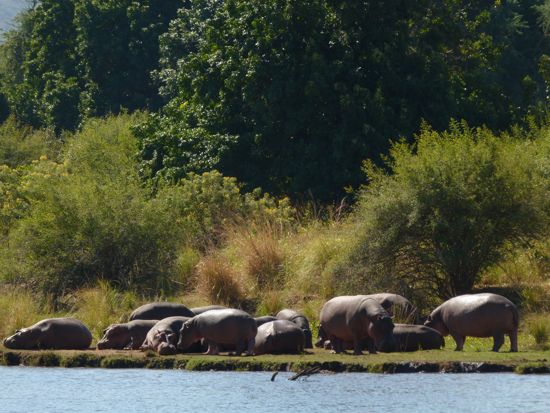
Today I stayed back while the other three of us went canoeing in the afternoon, imagine, canoeing on the Zambezi, what a thrill. I packed, thoughtfully, and watched the hippos transfer from their sunning spot to their sand spit. I always loved what I thought of as hippo-laughter, but I am told it is simply an announcement of “I am here.” Like a space – I am in it. I wouldn’t want to get between a hippo and where they were going, but I do find them charming, and I still love hippo sounds. For me, another day in paradise is having the luxury of some time to myself, not to do anything important, think through my packing, read a little of the book I am reading, watch the hippos, just enjoy my own company for a few minutes.
They have brought in a large barrel and put it by the fire; it looks like a kind of a grill . . . hmmmm. They are so full of good surprises here. I wonder what this one is all about.

It IS barbecue, and when the three canoe-ers come back, all full of a really fun adventure, we sit by the fire with our wine and watch dinner being cooked. It is dark, but the cook has a headlamp so he can see what he is doing:
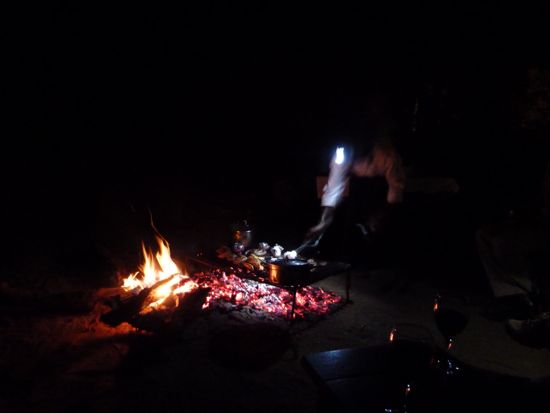
Our last dinner – awesome!

We fly tomorrow, first from “Royal,” which is really just a strip, to Lusaka, then from Lusaka to Johannesburg, then from Johannesburg to Atlanta and then Pensacola. We have only confirmed two flights . . . there is no internet connection in the bush, not for guests. It makes things more complicated. I am just hoping they make allowances for such, especially on the Delta flight out of JoBerg, but as our travel friend says “who cares if we get home on time? It was only getting here that mattered!” and she is right!
As we get into bed, we have hot hot water bottles, in cheetah-patterned flannel covers. 🙂 ZZZZzzzzzzzzzzzzzzzzzzzzzzzz . . . . .
Wooo HOOO, Saudi Arabia Allowing Female Olympic Athletes
It hasn’t been so long in our own country since Title IX made it possible for more and more women to participate in athletic events, making funding possible, giving women in the United States an opportunity to participate in healthy athletic activities.
RIYADH, June 25 (Reuters) – Saudi Arabia will allow its women athletes to compete in the Olympic Games for the first time ever in London this summer, the Islamic kingdom’s London embassy said on its website.
Human rights groups had called on the International Olympic Committee to bar Saudi Arabia from competing in London, citing its failure ever to send a woman athlete to the Olympics and its ban on sports in girls’ state schools.
Powerful Muslim clerics in the ultra-conservative state have repeatedly spoken out against the participation of girls and women in sports.
“I think this is a victory for Saudi sportswomen and hopefully it will promote sports and women’s health awareness for the Saudi society,” said Lina al-Maeena, co-founder of Jeddah United Sports Company, a rare women’s exercise club that runs a female basketball team.
In Saudi Arabia women have a lower legal status than men, are banned from driving and need a male guardian’s permission to work, travel or open a bank account.
Under King Abdullah, however, the government has pushed for them to have better education and work opportunities and will allow them to vote in future municipal elections, the only public polls held in the kingdom.
Saudi women will be able to compete in the London Olympics only if they reach the qualifying standard for their event, and the Games opens in just over one month, on July 27.
“The kingdom of Saudi Arabia is looking forward to its complete participation in the London 2012 Olympic Games through the Saudi Arabian Olympic Committee, which will oversee the participation of women athletes who can qualify for the Games,” said a statement published on the embassy website.
The woman most likely to compete under the Saudi flag in London, show jumper Dalma Malhas, was ruled out on Monday when the World Equestrian Federation (FEI) said the 20-year-old’s mare Caramell KS had been sidelined by injury for a month during the qualifying period and had missed a June 17 deadline.
“Regretfully the Saudi Arabian rider Dalma Rushdi Malhas has not attained the minimum eligibility standards and … will not be competing” at the London Olympics, FEI secretary general Ingmar De Vos told the FEI website (www.fei.org).
Malhas won individual bronze at the junior Olympics in Singapore in 2010, but without official support or recognition.
In April the head of the General Presidency of Youth Welfare, which regulates sport in Saudi Arabia, said it would not prevent women from competing but they would not have official government endorsement.
The government’s role would be limited to ensuring that Saudi women’s participation “is in the proper framework and in conformity with sharia”, he said.
The IOC said on Monday that talks with the Saudis were “ongoing” and that “we are working to ensure the participation of Saudi women at the Games in London”.
The head of the kingdom’s Olympic mission, Khalid al-Dakheel, told Reuters on Sunday that he was unaware of any developments allowing women to participate.
Top Saudi clerics, who hold government positions and have always constituted an important support base for the ruling al-Saud royal family, have spoken against female participation in sports.
In 2009 a senior cleric said girls risked losing their virginity by tearing their hymen if they took part in energetic sport.
Physical education is banned in girls’ state schools in the kingdom, but Saudi Arabia’s only female deputy minister, Noura al-Fayez, has written to Human Rights Watch saying there is a plan to introduce it. (Reporting by Angus McDowall and Asma Alsharif; editing by Tim Pearce)
Leaving Nsefu for Chongwe; The Most Exciting Moment of our Trip
Early, early the next morning we heard a crashing and crunching – sounds we can easily identify as elephant. At first we continue sleeping, our only morning for sleeping in, but I can’t resist, I have to get up, and lo! The elephant is between our cabin and the next, obliviously chomping and breaking and tearing the tree for an early breakfast.
I decide to get up and get dressed so I can get the iPad charged before the generator goes off at 10, but I can’t go out until the elephant has departed, and she heads in the direction of the lodge, which is where I need to be. Deb Tuttle, the walking guide, walks with me once we see the elephant walk a little further down the valley, I’m able to get the iPad charging and grab a cup of coffee so to be able to say farewell to some of the guests whom we will not see again.
Sunrise over Nsefu:

Travel agents heading out on a Robin Pope Walking Safari:

Making Toast is the favorite job in the winter, close to the hot coals:

It is so nice to be able to pack in daylight! My iPad is at 100%; I have finished The Paris Wife and am starting Wolf Hall, which also holds my attention. While carrying books is bulky, this constant underlying awareness of needing to recharge camera batteries and iPad is also a deterrence. I find I am less desperate about the camera batteries, I always carry at least one back-up so I always have a charged spare, but when the iPad goes, it has to be recharged before we can use it again.
A couple of the travel agents who didn’t know each other had to bunk together in Nsefu. I don’t feel sorry for them; they get to come free. It seems to me, though, is hard to come on these trips as a single person and not feel the odd one out when the game drives go out. They say it is no problem, but I’ve been the odd one on trips to Kawazaa, etc., when AdventureMan wanted to do some activity and I wanted to do something else. It is possible, anything is possible, but sometimes it is just a little awkward. Sometimes people are nice; sometimes they are not so happy to have someone else with them. We are finding that the best of all worlds is to come with your own little traveling group.
The first time we came as a small group was with our son and his wife. We were able to do game drives with people who share our preferences, have people to talk to at dinner if everyone else has their group, etc. We like meeting up with other people, and at the same time, it gives you more confidence to have a group with you, if the other people are all absorbed in one another, or not great company.
The most difficult people are those who don’t understand that this is not a predictable experience – that’s why it is an adventure. There is no guarantee that the lion will crawl over the lip of the riverbank just in front of your car. There is no guarantee you will find the same great, shaggy maned lion at the salt pans that the other guests found the day before. There are NO guarantees, and so you have to treasure all the moments, great and small, and if you are blessed with an extraordinary experience, you celebrate, but honestly, just being here is cause for celebration. Those whose noses get out of joint because you might have seen something they haven’t aren’t a lot of fun to be around. We had one experience when a group that had been friendly to us got all sour and disgruntled because we had seen the lions at the salt pan and they had not. Hey! The lion don’t always show up! The leopard are elusive. This experience is one that totally has to be lived in the moment.
You have to love the smell of the campfire in the morning, and be willing to sacrifice your one morning of sleeping in to spot the elephant chomping outside your bathroom wall. You have to love the little elephant shrew as much as the elephant. There are some drives that are just quiet. It’s like you can’t expect Christmas every day, and if it were Christmas every day, it wouldn’t be special any more.
Just before Holly arrives to open up the Bend Over Store (LOL, it’s a trunk full of goodies) we are blessed with one last elephant crossing! Two days earlier, the elephant were crossing back and forth like a street in New York, then yesterday – not an elephant! It was so unearthly quiet! Today, groups are massing once again, and crossing. We love watching the baby elephants as they learn how it is done.
Drinking; getting ready to cross:

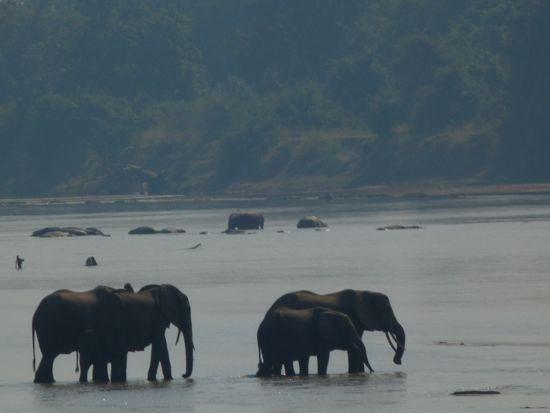

Mom, wait!

On the way to Mfuwe airport, we see Eland – we’ve been looking and looking for these large elk-like ungulates, they are shy and elusive, but Jonah spots them off in the distance, a parting gift from Nsefu.
We have an all-too-brief mad dash through Tribal Textiles, where we ‘invest’ in tablewares, cushion covers and deco for children’s rooms. AdventureMan befriends one of the Tribal Textile cats while I am busy shopping. I have cleared out my backpack so I would have space to put my purchases. 🙂
We have a full flight from Mfuwe to Lusaka, and not a lot of time to spare before our next flight. Smooth flight to Lusaka, just minutes to pick up luggage and transfer to next ProFlight flight, this one is not even on the departure board, only eight passengers, our party of four and a German family from Bavaria. At the very last minute another man comes running, running to catch the plane, we are all busy chatting, it is already a family. They are en route to Chiawa.
It’s a short flight, but here comes the most exciting moment in our day. The pilot is looking at a cheat sheet and the suddenly the plane is saying loudly “Pull Up! Pull Up!Terrain! Terrain!”
The pilots are looking confused and annoyed, one still looking at the instruction sheet, a mountain is rising in front of us, the plane is banking and the loud voice keeps saying “Pull up! Pull up! Terrain!”
I thought I had a movie of all this. I remember making a movie, thinking that if these are my last moments, I will record what happened and try to store the iPad in a place where it might be safely found. Of course, as it turns out, we landed safely and . . . somehow, I don’t have the movie. I must have shut it off too quickly and it didn’t save; I was in a hurry – just in case those were my last moments. I have to admit I am disappointed not to have it to share with you.
Waiting at the airstrip is Victor, our guide, and we rode with him and Chris, who turns out to be one of the owners of Chongwe, to the Chongwe River Camp.
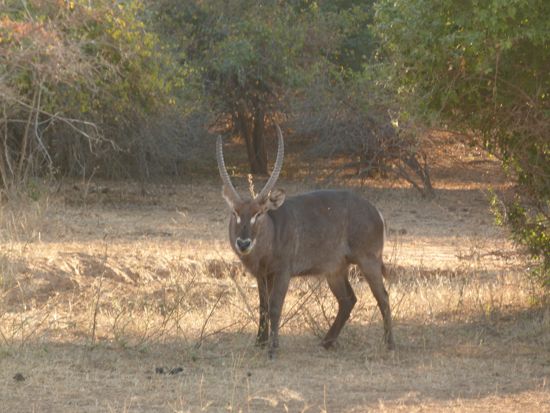
(This is a waterbuck we passed on our way into camp, and again on our way out of camp the next morning; so so sad, part of the circle of life and death, but as we departed Chongwe, his bloated body was in the same field; they suspect he was bitten by a snake and died.)
Arrival is lovely, we are greeted at a tall stand, so we are not climbing in and out of the Land Cruiser, we walk right out onto this stand and down the steps. Flossie greets us and then they tell us that we have been upgraded and put in the family suite.
The Family Suite . . . As soon as we see it, we remember. We had totally forgotten . . . we loved our cabins at Chongwe, we were delighted with all the amenities, and we also remember our first boat trip riding by a place that looked like a fantasy from 1001 Nights, a tented living room and dining room, with carpets and nice furniture and linen tablecloths and gleaming candles – it was so lovely. We remember, it was the family suites. And now, the family suite was ours!
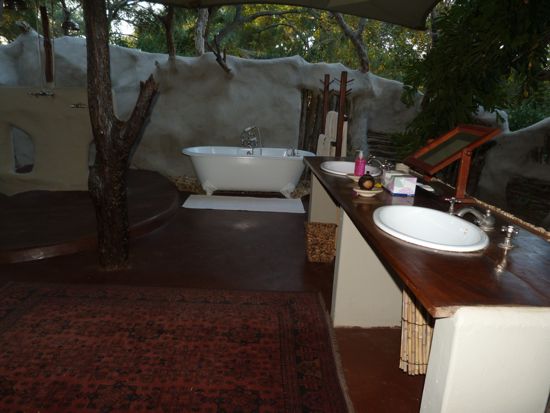
We were a little dazed by our good fortune, we couldn’t believe this lovely place was ours. Our butler, Steve, offered us drinks, Flossie, the camp hostess showed us to our bedroom/bathroom/dressing areas and explained how everything worked, where the electrical outlets and switches were, how the double shower works, where the bath oils were for the claw-footed bathtub, gave us the white cotton pique robes and the fluffy thick Turkish Towels.
This is our sleeping area:
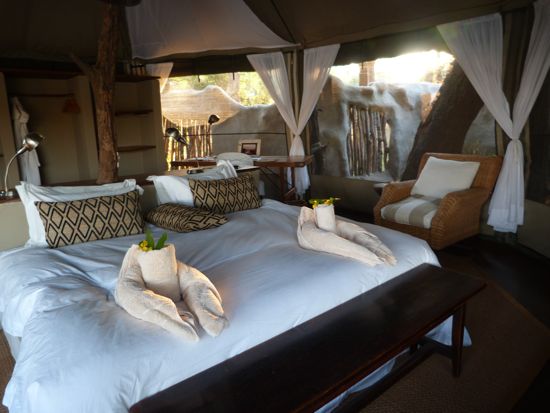
This is our dressing area:
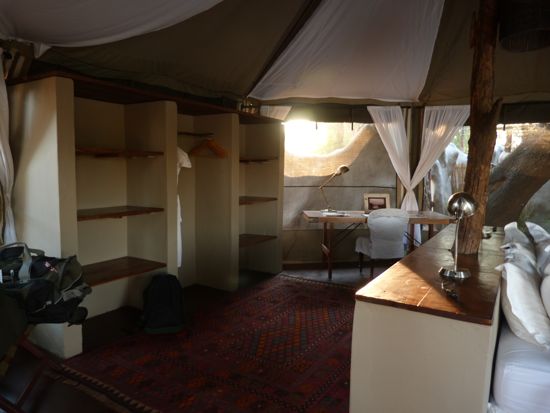
This is the view from our tent toward where the Chongwe River meets the Zambezi River:

This is our bathroom, with a two-person shower and claw-foot tub 🙂
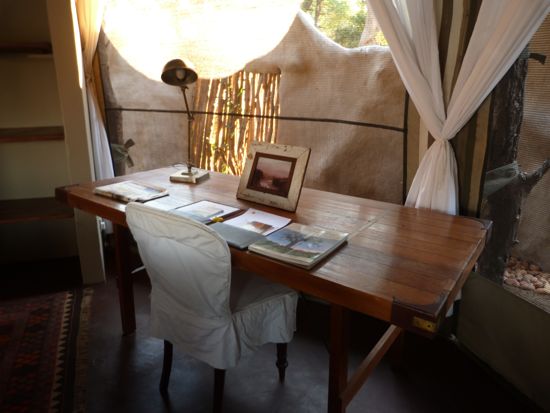
And this is the desk area, also where we can charge our batteries and electronics:
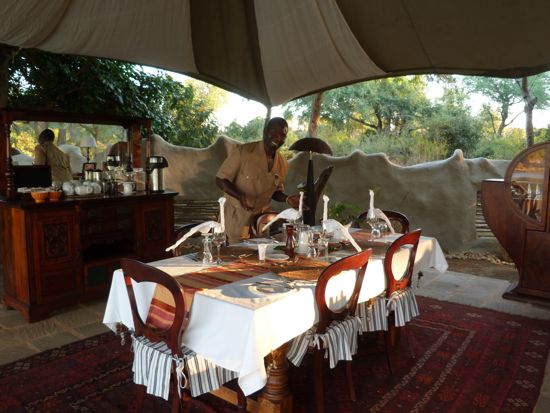
This is our dining room:
The Family Room:

This is the view out over our swimming pool to the Chongwe and Zambezi Rivers, and the hippo pods:
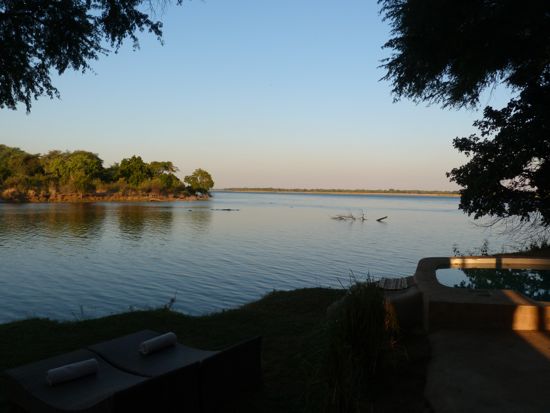
There are woven mats and kelim carpets, and we feel at home, if home can be a huge octagonal tent with an indoor / outdoor feel. Victor comes back, pulling up in a boat next to our swimming pool,to take us for a sundowners up the Chongwe and then back down into the Zambezi.

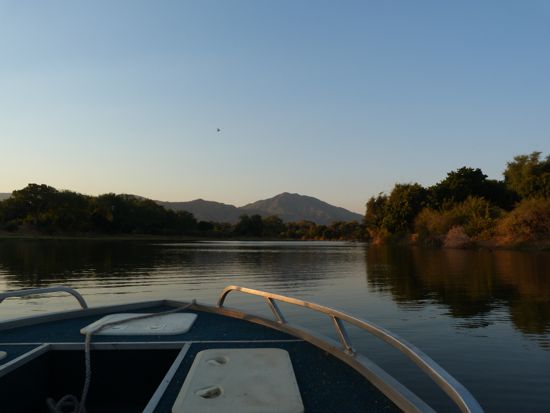
And Victor has fishing equipment with him for the fishing enthusiast in our party. He is able to cast to his heart’s content with a rod and reel trying to hook a Tiger Fish (catch and release) but no luck.

We see lots of animals coming down to drink at dusk, just across the Chongwe:


Our first Chongwe sunset:

Dusk settles on the Zambezi:

After sundowners, we head back and go to our luxurious tents to clean up, then reassemble around the fire to have a glass of wine before dinner.
The ultimate luxury is privacy. We have met such lovely people in the camps, and still, I am who I am, it is hard for me to exert myself to be charming every night at the end of a long day. I do fine at breakfast around a campfire. I manage at lunch, although after an early start and a long game drive, I am usually eager for a quick snooze. But by night, at the end of the game drive, all I want is comfort food, quick, like tomato soup and a cheese sandwich, not so much chit chat and good night, see you all in the morning when I am more chipper.
I recognize there are people who do well later in the day. I recognize that there is this thing called civilized behavior. I do have manners, I know what is important, and . . . yet . . . late in the day, I have the nature of a curmudgeon. I need some quiet. AdventureMan and our friends are out having a great conversation in our living room area, I can hear them, I delight that they are having such a great conversation, and I really, really need to be in here, writing up my notes. By the grace of God, they understand me and have compassion on me. I am able to join them a little later, and we have a lovely laughter-filled dinner in our private dining room and then off to bed – we have a full day tomorrow in Chongwe!
The butler, Steve, does wonderful napkins:

We did nothing to deserve this beautiful upgrade. We loved the spacious tents we had the last time we were in Chongwe River Camp, but this . . . this is a totally unexpected, undeserved blessing, it just fell in our laps, and we are so appreciative. We feel so cherished, so blessed, so beautifully taken care of. We go to sleep with the sound of hippos . . . . .ZZZzzzzzzzzzzzzzzzzzzzzzzzzzz . . . . . .
Syria’s Stonehenge
Older than the pyramids . . . desert find in Syria
A mystery city lies in Syria’s deserts, one older than the pyramids — but the war-torn area is preventing archaeologists from decoding its riddles.
Fragments of stone tools, stone circles and lines on the ground, and even evidence of tombs appear to lie in the desert near the ancient monastery of Deir Mar Musa, 50 miles north of Damascus, archaeologist Robert Mason of the Royal Ontario Museum said. He likened the formations to “Syria’s Stonehenge.”
“What it looked like was a landscape for the dead and not for the living,” Mason said Wednesday during a presentation at Harvard University’s Semitic Museum, according to the University publication the Harvard Gazette.
He made the find during a 2009 trip and is eager to return and further explore the site. But he says regional conflicts make such a return trip nearly impossible.
“It’s something that needs more work and I don’t know if that’s ever going to happen.”
‘What it looked like was a landscape for the dead and not for the living.’
– Archaeologist Robert Mason
The monastery itself, also called the Monastery of Saint Moses the Abyssinian, was built in the late 4th or early 5th century, he said, and contains several frescoes from the 11th and 12th century depicting Christian saints and Judgment Day. He told the audience at Harvard that he believes it was originally a Roman watchtower, partially destroyed by an earthquake and rebuilt.
But the desert puzzle is much older.
Bits of tools Mason found nearby suggest the mystery he discovered in the desert is much older than the monastery. It may date to the Neolithic Period or early Bronze Age, 6,000 to 10,000 years ago, the Gazette said.
Egypt’s oldest pyramid, the Great Pyramid of Giza, was built about 4,500 years ago.
Mason also saw corral-like stone formations called “desert kites,” which would have been used to trap gazelles and other animals. The desert around the monastery is hardly a verdant pasture — “very scenic, if you like rocks,” Mason reportedly said — but was probably greener a few millennia ago, the archaeologist explained.
Like Indiana Jones exploring Italy’s museums in “The Last Crusade,” Mason hopes to return to the monastery to excavate under the church’s main altar — he believes he’ll find an entrance to underground tombs there.
He also hopes to return to strange stone formations he found in the desert, which he dubbed “Syria’s Stonehenge.”
The Customer from Hell at Target
Me. Today I was the customer from hell at Target.
I like Target. I like it that you can find just about anything you need there. I usually look for a deal, or a good price on things, but when I just need something, I just go buy it at Target. I also like their ad campaign, it’s a little camp but very colorful and always has cool products featured.
So today I went in for hair color stuff. I found it, but then I also found a display containing packages of two together, and it costs a lot less. It says Buy Two for Less!
Yes! Yes! I am buying two! I always buy at least two so I don’t have to go shopping that often; holdover from my days of buying six months worth when I was living in Kuwait and Qatar. It doesn’t go bad, and you have it when you need it.
None of the cellophaned two-packs have the color I need, so I take the ones I need and the two pack to the cashier, and I explain I want the special “Buy Two and Save” price, and she says “Whoa! That’s beyond me!” and sends me to the customer service counter.
At the customer service counter they explain to me that this is a special deal to encourage customers to buy more than one; they buy two and get a special deal. I agree with them, and isn’t this great, I want to buy two! Well no, they explain, Target pays a different price for the package than for the singles, so they can’t sell the singles two for the same price as the two bundled together.
Wait. These are the exact same product. EXACT. Except that these two wrapped in cellophane are 2 for $11.99, and the two exact same product I want to buy are priced at $7.99 EACH. So I am supposed to pay $5 MORE to buy two single ones? Something is not right with this picture. I ask to see a supervisor.
I am quiet and mannerly. I have a secret weapon – it is called pleasant persistence. They keep explaining to me that I can’t buy what I want at the special price and I just smile at them and politely explain how it doesn’t make sense. They are telling me in their explanations to “PLEASE GO AWAY!” and I am smiling and politely telling them in my own way that I am not going anywhere, and I want my product at the two-for price.

Finally, the supervisor says to sell it to me at the two-for price. As she is ringing it up, the customer service rep says “this happens all the time, not with hair products but with all kinds of products when we have the bundle price and the single price.” I suggest she mentions it to management, and that it costs a lot in time and in customer frustration and customer service frustration, and she says “it wouldn’t help.”
I still like Target. I imagine there are a lot of customers who give up and walk away. Not me. It doesn’t make sense to me to pay $5 more for something that they WANT you to buy two of . . .
Recent Comments
intlxpatr on Shampoo Ginger tigerbutterya0c5ff1d… on Shampoo Ginger intlxpatr on British Soldier Kidnapped, Esc… John on British Soldier Kidnapped, Esc… intlxpatr on British Soldier Kidnapped, Esc… Wikipedia Donate Button

Amazina


Early Voting in Florida


