The Problem of Saint Bridget
Today is the Feast of St. Bridget, and I found the following in our Lectionary for today. The problem for Christians is that we are to travel lightly on the earth, caring not for possessions, as Bridget did. The poem is hilarious:
ST BRIDGET OF KILDARE
ABBESS (1 FEB 523)
Bridget (Brigid, Bride, Bridey, or in Welsh, Ffraid) of Kildare was born around 450 into a Druid family, being the daughter of Dubhthach, court poet to King Loeghaire. At an early age, she decided to become a Christian, and she eventually took vows as a nun. Together with a group of other women, she established a nunnery at Kildare (meaning, Church of the Oak). She was later joined by a community of monks led by Conlaed. Kildare had formerly been a pagan shrine where a sacred fire was kept perpetually burning, and Bridget and her nuns, instead of stamping out the fire, kept it going but gave it a Christian interpretation. (This was in keeping with the general process whereby Druidism in Ireland gave way to Christianity with very little opposition, the Druids for the most part saying that their own beliefs were a partial and tentative insight into the nature of God, and that they recognized in Christianity what they had been looking for.) Bridget as an abbess participated in several Irish councils, and her influence on the policies of the Church in Ireland was considerable.
Many stories of her younger days deal with her generosity toward the needy. This aspect of her character has been the subject of a poem:
“The Giveaway” (from The Love Leters of Phyllis McGinley, New York, Viking Press, 1957)
 Saint Bridget was
A problem child.
Although a lass
Demure and mild,
And one who strove
To please her dad,
Saint Bridget drove
The family mad.
For here’s the fault in Bridget lay:
She would give everything away.
To any soul
Whose luck was out
She’d give her bowl
Of stirabout;
She’d give her shawl,
Divide her purse
With one or all.
And what was worse,
When she ran out of things to give
She’d borrow from a relative.
Her father’s gold,
Her grandsire’s dinner,
She’d hand to cold
and hungry sinner;
Give wine, give meat,
No matter whose;
Take from her feet
The very shoes,
And when her shoes had gone to others,
Fetch forth her sister’s and her mother’s.
She could not quit.
She had to share;
Gave bit by bit
The silverware,
The barnyard geese,
The parlor rug,
Her little
niece’s christening mug,
Even her bed to those in want,
And then the mattress of her aunt.
An easy touch
For poor and lowly,
She gave so much
And grew so holy
That when she died
Of years and fame,
The countryside
Put on her name,
And still the Isles of Erin fidget
With generous girls named Bride or Bridget.
Well, one must love her.
Nonetheless,
In thinking of her
Givingness,
There’s no denial
She must have been
A sort of trial
Unto her kin.
The moral, too, seems rather quaint.
Who had the patience of a saint,
From evidence presented here?
Saint Bridget? Or her near and dear?
It is reported of Francis of Assisi that as a young man he had a dream in which God said to him, “Francis, repair my church.” He took this to refer to a church building near Assisi which was in need of repair, and he sold a bale of silk from his father’s warehouse to obtain building materials. His father was furious. Francis had not asked for permission: he simply took it for granted that his father would wish to contribute to such a worthy cause. It is said of Bridget that as a young girl she made similar assumptions about her family.
 |
| St. Bridgit’s Cross, at St. Bridgit’s Church in Kildare |
There is a problem here. On the one hand, it can be argued that if our family members do not choose to make sacrifices for God we have no right to make that choice for them. Some time ago, if I remember aright, one listmember wrote in considerable bitterness about a childhood that had been blighted by the decision of the father that it would be nice if the whole family lived in Christian Poverty. (Said listmember found no spiritual blessings in the experience, and saw no sign that anyone else did, emphatically including said father.)
On the other hand, I far more frequently hear Christians argue that their sacred duty to keep everything nice for their spouses and children prevents them, not only from going as missionaries to distant shores, but also from volunteering even quite moderate amounts of their time and money for worthy causes down the block. (Not that all unattached Christians are blameless in this regard.) You will note that Saint Paul, writing to the Corinthians, told them that marriage, while instituted of God and a sign of the union between Christ and His Church, was not without its dangers to the spiritual life of the Christian. But the danger he saw had nothing to do with sex. He was concerned instead that the married are tempted to overvalue security, to feel that they cannot afford, for their families’ sakes, to take chances. And since he expected Christians to be facing persecution soon, he saw this as a matter of urgency.
So, as I said, there is a problem here. I have no final answer to give, but commend it to your consideration.
by James Kiefer
Social Network Interactions
I do go to FaceBook now and then, and I have connected with old friends, college friends, high school friends, and people from the many ‘places I remember’ in my life . . .
It’s pretty public, don’t you think? And you do one little thing, and it’s like glue, you’re stuck with that relationship. I am now careful who I ‘like’, because I seem to end up linked to them, and honestly, I try to be careful to limit my connections to people I know, or have known, people I have something in common with, like a family member, etc.
It’s like if you indicate any interest at all, you get linked. Is it just me? I don’t think of myself as isolationist, but time is precious, and I try to spend it wisely, focusing on genuine long term relationships, family relationships and people with whom I have commonalities.
I find that magazines who which I subscribe, cultural organizations, charitable organizations are all sending me surveys; they want to get to know me better. (? ? ? )
It’s too much relationship for me. I know there are people who can handle a huge number of social acquaintances . . . that’s not me. I am civil, even cordial. I don’t want to get to know organizations through surveys, nor businesses, relationships take TIME. So many of the ‘relationships’ make me feel rushed, and when I feel rushed, or pushed, my reaction tends to be to drop the relationship; it just doesn’t work for me.
I do believe we are all supposed to be connected, to be kind to one another, to care about one another. It’s asking too much of me to expect it to happen quickly. Am I the only one? Does anyone else have any problems with the instant sort of intimacy that seems to spring up so commonly on the social networks?
A and E Drugstore in Pensacola
When I got here, the only quilt shop had closed, leaving me with JoAnn Fabrics as my only alternative. I’d been here about 10 months when one of my bible-study buddies asked me if I had ever heard of A & E? Well, yes, I had heard people mentioning they were running there, but I’d never been there. My friend took me there – took me to heaven for a quilter. You would never guess this place had bolts and bolts of just-what-you-never-knew-you-needed.
I went back yesterday looking for something exotic and out of the ordinary, and I found it – of course. As I went in, I had to laugh. I had been telling my friends what I really needed was the Kuwait or Qatar souks, where shiny fabrics are everywhere, and I needed some specific shiny fabric. I grinned because I realized this is the Pensacola souk, where you can find just about anything, especially if it sparkles. This is just a small part of the selection for Mardi Gras:


If you’ve ever watched Treme’, you will understand that there were a lot of people in A and E buying sparkle – sparkly masks, sparkly fabric, sparkly everything. As I was checking out, I even saw a separate section where you could buy beads in bulk, a really good thing in a town with a lot of parades where beads are thrown to the crowd.
But it isn’t called A and E Fabrics . . . it’s called A & E Drugstore! There is a pharmacy there, and a whole lot of home health care supplies. Just all part of the serendipity and quirkiness that is Pensacola. 🙂
Open Faced Crab Sandwiches
Remember Qwon Chi Rolls? No self respecting Alaska girl would eat a roll make with “Crab with a K” which we all know is really Alaskan pollack re-textured to remotely resemble real crab. My friends, don’t eat that pretend stuff. Look for real crab. It’s out there.
When I was a little girl, my parents would go out, and sometimes they would come back, bring their friends, and my mother would make open faced crab sandwiches. To me, they are still special; I get hungry just thinking about them.
They are fun, and easy to make.
You get Crab – the real thing. I like claw meat, but any crab you prefer, as long as it is REAL crab, will do. You put crab meat in a bowl. You add just a little horseradish, just a little fresh ground pepper and a little fresh ground salt. You add some of the green from green onions, not a lot, just a little, and then you add just a little mayonnaise.
Toast English muffins, and spread crab generously on the muffins.

Top the crab with grated cheddar cheese, and broil in the oven until the cheese is melted.


Now, they are ready to eat!

I think I had better go eat dinner . . . . I’m HUNGRY!
Qatar, the Magical Kingdom
I just finished watching the 13 minute segment 60 minutes showed this last weekend on Qatar:
Oh, to be in the Souk al Wakif in January / February. My Doha buddies and I are getting together next weekend; if only we could have breakfast once again together at the Beirut. We truly enjoyed our years in Qatar.


It was fun seeing the shiny sparkly skyline, only five or six of those buildings were there when we arrived in January of 2003. When my husband used to travel to Doha in the ’80’s, it was called “sleepy little Doha” or even “Doh-ha-ha-ha” but no one is laughing at Doha any more, and sleepy little Doha has gone uptown in a big way.

The Emir used to carry a lot more weight – literally. He looks good, he looks healthier and more fit, and consequently younger, and more vital. I’m betting he has the Sheikha Moza to thank for that; don’t we all nag our husbands a little to encourage them to take care of themselves? We want them to live a long, healthy life.

Not a single mention of the Sheikha Moza in the entire segment, nor of her influence in the creation of the Qatar foundation, bringing reputable American and Canadian universities to Qatar, the creation of the Islamic Museum of Art, the face-lift to the Souk al Waqif, the creation of the symphony. Not a mention of her influence on the schools, the health system, the modern face of Qatar.

Only a passing reference to the appalling conditions under which the laborers work in Qatar, treated like animals, worked to the bone. Not a mention that many of those glorious buildings don’t meet any codes, that proper building standards have not been enforced, and that the standards for safety are noticeable in their absence. Not a mention of the malls where the laborers are not allowed on Fridays, their only day off, or the beatings they get if they wander into the Souk al Waqif. The miracle of this richest city on earth is built on the back of the Indians, Philipinos, and Nepalese who sacrifice health, family and comfort to be able to send something back in hopes that their children will be educated and live better lives.

Not a mention of the concerns among the conservatives that Qatar has modernized too fast, that traditional standards are not being respected, that English is the language spoken in all the stores, not Arabic. Not a mention that this ‘richest nation on earth’ is now also the fattest nation on earth, that the Qatari children are suffering obesity, and are greatly raised by the household help. Not a mention of the crisis of intermarriage, and the tragic health problems the children suffer from inbreeding. The 6 minute segment showed a Qatar that was all shine and glitter, and none of the dark underbelly.

Grandparents Move Near Children and Grandchildren
Fascinating article published this week in the AOL News Huffpost section on Life and Style on a growing trend for people in the grandparent stage of their lives to uproot, sell the family home and move to be near their children and grandchildren while the grandchildren are little.
Karin Kasdin, Author, ‘Oh Boy, Oh Boy, Oh Boy: Confronting Motherhood, Womanhood and Selfhood in a Household of Boys’
Grandparents Uprooting Their Lives to Move Near Grandchildren
Edye was the first to leave. In her late 50s, she sold her home, packed her belongings and her cats, and left her close circle of friends to pursue a relationship and a job three states away from those who love her most. My inelegant and somewhat selfish response was, “Seriously? In late middle age you’re going to LEAVE ME AND START ALL OVER?”
Apparently her answer was “yes,” because she lives in Chicago, and I live near Philadelphia. She owns a house that she renovated from the floorboards up, and she has meaningful work she loves. It’s been a decade since the big move, so it’s almost time for me to accept the fact that this could be a permanent situation. And I would accept it, if it weren’t for another fact … the fact that she now has a grandson on the East Coast. She’s talking about how nice it would be to live near him. Grandchildren trump everything else, even best friends.
I know this because Elayne moved next. She moved to California permanently in order to enjoy her grandchildren’s formative years. After managing a bicoastal relationship with the kids for nine years, she simply could not bear the distance any longer. So off she went, leaving me bereft and confused.
“I suddenly realized I have very few years to spend with the kids before they become teenagers,” she explained to me one day as I sat in her kitchen crying into my tea. “When that day comes, they will prefer to spend time with their friends and I will become irrelevant.”
She was right. The frequency of her grandchildren’s visits had dwindled considerably over the years as the kids became engaged in school and neighborhood activities.
Gathering the fragments and memories of one’s entire adult life to begin anew in an unfamiliar place is not on most middle-agers’ to-do lists. But those lists were most likely compiled before we thought about grandchildren, and today baby boomer grandparents are moving in droves.
A recent AARP study revealed that 80 percent of adults 45 and older believe it is important to live near their children and grandchildren.
Nancy and Harm Radcliffe are among this number. After spending much of their adult lives living abroad, they returned to the United States and established a happy home in Bethesda, Maryland. In the 13 years they resided in Bethesda they made lifelong friends, became very involved in their church, and looked forward to spending their retirement years there.
Their plans were discarded in the blink of an eye when their daughter and son-in-law called from Philadelphia and hinted that they could use some help with their 7-year-old special needs son and his two siblings.
For Nancy, the decision was a no-brainer. She said, “As soon as I was off the phone, I asked myself, ‘Why am I here in Maryland when my daughter and three kids need me in Philadelphia?'”
Convincing her husband, Harm, to leave the Washington, DC area, was a bit challenging. He was retired and had fashioned a contented life for himself in Bethesda. Reluctantly, he agreed to the move and now says he has no regrets.
For the first two months the Radcliffes babysat 12 hours a day, five days a week. Their daughter, Laurel, works fulltime as a doctor. Today the Radcliffes spend three days a week engaged with their grandchildren. They like to give each child one full day alone with them.
Friends have been plentiful in their new neighborhood. “I don’t wait for people to come to me,” Nancy said. “I extend invitations to the neighbors. You have to be proactive with regard to making new friends.”
Sally Fedorchek followed her grandchild from Yardley, Pennsylvania to Austin, Texas when her son-in-law’s job took him there. It was a move she never expected to make, and it happened so quickly that she and her husband had little time to find a house.
“We found something reasonable. It’s not the perfect house, but the longer I’m in it, the more I like it,” she said. “At first it felt like this was just an extended visit. I had to keep reminding myself that I’m here permanently. I miss my friends back home, but not as much as I missed the kids when I was living in Yardley. I’m not worried about a new life. So far the kids have included us in everything. I’m well aware that won’t last and I’ve already made a list of activities I’d like to try.”
We boomers encouraged our kids to be independent. In many cases we sent them to college far from home. Our children have traveled more than we ever did at their age. Cellphones, Skype and email have made it possible for them to feel close to us even when they live a continent or two away. Sometimes the price we pay for the independence we granted our children is the disappointment we feel when they decide to leave the homestead for other adventures. If we want major roles rather than cameo appearances in our grandchildren’s lives, it becomes our burden to make that happen. Some of us choose to move. Others practically live on airplanes and manage their lives around their frequent flyer miles.
Susan Newman, PhD, a social psychologist and author of 13 books about family life, asks grandparents to consider the following questions before making the big move:
Is your child or his/her spouse likely to relocate in a year or two? Will you continue to follow them if their careers involve living in several different places?
How jarring would it be for you to move in terms of your own social network? Do you make friends easily? Can you give up the friends you already have?
Remember your adult children will have lives of their own. When they have commitments that don’t include you, will you feel cut off?
If you’re still working, what does the employment picture look like in the new location?
If you’re single, what activities will be available to you?
I am no longer confused by Elayne’s move. Still sad, but not confused. I know exactly why she did it. At the moment, I have a 6-month-old granddaughter and a one-month lease on an apartment in California. We’ll see how it goes.
We did this. After carefully planning our retirement, when our son told us they were going to have a baby, suddenly all our former plans paled in comparison to being near our son, his wife and coming baby. Within months, we had bought a house in an area we had never considered living, and had begun a life totally different from that we had envisioned.
There are risks. Especially in this economy, things can change. For us, it was a calculated risk – we kept our house in Seattle, because it’s there, if we ever want to live in Seattle, and meanwhile brings in income as a rental house. We calculated that while our son and his wife have adventuresome spirits, that she also has a lot of family in this area, and the odds are, at least in the early years of marriage and child-bearing, that they will stay put long enough for our investment in living here to pay off in terms of growing a solid relationship with our son as an adult, his wife, and our grandchild(ren), before he/they hit(s) those independent pre-teen and teenage years.
We had actually spent some time in Pensacola, through the last five years, visiting our son. We knew there was a church here we liked, and I knew there was a quilting group. We knew the cost of living was within our means, and that there were military resources nearby. There were a lot of factors to consider, which we did, but the deciding factor was our commitment to being a part of an extended family.
My next younger sister and her husband recently made a similar decision, and I know they are as happy with their decision as we are with ours. Time passes so quickly, and we want to know our grandchildren, and to be a part of their lives. We are thankful that they feel the same way. 🙂 I find it interesting to know that we are part of a growing trend; we thought it was the influence of the Arab world on us, but it appears to be a part of a generational shift in paradigm.
Tinker Tailor Soldier Spy

We couldn’t wait. We saw the earlier version of Tinker Tailor Soldier Spy, you know, the one with Alec Guiness, and we couldn’t wait to see this new version, with Gary Oldman playing the Smiley role. He was awesome.
The LeCarre’ books featuring George Smiley are grim and grey, and the opening captures that exactly. The entire movie has a bureaucratic, institutional bleakness, with all the power plays, the petty snobberies, the jockeying for position that these bureaucracies seem to nurture. The only times in the movie when there is color and life is the annual bureau party, once done entirely in Russian, once in French.
The movie is faithful to the book, which I think I need to go back and read once again. It all seems so historical now.
One of the things we noticed was that the theatre was utterly quiet as the movie progressed. A lot of the action is in the mind, figuring things out, and trying not to get caught, so the suspense is of the subtle kind, not the car-crashing and jumping off buildings kind. It was as if the entire theatre were holding its breath; noticeable because of its rarity.
We were oddly jangled as we left the theatre, and over dinner we talked about how we never thought we would be obsolescent, but the Cold War has passed; the soldiers of today weren’t even alive when the Berlin Wall came down and the Iron Curtain parted and the cars flowed east. Life goes on.
There were several quotes, one that made us laugh was spies talking about recruiting other nationalities “You can hire an Arab but you can’t buy ’em.”
Insecure
How can I be this ripe old age and still suffer from insecurity? Thanks be to God, it isn’t often, actually only a couple situations. I always joke that when I visit my Mom, I gain ten pounds on the way, and feel huge as I waddle off the plane. Flying back home, those new pounds miraculously disappear. I know it is all in my imagination, and knowing that doesn’t help.
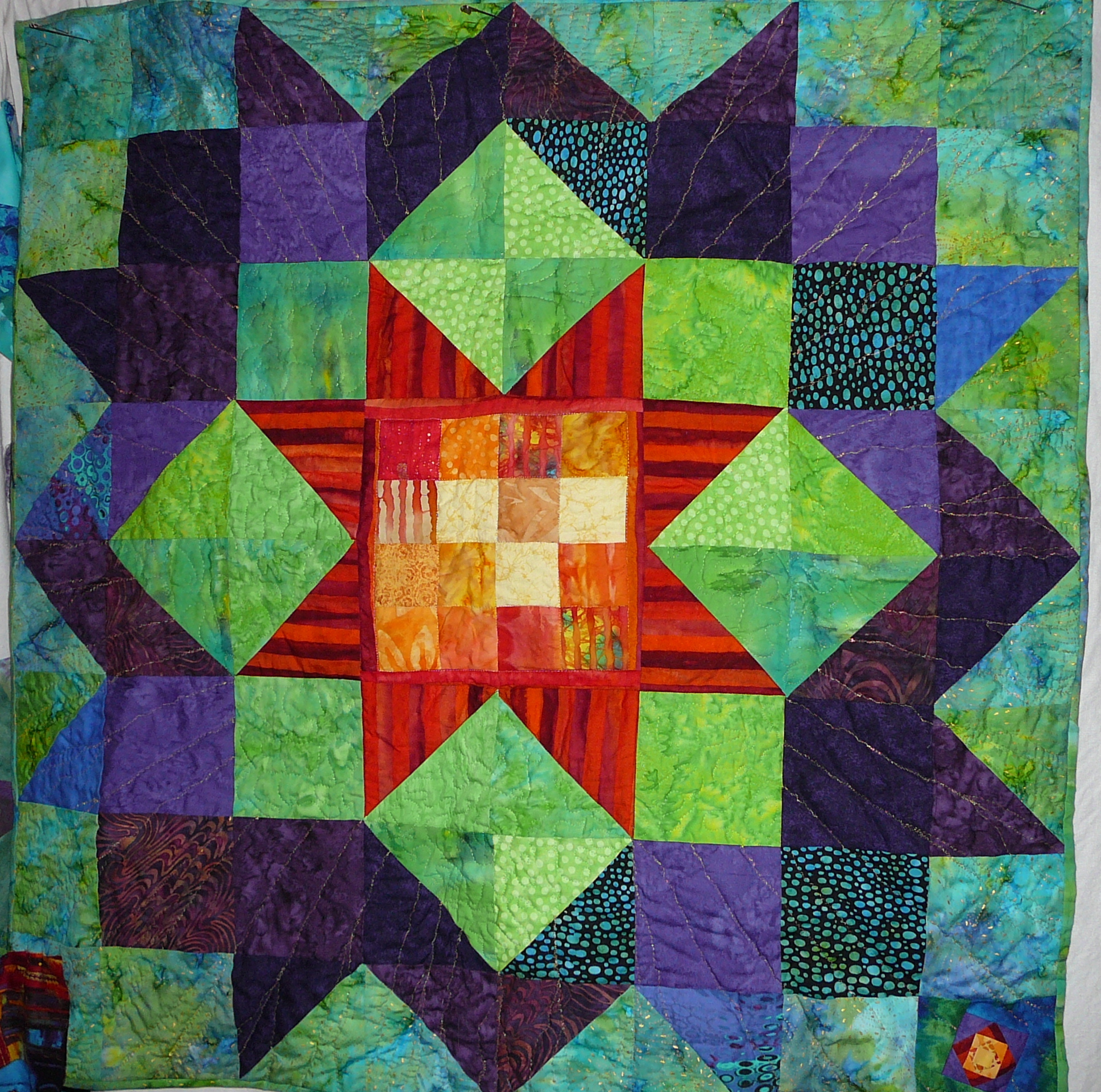
There is a competition coming up, a quilt show, and I am trying to get a couple entries ready. One design I knew would be a snap, I’ve done all the various parts a hundred times before (well, many times anyway) but this time I am painfully aware if points don’t match up or placement is not perfect. It is costing me time, crucial time for the preparations, as I rip out and re-do, sigh, rip out again and re-do. Just when I think I have it licked, I see something else that needs a re-do.
I know that the problem is that I am looking with a critical eye of the most critical judge. Most of the time my quilts are for babies, or friends, or family, and while they may be flawed, my family and friends love me and love my quilts, and they live happily ever after. It’s only when I know the quilts will be compared to other quilts, other, more painstaking and meticulous quilters, that I start to quail and flounder.
When I teach, I tell my students “this is supposed to be fun! Have fun with it! If you struggle too long, set it aside and come back; a solution will appear.” I teach tricks to cover flaws, I build their self-confidence, I show them how to attain ‘good enough’.
I am my own worst critic. I just have to fight discouragement and defeat at the hands of my inner critic.
(The quilt at the top is not one of the entries; it is a quilt I did for an earlier competition.)
Teach Your Teen to Negotiate
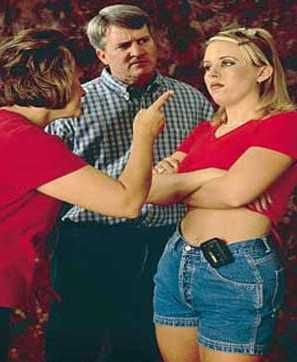
I found this article on the National Public Radio Health Page; with the title Why a Teen Who Talks Back may have a Bright Future. It has to do with teaching your teen to talk problems through confidently; researchers found teens who could express themselves confidently had a greater likelihood of turning down offers of illegal drugs or behaviors.
It is interesting to me, too, that the Dutch who had the courage to shelter the Jews during the Holocaust were those who had learned to think independently as teenagers.
If you’re the parent of a teenager, you likely find yourself routinely embroiled in disputes with your child. Those disputes are the symbol of teen developmental separation from parents.
It’s a vital part of growing up, but it can be extraordinarily wearing on parents. Now researchers suggest that those spats can be tamed and, in the process, provide a lifelong benefit to children.
Researchers from the University of Virginia recently published their findings in the journal Child Development. Psychologist Joseph P. Allen headed the study.
Allen says almost all parents and teenagers argue. But it’s the quality of the arguments that makes all the difference.
“We tell parents to think of those arguments not as nuisance but as a critical training ground,” he says. Such arguments, he says, are actually mini life lessons in how to disagree — a necessary skill later on in life with partners, friends and colleagues on the job.
Teens should be rewarded when arguing calmly and persuasively and not when they indulge in yelling, whining, threats or insults, he says.
In Allen’s study, 157 13-year-olds were videotaped describing their biggest disagreement with their parents. The most common arguments were over grades, chores, money and friends. The tape was then played for both parent and teen.
“Parents reacted in a whole variety of ways. Some of them laughed uncomfortably; some rolled their eyes; and a number of them dove right in and said, ‘OK, let’s talk about this,'” he says.
It was the parents who said wanted to talk who were on the right track, says Allen. “We found that what a teen learned in handling these kinds of disagreements with their parents was exactly what they took into their peer world,” with all its pressures to conform to risky behavior like drugs and alcohol.
Allen interviewed the teens again at ages 15 and 16. “The teens who learned to be calm and confident and persuasive with their parents acted the same way when they were with their peers,” he says. They were able to confidently disagree, saying ‘no’ when offered alcohol or drugs. In fact, they were 40 percent more likely to say ‘no’ than kids who didn’t argue with their parents.
For other kids, it was an entirely different story. “They would back down right away,” says Allen, saying they felt it pointless to argue with their parents. This kind of passivity was taken directly into peer groups, where these teens were more likely to acquiesce when offered drugs or alcohol. “These were the teens we worried about,” he says.
Bottom line: Effective arguing acted as something of an inoculation against negative peer pressure. Kids who felt confident to express themselves to their parents also felt confident being honest with their friends.
So, ironically the best thing parents can do is help their teenager argue more effectively. For this, Allen offers one word: listen.
In the study, when parents listened to their kids, their kids listened back. They didn’t necessarily always agree, he says. But if one or the other made a good point, they would acknowledge that point. “They weren’t just trying to fight each other at every step and wear each other down. They were really trying to persuade the other person.”
Acceptable argument might go something like this: ‘How about if my curfew’s a half hour later but I agree that I’ll text you or I’ll agree that I’ll stay in certain places and you’ll know where I’ll be; or how about I prove to you I can handle it for three weeks before we make a final decision about it.”
Again, parents won’t necessarily agree. But “they’ll get across the message that they take their kids point of view seriously and honestly consider what they have to say,” Allen says.
Child psychologist Richard Weissbourd says the findings bolster earlier research that finds that “parents who really respect their kids’ thinking and their kids’ input are much more likely to have kids who end up being independent thinkers and who are able to resist peer groups.”
Weissbourd points to one dramatic study that analyzed parental relationships of Dutch citizens who ended up protecting Jews during World War II. They were parents who encouraged independent thinking, even if it differed from their own.
So the next time your teenager huffs and puffs and starts to argue, you might just step back for a minute, take a breath yourself, and try to listen. It may be one of the best lessons you teach your child.
Recent Comments
ExpatAlien on What Country am I Living … intlxpatr on Yellowstone: Old Faithful to C… Michelle on Yellowstone: Old Faithful to C… Cathy on No Grown-Ups in Charge intlxpatr on Waiting for Snow Wikipedia Donate Button

Amazina


Early Voting in Florida


 Here There and Everywhere